1 Recebido para publicação em 11.6.2015 e aprovado em 17.8.2015.
2 Embrapa Agropecuária Oeste, Dourados-MS, Brazil, <[email protected]>; 3 Instituto Federal de Tecnologia de Santa Catarina, Santa Rosa do Sul-SC, Brazil.
Conyza
SPP.
: F
ROMU
GLYD
UCKLING TOA
GRICULTURE’
SF
ITTESTS
WAN– B
RIEFR
EVIEW1Conyza
spp.: de Patinho Feio a Cisne Mais Adaptado da Agricultura – Breve Revisão
CONCENÇO, G.2, and CONCENÇO, S.E.3
ABSTRACT - Conyza spp. are widely responsible for yield losses in agriculture due to its worldwide occurrence, resistance to herbicides and other traits which turn these species into first grade weeds. Since the 1980’s, these species started to be cited on books both related to the ecology and the weed science, being usually classified as ruderals. Occurrence of Conyza in crops shows that these species are highly adaptable due to its recent evolutionary origin and occur in environments prone concomitantly to a moderate set of competition, disturbance and stress. There are also limitations in Grime’s theory which may lead us to mistakes about the behavior of Conyza. Thus, simple and isolated recommendations certainly will not solve the problem of Conyza. Neither soil tillage nor tolerant crops to 2,4-D will free the agriculture from this weed, being necessary an integrated approach to solve this problem which demands qualified human resources in weed science and planning.
Keywords: horseweed, fleabane, ruderal, Grime’s theory, demographic theory.
RESUMO - Espécies do gênero Conyza são responsáveis por perdas de produtividade na
agricultura contemporânea devido à ocorrência cosmopolita, à resistência a herbicidas e a uma série de outras características que as tornam plantas daninhas de primeiro escalão. A partir dos anos 1980, essas espécies começaram a ser citadas tanto em livros relacionados à ecologia como à ciência das plantas daninhas, sendo geralmente classificadas como ruderais. A ocorrência atual de Conyza em áreas cultivadas demonstra que essas espécies são altamente adaptáveis devido à sua recente origem evolucionária e ocorrem em ambientes suscetíveis concomitantemente a competição, distúrbio e estresse moderados. Há ainda limitações na teoria de Grime que podem nos levar a enganos sobre o comportamento de
Conyza. Logo, recomendações simples de manejo e isoladas certamente não resolverão o problema causado por plantas desse gênero. Preparo do solo ou culturas tolerantes ao herbicida 2,4-D não livrarão definitivamente a agricultura dessa planta daninha, sendo necessária uma abordagem integrada para esse fim, o que demanda recursos humanos qualificados em ciência das plantas daninhas e planejamento.
Palavras-chave: buva, voadeira, ruderal, teoria de Grime, teoria demográfica.
Conyza spp. (C. bonariensis, C. canadensis, C. sumatrensis) are widely responsible for yield losses in agriculture due to its worldwide occurrence, resistance to herbicides and a series of other traits which turn these species into important weeds (Constantin et al., 2013). The great interest by these troublesome weeds
Some decades ago this species was rarely cited in books related to ecology and agriculture. For illustrating its evolution in occurrence and importance, 18 books related to field surveys of plant/weed occurrence and its management, published from 1941 to 1993, were randomly sampled. Only six of them cite any species of Conyza (syn. Erigeron), as summarized in Table 1.
Audus (1976) was one of the first to refer to species of Conyza (syn. Erigeron) regarding its invasiveness, discussing about the effect of 2,4-D causing fasciation on inflorescences with formation of witches broom. Although this was one of the first references regarding Conyza as weed species, nothing was reported about its difficulty of control.
Barbour et al. (1980) cites a study regarding plant succession (secondary succession) as a function of time (years) after field abandonment; C. canadensis was reported to be consistent in density and frequency in several fields only one year after abandonment, but after that it started to disappear quickly; this author reported self-allelopathy to the species by means of its decaying roots, thus limiting its occurrence in the environment to the first years of succession. This was lately confirmed by Aldrich (1984). Allelopathy of root extract of Conyza was also reported as inhibiting sorghum, wheat, cucumber, turnip and mustard (Constantin et al., 2013). Barbour et al. (1980) also reported the species ability to be part of forbs development in highly stressed, nutrient restrained seashore environments.
Roberts (1982), in his weed control handbook, discusses about time of flowering for weeds regarding day length; C. canadensis was reported as one of the few British weeds which flower during the shortening days of autumn, but also no mention is done about its importance as a weed on British cropping fields.
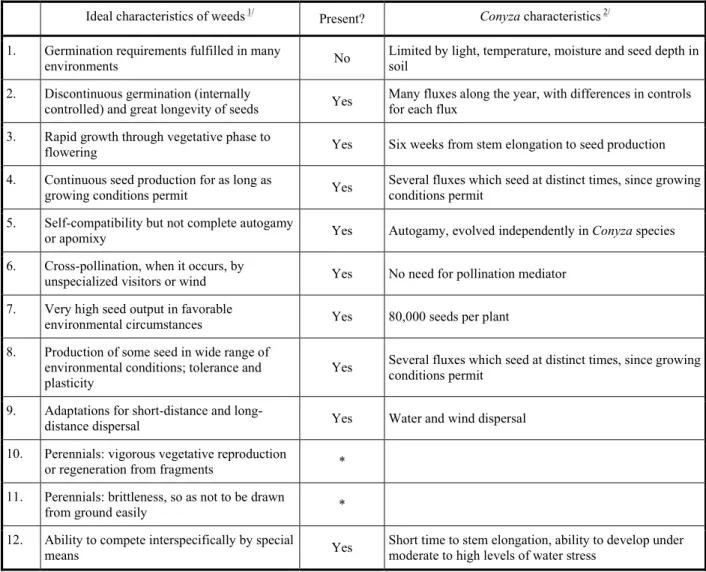
For a plant to become a successful weed in agriculture, it needs to fulfill a series of requirements which will determine its adaptation to climatic, physiographic, biotic and management factors (Monquero, 2014). Radosevich & Holt (1984) summarized the theoretical characteristics that turn a
plant species into a weed; from the 12 characteristics for the ideal weed, two are not of concern for being related to perennials; and from the remaining ten characteristics, only one is not fully present in Conyza (Table 2).
Data in Table 2 impels one to infer that Conyza is prone to be a tough weed; in fact, from the 1980’s on, Conyza started to be considered an often-seen species from the ecological point-of-view, and a significant weed from the agricultural point-of-view (Table 1). By coincidence (or not), this was when some biotypes of Conyza started to evolve resistance to herbicides (Constantin et al., 2013).
Aldrich (1984) reports that the botanical family Asteraceae (Compositae), which includes the Genus Conyza, is recognized as being of relatively recent evolutionary origin. There is evidence that the preponderance of weeds from relatively recent evolutionary origin signals for the trend to an increasing of troublesome, highly adaptable weeds in agriculture (Aldrich, 1984), being Conyza one of the first Genus to predominate in agriculture-related fields. This species will probably be soon followed by others also from recent evolutionary origin families.
Table 1 - Random references checked for citations about species of Conyza or Erigeron, listed by year of publication
As a function of intensity of these two factors, Grime (1979) proposes three ecological adaptation strategies for plants: ruderals, competitors and stress tolerators, whose definition and traits escape the scope of this study but can be found in Radosevich & Holt (1984) and Carvalho (2013). In a summarized way, after disturbance, ruderals are those plants which occur in the first stages of the ecological succession, where abundant resources and almost no competition are present, directing most resources to reproduction; competitors are those plants which specialize in obtaining or using scarce resources in intermediary stages of the ecological succession, and stress tolerators prioritize characteristics which guarantee their survival.
For productive sites, as those used for agriculture, it is expected that areas after disturbance will be occupied by ruderals
which are lately substituted by competitors; agricultural fields are supposed not to reach the stage where they will be occupied by stress tolerator species since it means the area is undergoing desertification being not suitable for agriculture anymore. In this sense, Aldrich (1984) described plant succession after disturbance reporting four stages for the secondary ecological succession in a given study (Table 4).
The study reported by Aldrich (1984) includes, mostly, ruderals and competitors; from pioneer weeds to true prairie (Table 4). Evidently, weed species are not exclusively from one of the classes present in Table 3 but mix characteristics and abilities as presented by Radosevich & Holt (1984), floating in an equilibrium between stress, disturbance and competition for its occurrence in the community. Aldrich (1984) reported C. canadensis as a “pioneer weed”, being
Author Title Citation Year
1. McDOUGALL, W.B. Plant Ecology No 1941
2. KRAMER, P.J. Plant and Soil Water Relationships No 1949
3. OOSTING, H.J. The Study of Plant Communities No 1950
4. ASHBY, M. Introduction to Plant Ecology No 1963
5. GREIG-SMITH, P. Quantitative Plant Ecology No 1964
6. PANDEYA, S.C. et al. Research Methods in Plant Ecology No 1968
7. ASHTON, F.M.; CRAFTS, A.S. Mode of Action of Herbicides No 1973
8. KERSHAW, K.A. Quantitative and Dynamic Plant Ecology No 1973
9. ETHERINGTON, J.R. Environment and Plant Ecology No 1975
10. AUDUS, L.J. Herbicides: Physiology, Biochemistry, Ecology Yes 1976
11. BARBOUR, M.G. et al. Terrestrial Plant Ecology Yes 1980
12. KLINGMAN, G.C. et al. Weed Science: Principles and Practices No 1982
13. ROBERTS, H.A. Weed Control Handbook: Principles Yes 1982
14. ALDRICH, R.J. Weed-Crop Ecology Yes 1984
15. RADOSEVICH, S.R.; HOLT, J.S. Weed Ecology Yes 1984
16. MOORE, P.D.; CHAPMAN, S.B. Methods in Plant Ecology No 1986
17. SILVERTOWN, J Plant Population Ecology No 1987
Currently, most weeds reported in agricultural fields are considered “competitors”, and several studies aim to describe the differential competitive ability between weed species and crop plants; several of these studies, however, reach to the conclusion that in equality of conditions (equivalent density and simultaneous emergence), most crops are more competitive than several weed species. Authors often explain this behavior by stating that under field conditions crops occur in a much lower density than weeds, what is usually true, and that this is responsible for weed damage on crops. The general consensus, however, tends to report that most weeds are essentially Table 2 - Ideal characteristics of weeds, and its presence or absence in species of Genus Conyza
Ideal characteristics of weeds 1/ Present? Conyza characteristics 2/
1. Germination requirements fulfilled in many
environments No
Limited by light, temperature, moisture and seed depth in soil
2. Discontinuous germination (internally
controlled) and great longevity of seeds Yes
Many fluxes along the year, with differences in controls for each flux
3. Rapid growth through vegetative phase to
flowering Yes Six weeks from stem elongation to seed production
4. Continuous seed production for as long as
growing conditions permit Yes
Several fluxes which seed at distinct times, since growing conditions permit
5. Self-compatibility but not complete autogamy
or apomixy Yes Autogamy, evolved independently in Conyza species
6. Cross-pollination, when it occurs, by
unspecialized visitors or wind Yes No need for pollination mediator
7. Very high seed output in favorable
environmental circumstances Yes 80,000 seeds per plant
8. Production of some seed in wide range of
environmental conditions; tolerance and plasticity
Yes Several fluxes which seed at distinct times, since growing
conditions permit
9. Adaptations for short-distance and
long-distance dispersal Yes Water and wind dispersal
10. Perennials: vigorous vegetative reproduction
or regeneration from fragments *
11. Perennials: brittleness, so as not to be drawn
from ground easily *
12. Ability to compete interspecifically by special
means Yes
Short time to stem elongation, ability to develop under moderate to high levels of water stress
Adapted from Radosevich & Holt (1984). Adapted from Green (2010). * Characteristics 10 and 11 were ignored for being related to perennials.
1/ 2/
Table 3 - Ecological adaptation strategies of plants as a function of stress and disturbance
Intensity of stress Intensity of
disturbance
High Low
High Plant mortality Ruderals
Low Stress tolerators Competitors
Source: Adapted from Radosevich & Holt (1984).
competitors, what may or may not be true on a case-by-case basis (Silvertown, 1987).
Furthermore, if we consider the equilibrium between stress, disturbance and competition in a single plant species, according to the theory of Grime (1979), competitive ability would depend greatly upon the environment where species are located. Thus, most competition studies under controlled environments – mainly those by the replacement series (substitutive) methodology, may simply fail in describing the real competitive relations between crops and weeds (Galon et al., 2015).
By analyzing data in Tables 1, 2 and 4 it seems that Conyza, in its origin, was not essentially a “competitor” as most important weeds are expected to be, but resembled more to a ruderal; along years it adapted to a wide range of environments and stresses. Regarding the dominant aspect of Conyza reported by Barbour et al. (1980), Aldrich (1984) reinforces the importance of phytosociological surveys by reporting that dominant species should be prioritized for management due to its ability to override crop performance and yields.
From the original report of Conyza as dominant species in stage 1 of succession (Barbour et al., 1980), Aldrich (1984) also classified other species of Conyza (syn. Erigeron) as dominants of stage 2 – those that occur from 2 to 10 years after field is abandoned. In this sense, Conyza was expected to disappear after ten years of assembly of no-till planting systems, as it is supposed to be
essentially a ruderal, which we know to be untrue. Despite the ecological resources cited above, field observations regarding the wide adaptation and great performance of Conyza as a weed impels one to consider plants in this Genus to float at least among ruderals and competitors.
Almeida & Vidotti (2014) have not considered all the theoretical knowledge available and classified Conyza as “competitor”. Reporting back to Table 3, one would be impelled to state that efficient weed control for those species considered as “competitors” would be easily achieved by imposing disturbance to the environment; this would, as expected by theory, eliminate competitor species exchanging them for ruderals which are believed not to cause significant harm to crop plants.
First, one should be aware that disturbance does not include only catastrophic events as earthquakes and vulcanic eruptions; it passes through soil tillage and includes also a simple mowing as well as chemical control with either long residual herbicides or with non-residual herbicides applied several times per cropping cycle (Radosevich & Holt, 1984; Andel et al., 1987). Almeida & Vidotti (2014) applied the theory of Grime in a simple way and concluded that soil tillage (disturbance) would be an almost definitive solution for the problem of Conyza in Brazil. So simple? The reality of the Brazilian agriculture shows it is not, otherwise the disturbance caused by herbicides would be enough to eliminate Conyza – but they became resistant. This is Nature always one Table 4 - Predominant species for each of the four stages of plant succession in old fields in central Oklahoma, USA
Stage 1 Stage 2 Stage 3 Stage 4
Pioneer Weeds (2 – 5 years)
Annual Grasses (3 – 10 years)
Perennial Bunch Grasses (10 – 20 years or more)
True Prairie
Examples:
Helianthus annuus Conyza canadensis Chenopodium album Sorghum halepense Digitaria spp.
Examples:
Aristida oligantha
Examples:
Andropogon scoparius
Examples:
Andropogon gerardii Panicum virgatum Sorghastrum nutans
step before us. Research support the evidence that the solution for controlling Conyza as proposed by Almeida & Vidotti (2014) does not satisfy farmers expectations in the long term.
Fortunately, most technical bibliography, as that by Constantin et al. (2013) and several others (Vargas et al., 2007; Lamego & Vidal, 2008; Moreira et al., 2010; Silva et al., 2014; Pereira, 2015), do not face the problem of Conyza with simplicity and levity. It is a fact that the problem of Conyza in Brazil started in the 1980’s, as evidenced in Table 1, when the no-till planting system was gaining importance; there is no evidence, however, which links the spread of no-till to the occurrence of Conyza.
There is also evidence that the true ecological behavior of weeds lies beyond our current level of knowledge. Grime’s theory is prioritized for weed ecology but sometimes we lack in taking a sight into knowledge available elsewhere. Grime’s theory is criticized because (i) several factors cause stress on plants, which in turn respond differently to these stresses; (ii) for an species to be plotted into Grime’s triangle (competition, stress, disturbance) there is need to relativize all variables, which implies distortions to data; and (iii) only the last life stages of plants are considered, being all behavior of plants in their initial stages ignored (Loehle, 1988; Silvertown et al., 1992; Wilson & Lee, 2000).
Aiming to fix these limitations, the Demographic Theory was proposed (Silvertown et al., 1992) who connected the demographic traits throughout plant’s life cycle to life history and proposed a demographic triangle based upon fecundity (F), growth (G) and survival (S). The problem is that classification of a given plant species differs greatly when both theories are compared. In summary, the demographic theory seems to correct some issues on plant classification and may be the way we should follow for the future of weed ecology. It also means that currently we may be discussing about plant classification theories which are about to change.
Despite the new theoretical knowledge to come in plant classification by ecological strategies, tolerance and plasticity, as stressed by Radosevich et al. (1984) (Table 2),
are the key for the importance of Conyza in Brazilian and by extent to worldwide agricultural cropping systems. It probably started as a ruderal which directed most resources to seed production and dispersal by wind (Dauer et al., 2006) and water (Aldrich, 1984), but due to its flexibility it adapted to highly competitive environments where it currently warriors for water, nutrients, light and physical space (Constantin et al., 2013) and also adapted to stressed environments, e.g. being able to grow and reproduce under high levels of water deficit where most species halt growth or wilt (Neckar et al., 2008).
Although C.bonariensis is reported as a temperate climate species (Green, 2010), Zimdahl (1993) reported C. canadensis as a hard-to-kill weed by solarization, highlighting its resistance to high temperatures; while pigweed (Amaranthus spp.) and some other weeds were eliminated in more than 90% from soil after two weeks of solarization, this control level for C. canadensis was only reached after more than eight weeks of solarization. This illustrates how wide is the adaptation range for these weed species, and the necessary research attention which need to be spent to other weeds from recent evolutionary families.
LITERATURE CITED
ALDRICH, R. J. Weed-crop ecology: principles in weed management. Belmont: Breton, 1984. 465 p.
ALMEIDA, J. C. V.; VIDOTTI, M. O caso da buva. Doutores Terra, v. 1, n. 2, p. 20-24, 2014.
ANDEL, J. V.; BAKKER, J. P.; SNAYDON, R. W. Disturbance in grasslands. Hingham: Kluwer Academic Publishers, 1987. 306 p.
AUDUS, L. J. Herbicides: physiology, biochemistry, ecology. London: Academic Press, 1976. 608 p.
BARBOUR, M. G.; BURK, J. H.; PITTS, W. D. Terrestrial plant ecology. Menlo Park: Benjamin/Cummings, 1980. 604 p.
CARVALHO, L. B. Plantas daninhas. Lages: L. B. Carvalho, 2013. 92 p.
CONSTANTIN, J.; OLIVEIRA Jr., R. S.; OLIVEIRA NETO, A. M. Buva: fundamentos e recomendações para manejo. Curitiba: Omnipax, 2013. 104 p.
DAUER, J. T.; MORTENSEN, D. A.; HUMSTON, R. Controlled experiments to predict horseweed
(Conyza canadensis) dispersal distances. Weed Sci., v. 54,
n. 3, p. 484-489, 2006.
GALON, L. et al. Comparison of experimental methods to assess the competitive ability of weed species. Am. J. Plant Sci., v. 6, n. 13, 2015. (In Press)
GREEN, T. The ecology of fleabane (Conyza spp.). 2010. 183 f. Thesis (Ph.D. in Ecological Agriculture) – University of New England, School of Environmental and Rural Science, 2010.
GRIME, J. P. Plant strategies and vegetation processes. New York: Wiley, 1979. 222 p.
LAMEGO, F. P.; VIDAL, R. A. Resistência ao glyphosate em biótipos de Conyza bonariensis e Conyza canadensis no Estado do Rio Grande do Sul, Brasil. Planta Daninha, v. 26, n. 2, p. 467-471, 2008.
LOEHLE, C. Problems with the triangular model for representing plant species. Ecology, v. 69, n. 1, p. 284-286, 1988.
MONQUERO, P. A. Aspectos da biologia e manejo das plantas daninhas. São Carlos: Rima, 2014. 430 p.
MOREIRA, M. S. et al. Herbicidas alternativos para controle de biótipos de Conyza bonariensis e C. canadensis resistentes ao glyphosate. Planta Daninha, v. 28, n. 1, p. 167-175, 2010.
NECKAR, K. et al. Germination of weed species from Asteraceae family under water deficit conditions. J. Plant Dis. Protec., v. 21, p. 271-275, 2008. (Número Especial)
PEREIRA, L. V. Alternativas para manejo químico de azevém (Lolium multiflorum) e buva (Conyza sp.). 2015. 126 f. Dissertação (Mestrado em Produção Vegetal) – Universidade do Estado de Santa Catarina, Florianópolis, 2015.
RADOSEVICH, S. R.; HOLT, J. S. Weed ecology:
implications for management. New York: John Wiley & Sons, 1984. 265 p.
ROBERTS, H. A. Weed control handbook: principles. Oxford: Blackwell, 1982. 533 p.
SILVA, D. V. et al. Resistência de buva (Conyza spp.) ao glyphosate. In: AGOSTINETTO, D.; VARGAS, L. (Ed.). Resistência de plantas daninhas a herbicidas no Brasil. 2.ed. Pelotas: Universidade Federal de Pelotas, 2014. p. 269-279.
SILVERTOWN, J.; FRANCO, M.; McCONWAY, K. A demographic interpretation of Grime’s triangle. Func. Ecol., v. 6, n. 2, p. 130-136, 1992.
SILVERTOWN, J. Introduction to plant population ecology. 2.ed. Essex: Longman, 1987. 229 p.
VARGAS, L. et al. Buva (Conyza bonariensis) resistente ao glyphosate na região Sul do Brasil. Planta Daninha, v. 25, n. 3, p. 573-578, 2007.
WILSON, J. B.; LEE, W. G. C S R triangle theory:
community level predictions, tests, evaluation of criticisms, and relation to other theories. Oikos, v. 91, n. 1, p. 77-96, 2000.