Instituto Universitário de Lisboa
Departamento de Ciências e Tecnologias da Informação
Large Scale Agile Software
Development compliant to
IEC 62443-4-1
Artefact Design and Tool support
Rafael Martins Soares
A Dissertation presented in partial fulfillment of the Requirements
for the Degree of
Master in Computer Engineering
Supervisor
Doctor Maria Cabral Diogo Pinto Albuquerque, Assistant Professor
ISCTE-IUL
Co-Supervisor
Doctor Kristian Hendrik Beckers, Cyber security consultant
Siemens Corporate Technology
Resumo
Nos últimos anos houve um aumento considerável no uso de metodologias ágeis. No entanto, a aplicação destas metodologias pode ser um desafio, em especial para sistemas de controle industrial que têm a obrigação de obedecer a requisitos ope-racionais rigorosos através de regulamentos e normas, e em particular no âmbito da cibersegurança. Este trabalho propõe um conceito para uma integração estru-turada e sistemática de actividades de segurança num pipeline de DevOps, com o intuito de alcançar ambas as capacidades de desenvolvimento ágil seguro e enge-nharia de software ágil em conformidade com segurança. A base para este conceito é a integração da norma IEC 62443-4-1 (4-1), que descreve o desenvolvimento se-guro de produtos em ambientes de controle industrial, com um especificação de Continuous Integration/Continuous Delivery. Para alcançar isto, foi feito um ma-peamento de requisitos de segurança, de acordo com a descrição na norma 4-1, numa especificação simples de DevOps. Como resultado, todas as actividades da norma 4-1 foram analisadas e classificadas de acordo com a possibilidade de serem automatizadas através de suporte de ferramentas. Para avaliar o trabalho, foram realizadas entrevistas com profissionais especializados nas áreas de conformidade em segurança de TI’s e engenharia de software ágil. Os resultados mostram evidên-cias sobre a possibilidade de fornecer suporte de ferramentas para a automatização da norma IEC 62443-4-1 e para a especificação um pipeline de DevOps conforme com a norma 4-1.
Palavras-chave: Segurança em TI’s, norma de segurança, segurança con-tínua, conformidade contínua.
Abstract
There has been a considerable increase in the use of agile methodologies over the last years. However, applying these methodologies can be challenging, par-ticularly for industrial control systems that must obey to rigorous operational requirements through regulations and standards, and in particular cybersecurity requirements. The current work proposes a concept for a structured and system-atic integration of security activities into a DevOps pipeline, with the ambition of pursuing the capability of both secure agile development and security compliant agile software engineering. The basis for this concept is the integration of the IEC 62443-4-1 (4-1) standard, which describes secure product development in indus-trial control systems, with a Continuous Integration/Continuous Delivery pipeline specification. To achieve this, the security requirements, as described in the 4-1 standard, were mapped into a simple DevOps pipeline specification. As a result, all of the 4-1 activities were analysed and classified according to the possibility of being automated through tool support. Interviews with expert practitioners, from the fields of security compliance and agile software engineering, were conducted to evaluate the present work. Results have shown evidence about the possibility of providing tool support for the IEC 62443-4-1 standard and to specify a DevOps pipeline compliant to the 4-1 standard.
Keywords: IT Security, security standard, continuous security, continuous compliance.
Acknowledgements
I would like to acknowledge my supervisors, Professor Maria Pinto Albuquerque and Dr. Kristian Beckers, for constantly guiding me and making this work possible. To all the people at Siemens CT for providing me a great work environment, especially to the working students, for all the ideas shared during the coffee breaks and for making this a more enjoyable experience. I also want to thank Fabiola Moyon, for being my unofficial supervisor, and Tiago Gasiba, for introducing me to Siemens CT and for all the advice he has given me during my time at the company.
A special thank you to my colleague André Narciso, for deciding to share this journey with me from the beginning. Without him, this experience wouldn’t be the same.
Most importantly, I want to show my gratitude to my parents, for uncondi-tionally supporting me, and for always motivating me to achieve greater goals in life.
Last but not least, I want to thank my older brother, Rúben, for always being there for me on crucial times, and for helping me keep both my feet on the ground.
Contents
Resumo iii
Abstract v
Acknowledgements vii
List of Figures xiii
List of Tables xv Abbreviations xvii 1 Introduction 1 1.1 Overview . . . 1 1.2 Motivation . . . 2 1.3 Objectives . . . 3 1.4 Outline . . . 5 2 Literature review 7 2.1 Software development life cycle . . . 7
2.2 Deployment pipeline . . . 10
2.3 DevOps . . . 11
2.4 DevSecOps . . . 13
2.5 Security compliant product development . . . 15
2.5.1 Security standards . . . 16
2.5.2 IEC 62443-4-1 standard . . . 16
2.5.3 Foundation of 4-1 in process models . . . 19
2.5.4 4-1 standard compliant solutions . . . 20
3 Concept for combining the 4-1 standard and pipelines 23 3.1 Integration of the 4-1 standard into the pipeline . . . 23
3.2 Evolving the process models into pipeline specifications . . . 24
3.2.1 Specification overview . . . 25
3.2.2 Practice specification . . . 26
4 Proposed methodology 29
4.1 Description of the methodology . . . 29
4.1.1 Define and create templates for automation tool support . . 30
4.1.1.1 Classification criteria definitions for automation . . 30
4.1.1.2 Tool selection criteria . . . 31
4.1.2 Create standard specification templates . . . 31
4.1.3 Observe and analyse the templates . . . 32
4.2 Application of the methodology . . . 33
4.2.1 Creation of tables for automation tool support . . . 33
4.2.1.1 Process model analysis . . . 33
4.2.1.2 Automation level and tool selection . . . 35
4.2.2 Creation of standard specification templates . . . 39
4.2.3 Challenges . . . 41
4.2.4 Observation and analysis of results . . . 42
5 Evaluation 47 5.1 Objective . . . 47 5.2 Design . . . 48 5.2.1 Overview . . . 48 5.2.2 Interviewees . . . 48 5.2.3 Interview . . . 49
5.3 Analysis of the evaluation results . . . 51
5.3.1 Classification criteria . . . 51
5.3.2 Automation and tool selection . . . 52
5.3.3 Overall feedback . . . 54
5.4 Threats to validity . . . 57
5.5 Overview . . . 57
6 Conclusion and Future Work 59 6.1 Conclusion . . . 59
6.2 Future work . . . 61
Appendices 65 A High-level 4-1 compliant pipeline specification 65 B Automation tool support summary tables 67 B.1 Practice 1 - Security Management . . . 67
B.2 Practice 2 - Security Requirements Specification . . . 68
B.3 Practice 3 - Secure Design . . . 69
B.4 Practice 4 - Secure Implementation . . . 69
B.5 Practice 5 - Security Verification and Validation Testing . . . 70
B.6 Practice 6 - Management of security-related issues . . . 70
Contents
B.8 Practice 8 - Security Guidelines . . . 72
C Questionnaire 73
List of Figures
2.1 Software development life cycle phases, adopted from (Synotive, 2017) . . . 8 2.2 A simple value stream map for a product, adopted from (Humble
& Farley, 2010) . . . 10 2.3 Changes moving through the deployment pipeline, adopted from
(Humble & Farley, 2010) . . . 11 2.4 Security checks and controls in engineering workflows , adopted
from (Bird, 2016) . . . 13 2.5 DevSecOps: Secure Development as a Continuous Improvement
Process , adopted from (Gartner, 2017) . . . 15 2.6 Scope of the ISA99/IEC 62443 series of standards , adopted from
(ISA, 2018a) . . . 17 2.7 IEC 62443-4-1 Practice Overview as BPMN Model, adopted from
(Moyon, Beckers, Klepper, Lachberger, & Bruegge, 2018) . . . 20 3.1 Evolving Process Models into Pipeline Specifications . . . 25 3.2 Excerpt of the specification of the integration of the 4-1 standard
with the pipeline . . . 26 3.3 Stored artefacts by tools for compliance proof . . . 27 4.1 4-1 Standard Excel Specification Excerpt . . . 32 4.2 IEC 62443-4-1 Process models excerpt - Security Management practice 34 4.3 IEC 62443-4-1 Process models excerpt - SD-g3 gate is highlighted
in green . . . 35 4.4 Standard specification, secure implementation review requirement . 41 4.5 Obtained IEC 62443-4-1 automation tool support . . . 43 4.6 Obtained IEC 62443-4-1 automation tool support per practice . . . 44 5.1 Flow of the conducted interviews . . . 51 A.1 High-level 4-1 compliant pipeline specification . . . 66
List of Tables
4.1 Template for automation tool support . . . 30
4.2 Table template for summary of the specification . . . 32
4.3 Number of Tasks, Events and Gates identified in the process models 34 4.4 Automation tool support excerpt . . . 37
4.5 Transparency tool support excerpt - SR-t12 . . . 37
4.6 Transparency tool support excerpt - DM-t3 . . . 38
4.7 Tool possible excerpt - SR-t8 . . . 39
4.8 Tool possible excerpt - SD-t1 . . . 39
4.9 Complete list of automation tool support tables, sorted by practice 39 4.10 Tool support excerpt - SVV-t4 . . . 42
5.1 Interviewees’ selected level of knowledge and expertise in the differ-ent topics . . . 49
Abbreviations
SDLC Software Development Life Cicle (see page 1)
CI/CD Continuous Integration/Continuous Delivery (see page 2) ICS Industrial Control System (see page 3)
4-1 IEC 62443-4-1 Standard (see page 3) SAFe Scaled Agile Framework (see page 3)
BPMN Business Process Model Notation (see page 4)
IAST Interactive Application Security Testing (see page 14) IACS Industrial Automation and Control System (see page 16) SDL Secure Development Life-cycle (see page 16)
SL-C Security Level-Capability (see page 38) 4-2 IEC 62443-4-2 standard (see page 38)
Chapter 1
Introduction
This Chapter introduces the scope of the work by presenting an overview and background of the topic, followed by the motivation and the proposed objectives. An outline of the following chapters of the document is also presented in this Chapter.
1.1
Overview
Over the last years there has been a considerable increase in the use of agile meth-ods. Agile methodologies promote continuous iterations in which requirements and solutions evolve throughout the software development life cycle (SDLC) through customer collaboration (Beck et al., 2001; Highsmith & Cockburn, 2001). Despite the fact that agile methods were originally seen as more appropriate to small and co-located teams, according to (VersionOne, 2011), a large-scale industry survey recorded that 80% of the studied organisations were already following an agile approach in 2011.
DevOps is a combination of cultural philosophies and practices that aim at breaking the barrier between software development (Dev) and information tech-nologies operations (Ops) teams (Atlassian, 2016). It relies on Agile and Lean1
techniques that require a comprehensive collaboration among stakeholders and has the intention to reduce the time between the commit of a change and its placement into production.
An essential part of DevOps is the concept of a Continuous Integration / Continuous Delivery (CI/CD) pipeline . This pipeline is a systematic use of aligned processes and tools that enable agile teams to release software by the push of a "button". The button triggers a set of automated checks and tests for the software that ensure its quality (Semaphore, 2019).
For this reason, there has been an increase in the adoption of DevOps tech-niques among enterprises, aiming for a faster time to market with the help of automation.
Applying DevOps in an industrial environment can be challenging, specially when it comes to industry operations and control systems. Not only these sys-tems must obey to rigorous operational requirements, like high availability and real-time performance, they also must comply with regulations and standards for safety and security (Gartner, 2017; Sonatype, 2019). Enhancements to existing practices and innovative methods and concepts are fundamental to safely apply DevOps in an Industry environment. An example of such innovative methods and concepts are the creation of new architecture concepts for more robust, side-effect free deployment of products.
1.2
Motivation
Agile software engineering along with Continuous software engineering method-ologies emerged with a closer cooperation with the customer, bringing numerous
1The core idea behind Lean is to maximize customer value while minimizing waste, i.e., create
Chapter 1. Introduction
benefits, such as faster software development and more feedback, allowing con-tinuous innovation. Such methodologies still remain as a paradigm for software engineering in numerous domains (Lieberman, Paternò, Klann, & Wulf, 2006; Wang, Conboy, & Cawley, 2012; Fitzgerald & Stol, 2014).
However, software engineering for domains that have a high demand for se-curity such as industrial control systems (ICS) , have yet several challenges to overcome before agile methodologies can be largely applied. Specially software for security critical systems that plays a vital role in supporting modern society and that has to be often engineered to be compliant to security standards. This software needs various security analysis and risk management activities, making secure development harder and less affordable (Alcaraz & Zeadally, 2015).
The ICS domain is regulated by security standard family IEC-62443 (ISA, 2017) and the secure software engineering process by IEC-62443-4-1 (4-1) in terms of cybersecurity.
Nowadays software engineering methods are lacking the ability to provide com-pliance between these standards and large scale agile methodologies, such as Scaled Agile Framework (SAFe) (Scaled Agile, 2017).
Additionally, a challenge that is currently emerging in the software engineering field is the recurring trade-off between implementing security into software engi-neering projects and competition with the speed of digital business, due to the ability to automate tasks and processes.
1.3
Objectives
The present document proposes a concept for a structured and systematic integra-tion of security activities (according to the IEC 62443-4-1 standard) into a DevOps Life cycle in order to tackle the current security and compliance challenges with-out taking a step back in respect to time to market / release cycle. The basis for the concept is the integration of the current 4-1 standard for secure product
development in Industrial Control systems (ICS) and its integration into a CI/CD pipeline specification.
Since DevOps pipelines are tool chains for software development that enable CI/CD of software products, the specification shall serve as a basis for an assess-ment of pipelines to check if they have the capabilities to be 4-1 ready and to provide a detailed list of missing tool capabilities in order to achieve this readi-ness. In addition, it shall enable large-scale agile development for secure software according to the 4-1 standard in an industry environment.
The current project for integrating the 4-1 standard security requirements into a product development pipeline was developed at SIEMENS CT, which is an in-dustrial environment that largely relies on automation and there is the need to strictly follow security best practices. Since the 4-1 is the current standard for secure product development in an ICS environment, SIEMENS CT provided a vi-sual representation of the standard in the form of Business Process Model Notation (BPMN) models developed by (Moyon et al., 2018) to describe the workflow of secure product development. The BPMN models break down the security require-ments into activities, which will serve as a basis for the Continuous Integration / Continuous Delivery (CI/CD) pipeline specification. Furthermore, the speci-fication is intended to contain the flow of information regarding secure product development and discuss which activities can be automated with the help of tools and which cannot.
By the end of the present work it shall be possible to answer the following research questions:
• RQ1 - Is it possible to create a DevOps Pipeline that follows a sys-tematic way to security compliance with IEC 62443-4-1 standard? – RQ1-a - How much tool support can we provide for 4-1
Chapter 1. Introduction
1.4
Outline
The present document is divided into six chapters, which contain:
• The following chapter, Chapter 2, introduces the fundamental concepts for the understanding the present work, as all as an analysis of the previous work realised under the current work research area. The main research domains included are DevOps and pipeline specifications, DevSecOps and security compliant product development.
• Chapter 3 describes the proposed concept for combining the 4-1 standard with a DevOps pipeline.
• Chapter 4 starts by describing a methodology to achieve the integration of the 4-1 standard and the pipeline, in particular the definition of templates for automation tool support. Later, it is described all the steps taken towards the application of methodology, as well as an observation and an analysis of the obtained results.
• Chapter 5 presents the evaluation of the obtained results through surveys and interviews with security practitioners and professionals.
• Finally, Chapter 6 draws the conclusions of the present work, the difficulties that emerged during its execution and recommendations for future work.
Chapter 2
Literature review
This Chapter presents a description of fundamental concepts to understand the present work, as well as a detailed analysis of work relevant to the area of study. The first sections focus in the field of software development, product development life cycle and agile methodologies, in particular DevOps. Subsequent sections focus on security compliant product development and security standards, especially the IEC 62443-4-1 standard. Furthermore, a key contribution of the IEC 62443-4-1 standard is described, as well as the reasoning for its adoption into the specification of a deployment pipeline.
2.1
Software development life cycle
A Software Development Life Cycle (SDLC) corresponds to a systematic process for creating software. Its goals are to ensure that the software is built with quality, correctness and that it meets the customer expectations (Techopedia, 2011).
There are different methodologies or models that will differ from one another, however they all share the same purpose of helping teams to deliver high quality software as fast and cost efficient as possible. Some of the most popular models are the Waterfall, the V-model, the Spiral and the Agile model, which is the one
with higher focus in this project and described in the first Section of the previous Chapter.
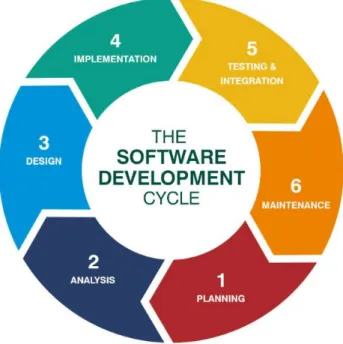
SDLC contains different phases and each of them has it own activities and deliverables that are mandatory to start the next phase. Figure 2.1 shows an overview of the different SDLC phases and its interactions, regardless of the chosen methodology.
Figure 2.1: Software development life cycle phases, adopted from (Synotive, 2017)
It is possible to have different SDLC phases, however this is an overview and other phases may be similar regarding processes, deliverables and interactions between them. The different phases of the SDLC as represented in the Figure 2.1 are the following:
1. Planning and Analysis are the first phases of the software development life cycle and are crucial for the development of a project. This is the phase which gives a clearer idea of the scope of the project where anticipated issues and opportunities are assessed. Furthermore, schedules, cost estimations and requirements need to be detailed precisely so that the organisation can set a timeline to finalise the project. If following a waterfall methodology, it
Chapter 2. Literature Review
is usually a document that lists all these requirements. In case of an agile methodology, its possible that a backlog of tasks to be performed is produced. 2. In the Design phase, the system and software design are prepared and documented according to the requirements gathered in the previous phase. This will also help in specifying requirements for the hardware and software, as well as defining overall system architecture. These specifications serve as an input for the following phase and testers also come up with a strategy where it is decided what, why and how to test.
3. Implementation phase, also known as coding or software development phase. Here’s where developers need to work according to predefined coding guidelines in order to produce the code that will build the entire system. This code is then used as an input for the following phase.
4. Testing & Integration phase starts once the code from the previous phase is developed. The code is then tested against the requirements to guarantee that the product meets the customer’s needs. Similarly explained in Figure 2.3 in the previous Section, during this process the code must pass different types of functional and non-functional testing. This will result in functional software that is ready to be deployed for customer usage.
5. Maintenance phase begins once the customers starts using the developed system. The main objective of this phase is to guarantee that the system continues to function according to the mentioned specifications in the early phases and that the needs continue to be satisfied. In this phase this phase it is possible that the customer finds bugs that need to be fixed, or asks for new features into the existing software. For this reason, the SDLC is an ongoing process, as seen in Figure 2.1.
It is important to note that specific SDLC models may not just perform a single cycle, as there may be several iterations. An example of this is the incremental model, in which the process of development is broken into multiple iterations that
pass through the different SDLC phases. Each subsequent iteration adds up to the previous one until all the designed functionalities have been implemented.
2.2
Deployment pipeline
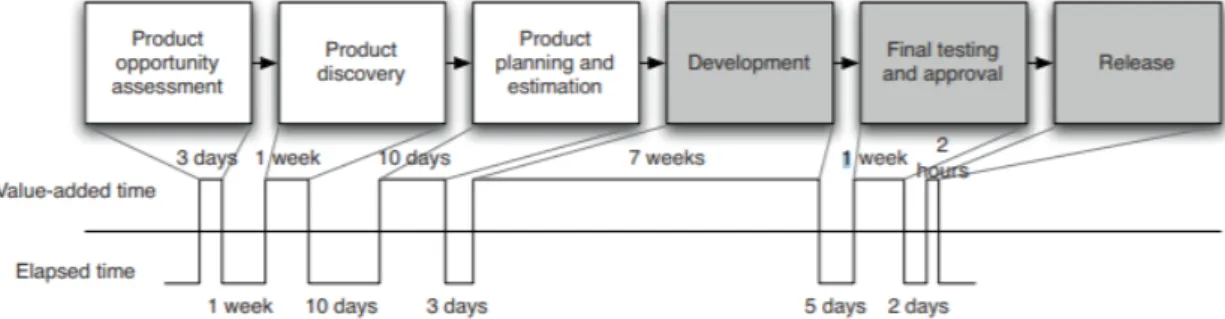
A deployment pipeline is a manifestation of every process that is needed to transfer a concept into the hands of the user, which allows the visualisation of progress as it moves from stake to stake, until it finally reaches release (Humble & Farley, 2010). Figure 2.2 is a simple illustration that shows the entire process of a deployment pipeline, where it is possible to see the elapsed time in each of the stages.
Figure 2.2: A simple value stream map for a product, adopted from (Humble & Farley, 2010)
It is important to notice in this picture of a pipeline that there are dependencies and waiting times between stages, making the “Elapsed time” higher than “Value-added time”1 (e.g., the time it takes to deploy an application to production-like
environment).
To get a better understanding of the dependencies and the flow of the pipeline, Figure 2.3 corresponds to the "drill down" of the grey shaded stages from Figure 2.2. It is possible to see that every new build and/or change has to go through a series of tests and has to pass them in order to be released. This way it is possible to receive early feedback to remove unfit builds and work on the root cause of their failure.
Chapter 2. Literature Review
Figure 2.3: Changes moving through the deployment pipeline, adopted from (Humble & Farley, 2010)
For the most part, deployment pipelines share a structure that is similar to the one illustrated in Figure 2.2 and Figure 2.3, that contain a set of subsequent stages, from "Product opportunity assessment" to Release".
2.3
DevOps
A literature survey and interviews with practitioners was conducted at (Lwakatare, Kuvaja, & Oivo, 2015) in order to understand the phenomenon behind DevOps. The study identified four main elements in DevOps, which are collaboration, au-tomation, measurement and monitoring. The noticed outcomes were the shared responsibility among teams, continuous deployments and operational data to mea-sure performance of development.
(DORA, 2018) conducted scientific studies over the last years with over 30.000 survey responses, counted with almost 1.900 professionals from all around the world that participated in the 2018’s State of DevOps. The report aims to un-derstand the practices that lead to higher performance in software delivery, and
to help teams benchmark them-selves into four categories, low, medium, high and elite performers. For this purpose, they took into account four main metrics to measure the performance, which were deployment frequency, change failure rate, time to restore a service and lead time for changes (i.e. time elapsed from code commit to production). Some of the key findings include the use of open source software from high performers, increase in software delivery performance with the use of cloud infrastructure and the fact that outsourcing by function is rarely adopted by the highest performers. Some of the key technical practices that drive to high performance include monitoring and observability, continuous testing and integrating security earlier in the software development process.
The company that created the tool Puppet has been conducting studies over the last seven years, with over 30.000 technical professionals participating. (Puppet, 2018) has recently published a "state of DevOps report" in order to identify De-vOps evolution, and key practices to help teams achieve success and progress in their journey. Some key findings stated in the report include the view on DevOps progress and impact regarding the C-suites and the teams that they manage. Another one that is highly mentioned is that automation of security policy config-urations is critical to reach the highest levels of DevOps evolution, which requires breaking down the barriers between operations and security teams.
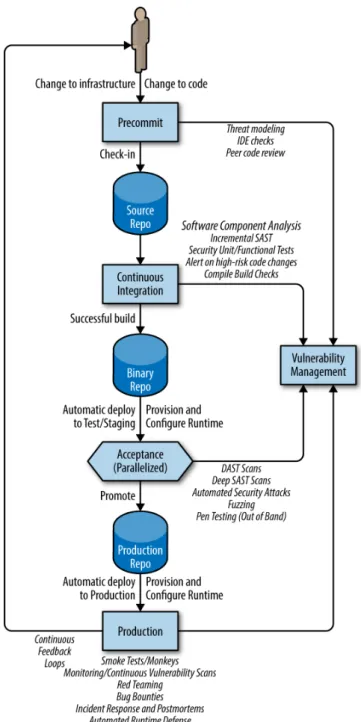
To this extent, over the last years deployment pipelines and workflows have been suffering changes in order to adapt to current needs and trends, including Continuous Integration and Continuous Delivery. This meant an increase in the demand of security in IT over time, with multiple attempts to reinforce and inject security into the CI/CD pipelines and workflows, such as addition of security checks and controls. (Bird, 2016) represents a good example of this, as illustrated in Figure 2.4. Figure 2.4 shows a clear mapping of some IT security practices and activities over all the different stages, from Pre-Commit to Production, providing a security guideline and assuring its application.
Chapter 2. Literature Review
Figure 2.4: Security checks and controls in engineering workflows , adopted from (Bird, 2016)
2.4
DevSecOps
The term "DevSecOps" has emerged as organisations, that started to apply De-vOps techniques, were concerned about the security aspects of software develop-ment. The term is also mentioned as "SecDevOps", "SecOps" and "RuggedOps" and it refers to the incorporation of security practices in a DevOps environment
through the collaboration between development, operation and security teams (Mohan & Othmane, 2016).
In order to have a better understanding on practitioners’ perceptions and prac-tices to integrate security in DevOps, (Rahman & Williams, 2016), analysed sev-eral articles and surveyed representatives of nine organisations. Some positive observations included leveraging on DevOps automation practices for monitoring, testing and deploying, and active collaborations between security, development and operation teams. It was also noted a correlation between the use of some non-automated security activities with security awareness among established DevOps organisations. On the other hand, it was observed that unrestricted collaboration can lead to inappropriate access to system resources.
(Gartner, 2017) presented key challenges and recommendations to aid the inte-gration of security into DevOps. Challenges identified include the fact that prod-uct development teams, that deliver new IT-enabled capabilities, satisfy more the customers, rather than information security or IT operations. It was also indi-cated that organisations producing new applications and services using DevOps have the same responsibility to produce secure and compliant code as required by any other application, as well as, information security must adapt to develop-ment processes and tools. As for recommendations, it targeted security and risk management, which should focus on ensuring application and data security. The recommendations included the integration of security and compliance testing into the DevSecOps, and the scan for known vulnerabilities and misconfigurations in all open-source and third party components. Another recommendation was to be open to new types of tools and approaches to minimise friction for developers, such as interactive application security testing (IAST) to replace traditional static and dynamic testing.
(Gartner, 2017) also recommends that security doesn’t stop in development, and that in order to achieve DevSecOps, the entire life cycle needs to be secured, from development to operations, as illustrated in Figure 2.5
Chapter 2. Literature Review
Figure 2.5: DevSecOps: Secure Development as a Continuous Improvement Process , adopted from (Gartner, 2017)
More recently, (Sonatype, 2019) conducted a survey with over 5.000 partici-pants, whose responses were divided into individuals that work in a mature De-vOps organisation and those who do not. Key findings include that DeDe-vOps teams are more likely to success, if they have a fully integrated and automated security practices across the DevOps pipeline, with increased feedback loops that enable security issues to be identified directly from tools. For top challenges related with security processes it was identified by developers that they receive security information late in the process, which leads them to rework and slowing down development. If security is not enforced in the processes, security is often inte-grated via impractical workarounds. The workarounds can cause various quality problems with the software.
2.5
Security compliant product development
One of the core characteristics of regulated environments is the need to comply with formal standards, regulations and guidance. For this reason, it was deemed important to investigate previous works and studies on security compliant product development.
2.5.1
Security standards
Standards were founded as a global agreement about the best approach to do something and there are currently standards that cover a whole range of sectors, from food safety management to secure medical packaging. Addressing standards can give a consumer the confidence that a product is safe, reliable and has good quality (ISO, 2017).
(Nair, de la Vara, Sabetzadeh, & Falessi, 2015) have conducted a study in order to get an understanding on how practitioners deal with safety evidence manage-ment for critical systems with safety standards. To do so, a survey was conducted among 52 practitioners from 15 different countries. According to the answers ob-tained from the survey, it was indicated that the most frequent safety evidence types are verification and validation test artefacts, requirements and design spec-ifications. It was also noticed that evidence completeness checking and impact analysis are predominantly performed manually with the aid of expert judgement. It was concluded by the study that industry will certainly benefit from more tool support for collecting and manipulating safety evidence.
2.5.2
IEC 62443-4-1 standard
The 4-1 standard belong to the ISA99/IEC-62443 series of standards that address security for industrial automation and control systems (IACS) (ISA, 2018b), there standards were built according to several sources regarding good practices in soft-ware engineering and secure development life-cycle (SDL), with a special focus on (ISCI, 2018). Figure 2.6 illustrates the current status and the scope of the IEC-62443 series of standards.
As illustrated in the Figure 2.6, the IEC 62443 series of standards is divided into four groups, which cover the different roles and responsibilities of stakeholders of an IACS cyber security program (IEC, 2014). The first group, General, contains elements that address topics that are common across the whole series, such as terminologies, concepts, abbreviations and use cases. Policies & Procedures
Chapter 2. Literature Review
Figure 2.6: Scope of the ISA99/IEC 62443 series of standards , adopted from (ISA, 2018a)
group is focused on management and the asset owner, includes standards whose target are to describe policies and procedures required for consistent operation of a cyber security management system. System group is targeted for the system integrator, includes requirements for security of a system in an IACS environment. Finally, Component group describes the security requirement of a component in an IACS environment, focused for the product supplier.
The 4-1 standard, which belongs in the Component group, provides descrip-tions of requirements and guidance to enable secure product development life-cycle for products intended for use in an IACS environment (IEC, 2018). Hence, the targeted audience for the standard are product development organisations and developers of automation and control products that need to care about security.
The requirements from the 4-1 standard are divided in eight practices, which are ordered as the following:
1. Security management (SM) - This practice contains descriptions of pro-cesses that ensure that security-related activities are adequately planed, doc-umented and executed through the entire product’s life cycle. Once these activities are planned, they can be executed and documented through each of the secure development life cycle’s practices.
2. Specification of security requirements (SR) - Describes the process to document the security capabilities that are required for a product, according to its security context. These security capabilities concern both physical and cyber security, such as authentication, authorisation, encryption, auditing and network security.
3. Secure design (SD) - Contains descriptions of processes to ensure that the product is secure by design. These processes should apply from the overall architecture to the design of individual components. This practice states that all of the product’s physical and logical interfaces shall be identified and characterised.
4. Secure implementation (SI) - This practice contains processes to ensure that the product is implemented securely. These include requirements that apply to the product supplier for hardware and software development. 5. Security verification and validation testing (SVV) - This practice
de-scribes the processes that ensure that security testing is performed and doc-umented. Security testing ensures that the product achieves its security requirements and that it is protected according to its security context. 6. Management of security-related issues (DM) - Contains descriptions of
processes to handle product’s security related issues that affect the product according to its security context. A process shall be employed to receive and track to closure security related issues reported by internal and external
Chapter 2. Literature Review
sources, such as security testers, third-party supplies, developers and product users.
7. Security update management (SUM) - Describes the processes that en-sure that security updates related to the product are tested for regressions and are delivered to users in a timely manner. The product supplier shall verify that the developed security updates solve intended vulnerabilities and that the update is not contradicting other operational, safety or legal con-strains.
8. Security guidelines (SG) - Contains descriptions of processes that ensures that the user is provided documentation in order to integrate, configure and maintain the product.
2.5.3
Foundation of 4-1 in process models
In collaboration with SIEMENS CT, (Moyon et al., 2018), focused on removing the ambiguity from the 4-1 standard and described it in a visual representation in the form of Business Process Model Notation (BPMN) models. Figure 2.7 illustrates an BPMN model that presents an overview of the 4-1 standard by representing all of its previously mentioned practices and its interactions between each other over time.
As shown in the Figure 2.7, the process models are divided into eight sections, with each of the sections corresponding to a practice from the 4-1 standard. Each of the sections contains a detailed sequence of events, tasks and generated artefacts that are necessary to be 4-1 compliant. Additionally, each of these items includes a brief description.
Figure 2.7: IEC 62443-4-1 Practice Overview as BPMN Model, adopted from (Moyon et al., 2018)
2.5.4
4-1 standard compliant solutions
The stated objective of this work is to create a 4-1 security standard compliant specification and for this reason it is important to investigate previous works that have found a solution that integrates this specific standard.
(Moyon et al., 2018) suggested a new approach to achieve continuous and se-cure development in security domains, specifically in industrial and automation control systems. To do so, (Moyon et al., 2018) proposed a model based approach, which consisted on merging visual representations of security norms and process models, in particular the SAFe framework and the IEC 62443-4-1 standard, re-sulting in a BPMN model. The use of a graphical modelling language was capable of removing the ambiguity generated by natural language, allowing for an easier review and more focused discussions among experts. It was concluded that more comprehensive models and validation with experts were required, however, initial results received a positive feedback from practitioners, judging that the models were suitable for what they were intended.
Chapter 2. Literature Review
Furthermore, (Dännart, Constante, & Beckers, 2019) have created an assess-ment model specifically tailored for the 4-1 standard and the SAFe framework. The proposed model assessment meant to detail the development process activi-ties and artefacts, and merged them into a compliance matrix in order to evaluate the compliance distance to the 4-1 standard. Goals and metrics were introduced by the creation of "requirement cards", which contained the expected input and output artefacts to enable precise assessment and easily identify which activities and artefacts have to be introduced or improved in order to comply with the 4-1 standard. Thus, providing a foundation for business-driven security compliance management by enabling a estimation of security compliance costs.
Chapter 3
Concept for combining the 4-1
standard and pipelines
This Chapter details the idea that leads towards the integration of the 4-1 standard with a DevOps pipeline as proposed in the first Chapter. Section 3.1 starts by giv-ing a first impression of the integration of the 4-1 standard with a DevOps pipeline with an illustration of an initial high-level specification. Section 3.2 provides an insight on how to extend the previous process models into pipeline specifications, which includes two illustrations, one for an overview of the specification and an-other one for a specific practice specification. Finally, Section 3.3 describes how the specification shall provide proof of security compliance along the pipeline.
3.1
Integration of the 4-1 standard into the pipeline
Identically to (Moyon et al., 2018), the integration of the 4-1 standard into the pipeline consists on creating a visual representation of the specification, i.e., merg-ing the 4-1 standard into a DevOps pipeline. To do so, it was fundamental to extensively analyse the purpose, as well as identify all the events and tasks that are attached to each of the 4-1 standard practices. Furthermore, the works de-scribed in the Chapter 2 play an important role in obtaining a better understanding
of the common structure of a DevOps pipeline, as well as the stages and the flow of processes.
In fact, the first step for integration of the 4-1 standard into the pipeline consisted in identifying the characteristics in common in both DevOps pipeline and the 4-1 standard. Afterwards, it was possible to merge each of the 4-1 standard practices into the corresponding stage of the DevOps pipeline. Therefore, allowing the design of an initial high-level 4-1 compliant pipeline specification, as presented in Figure A.1 (see Appendix A), thus making it possible to turn the process models into pipeline specifications.
3.2
Evolving the process models into pipeline
spec-ifications
With the current DevOps challenges in mind that were stated in the previous Chapter, this section describes how this approach emerges to overcome such chal-lenges by easing the developers’ work and adapting security by integrating security tools and practices directly into the pipeline, as well as covering the entire security life-cycle with a combination of automated and manual tasks.
In order to achieve this, it is essential to define and create templates prior to the creation of all the practice specifications. The templates detail the level of automation that is possible to achieve for each of the requirements from all the 4-1 practices. Each requirement contains an activity, which can be an event or a task and is detailed with the necessary input, output, description and extent of possible tool support, as well as the identification of the tool. Each of the templates has a specified output that functions as a quality gate, which can assure that security activities were executed or have the expected results. Generally speaking, a quality gate is a milestone that is located between two dependent phases in a pipeline and contains a list of activities or checklists verifying if the
Chapter 3. Concept
requirements from one phase were fulfilled in order to decide if the pipeline should continue to the following phase.
3.2.1
Specification overview
With the given information described in the previous section, this section shows an overview of the specification. The Figure 3.1 illustrates how it is possible to integrate each of the practices in the 4-1 standard into the DevOps pipeline by creating new activities that allow 4-1 compliance. Each of the activities in the specification includes the identification of the practice, the necessary input, its description and the resulting output, according to the template, as stated in the previous section. Each of the added activities into the pipeline also includes a list of existing tools that help fulfil and automate the activity, according to the previously defined levels of automation. Thus, aiding and enabling secure software development by including security from the first to the last stage of the DevOps pipeline.
3.2.2
Practice specification
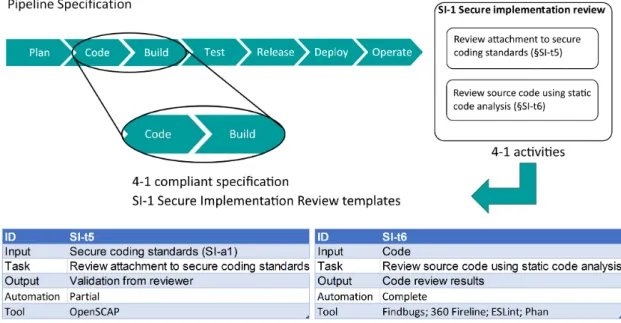
Once it is identified into which stages of the pipeline the 4-1 practices belong, as referred in section 3.1, it is possible to create practice pipeline specifications. Figure 3.2 shows an excerpt, which corresponds to a drill down of the specification overview and may serve as an example of how 4-1 practices can be merged into a specific stage of a DevOps pipeline. In this specific case, it is possible to observe that tasks from the Secure Implementation Review requirement from the Secure Implementation practice were introduced into the Code and Build stage(s) of the DevOps pipeline. The illustration doesn’t show all the necessary tasks for this requirement, as it solely serves the purpose of demonstrating how to merge the 4-1 practices along with the automation tool templates into the DevOps pipeline.
Figure 3.2: Excerpt of the specification of the integration of the 4-1 standard with the pipeline
Chapter 3. Concept
3.3
Ensuring proof of security life-cycle
compli-ance
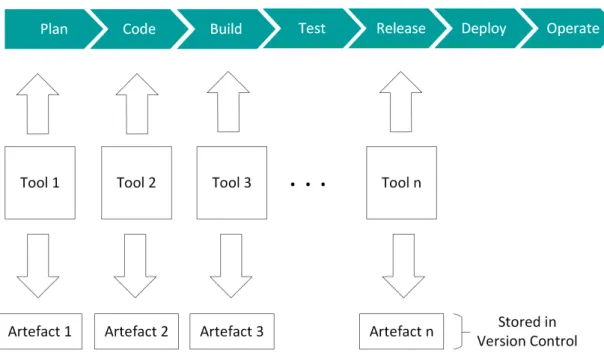
The integration of the 4-1 security activities into the product development life cycle is not complete without actual proof of compliance each time that a prod-uct is developed according to this pipeline specification. As mentioned earlier in the Section 3.2 of this Chapter, the output of each of the 4-1 activities has the function of a quality gate (e.g., documentation for security testing, vulnerability scoring system artefact). For this reason, for each activity demanded by the 4-1 standard, it is needed to have the capability of logging that the activity has been accomplished. Therefore, each tool should have the capability to store the results of the 4-1 activities in a central version control system to guarantee proof of compliance. Figure 3.3 serves the purpose of representing this idea.
Figure 3.3: Stored artefacts by tools for compliance proof
Figure 3.3 illustrates the idea that the tools that aid performing the 4-1 ac-tivities across the pipeline store the generated results of the acac-tivities (artefacts 1 to n) in a version control system. Since they act as a quality gate, it makes the artefacts dependent, i.e., there’s the need to have all the artefacts stored until artefact n in order to generate artefact n. Thus, guaranteeing that all the artefacts
needed to achieve 4-1 proof of compliance are stored by the end of the product life cycle.
To this extent, the intention is to leverage on the recommendations given in the previous sections by specifying a DevOps pipeline compliant to the IEC 62443-4-1 standard. Thus, making the life cycle secure from the beginning, support transparency and traceability, as well as tackling the trade-off between security and the competition with the speed of digital business by leveraging automation as much as possible.
Chapter 4
Proposed methodology
This chapter is divided into two sections. The first section contains a description of the proposed methodology to enable the development of the proposed concept in the previous chapter. The second section details all the steps taken towards the application of the methodology described in the first section.
4.1
Description of the methodology
In this section, it is detailed all the necessary steps towards the development of the concept proposed in the previous chapter. This section is divided into three subsections, which are ordered as the following:
1. Define and create templates for automation tool support; 2. Create standard specification templates;
4.1.1
Define and create templates for automation tool
sup-port
Table 4.1 illustrates the defined structure of the templates for automation tool support for each of the 4-1 requirements. The line of the table with the label ID corresponds to the identification code of the task, event or gate according to the given 4-1 process models, which identifies its number, as well as the correspond-ing standard practice. The line Input contains the identification number of the necessary file or other activity that triggers that specific task, event or gate. The third line contains its description and will be named as Task, Event or Gate ac-cordingly. Automation contains the automation level, which is further detailed in the Section 4.1.1.1. Finally, the Tool line contains the identification of the tool that aids with the execution of the task, event or gate according to the criteria detailed in the Section 4.1.1.2.
ID Identification code of the event or task Input File or event input
Description Description of the Task, Event or Gate Output Resulted output
Automation Automation Level Tool Tool identification
Table 4.1: Template for automation tool support
4.1.1.1 Classification criteria definitions for automation
In order to identify tool capabilities for all the tasks, events and gates identified in the provided process models, five different possible automation levels were defined. The classification criteria proposed for automation level are the following:
• Human Task - For tasks, events and gates that have to be manually per-formed by a security expert and/or practitioner;
• Partial - For tasks, events and gates that can be partially automated but have to be manually completed;
Chapter 4. Methodology
• Transparency - For tasks, events and gates to be performed by a human, but based on a tool visualisation of a problem;
• Complete - For tasks, events and gates that can be fully automated and performed by a tool;
• Tool possible - For straightforward tasks, events and gates for which a tool could be build, but there is currently no tool available.
4.1.1.2 Tool selection criteria
The tool selection is directly dependent to the selected Automation Level and has to follow specific criteria. The criteria is defined as described bellow, without following a specific order:
• If a task, event or gate has its Automation Level defined as Human Task or Tool Possible it will be assigned as "N/A" as it is not applicable for the specific case;
• It is required to have at least one tool identified for the remaining Automa-tion Level values, Partial, Transparency and Complete;
• Give priority to open source over proprietary tools;
• Given that this specification is intended to be used in a pipeline, give pri-ority to tools that easily integrate to Continuous Integration tools (e.g., Jenkins, Gitlab CI ).
4.1.2
Create standard specification templates
This phase consists on creating a specification of the entire 4-1 standard in the form of an Excel file that defines the 4-1 practices as a number of templates detailing the automation capability of each 4-1 requirement, as defined in the previous section. The flow of information between the requirements is represented as arrows based
on the process models described in the previous chapter. In order to represent this idea, Figure 4.1 corresponds to an excerpt of the idea. In this specific case it is relative to the Secure Implementation Review requirement from the Secure Implementation practice.
Figure 4.1: 4-1 Standard Excel Specification Excerpt
4.1.3
Observe and analyse the templates
Once all the previous steps are executed, this phase consists on observing and analysing the obtained results from the creation of all the automation tool support specifications. For this, it was decided to create a summary of all the automation tool support tables created. Table 4.2 shows the defined template for this summary, which follows a similar structure as the defined templates in the Section 4.1.1.
Practice Id Type Automation Tool Creates Artefact PX Id code Task Automation Level Tool name Yes
PX Id code Event Automation Level Tool name No
PY Id code Gate Automation Level Tool name No
Chapter 4. Methodology
As opposed to the previously defined template, the description is omitted, however, Table 4.2 additionally mentions the Practice, the Type, which can take the values Task, Event or Gate, and indicates if there is an Artefact being created out of that specific task, event or gate.
This table serves the purpose of making it easier to gather information regard-ing the possibility of automation across all the 4-1 standard and filter accordregard-ing to different levels of criteria. Furthermore, it will allow to answer the research question RQ1-a (How much tool support can we provide for 4-1 compliance?).
4.2
Application of the methodology
This section details all the steps towards the application of the defined methodol-ogy in the previous section. It is divided in four subsections. Section 4.2.1 explains the process of creating the tables for automation tool support. Followed by the creation of standard specification Excel templates in Section 4.2.2. The challenges of applying the methodology are mentioned in section 4.2.3. Finally, Section 4.2.4 shows an observation and an analysis of the obtained results.
4.2.1
Creation of tables for automation tool support
4.2.1.1 Process model analysis
The first step towards the creation of the tables for automation tool support is the analysis of the provided 4-1 process models. After an initial analysis, it was identified the amount of tasks, events and gates present in the process models, as shown in Table 4.3.
The practice Security Management is different from the other practices. Not only this practice occurs throughout the whole product’s life cycle, there are artefacts that are created from activities that are different from the previously
Practice Tasks Events Gates Total Practice 1 9 21 5 35 Practice 2 12 0 1 13 Practice 3 22 1 4 27 Practice 4 8 1 2 11 Practice 5 16 0 2 18 Practice 6 21 8 5 34 Practice 7 9 2 1 12 Practice 8 10 0 0 10 Total 107 33 20 160
Table 4.3: Number of Tasks, Events and Gates identified in the process models
may change over time and are mainly related to organisational documentation, such as "Organisational roles and personnel responsible" and "Personal security qualifications". These activities and artefacts are highlighted in orange in Figure 4.2, which shows an excerpt of the security management practice. For this reason, these activities are not included in the scope of this project and are excluded from the automation tool support tables.
Figure 4.2: IEC 62443-4-1 Process models excerpt - Security Management practice
It was also found that some of the gates mainly have the purpose of triggering other activities or making a decision and contain no description. For this reason, a
Chapter 4. Methodology
small textual description was added to the automation tool support templates of the gates to make it more clear. An example of this is gate SM-g2 in Security Management practice, in which there is a need to make a decision whether the product development process is mature or not, as highlighted in green in Figure 4.2. Another example is the gate SD-g3 in Secure Design practice, which serves the purpose of triggering a set of tasks regarding the requirements of secure design principles for an interface, as shown in Figure 4.3.
Figure 4.3: IEC 62443-4-1 Process models excerpt - SD-g3 gate is highlighted in green
4.2.1.2 Automation level and tool selection
Subsequently, the creation of tables for automation tool support is processed for each of the identified tasks, events and gates from the Table 4.3. For each of them it was analysed the scope of the practice and requirement it belonged to, the flow of events that surrounded them, as well as the necessary artefacts that serve as input or output.
the capabilities of the identified tool (i.e., a task may seem to be fully automated, however the identified tool can only partially automate it and has to be manually completed).
In order to fulfil the tool and automation level fields at the table it was followed the following approach:
1. Comprehensively understand the necessary action to fulfil each of the activi-ties, in particular tasks, since most of the identified gates and events serve the purpose of triggering other tasks;
2. Look for reliable sources such as (Hsu, 2018; SANS, 2018), as well as sys-tematic reviews on tools for continuous integration, delivery and deployment, such as (Shahin, Babar, & Zhu, 2017) in order to find possible tools to fulfil a certain activity;
3. Investigate the selected tool and check if it fits the activity and select the adequate level of automation;
4. Discuss with company supervisor and security practitioner/expert in order to validate accuracy and consistency of the selection, in particular automation level selection.
Table 4.4 is an excerpt of the automation tool support, which is a result of the above sequence of actions. It corresponds to a task that belongs to the requirement secure implementation review from the practice 4, Secure Implementation. The assigned tool for this task was Jira, which is a tool that is used to aid with planning, tracking and managing agile software development projects. The outputs from this task can also forward an artefact message in case a security requirement is not adequately implemented, which will result in triggering an event to alarm that security-related issues were detected. This will be further detailed in the following section.
Chapter 4. Methodology
ID SI-t4
Input Security Requirements (SR-a7)
Task Review security requirements were adequately implemented Output Mapping security requirements, code, code review results Automation Partial
Tool Jira
Table 4.4: Automation tool support excerpt
In order to get a better understanding of the transparency automation level, the following tables, Table 4.5 and Table 4.6 correspond to excerpts of tasks eval-uated with this automation criteria.
As illustrated in Table 4.5, SR-t12 corresponds to a task in which a secu-rity practitioner or expert has to accept secusecu-rity requirements submitted by other practitioners into a repository. The input received in this task is a gate in which a requirement is checked for its clarity and validity. This task was classified as transparency since the tool Jira helps the author of the decision, with the visu-alisation of the requirements.
ID SR-t12 Input SR-g1
Task Approve security requirements Output Practice 3 - SD
Automation Transparency Tool Jira
Table 4.5: Transparency tool support excerpt - SR-t12
Task DM-t3, represented in Table 4.6, is also classified as transparency, as Jira helps the practitioner with the visualisation and tracking of the issues. The input received in this task corresponds to a notification of the given issues. The resulting output is the placement of the issue tracked into a repository and the trigger of an event that starts a set of tasks to investigate the issue.
In order to get an overview of the tool possible automation level, the following tables, Table 4.7 and Table 4.8 correspond to excerpts of tasks evaluated with this automation criteria.
ID DM-t3 Input DM-t2
Task Track security-related issues Output DM-a2;
DM-e1
Automation Transparency Tool Jira
Table 4.6: Transparency tool support excerpt - DM-t3
As illustrated in Table 4.7, SR-t8 corresponds to a task in which the security requirements have to be identified based on the security level-capability (SL-C). SL-C is used to determine the overall security level of a component or system if ad-equate information is provided (for example, if a component contains a capability security level of 3, it means that the component or system includes the capability to achieve security functions required for capability security level 3 according to the IEC 62443-4-2 standard (for components) (Blumano, 2018). The task receives as an input, the required SL-C of the component from the previous task SR-t7, the threat model and the IEC 62443-4-2 standard (4-2). The 4-2 standard pro-vides detailed requirements for technical control system components according to the selected level of SL-C associated with the seven foundational requirements, which are identification and authentication control, use control, system integrity, data confidentiality, restricted data flow, timely response to events and resource availability (IEC, 2019).
Since the requirements of the components are detailed in the 4-2 standard for the seven foundational requirements according to the desired SL-C level, different components can have the same or similar requirements. For this reason, this task was assigned with tool possible in the automation criteria.
Table 4.8 corresponds to a task in which a set of appropriate practices must be selected for a product, artefact SD-a2, based on a given list of industry accepted secure design best practices , artefact SD-a1. Since a list of practices is provided for this task, it was classified as tool possible due to the likelihood of similar products receiving the same set of practices as an output of this task.
Chapter 4. Methodology ID SR-t8 Input SR-t7;
SR-a3 (IEC 62443-4-2 Standard); SR-a6 (Threat model)
Task Identify security requirements based on capability security level Output
Automation Tool Possible Tool N/A
Table 4.7: Tool possible excerpt - SR-t8
ID SD-t1
Input SD-a1 (Industry accepted secure design best practices) Task Determine appropriate secure design best practices
for the type of product
Output SD-a2 (Selected secure design best practices) Automation Tool Possible
Tool N/A
Table 4.8: Tool possible excerpt - SD-t1
The IEC 62443-4-1 automation tool support tables set depicts the complete 4-1 Standard. For documentation purposes, the tables set is listed in Table 4.9, and the tables for each practice are shown in Appendix B.
Practice Table
Practice 1 - Security Management (SM) B.1 Practice 2 - Security Requirements (SR) B.2 Practice 3 - Secure Design (SD) B.3 Practice 4 - Secure Implementation (SI) B.4 Practice 5 - Security verification and validation testing (SVV) B.5 Practice 6 - Management of security related issues (DM) B.6 Practice 7 - Security Update Management (SUM) B.7 Practice 8 - Security Guidelines (SG) B.8
Table 4.9: Complete list of automation tool support tables, sorted by practice
4.2.2
Creation of standard specification templates
Once all the tables for automation tool support are completed, it is possible to create the standard specification templates. This phase consists in merging sets of tool templates that belong to the same requirement from each of the 4-1 practices
of information and the sequence of actions that need to be performed in order to fulfil a given requirement, as well as all the necessary artefacts that serve as input and output.
Figure 4.4 is an excerpt of the standard specification; in this case it corresponds to the secure implementation review requirement from practice 4, secure implementation. In order to fulfil this requirement, there’s the need to execute five tasks, which are:
• SI-t4 - Review security requirements were adequately implemented • SI-t5 - Review attachment to secure coding standards
• SI-t6 - Review source code using static code analysis
• SI-t7 - Review implementation and its traceability to security capabilities defined to support security design
• SI-t8 - Examine threats and ability to exploit interfaces, trust boundaries and assets.
As mentioned in the description of SI-t4 in the previous Section, each of these tasks shall forward an artefact message in case a security related issue is found during the reviewing process. It will then create the artefact labelled as SM-a4, security related issues. Once all the tasks from the requirement were executed, the gate labelled as SI-g2, will check if the artefact SM-a4 was created to verify if any security related issue was found. In case there aren’t any issues found, it will proceed to the practice 5, security verification and validation testing. If there was any issue found, it will trigger the event SM-e6, security related issues detected, which will then trigger a set of tasks from practice 6, management of security-related issues, in order to review and fix the issue.
Chapter 4. Methodology
Figure 4.4: Standard specification, secure implementation review requirement
4.2.3
Challenges
During the execution of the application of the methodology, several challenges emerged, in particular during the phase of the creation of the automation tool support tables. The challenges are essentially related to the understanding of the given process models and the tool selection to fulfil each of the activities. The emerged challenges are as follow:
• As previously mentioned in the Section 4.2.1.1. some of the activities, in particular gates, contained no description, thus its purpose had to be often speculated;
• There was an occasional unawareness of existing tools to fulfil a particular activity, due to the high diversity regarding the fields of interest present in the product development life cycle;
• It was often found solely a tool to fulfil a particular activity;
• There were cases where the description of an activity wasn’t clear in the process models, leading to a lot of possible actions or a set of actions to fulfil it, as well as a high variety of tools selected. An example of this is the task SVV-t4 shown in Table 4.10, which is described as "Conduct functional testing of security requirements". In this particular case, the needed set of actions will highly depend on the product and type of tests needed;
• Once all the tool support templates were completed, a total of 70 different tools were identified. Due to the limitations imposed in the workplace it was not possible to test every single one in order to verify their capabilities of fulfilling the activities and automation level they were assigned to.
ID SVV-t4
Input SVV-a7 (Security Requirements)
Task Conduct functional testing of security requirements Output
Automation Complete
Tool Unit tests: JUnit; Mocha; xUnit; Smoke tests: ZAP Baseline scan; nmap
Security Acceptance testing: BDD-Security; GauntIT; Mittn Infrastructure Compliance Checks: inSpec; HubbleStack; Cloud Compliance: Cloud Custodian; Compliance Monkey
Table 4.10: Tool support excerpt - SVV-t4
4.2.4
Observation and analysis of results
Once the application of the methodology as described in Sections 4.2.1 and 4.2.2 was concluded, it was possible to gather data regarding the possibility of automa-tion of the IEC 62443-4-1 standard.
Chapter 4. Methodology
Figure 4.5 depicts the automation tool support obtained for the IEC 62443-4-1 standard according to the automation criteria defined in the Section 4.1.1.1.
Figure 4.5: Obtained IEC 62443-4-1 automation tool support
It is possible to initially observe that human task is the classification that is the most predominant, followed by complete and partial, with transparency and tool possible being the least identified among the activities analysed in the standard process models.
As previously stated, the 4-1 standard provides descriptions of requirements to enable secure product development life cycle for products in an ICS environment, which need to go through extensive security activities that frequently need to be performed by humans, as well as documented. Hence, human task being the most prevalent activity identified in the process models.
Figure 4.6 depicts a more detailed view on the obtained automation tool sup-port for the 4-1 standard, in particular the number of activities identified for each of the automation classification criteria for each of the 4-1 standard practices.
After observing Figure 4.6 it is possible to make the following initial observa-tions:
Figure 4.6: Obtained IEC 62443-4-1 automation tool support per practice
which initially seemed very unlikely, due to the practice being referred as security management. Taking into account the scope of the practice, as well as the analysis of the process models described at the Section 4.2.2.1 from this Chapter, it is possible to observe that this happens due to the high amount of events and gates that are present in the process models that often serve the purpose of triggering other activities from all of the practices during the product development life cycle;
• Practice 5, security verification and validation testing, contains a balanced amount of activities classified as human task, partial and com-plete. This happens due to the variety of activities present in the practice, which include the execution of several tests with the aid of tools, as well as the analysis and documentation of the generated results that often require human effort;
• It was expected for practice 6, management of security-related issues, to contain the majority of the activities classified as transparency due to its purpose of tracking and handling security related issues, which often require decision making based on the visualisation of a problem;
Chapter 4. Methodology
• Practice 8, security guidelines, has the main purpose of enforcing the creation of documentation for the end user of the product, hence contains no automation and has mostly human tasks.
Chapter 5
Evaluation
This chapter details the steps taken towards the evaluation of the present work. The possible automation of the 4-1 standard and its integration into a DevOps pipeline are evaluated through a qualitative study. The evaluation was carried out through the aid of interviews that involved 7 expert practitioners from the fields of security compliance and agile software engineering. This Chapter is divided in three sections. Section 5.1 starts by explaining the evaluation goals. The design of the evaluation is followed in Section 5.2, detailing the interviewee selection, the structure and flow of the interviews. Section 5.3 analyses the data collected from the interviews to evaluate the proposed solution for the possibility of building a 4-1 standard compliant DevOps pipeline. The possible threats to the validity of our study are described in Section 5.4. Finally, Section 5.5 presents an overview of the evaluation of the proposed solution.
5.1
Objective
The objective of this phase is to answer the research questions mentioned in the first chapter: