Ana Luísa Rebelo Bragança
Career Interventions for Refugees – A
Systematic Review
Ana Luísa Rebelo Bragança
Career Interventions for Refugees – A
Systematic Review
Dissertação de Mestrado
Mestrado em Psicologia Aplicada
Trabalho efetuado sob a orientação da
Doutora Ana Daniela dos Santos Cruzinha Soares da Silva
ii Index Agradecimentos ... iii Resumo ...iv Abstract ... v Introduction ... 6 Study aim ... 9 Method ... 9
Protocol and registration ... 9
Eligibility criteria ... 9 Information sources ... 10 Research ... 11 Study selection ... 12 Meta-synthesis ... 12 Results ... 14 Discussion ... 20 Conclusion ... 22 References ... 23 Index of Figures Figure 1. Process of search and selection of articles ... 13
Index of Tables Table 1. Eligibility criteria ... 10
Table 2. Covered Subjects ... 10
Table 3. List of articles included ... 15
iii
Agradecimentos
“You may say I’m a dreamer, But I’m not the only one”
John Lennon
O meu percurso universitário foi tudo menos consistente, e é incrível aquilo que atingimos quando estamos abertos a novas experiências e ideias.
Gostaria de agradecer à Doutora Ana Daniela Silva pela oportunidade de trabalhar numa área da psicologia com a qual não tinha muito contacto, mas acima de tudo, pela força e motivação quando estas me faltaram. Agradeço pela orientação, liberdade de trabalho e por todos os votos de confiança ao longo deste ano e meio.
Dra. Cátia, obrigada pela motivação, apoio e conselhos, mas sobretudo pelo exemplo de dedicação e de trabalho.
Aos meus pais, por tornarem tudo isto possível, pela liberdade que sempre me deram para escolher o meu caminho, por nunca me cortarem as asas mesmo quando eu voo para longe, e por me apoiarem quando regresso.
Ao meu irmão, cuja distância nos aproxima e a diferença nos assemelha. És quem melhor entende o meu caminho, as minhas batalhas e ambições, e aquele que me tranquiliza dizendo que no fim vai ficar tudo bem e eu vou conseguir.
Àqueles que me acompanham nesta viagem que é a vida há mais tempo do que o que eu me recordo, e que tornaram o meu regresso e este mestrado mais serenos, e aos que se juntaram à viagem, pelo apoio, as conversas, os passeios, os conselhos e amizade.
“The future belongs to those who believe in the beauty of their dreams” Eleanor Roosevelt
iv
Intervenções de Carreira para Refugiados – Revisão Sistemática
RESUMO
O mundo enfrenta atualmente a maior crise migratória desde a Segunda Guerra Mundial. Os refugiados deixam os seus países na incerteza de quando poderão regressar. Uma das
necessidades já estabelecidas na literatura para esta população, é um emprego,
subsequentemente, uma carreira, no novo país. Esta revisão sistemática tem como objetivo determinar a literatura existente sobre intervenções de carreira para refugiados, seguindo os princípios orientadores do PRISMA Statement. As palavras-chave de pesquisa resultaram da combinação de sinónimos da população (i.e. refugiado) e sinónimos do fenómeno em estudo (i.e. intervenção de carreira). Seis bases de dados foram utilizadas para garantis uma pesquisa extensa de artigos entre 1900 e 2017. Critérios de inclusão consideram a presença de ambas as palavras-chave, idiomas, presença de Abstract, população, presença de intervenção de
carreira, descrição da intervenção, e ano de publicação. Das 1399 publicações encontradas, 19 cumpriram os critérios, resultando em 10 publicações únicas. Os resultados mostram uma escassa literatura, um foco na teoria sobre possíveis intervenções de carreira e que pouca atenção é direcionada para as intervenções de carreira em prática. Futura investigação deverá focar-se em aplicar as intervenções propostas e avaliar as intervenções em prática.
Palavras-chave: refugiado, intervenção de carreira, requerentes de asilo, migrantes,
v
Career Interventions for Refugees – A Systematic Review
ABSTRACT
The world is currently facing the biggest migration crisis, since the Second World War. Refugees leave their countries not knowing when they will be able to return. One of the needs already identified in literature for this population, is a job, subsequently, career, in the
resettlement country. This systematic review aims to determine the existent literature about career interventions designed for this specific population, using PRISMA Statement
orientation. Research keywords resulted from a combination of population synonyms (i.e. refugee) and phenomenon synonyms (i.e. career intervention). Six databases were used to ensure a broad research of articles within 1900 and 2017. Criteria of inclusion regard the presence of both keywords, languages, presence of an abstract, population, presence of a career interventions, description of the intervention and year of publication. Among the 1399 initial publications, 19 of these fulfilled the criteria, resulting in 10 unique publications. Results show a lack of literature, a focus mainly in theoretical framework regarding potential career interventions and the possible influences in the career development of this specific population, and that minimal attention is given to the career interventions in practice
worldwide. Further research should focus on applying the interventions proposed and evaluate the interventions currently used.
6
Introduction
The world is currently living the biggest migration crisis since the Second World War (United Nations High Commissioner for Refugees [UNHCR], 2014). According to the statistics, the number of registered Syrian refugees exceeds the 4,8 million people who have run away from the civil war in Syria and the regime of “Islamic State”, in both Iraq and Syria, which about 10% of these live now in refugee camps (UNHCR, 2016b). This crisis is highly affecting not only the neighbouring countries as Turkey, Lebanon and Jordan (UNHCR, 2016a) but also European countries (UNHCR, 2016b). Serbia and Germany register the highest number of Syrian asylum applications 62%, while Sweden, Hungary, Austria, Netherlands and Denmark represent 27% of the Syrian asylum applications and the remain 11% applications are distributed in non-specified European countries (UNHCR, 2016b).
Dictionary presents immigrant as a person who moves permanently to a foreign country, whereas a refugee is a person who is forced to leave the country due to war, persecution or a natural disaster (Oxford, 2016a, 2016b). Even though refugees are not moving at free will, and some might wish to return to their country someday, it is not certain when and if the return be possible, it could take months, years or even decades. Hence, it is considered here that refugees are moving permanently to a foreign country, which itself describes an immigrant according to the definition previously presented. Based on these definitions, in this paper, a refugee is considered a specific type of an immigrant
Nevertheless, it is not disregarded that refugees might have additional and different needs from other types of immigrants, for example, work-driven immigrants or people who immigrate to reunite a family.
In Chen (2008), immigration is described, based on Polachek and colleagues (2006) work, as a human phenomenon influenced by complex factors as political, social and
economic. Although this is not a recent phenomenon, the emergent crises the world is facing is urging the hosting countries to develop and create strategies to integrate and help the refugees they are accepting in, both in short and long term. According to Yakushko,
Backhaus, Watson, Ngaruiya, & Gonzalez (2008), many refugees find integration into society a very challenging process. Although a career is not often the refugees’ immediate concern, it is indeed a medium-long term concern as they will need to support their basic needs and re-establish their finances (Colic-Peisker & Tilbury, 2006). Although little, there is some research on the challenges immigrants and/or refugees encounter during a life-career transition in a new country.
7 Based on existent literature, Chen (2008) outlined four major challenges that
immigrants face during the process of career transition in the new country. Language
proficiency, culture familiarity, discrimination and prejudice, and vocational identity change. Immigrants come from a variety of countries, and at their destination, they often find a different language which they are not familiarised with. In order to adjust to their new place, immigrants have to master the new language. Chen (2008) asserts this mastery of the new language as a key variable that affects both social and career adjustment, as this is a basic and vital instrument for establishment in the host country. The author further adds that being non-native is often a difficulty when interacting with non-natives because communication gets
compromised once they do not master the language. Moreover, proficiency comprises four main components, listening comprehension, speaking, reading and writing, which operate as a whole, and insufficiency in even just one, it might debilitate one’s language proficiency (Chen, 2008). The accent is also considered by Chen, based on Purkiss and colleagues (2006) work, as an obstacle because it is often perceived as a deficiency in language, therefore it might create some anxiety which consequently may reduce immigrants’ confidence to interact with others, jeopardizing their effort to seek or maintain employment. The lack of
communication competences might compromise the opportunity of displaying their
professionals capacities in the work world of the host country, considering that they might not be capable of competing with natives on the subject of presentations, report writings or persuasion (Chen, 2008). Additionally, the author explains that the cultural context that immigrants are trying to understand, often consist in another barrier to a language proficiency, because language operates within this cultural context that immigrants have not
comprehended yet, the norms and the code of that culture.
Regarding culture familiarity, Chen (2008) explains the powerlessness and sense of loss as the outcome of the immigrant’s lack of capacity to comprehend and adapt to the new societal practice, as this often differs significantly from the societal practices of the
immigrant’s country of origin, and this discrepancy leads to a sense of culture shock, difficulting the adjustment. According to the author, the lack of knowledge concerning the code of conduct and cultural norms of a country that often form the code of competence, might result in an impression of incompetency at a workplace, and represents a significant disadvantage comparing with the competitors. In order to familiarise with the new culture and behavioural practices, Chen further explains it requires an actual living within this culture, as immigrants will learn throughout the accumulation of social experiences.
8 On the other hand, discrimination and prejudice often appear as a significant obstacle for immigrants’ integration within the new culture (Chen, 2008). The researcher highlights that this preconception might not be so obvious comparing with the past in some countries, nevertheless is still present either invisible and/or hidden and immigrants will probably
experience it in the process of trying to access to the country labour market, or stablishing and develop their professional profile at workplace and general society (Purkiss et al., 2006, cited in Chen, 2008). Racial stereotyping bias – specific country of origin or region for example, lack of sensitivity towards multiculturalism, lack of multicultural awareness, misperception and incorrect presumptions on diversity, or even indifference, are pointed by Chen (2008) as causes for prejudice. The author also considers non-racial reasons, for example politics, social, personal and economic drivers for discrimination. People may disagree with one’s country immigration policy, because they perceive immigrants as a threat to economy, they fear the growth of potential competitors within the job market, and the decay of job
opportunities, the extra burden on both health care and education services. Even though it might not conscious or intentional, these cognitions will lead to discrimination practices that will affect immigrants who are already struggling with several other challenges (Chen, 2008).
Some immigrants had already a well stablished career in their home countries, and for these, the vocational identity change represents a significant challenge (Chen, 2008). The researcher asserts that occupation and career status play the major role in identity in several cultures, and numerous immigrants start gaining a sense of establishment when they rebuild their vocational life, or are progressing towards it, in the new country. Based on previous own work, Chen (2008) emphasises the importance a good career transition for a better overall transitional experience. Nevertheless, very often, immigrants come to conclude that their past credentials and experiences are not validated at the host country, because credentials and professional skills usually are not recognized outside the teaching country (Boyd & Thomas, 2002, cited in Chen, 2008). Therefore, after a number of interviews, immigrants realize that in order to achieve the desired goals is to start over and acquire the host country credentials and professional skills (Man, 2004 cited in Chen, 2008). Nonetheless, immigrants usually do not have conditions to immediately pursue this path due to the pressure of an income for
subsistence, and most of them find temporary and low-paying jobs, not in their area of expertise, to fulfil this need.
Based on this literature regarding the challenges immigrants face, it is clear the importance and pertinence of guidance, orientation and/or help, often denominated as career intervention or career counselling, that refugees, as a type of immigrants, should benefit from
9 at the arrival on the new country. Career interventions with this specific group, targeting the development of language skills, introduction to the new culture, obtainment of equivalence of credentials, among others, could facilitate the adjustment and integration in the host country’s job world. Career intervention comprises a wide range of activities developed in order to help individuals in matters related with their careers, therefore Dykeman and colleagues (2003) created a taxonomy based on United States high schools’ career development interventions. The taxonomy consists in four taxa, Field, Advising, Introductory and Curriculum. The first taxon consists in interventions that occur outside the school context. Advising taxon concerns the activities developed throughout career guidance. Introductory taxon comprises the
activities which aim to increase awareness of career opportunities. Curriculum taxon consists in the activities that aim to develop or increase skills and knowledge.
Considering the migration crisis and the major challenges presented previously, this study aims to determine the existent literature on career interventions to refugees, and ground further research. Considering the taxonomy developed by Dykeman and colleagues (2003), this study will consider a career intervention any activity that suits into the taxa presented above.
Study aim
This study aims to determine the existent literature about the career interventions designed for this specific population, answering the research question “What is the existent literature on career intervention for refugees?”, and base further research on the topic.
The adequate method found to achieve the desirable answer, is a systematic review, considering its rigorous methodology of a systematic search and detailed descriptions of the methodological procedures and decisions, to decrease biases and enable a replication (Lunet, 2012).
Method
Protocol and registration
The methodology of this systematic review of the literature was guided through the PRISMA Statement (Liberati et al., 2009), and, in consonance with the research question “What is the existent literature on career intervention for refugees?”.
10 In order to guide the research and the selection of the articles, seven criteria of
inclusion were defined. The criteria were designed for keywords, languages, abstract,
population, career intervention, description of the career intervention and year of publication as displayed in table 1.
Table 1
Eligibility criteria
Keywords Publications to be included shall contain both keywords in research Languages Publications are in one of the following languages, Portuguese, English,
Spanish, Italian, German, Arabic and French, due to researcher’s inability to interpret other languages.
Abstract The publications must contain an abstract describing the publication, due to possible full text unavailability.
Population The publication addresses specifically refugees (forced migrants and asylum seekers are to be considered) following the aim of this study. Career
intervention
A career intervention is present in the publication, considering the aim of this study.
Description of the career intervention
There is a description of the career intervention mentioned, considering the aim of this study.
Year of publication
Published in the range 1900-2017 to cover the majority of the publications.
Information sources
The information sources consisted in six databases (Table 2), ERIC (EBSCO), PsychArticles, SAGE, Scopus, Taylor & Francis and Web of Science (Core Collection) considering the interdisciplinarity of the subject. The research was performed between the months of November 2016 and February of 2017.
Table 2
Covered Subjects
Database Subject(s)
ERIC (EBSCO) Education
PsychArticles Psychology
SAGE Sociology and Political Sciences
SCOPUS Multidisciplinary
Taylor and Francis Multidisciplinary Web of Science (Core Collection) Multidisciplinary
11 Based on the classic review of the literature on the topic, and the aim of this study, six keywords were selected, organised in two groups. The first group considered the population targeted (refugee*; migration; migrant*; forced migrant*), and the second group comprised the phenomenon of the study (career; vocational exploration). The research was performed using a combination of one word from each group, resulting in eight combinations separated with the Boolean operator “AND”, in the Keywords field for all databases.
Research
In ERIC (EBSCO) database, all databases were selected (e.g. Academic Search Complete, Business Source Complete, and others), using Basic Search and Search Mode “Find all my search terms”. The research consisted in both keywords preceded by “KW” and separated with the Boolean operator (e.g. KW refugee* AND KW career), using the “Limit your results – Published Date (January, 1900 – December, 2017)” and “Special limiters for ERIC – Language”.
Regarding PsychArticles, all resources were also considered (e.g. Journals@Ovid, PsychArticles, PsychINFO, and others). Using the “Search Fields” mode, the field selected was “id: key concepts”, and keywords were separated combined with the Boolean operator. The results were filtered by “Specific Year Range (1900 – 2017)”.
For SAGE database, “Advanced Search” was used, by selecting “Keywords” as the search field, and for “Publication Date”, “Custom range” was selected (1900-2017).
In Scopus database, keywords were combined with the Boolean operator, and
“Keywords” field was selected. Regarding the “Data range”, all years were considered (1960-2017). The results were then filtered by “Keyword”, selecting the first keyword used and then using “Limit to”, and among these, selecting the second keyword and using “limit to”. The remain articles were filtered for language.
For Taylor and Francis, research was performed by writing the field of search, followed by the keywords separated with the Boolean operator (i.e. keyword: "forced migrant" AND keyword: career). Moreover, for keywords of two or more words, quotation marks were used.
Finally, in the Web of Science database, Advanced Search mode was used and six initial sets were created, one set per keyword using the Topic field tag considering the absence of a Keyword field tag, and restricting the results to the seven languages of the second criterion. An example of a set would be “(TS= refugee*) AND LANGUAGE: (English OR Arabic OR French OR German OR Italian OR Portuguese OR Spanish)”. Sets
12 were combined using the Boolean operator “and”. Results were manually screened for the presence of both keywords in the keyword section, both author’s keywords and the “keyword plus” section were considered.
Study selection
The process consisted in two phases, research and selection. Both phases were performed by one researcher and approved by an independent researcher. The publications selection was grounded on the criteria of inclusion above mentioned. Each publication was evaluated based on the seven criteria hierarchically, and excluded in case of failure in one criterion. By failing one criterion, the publication would not be evaluated for the remaining criteria. Therefore, only the publications which met all the criteria were selected.
Meta-synthesis
Concluded the study selection process, information on each publication was collected to perform a meta-synthesis. Each publication was presented upon the author(s), year, subject, journal/book, country, frequency in research, framework (theoretical or practical), refugee population targeted, description and main conclusions. Differences and similarities were analysed for each characteristic presented.
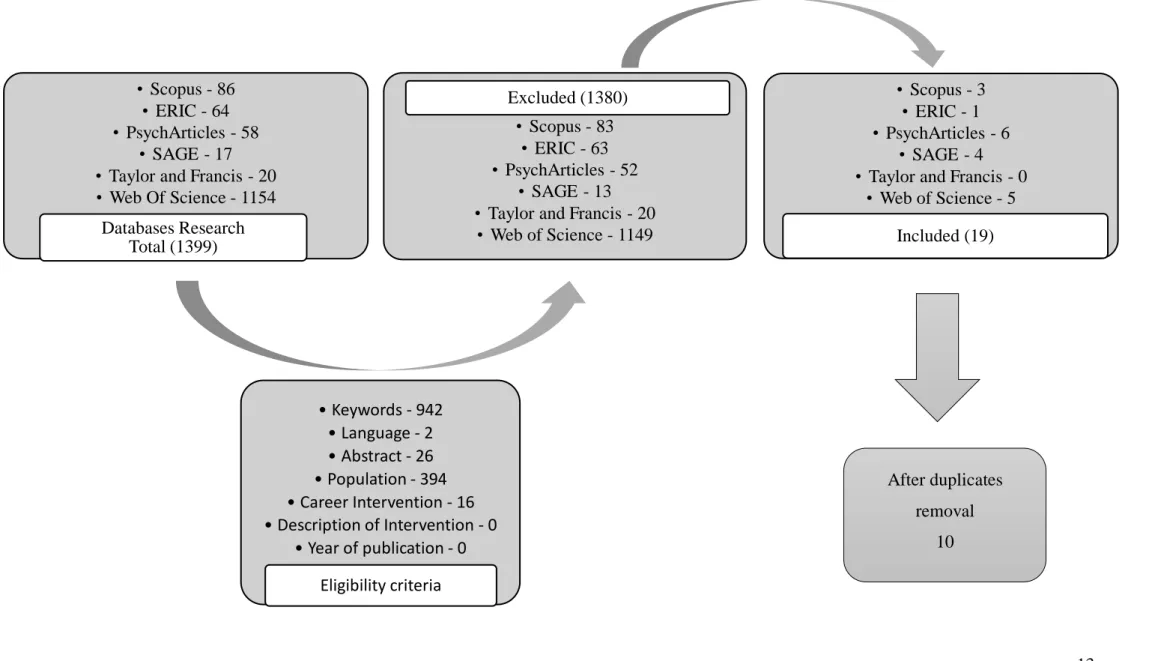
13 • Scopus - 86
• ERIC - 64 • PsychArticles - 58
• SAGE - 17 • Taylor and Francis - 20 • Web Of Science - 1154 Databases Research Total (1399) • Scopus - 83 • ERIC - 63 • PsychArticles - 52 • SAGE - 13 • Taylor and Francis - 20
• Web of Science - 1149
Excluded (1380) • Scopus - 3
• ERIC - 1 • PsychArticles - 6
• SAGE - 4 • Taylor and Francis - 0
• Web of Science - 5 Included (19) • Keywords - 942 • Language - 2 • Abstract - 26 • Population - 394 • Career Intervention - 16 • Description of Intervention - 0 • Year of publication - 0 Eligibility criteria After duplicates removal 10
14
Results
From the first phase of the process, the research within the six databases, a total of 1399 publications were found, as demonstrated in Figure 1. The figure displays the steps of the process, the total number of publications per database, publications excluded an included, also per database. It also presents the eligibility criteria, detailing the number of publications excluded in each criterion.
As demonstrated in Figure 1, keywords is the criterion that excluded more
publications, followed by population, whereas description of the intervention and year of publication did not exclude publications. Furthermore, Taylor and Francis is the only database with no publications within the 19 included. These 19 publications were screened for
duplicates, resulting in a total of 10 singular publications.
Table 3 presents the descriptions of the 10 publications, detailing the authors, year of publication, title, the subject, the journal, or book, in which was publicised, the country or countries, the frequency of appearance during researching phase and whether it was possible to access full text or not. Analysing the table, among the 10 publications, the majority was published in the 21st century (n=7), and the remaining were published during the last decade of the 20th century (n=3). USA is the origin of five publications, sharing the nationality of one
with the United Kingdom, which has two publications alongside with Australia. Japan and Poland have one publication each. Regarding the subject highlight for the five publications that pointed career development as the subject, and the two that indicated Medicine. Other subjects designated were Education, Mental Health and Psychology. All the subjects meet the journals, or books, themes. Okasana Yakushko is the only author with two publications included. Access to full text was possible for 6 of the 10 publications.
In table 4, each publication is described in terms of framework, refugee population, description, and conclusions. Framework concerns the type of the publication, whereas it describes or proposes theories (theoretical) or it describes or evaluates career interventions previously or currently in practice (practical). The majority of the publications lay on the theoretical framework (n=7). Regarding the refugee population, three publications concern this in general and two specifically address students. South Asian refugees, children, doctors, youths in general and women, are the focus of one publication each.
15 Table 3
List of articles included
No. Author(s) Year Title Subject Journal/Book Country Frequency Access to full text 1 Abkherz, McMahon &
Rossouw
2015 Youth with refugee backgrounds in Australia: Contextual and practical considerations for career counsellors Career development Australian Journal of Career Development Australia 2 Yes 2 Eastwood, Emmett, Cappuccio & Maxwell
2006 Re-training refugee and other overseas doctors: Re-qualification through the United Examining Board examination
Medicine Clinical Medicine, Journal of the Royal College of Physicians of London
United Kingdom
2 Yes
3 Hayashida et al. 1996 Support for refugee children and their families
Medicine International Medical Journal
Japan 1 No
4 Hughes & Scott 2013 A career intervention for
humanitarian entrant students: An example Career development Australian Journal of Career Development Australia 1 No
5 Ready 1991 School and the passage of refugee youth from adolescence to
adulthood
Education Refugee children: Theory, research, and services. (Book)
USA 1 No
6 Rosser & Nguyen 1995 Southeast Asian refugees Mental Health
Experiencing and counseling multicultural and diverse populations., 3rd ed. (Book)
16 7 Schultheiss, Watts,
Sterland & O’Neill
2011 Career, migration and the life CV: A relational cultural analysis
Career development Journal of Vocational Behavior USA/ United Kingdom 4 Yes
8 Slowik 2014 `Life space mapping' as an innovative method in career counselling for refugees, asylum seekers and migrants
Psychology Procedia Social and Behavioral Sciences
Poland 1 Yes
9 Yakushko 2006 Career Concerns of Immigrant Women: Issues and Implications for Career Counseling
Career development
Handbook of career counseling for women., 2nd ed. (book)
USA 1 Yes
10 Yakushko, Backhaus, Watson, Ngaruiya & Gonzalez
2008 Career Development Concerns of Recent Immigrants and Refugees
Career development
Journal of Career Development
17 Description was based in the publication abstract, and in the full text when available. Three of the publications describe the application of the interventions and two publications propose new interventions/methods. Furthermore, four publications focus on specific concerns of the targeted populations and three of them propose the application of existent theories to this population, explaining the strengths and weaknesses of each theory for the population of focus. Additionally, among the theories mentioned or described, culture related theories are the basis for the majority of the articles (n=6), information that was not possible to access for three publications, due to full text unavailable access. Social Cognitive Career Theory is mentioned in two publications. This theory is based on Bandura’s Social Cognitive Theory, and proposes a framework for an individual’s career interests, career choices and performance, which are based on the previous experiences and shaped by personal and environmental factors (Lent, Brown, & Hackett, 1994). Further indications for counsellors working with refugees are outlined in seven publications, information not acquired for two publications due to full text unavailability. Finally, main conclusions were access for the six publications with full text access. Empowerment is mentioned in two publications regarding distinct aspects, empowerment over future career plans, and empowerment to discover own strengths. One publication highlights the success of a specific design, time reduced and cheaper program that could facilitate professionals’ entry to country’s workforce. One of the articles stresses the need of empirical research on theories, and another publication emphasis the lack of appropriate training to better understand and assist a specific population.
18 Table 4
Publications description
No. Framework Refugee population
Description Conclusions
1 Theoretical Youths Outlines specific considerations for this population in career counselling, and suggests three possible approaches -
Culture-infused counselling model, Cultural preparedness approach and Narrative career counselling.
A more successful resettlement and integration in Australia, for this specific population, is facilitated by career
counselling models that boost empowerment over youths’ future career plans.
2 Practical Doctors Medical training and re-qualification for refugee and other overseas doctors, and follow up information. Outlines major differences between planned migration and hurried
migration. Several doctors were awarded grants to pay the course fees, and others resorted to loans.
The course offers an alternative route, time reduced and less expensive comparing to university, to refugee doctors, and other overseas doctors, to entry the UK workforce and progress, and proved to be successful. 3 Theoretical Children Outlines existent support for refugee children and families
in Japan. Review of further support for this population to enhance adaptation.
---
4 Practical Students Describes a career intervention developed for a group of refugee and humanitarian students, based on two
approaches, Guiding Circles and Hope-Filled Engagement.
---
5 Practical Students Describes how the program (Multicultural Career Intern Program of Washington, D.C.) applied to refugees in high school, during the early 1980s, met the needs of the refugees, and its efficacy is presented in terms of employment years after leaving the school.
19 6 Theoretical South Asian
refugees
Describes Indochinese refugees’ needs of personal and career guidance, the counselling services, and suggestions for professionals.
---
7 Theoretical General Based the relational cultural paradigm and the life design career model, an original approach is proposed, The Life CV. This process consists in improving the understanding of the concept of skills, recognition and confidence in own skills, abilities and employability potential.
This approach encompasses the strengths of two frameworks, to empower the individuals to not only discover themselves, but also to explore diverse ways to present themselves to potential employers.
8 Theoretical General ‘Life space mapping’ is presented as a career counselling method that meets counsellors’ difficulties in assisting refugees, asylum seekers and migrants, by educating the counsellor on the counselee life and path.
In order to better assist counselees,
counsellors shall understand counselees’ life experiences.
9 Theoretical Women The chapter extensively describes several concerns regarding immigrant women’s career, including refugees, and presents four existent career theories that meet this specific population’ needs and characteristics - social-cognitive learning theory, theories of career transition, ecological theory, and feminist theory.
The chapter reviews the existent literature on immigrant women in the USA and outlines the major concerns to be considered in career counselling with this specific population. Career counselling training should include specific training for this specific refugee population.
10 Theoretical General Several concerns and obstacles to immigrants and refugees’ career development are outlined. Social cognitive career theory, which has been applied to several minority groups, is proposed as potential valuable in understanding this specific population career development. The article also provides further suggestions for counsellors working with this specific population.
The article is a theoretical review of the concerns and possible influences in career development for this population, and outlines the need of empirical research to expand the existent knowledge improve existing tools.
20
Discussion
Considering the migration crisis that the world currently faces, countries are receiving several refugees or asylum seekers in a brief period. People fleeing from wars, leave their country without time to prepare themselves for the transition. They do not have time to learn the new language, sometimes they do not have time to collect essentials as money, clothes, or other items, and they arrive at a new country not knowing when it will be safe to return home. The literature has already stablished some career transition challenges immigrants, and
therefore refugees, face during resettlement. Chen (2008) gathered the literature main findings into four major challenges, language proficiency, culture familiarity, discrimination and prejudice, and vocational identity change. Based on these findings, refugees would benefit from career interventions designed to help them overcome the challenges they may face in pursuing a career in the host country. Hence, this study aimed to determine the existent literature on the career interventions for refugees, and based on this aim, a systematic review of the literature was the method selected.
The number of publications included in this study exposes the lack of attention that researchers have drawn to the subject, and framework characteristic reveals a focus on theories rather than what is actually in practiced worldwide. The results present three main focus. A focus on the concerns, considerations, possible influences on career development for refugees, and rational for possible theories that might be applied to this minority (Abkhezr, McMahon, & Rossouw, 2015; Rosser & Nguyen, 1995; Yakushko, 2006; Yakushko et al., 2008) . A focus on career interventions with a very specific population within refugees (Eastwood, Emmett, Cappuccio, & Maxwell, 2006; Hayashida et al., 1996; Hughes & Scott, 2013), and a focus on the development of new theoretical frameworks specifically for this population (Schultheiss, Watts, Sterland, & O’Neill, 2011; Slowik, 2014).
Regarding the targeted population, the publications focus mainly in a specific
population of refugees such as youths, children, and women, but none of the studies focused on men specifically. Furthermore, two of three publications with a practical framework focused on students (Hughes & Scott, 2013; Ready, 1991), a population that is at the beginning of their career development yet, which reveals an attention and effort to prepare this population before the entry on the country labour force, and therefore reduce the challenges.
Additionally, there is a lack of studies on career interventions considering specific groups, for example, the refugees that had a career in their home country but never had
21 education or credentials, people who worked in restaurants, supermarkets, offices, clothes’ stores, among several others. Moreover, some attention was given to the refugees arriving at the United Kingdom with medical credentials and proved to be beneficial both for the refugees and for the country’s workforce (Schultheiss et al., 2011), and likewise, attention should be drawn to career interventions for all the other types of credentials to decrease the challenges and maximise refugees’ potential contribution for the host country economy. Hence, considering age, all the age groups are covered, but literature is still lacking on specific groups, apart from the age taxonomy.
Furthermore, most of the publications are prior the present migration crisis. Only three articles were published in the last five years, and the number arises to five when considering the last ten years. USA is the country that contributes the most for the subject, Europe is represented with two countries, and Asia and Oceania are represented with one article each. Additionally, none of the European and non-European countries indicated as highly affected by the crisis have contributed for the subject. Although using six wide ranging databases, most the publications appeared only once, and only two publications had a frequency of four or more.
Taking everything into account, the main finding of this study is the scarcity of literature on career interventions for the refugee population. Although it is possible that countries have designed programs and interventions to assist this population, this is not documented in scientific papers, and therefore are not published in scientific databases. Nonetheless, it is possible that these documents are published in governments websites, or in specific platforms.
Additionally, the absence of contribution by the countries highly affect by the current crisis, may be due to the reduced time to investigate and publish frameworks concerning the interventions in practice and its evaluation or efficacy. It is likely that in the future, the number of publications regarding this subject will increase because of this crisis, possibly mainly longitudinal studies to evaluate the career interventions applied and respective efficacy.
On the other hand, another finding of this study is a well stablished theoretical base for career interventions with refugees. The concerns and considerations to account in career counselling with this minority, the challenges, and possible influences in career development, have been extensively described, and possible theories that may be applied to this specific population are also described. Therefore, the subject only lacks on empirical evidence, and further research should focus on providing this evidence.
22 Finally, the aim of this study was achieved, and considering that no identical studies were found, this is possibly the first systematic review on the subject of career interventions for refugees. Therefore, this study might consist in an important source of information regarding existent literature on the subject for researchers.
Conclusion
The migration crisis is urging countries all around the world to consider and analyse the support provided to refugees during resettlement. Although migration is not a recent phenomenon and every year countries receive migrants, this crisis in particular is highly increasing the number of entries in some countries in a short period. Refugees arrive in groups and it is urgent to allocate and help them stablish.
Survival and independence is acquired, among others, throughout a financial stability, therefore these individuals need to join the countries workforce. The challenges are several and are well stablished in the literature. Nevertheless, the strategies, the programs, the support, and the interventions available for this population, are not described in scientific papers although the countries do provide it. This study only considers scientific bases and papers, which consists in a limitation and might be an explanation for the lack of findings regarding what is in practice worldwide.
In conclusion, this is an urgent problem and attention needs to be shifted from theory to practice. What are the countries doing, what is effective and what is not effective, how can it be improved and what is lacking, are the questions unanswered in the literature, that further research could attempt to clarify.
23
References
References preceded by an asterisk indicate the publications included in the systematic review.
*Abkhezr, P., McMahon, M., & Rossouw, P. (2015). Youth with refugee backgrounds in Australia: Contextual and practical considerations for career counsellors. Australian
Journal of Career Development, 24(2), 71–80. doi: 10.1177/1038416215584406
Chen, C. P. (2008). Career guidance with immigrants. In J. A. Athanasou & R. Van Esbroeck (Eds.), International Handbook of Career Guidance (1st ed., pp. 419–442). Dordrecht: Springer Netherlands. doi: 10.1007/978-1-4020-6230-8_21
Colic-Peisker, V., & Tilbury, F. (2006). Employment Niches for Recent Refugees: Segmented Labour Market in Twenty-first Century Australia. Journal of Refugee Studies, 19(2). doi: 10.1093/jrs/fej016
Dykeman, C., Wood, C., Ingram, M., Gitelman, A., Mandsager, N., Chen, M.-Y., & Herr, E. L. (2003). Career Development Interventions and Academic Self-Efficacy and
Motivation: A Pilot Study. St. Paul, Minnesota: National Dissemination Center for
Career and Technical Education The Ohio State University. Retrieved from https://eric.ed.gov/?id=ED480312
*Eastwood, J. B., Emmett, L., Cappuccio, F. P., & Maxwell, J. D. (2006). Re-training refugee and other overseas doctors: Re-qualification through the United Examining Board examination. Clinical Medicine, Journal of the Royal College of Physicians of London,
6(1), 51–56. doi: 10.7861/CLINMEDICINE.6-1-51
*Hayashida, H., Inomata, J., Suzuki, J., Matsuda, F., Hayashi, M., Yamazaki, K., … Kobayashi, R. (1996). Support for refugee children and their families. International
Medical Journal, 3(4), 261–263. Retrieved from
https://www.scopus.com/inward/record.uri?eid=2-s2.0-0030481585&partnerID=40&md5=02602085ac7acecd8c4279ba13393dff
*Hughes, C., & Scott, R. (2013). A career intervention for humanitarian entrant students: An example. Australian Journal of Career Development, 22(3), 130–138. doi:
10.1177/1038416213502170
Lent, R. W., Brown, S. D., & Hackett, G. (1994). Toward a Unifying Social Cognitive Theory of Career and Academic Interest, Choice, and Performance. Journal of Vocational
Behavior, 45(1), 79–122. doi: 10.1006/jvbe.1994.1027
24 Moher, D. (2009). The PRISMA Statement for Reporting Systematic Reviews and Meta-Analyses of Studies That Evaluate Health Care Interventions: Explanation and
Elaboration. PLOS Medicine, 6(7), e1000100. doi: 10.1371/journal.pmed.1000100 Lunet, N. (2012). The Use of Systematic Review and Meta-Analysis in Modern
Epidemiology. In Prof. Nuno Lunet (Ed.), Epidemiology - Current Perspectives on
Research and Practice (pp. 195–210). doi: 10.5772/48975
Oxford. (2016a). Oxford Dictionaries. Retrieved May 2, 2016, from https://en.oxforddictionaries.com/definition/refugee
Oxford. (2016b). Oxford Dictionaries. Retrieved May 2, 2016, from http://www.oxforddictionaries.com/definition/english/immigrant
*Ready, T. (1991). School and the passage of refugee youth from adolescence to adulthood.
Refugee Children: Theory, Research, and Services. Baltimore, MD, US: Johns Hopkins
University Press. Retrieved from
http://ovidsp.ovid.com/ovidweb.cgi?T=JS&PAGE=reference&D=psyc3&NEWS=N&A N=1991-98445-009
*Rosser, R. L., & Nguyen, J. (1995). Southeast Asian refugees. In N. A. Vacc, S. B.
DeVaney, & J. Wittmer (Eds.), Experiencing and counseling multicultural and diverse
populations (3rd ed., pp. 273–292). Philadelphia, PA, US: Accelerated Development.
Retrieved from
http://ovidsp.ovid.com/ovidweb.cgi?T=JS&PAGE=reference&D=psyc3&NEWS=N&A N=1995-97249-011
*Schultheiss, D. E., Watts, J., Sterland, L., & O’Neill, M. (2011). Career, migration and the life CV: A relational cultural analysis. Journal of Vocational Behavior, 78(3, SI), 334– 341. doi: 10.1016/j.jvb.2011.03.013
*Slowik, A. (2014). `Life space mapping’ as an innovative method in career counselling for refugees, asylum seekers and migrants. Procedia Social and Behavioral Sciences, 114, 80–85. doi: 10.1016/j.sbspro.2013.12.661
United Nations High Commissioner for Refugees. (2014). World at War Global Trends 2014 in Reveiw. Retrieved May 12, 2016, from http://unhcr.org/556725e69.html
United Nations High Commissioner for Refugees. (2016a). Figures at a glance. Retrieved October 6, 2016, from http://www.unhcr.org/figures-at-a-glance.html
United Nations High Commissioner for Refugees. (2016b). Syria Regional Refugee Response. Retrieved May 12, 2016, from
25 *Yakushko, O. (2006). Career Concerns of Immigrant Women: Issues and Implications for
Career Counseling. In W. B. Walsh & M. J. Heppner (Eds.), Handbook of career
counseling for women., 2nd ed. (2nd ed., pp. 387–426). Mahwah, NJ, US: Lawrence
Erlbaum Associates Publishers. Retrieved from
http://ovidsp.ovid.com/ovidweb.cgi?T=JS%7B&%7DPAGE=reference%7B&%7DD=ps yc5%7B&%7DNEWS=N%7B&%7DAN=2006-00546-012
*Yakushko, O., Backhaus, A., Watson, M., Ngaruiya, K., & Gonzalez, J. (2008). Career Development Concerns of Recent Immigrants and Refugees. Journal of Career