https://doi.org/10.1007/s10329-020-00817-2
NEWS AND PERSPECTIVES
Chasing a ghost: notes on the present distribution and conservation
of the sooty mangabey (Cercocebus atys) in Guinea‑Bissau, West Africa
Maria Joana Ferreira da Silva1,2,3 · Christina Paddock1,4 · Federica Gerini2 · Filipa Borges2,5,6 ·
Isa Aleixo‑Pais1,6 · Mafalda Costa1 · Ivo Colmonero‑Costeira1,2 · Catarina Casanova7 · Miguel Lecoq8 ·
Cristina Silva9 · Michael W. Bruford1,10 · Jorge Varanda6,11 · Tânia Minhós6,5,12
Received: 4 November 2019 / Accepted: 30 March 2020 / Published online: 21 April 2020 © The Author(s) 2020
Abstract
The West-African sooty mangabey (Cercocebus atys) is threatened by habitat loss, hunting for meat consumption, and mortality during crop-foraging events. The species’ overall demographic trend is unknown. Presence and distribution in Guinea-Bissau, a country neighbored by Senegal and Republic of Guinea, was confirmed in 1946 but the species was declared extinct in 1989 and not observed in subsequent countrywide expeditions. Narratives of its presence across southern Guinea-Bissau are scattered in reports and occurrence in the eastern part was reported in 2017, but the limits of its distribution are currently unknown. Here, we present recent geo-referenced visual and molecular-based records of the sooty mangabey for three protected areas in southern Guinea-Bissau collected as part of a region-wide survey. Individuals were observed in Cufada Lagoons Natural Park (2015) and Dulombi National Park (NP) (2016) and photographed in Boé NP (2007, 2015 and 2020). Thirty-six samples collected in Boé NP (2017) were identified as sooty mangabey using a 402 base pair fragment of the mitochondrial cytochrome b gene. Our work suggests a wider distribution in Guinea-Bissau than previously described, augments knowledge of the populations’ current habitat use and threats, and has implications for efforts to conserve the spe-cies in West Africa. Considering the sooty mangabey as the reservoir of the simian immunodeficiency virus that led to the human variant, HIV-2, confirmation that the Guinea-Bissau population is not extinct may lead to a better understanding of early viral jump to humans and consequent epidemic spread, specifically of the HIV-2 Subgroup A. We highlight the need for extra conservation measures by Guinea-Bissau authorities.
Keywords Action plan · Gallery forest · Boé National Park · HIV-2 A · Viral jump · DNA barcoding
* Maria Joana Ferreira da Silva [email protected]
1 Organisms and Environment Division, School
of Biosciences, Sir Martin Evans Building, Museum Avenue, Cardiff CF10 3AX, Wales, UK
2 CIBIO/InBio, Centro de Investigação Em Biodiversidade E Recursos Genéticos, Campus Agrário de Vairão, 4485-661 Vairão, Portugal
3 CAPP, Centro de Administração E Políticas Públicas, Universidade de Lisboa, Rua Almerindo Lessa, 1300-663 Lisboa, Portugal
4 Bristol Zoological Society, Clifton, Bristol BS8 3HA, UK 5 Instituto Gulbenkian de Ciência, Rua da Quinta Grande 6,
2780-156 Oeiras, Portugal
6 CRIA, Centre for Research in Anthropology (CRIA-FCSH/NOVA), 1069-061 Lisbon, Portugal
7 CIAS, Centro de Investigação Em Antropologia E Saúde, University of Coimbra, Calçada Martim de Freitas, Edíficio de São Bento, 3000-456 Coimbra, Portugal
8 Rua Barão de Sabrosa, n.º 29-1.º, 1900-087 Lisboa, Portugal 9 Instituto Politécnico de Setúbal, Escola Superior de
Tecnologia, Campus do IPS-Estefanilha, 2910-761 Setúbal, Portugal
10 Sustainable Places Research Institute, Cardiff University, 33 Park Place, Cardiff CF10 3BA, UK
11 Global Health and Tropical Medicine, Institute of Hygiene and Tropical Medicine (GHTM-UNL), R. da Junqueira 100, 1349-008 Lisbon, Portugal
12 Department of Anthropology, School of Social Sciences and Humanities, Universidade Nova de Lisboa, 1069-061 Lisbon, Portugal
Introduction
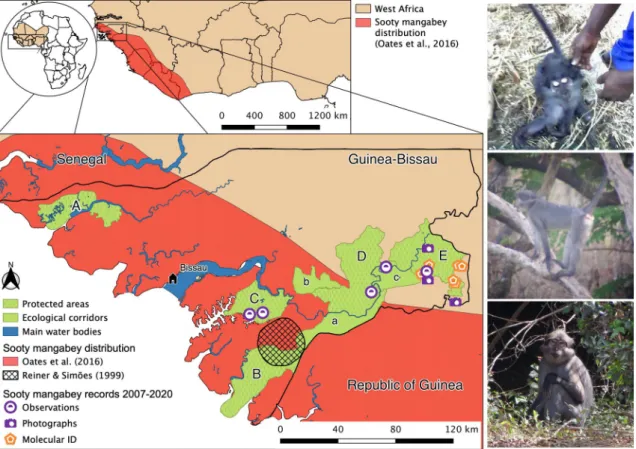
The sooty mangabey (Cercopithecidae: Cercocebus atys; Audebert, 1797) is a terrestrial diurnal primate, native to the West African countries of Senegal, Guinea-Bissau, Guinea, Sierra Leone, Liberia, and Côte d’Ivoire (Fig. 1). The sooty mangabey occupies primary and secondary, gallery, swamp and mangrove forests, and woodland savanna (Oates et al. 2016). The species was classified as Near Threatened in 2008 by IUCN (Oates et al. 2016) and as Endangered by McGraw (2016b), and is included on Appendix II of CITES, Appendix I list of the Euro-pean Union and on Class B of the African Convention on the Conservation of Nature and Natural Resources (Oates et al. 2016). Populations are thought to have been declin-ing due to habitat loss, huntdeclin-ing for meat consumption, and mortality during crop-foraging events (McGraw 2016b). However, recent data on population size, distribution, and trends across the species’ range are lacking (Oates et al.
2016).
Guinea-Bissau is a small coastal country (36,125 km2) bordered by Senegal and Republic of Guinea, and is con-sidered a regional stronghold for primates, with ten species reported to occur in the country (Reiner and Simões 1999; Gippoliti and Dell’Omo 2003). There are five protected areas in mainland Guinea-Bissau, four of which are located in the south (Cantanhez National Park, Cufada Lagoons Nat-ural Park, Dulombi National Park and Boé National Park, see Fig. 1), where the majority of primates are thought to be present (Gippoliti and Dell’Omo 2003). Countrywide surveys for primates were conducted almost 20 years ago (Gippoliti and Dell’Omo 2003; Casanova and Sousa 2007; however, see Colmonero-Costeira et al. 2019) and mainly focused on species such as the western chimpanzee (Pan
troglodytes verus), the black-and-white colobus (Colobus polykomos, McGraw 2016a), and the Temminck’s red colo-bus (Piliocolocolo-bus temminckii, Galat-Luong et al. 2016). Recent information on primates in the northern margin of the Corubal River (such as in Dulombi National Park) is lacking, which prevents a better understanding of the direc-tion primate conservadirec-tion research should take in the region
Fig. 1 Top left: The distribution of the sooty mangabey in West Afri-can countries. Bottom left: Distribution of the sooty mangabey in Guinea-Bissau - before this work (based on Oater et al. 2016, repre-sented in red, and on Reiner and Simões 1999, represented in black crossed lines). The geographic location of observations, photographs, and molecular records of recent presence (2007–2020) by this work are indicated. Also illustrated: protected areas and ecological
corri-dors (in green) on the mainland. A: Cacheu mangroves Natural Park; B: Cantanhez National Park; C: Cufada Lagoons Natural Park; D: Dulombi National Park; E: Boé National Park, a: Cuntabane cal corridor, b: Salifo ecological corridor and c: Tché-Tché ecologi-cal corridor). Right, from top to bottom: photographs taken in Boé National Park in 2007 (credits to C. S.), and in 2015 and 2020 (credits to M. L.)
(Bersacola et al. 2018). Lack of updated information on the distribution of primates in Guinea-Bissau means the country’s Action Plan cannot be revised, and represents an important gap in conservation action plans currently being developed for primates in West-Africa (e.g., Red Colobus Conservation Action Plan: 2019–2021; Cronin et al. in prep. and the Mangadrill Conservation Action Plan; Fernández et al. 2019).
The current distribution of the sooty mangabey in Guinea-Bissau (locally known as “macaco cinzento” in creole) is uncertain. Its presence was confirmed from the 1940s onwards (Monard 1938; Frade et al. 1946) with the capture of a specimen within the current limits of the Can-tanhez National Park (NP), near the border with Guinea (Frade et al. 1946). This record became the basis for the estimated distribution of the species in Reiner and Simões’s (1999) “Guinea-Bissau Wild Mammals” guide (Fig. 1). However, the species was not observed during the expedi-tions of Limoges (1989), Gippoliti and Dell’Omo (1996), and Gippoliti and Dell’Omo (2003) in the same region. Kar-ibuhoye (2004) gathered reports from villagers and hunt-ers of its occurrence in forested habitats and croplands in Cantanhez NP and Cufada Lagoon Natural Park but did not observe the species. Amador et al. (2014) reported that the sooty mangabey was considered edible by Cufada Lagoons Natural Park residents. Both studies may reflect historical records of its occurrence in the region of Cufada Lagoons Natural Park (Fig. 1). In a more recent survey in Dulombi NP, Bersacola et al. (2018) did not report the presence of the species.
Based on his results, Limoges (1989) declared the sooty mangabey to be extinct in Guinea-Bissau. However, evi-dence for its presence in the country after 1989 can be found in unpublished reports: Silva (2007, see Fig. 1), Goedmak-ers (2011), who reported its occurrence in the Boé NP, and Casanova and Sousa (2003, 2007) and Casanova (2006), who obtained evidence in the Dulombi and Quínara region and outside Cantanhez NP. Recently, Binczik et al. (2017) reported observations of individuals in secondary, semi-dense and gallery forests across the Boé region.
Evidence that the sooty mangabey is not extinct in Guinea-Bissau may represent an important route for research on the origins and transmission of the human immunodefi-ciency virus type 2 (HIV-2). The virus originated from the simian immunodeficiency virus found in the sooty mangabey (Visseaux et al. 2016). Recent analyses found two subtypes of HIV-2A (subtype 1 and 2) and suggested two geographi-cally independent founding events, respectively in Ivory Coast, and in an area comprising Guinea-Bissau, Senegal, Gambia, and Guinea (Visseaux et al. 2016). Guinea-Bissau was described as the epicenter of the epidemic transmission, but the continuing narrative of extinction of the sooty mang-abey in the country by Limoges (1989) (e.g., Santiago et al.
2005; Faria et al. 2002) has hindered research on the prime reservoir of the HIV-2A. Confirmation of the recent pres-ence, and further research on sooty mangabeys in Guinea-Bissau is required to corroborate a second event of transmis-sion of HIV-2 to humans and thus to rethink the present-day narrative on HIV-2 epidemic (Varanda 2016; in press).
Here we report visual and molecular records (photo-graphs and fecal samples identified using DNA barcoding) that confirm recent presence (2007–2020) of sooty mang-abey in Guinea-Bissau, namely in Cufada Lagoons Natural Park, Dulombi NP and Boé NP. Our work contributes to a more accurate assessment of the conservation status of the sooty mangabey, with implications for species conservation actions and for future research on the origin of epidemic HIV-2A.
Methods
We gathered recent evidence on the presence of the sooty mangabey in Guinea-Bissau by collating photographic records (2007, 2015, and 2020) and collecting presence data (visual and/or molecular records) during expeditions to Cufada Lagoons Natural Park (December 2015), Dulombi NP (February 2016), and Boé NP (January 2017; Fig. 1). Presence and molecular data were collected as part of the PRIMACTION project (2015–2019), aimed at updating information on the presence and distribution of primate spe-cies across southern Guinea-Bissau using DNA barcoding tools. Within each national park, we visited areas reported by guards and locals to be frequently used by primates (includ-ing croplands, drink(includ-ing spots, gallery, mangrove, primary and secondary forests, and savannah habitats), to collect geo-referenced visual records and non-invasive fecal material for DNA barcoding. The team members remained at those locations for a minimum of 30 min and actively searched for evidence of primate presence, such as footprints, vocaliza-tions, and/or fecal samples.
Fecal samples were collected and preserved by the two-step method until DNA extraction (e.g., Roeder et al. 2004) using silica gel Type II (S-7625, indicating for desiccation, Sigma-Aldrich® Company Ltd, Dorset, UK). We prevented contamination by exogenous DNA by wearing gloves, and head and face masks during collection of samples.
Fecal DNA extraction was carried out in dedicated facilities at Centro de Investigação em Biodiversidade e
Recursos Genéticos (Vairão, Portugal) and at Instituto Gul-benkian Ciência (Oeiras, Portugal) using the Vallet et al.
(2008) 2CTAB/PCI protocol with adaptations by Quéméré et al. (2010) and/or the Qiagen Stool Kit®, following the manufacturer’s protocol. A fragment of 402 base pairs (bp) of the mitochondrial cytochrome b gene (cytb) was amplified by polymerase chain reaction (PCR) using the
primers GVL14724 and H15149 published by Gaubert et al. (2015). PCRs were carried out in 10 μl and included 5 μl of 1 × MyTaq™ Mix (Bioline, England), 1 μl of 10 μM primer pair mix, and 1 μl of DNA. PCRs were performed in a T100TM BIO-RAD 96-Well Thermal Cycler following cycling conditions by Gaubert et al. (2015). Successful PCR amplifications were subjected to an enzymatic clean-up by ExoSAP-ITTM PCR Product Cleanup (Exonuclease I and Shrimp Alkaline Phosphatase) by Applied Biosystems™, following the manufacturer’s protocol. Fragments were sequenced either uni or bi-directionally using the BigDye® Terminator Cycle Sequencing Kit in a 3130xl Applied Bio-systems® automated sequencer. After visually correcting sequences using Geneious® v. 4.8.5 (Kearse et al. 2012), query sequences were assigned to the species by searching the NCBI database (https ://www.ncbi.nlm.nih.gov/) using BLAST for the most similar voucher.
Results
Sooty mangabeys were photographed at least three times at Boé NP, in 2007 (credits to C.S.) and in 2015 and 2020 (credits to M.L.; Fig. 1). During surveys carried out between 2015 and 2017 in protected areas in the southern part of the country, we observed the species five times, although we do not have photographs of those individuals. We observed sooty mangabeys at two localities in Cufada Lagoons Nat-ural Park (feeding at a cropland near the village of Buba Tumbo, and in a degraded forest at the northern margin of the Buba Channel), at Dulombi NP (on the branch of a tree, near a water-spring in a gallery forest habitat) and twice in Boé NP (near the site of Pataque and on a branch of a tree on the northern bank of the Corubal River). These were full body observations (i.e., animals were not hidden by vegeta-tion). The species was identified based on their morphology using Oates’ (2011) field guide.
We molecularly identified 36 fecal samples as sooty mangabey using DNA barcoding; they were collected in six geographically independent locations in Boé NP (approxi-mately 3 km between sites on average, maximum distance of 29 km), surveyed on three different days. Sequences for each sample varied in length (mean sequence length aver-age = 403.6 ± 44.7 bp; ranging between 259 and 462 bp). Only one haplotype was found. When using BLAST, the haplotype found in this study showed a 92.8, 96.8, and 99.3% identity to the three 402 bp cytb sequences for sooty mangabey available in the NCBI GenBank database (acces-sion numbers KJ193498, KP090062 and NC_028592, respectively). This result indicates that the 402 bp haplotype sampled in Guinea-Bissau is between 93 to 99% identical to the nucleotide sequences deposited in NCBI GenBank
identified as sooty mangabey, thus the samples harboring that haplotype can be assigned to the same species. The 402-bp nucleotide sequence reported here is available from the GenBank database under the accession number MT179319.
Discussion
We report anecdotal observations and photographic evidence from the last 13 years (2007, 2015, 2016, 2017, and 2020) that confirm the present occurrence of sooty mangabey in Cufada Lagoons Natural Park, Dulombi NP and Boé NP, supported by the first molecular evidence of its occurrence in Boé NP. Our work definitively refutes the claim that the species is currently extinct from Guinea-Bissau. It also has direct implications for the Guinea-Bissau Action Plan, which is currently being updated and expanded to other species (the previous version, by Casanova and Sousa (2007) was for the western chimpanzees and black-and-white and red colobus), and for global conservation planning of the species, specifi-cally the Mangadrill Conservation Action Plan (Fernández et al. 2019). Moreover, confirmation that the sooty mang-abey is present in Guinea-Bissau may allow new routes of research in the ongoing investigation of the origin of the HIV-2A. It may also contribute, more generally, to a bet-ter understanding of the process of viral spillover (Varanda
2016; in press).
We found only one haplotype in 36 sequences collected in Boé NP, which is not unexpected given that the DNA bar-coding marker used was designed to be highly conservative within the species level (Gaubert et al. 2015). Nevertheless, further study of the genetic diversity of these populations, using fast-evolving genetic markers such as the mtDNA con-trol region and microsatellite loci, would benefit conserva-tion acconserva-tion planning.
We observed and collected molecular evidence for the presence of the sooty mangabey in evergreen gallery forest habitats in Dulombi NP and Boé NP, and in croplands and degraded forest habitats in Cufada Lagoons Natural Park (Fig. 1). Our observations concur with the few previous records available for the country, such as Binczik’s (2017) report of sooty mangabeys in secondary/semi-dense forests and gallery forests in Boé NP, and Karibuhoye’s (2004) men-tion of crop-foraging events in maize fields by this species in Cufada Lagoons Natural Park. This suggests that mangabeys in Guinea-Bissau occupy the range of habitats observed in other locations (McGraw 2016b). Although anecdotal, these observations can help identify some threats faced by the sooty mangabey in Guinea-Bissau, which may include habitat loss and degradation, hunting for the bushmeat trade and consumption, and for the trade of body parts for tradi-tional medicine (Sá et al. 2012; Minhós et al. 2013). Agricul-tural land has been expanding for the last two decades in the
country, involving the rapid replacement of slash-and-burn practices (rice, groundnuts, and sorghum) with cultivation of cash-crops, in particular cashew nuts (Anacardium
occiden-tale; Catarino et al. 2015; Monteiro et al. 2017). An increase of harvested cashew nut areas occurred between 2001 and 2010 (Monteiro et al. 2017), reaching 223,000 ha of culti-vated area and 130,000 tons of nut production in 2012 (data from FAOSTAT in Catarino et al. 2015). Cashew orchards are usually planted in uncultivated lands intermingled with semi-natural, tropical or savanna woodlands, even within protected areas (Hockings and Sousa 2013; Monteiro et al.
2017). The evergreen riparian forests in the Boé region, where sooty mangabeys were molecularly confirmed to be present, are threatened by periodic fires that are followed by slash-and-burn agriculture and planting of cashew orchards (Kühnert et al. 2019).
The presence of sooty mangabey individuals in a variety of habitats in Guinea-Bissau suggests a degree of behavio-ral and ecological flexibility that may allow populations to adapt to rapid transformation of the habitats into croplands (e.g., as observed by Wieczkowski 2005 for the Tana River mangabey Cercocebus galeritus in Kenya); however, the high rate of loss and degradation of primary/secondary for-est habitats and higher frequency of contact between farm-ers and sympatric wildlife (Hockings and Sousa 2013) may further reduce and isolate populations. Narratives of man-gabey fatalities during crop-foraging were documented by Karibuhoye (2004) and Amador et al. (2014), but the impact of crop-raiding mortality needs to be further assessed.
Although it is currently unknown if sooty mangabeys form interspecific associations with other nonhuman primate species in Guinea-Bissau, as observed in other locations of West Africa (e.g., Western red colobus Piliocolobus badius and Diana monkey Cercopithecus diana, McGraw 2016b), Binczik et al. (2017) and our surveys recorded mangabeys in evergreen gallery forests in Dulombi and Boé NPs, high-lighting the importance of protecting these types of habitats not only for the conservation of the sooty mangabey, but also other primates, and other sympatric species.
Sooty mangabey was not found to be traded at urban primate bushmeat markets during previous molecular sur-veys (Minhós et al. 2013) but it may be hunted for meat consumption in Guinea-Bissau: C.S. recorded a dead indi-vidual hunted in Boé NP (Fig. 1), Karibuhoye (2004) and Amador et al. (2014) documented hunting for bushmeat con-sumption at Cufada Lagoons Natural Park, and the unpub-lished reports by Casanova and Sousa (2007) and Casanova (2006) recorded hunters of the Tombali region (where Can-tanhez NP is located) mentioning sporadic hunting of man-gabeys. Future research on the motivation for hunting and degree of hunting pressure on the populations of mangabeys is needed to better assess the impact of this threat.
Molecular sampling in six distinct sampling sites in the Boé region, which combined with the five geographically independent observations from Cufada Lagoons Natural Park, Dulombi NP and Boé NP between 2015–2017, and the sites in Boé NP where individuals were photographed (Fig. 1), suggests a minimum of 14 geographically-inde-pendent sightings. As our methodology was designed to survey primates in general, we cannot exclude the possibil-ity that our results underestimate the population size of the sooty mangabey in southern Guinea-Bissau; it may be larger and more widely distributed than previously described (e.g., solely in Cantanhez NP by Frade et al. 1946; Reiner and Simões 1999). The species may have been overlooked by researchers and conservationists due to its cryptic behavior and use of lower-visibility habitats, and to a lack of system-atic surveys in the country’s protected areas (but see Binczik et al. 2017). Nevertheless, we argue that extra conservation measures must be taken by Guinea-Bissau authorities to pro-tect this species.
Acknowledgements We are very grateful to the Guinea-Bissau
gov-ernmental agencies Instituto da Biodiversidade e das Áreas Protegi-das (IBAP)—Dr. Alfredo Simão da Silva, Dr. Justino Biai, Dr. Aissa Regalla, Dr. Abílio Said, Abel Vieira, Iaia, Benjamim, Bemba, Dr. Augusto Cá, Dr. Joãozinho Mané and Dr. Sadjo Danfa for fieldwork and sampling permits and fieldwork logistics, and to Direcção-Geral de Florestas e Fauna (DGFF) for sample exportation permits; to the research assistants and guides Sadjo Camará, Mamadu Soares, Mam-adu Turé, Idrissa Camará, Baba Djaló, Nelson Domingues; to the NGO CHIMBO for logistical support to carry out fieldwork in the Boé region; to I. Espinosa and H. Foito for logistical support in Bis-sau. We dedicate this paper to the memory of Dr. Alfredo Simão da Silva. This work was supported by Portuguese national funds through FCT—Fundação para a Ciência e a Tecnologia, under the project MATOMICS (ref: PTDC/IVC-ANT/3058/2014), and the project PRI-MACTION funded by the Born Free Foundation, Chester Zoo Conser-vation Fund, Primate ConserConser-vation Incorporated, CAROSI, Cápsulas do Norte, Camarc, and JA-Rolhas & Cápsulas. MJFS worked under a FCT contract (CEECIND/01937/2017), I.A.P. and I.C.C. were sup-ported by FCT-doctoral fellowship (I.A.P. SFRH/BD/118444/2016; I.C.C: SFRH/BD/146509/2019) and C.P. by a UK Natural Environ-ment Research Council Studentship (NERC; CASE Studentship NE/ N007980/1). Research on the HIV-2 A emergence and epidemic, part of the project “An International Collaboration on the Political, Social, and Cultural History of the Emergence of HIV/AIDS.”, funded by the Collaborative Research Grant from the National Endowment for the Humanities, No. RZ5152313, and FCT PTDC/AFR/100646/2008 and UID/ANT/04038/2019. C. Casanova and C. Sousa were funded by FCT projects (ref. POCI/ANT/57434/2004 and PTDC/CS/ANT/099184).
Open Access This article is licensed under a Creative Commons Attri-bution 4.0 International License, which permits use, sharing, adapta-tion, distribution and reproduction in any medium or format, as long as you give appropriate credit to the original author(s) and the source, provide a link to the Creative Commons licence, and indicate if changes were made. The images or other third party material in this article are included in the article’s Creative Commons licence, unless indicated otherwise in a credit line to the material. If material is not included in the article’s Creative Commons licence and your intended use is not permitted by statutory regulation or exceeds the permitted use, you will
need to obtain permission directly from the copyright holder. To view a copy of this licence, visit http://creat iveco mmons .org/licen ses/by/4.0/.
References
Amador R, Casanova C, Lee P (2014) Ethnicity and perceptions of bushmeat hunting inside Lagoas de Cufada Natural Park (LCNP), Guinea-Bissau. J Primatol. https ://doi.org/10.4172/2167-6801.10001 21
Bersacola H, Bessa J et al (2018) Primate occurrence across a human-impacted landscape in Guinea-Bissau and neighbouring regions in West Africa: using a systematic literature review to highlight the next conservation steps. PeerJ 6:e4847. https ://doi.org/10.7717/ peerj .4847
Binczik A, Roig-Boixeda P, Heymann EW, Waltert M (2017) Conser-vation of chimpanzees Pan troglodytes verus and other primates depends on forest patches in a West African savannah landscape. Oryx. https ://doi.org/10.1017/S0030 60531 70010 90
Casanova C (2006) Unpublished field data collected during field mis-sion to Quínara and Tombali, Guinea-Bissau: interviews with hunters
Casanova C, Sousa C (2003) Unpublished data collected during field mission to Boé/Guinea-Bissau
Casanova C, Sousa C (2007) Plano de acção nacional para a con-servação das populações de chimpanzés, cólobus vermelhos oci-dentais e cólobus brancos e pretos ocioci-dentais na República da Guiné-Bissau. Bissau, IBAP: 98
Catarino L, Menezes Y, Sardinha R (2015) Cashew cultiva-tion in Guinea-Bissau—risks and challenges of the suc-cess of a cash crop. Sci Agric 72:459–467. https ://doi. org/10.1590/0103-9016-2014-0369
Colmonero-Costeira I, Minhós T, Djaló B, Fernandes N, Ferreira da Silva MJ (2019) Distribuição de primatas não-humanos no arqui-pélago dos Bijagós, Guiné-Bissau: actualização da presença de Chlorocebus sabaeus, Cercopithecus campbelli e Cercopithecus petaurista buettikoferi em sete ilhas com base em técnicas molec-ulares não invasivas. Sintidus - Universidade Lusófona-Bissau, Guiné-Bissau. 2:145–179. ISSN (online) 2616–3233. https ://sinti dus.blogs pot.com/p/numer o-2.html
Faria NR, Hodges-Mameletzis I et al (2012) Phylogeographical foot-print of colonial history in the global dispersal of human immu-nodeficiency virus type 2 group A. J Gen Virol 93:889–899. https ://doi.org/10.1099/vir.0.03863 8-0
Fernández D, Dempsey A, McCabe G, McGraw WS (2019) Mangadrill conservation action plan: a strategy for the survival of Cercocebus and Mandrillus. Afr Primates 13:66–67
Frade F, Bacelar A, Gonçalves B (1946) Trabalho da missão zoológica da Guiné I-V. Relatório da missão zoológica e contribuições para o conhecimento da fauna da Guiné Portuguesa. Anais da junta de investigações coloniais I:261–415
Galat-Luong A, Galat G, Starin D (2016) Temminck’s red colobus. In: Rowe N, Myers M (eds) All the world’s primates. Pogonias Press, Charlestown, pp 547–549
Gaubert P, Njiokou F et al (2015) Bushmeat genetics: Setting up a reference framework for the DNA typing of African for-est bushmeat. Mol Ecol Resour 15:633–651. https ://doi. org/10.1111/1755-0998.12334
Gippoliti S, Dell’Omo G (1996) Primates of the Cantanhez Forest and the Cacine Basin, Guinea-Bissau. Oryx 30:74–80. https ://doi. org/10.1017/S0030 60530 00214 14
Gippoliti S, Dell’Omo G (2003) Primates of Guinea-Bissau, West Africa: distribution and conservation status. Primate Conserv 19:73–76
Goedmakers A (2011) Annual Report 2011. CHIMBO Foundation 33.
http://chimb o.org/wp-conte nt/uploa ds/2012/12/Annua l-Repor t-2010-.pdf. Accessed 10 Apr 2020
Hockings KJ, Sousa C (2013) Human–Chimpanzee sympatry and interactions in Cantanhez National Park, Guinea-Bissau: current research and future directions. Primate Conserv 26:57–65. https ://doi.org/10.1896/052.026.0104
Karibuhoye C (2004) Mammal conservation status and prospects for community-based wildlife management in coastal Guinea-Bissau, West Africa. Mathematisch-Naturwissenschaftlichen Fakultäten. Göttingen, Georg-August-Universität, PhD, 287
Kearse M, Moir R et al (2012) Geneious Basic: an integrated and extendable desktop software platform for the organization and analysis of sequence data. Bioinformatics 28:1647–1649. https :// doi.org/10.1093/bioin forma tics/bts19 9
Kühnert K, Grass I, Waltert M (2019) Sacred groves hold distinct bird assemblages within an Afrotropical savanna. Global Ecol Conserv 18:e00656. https ://doi.org/10.1016/j.gecco .2019.e0065 6
Limoges B (1989) Résultats de l’inventaire faunique au niveau national et proposition de modifications à la loi sur la chasse. DGFC-MDRA/CECI/UICN. Bissau
McGraw W (2016a) Sooty Mangabey. In: Rowe N, Mittermeier RA, Rylands AB (eds) All the world’s primates. Pogonias Press, Charlestwon, p 777
McGraw W (2016b) King Colobus. In: Rowe N, Myers M (eds) All the world’s primates. Pogonias Press, Charlestwon, pp 527–529 Minhós T, Wallace E et al (2013) DNA Identificantion of primate
bush-meat from urban markets in Guinea-Bissau and its implications for conservation. Biol Conserv 167:43–49. https ://doi.org/10.1016/j. bioco n.2013.07.018
Monard A (1938) Resultats de la Mission Scientifique du Dr. Monard en Guinée Portugaise. 1) Primatas. Lisbon: 28. Arquivos do Museu Bocage 9.
Monteiro F, Catarino L et al (2017) Cashew as a high agricultural com-modity in West Africa: insights towards sustainable production in Guinea-Bissau. Sustainability 9:1666. https ://doi.org/10.3390/ su909 1666
Oates JF (2011) Primates of West Africa a field guide and natural his-tory. Conservation International, United States
Oates JF, Gippoliti S, Groves CP (2016) Cercocebus atys. The IUCN Red List of Threatened Species 2016. Downloaded on 23 Sep-tember 2019
Quéméré E, Champeau J et al (2010) Spatial variation in density and total size estimates in fragmented primate populations: the golden-crowned sifaka (Propithecus tattersalli). Am J Primatol 72:72–80 Reiner F, Simões P (1999) Mamíferos selvagens da Guiné-Bissau, Lis-boa: Projecto Delfim – Centro de estudos de mamíferos marinhos Roeder AD, Archer FI, Poinar HN, Morin PA (2004) A novel method
for collection and preservation of faeces for genetic studies. Mol Ecol Notes 4:761–764
Sá R, Ferreira da Silva MJ, Sousa F, Minhós T (2012) The trade in and ethnobiological use of Chimpanzee body parts in Guinea-Bissau: implications for conservation. Traffic 24:30–34
Santiago M, Range F et al (2005) Simian immunodeficiency virus infection in free-ranging sooty mangabeys (Cercocebus atys atys) from the Tai Forest, Côte d’Ivoire: implications for the ori-gin of epidemic human immunodeficiency virus type 2. J Virol 79:12515–12527. https ://doi.org/10.1128/JVI.79.19.12515 -12527 .2005
Silva C (2007) Confirmada a ocorrência de Cercocebus atys na Guiné-Bissau. Bissau, IBAP: 2
Vallet D, Petit E, Gatti S, Levréro F, Ménard N (2008) A new 2CTAB/ PCI method improves DNA amplification success from faeces of Mediterranean (Barbary macaques) and tropical (lowland goril-las) primates. Conserv Genet 9:677–680. https ://doi.org/10.1007/ s1059 2-007-9361-8
Varanda J (2016) HIV-2 in Guinea-Bissau. Seminar histories of HIVs—social contexts of the emergence of HIV/AIDS. American Museum of Natural History. New York. https ://www.amnh.org/ resea rch/anthr opolo gy/news-event s/histo ries-of-hivs. Assessed 13 Apr 2020
Wieczkowski J (2005) Comprehensive conservation profile of Tana mangabeys. Int J Primatol 26:651–660. https ://doi.org/10.1007/ s1076 4-005-4371-1
Publisher’s Note Springer Nature remains neutral with regard to jurisdictional claims in published maps and institutional affiliations.