Vol.56, n.4: pp. 541-546, July-August 2013
ISSN 1516-8913 Printed in Brazil BRAZILIAN ARCHIVES OF
BIOLOGY AND TECHNOLOGY
A N I N T E R N A T I O N A L J O U R N A L
Mutation
Breeding
of
Lipase-producing
Strain
Flavobacterium sp. by Supercritical CO
2with Hydrazine
Hydrate
Qiaoyan Zhang
1,2, Junqing Qian
1*and Lingzhi Ma
11
College of Pharmaceutical Science; Zhejiang University of Technology; Hangzhou, Zhejiang 310014; China.
2
Institute of Quality and Standard for Agro-products; Zhejiang Academy of Agricultural Sciences; Hangzhou, Zhejiang 310021 - China
ABSTRACT
This work aimed to obtain an ideal mutant strain with higher lipase yield using hydrazine hydrate (HZH) as a novel
additive to treat Flavobacterium sp. strain YY25 by supercritical CO2. The survival rate and the positive mutation
rate of the tested strain were strongly dependent on the dose of HZH. The treatment by 0.5% HZH in supercritical
CO2 (8 MPa, 35°C) for 30 min provided 58.3% of positive mutation rate and an expected mutant strain with about
76.7% increase in lipase yield compared with the wild strain. Possible mutagenesis mechanisms were further explored. The analysis on pH drop of the treated seed liquid was performed to better understand the interaction. Results proved that the induced mutation with enhanced yield of lipase could be achieved by co-mutagenesis of
supercritical CO2 and HZH.
Key words: Supercritical CO2, Hydrazine hydrate, Mutation, pH Drop,Lipase, Flavobacterium sp.
*Author for correspondence: [email protected]
INTRODUCTION
Lipases are well-known enzymes extensively used in industrial biotransformation processes, which
usually exhibit a good chemioselectivity,
regioselectivity, enantioselectivity and possess a broad substrate specificity exhibiting optimum activities over a wide range of temperatures
(Bertoldo et al. 2011). Flavobacterium sp. strain
YY25 produced an intermediate temperature alkaline lipase, which had stable and higher enzyme activity in tert-butanol, a common organic medium. Fermentation for 24 h provided the strain a maximum level of lipase yield, about 16.4 u/mL. Mutations of strains may be induced by the treatment with physical, or chemical mutagens to improve lipase yield for the sake of better
applications. It is known that stress is a disturbance to the normal functioning of a biological system and mutagenesis is often increased in the bacterial populations as a consequence of stress-induced genetic pathways (Tenaillon et al. 2004; Foster 2005). A previous
study had demonstrated that supercritical CO2 was
a promising environmentally-friendly mutagen, or co-mutagen owing to its distinctive stress (Zhang et al. 2008).
Carbon dioxide (CO2) is an inert, inexpensive,
2011). CO2 is frequently used in near-, or
supercritical conditions, wherein it shows
excellent mass transfer properties in terms of penetration into matrices (Valverde et al. 2010). Possibly due to assist in the permeability,
supercritical CO2 had been found to enhance the
sterilization effects and/or mutagenicity of the additives (co-solvents) such as hydrogen peroxide
(H2O2) (Zhang et al. 2006), dimethylsulfoxide
(DMSO) (Zhang et al. 2008), etc. The solvent
properties of supercritical CO2 could also be
drastically changed by the addition of a small amount of polar solvent as a modifier (Sicardi et al. 2000).
Hydrazine derivatives are widely used compounds in the pharmaceutical, agrochemical, polymer and dye industries, and also as precursors in organic synthesis. Many of them show significant biological activity and several are shown to be effective for the treatment of tuberculosis, Parkinson’s disease and hypertension (Bredihhin and Mäeorg 2008). Some hydrazine compounds, hydrazine hydrate (HZH), phenylhydrazine (PHZ), hydralazine (HLZ) and nialamide (NLD), have
been reported mutagenic in strain WP2
uvrA/pKM101. HZH could induce a higher level
of revertants, which carried suppressor mutations resulting exclusively from G:C–A:T transitions (Blanco et al. 1998).
In order to obtain a mutation with enhanced yield of lipase, here HZH was employed to treat
Flavobacterium sp. strain YY25 through adding
straight into the seed liquid before treatment by
supercritical CO2. The co-effects of supercritical
CO2 and HZH on the survival rate and positive
mutation rate of the tested strain were examined, and possible action mechanisms were explored in this work.
MATERIALS AND METHODS
Strains and culture conditions
Flavobacterium sp. strain YY25, a wild bacterium
that produced extracellular lipase, was used as a tested strain. Using a selective medium, it was isolated from the fat soil sample around piggery. The strain was a Gram-negative, rod-shaped bacterium and showed yellow circular colonies on
the agar plate. It was identified Flavobacterium
based on its physiological and biochemical characteristics using automatic microorganism identification instrument. The tested strain was
stored in refrigerator on agar slant (beef extract 0.5%, peptone 1%, NaCl 0.5%, agar 2%, pH 7.5). In order to prepare the seed liquid, a loop of cells from the slant was inoculated into 50 mL of seed medium (beef extract 0.5%, peptone 1%, NaCl 0.5%, pH 7.5) and cultivated with shaking at 30°C, 200 rpm for 16h, which contained a cell
concentration of about 108 cfu/mL. For the
production of lipase, 5.0 mL of seed liquid was inoculated into 50 mL of fermentation medium (peptone 0.5%, yeast extract 0.2%, beef extract
0.3%, K2HPO4 0.1%, NaCl 0.1%, MgSO4 0.01%,
olive oil 1%, glycerol 0.5%, Triton X-100 0.1%, pH 7.0) and cultivated with shaking at 30°C, 200 rpm for 24 h.
Mutation treatment
Various doses of HZH were added independently into the seed liquid and shaken up before supercritical treatment. HZH (0.5 mL at 64 wt.% hydrazine) in 50 mL of seed liquid expressed 1.0% content. A batch procedure was used for the treatment of the prepared seed liquid by
supercritical CO2. Figure 1 represented the scheme
of the apparatus. After the system was cleaned with 75% (v/v) aqueous ethanol solution and then sterile distilled water to prevent possible contamination, 50 mL of seed liquid with HZH was loaded into the reactor with thermostat and the
pipelines were linked tightly. Then CO2 was
pumped into the reactor with the high-pressure plunger-pump. The pressure and temperature were held for 30 min after the system reached 8 MPa, 35°C. Afterwards, gas-valve was opened to let out
the CO2 until a complete discharge of pressure was
attained. The samples from different runs of treatments were taken out from the reactor. The control sample without HZH received the same treatment as the treated sample except that it was kept at atmospheric pressure.
Cell viability measurement
different seed liquids was repeated in parallel for three times. The number of viable cells was expressed as cfu/mL (cfu: colony forming unit). The values of survival rate were calculated with
the arithmetic means of Log (N/No) of minimum
three runs, where No was the number of cells in
the control sample and N was the number of cells
in the treated sample.
Figure 1 - Supercritical CO2 treatment system. 1, CO2 cylinder; 2, filter; 3, Cooling bath; 4,
high-pressure plunger-pump; 5, reactor (thermostat of the high-pressure vessel). The labels T and P refer to the temperature probe and the pressure gauge, respectively.
Cell mutation measurement
After the treated seed liquid was poured into plate and cultivated for 48 h for the count, single colonies appeared on the agar medium plate. All the colonies from the plate of moderate colonies-number were selected individually and inoculated into the slant medium (beef extract 0.5%, peptone 1%, NaCl 0.5%, agar 2%, pH 7.5). After 48 h of culture at 30°C, they were stored at 4°C as potential mutant strains. The selected potential mutant strains as well as the wild strain were tested for lipase yield by fermentation. The positive mutation rate for each treatment was calculated as the number of the positive mutant strains divided by the number of all selected strains on the corresponding agar medium plate.
Lipase assays
At the end of fermentation, the fermentation liquid was centrifuged at 6000 g for 15 min and the clear supernatant containing extracellular lipase was obtained. The spectrophotometric method was used for rapid and routine measurement of lipase activity using pnitrophenylpalmitate (pNPP) as the substrate (Mahadik et al. 2002). The substrate solution was prepared by adding 0.1 mL of solution A (150 mg of pNPP in 50 mL of isopropanol) into 2.85 mL of solution B (2.22 g of Triton X-100 and 0.56 g of gum arabic in 500 mL of phosphate buffer, pH 9.0). The emulsion
obtained remained stable for at least 2 h. The assayed mixture consisting of 2.95 mL of substrate solution and 0.05 mL of suitably diluted enzyme was incubated at 50°C for 10 min. The pNPP
released was measured at 410 nm in
spectrophotometer. One unit of lipase activity was defined as the amount of enzyme, which released
1.0 µmoL of pNPP in 1 min under the above assay
conditions. The lipase yield of the fermentation liquid was expressed as u/mL.
Statistics
All the experiments were repeated for three to four times. The data shown in the corresponding figures were the mean values of the experiments, and it was indicated that the relative standard deviations were all within ±5%.
RESULTS AND DISCUSSION
In a previous work, 8 MPa, 35°C and 30 min was obtained as the acceptable treatment conditions of
supercritical CO2 to obtain ideal mutant strains.
The mutagenicity could be intensified by adding 1.0% DMSO into the seed liquid before supercritical treatment. The corresponding positive mutation rate was 45.6%. A mutant strain with about 44.2% increase in lipase yield than the wild
CO2
4 P
P T
5 3
strain was obtained by supercritical CO2 and 1.0%
DMSO (Zhang et al. 2008). In order to obtain a mutant strain with more productive lipase, a better substitute for DMSO was considered to be explored.
The effects of HZH on mutation in supercritical treatment
HZH is a monohydrate of hydrazine and relatively safer than anhydrous hydrazine (Satyanarayana and Bhattacharya 2004). Here, HZH was used as a potential mutagen to treat the seed liquid in
supercritical CO2 (condition: 8 MPa, 35°C, 30
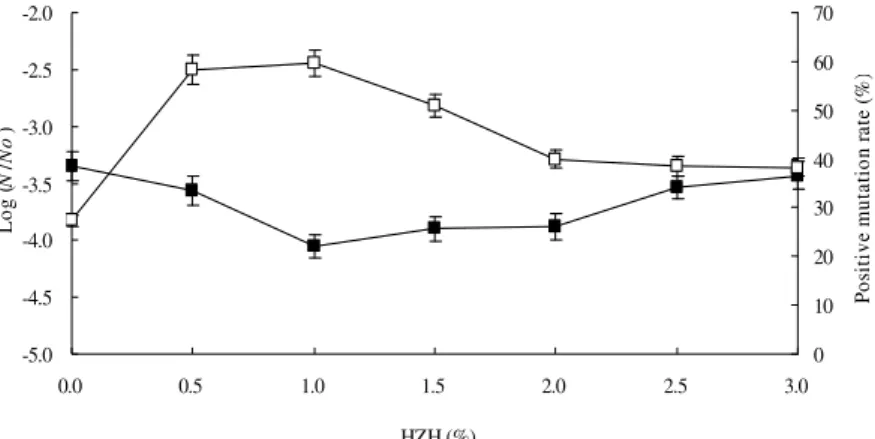
min). The results in Figure 2 showed that the effects of HZH in supercritical treatment on cell were content-related. The survival of the cells decreased with the increase in HZH content and reached a minimum at 1.0%. Afterwards, the survival rate slightly increased. HZH can absorb
CO2 in the air. Apparently, in the supercritical
system, higher concentration of HZH was easy to
react with CO2 into a hydrazine compound, which
reduced the inactivation effects.
Results showed that 0.5 and 1.0% HZH treatments had no significant differences in the positive mutation rates, adding up to the larger values of 58.3 and 59.6%, respectively. Pure supercritical
CO2 without HZH only provided the positive
mutation rates of 27.3%. Obviously, the mutation effects were strengthened greatly by 0.5%, or 1.0% HZH in supercritical treatment. More high-quality mutant strains and a selected mutant strain of maximum lipase yield, with approximately 76.7% increase than the wild strain, were obtained with 0.5% HZH treatment (Fig. 3). It suggested that 0.5% HZH was a better mutation dose than 1.0% HZH.
-5.0 -4.5 -4.0 -3.5 -3.0 -2.5 -2.0
0.0 0.5 1.0 1.5 2.0 2.5 3.0
HZH (%)
L
o
g
(
N
/
N
o
)
0 10 20 30 40 50 60 70
P
o
si
ti
v
e
m
u
ta
ti
o
n
r
a
te
(
%
)
Figure 2 - Effects of HZH in supercritical CO2 on survival rate (Log (N/No)) and positive mutation rate. Legend: ■, the survival rate; □, the positive mutation rate. Conditions: pressure, 8 MPa; temperature, 35 °C; treatment time, 30 min; HZH, variable.
100 110 120 130 140 150 160 170 180
0 1 2 3 4 5 6 7 8 9 10 11 12 13 14 15 16 17 18 19 20 21 22 23 24 25 26 27 28
Positive mutant strain number
R
el
at
iv
e
li
p
as
e
y
ie
ld
(
%
)
Although 0.5% HZH alone resulted in mutagenicity, it brought lower positive mutation rate (only 8.3%) than the case of HZH in
supercritical CO2. Perhaps supercritical CO2
facilitated transient permeability and induced mutation function of the additive (Zhang et al. 2008). Other authors have demonstrated that the activity of some intracellular enzymes declined, or lost after supercritical treatment such as ATPase, phosphatase, peroxidase, etc (Bertoloni et al. 2006; Gui et al. 2006; Liu et al. 2008). So it was also presumed that certain relevant enzymes with lipase production might be induced, or changed by
supercritical CO2 and HZH.
HZH was proved an alternative additive of DMSO
in the mutation treatment by supercritical CO2 due
to its more powerful mutagenicity. The chemical properties of HZH derive from hydrazine
(Satyanarayana and Bhattacharya 2004).
Hydrazine can react with the pyrimidines in DNA
to form N4-aminocytosine. The amination of
cytosine may be mutagenic for bacteria. The mutations from hydrazine are probably produced
by direct mis-pairing at replication rather than by error-prone repair (Kimball 1977). Here, five successive cultures of the selected mutant strain
were further performed under the same
fermentation conditions. All the cultures showed almost the same lipase yield, indicating the stability of the mutant genotype.
The effects of HZH on pH drop in the seed liquid
During the treatment of microorganisms by
supercritical CO2 in an aqueous medium, the
dissolution of CO2 into the liquid phase is a natural
process that leads to a pH decrease in the medium. Therefore, pH drop had been considered to be one
key in the supercritical inactivation of
microorganisms (Kim et al. 2007; Bortoluzzi et al. 2011). Here, a pH meter was employed to measure the pH value of the seed liquid before and after the
treatment by HZH and supercritical CO2. The
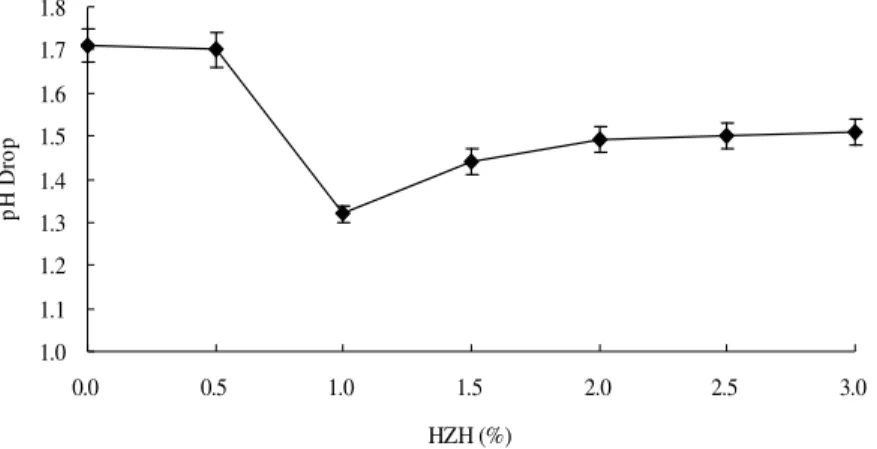
results of pH drop (Fig. 4) showed three stages: the stable first stage, the second stage of a rapid fall, and the third stage of a slight rise.
1.0 1.1 1.2 1.3 1.4 1.5 1.6 1.7 1.8
0.0 0.5 1.0 1.5 2.0 2.5 3.0
HZH (%)
p
H
D
ro
p
Figure 4 - Effects of HZH in supercritical CO2 on pH drop of the seed liquid. Conditions: pressure, 8 MPa; temperature, 35 °C; treatment time, 30 min; HZH, variable.
HZH is a polar solvent and can offer an alkaline environment for the seed liquid because of the highly alkaline nature of hydrazine (Satyanarayana and Bhattacharya 2004). The 0.5% HZH alone resulted increase in the pH in the seed liquid (data not shown). But 0.5% HZH in the supercritical
CO2 had almost the same pH drop as without
HZH. The change of pH drop reflected a balance
between the dissolution of CO2 and the reaction of
HZH with CO2 in an aqueous medium. Low dose
of HZH (0.5%) had hardly any effect on the medium environment. Apparently the mutagenic function was derived from the generated
compound of HZH and CO2.
Supercritical CO2 can cause the chemical
less pH drop than pure supercritical CO2. They
produced more hydrazine molecules to neutralize
the acidification of CO2. It was presumed that
HZH surrounding the cells affected the action of
supercritical CO2 and then the potential
mutagenesis path from the modification of membrane was blocked, which reduced the mutation effects.
CONCLUSIONS
The effects of HZH in supercritical treatment on the survival rate and positive mutation rate of the tested strain were related to its concentration. The analysis on pH drop of the treated seed liquid provided some possible explanations for the co-mutagenesis mechanisms. An expected positive mutant strain with higher lipase yield (about 29.0 u/mL) was obtained by the synergic action of HZH
(0.5%) and supercritical CO2 (8 MPa, 35°C) on the
seed liquid for 30 min. As far as mutation was concerned, HZH was a promising additive in
supercritical treatment and supercritical CO2 was a
potential co-mutagen as well.
REFERENCES
Bertoldo JB, Razzera G, Vernal J, Brod FCA, Arisi ACM, Terenzi H. Structural stability of
Staphylococcus xylosus lipase is modulated by Zn2+
ions. Biochim Biophys Acta. 2011; 1814: 1120-1126. Bertoloni G, Bertucco A, Cian DV, Parton T. A study
on the inactivation of micro-organisms and enzymes by high pressure CO2. Biotechnol Bioeng. 2006; 95:
155-160.
Blanco M, Martínez A, Urios A, Herrera G, O’Connor JE. Detection of oxidative mutagenesis by isoniazid and other hydrazine derivatives in Escherichia coli
WP2 tester strain IC203, deficient in OxyR: strong protective effects of rat liver S9. Mutat Res. 1998; 417: 39-46.
Bortoluzzi D, Cinquemani C, Torresani E, Spilimbergo S. Pressure-induced pH changes in aqueous solutions - On-line measurement and semi-empirical modelling approach. J Supercrit Fluid. 2011; 56: 6-13.
Bredihhin A, Mäeorg U. Effective strategy for the systematic synthesis of hydrazine derivatives.
Tetrahedron. 2008; 64: 6788-6793.
Foster PL. Stress responses and genetic variation in bacteria-a review. Mutat Res. 2005; 569: 3-11.
Gui F, Chen F, Wu J, Wang Z, Liao X, Hu X. Inactivation and structural change of horseradish peroxidase treated with supercritical carbon dioxide.
Food Chem. 2006; 97: 480-489.
Hegel PE, Camy S, Destrac P, Condoret JS. Influence of pretreatments for extraction of lipids from yeast by using supercritical carbon dioxide and ethanol as cosolvent. J Supercrit Fluid. 2011; 58: 68-78.
Kim SR, Rhee MS, Kim BC, Lee H, Kim KH. Modeling of the inactivation of Salmonella
typhimurium by supercritical carbon dioxide in
physiological saline and phosphate-buffered saline. J
Microbiol Meth. 2007; 70: 132-141.
Kimball RF. The mutagenicity of hydrazine and some of its derivatives. Mutat Res. 1977; 39: 111-126. Liu X, Gao Y, Peng X, Yang B, Xu H, Zhao J.
Inactivation of peroxidase and polyphenol oxidase in red beet (Beta vulgaris L.) extract with high pressure carbon dioxide. Innov Food Sci Emerg. 2008; 9: 24-31.
Mahadik ND, Puntambekar US, Bastawde KB, Khire JM, Gokhale DV. Production of acidic lipase by
Aspergillus niger in solid state Fermentation. Process
Biochem. 2002; 38: 715-721.
Satyanarayana SV, Bhattacharya PK. Pervaporation of hydrazine hydrate: separation characteristics of membranes with hydrophilic to hydrophobic behaviour. J Membrane Sci. 2004; 238: 103-115. Sicardi S, Manna L, Banchero M. Diffusion of disperse
dyes in PET films during impregnation with a supercritical fluid. J Supercrit Fluid. 2000; 17: 187-194.
Spilimbergo S, Mantoan D, Dalser A. Supercritical gases pasteurization of apple juice. J Supercrit Fluid.
2007; 40: 485-489.
Tenaillon O, Denamur E, Matic I. Evolutionary significance of stress-induced mutagenesis in bacteria-a review. Trends Microbiol. 2004; 12: 264-270.
Valverde MT, Marín-Iniesta F, Calvo L. Inactivation of
Saccharomyces cerevisiae in conference pear with
high pressure carbon dioxide and effects on pear quality. J Food Eng. 2010; 98: 421-428.
Zhang J, Burrows S, Gleason C, Matthews MA, Drews MJ, LaBerge M, et al. Sterilizing Bacillus pumilus
spores using supercritical carbon dioxide. J Microbiol
Meth. 2006; 66: 479-485.
Zhang QY, Qian JQ, Guo H, Yang SL. Supercritical CO2: A novel environmentally friendly mutagen. J
Microbiol Meth. 2008; 75: 25-28.