www.scielo.br/aabc
Plasma membranes from insect midgut cells
WALTER R. TERRA, RITA H. COSTA∗ and CLÉLIA FERREIRA
Departamento de Bioquímica, Instituto de Química, Universidade de São Paulo, C.P. 26077, 05513-970 São Paulo, SP, Brasil
Manuscript received on April 20, 2005; accepted for publication on May 29, 2005; contributed byWALTERR. TERRA**
ABSTRACT
Plasma membranes from insect midgut cells are separated into apical and basolateral domains. The apical domain is usually modified into microvilli with a molecular structure similar to other animals. Nevertheless, the microvillar structure should differ in some insects to permit the traffic inside them of secretory vesicles that may budd laterally or pinch-off from the tips of microvilli. Other microvillar modifications are associated with proton-pumping or with the interplay with an ensheathing lipid membrane (the perimicrovilllar membrane) observed in the midgut cells of hemipterans (aphids and bugs). The perimicrovillar membranes are thought to be involved in amino acid absorption from diluted diets. The microvillar and perimicrovillar membranes have densities (and protein content) that depend on the insect taxon. The role played by the microvillar and perimicrovillar proteins in insect midgut physiology is reviewed here trying to provide a coherent picture of data and highlighting further research areas.
Key words: microvillar membranes, perimicrovillar membranes, nutrient absorption, ion transport, water transport, midgut molecular physiology.
INTRODUCTION
Midgut cells are associated one another by junctions that separate the plasma cell membranes into an api-cal and a basolateral domain. The apiapi-cal domain is usually modified into finger-like projections, the microvilli, whose shape are ensured by a core of actin that are held in place by various ancillary pro-teins (see below). The insect microvilli may be mod-ified by the presence of inner mitochondria or an ensheathing membrane (the perimicrovillar
mem-Dedicated to the memory of Prof. Francisco Lara (1925–2004). *Present address: Curso de Farmácia, Universidade Metodista Rua do Sacramento 230, 09640-000 São Bernardo do Campo, SP, Brasil.
**Member Academia Brasileira de Ciências Correspondence to: Walter R. Terra E-mail: [email protected]
brane) or to make possible unique secretory mech-anisms. The basolateral domain has peculiar inter-cellular junctions in its lateral part (Lane et al. 1996), whereas the basal part may be modified into varied infoldings.
entero-cyte microvilli.
Ferreira and Terra (1980) succeeded in isolat-ing microvilli from an insect midgut havisolat-ing a sisolat-ingle cell type (midgut caeca from a lower Diptera, that is a sciarid fly) by using a differential calcium precipi-tation technique (Schmitz et al. 1973) developed for mammals. The technique consists in homogeniz-ing the tissue in a small Warhomogeniz-ing blendor, followed by the addition of a divalent cation (usually Ca++).
Calcium ions causes agglutination of cell membra-nes, except microvillar omembra-nes, because of the elec-tronic charge associated with their glycocalyx. The supernatant of low speed centrifugation is enriched with microvilli (electron microscope controls) that are collected by medium speed centrifugation. Sim-ilar results were obtained by time-consuming differ-ential centrifugation. A few months later, Hanozet et al. (1980) attempted to isolate microvilli from the columnar (principal) cells of a tissue (composed of columnar and goblet cell) of a lepidopteran (moth) larva. Although the final microvilli prepa-ration was enriched with some putative enzyme markers, contamination by cell membranes of the goblet cell could not be ruled out by the lack of mi-croscopic data. Goblet cells are characterized by having modified microvilli with mitochondria in-side them.
This paper reviews data on plasma membranes from midgut cells taking into account cell types, midgut regions and the phylogenetic position of the insect. Throughout, the focus is on providing a co-herent picture of data and highlighting further re-search areas.
MICROVILLAR AND BASOLATERAL MEMBRANES
ISOLATION OFMEMBRANES FROM THEMIDGUTS OF DIFFERENTINSECTS
The insect migut cell microvillus is homologous to that described in vertebrates and reviewed by Be-ment and Mooseker (1996). Thus, a bundle of paral-lel actin filaments cross-linked by the actin-bundling proteins villin and fimbrin form the core of a mi-crovillus. Lateral side arms (composed of myosin I
and the Ca2+-binding protein, calmodulin) connect
the sides of the actin bundle to the overlying plasma membrane. The actin bundles from the microvillus extend down into the cell and are rooted in the ter-minal web, where they are linked together by a set of proteins including spectrin and myosin II (Bautz 1989, Bonfanti et al. 1992, Morgan et al. 1995, Dal-lai et al. 1998).
After the development of a method to isolate microvilli from midgut caeca cells from a lower Diptera (see above), Cioffi and Wolfersberger (1983) devised an ingenious (although tedious) method to isolate plasma membranes from the mid-gut columnar and goblet cells of lepidopteran larvae, based on the stepwise disruption of the midgut by ultrasound. This method was used to recognize en-zyme markers (most of them digestive enen-zymes) for columnar cell microvilli (Wolfersberger 1984) and to show that H+/K+-ATPase is located exclusively
in the modified microvilli of the midgut goblet cells (Wieczorek et al. 1984). Cioffi and Wolfersberger (1983) were also able to isolate lateral and basal membranes from lepidopteran midgut cells.
Santos et al. (1986) compared several proce-dures to prepare microvilli from lepidopteran mid-gut columnar cells with electron microscope mon-itoring. They showed that, although preparations obtained by the ultrasound technique are almost free from contaminants, the yield of microvillar membranes is very low compared with the diva-lent cation differential precipitation methods. Af-ter this paper and complementary data from Eisen et al. (1989), differential precipitation methods be-came the method of choice to prepare microvillar membranes from columnar cells of lepidopteran midguts. Those preparations are used to study mem-brane-bound digestive enzymes, transport phenom-ena and the binding of toxins (see below).
Electron microscopy of insect midgut micro-villi preparations (Houk et al. 1986, Santos et al. 1986) demonstrates, as previously observed for ver-tebrate enterocytes (Schmitz et al. 1973), that they are substantially free from other cell structures, al-though the microvilli still contain some cytoskeleton elements. The amount of contaminating membranes is evaluated with marker enzymes. It should be noted, however, that many enzyme markers of sub-cellular structures, with the exception of succinate dehydrogenase (mitochondria) and lactate dehydro-genase (cytosol), are not always suitable. Thus, γ-glutamyl transferase, which is a useful microvil-lar membrane marker for Diptera (Bodnaryk et al. 1974, Espinoza-Fuentes et al. 1987), Lepidoptera (Eisen et al. 1989) and Dictyoptera (Parenti et al. 1986), occurs only in trace amounts in Coleoptera (Ferreira et al. 1990) and only in soluble form in Hymenoptera (bees, wasps, and ants) (Schumaker et al. 1993). Alkaline phosphatase, a plasma mem-brane (microvillar or microvillar plus basolateral membranes) marker in most insects (Terra and Fer-reira 1994), is a soluble enzyme in larvae of Coleop-tera (Ferreira et al. 1990, Reuveni et al. 1993) and in adults of Diptera (Houk et al. 1986) and Lepidop-tera (Terra et al. 1990). Acid phosphatase, which is a marker of lysosomes in some tissue (e.g. mam-malian liver, Evans 1978), is found mainly in the cytosol of larval midgut cells of Diptera (Ferreira and Terra 1980), Lepidoptera (Santos and Terra 1984) and Coleoptera (Ferreira et al. 1990).
The enrichment of microvillar membranes in a preparation depends on the ratio of total cellular protein to microvillar protein. The lower the micro-villar protein concentration relative to total protein, the more enrichment of microvillar membranes can occur. Thus, higher enrichments may result from small microvilli relative to cell size, of microvillar membranes poor in protein components or of the fact that only parts of the cells of the tissue have true microvilli. As a consequence, enrichments vary widely according to midgut region and to the phy-logenetic group the insect pertains (see review in Terra and Ferreira 1994).
BIOCHEMISTRY OFMICROVILLARMEMBRANES
Early attempts to study the biochemistry of micro-villar membranes consisted on the determination of the ratio of phosphorus to protein content in mi-crovilli preparations from Lepidoptera larvae and SDS-PAGE of these proteins (Wolfersberger et al. 1987) and in similar preparations from Diptera adults (Houk et al. 1986). Nevertheless, as dis-cussed above, microvillar membranes are contam-inated by cytoskeleton elements and other minor components. Jordão et al. (1995) prepared micro-villi from midguts ofRhynchosciara americanaand
Musca domestica (a lower and higher Diptera,
re-spectively) andTenebrio molitor(Coleoptera) using the calcium differential precipitation method. The microvilli were then treated with hyperosmotic Tris buffer that disrupts microvilli into microvillar mem-branes and core material. On dilution, the core mate-rial dissociates, permitting the pelleting of microvil-lar membranes, while leaving cytoskeleton elements in the supernatant. The microvillar membranes were shown to be free from contaminating membranes and cytoskeleton elements by chromatography in Sepharose 4B, SDS-PAGE and electron microscopy. A similar approach was used to prepare microvillar membranes free from cytoskeleton elements from
Spodoptera frugiperda(Lepidoptera) (Capella et al.
1997). Specific activities of marker enzymes are 1.5- to 2.5–fold higher than in the original microvilli preparations, which is not different from the best preparations from mammals.
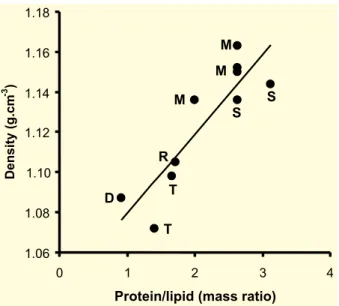
The density of the purified insect midgut microvillar membranes linearly increase with the protein-lipid mass ratio (Fig. 1). Nevertheless, T.
molitordatum is remarkably low and should be
re-investigated. The observed range of protein-lipid mass of insect microvillar membranes is 1.41–3.13, which is wider than that found among mammalian enterocytes (1.54–2.44, Proulx 1991).
protein-1.06 1.08 1.10 1.12 1.14 1.16 1.18
0 1 2 3 4
Protein/lipid (mass ratio)
D
e
n
s
ity
(g
.c
m
-3 )
M
M
M
S S
R
T
T D
Fig. 1 – Densities and protein-lipid mass ratios of purified midgut microvillar mem-branes from different insects. Densities were taken from Table I and the corresponding protein-lipid ratios from the cited literature. The three heaviest membranes were from M. domesticaposterior midgut and their densities were averaged before displaying in Table I. D,Dysdercus peruvianus; M,Musca domestica, R,Rhynchosciara amer-icana; S,Spodoptera frugiperda; T,Tenebrio molitor.
lipid mass ratio, carbohydrate (µg/mg protein) and cholesterol (µg/mg protein) contents are, respec-tively: 1.4–1.7, 400–700, and 110–140 for Coleop-tera; 2.0–2.6, 240–410, and 40–59 for higher Dip-tera; 2.6–3.8, 0–80, and 17–28 for Lepidoptera (Jordão et al. 1995, Capella et al. 1997). Lipids in insect microvillar membranes are supposed to be (total phosphorus data) phospholipids (Jordão et al. 1995), in accordance with similar data for mammalian enterocytes (Proulx 1991). It is not possible, however, to discount that in insects other than lepidopterans glycolipids may be important components of membranes. In this case, part of the phosphorus found in membranes would occur in proteins and carbohydrates (Jordão et al. 1995, Capella et al. 1997).
A detailed study of the chemical composition of microvilli (microvillar membranes plus contami-nating cytoskeleton) fromBombyx morimidgut cells (Leonardi et al. 2001) confirms the previous data. Thus, protein-lipid ratio is smaller (1.85) in
ante-rior plus middle in comparison to posteante-rior midgut (2.30). Phospholipids account for 77% (phospha-tides add to 62%) of total lipids with glycolipids summing 8%.
This suggests that the sucrose gradients are resolving more than one domain of basolateral membranes. Microvillar densities vary widely among insects, with more evolved ones (Lepidoptera and Diptera) having membranes with densities higher than 1.135. This suggests that the midgut cell surface plays more sophisticated roles (associated with a higher protein content) than in lower insects. The same is true for microvillar in comparison to basolateral mem-branes. What kind of roles these membranes play will be discussed in the next section.
PHYSIOLOGICALROLE OFMICROVILLAR AND BASOLATERALMEMBRANES
Initial considerations and surface digestion
The physiological role of midgut microvillar mem-branes may change along the midgut and among insect taxa and should include: surface (terminal) digestion, absorption, ion homeostasis, signaling, and unique digestive enzyme secretion mechanisms. Some of these functions depend on the concurrent participation of basolateral membranes, like those associated with the transepithelial transport of water, ions and nutrients. Most of the membrane roles are played by integral membrane (occasion-ally cytoskeleton) proteins that will be considered in turn.
The densities of isolated plasma membranes of insect cells depend essentially on their protein contents (Fig. 1). If we set appart data onP.
ame-ricana (not purified microvillar membranes) and
on hemipterans (to be discussed on section 4), the amount of protein in membranes may largely re-flect digestive enzyme content, in accordance with the presumed role of these membranes in digestion. Thus, in Coleoptera most digestion occurs inside the peritrophic membrane (cylindrical anatomical structure separating the midgut contents from the midgut cells) with little or no digestion being car-ried out by enzymes associated with the microvillar membranes. In contrast, in Diptera the initial and intermediate stages of digestion occur in midgut lu-men and most terminal digestion is carried out by
microvillar enzymes. Furthermore, there is a differ-entiation along the Coleoptera and higher Diptera midguts so that most terminal digestion takes place at the posterior midgut, which in higher Diptera functionally corresponds to the whole midgut of other insect species (Terra and Ferreira 1994, 2005).
Pyrearinus termitilluminanslarvae regurgitate
onto their prey their midgut contents that accom-plishes initial digestion. Pre-liquefied material is then ingested by larvae and the intermediate and final digestion take place on the surface of midgut cells by microvillar enzymes (Colepicolo-Neto et al. 1986), thus explaining the high density of microvillar branes. It is not clear why the microvillar mem-branes in Z. subfasciatus midgut cells are heavy, because most digestion in these insects occurs in luminal contents (Silva et al. 1999). One possibil-ity is contamination of the microvillar membranes by peritrophic gel, a not well-known substance that replaces the peritrophic membrane in these insects (Terra 2001).
Lepidopteran data (Table I) clearly do not fol-low the rule according to which the amount of pro-tein in membranes reflects digestive enzyme con-tent. In these insects, enzymes involved in terminal digestion are immobilized at the surface of midgut cells because they are entrapped in the cell glyco-calyx, instead of being integral membrane proteins (Terra and Ferreira 1994, 2005). The high density of lepidopteran midgut microvillar membranes proba-bly results from a large amount of different trans-porters, although it is not clear why lepidopteran larvae need more transporters than dipteran larvae.
Microvillar integral digestive enzymes vary among different taxa. Most frequently they are: aminopeptidase, alkaline phosphatase, carboxypep-tidase, dipepcarboxypep-tidase, and α-glucosidase (Terra and Ferreira 1994). For a recent review of these enzymes see specific entries in Terra and Ferreira (2005).
Ion and water transport
TABLE I
Densities (g.cm−3)of isolated microvillar (MVM), perimicrovillar (PMVM) and
basolateral (BLM) membranes of insect midgut cells1.
Insect (Order) Midgut region MVM PMVM BLM Reference
P. americana(Dyc) Anterior 1.092
2 – 1.056 This paper
Posterior 1.1542 – 1.081 This paper
D. peruvianus(Hem) Whole 1.132 1.087 1.064 Silva et al. 1996
R. prolixus(Hem) Whole 1.086 1.068 n.d. Ferreira et al. 1988
A. pisum(Hem) Whole 1.153 1.138 1.117 Cristofoletti et al. 2003
T. molitor(Col) Anterior 1.072 – n.d. Jordão et al. 1995 Posterior 1.098 – n.d. Jordão et al. 1995 P. termitillum.(Col) Whole 1.168 – 1.128 This paper
Z. subfasciatus(Col) Whole 1.170 – 1.120 This paper
M. frianus(Col) Whole 1.116 – 1.107 This paper
M. domestica(Dip) Anterior 1.136 – 1.113 Jordão et al. 1995 Posterior 1.1553 – 1.1103 Jordão et al. 1995 R. americana(Dip) Caeca 1.105 – n.d. This paper
D. saccharalis(Lep) Anterior 1.155 – 1.075 This paper Posterior 1.162 – 1.074 This paper
S. frugiperda(Lep) Anterior 1.136 – 1.068 Capella et al. 1997 Posterior 1.144 – 1.065 Capella et al. 1997
1Procedures used in the determinations were described in the corresponding references, whereas those em-ployed in this paper were as follows. Purified microvillar membranes (no cytoskeleton) were prepared by Tris disruption from microvillus samples obtained by Mg++-differential precipitation of midgut tissue
ho-mogenates, according to Capella et al. (1997). Microvillar membranes were resolved in 10 ml sucrose gradients (10–60%) prepared in 50 mM Tris-HCl, pH 7.0. Aminopeptidase was assayed as a marker enzyme and den-sities were calculated from the refractive index of gradient fractions as detailed in Capella et al. (1997). The densities of the basolateral membranes forM. domesticaandS. frugiperdawere calculated from the authors’ data. Col, Coleoptera; Dip, Diptera; Dyc, Dyctioptera; Hem, Hemiptera; Lep, Lepidoptera;P. termitillum, P. termitilluminans; -, structure absent; n.d., not determinant. –2Microvilli samples, not purified microvillar membranes. –3Average of densities of membranes from 3 sections of the posterior midgut.
Ion transporters may be ion-motive ATPases, an-tiporters, and symporters. Ion-motive ATPases are divided into three distinct families: F-, V-, and P-type ATPases (Pedersen and Carafoli 1987a). The F-type ATPases are proton ATPases found in the inner mitochondrial membrane and are not relevant here.
The V-type (vacuolar-type) ATPases (H+
V-ATPases) are critical for receptor recycling path-ways by acidifying endocytotic vesicles and pro-moting receptor-ligand dissociation. They are also
found in epithelia of vertebrate kidney, lepidopteran midgut globlet cells and insect Malpighian tubules (Forgac 1999, Nishi and Forgac 2002). The H+
V-ATPase has two distinct sectors: the membrane-bound Vosector and the intracellular V1sector. The last one corresponds to stalked structures in the cyto-plasmic face of insect epithelia called “portasomes” (Forgac 1999, Nishi and Forgac 2002, Wieczorek et al. 2003, Rizzo et al. 2003). The H+V-ATPase,
which is bafilomycin-sensitive, transports H+ and
by K+-amino acid symport (see below), fluid
se-cretion by Malpighian tubules (see water transport below), or midgut luminal alkalinization (see Mod-ified Microvillar Membranes).
P-type (or E1E2 type) ATPases are so called because the enzyme works via a covalent, phospho-rylated intermediate. Because of this, P-type AT-Pases can generally be inhibited by vanadate, which binds to the phosphate-binding site and thus blocks the phosphorylation cycle of the enzyme (Peder-sen and Carafoli 1987a). They use the energy re-leased from ATP hydrolysis to drive the membrane transport of mono- and divalent ions (Horisberger et al. 1991). Eukaryotic P-type ATPases include ouabain-sensitive Na+/K+-ATPases of the plasma
membrane of multicellular animals (including in-sects, see Emery et al. 1998), the H+/K+-ATPases
of gastric and colon of mammals (Pedersen and Carafoli 1987b) and higher Diptera middle midguts (see 3). The Na+/K+-ATPase is responsible for
maintenance of electrochemical gradients across the plasma membrane by exporting 3 Na+from the cell
and importing 2K+ to the cell during each
reac-tion cycle. The H+/K+-ATPase pumps H+ and is
most closely related structurally to Na+/K+-ATPase
(Maeda et al. 1990).
Other ion-transporters found in insects are: amiloride-sensitive Na+or K+/H+-antiporter,
ami-loride-resistant Na+/H+-antiporter, and
bumeta-nide-sensitive Na+/K+/Cl−symporter (Pullikuth et
al. 2003). The putative mechanism (Pullikuth et al. 2003) for fluid secretion by mosquito Malpighian tubules illustrates how the ion-transporters may have a concerted role. According to this mechanism, an apical H+ V-ATPase pumps H+ ions that are
exchanged by Na+ or K+ ions through an apical
amiloride-sensitive Na+ or K+/H+-antiporter,
re-sulting in fluid secretion with the presumed help of aquaporins (Borgnia et al. 1999). Basolateral transport activated through cAMP (formed by the action of diuretic peptides onto basolateral mem-brane receptors) involve a Na+/K+/Cl−symporter
and an amiloride-resistant Na+/H+-antiporter.
Some Malpighian tubular cells have also a basal
Na+/K+-ATPase.
Most insects have a countercurrent flux of fluid in their midguts caused by secretion of fluid in the posterior midgut and its absorption in anterior mid-gut (Terra and Ferreira 1994, 2005). The mecha-nism described above for mosquitoes may serve as a model for fluid secretion in posterior midgut of most insects. The absorption of fluid in the insect anterior midgut lacks a model incorporating molecular fea-tures and discussion on this subject relies on mor-phological observations. The cells in insect ante-rior midgut usually display basal plasma membrane infoldings modified into long and narrow channels with particles attached to their cytoplasmic side (e.g. interstitial cell in higher Diptera, Terra et al. 1988) or modified into short and ramified channels with few apertures to the extracellular space (e.g. lepi-dopterans, Santos et al. 1984). The fact that these infoldings constitute an extracellular compartment, which has restricted access to the hemolynph (due to the restricted openings into the underlying extracel-lular space), should permit the cell to concentrate solutes in that compartment to create an osmotic pressure gradient between compartment and lumen, which might assist the absorption of water.
In addition to their involvement in the transep-ithelial transport of solutes and water, basolateral membranes may have other functions. The presence of several digestive enzymes in these membranes is not understood, but trehalase may play a role in the midgut utilization of hemolymph trehalose (Azuma and Yamashita 1985.
Sugar absorption
In mammalian enterocytes, there are two kinds of glucose transporters: the Na+/glucose
cotranspor-ter, or symporter (SGLT1), and the facilitative trans-porter, or uniporter (GLUT2). The symporter is strictly dependent on the presence of Na+, inhibited
Takata 1996, Kellett 2001, Giordana et al. 2003). Although it has not been functionally demon-strated the presence of sugar transporters in insect midgut cells, a glucose uniporter is very likely to
oc-cur. Drosophila melanogasterhas a glucose
trans-porter gene that is homologous with the mammalian glucose uniporter genes (Escher and Rasmuson-Lestander 1999). Furthermore, the absorption of glucose by the epidermis of the endoparasitoid
Aphidius ervi seem to involve a uniporter
(Gior-dana et al. 2003).
Amino acid transport
Amino acid transporters have been studied in the midguts of adult stage of the dictyopteran (cock-roach)Blabera giganteaand in the larval stage of the coleopteranLeptinotarsa decemlineataand the lepi-dopteransPhilosamia cynthia, andBombyx mori. In coleopterans, only uniporters were found, whereas in the other insects amino acid-cation symporters occur in addition to the uniporter. Dictyopterans have a Na+-coupled amino acid transport with the
electrochemical potential maintained by a Na+/K+
-ATPase such in mammalian cells. Lepidopterans possess transport features different from those of mammals. K+is secreted in these insects through
the concerted action of an apical H+V-ATPase and
apical K+/H+-antiporter, thereby providing the
drive force for absorption of amino acids by an amino acid-K+symporter (Castagna et al. 1997).
The successful preparation of vesicles from lepidopteran midgut microvillar membranes (brush-border membrane vesicles) (see Isolation of Mem-branes from Midgut of Different Insects) prompted the study of amino acid transport, beginning with the paper of Hanozet et al. (1980). The studies led to the finding of several distinct amino acid-K+
symporters with overlapping specifies (Castagna et al. 1997, Wolfersberger 2000). A cDNA encod-ing a lepidopteran midgut amino acid-K+symporter
was cloned. The encoded protein showed weak but significant sequence identity with amino acid trans-porters belonging to the sodium-dependent and
chloride-dependent γ-aminobutyric acid (GABA) superfamily (Castagna et al. 1998). Since then, the sequence of several new insect cation-amino acid symporters were deposited in the GenBank and most of the present research looks for specific inhibitors of amino acid transport like bestatin, (previously widely used as an aminopeptidase inhibitor) and fenoxycarb (Wolfersberger 2000).
Secretory mechanisms
The microvillar molecular organization is proba-bly modified in insects displaying unique secretory mechanisms not seen in other animals. Lepidopte-ran anterior midgut cells secrete digestive enzymes by two kinds of microapocrine secretion. In the mi-croapocrine secretion with budding vesicles, small vesicles migrate into the microvilli, from which they bud laterally as double membrane vesicles. Microapocrine secretion with pinched-off vesicles is characterized by vesicles migrating to the tips of microvilli, where they fuse one another and with the microvillar membrane. Finally, vesicles pinch off from the enlarged microvilli tips. In both cases, the secretory contents are released by membrane fusion and/or by membrane solubilization caused by high pH contents or by luminal detergents (Terra and Ferreira 1994, 2005).
MODIFIED MICROVILLAR MEMBRANES
Modified microvilli are typical of the lepidopteran goblet cells and higher dipteran oxyntic cells. Gob-let cells have a cavity, which is formed by invagi-nation of the apical membrane and which occupies most of the cell (long-neck goblet cell) or only its upper part (stalked goblet cell). The infolded apical membrane shows modified microvilli containing mitochondria and their cytoplasmic side are studded with small particles (Cioffi 1979, Santos et al. 1984) that corresponds to a H+V-ATPase (Wieczorek et
al. 2003). Goblet cells generate a high gut pH in lepidopterans according to the following model (Wieczorek et al. 2003). Carbonic anhydrase pro-duces carbonic acid that dissociates into bicar-bonate and a proton. The proton is pumped by an H+V-ATPase into the goblet cell cavity, from
where it is removed in exchange with K+that
even-tually diffuses into lumen. Bicarbonate is secreted in exchange with chloride and loses a proton due to the intense field near the membrane, forming carbonate and raising the gut pH.
Oxyntic cells have an apical membrane invagi-nated into ramified crypts which are coated with microvilli and display numerous mitochondria in their cytoplasm. The cytoplasmic side of oxyntic microvillar membranes are studded with small particles (Terra et al. 1988). These are believed to be proton pumps (P-type ATPase, seeIon and water
transport) that acidify to pH 3.2 the contents of
mid-dle midgut in higher Diptera. Chloride ions seem to follow the movement of protons. This hypothesis is supported by the observed effect of different com-pounds in luminal pH and in the luminal chloride content (Terra and Regel 1995). It is remarkable how similar is the mechanism of insect midgut luminal acidification and that one found in mam-malian stomachs (Forte et al. 1980).
PERIMICROVILLAR MEMBRANES
Perimicrovillar membranes (PMVM) are mem-branes that cover the midgut cells microvilli extend-ing into the gut lumen with dead ends (Lane and
Harrison 1979, Andries and Torpier 1982, Silva et al. 1995) and were described in Hemiptera (bugs, aphids, and cicadas). The domain of PMVM en-sheathing the microvilli are set in position by columns obliquely disposed between them and the microvillar membrane (Lane and Harrison 1979).
Freeze-fracture replicas showed that PMVM are almost free from intramembranous particles, thus resembling myelin sheets (Lane and Harrison 1979, Andries and Torpier 1982). Therefore, PMVM must display a lower buoyant density than the microvillar membranes. Based on this, the two membranes were isolated by density-gradient centrifugation and enzyme markers identified: α-glucosidase for PMVM and α-mannosidase or β -glucosidase for microvillar membranes (Ferreira et al. 1988, Silva et al. 1996). PMVM densities ofR.
prolixusandD. peruvianusare alike that of myelin
sheets, as expected, althoughA. pisumPMVM are surprisingly heavy (Table I). It should be noted, how-ever, that the last mentioned PMVM are actually modified PMVM and seem to have a high enzyme content (see below). Microvillar membrane densi-ties of R. prolixusare small in contrast to that of
D. peruvianusandA. pisum(Table I). This probably
reflects the putative pumps seen inD. peruvianus crovillar membranes and the contamination of mi-crovillar membranes by lamellar links inA. pisum (see below). Immunolocalization of the PMVM enzyme marker,α-glucosidase, suggests that these membranes are formed when double membrane vesicles fuse their outer membranes with the mi-crovillar membranes and their inner membranes with PMVM. A double membrane Golgi cisterna (on budding) forms the double membrane vesicles (Silva et al. 1995).
an-cestors should feed as present-day thrips on phloem by a punch and suck mechanism. Phloem has very low contents of protein (with few exceptions) and carbohydrate polymers and is rich in sucrose and relatively poor in free amino acids (Terra 1990). Upon adapting to this food, Condylognathan an-cestors would lose most digestive enzymes and the peritrophic membrane that are associated with lu-minal digestion. Essential amino acids present in low concentrations in sap may be absorbed by a hy-pothesized mechanism (Terra 1988, Terra and Fer-reira 1994) as follows: microvillar membranes ac-tively transport K+from the perimicrovillar space
into the midgut cells, generating a concentration gra-dient between the gut luminal sap rich in K+and
the perimicrovillar space. This concentration gra-dient may be the driving force for the active ab-sorption of amino acids by appropriate symporters in PMVM. Amino acids, once in the perimicrovil-lar space may diffuse up to specific transporters on the microvillar surface. Although amino acid sym-porters have been found in the microvillar mem-branes of several insects (seeAmino acid transport), no attempts have been made to study the other pos-tulated proteins (e.g., amino acid-K+-symporters in
PMVM and potassium pumps in microvillar mem-branes). Thus, in spite of the model provided an explanation for the occurrence of these peculiar cell structures in condylognatha, it is supported only by: (1) evidence that amino acids are absorbed with potassium ions inDysdercus peruvianus(Silva and Terra 1994); (2) occurrence of particles studying the cytoplasmic face of the midgut microvillar membrane ofD. peruvianus. These might be ion pumps responsible for the putative K+-transport
(Silva et al. 1995).
Organic compounds in xylem sap (much more diluted than phloem sap) need to be concentrated before they can be absorbed by the perimicrovillar membrane. This occurs in the filter chamber that consists of a thin-walled, dilated anterior midgut in close contact with the posterior midgut and the prox-imal ends of the Malpighian tubules (anatomical structure analogous to the mammalian nephron).
This arrangement enables water to pass directly from the anterior midgut to the Malpighian tubules, con-centrating food in midgut. The high permeability of the filter chamber membrane to water results from the occurrence of specific proteins named aquapor-ins (Borgnia et al. 1999). These were immunolo-calized in the microvillar border (PMVM and mi-crovillar membranes) of the filter chamber cells of several hemipteran xylem sap feeders (Le Cahérec et al. 1997).
Hemipterans like aphids may suck high-sucrose phloem saps with osmolarity up to three times that of the insect hemolymph. This results in a considerable hydrostatic pressure caused by the tendency of water to move from the hemolymph into midgut lumen. To withstand these high hydro-static pressures there are links between apical lamel-lae (replacing usual midgut cell microvilli). As a consequence of these links, PMVM could no longer exist and were replaced by membranes seen asso-ciated with the tips of the lamellae, the modified PMVM, which contain unexpected enzymes like a cysteine proteinase (Ponsen 1991, Cristofoletti et al. 2003).
Haematophagous, seed-sucking, and predator hemipterans evolved from the sap-feeders regain-ing the ability to digest polymers. Compartmentali-zation of digestion was maintained by PMVM as a substitute for the absent peritrophic membrane (Fer-reira et al. 1988, Silva et al. 1995).
CONCLUDING REMARKS
the functioning of oxyntic and interstitial cells from the midgut of higher Diptera should illustrate a mar-velous case of convergence with mammalian gastric cells. A molecular physiological approach to the interplay of hemipteran midgut plasma membranes will certainly be revealing, as these insects are the only animals that live exclusively sucking the usu-ally nutrient-poor plant saps. Finusu-ally, the implica-tions of the knowledge on the plasma membrane signaling system of midgut-function coordination is beyond speculation, due to scarcity of data. Progress in the fields reviewed is being supported by the asso-ciation of biochemical and molecular biology pro-cedures. A proteomic approach to those fields is still hampered by the lack of sufficient biological material from specific insect tissues.
ACKNOWLEDGMENTS
This work was supported by Brazilian Research Agencies: Fundação de Amparo à Pesquisa do Es-tado de São Paulo (FAPESP) and Conselho Nacio-nal de Desenvolvimento Científico e Tecnológico, Programa de Apoio a Núcleos de Excelência (CNPq/PRONEX). R.H. Costa had a post-doctoral position on leave from UNIFESP-EPM, São Paulo; W.R. Terra and C. Ferreira are staff members of the Biochemistry Department and research fellows of CNPq.
RESUMO
As membranas plasmáticas das células intestinais dos insetos apresentam um domínio apical e outro basal. O domínio apical é geralmente modificado em microvilosi-dades com organização molecular similar a de outros animais, embora possam diferir naqueles insetos que apresentam vesículas secretoras em trânsito que brotam lateralmente ou destacam-se das extremidades das mi-crovilosidades. Outras modificações microvilares estão associadas a bombeamento de prótons ou a interrelações com uma membrana lipídica (a membrana perimicrovi-lar) que reveste as microvilosidades de células intesti-nais de hemípteros (pulgões e percevejos). Admite-se que as membranas perimicrovilares estejam envolvidas
na absorção de aminoácidos a partir de dietas diluídas. As membranas microvilares e perimicrovilares tem den-sidades distintas (e conteúdo protéico) que dependem do táxon do inseto. O papel desempenhado pelas proteínas microvilares e perimicrovilares na fisiologia intestinal dos insetos é revisto, procurando fornecer uma visão coerente dos dados e chamando a atenção para novos objetivos de pesquisa.
Palavras-chave: membranas microvilares, membranas perimicrovilares, absorção de nutrientes, transporte de íon, transporte de água, fisiologia molecular do intestino médio.
REFERENCES
ANDRIESJCANDTORPIERG. 1982. An extracellular brush border coat of lipid membranes in the midgut of Nepa cinerea(Insecta: Heteroptera): ultrastructure and genesis. Biol Cell 46: 195–202.
AZUMAMANDYAMASHITAO. 1985. Cellular local-ization and proposed function of midgut trehalase in the silkworm larva,Bombyx mori. Tissue Cell 17: 539–551.
BAUTZ AM. 1989. A villin-like protein in the intesti-nal brush border ofCalliphora vicina R.D. larvae (Diptera: Calliphoridae). Int J Insect Morphol Em-bryol 18: 281–288.
BEMENT WM ANDMOOSEKERMS. 1996. The cy-toskeleton of the intestinal epithelium: components, assembly, and dynamic rearrangements. In: HES -KETHJEANDPRYMEJF (Eds), The cytoskeleton: a multi-volume treatise. Greenwich: JAI Press 3: 359–404.
BODNARYKRP, BRONSKILLJFANDFETTERLEYJR. 1974. Membrane-boundγ-glutamyl transpeptidase and its role in phenylalanine absorption-reabsorption in the larva ofM. domestica. J Insect Physiol 20: 167–181.
BONFANTI P, COLOMBO A, HEINTZELMAN MB, MOOSEKER MS AND CAMATINI M. 1992. The molecular architecture of an insect midgut brush-border cytoskeleton. Eur J Cell Biol 57: 298–307. BORGNIA M, NIELSEN S, ENGEL AANDAGREEP.
CAPELLAAN, TERRAWR, RIBEIRO AFANDFER -REIRAC. 1997. Cytoskeletal removal and charac-terization of the microvillar membranes isolated from two midgut regions ofSpodoptera frugiperda (Lepidoptera). Insect Biochem Molec Biol 27: 793–801.
CASTAGNAM, SHAYAKULC, TROTTID, SACCHIVF, HARVEYWR ANDHEDIGERMA. 1997. Molec-ular characteristics of mammalian and insect amino acid transporters: implications for amino acid home-ostasis. J Exp Biol 200: 269–286.
CASTAGNA M, SHAYAKUL C, TROTTI D, SACCHI VF, HARVEYWRANDHEDIGERMA. 1998. Clo-ning and characterization of a potassium-coupled amino acid transporter. Proc Natl Acad Sci USA 95: 5395–5400.
CIOFFIM. 1979. The morphology and fine structure of the larval midgut of a moth (Manduca sexta) in relation to active ion transport. Tissue Cell 11: 467–479.
CIOFFIMANDWOLFERSBERGERMG. 1983. Isolation of separate apical, lateral and basal plasma membrane from cells of an insect epithelium. A procedure based on tissue organization and ultrastructure. Tissue Cell 15: 781–803.
COLEPICOLO-NETOP, BECHARAEJH, FERREIRAC ANDTERRA WR. 1986. Evolutionary considera-tions of the spatial organization of digestion in the luminescent predaceous larvae ofPyrearinus termi-tilluminans (Coleoptera: Elateridae). Insect Bio-chem 16: 811–817.
CRISTOFOLETTI PT, RIBEIRO AF, DERAISON C, RAHBÉYANDTERRAWR. 2003. Midgut adapta-tion and digestive enzyme distribuadapta-tion in a phloem feeding insect, the pea aphidAcyrtosiphom pisum. J Insect Physiol 49: 11–24.
DALLAIR, LUPETTIP ANDLANENJ. 1998. The or-ganization of actin in the apical region of insect midgut cells after deep etching. J Struct Biol 122: 283–292.
EISENNS, FERNANDESVF, HARVEYWR, SPAETH DDANDWOLFERSBERGERMG. 1989. Compari-son of brush border membrane vesicles prepared by three methods from larvalManduca sexta midgut. Insect Biochem 19: 337–342.
EMERY AM, BILLINGSLEY PF, READY PD AND
DJAMGOZMBA. 1998. Insect Na+/K+-ATPase. J
Insect Physiol 44: 197–209.
ESCHERSA ANDRASMUSON-LESTANDERA. 1999. The Drosophila glucose transporter gene: cDNA se-quence, phylogenetic comparisons analysis of func-tional sites and secondary structures. Hereditas 130: 95–103.
ESPINOZA-FUENTES FP, RIBEIRO AF AND TERRA WR. 1987. Microvillar and secreted digestive en-zymes fromMusca domesticalarvae. Subcellular fractionation of midgut cells with electron micros-copy monitoring. Insect Biochem 17: 819–827. EVANS WH. 1978. Preparation and characterization
of mammalian plasma membrane. In: WORK TS AND WORK E (Eds), Techniques in Biochemistry and Molecular Biology Part 1, Amsterdam: North-Holland, p. 103–121.
FERREIRACANDTERRAWR. 1980. Intracellular dis-tribution of hydrolases in midgut caeca cells from an insect with emphasis on plasma membrane-bound enzymes. Comp Biochem Physiol 66B: 467–473. FERREIRAC, RIBEIROAF, GARCIAESANDTERRA
WR. 1988. Digestive enzymes trapped between and associated with the double plasma membranes ofRhodnius prolixusposterior midgut cells. Insect Biochem 18: 521–530.
FERREIRA C, BELLINELLO GL, RIBEIRO AF AND TERRAWR. 1990. Digestive enzymes associated with the glycocalyx microvillar membranes and se-cretory vesicles from midgut cells ofTenebrio moli-torlarvae. Insect Biochem 20: 839–847.
FORGACM. 1999. Structure and properties of the vacuo-lar (H+)-ATPases. J Biol Chem 274: 12951–12954.
FORTE JG, MACHEN TE AND OBRINK KJ. 1980. Mechanisms of gastric H+ and Cl- transport. Annu Rev Physiol 42: 111–126.
GIORDANAB, MILANIA, GRIMALDIA, FARNETIR, CASARTELLI M, AMBROSECCHIO MR, DIGILIO MC, LEONARDIMG,DEEGUILEARMANDPEN -NACCHIOF. 2003. Absorption of sugars and amino acids by the epidermis ofAphidius ervilarvae. J In-sect Physiol 49: 1115–1124.
HANOZETGM, GIORDANABANDSACCHIJF. 1980. K+-dependent phenylalanine uptake in membrane
HEDIGERMA, COADYMJ, IKEDATDANDWRIGHT EM. 1987. Expression, cloning and cDNA sequenc-ing of the Na+/glucose cotransporter. Nature 330:
379–381.
HORISBERGERJD, LEMASV, KRAEHENBUHLJPAND ROSSIERBC. 1991. Structure-function relationship of Na+, K+-ATPase. Annu Rev Physiol 53: 565–
584.
HOUKEJ, ARCUSYMANDHARDYJL. 1986. Isola-tion and characterizaIsola-tion of brush border fragments from mosquito mesenterons. Archs Insect Biochem Physiol 3: 135–146.
JORDÃO BP, TERRA WR AND FERREIRA C. 1995. Chemical determinations in microvillar membranes purified from brush-borders isolated from the larval midgut of one Coleoptera and two Diptera species. Insect Biochem Molec Biol 25: 417–426.
KELLETTGL. 2001. The facilitate component of intes-tinal glucose absorption. J Physiol 531: 585–595. LANE NJANDHARRISONJB. 1979. An unusual cell
surface modification: a double plasma membrane. J Cell Sci 39: 355–372.
LANE NJ, DALLAI R AND ASHHURTS DE. 1996. Structural macromolecules of the cell membranes and the extracellular matrices of the insect midgut. In: LEHANEMJANDBILLINGSLEYPF (Eds), The Biology of Insect Midgut, London: Chapman & Hall, p. 115–150.
LECAHERECF, GUILLAMMT, BEURONF, CAVALIER A, THOMAS DANDGOURATON J. 1997. Aqua-porin-related proteins. Cell Tissue Res 290: 143– 151.
LEMOS FJA AND TERRA WR. 1992. A high yield preparation ofMusca domestica larval midgut mi-crovilli and the subcellular distribution of amylase and trypsin. Insect Biochem Molec Biol 22: 433– 438.
LEONARDI MG, MARCIANI P, MONTORFANO PG, CAPPELLOZZA S ANDGIORDANA B. 2001. Ef-fect of fenoxycarb on leucine uptake and lipid com-position of midgut brush border membrane in the silkworm,Bombyx mori(Lepidoptera, Bombycidae). Pest Biochem Physiol 70: 42–51.
MAEDAM, OSHIMANK, TAMURAS ANDFUTAIM. 1990. Human gastric (H++ K+)-ATPase gene.
Sim-ilarity to (Na++ K+)-ATPase genes in exon/intron
organization but difference in control region. J Biol Chem 265: 9027–9032.
MAROUX S, COUDRIERE, FERACCI H, GORVELJP AND LOUVARDD. 1988. Molecular organization of the intestinal brush border. Biochimie 70: 1297– 1306.
MILLERDANDCRANERK. 1961. The digestive func-tion of the epithelium of the small intestine. II. Localization of disaccharide hydrolysis in the iso-lated brush border portion of intestinal epithelial cells. Biochim Biophys Acta 52: 293–298. MORGAN NS, HEINTZELMAN MBANDMOOSEKER
MS. 1995. Characterization of myosin-IA and myo-sin-IB, two unconventional myosins associated with the Drosophila brush border cytoskeleton. Devel Biol 172: 51–71.
NISHITANDFORGACM. 2002. The vacuolar (H+)
-ATPases-Nature’s most versatile proton pumps. Nat Rev Mol Cell Biol 3: 94–103.
PARENTIP, SACCHI, FV, HANOZETGMANDGIOR -DANA B. 1986. Na-dependent uptake of phenyla-lanine in the midgut of a cockroach (Blabera gigan-tea). J Comp Physiol 156B: 549–556.
PEDERSEN PLANDCARAFOLIE. 1987a. Ion motive ATPases. I. Ubiquity, properties and significance to cell function. Trends Biochem Sci 12: 146–150. PEDERSEN PL AND CARAFOLI E. 1987b. Ion
mo-tive ATPases. II. Energy coupling and work out put. Trends Biochem Sci 12: 186–189.
PONSEN MB. 1991. Structure of the digestive system of aphids, in particularHyalopterusandColoradoa, and its bearing on the evolution of filterchambers in the Aphidoidea. Wageningen Agricultural Univer-sity Papers 91–5, 3–61.
PROULX P. 1991. Structure-function relationships in intestinal brush border membranes. Biochim Bio-phys Acta 1071: 255–271.
PULLIKUTH AK, FILIPPOV V AND GILL SS. 2003. Phylogeny and cloning of ion transporters in mos-quitoes. J Exp Biol 206: 3857–3868.
RIZZO VF, COSKUNU, RADERMACHERM, RUIZT, ARMBRUSTERAANDGRUBERG. 2003. Resolu-tion of the V1 ATPase fromManduca sextainto sub-complexes and visualization of an ATPase-active A3 B3EG complex by electron microscopy. J Biol Chem 278: 270–275.
SANTOS CD AND TERRAWR. 1984. Plasma mem-brane-associated amylase and trypsin: intracellular distribution of digestive enzymes in the midgut of the cassava hornworm,Erinnyis ello. Insect Biochem 14: 587–595.
SANTOSCD, RIBEIROAF, FERREIRACANDTERRA WR. 1984. The larval midgut of the cassava horn-worm (Erinnyis ello). Ultrastructure, fluid fluxes and the secretory activity in relation to the organization of digestion. Cell Tissue Res 237: 565–574. SANTOS CD, RIBEIRO AF ANDTERRA WR. 1986.
Differential centrifugation, calcium precipitation and ultrasonic disruption of midgut cells ofErinnyis ello caterpillars. Purification of cell microvilli and infer-ences concerning secretory mechanisms. Can J Zool 64: 490–500.
SCHMITZJ, PREISERH, MAESTRACCID, GHOSHBK, CERDAJANDCRANERK. 1973. Purification of the human intestinal brush border membrane. Biochim Biophys Acta 323: 98–112.
SCHUMACKERTTS, CRISTOFOLETTIPTANDTERRA WR. 1993. Properties and compartmentalization of digestive carbohydrases and proteases in Scaptotri-gona bipunctata(Apidae: Meliponinae) larvae. Api-dologie 24: 3–17.
SILVACPANDTERRAWR. 1994. Digestive and ab-sorptive sites along the midgut of the cotton seed sucker bugDysdercus peruvianus(Hemiptera: Pyr-rhocoridae). Insect Biochem Molec Biol 24: 493– 505.
SILVACP, RIBEIROAF, GULBENKIANSANDTERRA WR. 1995. Organization, origin and function of the outer microvillar (perimicrovillar) membranes of Dysdercus peruvianus(Hemiptera) midgut cells. J Insect Physiol 41: 1093–1103.
SILVACP, RIBEIROAFANDTERRAWR. 1996. En-zyme markers and isolation of the microvillar and perimicrovillar membranes of Dysdercus peruvia-nus(Hemiptera: Pyrrhocoridae) midgut cells. Insect Biochem Molec Biol 26: 1011–1018.
SILVACP, TERRAWR, XAVIER-FILHOJ, GROSSI-DE -SÁMF, LOPES ARANDPONTES EG. 1999. Di-gestion in larvae ofCallosobrucchus maculatusand Zabrotes subfasciatus(Coleoptera: Bruchidae) with emphasis onα-amylases and oligosaccharidases.
In-sect Biochem Molec Biol 29: 355–366.
SILVACP, SILVAJR, VASCONCELOSFF, PETRETSKI DA, DAMATTA RA, RIBEIRO AF AND TERRA WR. 2004. Occurrence of perimicrovillar membra-nes in paraneopteran insect orders with comments on their function and evolutionary significance. Arthr Struct Devel 33: 139–148.
TAKATAK. 1996. Glucose transporters in the transep-ithelial transport of glucose. J Electron Microsc 45: 275–284.
TERRAWR. 1988. Physiology and biochemistry of in-sect digestion: an evolutionary perspective. Braz J Med Biol Res 21: 675–734.
TERRAWR. 1990. Evolution of digestive systems of insects. Annu Rev Entomol 35: 181–200.
TERRAWR. 2001. The origin and functions of the per-itrophic membrane and perper-itrophic gel. Arch Insect Biochem Physiol 47: 47–61.
TERRA WR AND FERREIRA C. 1994. Insect diges-tive enzymes: properties, compartmentalization and function. Com Biochem Physiol 109B: 1–62. TERRAWRANDFERREIRAC. 2005. Biochemistry of
digestion. In: GILBERTLI, IATROUKANDGILL SS (Eds), Comprehensive Molecular Insect Science, Oxford: Elsevier 4: 171–224.
TERRA WR AND REGEL R. 1995. pH buffering in Musca domesticamidguts. Comp Biochem Physiol 112A: 559–564.
TERRA WR, ESPINOZA-FUENTES FP, RIBEIRO AF AND FERREIRA C. 1988. The larval midgut of the housefly (Musca domestica): ultrastructure, fluid fluxes and ion secretion in relation to the organization of digestion. J Insect Physiol 34: 463–472. TERRAWR, SANTOSCDANDRIBEIROAF. 1990.
Ul-trastructural and biochemical basis of the digestion of nectar and other nutrients by the mothErynnyis ello. Ent Exp Appl 56: 277–286.
WIECZOREK H, HUSS M, MERZENDORFERH, REI -NEKES, VITAUSKAOANDZEISKEW. 2003. The insect plasma membrane H+/V-ATPase: intra-,
inter-and supramolecular aspects. J Bioenerg Biomem 35: 359–366.
WIECZOREKHC, CIOFFIM, HARVEYWR, KULBLER GANDWOLFERSBERGERMG. 1984. KCI- stim-ulated ATPase activity in purified goblet cell apical membrane from Manduca Sexta larval midgut. Proc First Intern Congress Comp Physiol Biochem, Liege, Belgium, B–101.
WIGGLESWORTHVB. 1933. The function of the anal gills of the mosquito larva. J Exp Biol 10: 16–26.
WOLFERSBERGERMG. 1984. Enzymology of plasma membranes of insect intestinal cells. Am Zool 24: 187–197.
WOLFERSBERGERMG. 2000. Amino acid transport in insects. Annu Rev Entomol 45: 111–120.