ALTERNATIVES TO CUSTODY
FOR YOUNG OFFENDERS
NATIONAL REPORT ON JUVENILE JUSTICE TRENDS
Portugal
Maria João Leote de Carvalho,
Cesnova – Universidade Nova de Lisboa
Introduction
The aim of this report is to examine current national policies on juvenile justice and alternatives to detention for young offenders in Portugal. It is carried out within the framework of the involvement of the IJJO as a partner in the project ‘Alternatives to Custody for Young Offenders - Developing Intensive and Remand Fostering Programmes’, coordinated by the British Association for Adoption and Fostering (BAAF) and financed by the European Commission, DG Justice, through its Daphne Programme (Grant Agreement JUST/2011/DAP/AG/3054).
In preparing this report, data were gathered through desk-based research, and informal contacts were made with key stakeholders from State agencies and from the judiciary as well as from NGOs. Previously, the author answered a questionnaire online about good/ innovative practices concerning young offenders sent to foster families as an alternative to penal measures and sanctions in the country (November 2013).
Besides the introduction and the conclusion, the present report consists of three sections plus references and appendices, which allow statistical information to be included.
-
Section I: The Portuguese Juvenile Justice System. Section I provides a brief overview of the legal framework and main characteristics of the juvenile justice system in Portugal.-
Section II: Restorative Approach within Juvenile Justice. Section II includes a gener-al comment on the restorative approach within the Portuguese juvenile justice system, mainly focused on the discussion of the strengths and limitations in the use of mediation.-
Section III: Foster Care. Section III contains specific information about foster care and its legal basis in the country. Some constraints identified in the implementation of fostering programmes in general, as well as in the cases where it could be applied to ju-venile offenders, are presented.The author wishes to express her appreciation to the stakeholders who have provided official data, and willingly shared their knowledge on this matter.1
1 As researcher of CESNOVA, this work was supported by the FCT - Fundação para a Ciência e a Tecnologia within the Proj. Pest-OE/GDSS/UI4067/2014.
A. The Portuguese Juvenile Justice
System
The Portuguese juvenile justice system differs from most other EU countries, giving less importance to the offence than to the need for the offender
to be educated on the fundamental community values that have been violated by the illicit act. It can be regarded as a third perspective falling in between a welfare
model and a punitive or penal one.2 The set of educational measures applied
by the courts to youths aims at socializing and educating offenders about the values protected by the penal law, in a process called ‘education in the law’.
The shaping of the Children and Youth Justice in recent years
Whilst major social changes in the country have occurred, for decades the Portuguese
juvenile justice system has remained deeply rooted in a welfare model, which
can be traced back to the country’s first specific laws on the protection of children. The first Portuguese legislation concerning children in conflict with the law was published in 1911, a year after the republican regime was established in the country by replacing the monarchy, and it is commonly known as The Childhood Protection Act (Lei de Protecção
à Infância, LPI, Decree-Law of 27th of May 1911). Children under the age of 16 years who had committed offences were removed from the scope of criminal law and become subject to a specialized jurisdiction. Since then, Portugal has a special law regarding
juvenile justice and there are separate justice systems for young people and adults. The minimum age of criminal responsibility, which is also of criminal majority, has been maintained at 16 years although the age of civil majority is 18 years.
In the 19th century, in the Penal Codes of 1837, 1852 and 1886 several special rules were defined concerning the application of sanctions to delinquent minors, but only later, in the first quarter of the 20th century, was a specialized jurisdiction established for children at risk, including offenders. The process of removing children under the age of 18 from adult prisons started earlier, in 1871, with the creation of the Correctional and Detention Home of Lisbon (Casa de Correcção e Detenção de Lisboa), the first custodial facility for male juvenile offenders in the country.
As stressed by Agra and Castro (2002), since 1911, the Portuguese juvenile justice
system has been characterized by three periods of evolution. The first one,
extending from 1911 until the 1962 reform, constituted a period of paternalist-repressive
2 According to the Council of Europe’s Recommendation Rec(2003)20, in this report, the term ‘juvenile justice’ is used in a broad sense. It refers to “all legal provisions and practices (including social and other measures) relevant for treating children in conflict with the law” (Doak, 2009, p. 19).
logic based on a degeneration-dangerousness model for minors under the age of 16 years, and it emphasized individual protection. At the core of the judicial intervention was the need for the rehabilitation and treatment of children, both victims and offenders in the same terms, initially based on bioanthropologic theories as was common at the time. Specific proceedings regarding offenders were established; however, as in other countries, the law had at its basis the need for a protective intervention.
The second period, which began in 1962 with the establishment of a new legal framework, the Organizational Guardianship of Minors (Organização Tutelar de Menores, OTM, Decree-Law n.º 44.288/62, of 20th of April), was protective of children and followed the welfare model; thus, it was not a complete break from the previous legal framework. The law provided the family and youth courts with a set of protection, assistance and educational measures to be imposed either separately or cumulatively and which covered measures from admonition to the deprivation of liberty (Fonseca, 2005). The social and political changes that occurred with the Revolution in April 1974 led to the introduction of some alterations of the law in 1978 (Decree-Law n.º 314/78, of 27th of October), but the juvenile justice system remained firmly rooted in the welfare model. According to Rodrigues and Fonseca (2010), the reason for this lies in the fact that the country did not reached political and governmental stability at the time, and the State’s priority was consolidating democracy and the rights of citizens after a period of 48 years of dictatorship.
The system did not undergo significant changes until the end of the 20th
century and the beginning of the 21st century. The process of ratifying the
Convention on the Rights of the Child (CRC) by Portugal in 1990 supported the need for its implementation,3 which has led to a broader evaluation and deep critical reflection on the efficacy and constraints of the Portuguese welfare model. Culminating a long process of debate and work started in 1996 by the Commission for the Reform of the Enforcement System of Penalties (Comissão de Reforma do Sistema de Execução de
Penas e Medidas) and other measures,4 the system was evaluated as inadequate and ineffective, quite inoperable in relation to the problems it was supposed to address. The frequent and indeterminate use of liberty-depriving measures was common, and the custodial institutions continued to be overcrowded until the late 1990s. Conjectural and structural reasons, associated with insufficiencies, especially the lack of resources, and other faults relating to the conception and enforcement of the model were clearly identified by the Commission and different stakeholders (Rodrigues & Fonseca, 2010).
Since 1999, the Portuguese juvenile justice system has made significant changes, and international standards have been integrated into the legal
3 The Convention on the Rights of the Child was signed by Portugal on the 26th of January of 1990, approved
for ratification by the Resolution Nº 20/90 of the Assembly of the Portuguese Republic and published in the Official Gazette of Portugal (Diário da República), Series I, n.º 211, 12th of September of 1990.
4 This Commission was constituted under Order No. 20/96 of January, of the Ministry of Justice, and was chaired by Professor Anabela Rodrigues, currently the Director of the Faculty of Law of the University of
framework.5 Current legal frameworks integrate the tools and procedures for exercising formal social control, framed by the definition of criteria and socially accepted norms consecrated by law, embodying the guarantee to protect human rights established, and the State can only intervene in indispensable cases (Moura, 2000). All situations that constitute a violation of its implementation are a potential risk for individuals at various levels, demanding that actions must be taken in order to promote respect for individual rights (Leandro, 1995).
Therefore, the third period has been characterized by the deep modifications to the juvenile justice system carried out with the approval, in 1999, of two new laws:
the Promotion and Protection Law for Children and Young in Danger (Lei
de Promoção e Protecção de Crianças e Jovens em Perigo, LPCJ, Law n.º
149/99, of 1st September), and the Educational Guardianship Law (Lei
Tutelar Educativa, LTE, Law n.º 166/99, of 14th September). Both laws came into force on the 1st of January 2001. The essential idea was to distinguish the situation of children in danger,6 that legitimizes a State’s intervention of protection (LPCJP), from the needs and situation of the children, between 12 and 16 years old, who commit an offence qualified by the penal law as crime and, as a result, justify another kind of intervention, an educational one (LTE) (Gersão, 1998, 2000; Moura, 2000; Guerra, 2004; Bolieiro & Guerra, 2009, Abreu et al., 2010). Following the suggestion of the CRC Committee,
status offences are no longer sufficient to initiate a juvenile proceeding involving a young person, and only alleged criminal offences are eligible to start a judicial process within the LTE.
The two laws approved in 1999 represent a great change in the traditional justice practice in the country, and became the fundamental pillars of the Children and Youth Justice Reform. However, they only came into force on the 1st of January 2001, after a controversial and intense mediated youth criminal occurrence involving a famous actress in the summer of 2000 in the Lisbon Metropolitan Area. The influence of the media over policy makers’ decision-making processes regarding the law became clear in this process (Carvalho, 2013a).
The new social representation of childhood and youth
Childhood and youth are no longer understood as mere biological or homogeneous 5 According to the Constitution of the Portuguese Republic (Article 8) ‘the rules and principles of general or customary international law are an integral part of Portuguese law’ (§1) and the ‘rules provided for in international conventions that have been duly ratified or approved, shall apply in national law, following their official publication’ (§2).
6 The LPCJP (Art. 3º) considers that children are in danger when: “a) are abandoned or left to themselves; b) suffers physical or psychological abuse or is a victim of sexual abuse; c) do not receive the care or affection appropriate to their age and personal circumstances; d) is involved in activities excessive or inappropriate to their age, dignity and personal well-being or prejudicial to their fully development; e) is subject or exposed, directly or indirectly, to behavior which seriously affect their safety or emotional balance; f) assume behavior or indulges in activities or consumption that seriously affect their health, safety, training, education or development without the parents, legal representative or who has custody preclude them properly to remove this situation.”
realities; instead, they are considered social categories that aggregate a plurality and diversity of conditions and ways of life, some of which are socially diametrically opposed (Almeida, 2009). Analysing the social condition of childhood and youth in the Portuguese society implies, first of all, taking into account the fact that compared to other European countries, Portugal entered late into modernity (Viegas & Costa, 1998). The establishment of democracy with the April Revolution in 1974 was the turning point. However, concerning the juvenile justice system, the laws and practices have only started to reflect in their content and language the new social representation of childhood and youth with the Children and Youth Justice Reform, in the late years of the 20th century. The terms ‘child’ and ‘youth’ arise in the two new approved legal diplomas, LPCJP and LTE, representing a new approach in the field of Law. Previously, the term ‘minor’ was repeatedly used in the legislation and in the justice system, indiscriminately applicable to individuals aged up to 18 years, a level at which the individual reaches the age of civil majority in Portugal.
The concept of child defined by Article 1 of the Convention on the Rights of the Child, ratified by the Portuguese State (1990) – “a child means every human being below the age of eighteen years unless under the law applicable to the child, majority is attained earlier“− is integrated into the national legislation. Aiming at its enforcement in the Portuguese system of promotion and protection of children and youth in danger, the LPCJP states “a child (criança) or young person (jovem) is a person under 18 years or a person under 21 who requests the continued intervention started before the age of 18 years“ (Article 5). The LPCJP extended the concept of ‘young people’ to the age of 21, in case a young person under the age of 18 years with a protection measure asks to keep the same legal status after that age. This occurs when a young person has not yet defined his personal projects in order to live on his own and desires to carry on with a protection measure until 21 years old.
The terms ‘young person’ and ‘youth’ (jovem) are present in the LTE legal text, even though there are some articles where the term ‘minor’ (menor) is still being used. The terms ‘juvenile’ or ‘young offender’ could only be used in a restricted way in relation to the current Portuguese youth offending sentencing framework, the LTE: these refer to a person between 12 and 16 years old who commits an offence qualified by the penal law as crime and, as a result, can be subject to educational measures. As noted by Neves (2008), this option is not a way to ontologize a youth’s behaviour, focussing instead on the formal social reaction.
Although following the CRC, in practical terms in Portuguese the term ‘child’ is more used when referring to a pre-adolescent boy or girl and ‘young people’ or ‘youth’ are generally used to name adolescents under the age of 18. This explains the use of the expression ‘childhood and youth’ (infância e juventude) in normal language and in legal texts, including the Constitution of the Portuguese Republic, which has two specific articles on childhood (Article 69) and youth (Article 70).
Another important achievement in recent years relates to the increasing use in the legal documents, social and judicial practices and in research of the expression ‘Children and Youth Law’ (Direito das Crianças e dos Jovens) instead of the former term ‘Minors Law’ (Direito de Menores). This last one was widely spread when the welfare model of juvenile justice was prevailing. Compared with the previous model (OTM), this point reflects a new intention by the legislator, who thus integrates the principles arising from the current social representation of childhood in Western societies, which is being incorporated in the Portuguese society. However, the idea of ‘minority’ still persists in some sectors of the Portuguese population when discussing childhood and the condition of children in the country (Gersão, 1998, 2000; Rodrigues, 1999; Fonseca, 2005; Bolieiro & Guerra, 2009; Carvalho, 2010, 2013c), which constitutes an obstacle to the full realization of the Rights of the Child.
The current juvenile justice framework
Currently, the Portuguese justice system combines three different kinds of intervention regarding children and youth offending, taking into account three age ranges: 1) children below the age of 12 years, 2) juveniles between 12 and 16 years, and 3) young adults between 16 and 21 years of age. The first two categories fall within the scope of juvenile justice, whereas young adults are subjected to the adult criminal justice system. (Rodrigues & Fonseca, 2010).
Since 1911, Portugal has had a juvenile justice system and special laws regarding children and youth offenders. There has never been a juvenile criminal law in the country, and as a result, the minimum age of criminal responsibility (MACR) is 16 years old, which is also the minimum age for criminal majority. Portugal has a strict model, which does not allow for exceptions in the enforcement of criminal laws and does not foresee the prosecution of juveniles for certain offences only. Below the age of 16, it is not possible to sentence children and youth in criminal or penal terms.
Concerning children and youth under the age 16 who commit acts qualified by the penal law as crimes, the two new laws approved in 1999 must be taken into consideration. The Portuguese Children and Youth Justice is currently based on an approach that distinguishes between situations involving children in danger, who require a protective intervention coordinated within the national system for the promotion and protection of children and youth in danger,7 and juveniles who commit an offence qualified by the penal law as a crime, who are subjected to a specific educational intervention carried out within the juvenile justice system and managed by services from the Ministry of Justice. Depending on the nature of the offences committed by a young person who is 12 years of age or older, on his or her social and educational needs, and on other specific criteria, both differentiated interventions could be applied to the same individual since, as in many cases, both needs are often related (Rodrigues & Fonseca, 2010).
The Young Adult´s Special Penal Regime (16-21 years old)
Despite following the concept of child defined by the CRC considering the age of 18 years to reach civil majority in Portugal, youths who commit offences at the age of 16 fall under the general penal law and are regarded and judged as adults (Article 19 of the Portuguese Penal Code). As a result of the Penal Code Reform of 1982, a Young Adult’s Special Penal Regime (Regime Penal Especial para Jovens Adultos, Decree-Law n.º 401/82, of 23th of September) is applied to those aged from 16 to 21 years, but in fact, until 18 years, from a civil point of view, they are still considered minors. At the age of 16 and 17 they can be sent to prison and be placed together with adults in the same facilities.8 Concerning this ambiguity it is clear the CRC is not being carried out yet in full (Muncie, 2008; Bolieiro & Guerra, 2009; Fonseca, 2010; Rodrigues & Fonseca 2010; Kilkelly, 2011, Carvalho, 2012a).
The Young Adult’s Special Penal Regime makes possible some specific mitigating regulations and alternatives to this age group. The application of the so-called corrective measures (medidas de correção) as an alternative to a prison sentence for certain cases is foreseen by the law. These measures are: admonition, imposition of obligations, fine and detention in a detention centre, though these facilities have never been built, which means there has not been the possibility of imposing this last measure. The law promotes reduced sentences and, more recently, in 2007, house arrest (including electronic monitoring) was added as a measure eligible for application to young adult offenders (Dunkel & Pruin, 2012).
Youth offending (12-16 years old)
A person between 12 and 16 years old who commits an offence qualified by the penal law as a crime can be subject to educational measures, as defined by the Educational Guardianship Law (LTE). In this age range a transfer of the juvenile to adult’s
courts is totally inadmissible, whatever the nature of the offences committed, and the family and youth court can only impose educational measures.
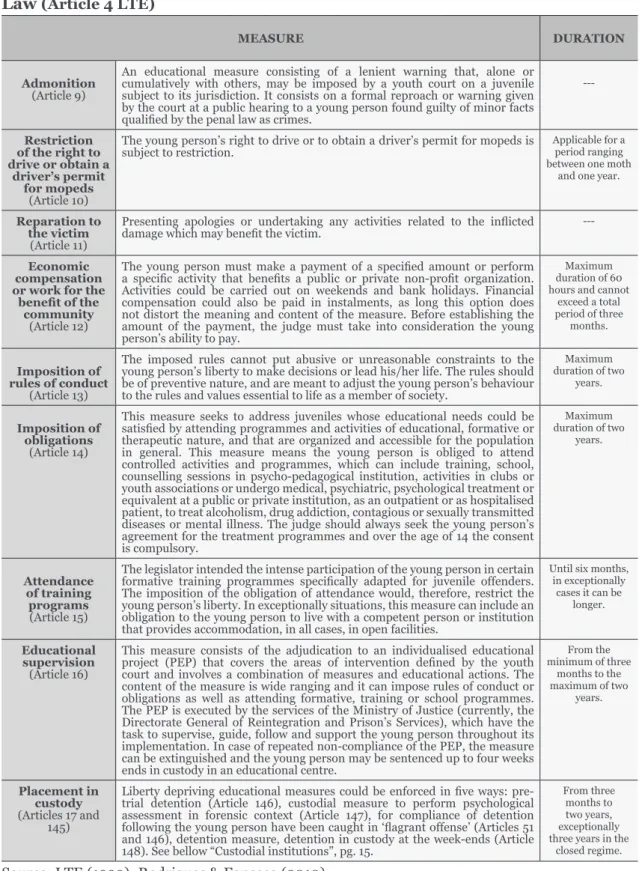
The LTE provides a diversified set of educational measures (Article 4). From the least to the most impactful to the young person’s life, they are as follows (Table 1): admonition, restriction of the right to drive or obtain a driver’s permit for motorcycles, reparation to the victim, economic compensation or work for the benefit of the community, imposition of rules of conduct, imposition of obligations, attendance of training programs, educational supervision, and placement in custody at educational centres.9
Educational measures can be executed until the age of 21 (Article 5). Electronic tagging is not applied to juveniles; this measure can only be imposed in the penal system for those
8 According to the official judicial statistic, based on the seven last years, 16 to 18 year olds on average represent less than 1% of the prison’s population (by the end of December 2007 were 0.9% of the total prison’s population (n=101), 0.6% in 2011, and 0,5% in 2012).
who are at the age of 16, and fall under the general penal law. The criteria on which an educational measure is determined by the youth court rely not only on young offenders’ needs, which are evaluated before the sentence by social and psychological or psychiatric assessments, but also on the seriousness of the committed offences in comparison to what is defined in the penal code.
Table 1 Educational measures provided by the Educational Guardianship Law (Article 4 LTE)
MEASURE DURATION
Admonition
(Article 9)
An educational measure consisting of a lenient warning that, alone or cumulatively with others, may be imposed by a youth court on a juvenile subject to its jurisdiction. It consists on a formal reproach or warning given by the court at a public hearing to a young person found guilty of minor facts qualified by the penal law as crimes.
---Restriction of the right to drive or obtain a driver’s permit for mopeds (Article 10)
The young person’s right to drive or to obtain a driver’s permit for mopeds is
subject to restriction. Applicable for a period ranging between one moth
and one year.
Reparation to the victim
(Article 11)
Presenting apologies or undertaking any activities related to the inflicted
damage which may benefit the victim.
---Economic compensation or work for the benefit of the
community
(Article 12)
The young person must make a payment of a specified amount or perform a specific activity that benefits a public or private non-profit organization. Activities could be carried out on weekends and bank holidays. Financial compensation could also be paid in instalments, as long this option does not distort the meaning and content of the measure. Before establishing the amount of the payment, the judge must take into consideration the young person’s ability to pay.
Maximum duration of 60 hours and cannot
exceed a total period of three months. Imposition of rules of conduct (Article 13)
The imposed rules cannot put abusive or unreasonable constraints to the young person’s liberty to make decisions or lead his/her life. The rules should be of preventive nature, and are meant to adjust the young person’s behaviour to the rules and values essential to life as a member of society.
Maximum duration of two years. Imposition of obligations (Article 14)
This measure seeks to address juveniles whose educational needs could be satisfied by attending programmes and activities of educational, formative or therapeutic nature, and that are organized and accessible for the population in general. This measure means the young person is obliged to attend controlled activities and programmes, which can include training, school, counselling sessions in psycho-pedagogical institution, activities in clubs or youth associations or undergo medical, psychiatric, psychological treatment or equivalent at a public or private institution, as an outpatient or as hospitalised patient, to treat alcoholism, drug addiction, contagious or sexually transmitted diseases or mental illness. The judge should always seek the young person’s agreement for the treatment programmes and over the age of 14 the consent is compulsory. Maximum duration of two years. Attendance of training programs (Article 15)
The legislator intended the intense participation of the young person in certain formative training programmes specifically adapted for juvenile offenders. The imposition of the obligation of attendance would, therefore, restrict the young person’s liberty. In exceptionally situations, this measure can include an obligation to the young person to live with a competent person or institution that provides accommodation, in all cases, in open facilities.
Until six months, in exceptionally cases it can be longer. Educational supervision (Article 16)
This measure consists of the adjudication to an individualised educational project (PEP) that covers the areas of intervention defined by the youth court and involves a combination of measures and educational actions. The content of the measure is wide ranging and it can impose rules of conduct or obligations as well as attending formative, training or school programmes. The PEP is executed by the services of the Ministry of Justice (currently, the Directorate General of Reintegration and Prison’s Services), which have the task to supervise, guide, follow and support the young person throughout its implementation. In case of repeated non-compliance of the PEP, the measure can be extinguished and the young person may be sentenced up to four weeks ends in custody in an educational centre.
From the minimum of three months to the maximum of two years. Placement in custody (Articles 17 and 145)
Liberty depriving educational measures could be enforced in five ways: pre-trial detention (Article 146), custodial measure to perform psychological assessment in forensic context (Article 147), for compliance of detention following the young person have been caught in ‘flagrant offense’ (Articles 51 and 146), detention measure, detention in custody at the week-ends (Article 148). See bellow “Custodial institutions”, pg. 15.
From three months to two years, exceptionally three years in the
It is possible for young adults who are 16 to 21 years of age to be under juvenile justice supervision if, under the age of 18, they had judicial proceedings for having committed acts qualified by the penal law as crimes when they were between 12 and 16 years old. Moreover, a series of rules and specific legal procedures resulting from the joint application of educational and penal orders for the same young person must be considered. The LTE foresees the possibility for a youth court to intervene and enforce an educational measure for a young person under the age of 18 for an offence committed before he/she reached 16, as long as he/she is serving a prison preventive detention (prisão preventiva) (Article 27).
Children in conflict with law (under the age of 12)
Under the current juvenile justice system in Portugal, for children below 12 years of age who have committed an offence qualified by the penal law as crime, the Promotion and Protection Law for Children and Youth in Danger (LPCJP) is applied and can only be implemented in terms of protection measures. This means they receive the same treatment as any other children who are in danger because Portuguese legislators considered that below this age, children’s psycho-biological development requires a specific intervention that is not compatible with the principles and goals defined in the LTE. As Rodrigues and Fonseca (2010, p. 1034) noted, “the commission of an offence qualified by the penal law as crime by a minor aged below 12 years, to the extent that is related to situations of social need, may indicate that the State should intervene. The intervention in this case should be solely of a protective nature, carried out within the framework of LPCJP”. The intervention for the promotion and protection of the child’s rights expressed in the LPCJP is applied to all the children in danger, between 0 and 18 years old, and in some cases it can be extended until the age of 21.10 The protection measures applied by the local Children and Youth’s Protection Commissions or by the family and youth courts aim to remove children from the danger they are facing,11 giving them conditions that protect and promote their safety, health, education, well-being and full development, and trying to assure the physical and psychological recovery of those who were victims of any form of exploitation or abuse. The protection measures are divided into two categories (Article 35). In the first category are the family-based protection measures enforced in 10 See page 5.
11 The Children and Youth’s Protection Commissions are non-judicial official institutions (Epifânio, 1993), with autonomy, located in every municipality, and are composed by representatives of local entities, such as the administration State services, social services, education and health services, police authorities, youth associations, and others. The Commission intervention’s depends on the consent of the parents, legal guardian or de facto guardian, and is also required the non-opposition of the child aged 12 years or older. These Commissions can apply measures for the protection of children and youth (except placement for future adoption), but only when having an agreement in the terms mentioned above. If there is no agreement regarding the implementation of the protection measures proposed by the Commission, or if the required consents are withdrawn, this entity has to report the case to the Public Prosecution services. The Public Prosecutor monitors and assesses the activity of the Children and Youth’s Protection Commissions, and has the legal duty to represent children, by bringing to court the cases for the protection of their rights. In care and protection cases, the court can take protective measures by a care and protection agreement or by a judicial order, after a trial (judicial debate, as it is called by the law) (Bolieiro, 2010).
the children’s living environment: parental support; family support (given to another child’s relative); entrustment to a third person (non relative); entrustment to a person selected for adoption; and youth’s support towards autonomy. The second category refers to the placements’ measures, which imply the removal of the child or of the young person from his/her life context: foster care, institutional care, and entrustment to a residential institution aiming at future adoption.
The protection measures can also be applied to young people older than 12 and below the age of 16, who have committed offences qualified by the penal law as crime and whose needs for protection in face of the situation of danger affecting them overlap the goal of ‘education in the law’ (educação para o direito) foreseen in the LTE (Rodrigues & Fonseca (2010).12 Rules and procedures of interconnection between the protective and educational interventions (Article 81 of the LPCJP and Article 43º of the LTE), support the enforcement of promotion and protection measures instead of, or in association with, an educational measure.
Youth offending: juvenile justice proceedings
The Portuguese juvenile justice system does not have a retributive or punitive purpose; it is focused on addressing the offending behaviour in a manner appropriate
to the young person’s development. At the core of the LTE is the respect for the young person’s personality, ideological, cultural and religious freedom, within all the rights conferred upon him/her by the Constitution of the Portuguese Republic. The State can
only intervene in indispensable cases. Juvenile offenders’ rehabilitation is based
on their needs to be educated on the fundamental values for living in society, with the objective being that they assume a constructive role in society.
The set of educational measures established by the LTE aims at the offender’s socialization, “based on the core principle of education in the law” (Rodrigues
& Fonseca, 2010, p. 1035). The concept of ‘education in the law’ has been
understood as the process that makes the young person learn, adhere to and respect the fundamental values of society, which are expressed in the legal-criminal values protected by the penal code (Figueiredo, 2001). The meaning of
socialization is fully explicit in the LTE and the ‘education in the law’ principle “does not represent moral correction, but is rather – in respect for the freedom of conscience that pertains to all citizens – to educate the minor to pursue a social life that complies with essential legal norms” (Rodrigues & Fonseca, 2010, p.1035). The proof of the facts of
a criminal offence is indispensable to the lawsuit, but merely by itself it is insufficient; also required is the evaluation of the young offender’s need for ‘education in the law’. Only by the corroboration of the above assumptions could the
youth court decide to apply an educational measure (Articles 2 and 3).
12 ‘Education in the law’ corresponds to the Portuguese term ‘educação para o direito’ accordingly to the translation defined by the national legislators in Rodrigues and Fonseca (2010).
The fundamental principles foreseen by the CRC (Article 37) are the basis of the LTE core principles. The Children and Youth Justice Reform introduced the principle of the
juvenile offenders’ responsibility, but it has remained focused on the application
of educational measures and has not signified a rising punitive trend. The Portuguese juvenile justice explicitly follows the ideal of education while at the same time emphasising prevention of re-offending. The juvenile offender is considered responsible for
his actions, but not in a penal way. The system could be described in what Bailleau
and Fraene (2009: 6) considered a “tendency towards bifurcation – a soft approach in most cases and tougher actions against a limited number of adolescents undergoing a custodianship order”.
The key juvenile justice system principles established by the LTE are: preference for non-institutional measures over institutional measures; specific duration of educational measures; proportionality (according to the gravity of the offence and the identified educational needs); jurisdictional control over the execution of the order; legality (in terms of the ‘vagueness doctrine’ - the legislator provided a closed catalogue of educational measures and other modalities, types or measures distinct from those stipulated in the law cannot be applied); need; suitability; and subsidiary.
The youth court may — after a specific procedure that is different from a penal one but follows some similar rules to a criminal procedure for adults — apply compulsory educational measures, but no penal sanctions. Due process guarantees were introduced by the Children and Youth Justice Reform and when a young person has committed an act qualified by the penal law as a criminal offence jointly with an adult, he/she is tried in a youth court accordingly based on his/her age.
A juvenile process is organized in two stages: the investigation, led by the public prosecution services (Ministério Público, MP), and the jurisdictional stage, led by the judge. This two-stage organization promotes the emergence of a youngster as “the procedural ‘subject’, bestowed with individual rights and guarantees” (Rodrigues and Fonseca (2010, p. 1044.
The MP assumes a central investigative role and the conduction of interrogations (Article 75) acting in accordance with the legal principle of speedy
procedure (Article 44). The judicial authorities may request information from the
auxiliary body of the judiciary administration concerning the enforcement of juvenile justice measures, which is currently the Directorate General of Reintegration and Prison’s Services (DGRSP). The DGRSP staff is in charge of
providing a young person’s social report and when there is the option for the imposition of a custodial measure in an educational centre in the open or semi-open regime, this report must include a psychological assessment, and in the cases of a closed regime, the young person’s psychological assessment in a forensic context is mandatory. If the offence is qualified as a crime punishable with a prison sentence of up to three years, and the MP did not conclude there is the need for education in the law, the case can be closed. In the light of the evidence of the facts, an essential pre-condition for verifying the educational needs, if the MP considers it necessary to enforce an educational measure, the jurisdictional stage will follow the investigation. A similar situation occurs in all the
cases where the offence is qualified as a crime punishable with a prison sentence of more than three years, even when the MP does not consider it necessary to apply such an order. After the MP requests to open the jurisdictional stage (Article 86), the
judge may dismiss the process in those cases where he/she evaluates the MP’s proposal of educational measures as unnecessary.
The imposition of preliminary measures or of the dismissal of the case requires a prior hearing with the parents. The Portuguese legislation emphasizes the involvement
of parents or the legal guardians at each stage of the juvenile proceedings, court trial and even during the enforcement of the judicial measures. The
young person could also be assisted by an expert in psychiatry or in psychology whenever required for the purpose of assessing the need to apply any educational measure.
The trial audience in the jurisdictional stage can take one of three forms. It
could be an informal and short session intended to obtain the young person’s agreement concerning the order proposed by the MP in which the judge also agrees or a similar type of session in search for the consensus of the MP regarding an order proposed by the judge. A formal and more complex session with a preliminary audience could be carried out, in which the contradictory procedure of proof is guaranteed prior to the judge’s decision. Whenever the MP requests the application of liberty-depriving measures, a formal audience is required.
A formal juvenile audience is public, but the law allows the judge to limit or even exclude the publicity concerning it based on certain limited grounds, such as when is considered that the presence of the public might psychologically affect the young person. The court‘s
final decision must always be read at public sittings. Each juvenile judicial file is confidential until the court order scheduling a trial; even afterwards, the publicity of the case must respect the young person´s personality and privacy, concealing, as much as possible, his/her identity (Article 41). According
to the law, the judge can order that the media must refrain from narrating or reproducing certain acts or documents of the case file, or disclosing the juvenile offender’s identity (Bolieiro, 2010).
The educational measures are ordered by a specialized judge, and for the application of a liberty-depriving measure a panel of three judges is required, composed of one professional and two social specialized judges (lay judges)
(Article 30). In all of the cases, the procedural initiative rests with the public prosecution services.
A young person can avoid a trial in specific cases. Based on the principle of
opportunity, if the offence committed by a young person corresponds to a crime punishable with a prison sentence of less than five years, the process may be suspended by the public prosecutor, and instead, a juvenile offender’s conduct plan can be executed (Article 84). It is a way of promoting a consensual solution in the cases of minor offences involving both the young person and his/her parents or the legal guardians. The suspension of
the process can take a maximum of one year. In developing and implementing the
plan, the young person, his/her parents or the legal representatives or legal guardians may seek the assistance of mediation services. The conduct plan may require the
young person to engage in one or more restorative actions (Castela et al, 2005). Rules and procedures of interconnection between the protective and educational interventions support the enforcement of promotion and protection measure instead of an educational measure for specific cases.
In the case of minor offences, and when the young person is in a dangerous situation, diversion could be used and protection measures can be applied by the local Children and Youth’s Protection Commissions (Article 81 of the LPCJP and Article 43º of the LTE). A major improvement brought up by the Children and Youth Justice Reform regarding youth offending has been the introduction of the young person defence lawyer,
whose participation is required in all the judicial proceedings (Article 46). The
mandatory constitution of assistance by a defence lawyer finds its rationale in the need to ensure the effective protection of the child’s rights. The young person has the right to constitute or to request the nomination of a defence lawyer, and this right could be exercised by him/her or by the parents or legal guardians. If he/she or the parents or legal guardians cannot afford it, the judge decides to appoint one that will act free of charge.
The right to assistance by a defence lawyer must give legal expression to the young person’s point of view. From his/her first contact with the police, the
young person must be assisted by a defence lawyer whose action is extended to all the proceedings and stages of the process in which he/she is participating. It is compulsory for a young person to be assisted by a defence lawyer in the first interrogation when detained, and also in any hearing during the investigation stage and on the trial. When arrested, he/she could communicate in private with the defence lawyer. The police can
only take the responsibility of identifying the juvenile and presenting him/ her for interrogation led by the public prosecutor.
A young person suspected of having committed an act qualified by the penal law as a crime cannot remain more than three hours in a police station for purposes of identification. When present at the young person’s first interrogation, the parents, legal representative or legal guardians must refrain from any interference.
At any time of the proceeding, the young person has the right to contact the judge, the public prosecutor and his/her defence lawyer in private. The
assistance of the defence lawyer is also required in the cases of revision of the pre-trial detention measure and in the preliminary hearings. The defence lawyer must guarantee assistance to the young person in every stage of custody by analysing the need to apply a liberty-depriving measure, and if the terms of its appllication respect the CRC.
The needs of those placed in custody, not restricted to the intervention of a defence lawyer and all the necessary individual assistance – social, educational, vocational, psychological, medical and physical - during placement in the institution, is fully considered by the Portuguese legislation. In the view of his/her age, sex and personality, the young
person might require other specific or more relevant assistance while being subject to liberty-depriving measures.
Authorities responsible for the reactions to youth offending
The Constitution of the Portuguese Republic establishes, under Article 209, the organization of the Portuguese courts (DGPJ, 2013). In this article, a
fundamental distinction is drawn between, on one hand, the civil jurisdiction and, on the other hand, the administrative one.13In terms of civil jurisdiction, the national territory is divided into judicial districts, judicial circles and county courts. The judicial courts divide themselves into three degrees or instances: the courts of first instance, which are, in general, the county courts; the courts of second instance, which are the Courts of Appeal; and lastly, the Supreme Court of Justice. The Courts of Appeal have jurisdiction within their own judicial district or part of it, while the first instance courts are competent in their own jurisdiction (DGPJ, 2013).
The civil jurisdiction first instance courts are divided in accordance with three categories: general jurisdiction, specialized jurisdiction and specific jurisdiction. The courts of general, specialized or specific jurisdiction may be divided
into benches. In the county courts, the benches may have general, specialized or specific jurisdiction. The reasoning behind this is that not only the ‘special’ courts may divide themselves into different benches with the same jurisdiction, but the ‘general’ courts may also divide themselves into benches with different jurisdiction, in accordance with the matter and the form of procedure (DGPJ, 2013).
The specialized jurisdiction courts hear specific matters, irrespective of the form of procedure. The LTE intervention is the responsibility of the specialized family
and youth courts (Tribunais de Família e Menores). The first children courts (Tutorias
da Infância) in the country were created in 1911 by the Childhood Protection Act. Since
then, there have been youth specialized courts as well as specialized youth prosecutors. These courts are competent to decide on measures to be applied for children who are, in general, in a dangerous situation,14 either in view of mistreatment or abandonment or by having committed an act qualified by the penal law as crime. Before the judicial network Reform that came into effect in the 1st of September 2014 (Decrew Law n.º 49/2014), in the few regions where they did not exist, the county courts (Tribunais de Comarca), of general competence, exist as youth courts (Rodrigues & Fonseca, 2010).15
In the past two and half decades there has been a significant growth in the number of family and youth specialized courts. At the same time, there has been a broadening in the territorial area of the specialized juvenile jurisdiction. This process of specialization has occurred especially in the coastal and more urban areas of the country; the interior,
13 More information available at the Directorate-General for Justice Policy of the Ministry of Justice website http://www.dgpj.mj.pt/sections/english-version/strategic-planning/annexes/the-portuguese-judicial/the-portuguese-judicial/
14 The family and youth courts can only intervene to determine protection measures to children and youth in danger when the parents or legal guardians are in disagreement with the measures proposed by the Children and Youth Commissions’.
with less population, has a justice more based on general jurisdiction courts. One has observed a high concentration of family and youth specialized courts in the Lisbon and Oporto Metropolitans areas, which corresponds to the demographic trends (Pedroso et al., 2010). In January 2014, there were close to 20 of these courts, with increasingly more judges and prosecutors with specialized training. More recently the number of these courts has been rising, now totalling 23, one in each county capital. As a result of the judicial network Reform (September 2014), the whole country is now covered with family and youth specialized jurisdiction.
Currently, the auxiliary body of the judiciary administration concerning
the enforcement of juvenile justice measures is the Directorate General of
Reintegration and Prison’s Services (DGRSP).16 From the end of October 2010
to September 2012, the Director-General of Prison Services assumed the function of Director-General of Social Reintegration (DGRS), simultaneously managing these two Ministry of Justice departments. From 1925 to 2012 there was an independent
State juvenile justice service, something that no longer exists due to the recent merge of the former DGRS and the Prison’s Service into the new DGRSP, which has the task of managing the implementation of public policies of crime
prevention and the social reintegration of young and adult offenders as well as managing the prison services.
The DGRSP ensures the enforcement of the non-institutional educational measures for young offenders in the community, and it is responsible for enforcing the liberty-depriving educational measures through the management of the educational centres. The DGRSP staff, in local teams or
in custodial institutions, is responsible for assisting the youth courts and the public prosecution services concerning the juvenile proceedings. This state justice department provides technical and specialized counselling to the youth courts, psychosocial support to young people and adults involved in lawsuits, in conjunction with the competent public entities and individuals, and promotes the connection between justice administration and community agencies.
In Portugal there are no specialized police units regarding juvenile justice.
Since 1992, there has been a specialized police program named Safe School Program (Programa Escola Segura), which is focused on violence in and around schools, including youth offending.17 This program is a joint initiative of the Ministry of Internal Affairs, which corresponds to Ministry of Home Affairs in other EU countries, and the Ministry of Education and Science, covering state and private schools, violence within and outside the physical grounds of the school, from primary school to university.
As highlighted in national and international documents, the existence of independent
16 Decree-Law no. 215/2012, of 28th September.
mechanisms and structures responsible for the inspection, the supervision and the evaluation of the juvenile justice system is crucial for the promotion
of a child-friendly justice. The Portuguese law (LTE), in its Article 209, establishes the constitution of an independent Commission for the Supervision of the
Educational Centres (“Comissão de Fiscalização dos Centros Educativos, CESC”).
Not only are educational centres supervised and monitored by the court judges, by the publicprosecutors, and through the visits carried out by families or other entities related to this field, the law also states that the deprivation of liberty of a young person and the centre’s activities should be followed and evaluated by an independent commission. The CESC includes two representatives of the Portuguese Assembly of Republic (Parliament), one representative of the Government, one representative of the Superior Council for the Judiciary (“Conselho Superior da Magistratura”), one representative of the Superior Council of Public Prosecution (“Conselho Superior do Ministério Público”), and two representatives of non-governmental children’s organizations. This independent commission may request information about the centres and visit them, at any time its members consider it necessary, in accordance to the law, which grants them free access. Two major reports have been produced and made publically available by the CESC in recent years (January 2011 and June 2012).
Another independent structure with an important work of evaluation and consultation in the field of the Portuguese justice system, since 1996, is the Permanent Observatory on Portuguese Justice (Observatório Permanente da
Justiça Portuguesa, OPJ), at the Centre for Social Studies, of the University of Coimbra.18 The Observatory aims at accompanying and analyzing the performance of the Portuguese courts, as well as related institutions such as police forces, prisons, alternative dispute resolution mechanisms, forensic services, and social reintegration services. The OPJ evaluates the reforms introduced in the judiciary, suggests reforms, and contributes to comparative studies, with mixed international teams or co-coordinated teams, within and outside Europe. A main objective of its studies is to inform the public debates on justice policies in Portugal, and help its transformation into policies aiming to be more democratic and more attentive to citizens’ rights.
Regarding the evaluation of the Portuguese juvenile justice system, since 2001 two major reports have been produced by the OPJ: the first one, in 2004,19 and the last one in 2010,20, in which some of the main conclusions and recommendations presented in this report are based.
18 Webpage: http://opj.ces.uc.pt/. The Observatory has the scientific coordination of Prof. Boaventura de Sousa Santos.
19 Santos et al. (2004).
Custodial institutions
The Portuguese state custodial facilities for juvenile offenders, called educational centres (Centros Educativos), are managed by the DGRSP,
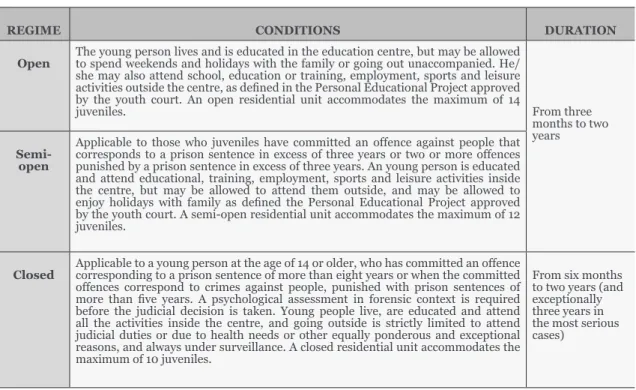
which constitutes an auxiliary body of the judiciary administration for juvenile justice. The educational centres are distinguished according to the type of regime carried out and are organized into residential units (Article 4) with secure accommodations provided for 10, 12 or 14 juvenile offenders. A custodial measure can be executed in one of the three regimes defined by the LTE, which are based on the extent of their deprivation of the youth’s liberty.
Table 2 Educational centre’s regimes (Article 17 LTE)
REGIME CONDITIONS DURATION
Open The young person lives and is educated in the education centre, but may be allowed to spend weekends and holidays with the family or going out unaccompanied. He/ she may also attend school, education or training, employment, sports and leisure activities outside the centre, as defined in the Personal Educational Project approved by the youth court. An open residential unit accommodates the maximum of 14
juveniles. From three
months to two years
Semi-open
Applicable to those who juveniles have committed an offence against people that corresponds to a prison sentence in excess of three years or two or more offences punished by a prison sentence in excess of three years. An young person is educated and attend educational, training, employment, sports and leisure activities inside the centre, but may be allowed to attend them outside, and may be allowed to enjoy holidays with family as defined the Personal Educational Project approved by the youth court. A semi-open residential unit accommodates the maximum of 12 juveniles.
Closed Applicable to a young person at the age of 14 or older, who has committed an offence corresponding to a prison sentence of more than eight years or when the committed offences correspond to crimes against people, punished with prison sentences of more than five years. A psychological assessment in forensic context is required before the judicial decision is taken. Young people live, are educated and attend all the activities inside the centre, and going outside is strictly limited to attend judicial duties or due to health needs or other equally ponderous and exceptional reasons, and always under surveillance. A closed residential unit accommodates the maximum of 10 juveniles.
From six months to two years (and exceptionally three years in the most serious cases)
Source: LTE (1999); General and Disciplinary Regulation of the Educational Centres (2000).
The criteria on which the measure is determined by the court rely not only on young offenders’ needs, which are evaluated before the sentence by social, psychological or psychological assessment in a forensic context, but also on the seriousness of the committed offences in comparison to what is defined in the penal code.
Liberty-depriving educational measures within the LTE could be enforced in five ways: pre-trial detention (medida cautelar de guarda), custodial measure to carry
out the young offender’s psychological assessment in a forensic context (perícia sobre
a personalidade), detention, if the young person has been caught in ‘flagrant offense’
week-ends (internamento em fins de semana). In accordance with international
standards, detention, in any of its modalities, must be only used as last resort. Thus, fulfilling the principles of legality and proportionality, the requirements
and assumptions underlying the application of this measure are restricted, and in the case of the closed regime “are extremely restricted, which is perfectly understandable” (Rodrigues & Fonseca, 2010, p. 1060).
The minimum length for a custodial measure is three months in the open and semi-open regimes, and six months in the closed regime; the maximum length is up to two years in all the three regimes, and, exceptionally, three years in the closed regime for the most serious cases. Below the age of 14 a young
person cannot be placed in the closed regime, just in the open or semi-open regime. Depending on the juvenile offenders’ progress in detention, a change to a less restrictive regime can be proposed to the court and the custodial measure applied can be reviewed according to the law and changed, but never to a more restrictive regime.
The current law does not envisage a specific therapeutically custodial measure. According to the LTE, it is supposed that the young person is able to
understand the meaning of the measures and of the educational intervention. In these terms, it is supposed that the law is not applied to those who suffer serious mental health problems (Article 49) which prevent them from understanding the judicial process. As Bolieiro (2010) states in the Portuguese Report of the MHYO Project, in the Portuguese juvenile justice system, a juvenile offender who faces a custodial measure and has mental health issues that have to be therapeutically addressed, will receive psychiatric and/or psychological treatment during detention. Although the current legal
framework foresees the creation of specialized centres or residential units that should provide therapeutic programmes specifically designed for those with personality disorders or serious addictive behaviours, such units and programmes have not been fully implemented. It is important to note that the
placement of a young person in specialized centres or units and their enrolment in such therapeutic programs depends on the court’s approval.
The intervention in the educational centres should be structured around activities and programs concerning different areas (e.g. education, training,
social and cultural activities, sports, health and other activities depending on individuals’ specific needs) as well as focusing on daily routines to increase personal and social skills (Neves, 2007; Storino, 2012).To fulfil the objectives of the judicial intervention, each educational centre establish partnerships with various institutions and agencies in the community (schools, health centres and hospitals, recreational, sports, and cultural associations, NGO, religious and local authorities, and others services). Rules and procedures are defined within a legal regulation framework that provides a foundation for the system’s organization, the General and Disciplinary Regulation of the Educational Centres (“Regulamento Geral e Disciplinar dos Centros Educativos”, approved by Decree Law n.º 323-D/2000, of 20th December). For each young offender, there is a range
Personal Educational Project (Projeto Educativo Pessoal, PEP).
The LTE intervention is based on the principle of maintaining all the civil, political, social, economic, and cultural rights and guarantees that are legally granted to youths in the country and that are compatible with the deprivation of liberty. Among the guarantees and rights legally conferred upon the
young person placed in custody are: the right to be informed in a personal and appropriate manner; the right that the centre will act in the best interests of the young person’s life, physical integrity and health; the right to preserve one’s dignity; the right to preserve one’s privacy; the right to contact, in private, the judge, the public prosecutor and the defence lawyer; the right to attend school; the right to maintain authorized contact with the outside world, by different means (letter, phone, visits); the right to be heard prior to the imposition of any disciplinary measure and the freedom of religion (Rodrigues & Fonseca, 2010).
An important issue concerning the young offenders’ path to personal and social well-being is their preparation prior to release from an educational centre and the following monitoring process (Bailleu & Fraene, 2009). Unlike other EU legal frameworks,
in Portugal, the LTE does not establish any procedure or specific mechanism for monitoring a young person after a liberty-depriving measure, which
means local and community entities should be involved in the reintegration process prior to the release of the young offender from custody. Thus far, the last evaluation reports of official entities on the Portuguese juvenile justice system show there is not enough coordination among the different services (Santos et al., 2010; CESC, 2012).Up to a point, this happens due to the lack of sufficient and adequate responses at a national level for youth at these ages. Rehabilitation is not a process that can be completed when a young person is released from an educational centre; as a learning process, it continues over time, and the greatest challenges arise when the young person returns to the community (Carvalho, 2012b).
Pre-trial detention
In Portugal, the pre-trial detention measure consists of detention in an
Educational Centre in the closed or semi-open regime and must be used as a last resort, only applicable to youth if other precautionary measures provided by the LTE are insufficient or inadequate. This judicial order is regulated by
child-specific provisions according to international standards and can only be imposed by a judge as a precautionary measure on youths who have committed an offence qualified by the penal law as a crime between 12 and 16 years old, as long as they have not yet reached 18 years old. In addition, not all offences are eligible to the enforcement of this measure: it can only be applied when the offence committed corresponds to a maximum prison sentence of more than five years, or when two or more committed offences are classified as crimes against people punishable by a maximum prison sentence in excess of three years.
If the young person is over 14 years old, he/she can be placed in the closed regime; if he/she is below 14 years old the pre-trial detention order must
be carried out in the semi-open regime.The Portuguese legislation stipulates a
maximum duration of this measure: it can take up to three months and can be
extended for another three months, in any of the above mentioned regimes, in especially complex cases and where the reasons on which it is based are duly stated (Rodrigues & Fonseca, 2010).
In the decision-making process, the pre-trial detention may only be imposed on a young person when there is strong evidence of the offence or offences and there is the probability of the application of a LTE measure corresponding to the need of ‘education in the law’, and when there is the probability the young person will abscond or commit further offences. To impose a pre-trial detention measure, these three pre-conditions
must be cumulatively fulfilled and when they are no longer applicable the measure has to be extinguished.
As Rodrigues and Fonseca (2010) pointed out, the pre-trial detention of juveniles
in Portugal has at its core the principle of the ‘vagueness doctrine’ (only those orders stipulated by law may be applied) and the principles of need, suitability, proportionality and subsidiary. Proceedings involving pre-trial
detention in an educational centre, when carried out during judicial vacation, are given priority status. Only the public prosecution magistrate, who is in charge of the investigation stage, can request the enforcement of the pre-trial detention measure and the young person has the right of defence. Whenever possible, a prior hearing with the defence lawyer and parents, legal representatives or guardians should occur.
Trends in the enforcement of educational measures
In Portugal, between 1993 and 2012, most of the police-registered suspects under 16 years of age (Appendix A) were males acting in a group, and committed mostly minor offences against property (Carvalho, 2013c). Only a small proportion of these police
occurrences end up in the Portuguese courts (Agra & Castro, 2007). Among
those, between 2001 and 2008, on average, only 14.0% of the LTE cases in
the investigation stage (pre-trial), led by public prosecution services, were referred to the jurisdictional stage, led by a judge (Castro, 2011). Therefore, not
surprisingly, Bailleau and Fraene (2009, p. 6) concluded that “this percentage proves
the trifling nature of the facts recorded: only acts punishable by a maximum of three years of imprisonment could be closed; it also highlights the respect for the principles of opportunity and minimal intervention by the judicial authorities”.
The temporary suspension of the process (Article 84) represented a value of less than 1% of the total of cases, each year. One also notes an undetermined
number of lawsuit closures as a result of the withdrawal of the formal complaint by the victims, which can take place in the cases of ‘particular crimes’.
However, the knowledge of the Portuguese juvenile system is seriously affected by the lack of essential data concerning the sentencing process (Muncie, 2008; Carvalho, 2012a, 2012b), which means is difficult to have a complete and reliable portrait of the social and judicial reality of youth offending in the country.
When analysing the available official data about law enforcement in the past decade, it
is possible to identify a global trend towards an increasing diversification of educational measures (LTE) as an alternative to liberty-depriving measures. Among the set of non-institutional educational measures provided by the
LTE,21 the most important feature is the increase, over the years (Appendix B), of the
work for the benefit of the community and of the imposition of obligations.22
The enforcement of educational supervision has suffered more variations, despite always having a strong presence in this population during the years under analysis. These three educational measures have corresponded to a total of 72.3% (n= 2.696) of the educational interventions managed by the DGRSP in 2012 (n= 3.728) as liberty-depriving interventions represented 18.2%.
The other non-institutional educational measures have a reduced statistical expression: attendance of training programs (35 in 2012); imposition of rules of conduct (25 in 2012); reparation to the victim (10 in 2011; 5 in 2012), and economic compensation for the benefit of the community (15 in 2012).
In the first years after the Children and Youth Justice Reform, Portugal has undertaken in-depth changes of the custodial facilities (Bailleau & Fraene,
2009), improving not only the conditions of the institutions, but also assuring the reinforcement and reorganization of its staff, corresponding to principles and guidelines foreseen in international norms. However, this situation has changed. The reform has led to a first reduction of the number of educational centres, from 14 in 2000 to 8 in 2007, and afterwards to 6 in 2008. This process has been associated with
political options aiming at staffing cuts and, as a result, the closure of the facilities led to the overcrowding of the custodial institutions in 2008. The
total capacity of the educational centres decreased from 328 places in 2005 to 261 places on the 31st of December 2007. In 2007 three educational centres were closed, two in November and one in December.
In 2010, two new educational centres were opened based on a public-private partnership between the Ministry of Justice and an NGO of Spanish origin. In accordance with the LTE, this sort of partnership can only be implemented in the open and semi-open regimes.
21 On average, the 16-17 years has been the age group most represented over the years. By September 2010, the 17 years age-group represented 27.1% of the total, the 16 years age group was 26.0%. Regarding the sex distribution, 85.3% were male and 14.5% female. Around 38.6% committed crimes against property, and 24.1% against people. It is relevant that 8.7% of this population was of foreign nationality (DGRS, 2010).
22 Admonition represented around 63% of the total of educational measures applied in 2001, 41% of the total of 2002, 30% in 2003, 24% in 2004, and 22% in 2005. The figures related to the 2006-2012 are not available.