YOUNG OFFENDERS’ INSIGHTS INTO THEIR EXPERIENCES IN
ACCESSING TV AND PRESS NEWS IN A LIBERTY-DEPRIVING CONTEXT
Maria João Leote de Carvalho
CESNOVA – Centro de Estudos de Sociologia, FCSH – Universidade Nova de Lisboa, Portugal
Juliana Serrão
Portugal
Abstract
This paper seeks to give voice to young offenders placed in custodial institutions in Portugal, aiming to discuss their insights into their experiences in accessing TV and press news in a liberty-depriving context, and how through their choices they (re)view their own life trajectories and attitudes towards the institution and the juvenile justice system. Using both quantitative and qualitative methods, the study focused on a population that tends to gain the media’s attention, but their own interpretation of social matters has rarely been heard. Through informed consent, a random sample was collected involving 150 participants, of both sexes, between 12 and 21 years of age. The findings pointed up how news contents were mainly understood as essential windows to the world: for many participants, reading or watching news was a process sustained by the need for maintaining contact with their communities and the world outside custody. Not only was their experience in the juvenile system clearly reflected in their discussion about the news, they also strengthened the relation of some news content with their attitude towards their families, peers and institutions. The results reveal they were particularly interested in news on two issues - children in danger and crime -, and through the analysis young offenders made of their choices, they (re)viewed their life trajectories and projected into an aftercare future.
Key words: young offenders, Juvenile Justice, Children’s Rights, custodial institutions, TV and press news
Introduction
Young offenders’ rehabilitation presents a set of challenges to contemporary societies
that are particularly felt in the juvenile justice systems.1The complexity of children and youth’s lives in contemporary settings is expressed in the coexistence of multiple ways of life and experiences of delinquency associated with various contexts and trajectories. We live in a time where there is a growing recognition of children and youth’s specific needs and interests. Nevertheless, their opinions and attitudes are often devalued by adults, particularly in regard to the discussion ofmore complex issues, such as those relating to delinquency and juvenile justice. In the same way, the opportunities for participation in social life afforded to children and youth
1According to the Council of Europe’s Recommendation Rec(2003)20, in this paper, the term ‘juvenile justice’ is used in a
as full citizens in a society, particularly in the cases of young offenders, are, in many communities, far from legal ideals (Madge, 2006; Kilkelly, 2011; Pruin, 2011; Moore, 2013).
Several authors suggest that since James Bulger’s death in England, in 1993, in an act perpetrated by two young 10-year-old boys, public and judicial attitudes towards children and youth involved in delinquency have hardened worldwide (Asquith, 1996; Brym and Lie, 2007; Castro, 2009; Carvalho, 2013a). The role of the media in publicizing the crime has been extensively questioned (Smith, 1994; Rolim, 2006), and the controversy persists, as further legal charges against one of the murderers, now under a new adult personal identity kept anonymous by the courts, brought to public attention in recent years, rekindled the discussion about the
media’s role in the news coverage on justice proceedings (Carvalho, 2013a).
The James Bulger case is paradigmatic of the stereotypical dichotomy presented by the media between the so-called ‘good childhood’ associated with the child victim, innocent and
dependent, and the ‘bad childhood’ associated with the two boys who committed the act
(Madge, 2006). Recurrently, this opposition wins other forms of expression when considering
that the first one is frequently regarded as referring to ‘our children’, the children from the social groups supposedly dominant in society, while the second one refers to the ‘other children’, ‘other childhoods’, the ‘children without childhood’, whose lives are far away from social conformity where can be found a wide and complex range of unwanted situations, such as maltreatment, abuse, negligence or delinquency, among others (Almeida, 2009; Ponte and Afonso, 2009).
The structural ambiguity of societies towards young offenders tends to be built on a basis of stereotypes and simplification processes presented in the news which deny the complexity of this social problem. Thus, the media play an important role as a forum for the enforcement of social control, both formal and informal, which cannot be dissociated from the trend of calling for more punishment for youth offending that is widespread in Europe (Santos et al., 2010; Kilkelly, 2011; Pruin, 2011; Moore, 2013; Carvalho, 2013a). The economic crisis affecting some European countries, such as Portugal, could also be related to the controversial public and political call for more restrictive social control over youth (Moore, 2013). Furthermore, the public perception that youth have become more violent could lead to the idea that the few financial resources available should not be used in the rehabilitation of juveniles, only in their punishment, particularly of the most serious offenders.
In Portugal, this issue has emerged as a public concern over the last two decades, particularly considering the challenges and constraints arising in the administration of juvenile justice. The Children and Youth Justice Reform, started in the 1990s, introduced the principle of
the young offenders’ responsibility, but it has remained focused on the application of educational measures, and has not signified a rising punitive trend (Figueiredo, 2001; Carvalho, 2009). In fact, the Portuguese juvenile justice system differs from most other EU countries, giving less importance to the offence than to the need for the young offender to be educated on the fundamental community values that have been violated by the illicit act.2 This can be
regarded as a third perspective, falling in between a welfare model’ and a punitive or penal one.
2 The term ‘young offender’ is used in a restricted way according to the current Portuguese sentencing framework
(Educational Guardianship Law): it refers to a person between 12 and 16 years old who commits an offence qualified by the penal law as crime and, as a result, can be subject to educational measures. As proposed by Neves (2008a), this option is
The set of educational measures applied by the courts aims at socializing and educating
offenders in the values protected by the penal law, in a process called ‘education in the law’.3
As a population under permanent media attention and news coverage, it is crucial to identify and understand the role that the news play in the lives of young offenders. The right of the young person to be heard on all matters is regarded by the United Nations Committee on the Rights of the Child as a fundamental principle of a fair, ‘child-friendly justice’ system. The right of a child to effectively participate and express his/her views freely should be at the basis of
any judicial intervention. But even within a ‘child’s rights perspective’, a young offender’s
interpretation on social matters is rarely considered and publicly discussed (Smith, 1994; Hagel and Newburn, 1994; Asquith, 1996).
Within a ‘child-friendly justice’ framework, this paper seeks to give voice to young offenders placed in custodial institutions in Portugal, aiming to discuss their insights into their experiences in accessing TV and press news in a liberty-depriving context, and how through their choices they (re)view their own life trajectories and their attitudes towards the institution and the juvenile justice system.4 As an exploratory research study focused on a specific context and population at a particular time the findings presented cannot be generalized to other settings.
Youth offending: the current Portuguese sentencing framework
Currently, the Portuguese justice system combines three different kinds of intervention regarding children and youth offending, taking into account three age ranges: 1) children below the age of 12 years, 2) juveniles between 12 and 16 years, and 3) young adults between 16 and 21 years of age. The first two categories fall within the scope of juvenile justice, whereas young adults are subjected to the adult criminal justice system (Rodrigues & Fonseca, 2010).
Since 1911, Portugal has had a juvenile justice system and special laws regarding youth offending. There has never been a juvenile criminal law in the country. The minimum age of criminal responsibility is 16 years old, which is also the minimum age for criminal majority. A person between 12 and 16 years old who commits an offence qualified by the penal law as a crime can be subject to educational measures, as defined by the Educational Guardianship Law (Law n.º 166/99, of 14th September, LTE). In this age range a transfer of the juvenile to adult’s courts is totally inadmissible, whatever the nature of the offences committed, and the youth court can only impose educational measures.
The State can only intervene in indispensable cases, and young offenders’ rehabilitation
is based on their need to be educated on the fundamental values for living in society, with the aim that they would assume a constructive role in society (Neves, 2007, 2008a; Storino, 2012). The system could be described as what Bailleau and Fraene (2009: 6) considered a ‘tendency towards bifurcation – a soft approach in most cases and tougher actions against a limited
number of adolescent undergoing a custodianship order’.
3‘Education in the law’ corresponds to the Portuguese term ‘educação para o direito’
accordingly to the translation defined by the national legislators in Rodrigues and Fonseca (2010).
4
This paper is based on the work previously published at Participations. Journal of Audience & Reception Studies, Young
The LTE provides a diversified set of educational measures that can be executed until the
age of 21. From the least to the most impactful to the young person’s life, they are as follows: admonition, restriction of the right to drive or obtain a driver’s permit for motorcycles,
reparation to the victim, economic compensation or work for the benefit of the community, imposition of rules of conduct, imposition of obligations, attendance of training programs, educational supervision, and placement in custody at educational centres. Electronic tagging is not applied to juveniles; this measure can only be imposed in the penal system for those who are at the age of 16, and fall under the general penal law.
In accordance to international standards, placement in custodial institutions, in any of its modalities, must be only used as last resort. The Portuguese state custodial facilities for young offenders, called educational centres, are currently managed by the Directorate General of
Reintegration and Prison’s Services (DGRSP)– Ministry of Justice,5 which constitutes an auxiliary body of the judiciary administration. The educational centres are distinguished according to the type of regime carried out, and organized into residential units, with secure accommodations.
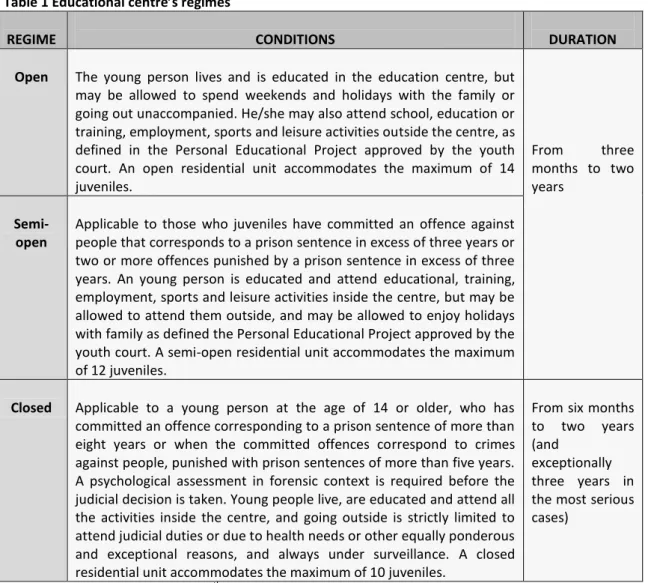
Table 1 Educational centre’s regimes
REGIME CONDITIONS DURATION
Open The young person lives and is educated in the education centre, but may be allowed to spend weekends and holidays with the family or going out unaccompanied. He/she may also attend school, education or training, employment, sports and leisure activities outside the centre, as defined in the Personal Educational Project approved by the youth court. An open residential unit accommodates the maximum of 14 juveniles.
From three months to two years
Semi-open
Applicable to those who juveniles have committed an offence against people that corresponds to a prison sentence in excess of three years or two or more offences punished by a prison sentence in excess of three years. An young person is educated and attend educational, training, employment, sports and leisure activities inside the centre, but may be allowed to attend them outside, and may be allowed to enjoy holidays with family as defined the Personal Educational Project approved by the youth court. A semi-open residential unit accommodates the maximum of 12 juveniles.
Closed Applicable to a young person at the age of 14 or older, who has committed an offence corresponding to a prison sentence of more than eight years or when the committed offences correspond to crimes against people, punished with prison sentences of more than five years. A psychological assessment in forensic context is required before the judicial decision is taken. Young people live, are educated and attend all the activities inside the centre, and going outside is strictly limited to attend judicial duties or due to health needs or other equally ponderous and exceptional reasons, and always under surveillance. A closed residential unit accommodates the maximum of 10 juveniles.
From six months to two years (and
exceptionally three years in the most serious cases)
Sources: Law n.º 166/99, of 14th September; Decree Law n.º 323-D/2000, of 20th December.
5 At the time of the field work, the educational centres were managed by the Directorate General of Social
A liberty-depriving measure can be executed in one of the three regimes defined by the law (Table 1), which are based on their extent of deprivation to youth’s liberty. The criteria on
which the measure is determined by the court rely on young offenders’ needs, which are
evaluated before the sentence by social, psychological assessment or psychological assessment in forensic context, and also on the seriousness of the committed offences in relation to what is defined in the penal code.
Below the age of 14 years old a young person cannot be placed in the closed regime, only in the open or semi-open regime. Depending on the young person’s progress in custody, a change to a less restrictive regime can be proposed to the court, and the detention measure applied can be reviewed and changed accordingly, although never to a more restrictive regime. For each young offender, there is a range of mandatory activities according to the individualised Personal Educational Project that are court-approved. Control and permanent attention, in the form of intensive occupation of time and space in the institution, are expressed in rules
embodied in internal regulations. These regulations ‘should be a relatively formal and explicit set
of requirements and prohibitions that exposes the main requirements for the conduct of the
institution’ (Goffman, 1961: 50).
Methodology
Within the project “Children and Youth in the News Media” (2005–2007),6 an exploratory
study was carried out by the authors with the purpose of exploring how young offenders placed in Portuguese juvenile justice institutions looked at TV and press news. Stressing the need for giving voice to youth, the main goal was to identify what interests, motivations and habits the young offenders have related to access to newspapers and television news inside and outside the juvenile institution where they were placed. For that purpose, a questionnaire survey and individual interviews were conducted, based on a set of guiding questions defined before entering the field with the following concerns: i) what interests young offenders reveal towards TV and press news; ii) what experiences they have had in relation to journalists; and iii) what forms of regulation they would propose to the journalists/reporters when editing news about children and youth. Because these generated a reflexive debate during the interviews, a fourth question arose from the field work: iv) when selecting and discussing TV and press news, especially those involving children and youth, in what ways do these young offenders (re)view their own life trajectories and their attitudes towards the institution and the juvenile justice system. In this paper we present the most important findings related to the last question.
This research on young offenders was based on a theoretical framework that views them as social actors, which highlights the need to attend to their voices from their own field of action and location, and enables us to understand the active part they play in social dynamics and change (Hagell and Newburn, 1994; Carvalho, 2003, 2013a; Neves, 2007, 2008a; Manso, 2009). This is a population that tends to be an object of media attention, but their own interpretation on social matters has rarely been emphasized (Carvalho and Serrão, 2012).
6
Context and participants
At the time of our field work, the Portuguese custodial institution’s facilities had the
capacity to accommodate a total of 267 individuals: 248 male (92.8%) and 19 females (7.2%). In this research, seven of the ten existing educational centres were selected, comprising two open residential units, seven semi-open and five closed residential units. The study involved 150 young offenders, of both sexes, between 12 and 20 years of age. The predominance of males, 140 in this study,7 matches the tendency in juvenile justice systems worldwide (Bailleau and De Fraene, 2009; Carvalho, 2003, 2013b).
Most had committed offences against property (80.5%), followed by a significant percentage of those who had committed acts against people (16.3%). By regime, the semi-open (78.1%) was the most common, followed by the closed (13.7%) and the open (8.2%). In terms of age, very few were between 12 and 14 years old. The majority were 17 (29.7%), 16 (22.5%) or 15 years old (18.8%), while the total for older ages (18–20 years) was significant (16.6%). Thus, the share of those who were already at the age of criminal responsibility was high at 68.8%. Females were slightly more represented at 14 and 17 years of age, while males were more often 16 and 15 years old.
A significant number had had a custodial educational measure imposed (86.8%), and nearly half of these measures pointed to a duration exceeding 18 months in custody. There were several cases in which the placement in the educational centres was extended for a further 1-2 years due to a succession of juvenile justice proceedings which led to the enforcement of more than one liberty-depriving educational measure.
In global terms, this population had low educational levels and school trajectories marked by school failure, absenteeism and abandonment. The most represented districts for the last-known place of the young person’s residence were those that, at the national level, have higher demographic rates in these age groups, particularly in the metropolitan areas of Lisbon and Oporto. By ethnic origin, when comparing to the average statistical expression on the Portuguese population, there was an overrepresentation of youngsters of African origin (25.3%), mainly from the former Portuguese colonies, and Gypsies (8.9%).
Procedures and data analysis
Using both quantitative and qualitative methods, the data collection involved two instruments: a questionnaire survey (N = 150; 56.1% of the total population placed in the juvenile justice system in 2006–2007), which covered the range of young offenders’ interests, motivations and attitudes towards the news extensively; and a semi-structured individual interview (N = 86; 32.2%) where their experiences in relation to news and journalists were explored. The data collection began in October 2006 and lasted until April 2007. Through informed consent, a random sample was collected.
7
The field work was carried out in close collaboration with the technical staff according to
young offenders’ daily lives in each of the selected institutions, based on an ethnographic approach. The authors had access to different moments in the lives of these youth, including the most formal in classrooms, the more relaxed in the playground or at meal times, and even occasionally in their rooms. All these aspects are relevant to the research and they ultimately influence the relation between the researcher and the population under study.
Ethical issues were acknowledged at all levels of collecting and analysing the study data (Denzin and Lincoln, 1994). As required by law, the complete depersonalization of the texts
produced was ensured, safeguarding the young participants’ identity and the privacy. The main
objective was to provide a space for them to speak freely, privileging open-ended questions because these allow the respondents to more freely express their beliefs, opinions, thoughts and feelings about the matters in discussion (Bourdieu, 1993). Translated from Portuguese, the
youth’s language and expressions presented in this paper are retained as much as possible. For
ethical reasons, participants are only referenced by gender (male/female), age and custodial regime.
Young offenders’ news interests and motivations related to TV and press news
The Portuguese custodial intervention is based on the principle of maintaining all the civil, political, social, economic and cultural rights and guarantees legally granted to youth that are compatible with deprivation of their liberty (Figueiredo, 2001). Within these guarantees and rights are, among others, the right to be informed in a personal and adequate manner; the right
that the centre will act in the best interest of the young person’s life, physical integrity and health; the right to preserve one’s dignity and privacy; and the right to maintain authorized contact with the outside world, by different means (e.g. letters, phone calls, visits) (Rodrigues and Fonseca, 2010).
Thus, the interests and motivations of young offenders placed in the Portuguese custodial institutions relating to access to TV and press news provide important information about the overall educational guidelines implemented by the juvenile justice system. The study results reveal that the young offenders had a special interest in reading newspapers: 74.3% had
‘interest’ or ‘strong interest’, only 18.9% indicated having ‘little interest’ and 6.8% responded ‘never have an interest’ in it. These figures point to a higher frequency trend among this
population when compared with different groups of young people in Portugal for the same type
of habits (Gomes, 2003). Their placement in custody reduced the number who claimed to ‘never read’ (minus 6%), and increased the number of those who read press news ‘every day’ (plus 3%).
Access to press news in the custodial context is conditional upon internal rules that vary from institution to institution. News reading tends to be an individual act (52.0%), but it was also done in peer groups (20.9%). Press news was also read on the Internet by 26.4%, and 14.9% had never done it but showed interest in trying. Nevertheless, a high percentage (28.4%) had never thought of accessing it in this manner.
newspapers, the most frequently mentioned were a daily specialized sports newspaper and the leader among the popular press.
Television news was a key part of their daily lives before the enforcement of the
liberty-depriving measure: most used to watch news on television ‘every day’ (67.6%) or ‘almost every
day’ (20.3%). Once placed in custody, the figure related to those who viewed TV news ‘every
day’ increased by 6%, while the other categories declined. This trend cannot be dissociated from
the internal regulations and institutional dynamics. With the loss of liberty, television had become an increasing pole of attraction for the youngsters. It is however important to note that the frequency of viewing television, in general, was slightly below the national average among this age (Gomes, 2003), which, up to a certain point, could be due to the strict regulations to which these young offenders are subjected. It is possible for them to watch TV news, but not at all times or every time they want. Therefore, not surprisingly, the participants pointed to watching more news at night. The most preferred TV channels for watching news on were two private generalist channels, followed by a public one, and a private cable news channel.
They also emphasized the opposition between TV news and printed news. Although the participants tended to follow both, they highlighted the strength of the image and the power of the spoken word broadcast live, two aspects which maximized their interest in TV news. They
tended to give more credibility to image and oral speech than to written text (‘Newspapers may
lie, but what you are seeing on television is more difficult to falsify.’ Female01, 16 years old, semi-open regime; ‘TV gives you more feeling about people, gives you more thoughts, gives it
all!’ Male01, 16 years old, semi-open regime).
Participants showed awareness of issues in the news that, at the time, were publicly being discussed in Portuguese society. They had different purposes and motivations for gaining this knowledge: to be informed, to increase their knowledge, to have an awareness of what is going on with people they know, and to occupy their free time. By contrast, school attendance does not provide strong motivation for watching/reading TV and press news, and a similar trend happens in what concerns employment and training needs.
It became clear that these youngsters privileged the need to be informed and to improve
their personal and social skills (‘I want to become more educated.’ Male02, 17 years old,
semi-open regime; ‘I like to read news ... is more knowledge that I get from the news’ Male03, 18 years old, closed regime). On the other hand, the news was understood as a window to the world: for many, watching or reading TV and press news was a process shared in their
institutional group based on their shared need to maintain contact with the outside world (‘I like
to hear things going on in my country... like work and even some policies, to see what happens
outside.’ Female02, 16 years old, semi-open regime).
The effects of their loss of liberty are reflected in the increasing importance they gave to their liking for direct references to their origins (neighbourhood, group, family, peers),
something that most pointed out in their preferences (‘I liked it because I saw my city.’
Female03, 16 years old, semi-open regime; ‘It may provide news of what happens around my
neighbourhood and I don’t know because I’m here inside, if anything bad happens I can see on the news.’ Male04, 15 years-old, semi-open regime). News may provide a connection to their
origins, which is regarded as extremely valuable because, given the educational centre’s
Young offenders’ news preferences and their relation to their personal life trajectory
Obviously, Portuguese educational centres are ‘total institutions’ meeting the most important features Goffman described in his work (Carvalho, 2003; Fernandes, 2008; Neves, 2008a; Manso, 2009). But, as Neves (2008b) stated, as noted above, they must be places that have a range of intensive educational purposes and actions. When addressing the
newsworthiness of the news on juvenile delinquency (‘I don’t know if you realize... When I see
the news on TV and on newspapers it seems that all the youth are young offenders, all youth are less serious people...’ Male21, 17 years old, open regime), the participants did not cease to question the appropriateness of the judicial intervention imposed on them, namely the beginning of the enforcement of the liberty-depriving measure, sometimes too far away from the time of the criminal offences were committed:
‘Journalists say there are many youth crimes, so many that young people are losing their
lives in crime...but I’ve gotten stuck here because of older processes. I was already out of
that life; I was working. When I committed the crimes, I was fourteen. Now, I’ll be eighteen soon, almost four years later!’Male05, 17 years old, closed regime
As pointed out by Trépanier (2008: 134) ‘if you want an intervention to have any chance
of success, you need to put it into practice as soon as possible after the facts, before the young
person had time to rationalize these facts in order to extract value from it’. This is not only a
problem of a delay in time; it could also indicate that the principles of opportunity and proportionality are not fully implemented, and some decisions are made without the necessary
update of evaluation of the young offender’s need for ‘education in the law’.
One of the strongest criticisms on the juvenile justice system made by one of the interviewed in relation to his comment on the news is focused on the founding model of the juvenile proceedings:
‘When I read the news I think these people [social workers and other practitioners] aren’t thinking clearly. They have the idea that children are in need of a psychologist, but I think
it is the opposite! My foster mom wanted to get me a psychologist and I told her “you’re the one who hit me and it’s me who needs to go to the psychologist?!...” And then she beat me again!’ Male06, 16 years old, closed regime
Young offenders’ responses to questions suggested that many news items tend to help spread an idea of a ‘universe of youth’, restricted, and closed the line advocated by Bourdieu
(1980: 145) as a social group seen as ‘of impermanent irresponsibility: these “young” are in a
sort of no man’s land, where for some things they are regarded as adults and as children for others.’ Most of the youngsters perceived the media as tending to present a negative portrait of
youth (‘Most newspapers only talk about the crap that young people do and never speak of the
youth are treated in the news in an unequal way when compared to other age categories, and emerge as devalued by adults. From their perspective, this situation could be associated with the existence of a certain paternalistic and condescending media attitude towards youth that does
not takes them seriously (‘Mistreated! Is true in all... News doesn’t give a correct idea of what
the youth are like.’ Male08, 17 years old, closed regime; ‘Speak all of evil, this young person here, the young person there, and if he is black or of other races is even worse!’ Male09, 17 years old, semi-open regime).
Among the news issues considered the most appealing, both on television and in press,
are sports/football, crime and music; conversely, they expressed having ‘no interest’ or ‘little interest’ in politics, employment, education and astrology topics (Carvalho and Serrão, 2012).
In their interviews, there was a prevalence of negative feelings about the news, in particular on the topics of poverty and social exclusion, delinquency and crime, disasters,
terrorism, and especially children and youth at social risk (‘Be happy? Every day I read the
newspaper I become more sad.’ Male10, 19 years old, closed regime; ‘Pedophiles! [Referring to a
case of sexual abuses] If it were me, I’d made them suffer in one way here ... the lower parts, cut them!’ Female01, 16 years old, semi-open regime). The topics in the news that marked them more positively are grouped around two main themes: sports and school.
When asked to talk about news they were more interested in, most reported cases have children and youth as protagonists, but in two different ways. Besides their attention to the news presented about themselves, a special preference was given to two themes: children at social risk or in danger, and crime. The most mediated cases in the country in recent years, especially related to the murder of children and youth or sexual abuses, were repeatedly mentioned. In their discussion of news content, a moral judgment emerges with negative connotations in relation to the crimes committed; there were even references to negative consequences that the knowledge of these events had on their personal well-being (‘If I would pick up a guy like those doing such harm to my sister, I would have killed him. This makes me
feel sick…’ Male11, 16 years old, closed regime).
It is in these subjects that TV and press news seem to provide them with a more powerful reflection about their personal trajectories and tend to project on the news a mixture
of intense feelings and emotions (‘Parents who leave home... mine did the same with me ... I
don’t like it ...’ Male04, 15 years old, semi-open regime). News on parental abuse and neglect and abandoned children were central concerns. But not only the past appeared in the interviews; some of them manifested a great concern with their own present or future parental role, especially in the cases of those who already had children or are going to have them in the near future:
‘As I am a father I think I’ll never do that to my daughter [in relation to news of parental
abuse]. Now my daughter is going to grow up without me. It will be one year in August
that I’ve been here. She’s going to grow up without me; she’s growing up without her father and I wanted... until five years I grew up with my father and at least that’s what I
want for her. I want her to grow up with a father until a certain age, until adulthood. I
don’t want to happen to her what happened to me. I don’t want it.’Male08, 18 years old,
Being a parent while in custody represents a significant challenge for the young person as well as for the institution. News on children and childhood themes seems to awaken these young people to a complex reality that has common characteristics with many of their own past experiences. Furthermore, regarding this matter, almost all participants expressed the view that
there was a regular violation of the Convention on the Rights of the Child when children’s issues are the main theme (‘In the news they only care when a parent does not want a child or a
mother that leaves her son, only then they talk about it.’ Male12, 15 years old, open regime; ‘I think the media do not respect the Rights of the Child.’ Female05, 14 years old, semi-open regime). The need to have a more constructive perspective on the enforcement of the Convention on the Rights of the Child in the country was suggested.
News about crime and delinquency tends to generate great ambivalence. At one level, some participants showed an attitude that reveals a degree of shock and bewilderment by analysing, now in custody, their own criminal offences and consequences from a distance, in an
apparent movement of internal reflection (‘Then I appeared in the newspaper, but I did not see it. I don’t like to see these things, you know, things that are mine… Now, if I were to see it, I
would become sad.’ Male13, 17 years old, semi-open regime). At another level, other
participants showed a sense of admiration and identification by being portrayed in the news. The news in which they were the protagonists was seen as a way to make real their own deviant
trajectory, which has led to several consequences, such as the reinforcement of that pathway (‘I
saw it on the news and it gave me joy (...) I said to the police that I was shown as a hero on the
news…’ Male14, 18 years old, semi-open regime). Others look at the news in a different way by
starting to rediscover and question their own criminal offences (‘When I read the news on what I did, I felt guilty for having done something terrible that I know it was me.’ Male04, 15 years old, semi-open regime).
The findings highlighted a tendency towards the internalization of a negative expectation presented in the news, and mentioned by them — ‘in other people’s eyes, we’re always the
problem!’ (Female03, 16 years old, semi-open regime). This can lead to the construction of a
social identity that switches between the role of passive actor and victim of the social systems (‘I think there’s something wrong on the news. They don’t tell everything. Maybe delinquency is
because of young people who do not have families or the parents had died early and then there
was no aid in this country.’ Male08, 18 years old, closed regime), and the role of author, aggressor, based on a feeling of omnipotence upon the others that justify, to themselves, the
criminal offences they had committed (‘People of the world can see this “issue” [the educational centre] is not for me. For me, this doesn’t have any issue and I’ve got to a point that I would rather go to adult’s prison than to be here. I’d rather be withmen.’ Male15, 17 years old, closed regime).
Conclusion
In this exploratory study, the young offenders’ insights into their experiences in accessing
TV and press news provided an understanding of the importance of the news in the relation to the world outside custodial institutions and in the rehabilitation process. In a context marked by the deprivation of liberty, it was possible to increase knowledge in the custodial institutions
where they were placed and empower youth’s participation within a ‘child-friendly justice’ framework. Some of the participants’ opinions on the juvenile proceedings show how the system needs to be more attentive to the core educational and socializing principles.
The findings pointed up how news contents were mainly understood as essential windows to the world: for many participants, reading or watching news was a process sustained by the need for maintaining contact with their communities and the world outside custody. The results show that this population was particularly attentive to what was happening around them, making the news a privileged vehicle for deepening relationships in their peer groups and with the institutional staff within a context of strict rules. They manifested apparently consolidated interests and habits, which the institutions tended to deepen by the easy, but simultaneously controlled under specific regulations, access to news. These trends become more visible where the deprivation of liberty was more restrictive, especially among those placed in closed regime units: the more the system is regulated and closed, the greater the value is assigned by these youngsters to the news content. This conclusion places them in a different position compared to other youth consuming news, once the deprivation of liberty is a crucial variable in the data analysis. Not only was their experience in the juvenile system clearly reflected in their discussion about the news, they also strengthened the relation of some news content with their attitude towards their families, peers and institutions.
Young offenders’ agency to analyse and participate in social life has been clearly expressed, and their preferences and motivations regarding news do not seem to differ significantly from those manifested by other social groups with the same age identified in different studies on the same matters (Hagell and Newburn, 1994; Gomes, 2003; Marôpo, 2013, 2014).
The study participants were particularly interested in news on two issues: children in danger, and crime. Their awareness of social problems was high, and their wish to be heard and to intervene was strongly expressed. As such, there is a need to engage more systematically with youth in the juvenile justice system, providing them with real opportunities for developing their potential and constructing and planning for their future. Institutional work requires community engagement in supporting youth focused on a positive and holistic approach towards offenders, recognizing their needs and strengths in a process where the media and journalists may play a decisive role.
answers concerning their habits prior to the enforcement of the liberty-depriving measure did not point out the regular use of the internet when accessing news.
Finally, the ways in which young offenders are seen and presented in the news ultimately influence their behaviour and are reflected in the attitudes and positioning of themselves towards their peers, adults and institutions that cannot be dissociated from their desire to be included in social life. Social relations and actions are shaped by the different points of view that the various individuals and social groups put into play, which includes the way these young offenders wanted to be seen, be known and be presented throughout this study.
Acknowledgements
This work was funded by the Portuguese Government through the FCT - Foundation for Science and Technology under the project PEst-OE/SADG/UI4067/2013. We gratefully acknowledge the Directorate General of Social Reintegration, Ministry of Justice, and we thank the young offenders who participated in the study.
References
Almeida, Ana Nunes, Para uma Sociologia da Infância. Jogos de Olhares, Pistas para a Investigação, Lisboa: Instituto de Ciências Sociais, 2009.
Asquith, Stewart, ‘When children kill children: the search for justice’, Childhood, February, 3(1), 1996, pp. 99-116.
Azeredo, Maria José Brites, A Representação da Delinquência Juvenil nos Media Noticiosos, Dissertação de Mestrado em Ciências da Comunicação, Lisboa: Faculdade de Ciências Sociais e Humanas, Universidade Nova de Lisboa, 2007.
Bailleau, Francis and Dominique De Fraene (2009), ‘The criminalization of minors and its evolution: the interplay of sanctions (Spain – Turkey – Portugal – England/Wales)’, Crimprev Info, nº26, CRIMPREV programme [WWW document] URL http://lodel.irevues.inist.fr/crimprev/index.php?id=232 [visited 02/11/2013]
Bourdieu, Pierre (ed.), La Misère du Monde, Paris: Éditions du Seuil, 1993.
Bourdieu, Pierre, Questions de Sociologie, Paris, Les Éditions de Minuit, 1980.
Brophy, Julia, The Views of Children and Young People Regarding Media Access to Family Courts, Oxford: University of Oxford, 2010.
Brym, Robert and John Lie, Sociology, Your Compass for a New World, Belmont California: Thomson Wadworsth, 2007.
Buckingham, David, Youth, Identity, and Digital Media, Cambridge, MA: MIT Press, 2008.
Carvalho, Maria João Leote and Juliana Serrão, ‘Young offenders’ interests and motivations related to accessing TV and Press news’, 11(1), May 2014, pp. 150-173.
Carvalho, Maria João Leote, ‘Infância «em Perigo», Infância «Perigosa»: as Crianças como Sujeitos e Objetos de Delinquência e Crime nas Notícias’, Comunicação & Cultura, nº 14, Lisboa: Universidade Católica, 2013a, pp.191-206.
Carvalho, Maria João Leote, Cobertura Jornalística da Infância em Risco Social: Principais Instrumentos Reguladores, in Cristina Ponte (ed.), Crianças e Jovens em Notícia, Lisboa: Livros Horizonte, 2009, pp. 47-57.
Carvalho, Maria João Leote, Entre as Malhas do Desvio. Jovens, Espaços, Trajectórias e Delinquências, Oeiras: Celta Editora, 2003.
Carvalho, Maria João Leote and Juliana Serrão, ‘Representações, interesses e motivações de jovens em centro
educativo sobre os media’, Ousar Integrar – Revista de Reinserção Social e Prova, n.º 11 2012, pp. 37-51.
Carvalho, Maria João Leote, Levina Ferreira, and Juliana Serrão (2009), ‘Delinquência(s) e Justiça: Crianças e
Jovens em Notícia’, in Cristina Ponte (ed.), Crianças e Jovens em Notícia, Lisboa: Livros Horizonte, 2009, pp. 81-102.
Castro, Josefina, ‘Le tournant punitif, y a-t-il des points de résistance? La réponse de l’expérience portugaise’,
Deviance et Société, 33(3) 2009, pp. 295-313.
Denzin, Norman and Yves Lincoln (eds.), Handbook of Qualitative Research, London: Sage Publications, 1994.
Doak, Jonathan, ‘The UN Convention on the Rights of the Child’, in Josine Junger-Tas and Frieder Dünkel (eds.),
Reforming Juvenile Justice, New York: Springer, 2009, pp. 19-31.
Figueiredo, João, ‘Execução de medidas tutelares educativas’, Infância e Juventude, Lisboa, 2 2001, abril-junho, pp. 25-46.
Fernandes, Luís, ‘Condição juvenil: do risco de ser vítima ao perigo de ser actor’, in Centro de Estudos
Judiciários (ed.), Direito das Crianças e Jovens. Actas do Colóquio, Lisboa: CEJ, ISPA, 2008, pp.85-96.
Goffman, Erving, Manicómios, Prisões e Conventos, São Paulo: Editorial Perspectiva, 1961.
Gomes, Rui, ‘Sociografia dos lazeres e práticas culturais dos jovens portugueses’, in José Machado Pais and
Manuel Villaverde Cabral (eds.), Condutas de risco, práticas culturais e atitudes perante o corpo, Oeiras: Celta Editora, 2003, pp. 167 - 263.
Hamley, Katherine (2001), Media Use in Identity Construction. [WWW document] URL www.aber.ac.uk/media/students/kl9802 [Visited 07/02/2014].
Hagell, Ann and Tim Newburn, Young Offenders and the Media: Viewing Habits and Preferences, London: Policy Studies Institute, 1994.
Kilkelly, Ursula, Measures of Deprivation of Liberty for young offenders: how to enrich International Standards in Juvenile Justice and promote alternatives to detention in Europe. IJJO Green Paper on Child Friendly Justice – Academic Section, Brussels: International Juvenile Justice Observatory and the European Juvenile Justice Observatory, 2011.
Livingstone, Sonia, Young People and New Media: Childhood and the Changing Media Environment, London and Thousand Oaks, CA: Sage, 2002.
Madge, Nicola, Children These Days, Bristol: The Policy Press, 2006.
Manso, Ana, ‘Representações sociais de jovens institucionalizados em Centro Educativo. Perspectivas sobre educação para o direito’, Ousar Integrar-Revista de Reinserção Social e Prova, 2(2) 2009, pp. 31-42. Marôpo, Lídia, ‘Youth, identity, and stigma in the media: From representation to the young audience’s
perception’, Participations. Journal of Audience & Reception Studies, 11(1), May, 2014, pp. 199-212. Moore, Marianne, Save Money, Protect Society and Realise Youth Potential. Improving Youth Justice Systems
During a Time of Ecnomic Crisis, Brussels: The European Council for Juvenile Justice White Paper, International Juvenile Justice Observatory, 2013.
Neves, Tiago, Entre Educativo e Penitenciário: Etnografia de um Centro de Internamento de Menores
Delinquentes. Porto: Edições Afrontamento, 2008a.
Neves, Tiago, ‘A defesa institucional numa instituição total: O caso de um centro de internamento de menores
delinquentes’, Análise Social, XLII(185) 2007, pp. 1021-1039.
Ponte, Cristina, ‘Os nossos filhos e os filhos dos outros. Linguagens jornalísticas na imprensa’, Braga: Annals of the Congresso Internacional sobre Intervenção com Crianças, Jovens e Família, 2009.
Ponte, Cristina and Bruna Afonso, ‘Crianças e jovens em notícia –Análise da cobertura jornalística em 2005’, in
Cristina Ponte (ed.), Crianças e Jovens em Notícia, Lisboa: Livros Horizonte, 2009, pp 29-46.
Pruin, Ineke, The Evaluation of the Implementation of International Standards in European Juvenile Justice Systems, IJJO Green Paper on Child Friendly Justice Public Administration Section, Brussels: Belgium: International Juvenile Justice Observatory and the European Juvenile Justice Observatory, 2011.
Rodrigues, Anabela and António Duarte Fonseca, ‘Portugal’, in Frieder Dünkel, Joanna Grzywa, Philip Horsfield,
and Ineke Pruin (eds.), Juvenile Justice Systems in Europe. Current Situation and Reform Developments, Vol. 2, Mönchengladbach: Forum Verlag Godesberg GmbH, 2010, pp. 1027-1076.
Rolim, Marco, A Síndrome da Rainha Vermelha. Policiamento e Segurança Pública no Século XXI, Rio de Janeiro, Jorge Zahar Editor, 2006.
Santos, Boaventura Sousa. and Conceição Gomes (eds), Entre a Lei e a Prática. Subsídios para uma Reforma da Lei Tutelar Educativa, Coimbra: Observatório Permanente da Justiça Portuguesa, Centro de Estudos Sociais da Faculdade de Economia da Universidade de Coimbra, 2010.
Smith, David, The Sleep of Reason: The James Bulger Case, London: Century, 1994
Storino, Carla, ‘Conjugando o verbo educar nos centros educativos portugueses’, Paidéia,Brasil: Universidade
Fumec Belo Horizonte, Ano 9 (13), jul./dez, 2012, pp. 15-41.
Trépanier, Jean, ‘Du passé au futur: réflexions à propos du régime canadien relatif aux mineurs délinquants’, in
Centro de Estudos Judiciários (ed.), Direito das Crianças e Jovens. Actas do Colóquio, Lisboa: CEJ, ISPA, 2008, pp.111-163
Biographical notes:
Maria João Leote de Carvalho, PhD in Sociology, is a researcher at CESNOVA, Universidade Nova de Lisboa, Portugal. Her research interests include children’s and juvenile delinquency, Juvenile Justice, Children’s Rights, and the role of the media concerning news on children and justice. Currently, she is a member of the European Council for Juvenile Justice, of the European Juvenile Justice Observatory and consultant to national research and social projects related to children and youth at risk.
Juliana Serrão is a Master in Clinical Psychology, Instituto Superior de Psicologia Aplicada, Lisboa, Portugal. Currently, she works in a town council department with children in social risk and their families, and also in private practice.
Corresponding author:
Maria João Leote de Carvalho ([email protected]) CESNOVA- Centro de Estudos de Sociologia Edifício FCSH-ID, 3º piso, sala 3.14