AN ASSESSMENT SCALE FOR TRAINEE ENGAGEMENT IN THE
PORTUGUESE NAVY
Ana Sílvia Bernardo Vinhas Frade
1, Feliciano H. Veiga
21
Portuguese Navy (PORTUGAL)
2
Institute of Education, University of Lisbon (PORTUGAL)
Abstract
In this study an Assessment Scale for Trainee Engagement in the Portuguese Navy (ASTE-PN) was designed for the Portuguese military context. The sample involved 149 trainees of the Training Course for Petty Officers 1st Class of the Portuguese Navy, ages ranging from 25 to 36, mostly of male gender. The psychometric properties of the study are presented and the results from the factor analysis displayed, which highlighted three factors – cognitive engagement, affective engagement and behavioral engagement. The scale presented good internal consistency indexes. When studying external validity, the scale factors appeared correlated, as expected, with other variables of commitment to training tasks, assessed with the Utrecht Work Engagement Scale (UWES). Subsequent studies may increase the external validity and also the qualities of the designed scale, contributing to the assessment in the scope of Psychology and Education research.
Keywords: navy trainee engagement, psychometric studies, assessment scale, military personnel.
1
INTRODUCTION
Over the past twenty eight years there has been an exponential increase in research on student engagement in school, actively and intensely developed by researchers from fields like educational psychology, developmental psychology, public health and teacher training (Christenson, Reschly & Wylie, 2012). Student engagement expresses the behavioral intensity and emotional and cognitive quality of a student’s active involvement during a learning activity (Fredericks, Blumenfeld, & Paris, 2004; Skinner et al., 2008; Wellborn, 1991) and is influenced by modifications of the context into which the student develops their activities thus showing its plastic nature (Connell, 1990; Finn & Rock, 1997; Finn, Pannozzo & Achiles, 2003; Kindermann, 2007; Marks, 2000; Skinner & Belmont, 1993). Student engagement with the intellectual work of schools is a primary goal of education, however taking achievement as the only outcome of education is a narrow focus. The study of student engagement makes it possible to understand their psychological background. According to Appleton, Christenson and Furlong (2008) “the importance of student engagement with school is recognized by educators, as is the observation that far too many students are bored, unmotivated, and uninvolved, that is, disengaged from the academic and social aspects of school life” (p. 369). Student engagement is beneficial to individuals and organizations alike (Schaufeli & Salanova, 2007). To individuals, it plays a fundamental role in promoting student’s health, leads to positive emotions and attitudes regarding work, increases intrinsic motivation, generates greater identification of the subject to their activities, is related to positive proactive behaviors and performance excellence, encourages learning new resources, fostering self-efficacy. To organizations, it makes it possible to increase positive organizational behaviors, guides towards the prosecution of human resources management policies (Schaufeli & Salanova, 2007), and contributes to organization success since it is related to positive results at work such as organizational commitment, high performance quality, productivity, low absenteeism, satisfaction and loyalty, lack of desire to change profession and safety (Bakker et al., 2007).
According to Guimarães, Bzuneck and Sanches (2002), studies concerning motivation in school context intend, mostly, to find ways to increase student engagement with training and the educational institution (Ryan & Deci, 2000). Therefore it may be said that, though different, motivation and engagement walk hand in hand.
Motivation explains the causes (reasons) that underlie, set and guide the behavior of individuals and is based on the experiences of the trainee’s development process and on the trainee’s personal interpretations of them (Frade & Veiga, 2013). Motivation is thus seen as a private, neural, biological, psychological and non-observable process (Reeve, 2012), though detectable through the trainees’ observable actions like the start of a task and the resilient commitment to its performance (Stipek,
2002), where the idea of engagement is implicit. Motivation represents, hence, “a gateway to engagement” (Barkley, 2010, p. 15). To Martin (2007) motivation consists of the trainee’s cognitive guidelines to themselves, to school and to school work, whereas engagement represents the behavior originated from cognitive guidelines as “energy in action, the connection between person and activity” (Russel, Ainley & Frydenberg, 2005, cit. in Appleton et al., 2008, p. 379), reflecting the active involvement of the individual towards the task (Reeve et al., 2004) which can be changed due to interactions with context (Furrer et al., 2006) and personal (Lam & Jimerson, 2008) variables.
Motivation and engagement do not overlap but rather complete each other in a sense that motivation plays a role of intent and engagement the role of action (Martin, 2007) though motivation does not cease when action starts (Guthrie et al., 2012, cit. by Janosz, 2012). The relation between the two constructs lies in understanding motivation as a process whose activity is directed, stimulated and sustained by the achievement of goals which in turn provide meaning to the action. This entails physical (notion of subject effort and persistence) and cognitive engagement (self-regulation, learning goals, and investment in learning) (Schunk, Pintrich & Meece, 2010), as well as affective engagement (feelings and affective reactions of the trainee regarding learning in general, school, trainers and colleagues (Connell & Wellborn, 1991; Finn, 1989; Fredericks et al., 2004; Lam et al., 2012; Lee & Shute, 2009; Skinner & Belmont, 1993; Skinner & Pitzer, 2012). From this point of view, it is the individual’s objectives and emotions that energize and direct the individual’s attention and behavior, resulting in their action (Skinner et al., 2009). Engagement is seen as a type of motivated action, that is, energized, directed, sustained and highly related to the trainee’s beliefs (Frade & Veiga, 2013). Over the past few years some researchers have been trying to develop assessment instruments for student engagement in school. Many academics now view engagement as a multidimensional construct. Fredericks and his colleagues (2004) classify several engagement studies into cognitive, emotional and behavioral categories. They argue that all three categories represent important dimensions of engagement and that more multidimensional research must be conducted. They view these categories as non-hierarchical, with each being equally important to student engagement. Preliminary quantitative research using this model has suggested that all three types of engagement cover different aspects of the student experience important to school success and personal development (Blumenfeld et al., 2005).
Cognitive engagement entails the use of metacognitive strategies to plan, monitor, and evaluate the student’s cognition when accomplishing tasks (Pintrich & De Groot, 1990; Zimmerman, 1990). Students use learning strategies such as rehearsal, summarizing, and elaboration to remember organize and understand the material (Corno & Madinach,1983; Weinstein & Mayer, 1986). They manage and control their effort on tasks, for example, by persisting or by suppressing distraction to sustain their cognitive engagement (Corno,1993; Pintrich & De Groot, 1990).
Some researchers assess emotional engagement by measuring emotional reactions to the school and the teacher (Lee & Smith, 1995; Stipek, 2002). Some conceptualize it as identification with school (Finn, 1989; Voelkl, 1997), meaning a sense of belonging and value, here implying the notion of flow, a term used by Csikszentmihalyi (1990) which represents an optimal state of experience characterized by special attention, clear mind and harmony with the body, effortless concentration, loss of self-consciousness, time distortion and intrinsic pleasure. According to VanDeWeghe (2013), flow is the most complete and all-encompassing state of engagement. Csikszentmihalyi and his associates describe flow as “a subjective state that people report when they are completely in something to the point of losing track of time and of being unaware of fatigue and of everything else but the activity itself” (Csikszentmihalyi, Rathunde, Whalen & Wong, 1993, p. 14). Fredericks et al. (2004) states that the definition of flow provides a conceptualization that represent high emotional involvement or investment.
Behavioral engagement is most commonly defined in three ways: as a positive construct which entails following the rules and adhering to classroom norms, as well as the absence of disruptive behaviors such as skipping school and getting in trouble (Finn, 1993; Finn, Pannozzo, & Voelkl, 1995; Finn & Rock, 1997); and includes behaviors like effort, persistence, concentration, attention; contributing to class discussion (Birch & Ladd, 1997; Finn et al., 1995; Skinner & Belmont, 1993). A third definition involves participation in school-related activities such as athletics or school governance (Finn, 1993; Finn et al., 1995).
a work-related positive and plenary state but also as a persistent affective-cognitive state characterized by three dimensions: vigour – high levels of energy and mental resilience, will to invest effort into one’s own work and persistence when facing difficulties; dedication – strong feeling of involvement with work, accompanied by feelings of enthusiasm, inspiration, pride and challenge; and absorption – satisfactory state of complete work immersion which is defined by attention, time distortion, loss of self-consciousness, effortless concentration, absolute control and intrinsic pleasure (Schaufeli and Bakker, 2004).
Though there is vast literature on engagement, there was no instrument found to assess training engagement in military context. Hence, given the lack of proper instruments for the objectives of the present study, the work conducted consisted in developing an instrument to assess the engagement applied by the trainees of the Training Course for Petty Officers 1st Class of the Portuguese Navy, called Assessment Scale for Trainee Engagement in the Portuguese Navy (ASTE-PN).
2
METHODOLOGY
Below is presented the study starting with sample subjects, followed procedures and precautions in elaborating the items and building the ASTE-PN.
2.1 Subjects
This study considered a representative heterogeneous and non-probability sample of the 149 trainees attending the Training Course for Petty Officers 1st Class which started in 2011 and 2012. This population consists of young adults, ages ranging from 25 to 38 (average age of 30,87 and standard deviation of 2,98), of both genders (92,6% male and 7,4% female). Joining the Portuguese Navy meant leaving the residence area to 53,7% of the trainees, having 45% maintained the same residence area. 20,8% of the trainees live in the barracks since their residence area is located over 120 km, they may therefore make use of navy facilities. The Training Course for Petty Officers 1st Class is composed of several classes with seventeen specialties (artilleryman, radar operator, torpedo man’s mate, machinist’s mate, mechanical automobile driver, electrician’s mate, ship’s serviceman, mess management specialist, marine, gunner’s mate, clerk, electromechanical technician, operations specialist, driver and services).
2.2 Procedure
After research approval by the Chief of Staff of the Portuguese Navy the course directors were asked for permission to conduct the survey. Once the survey was authorized, the data were collected outside working hours, immediately after classes or inside the classrooms, according to the availability of the trainers accompanying the process and without prejudice to the training. The students were told that cooperation was voluntary and anonymity was ensured. Before completing the questionnaires, the survey’s objectives were explained and some particularities of the questionnaire clarified.
2.3 Scale elaboration
The conducted bibliographic review has proven to be unsuccessful in finding an instrument which would adapt to the complexity and target population of this study. This instrument intends to know the level of engagement applied by the trainees attending the Training Course for Petty Officers 1st Class according to problem dimensions. Based on existing literature, namely the work by Fredericks, Blumenfeld, and Paris (2004), a first version of the questionnaire was drawn with thirty four items: eleven items related to cognitive engagement, eleven items related to behavioral engagement and twelve items related to affective engagement.
For the response options, a Likert scale of 1 to 6 was chosen, where the subjects classify themselves according to their agreement degree choosing an answer for each of the items from 1 (disagree entirely) to 6 (agree entirely).
With such a scale, the survey was pilot tested on 21 sample elements to check if any interpretation questions would arise from the chosen test. Based on the collected information a few corrections were made and from then on the instrument was considered ready for administration.
3
RESULTS
Before the statistic analysis of the results, an inversion of the numeric values of the inverse items (5, 10, 12, 17, 18, 23, 26) was conducted. The statistic analysis that follows studies the internal and external validity of the results. Let us begin with the information concerning internal validity.
3.1 Internal validity
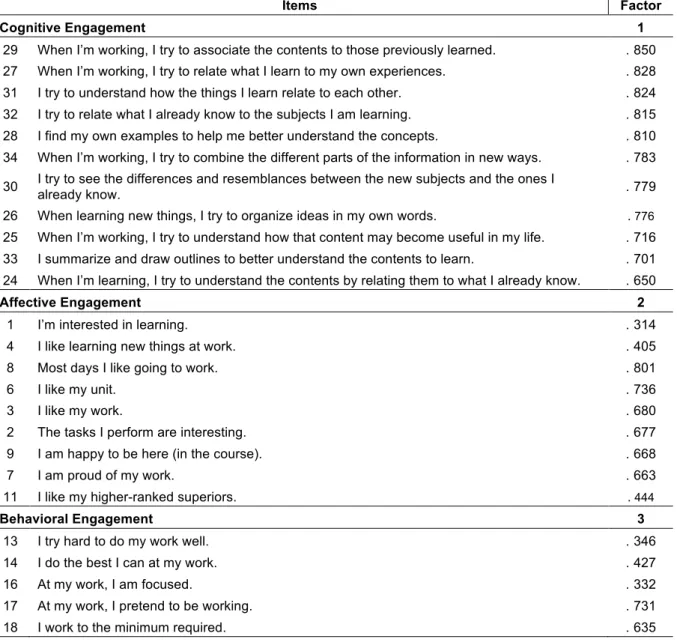
To analyse the internal validity, the procedure "Reliability" from the SPSS – version 21 was used. Since this is a scale whose items consist of a new totality and there is no previous study of them, and although the expected number of specific factors was known, an exploratory analysis of item distribution by factors was performed, without indication of the number of factors. The factor analysis of the results to the principal components followed by “varimax” rotation presented six dimensions with little expression. Respecting the theoretical underpinnings that were the construction bases of the scale, the analysis was performed to identify three factors. This procedure allowed the identification of three expressive factors: cognitive engagement, affective engagement and behavioral engagement, with adequate integration of each item in the significance set for each factor (see Table 1). This distribution by three factors presented itself according to theoretically expected, hence being accepted as most adequate. Items 5, 10, 1, 15, 19, 20, 21, 22 e 23 were excluded from the analysis because they were not considered to blend into the factor significance onto which they loaded. As seen in Table 2, the three factors present themselves with an explanation of 58,63% of total variance.
Table 1. Item loadings in rotated matrix.
Items Factor
Cognitive Engagement 1
29 When I’m working, I try to associate the contents to those previously learned. .850 27 When I’m working, I try to relate what I learn to my own experiences. .828 31 I try to understand how the things I learn relate to each other. .824 32 I try to relate what I already know to the subjects I am learning. .815 28 I find my own examples to help me better understand the concepts. .810 34 When I’m working, I try to combine the different parts of the information in new ways. .783 30 I try to see the differences and resemblances between the new subjects and the ones I already know. .779 26 When learning new things, I try to organize ideas in my own words. . 776 25 When I’m working, I try to understand how that content may become useful in my life. .716 33 I summarize and draw outlines to better understand the contents to learn. .701 24 When I’m learning, I try to understand the contents by relating them to what I already know. .650
Affective Engagement 2
1 I’m interested in learning. .314
4 I like learning new things at work. .405
8 Most days I like going to work. .801
6 I like my unit. .736
3 I like my work. .680
2 The tasks I perform are interesting. .677
9 I am happy to be here (in the course). .668
7 I am proud of my work. .663
11 I like my higher-ranked superiors. . 444
Behavioral Engagement 3
13 I try hard to do my work well. .346
14 I do the best I can at my work. .427
Table 2. Total variance explained, by each factor. Facto
r
Initial Eigenvalues Rotation Sums of Squared Loadings
Total % of Variance Cumulative % Total % of Variance Cumulative % 1 14.034 41.275 41.275 9.317 27.403 27.403 2 3.376 9.930 51.205 6.501 19.122 46.524 3 2.526 7.429 58.634 4.117 12.110 58.634 4 1.550 4.559 63.193
The factor analysis of the ASTE-PN revealed and confirmed important dimensions whose significance is specified as follows:
- Cognitive engagement: related to that on motivational goals and self-regulated learning (Boekarts Pintrich & Zeidner, 2000; Fredricks et al., 2004; Zimmerman, 1990);
- Affective engagement: related to that on student attitudes (Epstein & McPartland, 1976; Fredricks et al., 2004; Yamamoto, Thomas, & Karns, 1969) and student interest and values (Eccles et al., 1983);
- Behavioral engagement: related to that on student conduct and on-task behavior (Fredricks et al., 2004; Karweit, 1989; Peterson et al., 1984).
The semantic congruence of factors or scale dimensions is not free of reconsideration and in subsequent studies may be resumed and broadened. The kind of factor analysis used tends to maximize the independence among factors by identifying each item with a single factor. With the purpose of further analyzing the scale’s structure, the relation between each of them was determined (see Table 3) and high positive correlations among all engagement dimensions were found.
Table 3. Correlations among ASTE-PN dimensions. Cognitive Engagement Affective Engagement Behavioral Engagement Total Engagement Cognitive Engagement 1.000 Affective Engagement .564** 1.000 Behavioral Engagement .618** .592** 1.000 Total Engagement .879** .861** .800** 1,000 ** p < .01
In general, it may be said that these dimensions assess the related facets of engagement.
Table 4 shows the coefficients of internal consistency (“alfa” homogeneity indexes) obtained in the several factors, in the general sample.
Table 4. Coefficients of scale and factor internal consistency.
Factors Cronbach’s Alpha No. of items
Cognitive Engagement .948 11
Affective Engagement .885 9
Behavioral Engagement .776 5
As observed, the “alpha” index values in any of the factors and in total engagement – resulting from the sum of scores obtained in each dimension of the ASTE-PN – are high, above 0.78. In general, the values determined by Cronbach’s Alpha suggest very good consistency and coherence of the items of each dimension.
3.2 External Validity
When studying the external validity, it was considered the relation between the results in the ASTE-PN and the scoring on variables specific to commitment in training tasks assessed with the Utrecht Work Engagement Scale (UWES) by Schaufeli and Bakker (2003) – dedication and vigor, absorption and total engagement, resulting from the sum of the scoring obtained in each dimension of the UWES – having had high correlations. In Table 5 the correlation coefficients found are represented, as well as their levels of statistic significance.
Table 5. Correlation coefficients between ASTE-PN and UWES results.
Items Cognitive Engagement Affective Engagement Behavioral Engagement Total Engagement Dedication and Vigor .529** .868** .197* .776** Absorption .382** .709** .139 .596** Total Engagement .507** .853** .184* .754** * p < .05; ** p < .01
The obtained coefficients are statistically significant in general and, as expected, high in the correlation between ASTE-PN and UWES, confirming the external validity of both used scales. The correlations among dedication and vigor and the engagement dimensions of UWES revealed higher than in absorption. It is recognized that such results may have something to do with the robustness of the factor which encompasses two factors – dedication and vigor. This single factor refers to the level of individual engagement at work which leads them to experience a sense of meaningfulness, enthusiasm, inspiration, pride and challenge – a state of high levels of energy and mental resilience while working, will to invest on work, as well as persistence in difficult situations (Frade & Veiga, 2013). This definition comprehends elements of cognitive, affective and behavioral engagement, resulting in quite high correlations with these aspects.
Correlations among affective engagement and dedication and vigor and absorption are higher than those identified in other UWES dimensions. This fact is supposed to be related to the definition of affective engagement itself, intimately connected to the notion of flow (Csikszentmihalyi, 1990), which embodies elements of educational engagement – interest values and emotion – and cognitive engagement elements – motivation and effort.
Likewise is it presumed that the weak or inexistent correlations between behavioral engagement and the ASTE-PN dimensions are due to a conceptualization of this scale’s factors, which present a connotation linked to affective-cognitive states (Schaufeli and Bakker, 2004) and not due to behaviors as much.
4
CONCLUSION
The creation of the ASTE-PN was a consequence of the need to assess the engagement of trainees in military context, together with the scarceness of instruments to assess this construct under such a specific context. This scale is based on the engagement conceptualization by Fredericks, Blumenfeld, and Paris (2004), which highlights three kinds of engagement: cognitive - when students make personal investment into learning in a focused, strategic, and self-regulating way -; affective - exists when students have positive attitudes and reactions towards school, teachers, learning, and peers – and behavioral - student participation in academic, social, and extracurricular activities.
The scale’s psychometric characteristics in terms of internal and external validation are quite satisfactory, its dimensions being congruent to the UWES dimensions, namely in the range of affective-cognitive dimensions.
Considering the preceding, this instrument may be considered useful and adequate to assess the cognitive, affective and behavioral engagement of trainees, specially military personnel. Nonetheless, the conduction of future studies is suggested in order to further analyze the issues hereby exposed.
REFERENCES
[1] Christenson, S. L., Reschly, A. L., & Wylie, C. (2012). The handbook of research on student engagement. New York, NY: Springer Science.
[2] Fredericks, J. A., Blumenfeld, P. C., & Paris, A. H. (2004). School engagement: Potential of the concept, state of the evidence. Review of Educational Research, 74, pp. 59 – 109.
[3] Skinner, E., Furrer, C., Marchand, G., & Kindermann, T. (2008). Engagement and Disaffection in the Classroom: Part of a Larger Motivational Dynamic?. Journal of Educational Psychology, 100(4), pp. 765–781.
[4] Wellborn, J. G. (1991). Engaged and disaffected action: The conceptualization and measurement of motivation in the academic domain. Unpublished doctoral dissertation, University of Rochester, Rochester, NY.
[5] Connell, J. P. (1990). Context, self, and action: A motivational analysis of self-esteem processes across the life-span. In D. Cicchetti (Ed.), The self in transition: From infancy to childhood (pp. 61–97). Chicago: University of Chicago Press
[6] Finn, J.D., & Rock, D.A. (1997). Academic success among students at risk for school failure. Journal of Applied Psychology, 82, pp. 221-234.
[7] Finn, J.D., Pannozzo, G.M., & Achiles, C.M. (2003). The ‘why’s’ of class size: student behavior in small classes. Review of Educational Research, 73(3), pp. 321-368
[8] Kindermann, T. A, (2007). Effects of naturally-existing peer groups on changes in academic engagement in a cohort of sixth graders. Child Development, 78, pp. 1186-1203.
[9] Marks, H.M. (2000), Student engagement in instructional activity: Patterns in the elementary, middle, and high school years. American Education Research Journal, 37(1), pp. 153-184. [10] Skinner, E.A., & Belmont, M.J. (1993). Motivation in the classroom: Reciprocal effects of
teacher behavior and student engagement across the school year. Journal of Educational Psychology, 85(4), pp. 571–581.
[11] Appleton, J. J., Christenson, S. L., & Furlong, M. J. (2008). Student engagement with school: Critical conceptual and methodological issues of the construct. Psychology in the School, 45(5), pp. 369–386.
[12] Schaufeli, W. B., & Salanova, M. (2007). Work engagement: An emerging psychological concept and its implications for organizations. In Gilliland, S. W., Steiner, D. D. and Skarlicki, D. P. (Eds), Research in social issues in management, (pp. 135-177). Information Age Publishers, Greenwich, CT.
[13] Bakker, A.B., Hakanen, J.J., Demerouti, E., & Xanthopoulou, D. (2007). Job resources boost work engagement particularly when job demands are high. Journal of Educational Psychology, 99, pp. 274-284.
[14] Guimarães, S. E. R., Bzuneck, A. J., & Sanches, S. F. (2002). Psicologia Educacional nos cursos de licenciatura: a motivação dos estudantes. Psicologia Escolar e Educacional, 6, pp. 11-19.
[15] Ryan, R. M., & Deci, E. L. (2000). Self-determination theory and the facilitation of intrinsic motivation, social development, and well-being. American Psychologist, 55, pp. 68-78.
[16] Frade, A., & Veiga, F. (2013). Crenças motivacionais e autoconceito em adultos: um estudo com formandos dos cursos de formação de sargentos da marinha portuguesa. Atas do XII Congresso Internacional Galego-Português de Psicopedagogia. Braga: Universidade do Minho, pp. 5110-5124.
[17] Reeve, J. (2012). A self-determination theory perspective on student engagement. In S. L. Christenson, A. Reschly, & C. Wylie (Eds.), Handbook of research on student engagement (Chpt. 7, pp. 149-172). New York: Springer.
[18] Stipek, D. (2002). Good instruction is motivating. In A. Wigfield & J. Eccles (Eds.), Development of achievement motivation (pp. 309-332). San Diego, CA: Academic Press.
[19] Barkley, E. F. (2010). Student Engagement Techniques: A Handbook for College Faculty. San Francisco: Jossey-Bass.
[20] Martin, A. J. (2007). Examining a multidimensional model of student motivation and engagement using a construct validation approach. The British Journal of Educational Psychology, 77, pp. 413 – 440.
[21] Appleton, J.J., Christenson, S.L., & Furlong, M.J. (2008). Student engagement with school: Critical conceptual and methodological issues of the construct. Psychology in the Schools, 45, pp. 369-386.
[22] Reeve, J., Jang, H., Carrell, D., Jeon, S., & Barch, J. (2004). Enhancing students’ engagement by increasing teachers’ autonomy support. Motivation and Emotion, 28, pp. 147 – 169.
[23] Furrer, C., Skinner, E., Marchand, G., & Kindermann, T. A. (2006, March). Engagement versus disaffection as central constructs in the dynamics of motivational development. Paper presented at the Society for Research on Adolescence, San Francisco, CA.
[24] Lam, S., & Jimerson, S. (2008). Exploring Student Engagement in School Internationally. The International School Psychology Survey: Data from Austria, Romania, China, Portugal, and Canada. In XXX ISPA Conference: School Psychology in a Changing Society. Utrecht: University College Utrecht, pp. 8-13.
[25] Janosz, M. (2012). Outcomes of engagement and engagement as an outcome: Some consensus, divergences and unanswered questions. In S. L. Christenson, A. L. Reschly & C. A. Wylie (Eds.), The handbook of research on student engagement (pp. 695-703). New York: Springer Science.
[26] Schunk, D., Pintrich, P., & Meece, J. (2010). Motivation in Education – Theory, research, and applications. London: Pearson Education International.
[27] Connell, J. P., & Wellborn, J. G. (1991). Competence, autonomy, and relatedness: A motivational analysis of self-system processes. In M. Gunnar & L. A. Sroufe (Eds.), Minnesota Symposium on Child Psychology. (Vol 23, pp. 43-77). Hillsdale, NJ: Lawrence Erlbaum Associates.
[28] Finn, J. D. (1989). Withdrawing from school. Review of Educational Research, 59, pp. 117–142. [29] Lam, S., Wong, B., Yang, H., & Liu, Y. (2012). Understanding student engagement with a contextual model. In S. L. Christenson, A. L. Reschly & C. A. Wylie (Eds.), The handbook of research on student engagement (pp. 403-419). New York: Springer Science.
[30] Skinner, E., & Pitzer, J. (2012). Developmental dynamics of student engagement, coping, and everiday resilience. In S. L. Christenson, A. L. Reschly & C. A. Wylie (Eds.), The handbook of research on student engagement (pp. 21-44). New York: Springer Science.
[31] Skinner, E. A., Kindermann, T. A., Connell, J. P., & Wellborn, J. G. (2009). Engagement as an organizational construct in the dynamics of motivational development. In K. Wentzel & A. Wigfield (Eds.), Handbook of motivation at school (pp. 223-247). Mahwah, NJ: Erlbaum.
[32] Blumenfeld, P., Modell, J., Bartko, W.T., Secada, W.G., Fredricks, J.A., Friedel, J., et al. (2005). School engagement of inner-city students durning middle childhood. In C.R. Cooper, C.T.G. Coll, W.T. Bartko, H. Davis & C. Chatman (Eds.), Developmental pathways through middle childhood (pp 145-170). Mahwah, NJ: Lawrence Erlbaum Associates, Publishers.
[33] Pintrich, P. R., & De Groot E. (1990). Motivational and self-regulated learning components of classroom academic performance. Journal of Educational Psychology, 82(1), pp. 33-50.
[35] Corno, L., & Mandinach, E. (1983). The role of cognitive engagement in classroom learning and motivation. Educational Psychologist, 18, pp. 88–108.
[36] Weinstein, C.E., & Mayer, R.E. (1986). The teaching of learning strategies. In M. Wittrock (Ed.), Handbook of research on teaching (pp. 3 15-327). New York, NY: Macmillan.
[37] Corno, L. (1993). The best-laid plans: Modern conceptions of volition and educational research. Educational Researcher, 22, pp. 14–22.
[38] Lee, V. E., & Smith, J. B. (1995). Effects of high school restructuring and size on early gains in achievement and engagement. Sociology of Education, 68, pp. 241–270.
[39] Stipek, D. (2002). Good instruction is motivating. In A. Wigfield & J. Eccles (Eds.), Development of achievement motivation (pp. 309-332). San Diego, CA: Academic Press.
[40] Voelkl, K. E. (1997). Identification with school. American Journal of Education, 105, pp. 204– 319.
[41] Csikszentmihalyi, M. (1990). Flow: The Psychology of Optimal Experience. New York: Harper and Row.
[42] VanDeWeghe, R. (2013). Engaged Learning. London: Sage.
[43] Csikszentmihalyi, M., Rathunde, K., Whalen, & Wong, (1993). Talented teenagers: The roots of success and failure. New York: Cambridge University Press.
[44] Finn, J. D. (1993). School engagement and students at risk. Washington, DC: National Center for Education Statistics.
[45] Finn J. D., Pannozzo G. M., & Voelkl K. E. (1995). Disruptive and inattentive-withdrawn behavior and achievement among fourth graders. Elementary School Journal, 95, pp. 421–454. [46] Birch, S., & Ladd, G. (1997). The teacher–child relationship and children’s early school
adjustment. Journal of School Psychology, 35, pp. 61–79.
[47] Schaufeli, W. B., & Bakker, A. B. (2003). The Utrecht Work Engagement Scale (UWES). Test manual. Utrecht, The Netherlands: Department of Social & Organizational Psychology.
[48] Boekarts, M., Pintrich, P. R., & Zeidner, M. (Eds) (2000). Handbook of self-regulation. San Diego, CA: Academic Press.
[49] Epstein, J, & J.M. McPartland (1976). The concept and measurement of the quality of school life. American Educational Research Journal, 13, pp. 15–30.
[50] Yamamoto, K., Thomas, E., & Karns, E. (1969). School-related attitudes in middle school age students. American Educational Research Journal 6 (2), pp. 191-206.
[51] Eccles, J., Adler, T. F., Futterman, R., Goff, S. B., Kaczala, C. M., Meece, J., & Midgley, C. (1983). Expectancies, values and academic behaviors. In Spence, J. T. (ed.), Achievement and Achievement Motives, W. H. Freeman, San Francisco.
[52] Karweit, N. (1989). Time and learning: A review. In R. E. Slavin (Ed.), School and classroom organization. Hillsdale, NJ: Erlbaum.
[53] Peterson, P. L., Swing, S. R., Stark, K. D., & Waas, G. A. (1984). Students’ cognitions and time on task during mathematics instruction. American Educational Research Journal, 21, pp. 487-515.