Jorge Miguel Carvalho Claro
Licenciado em Ciências da Engenharia Eletrotécnica e Computadores
AGNI: an API for the Control of Automomous Service
Robots
Dissertação para obtenção do Grau de Mestre em Engenharia Eletrotécnica e de Computadores
Orientador: João Paulo Pimentão, Professor Auxiliar, Faculdade de Ciências e Tecnologia – Universidade Nova de Lisboa
Co-orientador: Pedro Sousa, Professor Auxiliar, Faculdade de Ciências e Tecnologia – Universidade Nova de Lisboa
Júri:
Presidente: Doutor Ricardo Luís Rosa Jardim Gonçalves, Professor Associado com Agregação da Faculdade de Ciências e Tecnologia da Universidade Nova de Lisboa
Vogais: Doutor José António Barata de Oliveira, Professor Auxiliar da Faculdade de Ciências e Tecnologia da Universidade Nova de Lisboa
AGNI: an API for the Control of Autonomous Service Robots
Copyright © Jorge Miguel Carvalho Claro, Faculdade de Ciências e Tecnologia, Universidade Nova de Lisboa.
Á minha família…
Acknowledgements
It was a hard journey since 2008, with its ups and downs. The work presented in this dissertation is the result of all the support I got during the last years, studying electrical Engineering.
I would like to thank my mentors and teachers João Pimentão, Pedro Sousa, Tiago Cabral Ferreira and Sérgio Onófre for all the support during the development this research. For many months I worked together with Bruno Dias, and Bruno Rodrigues who shared their ideas and made possible to accomplish the objectives that I intended to. Nuno Zuzarte naturally spread his good humor and João Lisboa, pooled great discussions that enriched my experience through Holos.
All my friends, especially Fábio Miranda, who guided, shared, listened and supported me for many, many years, also deserve my deepest thanks.
Resumo
Com o crescimento do número de dispositivos ligados á internet, a escalabilidade
dos protocolos utilizados para os interligar depara-‐‑se com um conjunto de novos
desafios. Na robótica estes protocolos de comunicação são um elemento essencial e
devem ser capazes de os superar.
Num contexto de uma plataforma de multi-‐‑agentes, os principais tipos de protocolos
de comunicação utilizados na robótica são revistos, desde o planeamento de missões,
até á alocação de tarefas. A forma de representação das mensagens, o seu transporte e
todos os passos envolvidos neste processo num tradicional sistema distribuído
também são tratados.
Uma abordagem à plataforma ROS está também presente, onde a possibilidade de
integrar um dos protocolos de comunicação já existentes no ServRobot, um robot
autónomo, e o DVA, um sistema de vigilância autónomo, é também estudada. A
possibilidade de atribuir missões de segurança ao ServRobot é tratada como objectivo
principal.
Palavras-‐‑chave: Robô; informação; protocolo; arquitetura; comunicação;
distribuído; serviço; missão
Abstract
With the continuum growth of Internet connected devices, the scalability of the
protocols used for communication between them is facing a new set of challenges. In
robotics these communications protocols are an essential element, and must be able to
accomplish with the desired communication.
In a context of a multi-‐‑agent platform, the main types of Internet communication
protocols used in robotics, mission planning and task allocation problems will be
revised. It will be defined how to represent a message and how to cope with their
transport between devices in a distributed environment, reviewing all the layers of the
messaging process.
A review of the ROS platform is also presented with the intent of integrating the
already existing communication protocols with the ServRobot, a mobile autonomous
robot, and the DVA, a distributed autonomous surveillance system. This is done with
the objective of assigning missions to ServRobot in a security context.
Keywords: Robot; information; protocol; architecture; communication;
distributed; service; mission
Contents
ACKNOWLEDGEMENTS ... VII
RESUMO ... IX
ABSTRACT ... X
LIST OF FIGURES ... XIII
LIST OF TABLES ... XV
GLOSSARY ... XVI
1. INTRODUCTION ... 1
1.1 MULTICORE AND CLOUD BASED COMPUTING ... 2
1.2 DISTRIBUTED COMPUTING ... 3
1.3 APPLICATIONS ... 5
1.4 NETWORK ABSTRACTION ... 6
1.5 DISSERTATION OUTLINE ... 7
2. MIDDLEWARE PLATFORMS ... 9
2.1 DEFINING MIDDLEWARE ... 9
2.2 SERVICE-‐ORIENTED ARCHITECTURES AND WEB SERVICES ... 9
2.3 MISSION PLANNING AND TASK ASSIGNMENT ... 11
2.4 PUBLISH/SUBSCRIBE AND MESSAGE-‐ORIENTED MIDDLEWARE ... 16
2.5 QUEUING AND MESSAGING LAYER FRAMEWORKS ... 18
2.5.1 Message Broker versus Peer-‐to-‐Peer (P2P) ... 18
2.5.2 Messaging Frameworks ... 19
2.5.3 Overview ... 24
3. IMPLEMENTATION ... 27
3.2.1 Choice of a Message Framework ... 30
3.2.2 Message Patterns in Use ... 30
3.2.3 Message Language ... 31
3.2.4 Message Format ... 31
3.3 ROS ... 37
3.3.1 Introduction to ROS ... 37
3.3.2 ROS Concepts and Resources ... 38
3.3.3 ROS versus Player ... 39
3.3.4 ServRobot Hardware ... 40
3.3.5 Motor Controller Solution ... 41
3.3.6 Parameter Server and the Roslaunch Tools ... 44
3.3.7 ROS ServRobot Remote Client ... 45
3.3.8 Arduino, Weather Shield and Converter node ... 46
3.3.9 Integration of the Proposed Protocol in the ServRobot ... 47
3.3.10 Protocol Benchmarks and Performance ... 51
3.3.11 Himu node ... 57
3.3.12 Lms1xx node ... 58
4. CONCLUSIONS AND FUTURE WORK ... 59
SCIENTIFIC CONTRIBUTIONS ... 65
REFERENCES ... 67
List of Figures
FIGURE 2.1 -‐ SURF -‐ TRADITIONAL NETWORKED ROBOTIC SYSTEM FOR SPECIFIC ENVIRONMENT E1 [14] ... 12
FIGURE 2.2 -‐ SURF -‐ ROBOTS INTEGRATED INTO CURRENT SERVICE ENVIRONMENTS [14] ... 12
FIGURE 2.3 -‐ SURF -‐ DETAILED ARCHITECTURE [14] ... 13
FIGURE 2.4 -‐ ROBOLINK PROTOCOL ARCHITECTURE [15] ... 14
FIGURE 2.5 -‐ SANCTA PLATFORM ARCHITECTURE [17] ... 15
FIGURE 2.6 -‐ MESSAGE BROKER ARCHITECTURE ... 19
FIGURE 2.7 -‐ PEER-‐TO-‐PEER ARCHITECTURE ... 19
FIGURE 3.1 -‐ PROJECTED ARCHITECTURE [24] ... 29
FIGURE 3.2 -‐ EXAMPLE OF A “START TELEOPERATION” MESSAGE REQUEST ... 32
FIGURE 3.3 -‐ EXAMPLE OF A EMERGENCY MESSAGE ... 32
FIGURE 3.4 -‐ EXAMPLE OF A HEARTBEAT MESSAGE ... 32
FIGURE 3.5 -‐ EXAMPLE OF A REGISTRATION MESSAGE ... 33
FIGURE 3.6 -‐ MESSAGES EXCHANGE UML ... 36
FIGURE 3.7 -‐ RQT ROS GUI FRAMEWORK [30] ... 38
FIGURE 3.8 -‐ SERVROBOT [33] ... 40
FIGURE 3.9 -‐ SERVROBOT INTERNAL DIAGRAM ... 41
FIGURE 3.10 -‐ ROS NODES AND TOPICS GRAPH FOR THE BASIC ROBOT CONTROL ... 44
FIGURE 3.11 -‐ EXAMPLE OF A .LAUNCH FILE ... 45
FIGURE 3.12 -‐ SSH DIAMOND SYSTEMS HERCULES II BATCH START SCRIPT ... 45
FIGURE 3.13 -‐ ROS SERVROBOT REMOTE CLIENT ... 46
FIGURE 3.14 -‐ ARDUINO MEGA 2560 WITH SPARKFUN WEATHER SHIELD ... 47
FIGURE 3.15 -‐ ADD NEW SENSOR FUNCTION ... 48
FIGURE 3.16 -‐ ROS TOPIC SUBSCRIBER UPDATING THE HASH-‐TABLES ... 49
FIGURE 3.17 -‐ /ROSZMQDRIVER REGISTRATION FUNCTION ... 49
FIGURE 3.18 -‐ EXAMPLE OF A PUBLISHER ROSJAVA CANCELABLE LOOP ... 50
FIGURE 3.19 -‐ PARAMETER LISTENER FOR HEARTBEAT UPDATE INTERVAL ... 51
FIGURE 3.20 -‐ ONE-‐WAY SIMPLE MESSAGE REQUEST DELAY ... 52
FIGURE 3.22 -‐ DELAY OF THE XML MESSAGE GENERATE PROCESS ... 55
FIGURE 3.23 -‐ DELAY OF THE XML MESSAGE SCHEMA VERIFICATION AND PARSING ... 56
FIGURE 3.24 -‐ DELAY OF THE ZMQ MESSAGE SERIALIZATION ... 57
FIGURE 3.25 -‐ XSENS INERTIAL MEASUREMENT UNIT ... 57
FIGURE 3.26 -‐ SICK LMS111 LIDAR ... 58
FIGURE 4.1 -‐ ROS GRAPH WITH ALL NODES AND TOPICS ... 61
FIGURE 4.2 -‐ DVA WEBSITE [35] ... 62
List of Tables
TABLE 2.1 -‐ SANCTA PREDEFINED COMPONENT LIST [17] ... 16
TABLE 2.2 -‐ COMPARISON OF MIDDLEWARE PLATFORMS ... 24
TABLE 3.1 -‐ TEST BENCH WITH ONE-‐WAY SIMPLE MESSAGE REQUEST DELAYS ... 52
TABLE 3.2 -‐ TEST BENCH WITH SIMPLE MESSAGE REQUEST-‐REPLY DELAYS ... 53
TABLE 3.3 – TEST BENCH TO GENERATE MESSAGE PROCESS ... 54
TABLE 3.4 -‐ TEST BENCH TO XML VALIDATION AND PARSING DELAY ... 55
TABLE 3.5 -‐ TEST BENCH WITH ZMQ SERIALIZATION DELAYS ... 56
Glossary
AGNI The API for the control of autonomous service robots presented in this dissertation.
AMQP The Advanced Messaging Queuing Protocol is an open standard application layer protocol for message-‐‑oriented middleware.
API Application Programming Interface is a set of programming instructions and standards for accessing a Web-‐‑based software application or Web tool. A software company releases its API to the public so that other software developers can design products that are powered by its service.
ARM ARM is a family of instruction set architectures for computer processors based on a reduced instruction set computing (RISC) architecture developed by British company ARM Holdings.
CORBA Common Object Request Broker Architecture is a standard for interoperability in heterogeneous computing environments. It enables applications to overlay different technologies and programming languages. It specifies how client applications can invoke operations on server objects.
CPU A central processing unit (CPU) is the hardware within a computer that carries out the instructions of a computer program by performing the basic arithmetical, logical, and input/output operations of the system.
DDS The Data Distribution Service for Real-‐‑Time Systems is an Object Management Group (OMG) M2M middleware standard that directly addresses publish-‐‑subscribe communications for “real-‐‑time” and embedded systems.
DPWS Device Profile for Web Services is a set of constraints that resource constrained devices should implement in order to enable secure and seamless Web service messaging.
DVA Is a distributed autonomous surveillance system able to detect risk situations using different types of sensors and their geo-‐‑localization.
GUI In computing, a graphical user interface is a type of interface that allows users to interact with electronic devices through graphical icons and visual indicators such as secondary notation, as opposed to text-‐‑based interfaces, typed command labels or text navigation.
IP An Internet Protocol address (IP address) is a numerical label assigned to each device (e.g., computer, printer) participating in a computer network that uses the Internet Protocol for communication.
IT Information technology is the collection of technologies that store, retrieve, transmit and manipulate data, often in the context of a business or other enterprise.
JMS Java Message Service API is a Java Message Oriented Middleware (MOM) API for sending messages between two or more clients
M2M Machine-‐‑to-‐‑Machine refers to technologies that allow both wireless and wired systems to communicate with other devices.
MAC A media access control (MAC) address is a unique identifier assigned to network interfaces for communications on the physical network segment. MAC addresses are used as a network address for most IEEE 802 network technologies, including Ethernet.
receiving messages between distributed systems. MQTT Message Queuing Telemetry Transport is a message-‐‑
centric wire protocol designed for telemetry-‐‑style data, along high latency or constrained networks, to a server or small message broker, typically used in M2M communications.
OWL The Web Ontology Language (OWL) is designed for use by applications that need to process the content of information instead of just presenting information to humans.
OWL-‐‑S Web Ontology Language for Services (OWL-‐‑S) is the Semantic Web Services description language. OWL-‐‑ S builds on the Ontology Web Language (OWL). P2P Peer-‐‑to-‐‑peer computing or networking is a
distributed application architecture that partitions tasks or work loads between peers. Peers are equally privileged, equipotent participants in the application.
PID A Proportional-‐‑Integral-‐‑Derivative (PID) controller is a control loop feedback mechanism (controller) widely used in industrial control systems.
PLAYER Robot framework, client/server based, where the client is an external program that interacts with the player server using classic TCP/IP sockets.
performance for traffic.
Qt Qt is a cross-‐‑platform application framework that is widely used for developing application software with a graphical user interface (GUI).
REST Representational state transfer is a style of software architecture for distributed systems such as the World Wide Web-‐‑
ROS The Robot Operating System (ROS) is a flexible framework for writing robot software. It is a collection of tools, libraries, and conventions that aim to simplify the task of creating complex and robust robot behavior across a wide variety of robotic platforms.
ROSJAVA Rosjava provides both a client library for ROS communications in java as well as growing list of core tools (e.g. tf, geometry) and drivers.
Rqt Rqt is a library for calling R functions within C++/Qt4 applications. The argument interface uses QVariant for flexible exchange of data to and from R. This allows R calls as if they were part of the local Qt environment.
RS-‐‑232 In telecommunications, RS-‐‑232 is a standard for serial communication transmission of data.
rviz ROS 3D visualization tool.
ServRobot Is an autonomous service robot designed specially to be integrated in surveillance systems.
everyday commerce and science.
SOA The concept of Service-‐‑Oriented Architecture (SOA) defines a way to organize and utilize distributed capabilities that may be controlled by different organizations or different owners.
SOAP Simple Object Access Protocol is an Exchanging XML-‐‑based messaging protocol used as a component of various middleware platforms including CORBA, JMS, and other proprietary platforms.
URI Uniform resource identifier is a string of characters used to identify a name of a web resource.
Wire Protocol The term “wire protocol” is commonly used to describe how the information is represented and transferred at the application layer from point-‐‑to-‐‑ point in the network.
WS-‐‑NOTIFICATION WS-‐‑Notification is a family of related specifications that define a standard Web services approach to notification using a topic-‐‑based publish/subscribe pattern.
WSN Is a wireless sensor network of spatially distributed intelligent sensors to monitor physical or environmental conditions, and cooperatively pass their data through the network to a central location. XML Extensible Markup Language (XML) is a subset of
applications or vendors. In other words XML is the Web'ʹs language for data interchange.
ZMQ Zero Message Queue (ZMQ), it’s a lightweight message-‐‑driven middleware library, specially designed for high throughput and low latency scenarios, such as AMQP that can be found in financial systems.
1.
Introduction
With the continuum growth of Internet connected devices, the scalability of the protocols used for communication between them is facing a new set of challenges. In robotics these communications protocols are an essential element, and must be able to accomplish with the desired communication.
In a context of a multi-‐‑agent platform, this dissertation refers to the main types of internet communication protocols used in robotics, mission planning and task allocation problems. How to represent a message and how to handle with their transport between devices in a distributed environment, reviewing all the layers of the messaging process, is the key objective of this dissertation.
A small review of the Player and ROS platform is also presented where the possibility of using one of the already existing communication protocols within the ServRobot, a mobile autonomous robot, capable of obstacle avoidance, follow people, among other functionalities and the DVA, a distributed autonomous surveillance system able to detect risk situations using different types of sensors and their geo-‐‑localization, is also considered. The objective consists of assigning missions to ServRobot in a security context.
1.1 Multicore and Cloud based Computing
Until a few years ago, multi-‐‑core CPUs were expensive and rare, and limited to higher-‐‑end servers. To achieve higher performance, the only solution was to increase more and more the clock cycles out of one single core CPUs, which lead to severe heat dissipation problems among other things. Today the multi-‐‑core CPUs have become very common and inexpensive, even in small devices that everybody uses in a day-‐‑to-‐‑day basis, like smartphones. While the clock speeds trends to become stable, as have been seen for the last years, the number of cores per processor is doubling every two years or less. Moore'ʹs Law still applies [1], [7].
There are several motives that support this change of approach when dealing with processing higher volumes of data. Manufacturers have found multi-‐‑core to be the best way to scale their architectures and offer more competitive products, and the spreading of multitasking operating systems, which can translate that power into performance, justify this even more.
Supercomputing, in the other end, faces similar problems. The cost of a single high-‐‑end computer can be much higher and more difficult to maintain when compared with a cluster of more common and cheaper computers networked together to achieve a common goal. These networked computers can be even faster, more reliable, more flexible and fault tolerant.
Cloud Computing, considered as the long-‐‑held dream of computing, has the potential to solve the large part of these problems. It refers to the ability to develop applications, without concerning about overprovisioning for a service whose popularity does not meet the expected predictions, thus wasting costly resources, or under provisioning for one that becomes wildly popular, thus missing potential customers and revenue. It refers also to the hardware and systems software in the data centers that provide those services. This flexibility that allows companies to scale their products, without paying for premium is unprecedented in the history of IT [2].
1.2 Distributed Computing
There are several definitions for distributed systems such as: “a system in which hardware or software components located at networked computers communicate and coordinate their actions only by message passing” [3] or “A collection of independent computers that appear to the users of the system as a single computer” [4].
In distributed systems, different ways of organizing multiple processors have been proposed. The tightly-‐‑coupled systems which consist in several processors connected together by the same bus, and sharing the same memory. And the loosely-‐‑coupled systems consisting of independent devices, each with their own separate bus and memory, sharing data over a network to achieve a predefined goal.
The term distributed can also be used in a wider sense. There are several processing methods, besides of how the processors are organized. The systems can be programmed to exchange messages inside the same process (in-‐‑process), between processes (inter-‐‑process), or between different systems [5], [6].
Some properties of distributed systems are listed below [7], [8].
• Collaboration and connectivity -‐‑ One of the main motivations of distributed systems is their ability to connect a high quantity of geographically distributed information and services.
• Performance and scalability -‐‑ Over time, software is required to serve more users and require more performance to be able to scale up in order to handle the increased load and data transmission requirements.
• Reliability and topology -‐‑ Making a distributed system reliable is very important. The failure of a distributed system can result in anything from easily repairable errors to catastrophic meltdowns. A reliable distributed system is designed to be as fault tolerant as possible, reducing the dependability on the components. The topology of the components can be classified in two classes.
o Physical topology -‐‑ Where are all physical devices and
network devices are interconnected in the real world.
o Virtual topology -‐‑ Where all virtual devices, responsible for
sending commands, store data, route information among the desired devices, and apply security rules in the network, are represented.
• Redundancy and fault tolerance -‐‑ If there are no additional mechanisms providing redundancy, it may make the system more vulnerable, since the failure of any element might impair the proper working of the whole system. The correct operation of all elements when facing partial failures is also a desired property, even if it is part of the network itself that fails.
• Flexibility and responsiveness -‐‑ In order to accomplish different service missions in the same environment, one of the most convenient solutions is to use heterogeneous or flexible robots. When changes are introduced in the working environment or mission conditions, task added or removed, low latency until achieving good results is a good way to grant a good responsiveness of the whole system.
• “Forgotten Synchronization” -‐‑ When developing programs using multiple threads accessing shared data, freezes, bizarre loops and data corruption may occur. To avoid this kind of problems, developers must use protective locks and semaphores on critical parts of the code. Only this way shared data is safely read or written by one thread at a time. • “Incorrect Granularity” -‐‑ Splitting code into parts to protect it, does not
grant that the system is going to work properly. Developers can easily make some sort of mistake, failing to consider all possible behaviors of the system. Those parts of dangerous code can be too large and they cause other threads to run slowly, or they can be too small, failing to protect the shared data properly.
• “Lock-‐‑free reordering” -‐‑ Even taking care of the number of locks in code, the compiler and the CPU are free to reorder instructions to make things run faster, causing inconsistency in the code. This reordering problem can cause some randomly breaks. To solve this, the solution is to add some kind of “memory barriers” to protect the code.
• “Lock convoys” -‐‑ When too many threads ask for the same lock at the same time, the entire application may freeze. There is no real solution to this problem except to try to reduce lock times and reorganize the code to reduce the probability of this problem.
There are some other rules besides these ones, but they cover more specific problems not much relevant for the main themes in this dissertation.
1.3 Applications
calculations. The financial services industry spends billions on new IT initiatives every year, and there are lots of research and development projects over the world [5].
1.4 Network Abstraction
There are several ways available to communicate in a networked distributed environment, where the wide range of protocols can be very heterogeneous. When configuring, each component should be independent from the network interface it uses and from the protocol used to define the rules how the messages are transported. To handle the necessity to transmit information consistently, many developers end up doing some kind of messaging. There are some message queuing products that developers can use, but most of the time, they end up using simple TCP and UDP sockets.
In general TCP and UDP protocols are not hard, but when implementing large systems where the amount of data being transmitted is much higher, there are a lot of problems that need to be solved. Any messaging layer must take care of all or most of these [10]:
• When designing a messaging layer, the way the I/Os are handled must be defined. The application that creates architectures that not scale well must be blocked or opt to run the I/O procedures in the background, but that can be very hard.
• Split the components into “client/servers” and hope that servers do not disappear, or define an interval to try to reconnect every few seconds if the connection is lost, are both valid ways to handle the dynamics of our system.
• The message format on the network is also an important factor to consider. The message must be small, easy to read and write, safe from buffer overflows and easy to route between devices. Besides it must be able to be adequate to transmit large files granting their consistency.
• Distinct platforms such as: Windows, Unix, Solaris, between many others, represent the data in different formats, therefor there are many compatibly problems even at the operating systems layer.
1.5 Dissertation Outline
In the next chapter of this dissertation, there is an introduction to the definition of middleware; to the way the different types of middleware platforms can be organized in different groups, and a comparison between the broker based and peer-‐‑to-‐‑peer messaging concepts. In the end of the chapter, is presented a table with a detailed comparison of the most important specifications of the different messaging layer frameworks, including the ROS (Robot Operative System), which will be addressed later.
The third chapter is focused in the implementation. It starts with the proposed architecture, including the reasons taken to the choice of the previously boarded messaging layer frameworks, the message language and format used over it. The ROS platform and the basic modules needed for the developed of this API are explained, starting from here, with the concepts and resources available, through the ServRobot hardware, implemented ROS nodes and finally, the performance benchmarks.
2.
Middleware Platforms
2.1 Defining Middleware
Most middleware messaging frameworks try to solve distributed architectures problems in modern distributed systems.
Creating a layer that insulates the application developer from the worries about implementation details, like different operative systems and different network interfaces. Middleware frameworks also allow the programmer to integrate applications developed for different executions contexts and in different times [7].
2.2 Service-‐‑Oriented Architectures and Web Services
organizations or different owners. It designates anything contributing to an enterprise platform based on service-‐‑oriented principles [11].
SOA provides the adequate means to offer, discover and interact with independent or loosely-‐‑coupled systems and inter-‐‑operable or tightly-‐‑coupled systems to support the exigent requirements of the business software and applications users [7].
With the emerging technologies, Cloud-‐‑based services and SOAs, as referred in section “1.1 Multicore and Cloud based Computing”, are booming, serving every client, ranging from casual Internet users to IT giants, and opening many possibilities of research advances by the scientific community. This includes more computational power, storing, networking and new infrastructure innovations, allowing significant progresses in understanding and solving complex real-‐‑world challenges [7][12]. Such challenges normally require a new approach when modeling a complex system at different levels of abstraction. It helps addressing separate system requirements and concerns, and integrates diverse sources of knowledge on the system’s components and their interactions [12].
should implement in order to enable secure and seamless Web service messaging [13].
2.3 Mission Planning and Task Assignment
Web Services technologies are already mature and support many middleware products and tools. It is important that robots deployed over large distributed systems use open standards and can communicate independently from the lower levels in the protocol stack.
With the progress of those communication protocols, many researchers have been working in Internet based remote control, monitoring, mission planning and task allocation platforms, with the objective of controlling mobile robots, unnamed vehicles or simple sensors in a networked environment.
Heterogeneous robots deal with different capabilities, disparity of tasks that can be performed, secondary problems like localization and navigation, are factors that affect the outcome of a mission. Besides those factors, distributed robot systems allow users from all over the world to visit museums, automatize distribution and storage centers, manufacturing systems or networks of embedded devices. They have great potential for industry, education, entertainment and security by making valuable robotic hardware accessible to a broad audience [8].
The main goal of mission planning and task allocation in a multi robot team is to optimize available resources, and integrate them into ubiquitous computing environments using a service-‐‑oriented approach. One good example of a platform capable of this, is SURF (Service-‐‑oriented Ubiquitous Robotic Framework) [14].
• EKR (Environmental Knowledge Repository) -‐‑ It stores KB (Knowledge Bases) with knowledge about the Web Services in OWL-‐‑S (Web Ontology Language for Services) the Semantic Web Services description language.
• SA (SURF agent) -‐‑ It can automatically discover required knowledge using KB to communicate with specific device and build a feasible service plan for according with the mission plan and the current environment.
• DWS (Device Web Service) -‐‑ Each DWS can have control objects for one device or multiple devices that may work cooperatively, for instance air-‐‑ conditioning devices and temperature sensors. It uses SOAP to transmit and receive the messages between them.
This structure allows SA to adapt their plans, when it is placed in unknown environments or when a new sensor is added to the actual one.
Figure 2.1 -‐‑ SURF -‐‑ Traditional networked robotic system for specific environment E1 [14]
Figure 2.3 -‐‑ SURF -‐‑ Detailed architecture [14]
RoboLink protocol provided by the Robolink Consortium, which includes different manufacturer companies and vendors, is another platform based on Web Services.
When compared with SURF is was not implemented for mission planning capabilities, only for scattered communication among loosely coupled robots, promoting the standardization of the robot architecture and connecting robots to the network [15], [16].
The RoboLink Protocol defines two main blocks:
• RoboLink Common Protocol -‐‑ It provides common functions to connect to a network and to communicate (session management, conversation, security).
Figure 2.4 -‐‑ RoboLink protocol architecture [15]
The Basic Profile includes all essential functions transversal for all kinds of robots, Motion Profile includes the basic low level motion functions, Dance profile gives control to independent components and Motion Pattern Profile is used to instruct a robot with the specification of the predefined movement pattern.
One last protocol important for the theme of this dissertation is SANCTA: An Ada 2005 General-‐‑Purpose Architecture for Mobile Robotics Research. As the name says, Sancta is a flexible architecture for controlling multi-‐‑robot teams mainly written in Ada 2005 programming language.
Accordingly with A. Mosteo:
“The SANCTA architecture receives its name from Simulated Annealing Constrained Task Allocation, since these are the first novel features that it implemented in the field of multi-‐‑robot task allocation. Simulated annealing is a probabilistic tool useful for optimization problems with large solution spaces, able to escape local minima and, with enough running time, find good solutions or even the optimal one” [17].
The SANCTA can be integrated with different robot platforms like Player, as it was tested with, or even ROS (Robot Operative System), since it provides an integration module.
Figure 2.5 -‐‑ SANCTA platform architecture [17]
Different executions modes can be used when assigning tasks, since Periodic, Event-‐‑driven or Asynchronous.
• Periodic: After an initial call, a determined interval can be defined for each subsequent run slice.
• Event-‐‑driven (or synchronous): This mode is based in a Publish/Subscribe middleware, where a specific component subscribes a topic of interest from a database and using an observer pattern it will invoke a specific procedure.
Table 2.1 -‐‑ SANCTA Predefined component list [17]
2.4 Publish/Subscribe and Message-‐‑Oriented Middleware
those that react to external stimuli and events, such as control systems and online stock trading systems [7].
The main aspects that prevent these systems to work properly in a request/response model can be summarized in synchronous communications restrictions between client and server. These restrictions can derail parallelisms necessary to the well function of these. The client must know the identity of the server, and bound a partnership between them, forming a point-‐‑to-‐‑point communication, where no other component can interact with them [7].
An alternative to convey its information to all interested recipients, distributed systems must use message-‐‑oriented middleware to handle the messages transactions. The main advantages when comparing with request/response systems include its support for asynchronous communications, where the senders don’t need to lock threads until they receive a reply. Many message-‐‑ oriented middleware platforms provide a set of properties, where messages are reliable queued and/or persisted until needed by the receiver.
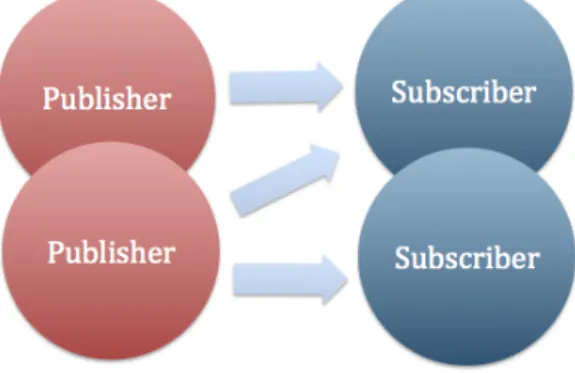
Publish-‐‑subscribe is a sibling of message queue paradigm and defines a pattern where publishers and subscribers are loosely coupled and thus do not know about each other existence. The main elements of a publish/subscribe middleware can be defined as:
• Publishers, the source of information. They classify and update information in topics that can later be read by subscribers interested on it.
• Subscribers, the information sinks. Every subscriber can request data from different topics and only receive messages from topics subscribed by it. Multiple subscribers can receive messages from the same publisher, and they don'ʹt have knowledge of what or how many publishers have written in a specific topic.
• Topics, the components in the system that create a channel, and propagate information from the publishers to subscribers. These channels propagate information across distribution domains to remote subscribers and can perform various services, such as filtering and routing, QoS enforcement, and fault management.
To represent the information passed from publishers to subscribers, there are various options available, ranging from, simple text messages to even richly-‐‑ typed data structures like XML. This flexibility allows the interfaces to be generic, such as send and receive methods that exchange arbitrary dynamically typed XML messages in WS-‐‑NOTIFICATION, or specialized formats, such as a data writer and data readers that exchange statically typed event data in DDS [7].
2.5 Queuing and Messaging Layer Frameworks
When the necessity of planning missions or any framework dedicated to their assignment to the robots could not be discarded, messages syntax, identification, routing, transportation, and error checking among other problems, still need to be solved. This is where messaging frameworks take in action.
Messaging platforms abstract some of the these low-‐‑level details or socket types, allowing to hide much of the complexity, that developers are forced to repeat in their applications, every time they try to exchange messages in a consistent way.
2.5.1 Message Broker versus Peer-‐‑to-‐‑Peer (P2P)
There are two main approaches to control the way the messages are exchanged between nodes, broker-‐‑based or peer-‐‑to-‐‑peer.
and delivery service. Subscribers only connect with the broker agent, and do not have to keep track of the status of the publishers, considering that it also performs message filtering, and prioritize a queue before routing [18].
Figure 2.6 -‐‑ Message Broker Architecture
In peer-‐‑to-‐‑peer implementations, subscribing node directly contacts every publisher, which is publishing a specific topic and maintains a separate subscription to each of them. This method has the advantage of independent connections between the nodes, leading to a more stable and more robust system. If the bandwidth of the underlying network is large enough, it also provides a low latency between the publishers and the subscribers [18].
Figure 2.7 -‐‑ Peer-‐‑to-‐‑Peer Architecture
2.5.2 Messaging Frameworks
2.5.2.1 AMQP
AMQP (Advanced Messaging Queuing Protocol) is a message-‐‑centric protocol born proposed by the financial sector, aimed to free users from proprietary and non-‐‑interoperable messaging systems. As well as JMS (Java Message Service), it was designed to address applications requiring fast and reliable business transactions, but unlike it, AMQP assures that implementations from different vendors are truly interoperable. JMS merely defines an API (Application Programming Interface) and AMQP is a true wire protocol. The term “wire protocol” is commonly used to describe how the information is represented and transferred at the application layer from point-‐‑ to-‐‑point in the network.
AMQP uses a binary encoding format and provides flow control with message-‐‑ delivery guaranties such at-‐‑most-‐‑once (where each message is delivered once or never), at-‐‑least-‐‑once (where the message will always certainly arrive and do so only once), and authentication and/or encryption based on SASL (Simple Allocation and Security Layer) and/or TLS (Transport Security Layer), assuming an underlying reliable transport layer protocol [19].
2.5.2.2 JMS
Java Message Service (JMS) is one of the most widely used publish-‐‑ subscribe messaging technologies. JMS is a message centric API for sending messages between two or more clients. JMS is part of Java Enterprise Edition (Java EE) and assures the communications of distributed and loosely-‐‑coupled applications based on Java EE. JMS is asynchronous and supports both point-‐‑ to-‐‑point and publish-‐‑subscribe style routing. The main limitations of JMS is that it is only a Java API standard, and does not define a wire protocol [19].
2.5.2.3 MQTT
networks, to a server or small message broker, typically used on M2M (Machine-‐‑to-‐‑Machine) communications.
Is an extremely simple protocol, supports publish-‐‑subscribe style and devices may range from sensors, actuators, smartphones, embedded systems on vehicles, or full-‐‑scale computers.
MQTT uses a binary encoding, and supports partial interoperability between different MQTT implementations. The Message body must be agreed between peers, otherwise the message cannot be interpreted [19].
2.5.2.4 REST
Representational State Transfer (REST) started as the predominant Web API design model in the context of HTTP (Hypertext Transfer Protocol), but not limited to that. RESTful style architectures are based on conventionally request-‐‑ response messaging style. It defines resources as any coherent and meaningful concept that may be addressed, based or not, in already existing applications layer protocols if they provide a rich and uniform vocabulary capable to represent a state [19].
2.5.2.5 CoAP
Constrained Application Protocol (CoAP) is a document transfer protocol designed to allow very simple electronic devices to communicate over the Internet. CoAP is lightweight, runs over UDP with support for multicast addressing, and is often used in WSNs (Wireless Sensor Networks). CoAP is compatible with client-‐‑server model based on RESTful architectures in which resources are server controlled abstractions identified by Universal Resource Identifiers (URIs). This new standard enables the use of IPv6 in Low-‐‑Power and Lossy-‐‑Networks (LLNs) such as those based on IEEE 802.15.4 and is currently being standardizing by the IETF (Internet Engineering Task Force) [19].
2.5.2.6 DDS
Data Distribution Service (DDS) was designed to support large scale, real-‐‑ time data sharing between devices in a network. It is used in many mission critical systems with large device-‐‑to-‐‑device data exchanges requiring efficient, predictable, low latency and reliable data sharing.
Unlike other platforms such as AMQP, MQTT or JMS, DDS provides support for dynamic discovery. This means that DDS doesn´t need to implement a broker agent to exchange messages between peers.
Communication between publishers and subscribers are all based on direct P2P links, between nodes (inter-‐‑process) or even on a single node (in-‐‑process) as referred in section “1.2 Distributed Computing” of this dissertation.
By design DDS´s connectionless architecture scales better than the other protocols when the number of applications on the node producing and consuming data increases [19].
2.5.2.7 ZeroMQ
ZeroMQ (ØMQ/ZMQ) resembles the standard Berkeley sockets. It’s a lightweight message-‐‑driven middleware library, specially designed for high throughput and low latency scenarios, such as AMQP that can be found in financial systems.
messages can be dispatched, delivered and queued (sender or receiver side) in parallel without need to block the main application process [21].
ZeroMQ is routing and network topology aware, since isn’t needed to explicitly manage the peer-‐‑to-‐‑peer connection state. A single ZeroMQ socket is able to bind two or more distinct ports to listen for inbound requests, at the same time without any conflict, or the same in reverse using a single API call to send data to distinct sockets [1], [10].
ZeroMQ has no type specification and does not know anything about the data a user sends. For this reason it has to be used with an external serializer. It’s considered as one of the major candidates to replace CORBA (Common Object Request Broker Architecture), as a standard on distributed systems, facilitating
the collaboration between different operating systems, programming
languages, and computing hardware. [6].
2.5.2.8 ROS
Robot Operating System (ROS) platform arose from the need to integrate common solutions employed in the robotic area and make the development easier. ROS is not a common operating system but rather a mixture of different tools. This high level and service oriented communication concept can be defined as a middleware, whereas the core libraries execute framework functionalities [22].
ROS developers adopted to use peer-‐‑to peer (P2P) communication instead of a centralized node (brokered) to handle the messages. Considering ROS a robot development framework where multiple nodes share information collected by sensors to processing nodes, the P2P model offers better scalability and performance.
2.5.3 Overview
Table 2.2 -‐‑ Comparison of Middleware Platforms
DDS MQTT AMQP JMS
Abstraction Pub-‐‑Sub Pub-‐‑Sub Pub-‐‑Sub Pub-‐‑Sub Architecture
Style
Global Data Space Brokered P2P / Brokered Brokered
Interoperability Yes Limited Yes No Performance 10s of 1000s of
messages per second. Massive fan-‐‑out
performance
Typically 100s to 1000+ messages per second per broker.
Typically 100s to 1000+ messages per second per broker.
Typically 100s to 1000+ messages per second per broker.
Real-‐‑time Processing
Yes No No No
Transport Layer
UDP by default TCP can also be used
TCP TCP Not Specified Typically TCP
Subscription Control
Partitions, Topics; Message filtering
Topics with hierarchical matching
Exchanges, Queues and bindings
Topics and Queues; Message filtering
Data
Serialization (Wire Protocol)
CDR Undefined AMQP type system or user defined
Undefined
Encoding Binary Binary Binary Binary Licensing
Model
Open Source; Commercial support
Open Source; Commercial support
Open Source; Commercial support
Open Source; Commercial support Service
Discovery Layer
Yes No No No
Mobile Devices (Android, iOS)
Yes, on commercial applications
Yes Yes Dependent on the OS JAVA
capabilities 6LoWPAN Yes Yes Implementatio
n Specific
Implementation Specific
Security Vendor Specific; SSL; TLS;
Proprietary access control
Simple Username-‐‑ Password; SSL
REST/HTTP CoAP ZeroMQ ROS Abstraction Request-‐‑
Response Request-‐‑ Response Pub-‐‑Sub Parallel-‐‑Pipeline Fair-‐‑Queuing Request-‐‑Response Pub-‐‑Sub Request-‐‑ Response Architecture Style
P2P P2P P2P P2P
Interoperability Yes Yes Limited Limited Performance Typically 100s
of requests per second.
Typically 100s of requests per second
Typically 100s to 1000+ of messages per second. Faster than ROS in every case.
Typically 100s to 1000+ of messages per second. Real-‐‑time
Processing
No No No No
Transport Layer TCP TCP TCP TCP UDP Subscription
Control
N/A Multicast Addressing
Queues Multicast Addressing
Topics
Data Serialization (Wire Protocol)
No Configurable ZMTP TCPROS
Encoding Plain Text Binary Binary Binary Licensing Model HTTP
available for free on most platforms
Open Source with
commercial support
Open Source with commercial support
Open Source
Service Discovery Layer
No Yes Yes Yes
Mobile Devices (Android, iOS)
Yes Via HTTP proxy Yes Yes
6LoWPAN Yes Yes Yes Yes
Security SSL; TLS DTLS Plain-‐‑text Username – Password; Curve25519
3.
Implementation
3.1 Introduction
Surveillance systems are part of the current mechanisms of the society for its protection against events that attempt against people health or goods. These systems have evolved, being less depended of humans and using more sensors'ʹ information to detect events.
In the DVA project (partially sponsored by the European Regional Development Fund and the Portuguese Government), a surveillance system based in geographic position of events and humans agents was developed which improves human-‐‑machine cooperation. This system reduces the dependence on humans in the detection of events and benefits from the location of the events and of human agents to improve and accelerate the response to events. It is composed by: Sensor Agents, Processor Agents, Inference Agent, Action Agents, Mobile Agents, Interface Agent, Backup Agent and Monitor Agent.
autonomous robot, developed in this later project, as an agent of the DVA system. ServRobot is an autonomous service robot designed specially for surveillance activities, and it is composed by many types of sensors, gathering information about its environment. The use of this robot as an agent, enables the execution of tasks (hitherto performed only by humans), by the robot and minimizes human intervention in various hostile situations. The ServRobot should adapt it self to different types of usage and environmental conditions, providing different residing capabilities such as: following people, lines, teleoperation, execute a predefined path based on reference points, avoid possible obstacles, in autonomous navigation and cargo transportation.
Given this partnership, AGNI, an API for the control of autonomous service robots, is presented in this dissertation. Agni is a Hindu deity, and the sacrifices made to Agni go to the deities because Agni is a messenger from and to other gods [23]. AGNI will enable the integration of the ServRobot as a DVA mobile agent.
3.2 Proposed Architecture
To use the autonomous robot, developed in ServRobot, as a new agent in the DVA’s surveillance system, it is necessary to define an integration architecture and a communication protocol. The integration of the robot in DVA'ʹs system could provide new capabilities to this system, such as: send the robot to execute a mission; teleoperate the robot; or get robot'ʹs sensory information.
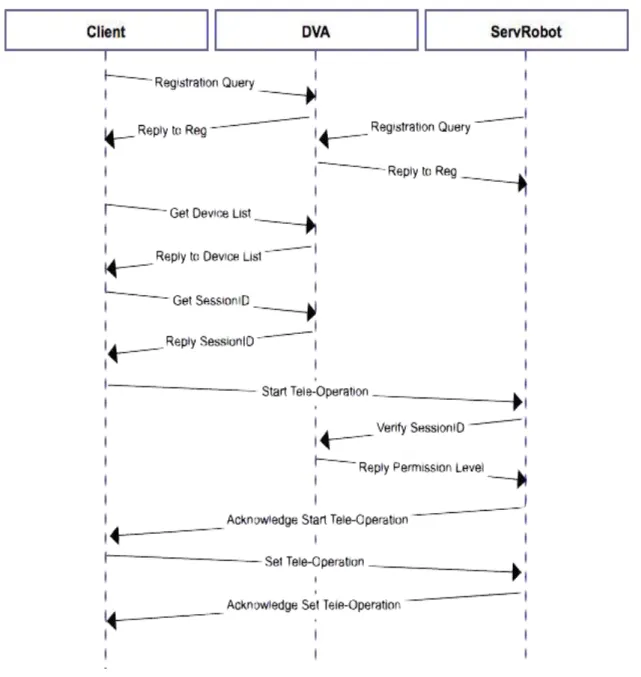
The architecture developed, depicted in Figure 3.1, has three primary nodes, DVA as the core of the architecture, ServRobot representing the robot and the Client representing others devices that can interact with the robot.
The ServRobot node represents the robot as an operable device. The robot must first request a registration to DVA. ServRobot'ʹs sensors can be subscribed by DVA. Subscribing a sensor allows receiving its output’s values updated with a specific frequency. It’s also possible for DVA to request execution of missions or remote control of the ServRobot.
The communication between ServRobot and DVA can be synchronous or asynchronous depending on what is being requested. For example in a teleoperation scenario it’s clearly a synchronous communication, the orders sent to the robot must have a “real time” acknowledgement. If the DVA wants to subscribe to sensors it doesn’t need to reply every time it receives an update, in this case the communication would be asynchronous [24].
Figure 3.1 -‐‑ Projected Architecture [24]
This architecture was projected to be scalable, allowing the integration with other systems. Client node could represent for example a mobile device that interacts directly with a ServRobot by teleoperating it as a remote control.
![Figure 2.1 -‐‑ SURF -‐‑ Traditional networked robotic system for specific environment E1 [14]](https://thumb-eu.123doks.com/thumbv2/123dok_br/16576407.738293/34.892.242.652.609.810/figure-surf-traditional-networked-robotic-specific-environment-e.webp)
![Figure 2.3 -‐‑ SURF -‐‑ Detailed architecture [14]](https://thumb-eu.123doks.com/thumbv2/123dok_br/16576407.738293/35.892.226.753.130.462/figure-surf-detailed-architecture.webp)
![Figure 2.4 -‐‑ RoboLink protocol architecture [15]](https://thumb-eu.123doks.com/thumbv2/123dok_br/16576407.738293/36.892.109.744.125.339/figure-robolink-protocol-architecture.webp)
![Figure 2.5 -‐‑ SANCTA platform architecture [17]](https://thumb-eu.123doks.com/thumbv2/123dok_br/16576407.738293/37.892.193.784.245.506/figure-sancta-platform-architecture.webp)

![Figure 3.1 -‐‑ Projected Architecture [24]](https://thumb-eu.123doks.com/thumbv2/123dok_br/16576407.738293/51.892.226.708.510.956/figure-projected-architecture.webp)
![Figure 3.7 -‐‑ RQT ROS GUI framework [30]](https://thumb-eu.123doks.com/thumbv2/123dok_br/16576407.738293/60.892.154.700.128.485/figure-rqt-ros-gui-framework.webp)