ABSTRACT
BACKGROUND AND OBJECTIVES: Post-traumatic stress disorder is a disabling disorder that can be developed after a per-son has experienced or exposed to a traumatic event. The evi-dence shows the coexistence between post-traumatic stress dis-order and chronic painful conditions as the temporomandibular dysfunction. This study aimed to review the literature to describe the coexistence relation between post-traumatic stress disorder and temporomandibular dysfunction.
CONTENTS: A non-systematic search was carried on the Pubmed, BVS and LILACS databases on studies evaluating the relationship between post-traumatic stress disorder and temporo-mandibular dysfunction. Clinical studies published in the last 10 years that presented a diagnostic criterion validated for temporo-mandibular dysfunction and the post-traumatic stress disorder were selected. Six studies were included in the review. The results showed that the post-traumatic stress disorder often occurs in patients with temporomandibular dysfunction and, at the same time, a higher prevalence of temporomandibular dysfunction is found in individuals with post-traumatic stress disorder. There is a trend for a larger connection between post-traumatic stress disorder and muscular pain than pain in the temporomandibular joint. The presence of post-traumatic stress disorder modulates the level of physical, psychological and behavioral involvement in individuals with temporomandibular dysfunction, and can predict the onset of this painful conditions.
CONCLUSION: The review shows a complex coexistence be-tween post-traumatic stress disorder and painful temporoman-dibular dysfunction.
Keywords: Psychological trauma, Stress disorders, Temporo-mandibular joint dysfunction syndrome, Trauma.
Post-traumatic stress disorder and temporomandibular dysfunction: a
review and clinical implications
Transtorno de estresse pós-traumático e disfunção temporomandibular: uma revisão e
implicações clínicas
Dyna Mara Araújo Oliveira Ferreira1, Camila Cristine de Oliveira Vaz2, Juliana Stuginski-Barbosa1, Paulo César Rodrigues Conti1
1. Universidade de São Paulo, Faculdade de Odontologia de Bauru, Departamento de Pró-tese e Periodontia, Bauru, SP, Brasil.
2. Instituto de Ensino Odontológico de Bauru, Bauru, SP, Brasil. Submitted in September 25, 2017.
Accepted for publication in January 15, 2018. Conflict of interests: none – Sponsoring sources: none.
Correspondence to:
Al. Octávio Pinheiro Brisola, 9-75 17012-901 Bauru, SP, Brasil. E-mail: [email protected]
© Sociedade Brasileira para o Estudo da Dor
RESUMO
JUSTIFICATIVA E OBJETIVOS: Transtorno de estresse pós-traumático é um transtorno incapacitante que pode se desen-volver após exposição ou testemunho de um evento traumáti-co. Evidências demonstram a coexistência entre transtorno de estresse pós-traumático e condições dolorosas crônicas como a disfunção temporomandibular. Este estudo teve como objetivo revisar a literatura para descrever a relação de coexistência entre transtorno de estresse pós-traumático e disfunção temporoman-dibular.
CONTEÚDO: Foi realizada uma busca não sistemática nas bases de dados Pubmed, BVS e LILACS para estudos avaliando a relação entre transtorno de estresse pós-traumático e disfun-ção temporomandibular. Foram selecionados estudos clínicos publicados nos últimos 10 anos e que apresentassem critério diagnóstico validado para a disfunção temporomandibular e o transtorno de estresse pós-traumático. Seis trabalhos foram in-cluídos na revisão. Os resultados demonstraram que transtorno de estresse pós-traumático ocorre frequentemente em pacientes com disfunção temporomandibular e ao mesmo tempo, uma maior prevalência de disfunção temporomandibular é encon-trada em indivíduos com transtorno de estresse pós-traumático. Há uma tendência indicando uma associação maior entre tran-storno de estresse pós-traumático e dor muscular que dor na ar-ticulação temporomandibular. Presença do transtorno de estresse pós-traumático modula o nível de comprometimento físico, psi-cológico e comportamental em indivíduos com disfunção tem-poromandibular e pode predizer início desta condição dolorosa. CONCLUSÃO: A revisão demonstra uma relação de coexistên-cia complexa entre transtorno de estresse pós-traumático e dis-função temporomandibular dolorosa.
Descritores: Síndrome da disfunção da articulação temporo-mandibular, Transtornos de estresse pós-traumáticos, Trauma, Trauma psicológico.
INTRODUCTION
Temporomandibular disorder (TMD) comprises a group of musculoskeletal conditions involving the temporomandibular joint (TMJ), masticatory muscles and associated structures1. It is an important public health problem affecting 5 to 12% of the world population and represents the most common chronic painful condition in the orofacial region2,3.
Post-traumatic stress disorder (PTSD) is a relatively common anxi-ety disorder and can be defined as a set of symptoms that manifests itself after exposure to a stressful or traumatic event4. According to the 5th edition of the Diagnostic and Statistical Manual of Men-tal Disorders (DSM), PTSD diagnosis requires that the subject be exposed to a stressful event such as death, death threat, actual or possible serious injury, actual or possible sexual violence in the following forms: direct exposure, trauma testimony, knowledge that a family member or friend was exposed to trauma, or indirect exposure to trauma details4. PTSD is characterized by symptoms of negative and inopportune thoughts about trauma, nightmares, emotional distress, increased reactivity to stressful stimuli, and dodge/avoidance behavior4. These symptoms’ persistence is what characterizes the pathological picture; i.e., PTSD reflects a failure of physiological and psychological adaptation, in which normal acute reactions to a stressor are not corrected over time5.
Evidence shows that chronic painful TMD pictures often coexist with PTSD. Epidemiological studies have indicated that PTSD is more prevalent in TMD patients when compared to the gen-eral population6,7 and PTSD subjects also presented more TMD than subjects without the disorder8. In addition, the comorbidity relationship between TMD and PTSD may be a complicating factor for TMD handling, as it reduces the efficacy of commonly used therapeutic interventions9.
The clinically observable relationship’s reasons between TMD and PTSD are not fully understood, but some theoretical models have been proposed to explain the relationship between chronic pain and PTSD10-12. Among them, the mutual maintenance model10 is the most widespread and suggests that components related to PTSD and painful condition exacerbate and maintain one another. Considering the negative impact of PTSD in the TMD patients handling, this study aims to describe the rela-tionship of coexistence between TMD and PTSD, as well as the clinical implications involved in this relationship.
CONTENTS
A non-systematic literature search for studies on the relationship between PTSD and TMD published between 2007 and June 2017 was performed in Pubmed, BVS and LILACS databases. The search included the following keywords: lar joint; temporomandibular joint disorders; temporomandibu-lar joint dysfunction syndrome; craniomandibutemporomandibu-lar disorders combined with stress disorders, traumatic; stress disorders, post-traumatic; combat disorders and psychological trauma. The ar-ticles’ titles and abstracts were evaluated to identify the inclusion criteria. There was no restriction for participants’ age and gender. The papers should present primary results and written in Portu-guese or English. The following criteria were adopted to verify the coexistence relationship between PTSD and TMD:
1. Cross-sectional, case-control, randomized clinical trial or co-hort studies;
2. TMD diagnosis based on validated criteria (RDC/TMD13, DC/TMD14 or AAOP guidelines15);
3. Medical PTSD diagnosis, or based on a structured question-naire defined by DSM4,16.
RESULTS
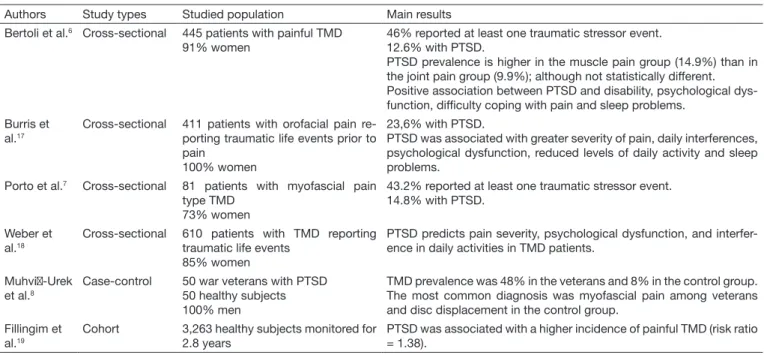
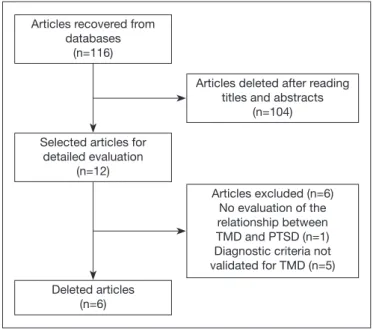
The databases search resulted in 116 articles. After sorting the titles and abstracts, 12 articles were selected for a complete read-ing of the texts. From these, six meet the inclusion criteria6-8,17-19. One paper was excluded because it did not evaluate the relation-ship between TMD and PTSD20 and five because they did not use diagnostic criteria validated for TMD, only evaluating signs and symptoms of dysfunction in the studied population21-25. The flowchart with the article selection process is shown in figure 1, and the information of the studies included in the review is shown in table 1.
Table 1. Information of the included studies
Authors Study types Studied population Main results
Bertoli et al.6 Cross-sectional 445 patients with painful TMD 91% women
46% reported at least one traumatic stressor event. 12.6% with PTSD.
PTSD prevalence is higher in the muscle pain group (14.9%) than in the joint pain group (9.9%); although not statistically different. Positive association between PTSD and disability, psychological dys-function, difficulty coping with pain and sleep problems.
Burris et al.17
Cross-sectional 411 patients with orofacial pain re-porting traumatic life events prior to pain
100% women
23,6% with PTSD.
PTSD was associated with greater severity of pain, daily interferences, psychological dysfunction, reduced levels of daily activity and sleep problems.
Porto et al.7 Cross-sectional 81 patients with myofascial pain type TMD
73% women
43.2% reported at least one traumatic stressor event. 14.8% with PTSD.
Weber et al.18
Cross-sectional 610 patients with TMD reporting
traumatic life events 85% women
PTSD predicts pain severity, psychological dysfunction, and interfer-ence in daily activities in TMD patients.
Muhvi-Urek et al.8
Case-control 50 war veterans with PTSD
50 healthy subjects 100% men
TMD prevalence was 48% in the veterans and 8% in the control group. The most common diagnosis was myofascial pain among veterans and disc displacement in the control group.
Fillingim et al.19
Cohort 3,263 healthy subjects monitored for
2.8 years
PTSD was associated with a higher incidence of painful TMD (risk ratio = 1.38).
The relationship between PTSD and TMD was investigated through cross-sectional, case-control, and cohort studies. Among TMD patients, 43 to 46% reported at least one traumatic stress-or event6,7. PTSD prevalence in TMD patients ranged from 12.6 to 23.6% in the studies6,7,17. The sample of TMD patients was composed mostly of women, with an average age ranging from 37 to 47 years old. One paper evaluated only subjects with mas-ticatory muscle myofascial pain7 and three studies investigated populations with painful muscle and joint TMD6,17,18. In these papers6,7,17,18 the participants were not formally diagnosed (medi-cal diagnosis) with PTSD but had symptoms consistent with PTSD diagnosis identified by Post-Traumatic Stress Disorder Check List-Civilian (PCL-C)26, a structured questionnaire, de-veloped according to the DSM, and validated to investigate the PTSD prevalence in epidemiological surveys.
Only one paper investigated the TMD prevalence in PTSD sub-jects8. TMD prevalence was 48% in PTSD subjects and 8% in healthy subjects. The most common TMD diagnosis was myo-fascial pain among PTSD subjects, while in the control group it was disc displacement. The PTSD population studied consisted of war veterans with an average age of 42 years and with medical PTSD diagnosis.
The positive association between PTSD symptoms and variables such as pain intensity, disability, psychological dysfunction, diffi-culties in coping with pain, interference with daily activities and sleep problems were found in three studies6,17,18.
Finally, a cohort study reported that PTSD predicted the inci-dence of painful TMD in healthy populations with a risk ratio of 1.3819.
DISCUSSION
The bidirectional relationship between PTSD and painful TMD is supported by studies evaluating the prevalence,
inci-dence, and correlation between the two conditions. Approx-imately half of the TMD patients reported at least one life-threatening traumatic event6,7 and 12,6 to 23,6% fulfilled the criteria for PTSD6,7,17. Epidemiological studies show that 30 to 90% of the population report a traumatic events history; however, the PTSD prevalence is less than 10%27,28. Therefore, the included studies indicated a higher PTSD prevalence in TMD subjects than in the general population. These results corroborate a recently published systematic review demonstrat-ing that there is sufficient evidence to confirm the association between PTSD and chronic painful conditions29. In addition, PTSD seems to be strongly associated with certain conditions of chronic pain in the craniofacial segment than other condi-tions. In a subgroup analysis, the PTSD prevalence was higher among subjects with a headache and facial pain (9 to 25%) than in subjects with lumbar pain (0.3 to 0.7%)29,30.
TMD patients reported traumatic stressors of different natures. Knowing that a family member or friend was injured or killed; experiencing automobile accidents and suffering from violent at-tacks were the most commonly reported traumatic experiences and of important personal significance for TMD patients17. PTSD prevalence for different TMD subgroups was investi-gated by Bertoli et al.6. Although not statistically significant, the values indicated a higher PTSD prevalence in subjects with masticatory muscles pain when compared to TMJ pain. An ex-planation for these results is the greater psychological vulner-ability found in subjects with myalgia. These patients present high levels of anxiety, depression, pain-related disability, and report a greater number of stressful events than subjects with arthralgia31,32. Additional studies investigating the PTSD prev-alence in subgroups of TMD patients are needed to elucidate this outcome.
From another perspective, the TMD prevalence is higher in PTSD subjects when compared to subjects without PTSD8. Studies of this nature are carried out mainly in at-risk popula-tions for PTSD, such as war veterans or natural disasters victims. PTSD development after traumatic events is associated with in-creased risk of musculoskeletal pain and functional somatic syn-dromes (FSS)33,34.
In addition, subjects with both conditions, TMD and PTSD, presented greater pain intensity, psychological dysfunction, in-terference with daily activities, sleep problems and pain coping difficulties when compared to subjects without PTSD6,17,18. These results may be reflective of changes in pain processing found in PTSD subjects.
A recent study with quantitative sensory tests demonstrated increased pain sensitivity (hyperalgesia) possibly related to pro-cesses of central sensitization in these subjects35. On the other hand, PTSD was associated with reduced sensitivity to noxious stimuli (hypoalgesia)36. This pattern type suggests preservation of the sensory pathways and absence of central sensitization and indicates that the pain perception in these patients is modulated centrally by emotional factors36. However, it is still uncertain whether alterations in pain processing are pre-existing risk fac-tors for PTSD development or whether they are consequences of exposure to trauma and its neurobiological implications.
Figure 1. Study selection process flowchart
TMD = temporomandibular disorder; PTSD = post-traumatic stress disorder.
Articles recovered from databases
(n=116)
Selected articles for detailed evaluation
(n=12)
Articles deleted after reading titles and abstracts
(n=104)
Deleted articles (n=6)
A set of physiological and psychological processes is triggered when the human being experiences stressful or traumatic events. For many, these physiological changes return to normal once the stressor or trauma is ceased. However, the initial state of hyperex-citation may become chronic for some subjects. Chronic hyper-excitation leads to physiological stress system dysregulation and to the development of several changes.
Studies have demonstrated dysfunction in the hypothalamic-pituitary-adrenal (HPA)37 axis and abnormal activation patterns in frontal-limbic brain areas (prefrontal cortex, hippocampus, insula, and amygdala) in PTSD subjects38. In addition, the trau-ma experience trau-may also affect the interpretation of a potentially threatening stimulus. This interpretation bias may then result in dodge behavior, catastrophic symptoms, and amplification of the disease state34.
Studies investigating the temporal relationship between TMD and PTSD are scarce in the literature and this review identified only one cohort study19. Fillingim et al.19 reported that the PTSD pres-ence in healthy subjects predicts the risk for developing painful TMD (Risk Rate 1.38). This result corroborates with retrospective studies outcomes. A recent meta-analyzes has shown that expo-sure to traumatic life events such as physical, sexual, emotional abuse, war combat or PTSD diagnosis increases by 2.7 times the chance of a subject developing FSS such as TMD, fibromyalgia, generalized chronic pain, chronic fatigue syndrome and irritable bowel syndrome34. In addition, when trauma results in PTSD, the link between exposure to traumatic events and FSS becomes more pronounced. This illustrates the impact that PTSD development following trauma can have on health. While a person exposed to trauma may or may not have a long-term maladaptive response, a subject who develops PTSD will likely have several physiologi-cal, psychologiphysiologi-cal, and behavioral consequences that may limit re-covery and may result in the FSS development34. Further research with prospective methodologies to delineate a temporal relation-ship between PTSD and TMD and the factors that influence this relationship are necessary.
Understanding the reasons that explain the coexistence between PTSD and painful TMD is difficult due to overlapping symp-toms. Both conditions share somatic hypervigilance, dodge be-havior, high levels of fear and arousal to traumatic stimuli, suffer-ing and dysregulation of the stress system28,39. Some theoretical models have been proposed to explain the relationship between chronic pain and PTSD10-12, although none presents significant empirical support. The mutual maintenance model proposed by Sharp and Harvey is the most widespread10. In this model, the cognitive, affective and behavioral components of chronic pain exacerbate and maintain PTSD; while the physiological, affective and behavioral components of PTSD exacerbate and maintain problems related to chronic pain. For example, pain in PTSD subjects can cause discomfort, increase stress, apathy and be a trigger to remember the trauma. On the other hand, remembering the trauma promotes hypervigilance behavior and dodge of activities related to pain that result in the pain experi-ence amplification. The subject then engages in a vicious cycle where the PTSD symptoms and pain interact producing emo-tional distress and self-sustaining funcemo-tional disability10.
Clinical implications
Psychiatric disorders related to traumatic events usually go unno-ticed when evaluating TMD subjects. Considering the high PTSD prevalence in these patients, especially in cases of masticatory muscle myalgia, it is prudent to adopt screening instruments for PTSD, since there is a chance of this condition being present. An-other implication is that treatments for chronic pain are time-con-suming and require patient adherence. Subjects diagnosed with PTSD are three times more likely not to adhere to treatment40. In addition, individuals with painful TMD who report high lev-els of psychiatric symptoms make up a subgroup of patients for whom conventional treatments are ineffective9. In such cases, ef-fective interventions for both TMD and PTSD, including psy-chiatric and psychological therapies, should be considered in the treatment plan.
CONCLUSION
This review described a complex coexistence relationship between PTSD and painful TMD. PTSD frequently occurs in patients with TMD, and at the same time, a higher TMD prevalence is found in PTSD subjects. There is a trend indicating a greater relationship between PTSD and muscle pain than TMJ pain. PTSD presence modulates the level of physical, psychological and behavioral impairment in TMD subjects and can predict the onset of this painful condition.
REFERENCES
1. de Leeuw R, Klasser GD. Diagnosis and Management of TMDs. In: Orofacial Pain: Guidelines for Assessment, Diagnosis, and Management. 5th ed. Chicago:
Quintessen-ce; 2013. 127-85p.
2. Facial Pain. In: National Institute of Dental and Craniofacial Research. Disponível em: http://www.nidcr.nih.gov/DataStatistics/FindDataByTopic/FacialPain/. Acesso em Julho de 2017.
3. Durham J, Shen J, Breckons M, Steele JG, Araujo-Soares V, Exley C, et al. Healthcare cost and impact of persistent orofacial pain: The DEEP Study Cohort. J Dent Res. 2016;95(10):1147-54.
4. Post-Traumatic Stress Disorder. In: Diagnostic and Statistical Manual of Mental Disorders(DSM). 5th ed.2013. Disponível em: https://www.ptsd.va.gov/professio-nal/PTSD-overview/dsm5_criteria_ptsd.asp. Acesso em Julho de 2017.
5. Friedman MJ, Resick PA, Bryant RA, Brewin CR. Considering PTSD for DSM-5. Depress Anxiety. 2011;28(9):750-69.
6. Bertoli E, de Leeuw R, Schmidt JE, Okeson JP, Carlson CR. Prevalence and im-pact of post-traumatic stress disorder symptoms in patients with masticatory mus-cle or temporomandibular joint pain: differences and similarities. J Orofac Pain. 2007;21(2):107-19.
7. Porto F, de Leeuw R, Evans DR, Carlson CR, Yepes JF, Branscum A, et al. Differences in psychosocial functioning and sleep quality between idiopathic continuous orofacial neuropathic pain patients and chronic masticatory muscle pain patients. J Orofac Pain. 2011;25(2):117-24.
8. Muhvić-Urek M, Uhac I, Vuksić-Mihaljević Z, Leović D, Blecić N, Kovac Z. Oral health status in war veterans with post-traumatic stress disorder. J Oral Rehabil. 2007;34(1):1-8.
9. Litt MD, Porto FB. Determinants of pain treatment response and nonresponse: iden-tification of TMD patient subgroups. J Pain. 2013;14(11):1502-13.
10. Sharp TJ, Harvey AG. Chronic pain and posttraumatic stress disorder: mutual main-tenance? Clin Psychol Rev. 2001;21(6):857-77.
11. Asmundson GJ, Coons MJ, Taylor S, Katz J. PTSD and the experience of pain: Re-search and clinical implications of shared vulnerability and mutual maintenance mo-dels. Can J Psychiatry. 2002;47(10):930-7.
12. Scioli-Salter ER, Forman DE, Otis JD, Gregor K, Valovski I, Rasmusson AM. The shared neuroanatomy and neurobiology of comorbid chronic pain and PTSD: thera-peutic implications. Clin J Pain. 2015;31(4):363-74.
13. Dworkin SF, LeResche L. Research diagnostic criteria for temporomandibular disor-ders: review, criteria, examinations and specifications, critique. J Craniomandib Di-sord. 1992;6(4):301-55.
Diag-nostic Criteria for Temporomandibular Disorders (DC/TMD) for Clinical and Re-search Applications: recommendations of the International RDC/TMD Consortium Network and Orofacial Pain Special Interest Group. J Oral Facial Pain Headache. 2014;28(1):6-27.
15. de Leeuw R, Klasser GD. Orofacial Pain: Guidelines for Assessment, Diagnosis and Management. Hanover Park, IL: Quintessence Publishing Company; 2013. 16. American Psychiatric Association. Diagnostic and Statistical Manual of Mental
Disor-ders (DSM), 4th ed. Washington, 2000.
17. Burris JL, Cyders MA, de Leeuw R, Smith GT, Carlson CR. Posttraumatic stress di-sorder symptoms and chronic orofacial pain: an empirical examination of the mutual maintenance model. J Orofac Pain. 2009;23(3):243-52.
18. Weber T, Boggero IA, Carlson CR, Bertoli E, Okeson JP, de Leeuw R. Smoking and posttraumatic stress disorder symptomatology in orofacial pain. J Dent Res. 2016;95(10):1161-8.
19. Fillingim RB, Ohrbach R, Greenspan JD, Knott C, Diatchenko L, Dubner R, et al. Psychological factors associated with development of TMD: the OPPERA prospective cohort study. J Pain. 2013;14(12 Suppl):T75-90.
20. Wiener RC. Oral health perception in veterans with self-identified disabilities: Natio-nal Survey of Veterans, 2010. J Public Health Dent. 2015;75(3):245-52.
21. Schur EA, Afari N, Furberg H, Olarte M, Goldberg J, Sullivan PF, Buchwald D. Fe-eling bad in more ways than one: comorbidity patterns of medically unexplained and psychiatric conditions. J Gen Intern Med. 2007;22(6):818-21.
22. Uhac I, Tariba P, Kovac Z, Simonić-Kocijan S, Lajnert V, Mesić VF, et al. Masticatory muscle and temporomandibular joint pain in Croatian war veterans with posttrauma-tic stress disorder. Coll Antropol. 2011;35(4):1161-6.
23. Mottaghi A, Zamani E. Temporomandibular joint health status in war veterans with post-traumatic stress disorder. J Educ Health Promot. 2014;23;3:60.
24. Ajanović M, Tosum S, Kamber-Ćesir A, Đonlagić A, Kazazić L, Hamzić A. Prevalence of signs and symptoms of temporomandibular disorder in patients with posttraumatic stress disorder. Pesq Bras Odontoped Clin Integr. 2014;14(1):43-8.
25. Afari N, Wen Y, Buchwald D, Goldberg J, Plesh O. Are post-traumatic stress disorder symptoms and temporomandibular pain associated? Findings from a community--based twin registry. J Orofac Pain. 2008;22(1):41-9.
26. Weathers FW, Huska JA, Keane TM. PCL-C for DSM-IV. Boston: National Center for PTSD – Behavioral Science Division; 1991.
27. Kessler RC, Berglund P, Demler O, Jin R, Merikangas KR, Walters EE. Lifetime pre-valence and age-of-onset distributions of DSM-IV Disorders in the National Comor-bidity Survey Replication. Arch Gen Psychiatry. 2005;62(6):593-602.
28. Kilpatrick DG, Resnick HS, Milanak ME, Miller MW, Keyes KM, Friedman MJ. National estimates of exposure to traumatic events and PTSD prevalence using DSM--IV and DSM-V criteria. J Trauma Stress. 2013;26(5):537-47.
29. Fishbain DA, Pulikal A, Lewis JE, Gao J. Chronic pain types differ in their reported prevalence of post-traumatic stress disorder (PTSD) and there is consistent evidence that chronic pain is associated with PTSD: an evidence-based structured systematic review. Pain Med. 2017;1;18(4):711-35.
30. Siqveland J, Hussain A, Lindstrøm JC, Ruud T, Hauff E. Prevalence of posttrauma-tic stress disorder in persons with chronic pain: a meta-analysis. Front Psychiatry. 2017;14;8:164.
31. Lindroth JE, Schmidt JE, Carlson CR. A comparison between masticatory muscle pain patients and intracapsular pain patients on behavioral and psychosocial domains. J Orofac Pain. 2002;16(4):277-83.
32. De Leeuw R, Bertoli E, Schmidt JE, Carlson CR. Prevalence of traumatic stres-sors in patients with temporomandibular disorders. J Oral Maxillofac Surg. 2005;63(1):42-50.
33. Wahlström L, Michélsen H, Schulman A, Backheden M, Keskinen-Rosenqvist R. Longitudinal course of physical and psychological symptoms after a natural disaster. Eur J Psychotraumatol. 2013;27;4.
34. Afari N, Ahumada SM, Wright LJ, Mostoufi S, Golnari G, Reis V, et al. Psychologi-cal trauma and functional somatic syndromes: a systematic review and meta-analysis. Psychosom Med. 2014;76(1):2-11.
35. Moeller-Bertram T, Strigo IA, Simmons AN, Schilling JM, Patel P, Baker DG. Evi-dence for acute central sensitization to prolonged experimental pain in posttraumatic stress disorder. Pain Med. 2014;15(5):762-71.
36. Mostoufi S, Godfrey KM, Ahumada SM, Hossain N, Song T, Wright LJ, et al. Pain sensitivity in posttraumatic stress disorder and other anxiety disorders: a preliminary case control study. Ann Gen Psychiatry. 2014;18;13(1):31.
37. Jones T, Moller MD. Implications of hypothalamic-pituitary-adrenal axis functioning in posttraumatic stress disorder. J Am Psychiatr Nurses Assoc. 2011;17(6):393-403. 38. Geuze E, Westenberg HG, Jochims A, de Kloet CS, Bohus M, Vermetten E, et al.
Al-tered pain processing in veterans with posttraumatic stress disorder. Arch Gen Psychia-try. 2007;64(1):76-85.
39. Rollman GB, Gillespie JM. The role of psychosocial factors in temporomandibular disorders. Curr Rev Pain. 2000;4(1):71-81.