Relationships among Trait Resilience, Virtues,
traumatic Stress Disorder, and
Post-traumatic Growth
Wenjie Duan1, Pengfei Guo2*, Pei Gan3
1Department of Applied Social Sciences, City University of Hong Kong, Hong Kong SAR, P. R. China,
2Hospital (T. C. M.) Affiliated to Luzhou Medical College, Luzhou, Sichuan, P. R. China,3The First Affiliated Hospital of Chongqing Medical University, Chongqing, P. R. China
Abstract
The present study aims to examine the relationship between trait resilience and virtues in the context of trauma. A total of 537 participants who attended the preliminary investigation and completed the Life Events Checklist were screened. Of these participants, 142 suffered from personal traumatic experiences in the past year; these individuals were qualified and invited to respond to online questionnaires to assess trait resilience, virtues (i.e., Conscien-tiousness, Vitality, and Relationship), post-traumatic stress disorder (PTSD) symptoms, and post-traumatic growth (PTG). The following questionnaires were used: Connor-David-son Resilience Scale-Revised, Chinese Virtues Questionnaire, PTSD Checklist-Specific, and Post-traumatic Growth Inventory-Chinese. Only 95 participants who manifested self-re-ported PTSD symptoms and PTG were involved in the current analyses. Trauma was posi-tively and significantly correlated with PTSD in the current sample. Results indicated that trait resilience was positively associated with virtues and PTG; by contrast, PTSD scores were negatively but not significantly related to most of these factors. The three virtues con-tributed to PTG to a greater extent than trait resilience in non-PTSD and PTSD groups. However, trait resilience remained a significant predictor in the PTSD group even when the three virtues were controlled. The relationship between trait resilience and PTG was moder-ated by PTSD type (non-PTSD group vs. PTSD group). Our results further suggested that trait resilience and virtues were conceptually related but functionally different constructs. Trait resilience and virtues are positively related; thus, these factors contributed variances to PTG in the context of trauma; however, trait resilience is only manifested when virtues are controlled and when individuals are diagnosed as PTSD. Furthermore, implications and limitations of this study are discussed.
OPEN ACCESS
Citation:Duan W, Guo P, Gan P (2015) Relationships among Trait Resilience, Virtues, Post-traumatic Stress Disorder, and Post-Post-traumatic Growth. PLoS ONE 10(5): e0125707. doi:10.1371/ journal.pone.0125707
Academic Editor:Alexandra Kavushansky, Technion
—Israel Institute of Technology, ISRAEL Received:October 29, 2014
Accepted:March 17, 2015
Published:May 1, 2015
Copyright:© 2015 Duan et al. This is an open access article distributed under the terms of the Creative Commons Attribution License, which permits unrestricted use, distribution, and reproduction in any medium, provided the original author and source are credited.
Data Availability Statement:All relevant data are within the paper and its Supporting Information files.
Funding:These authors have no support or funding to report.
Introduction
Life-threatening events, such as earthquake, bereavement, and cancer, cause post-traumatic stress disorders (PTSD) and post-traumatic growth (PTG); PTG is indicated as positive changes and transcendences from traumatic experiences [1,2]. Theoretical and empirical stud-ies have suggested that personalitstud-ies, traits, or qualitstud-ies may be important predictors of health-related outcomes (such as PTG) in the context of trauma [3] because individuals with stronger positive traits are more likely to maximize internal (e.g., hopeful thinking and gratitude) and external (e.g., social support) resources to overcome adversities than other individuals. Previ-ous studies demonstrated that virtues [4] and trait resilience [5] are positively related to PTG. However, these studies have not examined the relationship between trait resilience and virtues in the same traumatic context. Therefore, the present study aims to fill this gap.
Peterson and Seligman applied 24 human strengths and 6 virtues (i.e., wisdom and knowl-edge, courage, humanity, justice, temperance, and transcendence) to the same principle as di-agnostic and statistical manual of mental disorders (DSM) to establish current classification, particularly values in action (VIA) classification of strengths [6]. For example, transcendence virtue refers to the ability of individuals to establish meaningful connection with other individ-uals and nature, as well as with the world; such connection includes strengths, such as apprecia-tion of beauty and excellence, gratitude, hope, humor, and spirituality. Virtues are also defined as trait-like positive qualities that constitute basic factors influencing growth of humans [7,8]; virtues facilitate individuals to pursue goals and ideals and to stimulate pleasure, flow (or a state of absorption by which one’s abilities are well matched to the demands), and other posi-tive experiences [9]. Peterson and Seligman defined virtues as“a property of the whole person and the life that person leads”[6]. Studies have revealed that these positive components are positively related to psychological well-being [10] and enhanced mental health [11,12] among diverse populations in western and eastern cultures. Study [4] examined the relationship be-tween virtues and PTG by using 1,739 samples from different countries. In contrast to a theo-retically proposed six-factor structure, a five-factor virtue structure, including interpersonal, fortitude, cognitive, transcendence, and temperance, based on data pool is established by prin-cipal component factor analysis. These five virtues are significantly and positively related to PTG [4].
participants with various exposure levels; PTSD further mediates the relationship between trait resilience and PTG.
Fowers [7] and Robbins [19] suggested that trait resilience can be recognized as a virtue that can extend and enhance current virtue classifications in positive psychology [6]. The specific components included in both constructs in previous studies have been further examined, and similarities between trait resilience and virtues have been observed. For example, trait resilience contains a cluster of personalities, such as optimism, hope, self-improvement, self-regulation, self-enhancement, positive effect, and vitality, which help manage traumatic experiences [17, 18]; these personalities are character strengths in the VIA classification. Trait resilience likely overlaps with the virtue of courage, which refers to“emotional strengths that involve the exer-cise of will to accomplish goals in the face of opposition, external or internal”[6]. Previous study [20] investigated the relationship between psychological constructs among young adults and found that virtues and trait resilience exhibit a probable biological component.
Peterson, Park [4] and Hutchinson, Stuart [20] expressed concerns on virtue structure, which may provide contradicting conclusions. On the one hand, the five-factor virtue structure found by Peterson, Park [4] is inconsistent with the original six-virtue structure that they ini-tially developed [6]. On the other hand, Hutchinson, Stuart [20] admitted that the six-factor virtue structure may not be appropriate in the South African context. The issue of virtue struc-ture is not unique to these studies; various virtue strucstruc-tures, such as three-, four-, and five-fac-tor structures, have been identified in different cultures [21]. The lack of cross-cultural functional equivalence and factorial invariance of a virtue system may partially explain this in-consistency [22,23]. To explore cross-cultural and stable structure of virtues, Duan, Ho [21] applied the combined etic-emic approach to select 96 items that can be understood by Eastern and Western individuals from the original 240-item VIA inventory of strengths. Three virtues, namely, relationship (i.e., love, concern, and gratitude of a person toward others), vitality (i.e., curiosity and zest for creativity of an individual), and conscientiousness (i.e., an intrapersonal virtue that describes people who persist to achieve goals and exhibit self-control) [23], with construct invariance, high reliability, and theoretical meaning, have been identified by explor-atory and confirmexplor-atory factor analyses [24]. These morally valued virtues manifest through cognition, emotion, motivation, volition, and action [6]. Subsequent studies demonstrated the virtues were positively related to life with satisfaction and flourishing [24–27], as well as nega-tively related to depression, anxiety, psychological distress, and pathology Internet use [24,26, 28,29]. Thus, the three-virtue structure is applied in the current study.
On the basis of literature review, we hypothesize that trait resilience and virtues are concep-tually related constructs because both of these factors are traits or trait-like qualities that share the same probable biological component [20]. However, whether or not their functions in trau-matic sample differ remains unclear. To the best of our knowledge, this study is the first to in-vestigate the relationship between trait resilience and virtues in the same context of trauma. The relationship of these factors should be examined because health professionals likely con-sider their clients’strengths [30]. Our results provide further insights into strength-based re-search and practical applications in trauma-related fields.
Methods
1 Participants and Procedures
subjects were then invited to attend the next stage. In the second stage, the qualified partici-pants were sent an E-mail with a link directing to web-based questionnaires. After stating their consent to participate (i.e., clicking the button to agree; thus, written consent was obtained from the participants before data were collected), these participants proceeded to answer the questionnaires. Only participants who reported both PTSD symptoms and PTG were included in the current study. Several methods were used in this study to control common method bias [31]. For instance, the web-based survey was designed to protect personal information and en-courage subjects to present real reactions to sensitive questions; all items in the online survey system were arranged to appear randomly. Gosling, Vazire [32] and King, O’Rourke [33] con-sidered that web-based data collection method is reliable and helpful in obtaining sensitive in-formation and inaccessible populations. We applied these steps to ensure that all of the participants in the current study satisfied the A Criterion for PTSD in DSM-V [34]; in particu-lar, a person was directly exposed to trauma, such as death, threatened death, actual or threat-ened serious injury, or actual or threatthreat-ened sexual violence.
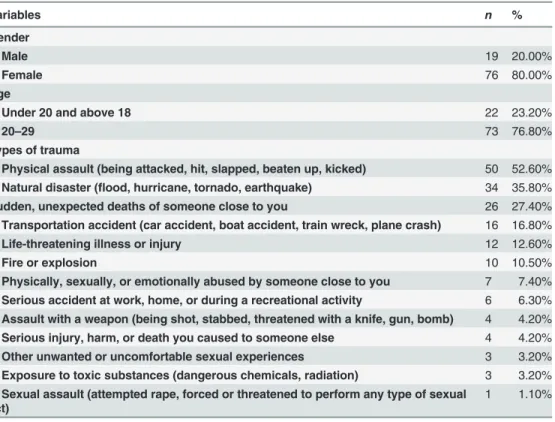
A total of 537 participants completed the LEC at Stage 1; among these participants, 26.44% (n= 142) personally experienced traumatic events. Among the 142 qualified individuals, 95 (66.90%) reported both symptoms of PTSD and PTG, whereas 47 did not exhibit symptoms of these conditions. A total of 95 participants who personally experienced traumatic events and reported both PTSD symptoms and PTG were included in the following analysis. Among the included participants, 76 (80.00%) are females and 19 (20.00%) are males. On the basis of pre-vious studies [35], we did not examine gender difference because of unequal distribution. Among 95 students, 73 (76.80%) were 20 years old to 29 years old, whereas 22 were 18 years old to 20 years old. Furthermore, 77 of the participants (81.10%) are single and 18 (18.90%) are in a relationship. Demographic characteristics and frequency of traumas are shown inTable 1. The Human Subjects Ethics Committee of the Hospital (T. C. M) Affiliated to Luzhou Medical College approved this study and the consent procedure. Data were analyzed using Statistical Product and Service Solutions (SPSS) 20.0.
2 Measures
2.1 LEC. LEC was used to screen individuals who suffered from traumatic experiences based on 17 different events [36], such as natural disaster (e.g., flood, hurricane, tornado, earth-quake), life-threatening illness or injury, and fire or explosion. The participants were requested to rate each event based on their true experiences by using a five-point Likert scale (1 = hap-pened to me, 2 = witnessed it, 3 = learned about it, 4 = not sure, 5 = does not apply). In this study, a time framework of“one year”was set in the instruction that required the participants to recall events that happened in the past year. Only the participants identified at least one trau-matic event as“happened to me”(1) were considered as qualified samples; other responses were excluded in this study. The total score of the whole scale reflect the frequency of trauma; high scores indicated high frequency of experienced traumatic events.
2.3 Chinese Virtues Questionnaire (CVQ). A 96-item Chinese scale CVQ was used to as-sess the virtues [21,24]. The respondents were requested to rate each item based on a five-point Likert scale ranging from 1 (very much unlike me) to 5 (very much like me). Item sam-ples include“I can accept love from others”(relationship),“I like to think of new ways to do things”(vitality), and“I control my emotions”(conscientiousness). The mean scores of the three virtues (32-item relationship, 40-item vitality, and 24-item conscientiousness) were used. A high score reflects that the individual exhibits a high degree of the virtue. In this study, Cronbach’sαvalues of the three subscales are 0.84 (relationship), 0.82 (vitality), and 0.85 (conscientiousness).
2.4 PTSD Checklist-Specific (PCL-S). PTSD symptoms were quantified using the 17-item PCL-S in a five-point Likert scale. Respondents were required to rate their experience from 1 (not at all) to 5 (extremely) [40]. Item samples include“feeling very upset when some-thing reminded you of the stressful experience”and“avoiding thinking about or talking about the stressful experience or avoiding having feelings related to it.”A high total score of the whole questionnaire indicates high degree of severity of PTSD symptoms. The participants who identified all items as“not at all”(1) were excluded in this study. In the current sample, Cronbach’sαof the whole scale is 0.89.
2.5 Post-traumatic Growth Inventory-Chinese (PTGI-C). PTG was quantified using the 15-item Chinese inventory scale PTGI-C [41]. Individuals indicated the extent to which they experienced changes as a result of crisis, ranging from 0 (not at all) to 5 (a very great degree). The PTGI-C is categorized using four factors, namely, self, spiritual, life orientation, and Table 1. Demographic and Sample Characteristics (N= 95).
Variables n %
Gender
Male 19 20.00%
Female 76 80.00%
Age
Under 20 and above 18 22 23.20%
20–29 73 76.80%
Types of trauma
Physical assault (being attacked, hit, slapped, beaten up, kicked) 50 52.60%
Natural disaster (flood, hurricane, tornado, earthquake) 34 35.80%
Sudden, unexpected deaths of someone close to you 26 27.40%
Transportation accident (car accident, boat accident, train wreck, plane crash) 16 16.80%
Life-threatening illness or injury 12 12.60%
Fire or explosion 10 10.50%
Physically, sexually, or emotionally abused by someone close to you 7 7.40%
Serious accident at work, home, or during a recreational activity 6 6.30%
Assault with a weapon (being shot, stabbed, threatened with a knife, gun, bomb) 4 4.20%
Serious injury, harm, or death you caused to someone else 4 4.20%
Other unwanted or uncomfortable sexual experiences 3 3.20%
Exposure to toxic substances (dangerous chemicals, radiation) 3 3.20%
Sexual assault (attempted rape, forced or threatened to perform any type of sexual act)
1 1.10%
Note: None of the participants identified four other kinds of trauma, including combat or exposure to a war zone (in the military or as a civilian), captivity (being kidnapped, abducted, held hostage, prisoner of war), severe human suffering, and sudden, violent death (homicide, suicide).
interpersonal, which correspond to the five-factor model of the PTGI’s original English ver-sion. Item samples included“I developed new interests”(self),“Knowing that I can count on people in times of trouble”(interpersonal), and“I’m more likely to try to change things which need changing”(life orientation). Previous studies confirmed the reliability and validity of the 15-item version [41]. The participants who identified all items as“not at all”(0) were excluded in this study. In the present sample, Cronbach’sαof the inventory was 0.80.
Results
1 Descriptive Statistics and Correlation Analysis
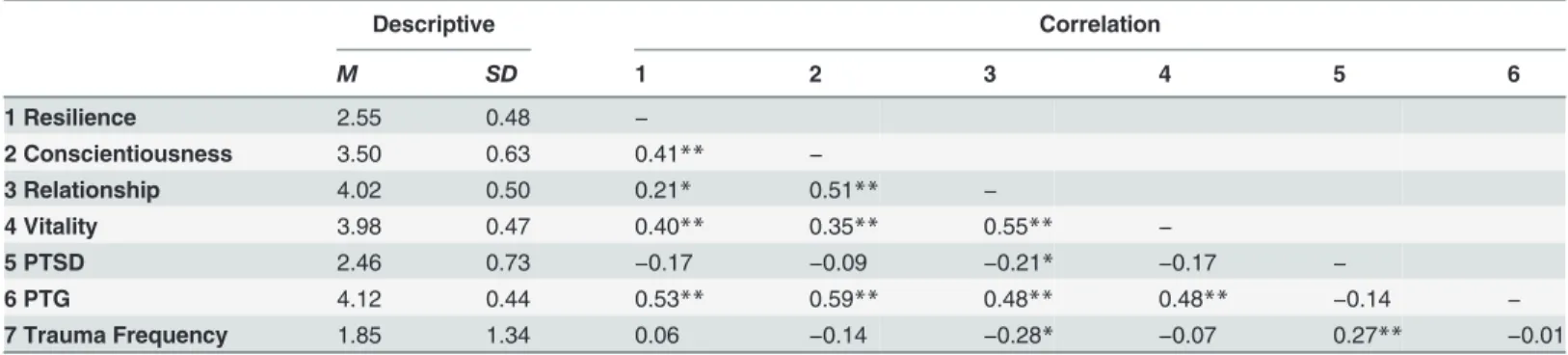
The results of descriptive statistics and correlation analysis are shown inTable 2. Resilience was significantly and positively related to three virtues (r= 0.21 to 0.41,p<0.01) and PTG
(r= 0.53,p<0.01). All of the three virtues (conscientiousness, relationship, and vitality) were
positively associated with PTG (r= 0.48 to 0.59,p<0.01), but only relationship was negatively
associated with PTSD (r=−0.21,p<0.05) and frequency of trauma (r=−0.28,p<0.05). PTG
was not significantly related to PTSD and frequency of trauma; however, PTSD was positively and significantly related to frequency of trauma (r= 0.27,p<0.01). According to the criteria
proposed by Blanchard, Jones-Alexander [42], scores of44 can indicate PTSD. Thus, 36 par-ticipants (37.90%) were classified under the PTSD group and 59 parpar-ticipants (62.10%) were classified under the non-PTSD group. However, ANOVA revealed no significant differences among all of the variables between the two groups (PTSD groupvs. non-PTSD group).
2 Regression Analysis
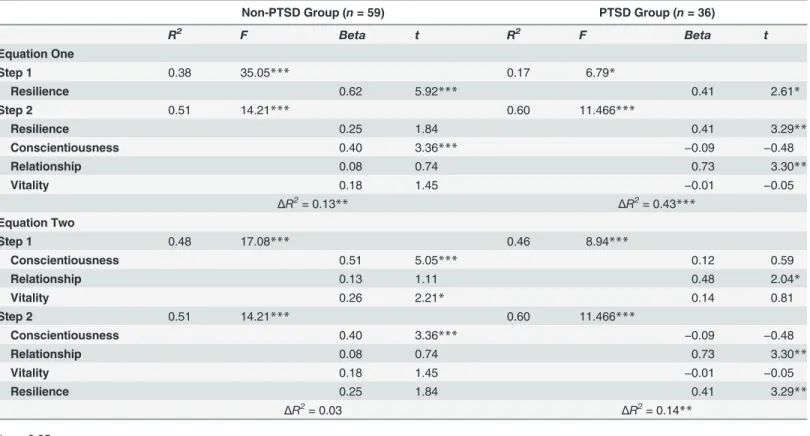
Hierarchical regressions were performed to examine the predictive ability of trait resilience and virtues to PTG (set as dependent variable) in PTSD and non-PTSD groups. Two equations were constructed to further investigate the incremental validity of the two target variables. In the first equation, trait resilience was encoded in the first step and three virtues were encoded in the second step. In the second equation, three virtues were included in the first step and trait resilience was included in the second step.Table 2shows the main results of regression analy-ses. In the non-PTSD group, conscientiousness contributed another 13% variance [0.38 to 0.51 = 0.13;Table 2, Equation (1)] to explain PTG after trait resilience was controlled; by con-trast, trait resilience only contributed 3% [0.48 to 0.51 = 0.03;Table 2, Eq. (2)] after the virtues were controlled. In the PTSD group, the virtues additionally explained 43% variance when trait Table 2. Descriptive and Correlation Statistics of Trait Resilience, Virtues, PTSD, PTG, and Trauma Frequency (N= 95).
Descriptive Correlation
M SD 1 2 3 4 5 6
1 Resilience 2.55 0.48 −
2 Conscientiousness 3.50 0.63 0.41** −
3 Relationship 4.02 0.50 0.21* 0.51** −
4 Vitality 3.98 0.47 0.40** 0.35** 0.55** −
5 PTSD 2.46 0.73 −0.17 −0.09 −0.21* −0.17 −
6 PTG 4.12 0.44 0.53** 0.59** 0.48** 0.48** −0.14 −
7 Trauma Frequency 1.85 1.34 0.06 −0.14 −0.28* −0.07 0.27** −0.01
*p<0.05;
**p<0.01.
resilience was controlled [0.17 to 0.60 = 0.43;Table 2, Eq. (1)]. Likewise, trait resilience ex-plained 14% variance when the virtues were controlled [0.46 to 0.60 = 0.14;Table 3, Eq. (2)]. Therefore, virtues likely exhibit a more powerful predictive ability than trait resilience in non-PTSD and non-PTSD groups; trait resilience contributed more variances of PTG in the non-PTSD group (14%) than in the non-PTSD group (3%). In the non-PTSD group, trait resilience was also not a significant predictor after the virtues were included in the equation [Table 3, Eq. (1)]; by con-trast, trait resilience remained significant in the PTSD group. These results suggested that the severity of symptoms of PTSD might moderate the relationship between trait resilience and PTG.
3 Moderation Effect Analysis
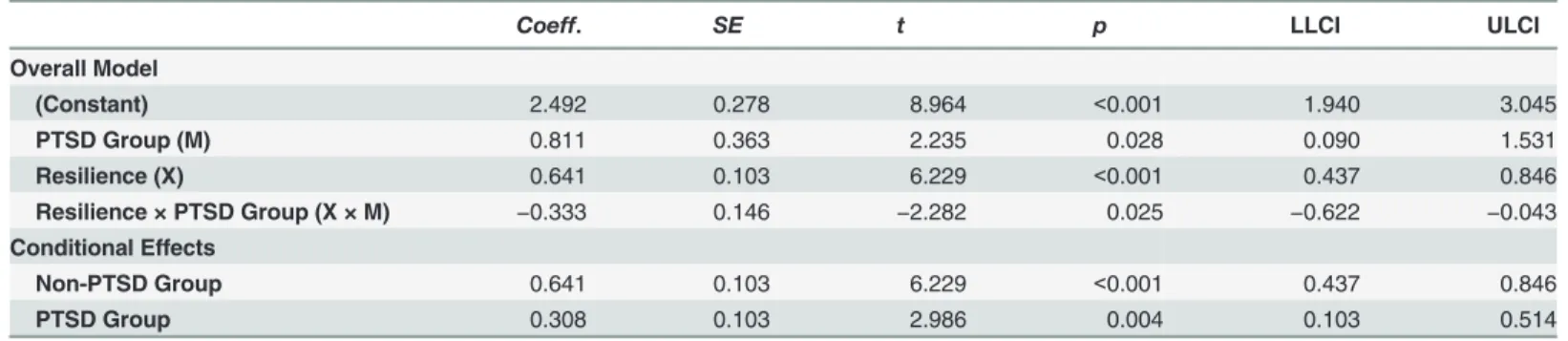
The moderation effect was examined using Model 1 in PROCESS [43]. Based on the results, trait resilience was set as predictor (X), PTG was set as outcome (Y), and PTSD group was set as moderator (M). The full model was significant:R2= 0.315, MSE = 0.139, F (3,91) = 18.899, p<0.001.Table 4indicates that the interaction variable (Resilience × PTSD Group) and the
slopes of the two groups were significant; therefore, the PTSD group can moderate the relation-ship between trait resilience and PTG.Fig 1further shows that the slope of the non-PTSD group was higher than that of the PTSD group; this result implied that the promoting role of trait resilience in the PTG group likely became weaker than that in the PTSD group.
Table 3. Regression of Trait Resilience and the Three Virtues on PTG in Different Subgroups (N= 95).
Non-PTSD Group (n= 59) PTSD Group (n= 36)
R2 F Beta t R2 F Beta t
Equation One
Step 1 0.38 35.05*** 0.17 6.79*
Resilience 0.62 5.92*** 0.41 2.61*
Step 2 0.51 14.21*** 0.60 11.466***
Resilience 0.25 1.84 0.41 3.29**
Conscientiousness 0.40 3.36*** −0.09 −0.48
Relationship 0.08 0.74 0.73 3.30**
Vitality 0.18 1.45 −0.01 −0.05
ΔR2
= 0.13** ΔR2
= 0.43***
Equation Two
Step 1 0.48 17.08*** 0.46 8.94***
Conscientiousness 0.51 5.05*** 0.12 0.59
Relationship 0.13 1.11 0.48 2.04*
Vitality 0.26 2.21* 0.14 0.81
Step 2 0.51 14.21*** 0.60 11.466***
Conscientiousness 0.40 3.36*** −0.09 −0.48
Relationship 0.08 0.74 0.73 3.30**
Vitality 0.18 1.45 −0.01 −0.05
Resilience 0.25 1.84 0.41 3.29**
ΔR2= 0.03 ΔR2= 0.14**
*p<0.05;
**p<0.01;
***p<0.001.
Discussion
The present study aims to explore the relationship between trait resilience and three virtues based on a sample with personal trauma in one year and on self-reported PTSD and PTG. These findings indicated that virtues and trait resilience were conceptually related but func-tionally different constructs. Trait resilience and virtues were positively related and contributed Table 4. Moderation Effect Analysis of PTSD Group Based on PROCESS (N= 95).
Coeff. SE t p LLCI ULCI
Overall Model
(Constant) 2.492 0.278 8.964 <0.001 1.940 3.045
PTSD Group (M) 0.811 0.363 2.235 0.028 0.090 1.531
Resilience (X) 0.641 0.103 6.229 <0.001 0.437 0.846
Resilience × PTSD Group (X × M) −0.333 0.146 −2.282 0.025 −0.622 −0.043
Conditional Effects
Non-PTSD Group 0.641 0.103 6.229 <0.001 0.437 0.846
PTSD Group 0.308 0.103 2.986 0.004 0.103 0.514
Note: PTSD group refers to the dichotomous variable, namely, the non-PTSD group (0) and the PTSD group (1); dependent variable is post-traumatic growth (Y).
doi:10.1371/journal.pone.0125707.t004
Fig 1. Interaction Effect between Trait Resilience and PTSD Groups on PTG.
variances to PTG in the context of trauma; however, trait resilience manifested after the virtues were controlled when individuals were diagnosed as PTSD.
The current traumatic sample experienced a wide range of different traumatic experiences, such as natural disaster, physical assault, transportation accident, and sudden, unexpected deaths of a close relative or individual. Previous studies revealed that the increased frequencies of traumas lead to increased risks of PTSD symptoms [44]; likewise, the present study reveals the positive relations between the frequency of trauma and the severity of PTSD symptoms. Hagenaars, Fisch [45] indicated that multiple trauma individuals among a clinical sample usu-ally report more dissociation, guilt, and interpersonal sensitivity than those who only experi-enced single trauma. However, these associations are not observed after PTSD severity is controlled [45]. These findings suggested that differences between clinical [45] and non-clinical (e.g., the current study) samples may result in inconsistent conclusions. Time point is also a factor that may affect such a relationship. Ogle, Rubin [46] found that events with similar greater frequency that occur early in life can yield more severe PTSD symptoms compared with those that occur later in life. Thus, frequency, time, and type of events should be carefully considered in future trauma-related studies.
In this study, a high level of trait resilience and three virtues were positively associated with PTG but negatively and not significantly associated with PTSD. Trait resilience and system of virtues share many common personality characteristics (hopeful, optimistic, and self-reliant). Thus, trait resilience is positively related to virtues; this finding is consistent with that in previ-ous studies [46]. Regarding the relationship between virtues and PTG, Hutchinson, Stuart [20] suggested that a number of strengths and virtues in the current VIA classification correspond to the dimensions of PTG. Therefore, these“theoretically related strengths,”as presented in the current study, should be positively related to PTG. For instance, kindness and love are theoreti-cally related strengths of improved relationships with other individuals; religiousness is the re-lated strength of spiritual development. Peterson, Park [4] compared the scores of personal strengths of US citizens before and after the 9/11 terrorist attacks. The authors proposed that strengths are possibly enhanced after individuals experience traumatic events [47]. These find-ings may be due to measurement overlap. In the Methods section, the item used to assess vitali-ty virtue“I like to think of new ways to do things”was similar to the item used to assess PTG“I developed new interests;”both of these items reflected the meaning of creativity and curiosity. On the basis of these findings and reasons, a person may think that the boundary between vir-tues and PTG remains unclear and conceptually overlapping. As such, we recommend that the approach of distinguishing between trait resilience and PTG should be applied to respond to trauma; therefore, virtues as positive traits are manifested before, during, and after traumatic events occur, whereas PTG as a mode of adjustment to trauma is exhibited only after traumatic events occur.
that only individuals with symptoms of PTSD can develop PTG [5]. This finding likely sup-ports our assumption. The current study implies that the“true”PTG requires PTSD after ad-versity occurs, and trait resilience is necessary to the“true”PTG. Dekel, Mandl [50] suggested that PTG may be an actual outcome of the response to threat and trauma. In this regard, virtues are functionally different from trait resilience.
Three virtues contributed additional variances to PTG after trait resilience was controlled. These virtues also exhibit specific functions in samples with or without PTSD diagnosis. Duan and Guo [51] found that vitality uniquely contributes variances to stress-related PTG in an in-direct trauma sample. The result was validated by another undergraduate sample. Individuals with high vitality often perceive less stress from minor events, which lead to less psychological symptoms [28]. These findings suggested that vitality might be a protective factor under low-pressure situations rather than trauma or high-low-pressure situations. One intervention study found that undergraduates with high vitality virtue are more willing to express their unsatisfied thinking and negative ideas related to daily stress to improve mental health; this approach part-ly shows the protective role of vitality [52,53].
With regard to the direct trauma sample without PTSD, previous study found that relation-ship and conscientiousness significantly contribute to PTG, whereas only conscientiousness uniquely explains PTG in the direct trauma sample with PTSD [51]. A 30-year longitudinal study further indicated that self-controllability, which is manifested by the conscientiousness virtue, uniquely predicts PTG when PTSD is controlled [50]. However, these findings were slightly different from the current one; in particular, vitality and conscientiousness significantly contributed to PTG in the non-PTSD group; by contrast, only relationship uniquely contribut-ed to PTG in the PTSD group. According to personality-event congruence hypothesis [54], personality-related vulnerabilities to specific stressors are sensitive to their correspondingly dif-ferent stressful life events. Thus, difdif-ferent types of traumatic event can cause such inconsisten-cy; thus, the current sample experiences a wide range of different traumas, whereas the previous sample almost experiences earthquake-related traumas [51]. Another possible expla-nation is that previous studies [50,51] did not analyze trait resilience. Although the results are slightly different, the protective function of virtues under stressful situations can be expected. For instance, a meta-analysis has indicated that social support is a very important contributor to PTG in 103 studies [55]. Individuals with stronger relationship virtue are more likely to maximize external resources (e.g., social support) to overcome adversities caused by trauma. A few studies have examined the role of virtues in the context of trauma; as a result, conclusions cannot be drawn from limited studies. Nevertheless, we can conclude that trait resilience is probably a more stable and reliable factor affecting PTG than virtues in the context of trauma; by comparison, virtues are more sensitive to different stressful situations than trait resilience.
Mandl [50] investigated the predictors of PTG and PTSD and suggested that PTG and PTSD possibly exhibit a shared psychological component. Therefore, future research should be con-ducted to distinguish and provide precise definition and measurements.
Supporting Information
S1 Dataset.
(ZIP)
Author Contributions
Conceived and designed the experiments: WD P. Gan P. Guo. Performed the experiments: WD P. Guo. Analyzed the data: WD. Contributed reagents/materials/analysis tools: WD P. Gan. Wrote the paper: WD P. Guo.
References
1. Calhoun LG, Tedeschi RG. Handbook of posttraumatic growth: Research & practice. Mahwah, NJ: Erl-baum; 2006.
2. Tedeschi RG, Calhoun LG. The Posttraumatic Growth Inventory: Measuring the positive legacy of trau-ma. Journal of traumatic stress. 1996; 9(3):455–71. PMID:8827649
3. Hampson SE, Friedman HS. Personality and health: A lifespan perspective. In: John PO, Robins WR, Pervin AL, editors. Handbook of personality: Theory and research. 3rd ed. New York, NY, US: Guilford Press; 2008.
4. Peterson C, Park N, Pole N, D'Andrea W, Seligman ME. Strengths of character and posttraumatic growth. Journal of Traumatic Stress. 2008; 21(2):214–7. doi:10.1002/jts.20332PMID:18404632.
5. Bensimon M. Elaboration on the association between trauma, PTSD and posttraumatic growth: The role of trait resilience. Personality and Individual Differences. 2012; 52(7):782–7. doi:10.1016/j.paid. 2012.01.011
6. Peterson C, Seligman MEP. Character strengths and virtues: A handbook and classification: Oxford University Press, USA; 2004.
7. Fowers BJ. Virtue and psychology: Pursuing excellence in ordinary practices: American Psychological Association; 2005.
8. Peterson C. Strengths of character and happiness: Introduction to special issue. Journal of Happiness Studies. 2006; 7(3):289–91. doi:10.1007/s10902-005-3645-9
9. Peterson C, Ruch W, Beermann U, Park N, Seligman MEP. Strengths of character, orientations to hap-piness, and life satisfaction. The Journal of Positive Psychology. 2007; 2(3):149–56. doi:10.1080/ 17439760701228938
10. Niemiec RM. VIA character strengths: Research and practice (The first 10 years). In: Knoop HH, Fave AD, editors. Well-Being and Cultures: Perspectives from Positive Psychology. New York, NY: Springer Science+Business Media; 2013. p. 11–29.
11. Duan W, Ho SMY, Tang X, Li T, Zhang Y. Character strength-based intervention to promote satisfaction with life in the Chinese university context. Journal of Happiness Studies. 2014; 15(6):1347–61. doi:10. 1007/s10902-013-9479-y
12. Seligman MEP, Steen TA, Park N, Peterson C. Positive psychology progress: empirical validation of in-terventions. American Psychologist. 2005; 60(5):410–21. Epub 2005/07/28. doi:10.1037/0003-066X. 60.5.410PMID:16045394.
13. Lepore SJ, Revenson TA. Resilience and posttraumatic growth: Recovery, resistance, and reconfigura-tion. In: Calhoun LG, Tedeschi RG, editors. Handbook of posttraumatic growth: Research and practice. New York: Lawrence Erlbaum Associates; 2006. p. 24–46.
14. Bonanno GA. Loss, trauma, and human resilience: have we underestimated the human capacity to thrive after extremely aversive events? American Psychologist. 2004; 59(1):20–8. doi: 10.1037/0003-066X.59.1.20PMID:14736317
15. Yehuda R, Flory JD. Differentiating biological correlates of risk, PTSD, and resilience following trauma exposure. Journal of Traumatic Stress. 2007; 20(4):435–47. doi:10.1002/jts.20260PMID:17721957
17. Agaibi CE, Wilson JP. Trauma, PTSD, and Resilience: A Review of the Literature. Trauma, Violence, & Abuse. 2005; 6(3):195–216. doi:10.1177/1524838005277438
18. Tedeschi RG, Calhoun LG. Posttraumatic growth: Conceptual foundations and empirical evidence. Psychological Inquiry. 2004; 15(1):1–18. doi:10.1207/s15327965pli1501_01
19. Robbins BD. What is the good life? Positive psychology and the renaissance of humanistic psychology. The humanistic psychologist. 2008; 36(2):96–112. doi:10.1080/08873260802110988
20. Hutchinson A-MK, Stuart AD, Pretorius HG. The Relationships Between Temperament, Character Strengths, and Resilience. In: Brdar I, editor. The Human Pursuit of Well-Being: A Cultural Approach. New York: Springer Science+Business Media B.V.; 2011. p. 133–44.
21. Duan W, Ho SMY, Bai Y, Tang X, Zhang Y, Li T, et al. Factor structure of the Chinese Virtues Question-naire. Research on Social Work Practice. 2012; 22(6):680–8. doi:10.1177/1049731512450074PMID: WOS:000309477500009.
22. Ho SMY, Rochelle TLR, Law LSC, Duan W, Bai Y, Shih S- M, et al. Methodological issues in positive psychology research with diverse populations: Exploring strengths among Chinese adults. In: Pedrotti JT, Edwards LM, editors. Perspectives on the Intersection of Multiculturalism & Positive Psychology. New York, N.Y.: Springer Science + Business Media B.V.; 2014. p. 45–57. doi:10.1037/a0019759 PMID:22402046
23. Ho SMY, Duan W, Tang SCM. The psychology of virtue and happiness in western and asian thought. In: Snow NE, Trivigno FV, editors. The Philosophy and Psychology of Character and Happiness. New York: Routledge; 2014. p. 215–38.
24. Duan W, Ho SMY, Bai Y, Tang X. Psychometric evaluation of the Chinese Virtues Questionnaire. Re-search on Social Work Practice. 2013; 23(3):336–45. doi:10.1177/1049731513477214PMID: WOS:000318182600009.
25. Tang X, Duan W, Wang Z, Liu T. Psychometric Evaluation of the Simplified Chinese Version of Flour-ishing Scale. Research on Social Work Practice. in press. doi:10.1177/1049731514557832
26. Zhang Y, Duan W, Tang X, Gan P, Gan F, Guo P. Psychometric Properties of Chinese Virtues Ques-tionnaire in Chinese Adolescents. Chinese Journal of Clinical Psychology. 2014; 22(3):470–4.
27. Duan W, Bai Y, Tang X, Siu PY, Chan RKH, Ho SMY. Virtues and positive mental health. Hong Kong Journal of Mental Health. 2012; 38(5):24–31.
28. Duan W, Ho SMY, Siu BPY, Li T, Zhang Y. Role of Virtues and Perceived Life Stress in Affecting Psy-chological Symptoms among Chinese College Students. Journal of American College Health. 2015; 63 (1):32–9. doi:10.1080/07448481.2014.963109PMID:25257884
29. Zhang Y, Yang Z, Duan W, Tang X, Gan F, Wang F, et al. A preliminary investigation on the relationship between virtues and pathological internet use among Chinese adolescents. Child and Adolescent Psy-chiatry and Mental Health. 2014; 8(1):8. Epub 2014/03/07. doi:10.1186/1753-2000-8-8PMID: 24594317.
30. McCrae RR. Personality traits and the potential of positive psychology. In: Sheldon KM, Kashdan TB, Steger MF, editors. Designing positive psychology: Taking stock and moving forward. New York: Ox-ford University Press; 2011. p. 193–206.
31. Podsakoff PM, MacKenzie SB, Lee JY, Podsakoff NP. Common method biases in behavioral research: a critical review of the literature and recommended remedies. Journal of Applied Psychology. 2003; 88 (5):879. PMID:14516251
32. Gosling SD, Vazire S, Srivastava S, John OP. Should we trust web-based studies? A comparative anal-ysis of six preconceptions about internet questionnaires. American Psychologist. 2004; 59(2):93. PMID:14992636
33. King DB, O’Rourke N, DeLongis A. Social media recruitment and online data collection: A beginner’s guide and best practices for accessing low-prevalence and hard-to-reach populations. Canadian Psy-chology/Psychologie canadienne. 2014; 55(4):240–9. doi:10.1037/a0038087
34. American Psychiatric Association. Diagnostic and statistical manual of mental disorders. 5th ed. Ar-lington, VA: American Psychiatric Association; 2013.
35. Barton S, Boals A, Knowles L. Thinking About Trauma: The Unique Contributions of Event Centrality and Posttraumatic Cognitions in Predicting PTSD and Posttraumatic Growth. Journal of Traumatic Stress. 2013; 26(6):718–26. doi:10.1002/jts.21863PMID:24490252
36. Gray MJ, Litz BT, Hsu JL, Lombardo TW. Psychometric properties of the life events checklist. Assess-ment. 2004; 11(4):330–41. doi:10.1177/1073191104269954PMID:15486169.
38. Connor KM, Davidson JR. Development of a new resilience scale: The Connor‐Davidson resilience scale (CD‐RISC). Depression and anxiety. 2003; 18(2):76–82. doi:10.1002/da.10113PMID:12964174
39. Wang L, Shi Z, Zhang Y, Zhang Z. Psychometric properties of the 10-item Connor-Davidson Resilience Scale in Chinese earthquake victims. Psychiatry and clinical neurosciences. 2010; 64(5):499–504. doi: 10.1111/j.1440-1819.2010.02130.xPMID:20923429.
40. Weathers FW, Litz BT, Herman DS, Huska JA, Keane TM, editors. The PTSD Checklist (PCL): Reliabil-ity, validReliabil-ity, and diagnostic utility. annual meeting of the international society for traumatic stress stud-ies, San Antonio, TX; 1993 October.
41. Ho SMY, Chan CLW, Ho RTH. Posttraumatic growth in Chinese cancer survivors. Psycho‐Oncology. 2004; 13(6):377–89.
42. Blanchard EB, Jones-Alexander J, Buckley TC, Forneris CA. Psychometric properties of the PTSD Checklist (PCL). Behaviour research and therapy. 1996; 34(8):669–73. doi:10.1016/0005-7967(96) 00033-2PMID:8870294
43. Hayes AF. Introduction to Mediation, Moderation, and Conditional Process Analysis. New York: The Guilford Press; 2013.
44. Gehrke A, Violanti JM. Gender differences and posttraumatic stress disorder: the role of trauma type and frequency of exposure. Traumatology. 2006; 12(3):229–35.
45. Hagenaars MA, Fisch I, van Minnen A. The effect of trauma onset and frequency on PTSD-associated symptoms. Journal of affective disorders. 2011; 132(1):192–9.
46. Ogle CM, Rubin DC, Berntsen D, Siegler IC. The frequency and impact of exposure to potentially trau-matic events over the life course. Clinical psychological science. 2013; 1(4):426–34. PMID:24660131
47. Peterson C, Seligman ME. Character strengths before and after September 11. Psychological Science. 2003; 14(4):381–4. PMID:12807415
48. Sumalla EC, Ochoa C, Blanco I. Posttraumatic growth in cancer: reality or illusion? Clinical psychology review. 2009; 29(1):24–33. doi:10.1016/j.cpr.2008.09.006PMID:18996633
49. Johnson RJ, Hobfoll SE, Hall BJ, Canetti‐Nisim D, Galea S, Palmieri PA. Posttraumatic growth: Action and reaction. Applied Psychology. 2007; 56(3):428–36. doi:10.1111/j.1464-0597.2007.00296.x
50. Dekel S, Mandl C, Solomon Z. Shared and unique predictors of post‐traumatic growth and distress. Journal of clinical psychology. 2011; 67(3):241–52. doi:10.1002/jclp.20747PMID:21254052
51. Duan W, Guo P. Association between Virtues and Posttraumatic Growth: Preliminary Evidence from a Chinese Community Sample after Earthquake. PeerJ. 2015; 3:e883. doi:10.7717/peerj.883PMID: 25870774
52. Zhang Y, Duan W, Tang X, Yang Z. Can virtues enhance the benefits of expressive writing among healthy Chinese? A pilot study. Journal of Mental Health. 2014; 23(5):231–5. doi:10.3109/09638237. 2014.924050PMID:24950302
53. Yang Z, Tang X, Duan W, Zhang Y. Expressive writing promotes self-reported physical, social and psy-chological health among Chinese undergraduates. International Journal of Psychology. 2015; 50 (2):128–34. doi:10.1002/ijop.12081PMID:24903848
54. Iacoviello BM, Grant DA, Alloy LB, Abramson LY. Cognitive personality characteristics impact the course of depression: A prospective test of sociotropy, autonomy and domain-specific life events. Cog-nitive therapy and research. 2009; 33(2):187–98. PMID:20216915