Revista Gaúcha
de Enfermagem
Occupational stress among health workers
of a university hospital
Estresse ocupacional entre trabalhadores de saúde de um hospital universitário Estrés ocupacional entre los trabajadores de la salud en un hospital universitario
Renata Perfeito Ribeiroa Maria Helena Palucci Marzialeb Julia Trevisan Martinsa Maria José Quina Galdinoc Patrícia Helena Vivan Ribeirod
ABSTRACT
Objective: To evaluate the occupational stress among health workers in a university hospital.
Methods: Cross-sectional study conducted with health workers in the areas of nursing and medicine at university hospital in sou-thern Brazil. The data were collected between August 2011 and August 2012 by a questionnaire of characterization and Job Stress Scale. A descriptive and univariate analysis was performed (Kruskal-Wallis).
Results: The participants presented high demand and high control of the work and low social support, indicating an active work. Nurses had less control over work (p<0.001) and physicians received more social support (p=0.006). Reduced social support was related to greater exposure to stress among nursing assistants and technicians (p=0.012).
Conclusion: Workers who felt the low social support had higher exposure to stress. Necessary to implement stress prevention stra-tegies among health workers, such as strengthening of social support at work.
Keywords: Occupational health. Stress, psychological. Social support. Hospitals, university.
RESUMO
Objetivo: Avaliar o estresse ocupacional entre trabalhadores de saúde de um hospital universitário.
Métodos: Estudo transversal com trabalhadores de saúde de enfermagem e medicina de um hospital universitário da Região Sul do Brasil. Os dados foram coletados entre agosto de 2011 e agosto de 2012 por um questionário para caracterização e a Job Stress Scale. Realizou-se análise descritiva e univariada (Kruskal-Wallis).
Resultados: Os participantes apresentaram alta demanda e alto controle do trabalho e baixo apoio social, indicando um trabalho ativo. Os enfermeiros tiveram menor controle sobre o trabalho (p<0,001) e os médicos receberam maior apoio social (p=0,006). Apoio social reduzido esteve relacionado à maior exposição ao estresse entre os auxiliares e técnicos de enfermagem (p=0,012).
Conclusão: Os trabalhadores que perceberam o apoio social reduzido apresentaram maior exposição ao estresse. Torna-se necessário implementar estratégias de prevenção ao estresse entre os trabalhadores de saúde, como o fortalecimento do apoio social no trabalho.
Palavras-chave: Saúde do trabalhador. Estresse psicológico. Apoio social. Hospitais universitários.
RESUMEN
Objetivo: Evaluar el estrés ocupacional entre los trabajadores de la salud en un hospital universitario.
Métodos: Estudio transversal con trabajadores de salud de enfermería y medicina de un hospital universitario del sur de Brasil. Los datos fueron recogidos entre agosto de 2011 y agosto de 2012 por un cuestionario para la caracterización y la Job Stress Scale. Se realizaron análisis descriptiva y univariada (Kruskal-Wallis).
Resultados: Los participantes mostraron una alta demanda y alto control del trabajo, y bajo apoyo social, indicando un trabajo activo. Las enfermeras tenían un menor control sobre el trabajo (p<0,001) y los médicos recibieron más apoyo social (p=0,006). Reducción de apoyo social se relaciona con una mayor exposición al estrés entre los auxiliares de enfermería y técnicos (p=0,012).
Conclusión: Los trabajadores que sentían el bajo apoyo social tenían una mayor exposición al estrés. Necesario implementar estrate-gias de prevención del estrés entre los trabajadores de la salud, como el fortalecimiento del apoyo social en el trabajo.
Palabras clave: Salud laboral. Estrés psicológico. Apoyo social. Hospitales universitarios.
How to cite this article:
Ribeiro RP, Marziale MHP, Martins JT, Galdino MJQ, Ribeiro PHV. Occupational stress among health workers of a university hospital. Rev Gaúcha Enferm. 2018;39:e65127. doi: https://doi. org/10.1590/1983-1447.2018.65127.
a Universidade Estadual de Londrina (UEL). Programa
de Pós-Graduação em Enfermagem. Londrina, Para-ná, Brasil.
b Universidade São Paulo (USP). Escola de
Enferma-gem de Ribeirão Preto (EERP). Centro Colaborador da OPAS/OMS para o Desenvolvimento da Pesquisa em Enfermagem. Ribeirão Preto, São Paulo, Brasil.
c Universidade Estadual do Norte do Paraná (UENP).
Departamento de Enfermagem. Bandeirantes, Para-ná, Brasil.
d Universidade Estadual de Londrina (UEL). Clínica
INTRODUCTION
The process of working in health is a complex and dy-namic phenomenon, constantly influenced by socioeco-nomic, political and technological changes. These changes in the last decades have changed the working conditions, especially the demands, which have resulted in an increase in occupational psychosocial risks. This contemporary sce-nario has been considered by many researchers as a major threat since it interferes with the health and safety of he-alth workers and makes them vulnerable to occupational stress and illness(1-2).
Occupational stress is understood as the one that co-mes from the work environment and involves aspects of the organization, management, conditions and quality of the interpersonal relationships at work. Based on these characteristics, occupational stress is considered a poly-semic term, however, in this study, the International Labor Organization has proposed that what it defines it as a set of manifestations in the worker’s body that have harmful potential to their health(3).
Nursing and medical professionals, especially those who develop their activities in hospital institutions, expe-rience situations that lead to stress, as they coexist routi-nely with pain, suffering and death, and are subjected to intense work rhythm, long hours, shift work, low wages, complex human relations, lack of materials and human resources, among other factors that can trigger and/or po-tentiate stress at work(3-4).
Continuous stress at work can have harmful conse-quences for the mental and physical health of the worker, such as the development of the metabolic syndrome, sleep disorders, diabetes, hypertension, psychosomatic illnesses, burnout syndrome, depression, psychoactive substance use, drop in productivity, absenteeism, job dissatisfaction, and low quality of life at work(1,5).
Among the theoretical models most adopted in the international literature for stress assessment at work is the Demand-Control - Social Support model, proposed by Töres Theorell in 1988, since it covers specific aspects of the labor process. It is a three-dimensional model that correla-tes the levels of the worker’s control over labor itself and the psychological demands from the work environment, whi-ch includes the psywhi-chic and organic consequences of the workers. The model indicates that work stress is the result of the interaction between many psychological demands, less control in the work process, and less social support received from co-workers and bosses in the work environment(6).
Thus, the demands refer to the psychological deman-ds of work, involving time, speed, and intensity in the
per-formance of their work activities, as well as the conflicting demands; the control refers to the use of the intellectual abilities and the autonomy to make a decision about one’s own work; the social support refers to the interaction and support offered by interpersonal relationships at work(6).
Among these dimensions, a study showed that the social and, especially, the organizational support exerts a function of slowing down the stressful events, since they collaborate so that the worker overcome the labor difficul-ties more easily, which contributes to the reduction of the vulnerability of individuals and promotes emotional and psychological well-being(7).
In view of the context and content of the health work process, the deleterious effects of occupational stress on the physical and mental health of individuals and the lack of scientific knowledge about this issue among health workers in university hospitals, It becomes relevant to car-ry out this research to provide subsidies for occupational stress prevention programs in order to promote satisfac-tion, well-being and quality of life at work.
Thus, this study had the following research question: Do health workers in a university hospital experience stress at work? In order to answer this question, we aimed at eva-luating occupational stress among health workers in a uni-versity hospital.
METHOD
This research was extracted from the doctoral the-sis titled “Prevalence of the metabolic syndrome among workers of the medical and nursing teams of a hospital in Paraná and its association with occupational stress, anxiety and depression”(8).
This is a quantitative, descriptive and cross-sectional study conducted at a university hospital in the southern region of Brazil. It is a state public institution with 313 beds, which provides medium and high complexity healthcare.
The study population consisted of 810 health workers from the nursing and medical areas of the institution. Ba-sed on this number, the sample size was calculated using a 50% ratio, a 95% confidence level, and an estimate error of 5%, which resulted in a minimum of 260 participants. The proportional stratification by gender and professional class was defined as the participation of 226 nursing pro-fessionals (183 females and 43 males) and 34 physicians (14 females and 20 males).
The data collection was performed from August 2011 to August 2012 at the hospital under study. The workers were invited to participate in the research during their shift change, being taken to a reserved room, where they were clarified about the study; and after signing the Free and In-formed Consent Term, the instrument was made available for completion. At the end, the participants were instruc-ted to insert the questionnaires into individual envelopes.
The data collection instrument consisted of two parts: the first one related to the characterization of workers, com-posed of sociodemographic and professional data (gender, age, marital status, education, and professional category). To evaluate the stress at work, the summarized version of the research instrument of the Demand-Control-Social Su-pport model, the Job Stress Scale, translated and validated for the Portuguese language in 2004 was used (10). This is a self-administered questionnaire, whose answers are provided on a 4-point Likert scale, with 17 questions: five to assess the psychological demand of work (ranging from 5 to 20 points), six to measure control over work (ranging from 6 to 24 points), and six to analyze the social support (ranging from 6 to 24 points).
As advocated in the Demand-Control-Social Support mo-del, these dimensions were dichotomized in “high” and “low” and classified according to one of four categories: work of high demand (low control and high demand - high risk of physical and mental illness of the worker); active work (high control and high demand - worker with autonomy in his acti-vities and use of their intellectual potential); passive work (low control and low demand - induces the worker to apathy and decline in their general activities); And work with low demand (high control and low demand - reference classification)(6,9).
The Statistical Package for Social Sciences (SPSS), ver-sion 20.0 was used to analyze the data. Absolute and re-lative frequencies were calculated for categorical variables and measures of the central position and dispersion for continuous variables. The Kolmogorov-Smirnov test
indica-ted non-normal distribution of the data. Thus, in the univa-riate analysis the Kruskal-Wallis test was used, considering statistically significant p<0.05.
The study followed the requirements of national and in-ternational norms regulating research involving human bein-gs, with the approval of the Research Ethics Committee of the Universidade Estadual de Londrina, according to the Opinion no. 267 of March 01, 2010 and CAAE 0218.0.268.153-09.
RESULTS
Of the 260 participants in this study, the majority belon-ged to the female gender (75.8%), with a stable marital re-lationship (69.3%), and a higher level of schooling (66.5%). The average age was 45 years old, with extremes at 23 and 66 years old.
As for the position attached to the institution under stu-dy, 13.1% were doctors and 86.9% were nursing workers; of whom 10.4% were nurses, 40.4% were technicians and 36.2% were assistants. 84.6% developed their occupational activities during the day and 15.4% at night. The working time at the institution studied ranged from 1 to 39 years, with an average of 19 years. Regarding the total hours worked, 54.2% of the participants worked up to 42 hours a week, 23.5% up to 60 hours, and 22.0% more than 60 hours a week. 21.9% of the respondents had more than one em-ployment relationship.
Concerning life habits, 33.5% of the workers reported regular physical activity, 20% were smokers (x–=15 cigaret-tes per day), and 40.8% indicated alcohol consumption.
Table 1 presents the central position and dispersion measures of the scores of the dimensions of the Job Stress Scale obtained by the participants.
There was a significant difference between occupatio-nal classes, control (p<0.001), and social support (p=0.006), indicating that nurses had less control over work and doc-tors received more social support.
Table 1 – Median and Interquartile Intervals of the Job Stress Scale scores, according to the occupational classes (n=260). Londrina, PR, Brazil, 2012
Occupational classes Demand Control Social Support Median (IQI)* Median (IQI)* Median (IQI)*
Doctors 9.0 (7.0 -9.0) 10.0 (8.0-11.0) 12.5 (10.0-14.5)
Nurses 8.0 (7.0 - 8.0) 8.0 (7.0 - 10.0) 9.0 (9.0-11.0)
Nursing Team 8.0 (7.0 - 9.0) 10.0 (9.0 - 12.0) 11.0 (9.0 - 13.0)
Nursing and medical workers presented high demand for work (x–=8.3), they also reported a high degree of con-trol over the work done (x–=9.9), and low social support (x–=11.1). According to the theoretical model used in this study, this relationship represents an active work with low wear, but attention must be paid to the low social support demanded by the institution from the health worker.
Regarding the classification of stress, it was verified that the majority of workers (72.7%) were in the low stress category, 16.2% in high exposure, and 11.2% with inter-mediate exposure to stress. It was also identified that the stress factors at work were the relationships with
collea-gues (23.2%), the activities required at work (62.8%), and the relationship with managers (62.8%).
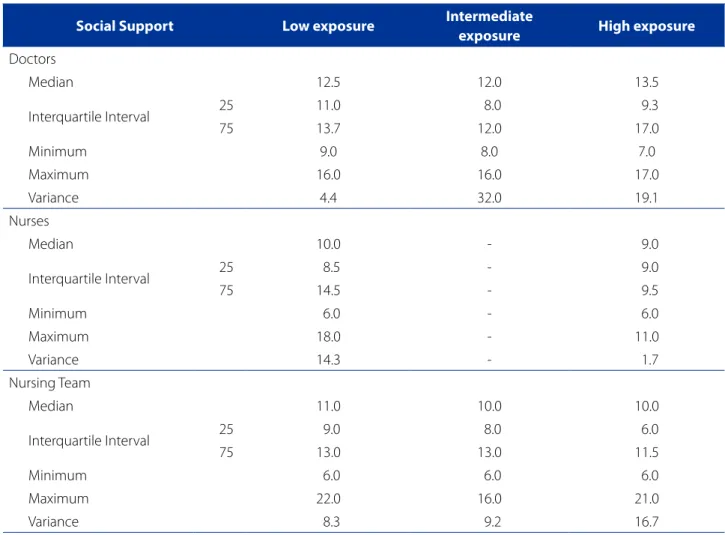
Table 2 shows the descriptive measures of the social support dimension, according to the Job Stress Scale classification.
There was no statistical significance between the cate-gories of stress classification and social support received among physicians (p=0.871) and nurses (p=0.253). Howe-ver, among nursing assistants and technicians, the higher the exposure to stress, the lower the social support recei-ved (p=0.012).
Table 2 - Descriptive statistics of the social support dimension according to the Job Stress Scale classification, according to occupational class (n=260). Londrina, PR, Brazil, 2012
Social Support Low exposure Intermediate
exposure High exposure
Doctors
Median 12.5 12.0 13.5
Interquartile Interval 25 11.0 8.0 9.3
75 13.7 12.0 17.0
Minimum 9.0 8.0 7.0
Maximum 16.0 16.0 17.0
Variance 4.4 32.0 19.1
Nurses
Median 10.0 - 9.0
Interquartile Interval 25 8.5 - 9.0
75 14.5 - 9.5
Minimum 6.0 - 6.0
Maximum 18.0 - 11.0
Variance 14.3 - 1.7
Nursing Team
Median 11.0 10.0 10.0
Interquartile Interval 25 9.0 8.0 6.0
75 13.0 13.0 11.5
Minimum 6.0 6.0 6.0
Maximum 22.0 16.0 21.0
Variance 8.3 9.2 16.7
Source: Research data, 2012.
DISCUSSION
The sociodemographic characteristics of the workers participating in this study are similar to the profile of the
workforce of nursing and medical teams working in Brazi-lian hospitals(10-11).
of work stress. Some authors mention that the occupatio-nal stress is related to the routine of the hospital environ-ment, marked by high tension, high workloads, unhealthy working conditions, dealing with severe patients, and the management of care activities. Thus, improvements in structure, organization and working conditions can mini-mize the effects of stress(12).
In this research, it was verified that the workers presen-ted high psychological demand for the execution of their work; and they also considered that they have autonomy in decision making, they need to use creativity and individual development to fulfill the health work process, characte-ristic aspects of the high control dimension of the work. This relationship represents an active worker with current challenges, motivated and autonomous about the work process, who can rethink the work process, reducing the risk of psychological stress and, consequently, the risk of developing physical illnesses.
However, the work situation considered to be “ideal” would be one in which the worker would experience low psychological demands of work, with high control of the work process, and high social support in the work environment(9).
However, in the health area, especially in hospital insti-tutions, the low psychological demand is almost impossi-ble to be found, since the situations presented in the work process cause a psychological wear of the worker, such as: the excessive workload, the accelerated rhythm of work imposed by the insufficient amount of professionals; in addition, the degree of complexity of the activities to be performed and the level of technical-scientific knowledge required should be considered(10,13).
The low social support verified in this study can also be a source of mental fatigue, which favors the appearance of aggravations to workers’ health, as indicated by the De-mand-Control model(6). The social support reflects the
en-vironment in the workplace and the relationship between co-workers and their superiors, based on two main com-ponents: the emotional relationship and the instrumental support, which are strongly influenced by the changes in the organizational processes of work. A study showed that an effective social support network produces mitigating effects on stress, helping the worker to cope and deal with stressful situations, which improves the individual’s adapti-ve abilities regarding new situations, including their health status(14). In addition, the low social support was associated
with higher levels of stress among hospital nurses from China, Japan, Argentina, and the Caribbean(15).
In researches carried out with nursing workers in Bra-zilian public hospitals, it was found that high psychologi-cal demand and low social support at work were
associa-ted with a decrease in work capacity and a lower health perception, with an increase in the prevalence of minor psychiatric disorders (insomnia, fatigue, irritability, soma-tic disorders, and difficulty in memory and concentration), conditions that negatively impact the individual and the organization(13,16).
It should be noted that in the social support dimension, the investigated workers may present relationship difficul-ties with supervisors and other co-workers, since 23.2% indi-cated that relationships in the work environment are stress factors. Some authors add that the interpersonal relationship between the members of a team is a decisive factor in the experiences of satisfaction, dissatisfaction and success in the work. In this way, the good relationship between the team and the manager collaborates in the transformation of the suffering into pleasure and satisfaction at work(17).
Among nursing assistants and technicians, the lower social support was significantly associated with a greater exposure to stress. It is assumed that their position of su-bordinated work in relation to other health professionals may favor difficult and conflicting interpersonal interac-tions(18), as well as the low social support related to this
oc-cupational class.
This statement is confirmed when it is analyzed that the doctors indicated greater social support, which refers to the socio-historical hierarchy that places them as a supe-rior class in relation to other health professionals. Thus, the physician is seen as the main responsible for the decisions in healthcare and, for this reason, receives greater social su-pport at work(19).
Health professionals and managers should recognize the importance of social support in their work process, stimulating the formation of this network of support not limited to the work team, but involving family and friends, in order to reduce the vulnerability of these individuals to occupational stress and, consequently, to have a beneficial impact on the quality of care provided to patients and their families, as well as to maximize the quality of life of these health professionals(20).
CONCLUSION
technicians with greater exposure to stress perceived less social support.
The study had limitations due to the use of the trans-versal design, which does not allow the realization of infe-rences about the causality of the associations. In addition, it was performed with health professionals from a hospital institution, which prevents the generalization of the results. The results of this research contribute to the advance-ment of scientific knowledge in the areas of Worker Heal-th and Nursing, since it makes possible its practical use in the programs of prevention of sickness at work in hospital institutions, and subsidizes the elaboration of future rese-arches. The findings also allow managers and the nursing and medical workers themselves to identify the pressure experienced at work, whether related to conflicts, auto-nomy, demands, content and context of work, in order to prevent diseases related to occupational stress.
REFERENCES
1. Gil-Monte PR. Riesgos psicosociales en el trabajo y salud ocupacional. RevPerú Med Exp Salud Pública. 2012;29(2):237-41.
2. Schmidt DRC. Demand-control model and occupational stress among nursing professionals: integrative review. Rev Bras Enferm. 2013 66(5):779-88. 3. Organización Internacional del Trabajo (CH). Factores psicosociales en el trabajo:
naturaleza, incidencia y prevención. Ginebra: Oficina Internacional del Trabajo; 1986. 4. European Agency for Health and Safety at Work (SP) Guia eletrónico para a
gestão do stress e dos riscos psicossocias [Internet]. Luxemburgo; 2014 [cited 2016 Apr 13]. Available from: https://eguides.osha.europa.eu/stress/PT-PT/. 5. Ribeiro RP, Marziale MHP, Martins JT, Ribeiro PHV, Robazzi MLCC, Dalmas JC.
Prevalence of metabolic syndrome among nursing personnel and its association with occupational stress, anxiety and depression. Rev Latino-Am Enfermagem. 2015;23(3):435-40.
6. Karasek RA, Theorell T. Healthy work:stress, productivity and the reconstruction of working life. New York: Basic Books; 1990.
7. Gutierrez AP, Candela LL, Carver L. The structural relationships between organi-zational commitment, global job satisfaction, developmental experiences, work values, organizational support, and person-organization fit among nursing fac-ulty. J Adv Nurs.2012;68(7):1601-14.
8. Ribeiro RP. Prevalência da síndrome metabólica entre trabalhadores das equipes médica e de enfermagem de um hospital do paraná e sua associação com es-tresse ocupacional, ansiedade e depressão [tese]. Ribeirão Preto (SP): Escola de Enfermagem de Ribeirão Preto, Universidade de São Paulo; 2012.
9. Alves MGM, Chor D, Faerstein E, Lopes CS, Werneck GL. Short version of the “Job Stress Scale”: a Portuguese-language adaptation. Rev Saúde Pública. 2004;38(2):164-71.
10. Lima RAS, Souza AI, Galindo RH, Feliciano KVO. Vulnerability to burn-out among physicians at a public hospital in Recife. Ciênc Saúde Coletiva. 2013;18(4):1051-8.
11. Griep RH, Fonseca MJM, Melo ECP, Portela LF, Rotenberg L. Nurses of large public hospitals in Rio de Janeiro: socio demographic and work related characteristics. Rev Bras Enferm. 2013;66(spe):151-7.
12. Versa GLGS, Murassaki ACY, Inoue KC, Melo WA, Faller JW, Matsuda LM. Occu-pational stress: evaluation of intensive care nurses who work at nighttime. Rev Gaúcha Enferm. 2012;33(2):78-85.
13. Prochnow A, Magnago TSBS, Urbanetto JS, Beck CLC, Lima SBS, Greco PBT. Work ability in nursing: relationship with psychological demands and control over the work. Rev Latino-Am Enfermagem. 2013;21(6):1298-1305.
14. Alves MGM,Hökerberg YHM, Faerstein E. Trends and diversity in the empirical use of Karasek’s demand-control model (job strain): a systematic review. Rev Bras Epidemiol. 2013;16(1):125-36.
15. Baba VV, Tourigny L, Wang X, Lituchy T, Monserrat IS. Stress among nurses: a multi-nation test of the demand-control-support model. Cross Cultural Manag. 2013;20(3):301-20.
16. Urbanetto JS, Magalhaes MCC, Maciel VO, Sant’Anna VM, Gustavo AS, Poli-de-Figueiredo CE, et al. Work-related stress according to the demand-control model and minor psychic disorders in nursing workers. Rev Esc Enferm USP. 2013;47(5):1180-6.
17. Rocha APF, Souza KR, Teixeira LR. Health and medical work of neonatal ICU phy-sicians: a study in a public hospital in Rio de Janeiro. Physis. 2015;25(3):843-62. 18. Urbanetto JS, Silva PC, Hoffmeister E, Negri BS, Costa BEP, Figueiredo CEP. Work-place stress in nursing workers from an emergency hospital: Job Stress Scale analysis. Rev. Latino-Am. Enfermagem. 2011;19(5):1122-31.
19. Price S, Doucet S, Hall LM. The historical social positioning of nursing and medi-cine: implications for career choice, early socialization and interprofessional col-laboration. J Interprof Care, 2014;28(2):103-9
20. Chen MF, Ho CH, Lin CF, Chung MH, Chao WC, Chou HL, et al. Organisation-based self-esteem mediates the effects of social support and job satisfaction on inten-tion to stay in nurses. J Nurs Manag. 2016;24(1):88-96.
Corresponding author:
Maria José Quina Galdino E-mail: [email protected]