1 Universidade de São Paulo, Faculdade de Saúde Pública, Departamento de Nutrição. Av. Dr. Arnaldo 715, Cerqueira César,
01246-904, São Paulo, SP, Brasil. Correspondência para/Correspondence to: F DAUN. E-mail: <[email protected]>. Support: Programa Aprender com Cultura e Extensão, Universidade de São Paulo (projeto nº 11110).
Como citar este artigo/How to cite this article
Daun F, Gambardella AMD. Educational videos with nutritional approach in YouTube. Rev Nutr. 2018;31(3):339-49. http://dx.doi.org/10.1590/1678-98652018000300007
Educational videos with nutritional
approach in YouTube
Vídeos educativos com abordagem
nutricional no
YouTube
Felipe DAUN1 0000-0002-5698-7380
Ana Maria Dianezi GAMBARDELLA1 0000-0003-1296-6745
A B S T R A C T
Objective
Produce food and nutrition education videos, post these on YouTube and evaluate their reception over a two-year period.
Methods
Afterward bibliographic searches, sixteen different themes were developed and explored. An educational objective was defi ned for each video, took into account food and nutrition aspects in Brazil. The reception of the videos was evaluated using the “YouTube Analytics” tool, which allows analysis of the number of times videos were played, average playing time, and profi le of the viewers.
Results
Sixteen videos were produced from November 2013 to July 2015. Views for each video within two years of posting were calculated individually, giving a total of 78,546 views for all videos. Most of the videos delivered their educational message before the audience lost interest.
Conclusion
Videos successfully reached the YouTube users and delivered the food and nutrition education messages. Therefore, this pioneering work showed YouTube as a new setting for health promotion in Brazil, paving the way for further initiatives with this platform.
R E S U M O
Objetivo
Este artigo teve como objetivo produzir vídeos educativos em alimentação e nutrição para serem publicados no YouTube, bem como avaliar sua recepção durante o período de dois anos.
Métodos
Após pesquisa bibliográfica, dezesseis temas diferentes foram desenvolvidos e explorados. Um objetivo educacional foi definido para cada vídeo, considerando os aspectos alimentares e nutricionais no Brasil. A recepção dos vídeos foi avaliada por meio da ferramenta “YouTube Analytics”, que permite a análise do número de vezes que os vídeos foram reproduzidos, do tempo médio de reprodução e do perfil dos espectadores.
Resultados
Dezesseis vídeos foram produzidos de novembro de 2013 a julho de 2015. As visualizações de cada vídeo, no prazo de dois anos após a publicação, foram calculadas individualmente, resultando num total de 78.546 acessos. A maioria dos vídeos entregou sua mensagem educacional antes que o público perdesse o interesse.
Conclusão
Os vídeos alcançaram com êxito os usuários do YouTube e entregaram as mensagens de educação alimentar e nutricional. Portanto, esse trabalho pioneiro mostrou o YouTube como um novo cenário para a promoção da saúde no Brasil, preparando o caminho para novas iniciativas nessa plataforma.
Palavras-chave: Educação alimentar e nutricional. Promoção da saúde. Vídeos educativos.
I N T R O D U C T I O N
Obesity, diabetes, hypercholesterolemia and hypertension are examples of chronic diseases closely associated with eating habits, which represents public health problems worldwide [1,2].
In Brazil, there has been a change in the profile of population with a reduction in the prevalence of malnutrition and an increase in obesity rates. The Brazilian population has increased the consumption of processed foods over the years, according to the latest Dietary Guidelines for this population, launched in 2014 [3]. Data from the Pesquisa Nacional de Saúde (PNS, Brazilian National Health Survey), conducted by the Instituto Brasileiro de Geografia e Estatística (IBGE, Brazilian Institute of Geography and Statistics) with the support of the Ministry of Health in 2013, indicate that only 34% of Brazilians aged 18-39 years consume fruit and vegetables, below levels recommended by the World Health Organization. In addition, 40% of the population reported a preference for fatty meats and 23% consumed soft drinks at least five times per week [4].
A recent survey found the Internet as one of the sources of topics related to nutrition of the Brazilian population [5]. With the diversification of devices with Internet access, most of the Brazilian population is already connected to the network [6]. Therefore, food and nutrition education on internet represents one way of improving the quality of life of the population, supporting the active dialogue of individuals, through the facilitated communication offered [2,7].
the internet, access YouTube at least once a day [11].
YouTube, as a free platform, does not control the types of videos posted. It is, however, essential that health-related videos are based on a reliable theoretical source that includes validated and up-to-date scientific content [12]. The influence of the media on the health of the population has been shown in a study which suggests that the promotion of healthy eating in the media, including YouTube, can positively influence the BMI of viewers cooking at home [13].
Beyond YouTube, Facebook also stands out as a social network with broad population reach. Both are easily accessible and free platforms, and its functionalities allow interaction with the population, making it possible to analyze the educational approaches [14,15].
No studies related to health promotion through the sharing of videos on the Internet, or specific YouTube videos on food and nutrition education, were found for the Brazilian population. Therefore, the objective of this study was to produce food and nutrition education videos for young adults and adults, post these on YouTube and evaluate their reception over a two-year period.
M E T H O D S
The video development process consisted of pre-production (collecting and organizing information, defining educational objective and preparing the script), production (filming and digital production) and post-production (editing and finishing) [16]. The production format chosen was musical parodies due to their comical concept and the audience’s familiarity with the songs, especially the audience of young adults (18-24 years) and adults (25-34 years). The public was not distinguished by educational level, however, the genre of viewers were analyzed.
In accordance with YouTube’s copyright regulations, parody videos are allowed for publication as long as advertisements are attributed on the watch page. These advertisements generate income, which is aimed at companies that own the copyright (the record companies of the original songs). This whole process of copyright identification is automatically done by YouTube.
A team composed by a nutritionist and two students of nutrition coordinated the entire creation process of the videos. The themes were chosen empirically by the study team, which, through discussion meetings based on bibliographic research, defined a theme at a time.
The evidences founded, witch demonstrate the reduction of the consumption of fresh foods, together with the increase of the consumption of processed foods, motivated the development of most themes. Sought to encourage the consumption of fruit, encourage the consumption of vegetables and value the consumption of fresh food. Also, with this same approach, were persuaded: to warn about the consumption of processed foods, inform about the intake of trans fats, warn about constipation and the association with fiber intake, discourse about iron intake, and encourage the cooking habit, developing all that information from evidences and Dietary Guidelines [3,4,17-20].
The influence of the media on food behavior stimulated the development of themes that wanted to: raise awareness about this influence [21]; to warn about the importance of nutritionists [22]; recognize reliable sources of nutrition information [23].
Although information on nutrition-related diseases were not considered in most videos, an exception was made for Diabetes Mellitus, due to its high prevalence in Brazil, and pursued to report the foods with most influence in glycaemia [24,25].
behavior in seasons of the year: the importance of the Christmas dinner [3]; the consumption of chocolate at Easter [26]; the water intake in summer [27]; and consumption of street foods in June festivities [28].
With these evidences, sixteen different themes were developed and explored. The educational approach adopted in all the videos was based on principles that requisite to value the food culture, the search of contextualized solutions, and the recognition of the different knowledges [7]. Based on the evidences that motivated the development of the themes, an educational objective was defined for each video, as depicted in Chart 1, outlining the abilities to be developed among viewers watching the video [29].
Following pre-production, the songs selected for the parodies were chosen empirically, based on the popularity lists generated by YouTube and sound suitability of the lyrics of the parodies in the original songs. The parodied lyrics were written to convey the educational objectives in a clear, direct and
Chart 1. Themes and respective educational objectives defined before the production of food and nutrition education videos for
USParódia (Nov/2013-Jul/2015).
N Theme Educational Objective
1 Fruit consumption Recognize the benefits of fruit consumption. 2 Nutritional guidelines in lay publications Recognize reliable sources for nutritional guidelines. 3 Eating behavior on holidays Understand the harmful effects of dietary restrictions. 4 Vegetable consumption Recognize the benefits of vegetable consumption. 5 Influence of media on eating behavior Understand media influence on eating behavior. 6 Diabetes Identify foods that increase blood glucose levels. 7 Trans fat intake Understand the dangers of consumption of trans fats.
8 Iron intake Recognize sources of iron.
9 Constipation Identify ways of avoiding constipation. 10 Water intake Recognize the need for adequate hydration. 11 Nutritional counseling Recognize the importance of the nutritionist. 12 Chocolate consumption Identify the best chocolate options and their benefits. 13 Fresh food Recognize the importance of consuming fresh foods. 14 Street food Identify the risks of street foods.
15 Habit of cooking Recognize the benefits of the habit of cooking. 16 Processed foods Understand the pitfalls of processed foods.
entertaining manner. The duration of each video sought to respect the duration of the original song, in some circumstances, when the chorus was repeated excessively, the time of music was reduced in the parody. Based on the lyrics, a script was devised telling a story in each video.
Filming took place at the premises of the School of Public Health of the University of São Paulo, and occasionally outdoors, such as in streets and parks. The process of editing the videos was conducted at a specialized laboratory using the following programs: “Wavosaur” for sound mixing, and “Windows Movie Maker” and “Microsoft Office Power Point” (Microsoft®, Redmond, Washington DC, United States) for images and video compilation.
Portuguese. YouTube has its own tag indexing system (words used to describe content) which allow users to find videos by search engines and link videos to others on the same theme, making it easy for users to browse. Therefore, the tags were responsible for structuring the information on the platform used. The core tags “parody” and “nutrition” were employed in all videos, plus other tags associated with the themes presented.
In addition, Facebook were also used for the divulgation of the videos. Similar to YouTube channels, Facebook allows creating custom pages for content publishing. Then, a page named USParódia were created, where links to YouTube videos were published according to the release.
The reception of the videos on YouTube was evaluated by the “YouTube Analytics” tool, which allows analysis of the number of times the videos were played, average playing time and profile of the viewers. To compare reception data among the videos, an interval of two years from the date of publication of each video was stipulated for analysis. Attainment of educational objective was determined by analyzing the average length of time each video was played, given that the videos need to be played for a given time in order to convey the educational message.
YouTube users can express opinion on videos using the like and dislike buttons. Although this information, is not related to the educational objectives the analysis of the subjective reception of each video was complemented. Also the user’s shares can add in this analysis, since represents the propagation of videos by the users.
The profile of users, likes, dislikes, shares and retention were tabulated, allowing a comprehensive analysis of the videos available.
Furthermore, the performance of the videos were also analyzed in an integrated way, verifying the number of YouTube users interested in receiving the content of the channel USParódia: the subscribers. For this, the total
period of exposure of the videos on the internet was considered, from the first video published until two years after the publication of the last video (November 2013 to July 2017). The same period was used to evaluate the reach data from Facebook and it was possible to verify the number of people interesting on page content (likes) and the number of users exposed to the link of videos published on Facebook. All data were exported from “YouTube Analytics” and from Facebook administrative tools, allowing the creation of tables and graphs for analysis.
R E S U L T S
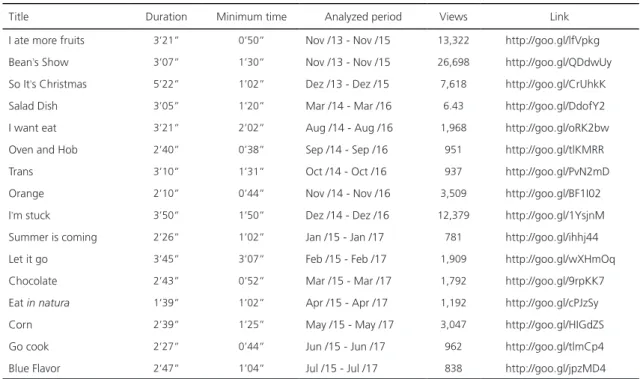
A total of 16 videos were produced from November 2013 to July 2015, according to the themes presented in Methods. The views were counted individually for each video over a two-year period of their release date, giving 78,546 views for the 16 videos (Table 1). “Bean Show” was the video with the highest number of views in the period.
The number of subscribers verification considered the period from November 2013 to July 2017, since it were not an individual analysis of each video. The video channel received 1,033 subscriptions, representing the number of users interested in receiving the content produced. The profile of users was primarily female (62.1%), aged between 18 and 24 years (25.0%) (Figure 1).
Figure 1. Profile of YouTube viewers (78,546 in total) of
USParódia between November 2013 and July 2017.
30
25
20
15
10
5
0
Audience (%)
years years years years years years years
13 - 17 18 - 24 25 - 34 35 - 44 45 - 54 55 - 64Over 65
Age range
Table 1. Duration (in minutes), minimum time to attain the educational message (in minutes), period analyzed, number of views and access link of all the videos produced for USParódia channel (Nov/2013-Jul/2015).
Title Duration Minimum time Analyzed period Views Link I ate more fruits 3’21” 0’50” Nov /13 - Nov /15 13,322 http://goo.gl/lfVpkg Bean’s Show 3’07” 1’30” Nov /13 - Nov /15 26,698 http://goo.gl/QDdwUy So It’s Christmas 5’22” 1’02” Dez /13 - Dez /15 7,618 http://goo.gl/CrUhkK Salad Dish 3’05” 1’20” Mar /14 - Mar /16 6.43 http://goo.gl/DdofY2 I want eat 3’21” 2’02” Aug /14 - Aug /16 1,968 http://goo.gl/oRK2bw Oven and Hob 2’40” 0’38” Sep /14 - Sep /16 951 http://goo.gl/tlKMRR Trans 3’10” 1’31” Oct /14 - Oct /16 937 http://goo.gl/PvN2mD Orange 2’10” 0’44” Nov /14 - Nov /16 3,509 http://goo.gl/BF1I02 I’m stuck 3’50” 1’50” Dez /14 - Dez /16 12,379 http://goo.gl/1YsjnM Summer is coming 2’26” 1’02” Jan /15 - Jan /17 781 http://goo.gl/ihhj44 Let it go 3’45” 3’07” Feb /15 - Feb /17 1,909 http://goo.gl/wXHmOq Chocolate 2’43” 0’52” Mar /15 - Mar /17 1,792 http://goo.gl/9rpKK7 Eat in natura 1’39” 1’02” Apr /15 - Apr /17 1,192 http://goo.gl/cPJzSy Corn 2’39” 1’25” May /15 - May /17 3,047 http://goo.gl/HIGdZS Go cook 2’27” 0’44” Jun /15 - Jun /17 962 http://goo.gl/tlmCp4 Blue Flavor 2’47” 1’04” Jul /15 - Jul /17 838 http://goo.gl/jpzMD4
Figure 2. Comparison of average percentage of playing time on YouTube with the minimum expected time to attain educational objective for USParódia channel videos between Nov/2013 and Jul/2015.
I ate mor
e fruits
Bean
s Show
’
So it
s Christmas
’ Salad Dish I want eat
Oven and Hob
Trans
Orange Im stuck’
Sumer is coming
Let it go
Chocolate
Eat in natura
Cor
n
Go cook
Blue Flavor
Videos Parodies
Average view duration Educational objective 100
90
80
70
60
50
40
30
20
10
0
Table 2. Likes, dislikes and shares obtained in the two-year period of analysis of each video of USParódia channel published between Nov/2013 and Jul/2015.
Title Likes Dislikes Shares
I ate more fruits 75 9 25
Bean’s Show 97 9 86
So It´s Christmas 21 3 6
Salad Dish 6 1 2
I want eat 23 3 5
Oven and Hob 14 1 2
Trans 21 0 0
Orange 29 5 5
I’m stuck 92 45 19
Summer is coming 14 3 1
Let it go 20 0 3
Chocolate 32 3 13
Eat in natura 15 3 9
Corn 11 4 0
Go cook 12 3 1
Blue Flavor 15 0 3
Figure 2 shows the average playing time of each video in percentage, representing the ability to retain viewers while playing, together with the time required to attain educational objective. Viewers lost interest in five videos before attaining their educational objective.
In the analysis period, the videos received 497 likes, 92 dislikes and were shared 180 times. The video with the most views also received the most likes and the most number of shares (“Bean Show”). The videos generally did not receive many dislikes, the video “I’m stuck” received the most negative impressions, although it also received a high number of likes and was shared many times (Table 2).
On Facebook, between November 2013 and July 2017, the page reached 3,085 users and obtained 626 likes, which is the number of people interested in continuing to receive the videos.
D I S C U S S I O N
All videos reached audiences of different ages (Figure 1). Children under 13 years old may have been reached but YouTube procedures precluded this count. The female audience predominated (62.0%), probably for cultural reasons, where women tend to have a greater concern for health and beauty and therefore seek videos about nutrition. A survey of college students showed this pattern, whose ages were similar to those of the present study, where the female group had greater concern over issues related to nutrition, diet and body weight. In addition, the age group in question was consistent with the intended age group, where young people (18-24 years) of both genders represented the highest percentage of the target population (38.9%) [30]. Moreover, the videos and the present study were produced in the university environment of the undergraduate course in nutrition; the majority of students are female and interested in the subject. Thus, the propagation of the videos may have been more intense in this audience.
appearing to be few videos with greater reach, it was important for the target audience concerned to be led to other videos, consequently attaining the educational objective of the study. Based on the least popular video, USParódia was an educational nutrition intervention that reached at least 643 people, a significant number relative to other media-based researches [31-34].
Were noted that the number of likes, dislikes, and shares tracked the number of views for each video. Hence, the videos that were most viewed were the ones that received the most impressions from the users. Observing the overview of impressions, the videos have all been well received, but maybe the users are more motivated to express their appreciation for the videos compared to the manifestation of disapproval. However, the video “I’m stuck” had a high number of dislikes when compared to other videos, and it is assumed that dislike might have happened because of the poor audio quality in this particular video.
The shares was very uneven between the videos, and the users did not share some videos. Nevertheless, the sharing of a few videos, such as “Bean Show”, “I ate more fruits”, and “I’m stuck”, may justify the high number of views in those videos or at least, evidence the collaboration of users in propagating the videos and their educational messages.
Likes, dislikes and shares were used to evaluate the positive impressions of the videos, but the reasons for users hitting the like or dislike button and sharing the video on a given platform are unknown and subjective, because this action can be linked to any factors and not necessarily to understanding the educational message.
Under these circumstances, with regard to conveying the educational message, the ability to hold users’ attention is much more relevant, as evidenced in Figure 2. The average percentage played shows how much of the video was seen before being closed. Thus, it
was possible to evaluate for each video whether the educational objective had been achieved, according to the play time of the educational message. The objective was not achieved for five videos, in all of which the educational message was delivered very late. This occurred for two reasons: in “I want to eat” and “Let it go”, sarcasm was used in the construction of the video narrative, leaving the clear message to the end. In both cases, this does not necessarily mean that the educational objective was not achieved if the user had not watched it to the end, but this information remains unclear. In “I’m stuck”, “Summer is coming” and “Corn” the late delivery of the message was due to the length of the video narrative. In these cases, the lyrics of the parody produced this structure based on the original lyrics and melody.
Although the premise of the use of combined platforms is promising, a gap in the reach of people between Facebook and YouTube was observed. But the Facebook page of USParódia was used exclusively as a redirector for YouTube. Unlike other Facebook pages related to health, analyzed in an explorative study, where the pages were used as a tool for dialogue with users. Then, the USParódia Facebook page, has not yet reached the full potential [34]. However, the use of Facebook should not be discouraged, since it allows, even to a reduced range, the propagation of messages of food and nutritional education.
C O N C L U S I O N
adults, who have already incorporated the internet in their daily lives, received the videos well, and subscribed to receive more of this content. The parodies were able to deliver the educational messages and will remain available for access after the evaluation period, creating a growing library of educational videos and reaching a wider audience. Thus, this pioneering work showed YouTube as a new setting for health promotion in Brazil, paving the way for further initiatives with this platform.
C O N T R I B U T O R S
F DAUN idealized and developed the project studied, collected the data, interpreted and analyzed the data, reviewed the literature and wrote the article; AMD GAMBARDELLA supervised the development of the project, reviewed the article and approved its final version.
A C K N O W L E D G E M E N T S
USParódia was developed thanks to the collaboration of Rebeca Freitas and Renata Orasmo. Also, USParódia always counts on the great support of Marilu Daun Sakemi and Eduardo Daun Sakemi.
R E F E R E N C E S
1. World Health Organization. World Health Statistics 2012. Geneva: WHO; 2012.
2. Boog MCF, Motta DG. Educação nutricional: por que e para quê. J Unicamp. 2004 ago 2-8. [acesso 2013 nov 28];2. Disponível em: http://www. unicamp.br/unicamp/unicamp_hoje/jornalPDF/ ju260pag02.pdf
3. Ministério da Saúde (Brasil). Secretaria de Atenção à Saúde. Guia alimentar para a população bra-sileira. 2a ed. Brasília: Ministério da Saúde; 2014. 4. Instituto Brasileiro de Geografia e Estatística.
Pes-quisa Nacional de Saúde: 2013. Brasília: IBGE; 2013.
5. Lindemann IL, Molon EP, Mintem GC, Mendoza-Sassi RA. Reception of nutrition information by adult and older adult users of Primary Healthcare: Occurrence, associated factors, and sources of
information. Rev Nutr. 2017;30(4):489-98. http:// dx.doi.org/10.1590/1678-98652017000400008 6. Instituto Brasileiro de Geografia e Estatística.
Pes-quisa Nacional por amostra de domicílios: 2014. Brasília: IBGE; 2014.
7. Ministério do Desenvolvimento Social e Combate à Fome (Brasil). Marco de referência de educação alimentar e nutricional para as políticas públicas. Brasília: MDS; 2012.
8. Boog MCF, Vieira CM, Oliveira NL, Fonseca O, L’Abbate S. Utilização de vídeo como estratégia de educação nutricional para adolescentes: comer... o fruto ou o produto? Rev Nutr. 2003;16(3):281-93. http://dx.doi.org/10.1590/S1415-527320030003 00006
9. Duncan I, Yarwood-Ross L, Haigh C. YouTube as a source of clinical skills education. Nurse Educ Today. 2012;33(12):1576-80. http://dx.doi. org/10.1016/j.nedt.2012.12.013
10. Abedin T, Ahmed S, Al Mamun M, Ahmed SW, Newaz S, Rumana N, et al. YouTube as a source of useful information on diabetes foot care. Diabetes Res Clin Pract. 2015;110(1):e1-4. http://dx.doi. org/10.1016/j.diabres.2015.08.003
11. Google Brasil. YouTube Insights 2017: Pesquisa Google e Reds com consumidores brasileiros online. São Paulo; 2017 [acesso 2018 jan 8]. Dis-ponível em: http://www.thinkwithgoogle.com/ intl/pt-br/youtubeinsights/2017/
12. Frossard VC, Dias MCM. O impacto da internet na interação entre pacientes: novos cenários da saúde. Interface. 2016;20(57):349-61. http://dx.doi. org/10.1590/1807-57622014.1334
13. Pope L, Latimer L, Wansink B. Viewers vs. Doers: The relationship between watching food television and BMI. Appetite. 2015;90:131-5. http://dx.doi. org/10.1016/j.appet.2015.02.035
14. Mairs K, McNeil H, McLeod J, Prorok JC, Stolee P. Online strategies to facilitate health-related knowledge transfer: A systematic search and review. Health Inf Libr J. 2013;30(4):261-77. http:// dx.doi.org/10.1111/hir.12048
15. Manca S, Ranieri M. Is it a tool suitable for learning? A critical review of the literature on Facebook as a technology-enhanced learning environment. J Comput Assist Learn. 2013;29(6):487-504. http:// dx.doi.org/10.1111/jcal.12007
16. Kindem G, Musburger RB. Introduction to media production: From analog to digital. Boston: Focal Press; 1997.
18. Santos RD, Gagliardi ACM, Xavier HT, Magnoni CD, Cassani R, Lottenberg AMP, et al. I Diretriz sobre o consumo de gorduras e saúde cardiovascular. Arq Bras Cardiol. 2013;100(1Suppl3):1-40. http:// dx.doi.org/10.1590/S0066-782X2013000900001 19. Fantini AP, Canniatti-Brazaca SG, Souza MC,
Mansi DN. Disponibilidade de ferro em misturas de alimentos com adição de alimentos com alto teor de vitamina C e de cisteína. Ciênc Tecnol Aliment. 2008;28(2):435-9. http://dx.doi.org/10.1590/S010 1-20612008000200026
20. Bernaud FSR, Rodrigues TC. Fibra alimentar: ingestão adequada e efeitos sobre a saúde do metabolismo. Arq Bras Endocrinol Metab. 2013;57(6):397-405. http://dx.doi.org/10.1590/S00 04-27302013000600001
21. Vieira CAL, Bosi MLM. Corpos em confecção: considerações sobre os dispositivos científico e midiático em revistas de beleza feminina. Physis. 2013;23(3):843-61. http://dx.doi.org/10.1590/S01 03-73312013000300010
22. Boog MCF. Atuação do nutricionista em saúde pública na promoção da alimentação saudável. Rev Ciênc Saúde. 2008;1(1):33-42. http://dx.doi. org/10.15448/1983-652X.2008.1.3860
23. Abreu ES, Paternez ACA, Chaud DMA, Valverde F, Gaze JS. Parâmetros nutricionais de dietas anunciadas na imprensa leiga destinada ao público masculino e feminino. Rev Ciênc Saúde. 2013;6(3):206-13. http://dx.doi.org/10.15448/19 83-652X.2013.3.13479
24. International Diabetes Federation. IDF Diabetes Atlas. 6th ed. Belgium: IDF; 2013.
25. Sociedade Brasileira de Diabetes. Diretrizes da Sociedade Brasileira de Diabetes: 2013-2014. São Paulo: AC Farmacêutica; 2014.
26. Latif R. Health benefits of cocoa. Curr Opin Clin Nutr Metab Care. 2013;16(6):669-74. http://dx. doi.org/10.1097/MCO.0b013e328365a235 27. Graciano LC, Ferreira FG, Chiapeta SMSV, Scolforo
LB, Segheto W. Nível de conhecimento e prática de hidratação em praticantes de atividade física em academia. Rev Bras Nutr Esport. 2014;8(45):146-55.
28. Bezerra ACD, Cervato-Mancuso AM, Heitz SJJ. Alimento de rua na agenda nacional de segu-rança alimentar e nutricional: um ensaio para a qualificação sanitária no Brasil. Ciênc Saúde Cole-tiva. 2014,19(5):1489-94. http://dx.doi.org/10.15 90/1413-81232014195.18762013
29. Cervato-Mancuso AM. Elaboração de um pro-grama de educação nutricional. In: Diez-Garcia RW, Cervato-Mancuso AM, editores. Mudanças alimentares e educação nutricional. Rio de Janeiro: Guanabara Koogan; 2011. p.139-61.
30. Poínhos R, Alves D, Vieira E, Pinhão S, Oliveira BMPM, Correia F. Eating behaviour among undergraduate students: Comparing nutrition students with other courses. Appetite. 2015;84:28-33. http://dx.doi.org/10.1016/j.appet.2014.09.011 31. Brown ON, O’Connor LE, Savaiano D. Mobile
MyPlate: A pilot study using text messaging to provide nutrition education and promote better dietary choices in college students. J Am Coll Health. 2014;62(5):320-7. http://dx.doi.org/10.1 080/07448481.2014.899233
32. Kadivar M, Seyedfatemi N, Farahani TM, Mehran A, Pridham KF. Effectiveness of an internet-based education on maternal satisfaction in NICUs. Patient Educ Couns. 2017;100(5):943-9. http:// dx.doi.org/10.1016/j.pec.2016.11.005
33. Au LE, Whaley SE, Gurzo K, Meza M, Rosen NJ, Ritchie LD. Evaluation of online and in-person nutrition education related to salt knowledge and behaviors among special supplemental nutrition program for women, infants, and children participants. J Acad Nutr Diet. 2017;117(9):1384-95. http://dx.doi.org/10.1016/j.jand.2016.12.013 34. Labegalini CMG, Previato GF, Dias GMS, Carreira
L, Jaques AE, Baldissera VDA. O lazer em rede social virtual: uma possibilidade de diálogo autêntico. Esc Anna Nery. 2017;21(2):1-7. http:// dx.doi.org/10.5935/1414-8145.20170037