Brazilian Journal of Physics, vol. 34, no. 1A, March, 2004 255
The Pion Electromagnetic Form Factor in the Meson Cloud Model
F. Carvalho
1, F.O. Dur˜aes
1,2, F.S. Navarra
1, and M. Nielsen
11Instituto de F´ısica, Universidade de S˜ao Paulo, C.P. 66318, 05389-970 S˜ao Paulo, SP, Brazil 2Dep. de F´ısica, Faculdade de Ciˆencias Biol´ogicas, Exatas e Experimentais,
Universidade Presbiteriana Mackenzie, C.P. 01302-907 S ˜ao Paulo, SP, Brazil
Received on 15 August, 2003.
In this work we calculate the meson cloud effects on the pion electromagnetic form factor and perform a comparison with experimental data. We show that, even though the cloud is not the only non-perturbative process to be considered, its contribution is significant. We also study the influence of the cutoff choices on the results.
1
Introduction
The region between the perturbative and non-perturbative sector of QCD is the key for understanding the strong inter-action. In this context, the pion electromagnetic form factor (Fπ) is of great interest. It is extremely well reproduced in the low momentum transfer (Q2) regime by the vector
dom-inance model, and at highQ2by perturbative QCD, which
proposes the following asymptotic behavior for theFπ func-tion:
Q2Fπ(q2) = 16πfπ2αs(Q2) (Q2→ ∞) (1) wherefπis the pion decay constant.
From the comparison between the experimental data and the asymptotic behavior it is possible to determine the scale of momentum where the perturbative regime of QCD is reached. Recently, the pion electromagnetic form factor has been measured at momentum transfers0.6GeV2 ≤Q2 ≤
1.6GeV2by the Jefferson LaboratoryF
πcollaboration. We can see that even at the highest experimentally accessible momenta, they are still very far from the asymptotic limit.
The main question here is: what are the non-perturbative effects responsible for the deviation from perturbative QCD at intermediate momenta? In this work we consider the con-tribution of the meson cloud around the pion to its eletro-magnetic form factor.
The role of mesons in deep inelastic scattering (DIS) was first investigated by Sullivan [1]. He suggested that some fraction of the sea anti-quark distribution of the nu-cleon may be associated with the pion cloud around it. Sev-eral works developed this idea and gave origin to the meson cloud model (MCM). They are all based on the notion that the physical proton (p) may be expanded in a sum of vir-tual meson-baryon states (MB). This model has presented very meaningful results when applied to hadronic interac-tions [2, 3, 4].
The success of the MCM in understanding particle pro-duction and asymmetries in open charm propro-duction leads us to expect it to play also an important role in hadron form factors.
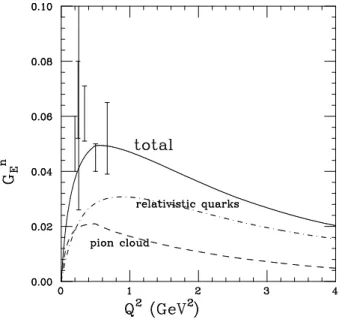
Indeed, in a recent paper, G. Miller [5] presented a cal-culation of the electromagnetic form factor of the nucleon where the inclusion of meson cloud effects was needed to fit the experimental data, as shown in Fig. 1.
Figure 1. Nucleon electromagnetic form factor.
The purpose of this work is to perform an extension of the MCM to the pion and investigate the importance of the meson cloud in its electromagnetic form factor. The idea of describing a pion with cloud states has already been used by us previously in [6], where we have studiedD−
/D+
asym-metry produced inπp→ DX collisions. In that work we could see that the inclusion of the meson cloud leads to a good agreement with experimental data.
As in the case of the nucleon, we can represent the pion as a “bare pion”|π−
>0which can fluctuate in virtual Fock
256 F. Carvalhoet al.
|π−
> = |π−
>0+|π−ρ0>+|π0ρ−>
+ |K−
K0∗
>+|K0K−∗
>
+ |D−
D0∗
>+|D0D−∗
>+... (2) Thus, we can understand the photon-pion interaction as being an interaction between the photon and the constituents of the cloud. In Fig. 2, we show the interaction of the photon and the state|P V >
Figure 2. Photon-pion interaction in the MCM.
2
The pion form factor
In order to obtain the pion form factor we need to calculate the vertex functionΓµ(p, p′)for all the diagrams of Fig. 2 and for all the states of the equation (2).
In the case of the diagram (a),Γµis given by
iΓµ(p, p ′
) =ig2Qπ
Z d4k
(2π)4F(k
2)F(k+q)2
i k2−m2
π
i
(k+q)2−m2
π
(2k+q)µ
(−i)p′ β(−i)
"
gαβ−(p−k)α(p−k)β/m2
ρ (p−k)2−m2
ρ
#
i pα (3)
For the internal vertex form factor (pion-meson-meson), we used the monopole parametrization:
F(k2) = m
2
π−Λ2
k2−Λ2
Using the expression 1
x2−a2 =−
Z ∞
0
dα eα(x2−a2)
in each one of the five denominators, we arrive at
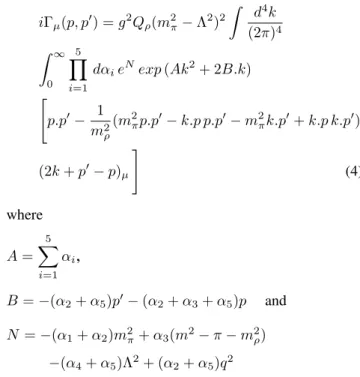
iΓµ(p, p′) =g2Qρ(m2π−Λ2)2
Z d4k (2π)4
Z ∞
0 5
Y
i=1
dαieNexp(Ak2+ 2B.k)
"
p.p′ − 1
m2
ρ (m2πp.p
′
−k.p p.p′
−m2πk.p ′
+k.p k.p′ )
(2k+p′ −p)µ
# (4) where A= 5 X i=1
αi
,
B=−(α2+α5)p′−(α2+α3+α5)p and
N=−(α1+α2)m2π+α3(m2−π−m2ρ)
−(α4+α5)Λ2+ (α2+α5)q2
The advantage of arranging the terms in this way is that the d4k integration can be performed analytically. Doing
this, we can group the terms proportional to pµand to p′µ. Now these terms depend only onQ2 =−q2and on theα
i variables.
The integrals inαican be solved numerically. Perform-ing them, the result is a function ofQ2, as we actually wish.
So we have as a final result, some expressions like: Γµ(p, p
′
) =a(Q2)pµ+b(Q2)p ′ µ
Doing the same type of calculation for all the diagrams in Fig. 2, including the contributions of the other diagrams in equation (2) and adding their results we find:
Γµ(p, p ′
) =F1(Q2)pµ+F2(Q2)p
′ µ
The pion electromagnetic form factor is associated with the term:
Fπ+(Q2) =
F1(Q2) +F2(Q2)
2 (5)
3
Inputs for the calculations
In order to evaluate the vertex functions derived in the previ-ous section, it is necessary to know the value of the relevant masses, coupling constants(g)and cutoff parameters(Λ).
Brazilian Journal of Physics, vol. 34, no. 1A, March, 2004 257
monopole parametrization for these vertices, we have cho-sen cutoff values close to the corresponding vector meson masses.
In Table I we present all the values used in these calcu-lations.
Table I: Values of coupling constants and cutoff used in the vertex functions.
4
Results and conclusions
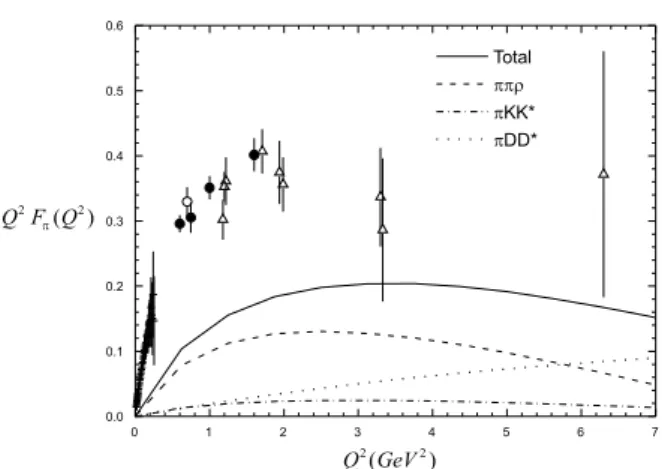
In Figs. 3 and 4 we present our results for Fπ(Q2) with smaller and larger cutoff values respectively. In both figures we include experimental data from theFπcollaboration [9], Amendoliaet al.[10], from DESY [11] and from Bebecket al.[12].
As it can be seen, the contribution from the meson cloud for the pion electromagnetic form factor is very important to understand the experimental data, specially in the inter-mediate momentum region. It is also possible to notice that there is a strong dependence of the results with the cutoff parameter.
As expected, we observe that the contribution from the |πρ >state is much larger than the others, due to the small masses involved. Surprisingly the |DD∗
>state gives a large contribution, which becomes more important at large
Q2. This is essentially due to the large value of theDD∗
π
coupling. A possible interpretation of this fact is that at higher momenta, the photon can probe havier states.
Finally, we can compare the strength of the meson cloud in the pion (Figs. 3 and 4) and in the nucleon (Fig.1). We conclude that they have comparable magnitude, but in the case of the pion, the cloud is more important at intermediate momenta, while for the nucleon, the cloud becomes domi-nant at low momenta.
Figure 3. Comparison between the MCM and experimental data. The solid circles, cross, open circles and open triangles are the experimental data from refs. [9], [10], [11] and [12] respec-tively. In this figure we choseΛππρ = ΛπKK∗ = 0
.7GeV and
ΛπDD∗ = 2.1GeV.
Figure 4. The same as Fig. 3, withΛππρ = ΛπKK∗ = 0.8GeV andΛπDD∗ = 2.1GeV.
As expected, we observe that the contribution from the |πρ >state is much larger than the others, due to the small masses involved. Surprisingly the |DD∗
> state gives a large contribution, which becomes more important at large
Q2. This is essentially due to the large value of theDD∗
π
coupling. A possible interpretation of this fact is that at higher momenta, the photon can probe havier states.
Finally, we can compare the strength of the meson cloud in the pion (Figs. 3 and 4) and in the nucleon (Fig.1). We conclude that they have comparable magnitude, but in the case of the pion, the cloud is more important at intermediate momenta, while for the nucleon, the cloud becomes domi-nant at low momenta.
References
[1] J.D. Sullivan, Phys. Rev. D5, 1732 (1972).
[2] F. Carvalho, F. O. Dur˜aes, F. S. Navarra and M. Nielsen, Phys. Rev. D60, 094015 (1999).
[3] F. Carvalho, F. O. Dur˜aes, F. S. Navarra, M. Nielsen, and F.M. Steffens, Eur. Phys. J. C18, 127 (2000).
258 F. Carvalhoet al.
Nucl. Phys. A605, 496 (1996); Nucl. Phys. A728, 182 (2003); K. Ohta, Phys. Rev. D35, 785 (1987); L. L. Barz et al., Nucl. Phys. A640, 259 (1998); Braz. J. Phys.27, 358 (1997); H. Forkelet al., Nucl. Phys. A680, 179 (2000).
[5] G. A. Miller, nucl-th/0206027.
[6] F. Carvalho, F. O. Dur˜aes, F. S. Navarra and M. Nielsen, Phys. Rev. Lett.86, 5434 (2001).
[7] see, for exeample, S. L. Zhu, Eur. Phys. J. AA, 277 (1999)
and references therein.
[8] S. Ahmedet. al., Phys. Rev. Lett.87, 251801 (2001).
[9] J. Volmeret. al. Phys. Rev. Lett.861713 (2001)
[10] S. R. Amendoliaet al., Nucl. Phys. B277, 168 (1986).
[11] P. Brauelet al., Z. Phys. C3, 101 (1979).