Original Article
Artigo Original
Effects of hearing and cognitive impairment
in sentence recognition
Efeitos da perda auditiva e da cognição no
reconhecimento de sentenças
Mirtes Bruckmann1
Maria Madalena Canina Pinheiro1
Keywords
Elderly Individual Hearing Loss Cognition Speech Perception Noise
Descritores
Idoso Perda Auditiva Cognição Percepção da Fala Ruído
Correspondence address:
Mirtes Bruckmann
Universidade Federal de Santa Catarina – UFSC
Avenida Internacional, 303, Florianópolis (SC), Brazil, CEP: 88058-084.
E-mail: [email protected]
Received: May 11, 2015
Study carried out at Curso de Fonoaudiologia, Universidade Federal de Santa Catarina – UFSC - Florianópolis (SC), Brazil.
1 Coordenadoria Especial de Fonoaudiologia, Universidade Federal de Santa Catarina – UFSC - Florianópolis
(SC), Brazil.
Financial support: none.
Conlict of interests: nothing to declare. ABSTRACT
Purpose: To evaluate the effects of hearing and cognitive impairment in sentence recognition in elderly people.
Methods: The study included 30 elderly individuals divided into two groups: GI, with 17 elderly people without hearing loss and GII, with 13 elderly people with mild hearing loss. In order to evaluate their cognition, the Mini Mental State Examination (MMSE) was performed, whereas, for the evaluation of the auditory effects, the Portuguese Sentence List (PSL) was performed, in which the sentence recognition thresholds in silence (SRTS) and the signal-to-noise ratio (S/N) were researched. Results: In MMSE, there was a higher percent of individuals with alteration for GI group when compared with GII group. In both SRTS and S/N, the GI group presented lower thresholds when compared with the GII group for both ears. Regarding the cognitive aspects,
no signiicant statistical difference between normal and altered groups was observed in the MMSE for SRTS and
S/N for GI and GII in both ears. Conclusion: Mild hearing loss exerted inluence on the sentence recognition
in silence and in noise. On the other hand, the cognitive aspects did not interfere in speech recognition in both silence and noise.
RESUMO
Objetivo: Avaliar os efeitos da perda auditiva e da cognição no reconhecimento de sentenças em idosos.
Métodos: Participaram do estudo 30 idosos distribuídos em dois grupos: GI- composto por 17 idosos sem perda auditiva e GII- composto por 13 idosos com perda auditiva de grau leve. Para avaliar a cognição, foi aplicado o Mini Exame do Estado Mental (MEEM) e, para analisar os efeitos auditivos, foi realizado o teste Listas de Sentenças em Português (LSP), no qual foi pesquisado o Limiar de Reconhecimento de Sentenças no Silêncio (LRSS) e a relação sinal/ruído (S/R). Resultados: No MEEM, houve um percentual maior de indivíduos com alteração no GI do que no GII. Tanto no LRSS quanto na relação S/R, o GI apresentou menores limiares do que o
GII em ambas as orelhas. Em relação aos aspectos cognitivos, não houve diferença estatisticamente signiicante
entre o grupo normal e alterado no MEEM com o LRSS e relação S/R dos grupos GI e GII de ambas as orelhas.
Conclusão: A perda auditiva de grau leve exerceu inluência no reconhecimento de sentenças no silêncio e no
INTRODUCTION
The process of population aging is a reality in Brazil and in the world and, as a consequence, it starts changing the perspective of life of people. Thus, it has become important to carry out studies on elderly individuals, in order to meet the new requirements and demands in terms of public health policies(1).
Aging causes different alterations in each individual, and it might be gradual for some people or faster for others. Although this process is not necessarily related to diseases and disabilities, these alterations are dependent on factors such as lifestyle, socioeconomic conditions and chronic diseases(2).
Among the alterations found in the elderly is presbycusis, which is the hearing loss due to aging and it becomes a common factor among elderly people(3). The occurrence of the beginning of this loss is common after the ifth decade of life. It primarily affects the high frequencies of the cochlear system bilaterally and it also causes alterations in central auditory pathways, associated with aging, which results in losses in the recognition and perception of rapid alterations in speech, mainly in noisy environments(4).
In addition to the disorder in the auditory system, aging is also responsible for generating cognitive impairment. These aspects are decreased and they mainly affect memory and attention. These two factors (hearing loss and cognitive impairment) together, lead to impairment in word recognition and comprehension of sentences(5).
In view of the fact that one of the biggest problems of the elderly individual is understanding speech in noisy environments, one of the speech perception tests that can evaluate this complaint, in acoustically unfavorable environment, is the Portuguese Sentence List test (PSL)(6). This test was the irst one to use sentences in Brazilian Portuguese to evaluate these dificulties. It translates the real complaints faced by elderly people in their “hearing routine” and not understanding and it also makes an analysis of how the comprehension of the individual, both in quiet and in noise, is occurring.
The results of some research on noise with sentence tests have shown that hearing dificulties in noise occurs in several study groups, such as adults and elderly people, but they are more common when the individual is getting older, regardless of the preservation of peripheral hearing(7). However, other studies have shown that in addition to the age of the individual, hearing loss causes great inluence on speech intelligibility in comprehension tasks in noise(8,9).
Due to the lack of consensus among the previous studies and the lack of studies correlating the sentence recognition in quiet and in noise with the cognitive aspects, the aim of this study was to evaluate the effects of hearing and cognition loss in sentence recognition in elderly individuals.
METHOD
This study is an exploratory research with descriptive observational and cross-sectional approach with non-probabilistic convenience sample. It consisted of participants that were
60 years or older, they were participants of elderly groups who were invited to be volunteers in the study.
The procedures were initiated after the approval of the research project at the Human Research Ethics Committee under the CAAE protocol number 19806713.0.0000.0212. All individuals who were invited to participate in the research were also asked about their free and spontaneous participation and instructed on the procedures to be performed. After accepted, the individuals signed an Informed Consent Form (ICF) which authorized their voluntary participation in this research, which also contained all the procedures to be performed.
The sample consisted of elderly people, both males and females, from three different groups of elderly people who met the following eligibility criteria: being 60 years or older; being literate in Portuguese; not presenting evidence of neurological or psychiatric disorders; not presenting speech disorders; absence of conductive hearing loss; absence of cerumen or any foreign body that could hinder the visualization of the external auditory meatus; never worn any Personal Sound Ampliication Product (PSAP).
At a irst moment, the volunteers started to answer to an anamnesis and the Mini Mental State Examination (MMSE) (10), being considered the years of study of individuals to obtain
the cut-off average and classify them as normal or abnormal in terms of cognitive aspects(11).
After, the basic audiological evaluation composed of Meatoscopy, Pure Tone Audiometry (PTA), Logoaudiometry and Immitanciometry.
From the result of PTA, the elderly people were divided into two groups (GI and GII) based on auditory thresholds, calculated by using the average of the sound frequencies of 500 to 4000 Hz of the audiogram(12):
- GI – it was composed of elderly people without hearing loss, in other words, those ones with the average of sound frequencies of 500 to 4000 Hz less than or equal to 25 dBHL.
- GII – it was composed of elderly people with symmetrical bilateral sensorineural hearing loss, until moderate level (60 dBHL) in the average of frequencies of 500 to 4000 Hz(12).
To perform these procedures, it was used the two-channel audiometer, Interacoustic, AC 40 model, supra-aural headphones TDH39, calibrated for evaluation by air conduction and bone vibrator to evaluate bone conduction. To perform the immitanciometry, it was used the immittanciometer AT 235 model - Interacoustic, in which the tympanogram curve and stapedial acoustic relex ipsilateral and contralateral was performed.
After the completion of the aforementioned reviews, individuals who were in accordance with the inclusion criteria were divided into GI and GII. Afterwards, the PSL(6) test was performed.
Before starting the test, it was performed the calibration of the output channel of the sentences by using the pure tone present on the CD and it was also performed the calibration of noise in another CD, by using the noise itself as a reference. Each channel was calibrated with the aid of the VU-meter of the audiometer, and both the pure tone and noise were placed at zero.
The test was performed in an acoustic booth, with the use of earphones. Stimuli (speech and noise) are recorded on the CD in independent channels, which enables carrying out evaluations of speech recognition skills in quiet and in the presence of competitive noise.
The research was performed in each ear, and speech and noise stimuli were presented ipsilaterally.
All individuals received irst training through the list 1A, which was used only for this purpose. The participants were instructed to repeat each presented sentence. From this list, only 20 sentences were used, ive to the right ear training in silence, ive to the left ear in silence, ive to the right ear in noise and ive to the left ear in noise.
The training helped to familiarize the elderly people with the test and also to determine the initial intensity in the thresholds would be surveyed in the next list. To facilitate the recognition of the irst sentence of each list, in order to ensure the understanding of the test, the initial intensity of presentation of the sentences in silence for training was 10 to 20 dB above the Speech Recognition Threshold (SRT)(13).
In the test were, the sentences were irst presented without the presence of competitive noise, in order to determine the Sentence Recognition Threshold in Silence (SRTS), then the sentences in the presence of competitive noise were presented to determine the Sentence Recognition Threshold in Noise (SRTN).
In all individuals, it was followed the same order of presentation of sentences, both in training and in the test. For the last one, it was used the list 1B to the right ear in silence, list 2B for the left ear in silence, list 3B to the right ear in noise and List 4B for the left ear in noise.
The noise was presented at ixed intensity of 65 dB SPL (A) with all participants and only the sentences had changes in intensity.
To obtain measures of the SRTS and SRTN, it was used the “sequential strategy, adaptive or ascending/descending”, which allows to determine the minimum level required for the individual to identify correctly about 50% of the presented sentences(14).
Thus, the application of the test consisted in presenting a sentence, in a particular initial intensity. If the individual answered correctly, the intensity of presentation of the next sentence was decreased. If the answer was incorrect, the intensity of the next sentence was increased, keeping the intensity of the noise when present. Intervals of 4 dB were used until the irst change in the type of response and, from there, the intervals of presentation of the stimuli were 2 dB between themselves until the end of the list, as suggested by the literature(14,15). A response was considered correct only when the individual repeated, without any mistake or omission all the presented sentence.
In the irst work performed with earphones(13), the existence of a difference of 7 dB between the recording volume of the two signals in the CD was observed (speech and noise). Thus,
the researchers performed a computerized spectrographic analysis of the recorded material on the CD, which showed that the sentences are recorded at an average intensity of 7 dB below the intensity of the noise, thus it was necessary to adopt the criterion of subtraction of 7 dB of speech values that were observed in the dial of the equipment.
During the test performance, the levels of presentation of each sentence levels were noted and, after the presentation of all the lists used in the test, it was performed the average of these values in each list, from the level of presentation on which occurred the irst change on the type of response to the level of presentation of the last sentence of the list. Then, to obtain the SRTS, 7dB of the inal value of the calculation were subtracted as described above, and the same was performed to obtain the SRTN expressed by the S/N ratio (signal/noise), which is the difference between the average intensity of presentation of the sentences and the noise.
Therefore, to calculate the S/N ratio, the average intensity calculated from the presented speech was subtracted from the intensity of the noise (65 dB SPL (A)).
For the statistical analysis, the Chi-Square Test, the Analysis of Variance Test (ANOVA) and the Pearson correlation were used. It was considered the statistical signiicance level of p <0.05 (5%), and the results were signiicant, indicated by an asterisk (*).
RESULTS
The initial population of this study consisted of 39 individuals, being nine of them excluded for not presenting the inclusion criteria: two individuals had perforated tympanic membrane, one individual had mixed loss, four individuals had asymmetrical hearing loss, one had total bilateral earwax and one individual had already worn hearing aids previously.
Thus, the population of the study was composed of a total of 30 individuals, being 19 females and 11 males (p-value= 0.039*). The average age of the participants was 68.5 years, with a minimum of 60 and maximum of 88 years. In GI, the average age was 66.1 years and in GII, the average was 71.7 years, with a statistically signiicant difference (p-value = 0.028*).
In relation to the years of study, the overall average of the population was 10.4 years, with a minimum of one year and maximum of 21 years of study. In GI, the average years of study was 11.35 years and the GII, the average was 9.08 years, however, there was no statistically signiicant difference (p-value = 0.249). In relation to the auditory features, 17 individuals were part of the GI and 13 individuals were part of the GII. The average of the hearing thresholds of 500 to 4000 Hz in GI was 17.12 dB, and, in GII was 35.91 dB.
In Table 1, it will be presented the analysis between the MMSE and the hearing of the studied individuals.
After analyzing Table 1, it was found that there was no statistically signiicant difference between the presence of hearing loss and MMSE scores between GI and GII.
In Table 2, we observed a statistically signiicant difference between groups for the SRTS both OD as in OE, and the GI showed better LRSS than GII.
Table 3 shows that there was also a statistically signiicant difference between groups in the S / N ratio. You can observe lower thresholds in GI to GII in both ears.
By correlating the SRTS and the S / N ratio with age, there was no statistically signiicant difference in GI in both ears: SRTS OD (p-value = 0.266), SRTS OE (p-value = 0.998), S / R OD (p-value = 0.656) and S / R OE (p-value = 0.837). In the GII, there was a statistically signiicant difference only for the SRTS,
OD (p-value = 0.004*) and OE (p-value = 0.015*). The S / N ratio, there was no difference: OD (p-value = 0.554) and OS (p = 0.233).
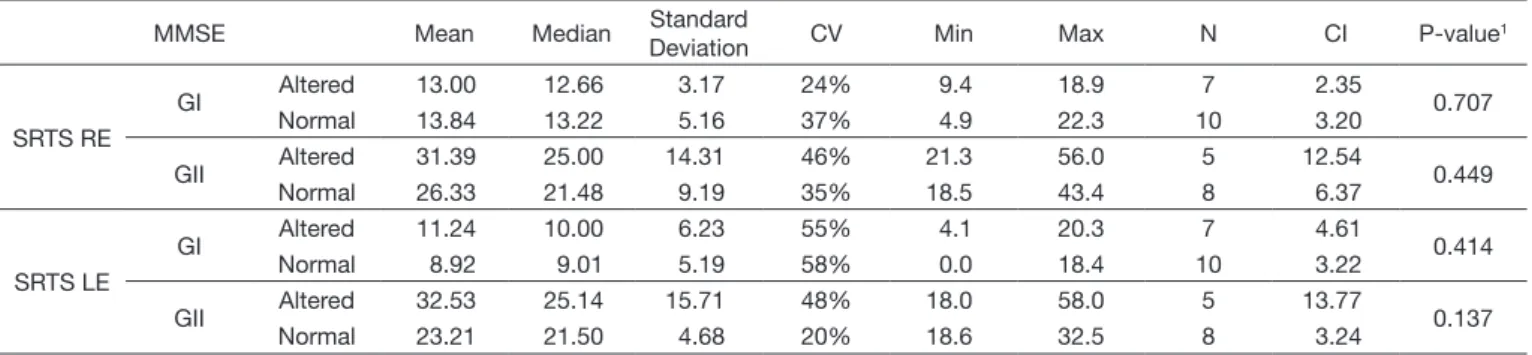
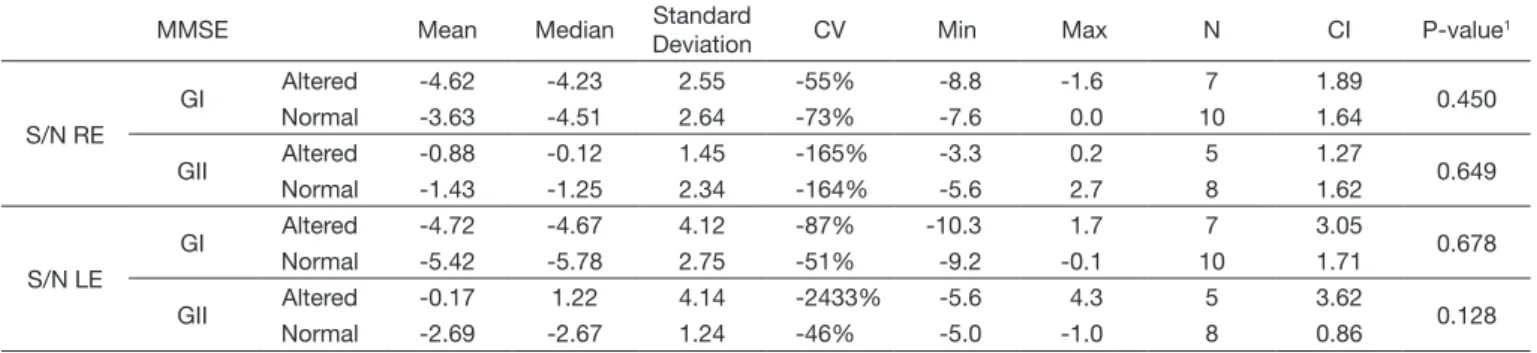
In Tables 4 and 5 shows the values found in the SRTS and S / N ratio in both ears, according to the MMSE performance of individuals of GI and GII.
From the analysis of Tables 4 and 5, it is possible to observe that there was no statistically signiicant difference between the groups classiied as normal and altered MMSE with regard to the SRTS values and S / N ratio in both the OD and in OE.
Table 2. Descriptive values (dB HL) of SRTS of RE and LE of GI and GII
Mean Median Standard
Deviation Q1 Q3 N CI P-value
1
SRTS RE GI 13.50 13.00 4.35 10.33 14.88 17 2.07 <0.001*
GII 28.27 23.00 11.14 20.85 32.55 13 6.06
SRTS LE GI 9.87 10.00 5.58 5.28 12.00 17 2.65 <0.001*
GII 26.79 24.00 10.83 20.28 27.42 13 5.89
* Statistically significant results; 1 ANOVA Test
Caption: Q1: first quartile; Q3: third quartile; N: absolute number of individuals; CI: confidence interval; RE: right ear; LE: left ear; SRTS: Sentence Recognition
Threshold in Silence
Table 3. Descriptive values (dB HL) of S/N ratio of RE and LE of GI and GII
Mean Median Standard
Deviation Q1 Q3 N CI P-value
1
S/N RE GI -4.04 -4.23 2.57 -5.56 -1.56 17 1.22 0.003*
GII -1.21 -1.00 1.99 -2.00 -0.12 13 1.08
S/N LE GI -5.13 -5.56 3.28 -7.45 -3.78 17 1.56 0.006*
GII -1.72 -2.34 2.87 -3.34 -1.00 13 1.56
* Statistically significant results; 1 ANOVA Test
Caption: Q1: first quartile; Q3: third quartile; N: absolute number of individuals; CI: confidence interval; RE: right ear; LE: left ear; S/N: sound/noise ratio
Table 4. Descriptive values (dB HL) of SRTS according to performance on MMSE in individuals of GI and GII
MMSE Mean Median Standard
Deviation CV Min Max N CI P-value
1
SRTS RE
GI Altered 13.00 12.66 3.17 24% 9.4 18.9 7 2.35 0.707
Normal 13.84 13.22 5.16 37% 4.9 22.3 10 3.20
GII Altered 31.39 25.00 14.31 46% 21.3 56.0 5 12.54 0.449
Normal 26.33 21.48 9.19 35% 18.5 43.4 8 6.37
SRTS LE
GI Altered 11.24 10.00 6.23 55% 4.1 20.3 7 4.61 0.414
Normal 8.92 9.01 5.19 58% 0.0 18.4 10 3.22
GII Altered 32.53 25.14 15.71 48% 18.0 58.0 5 13.77 0.137
Normal 23.21 21.50 4.68 20% 18.6 32.5 8 3.24
1 ANOVA Test
Caption: CV: coefficient of variation; Min: minimum; Max: maximum; N: absolute number of individuals; CI: confidence interval; MMSE: Mini Mental State Examination;
SRTS: Sentence Recognition Threshold in Silence; RE: right ear; LE: left ear
Table 1. Distribution of GI and GII according to the classification of MMSE
GI GII Total
P-value1
N % N % N %
MMSE Normal 10 59% 8 62% 18 60% 0.880
Altered 7 41% 5 38% 12 40%
1 Chi-Square Test
DISCUSSION
From the features that were analyzed in the population of the study, it was observed that in relation to gender, there were a great number of female participants, which led to a statistically signiicant difference between the two genders.
One of the reasons that can lead to an increase of the participation in studies by women is the fact that they have greater health concerns than men, and the fact that they are the majority to attend the elderly groups and have greater longevity(3,16).
With regard to the years of study of this population, it was observed that there is a signiicant number of elderly people with high levels of education, which is not common in most of the studies that are carried out with elderly people in public institutions, where the average is usually between primary or until four years of study(16,17).
The fact that the present research provides an average of years of study in higher elderly population can be justiied since the sample was collected from individuals who are still working or belonging to elderly groups with involvement with higher education institutions.
Regarding the hearing threshold of the population of the study, it could be veriied that the average of the elderly individuals of GII represented a mild hearing loss. This may be justiied due to the fact that presbycusis have its start in the high frequencies and, inally, in mid and low frequencies(4), which contributes to the classiication of hearing threshold is within the normal range or mild hearing loss, when the classiication used in this study (500 to 4000 Hz) is taken into account.
Regarding the presence of hearing loss, it could be seen that it occurred in 13 elderly individuals, which corresponds to 43.3% of the total participants, which shows that most of the elderly people did not show hearing loss, even though these individuals were randomly selected. These data are opposing to other research(18), which found a higher percentage of elderly individuals with hearing loss. However, another performed study showed a greater number of elderly people with hearing within normal limits or with mild hearing loss(19).
It is believed that the fact that a greater number of individuals with normal hearing are present in this study may be explained due to the classiication that was used for the level of hearing loss, which considered only high and medium frequencies.
Another reason that can be taken into consideration is the fact that the participants did not have noise exposure history or hearing loss in the family, which are factors that may contribute to the acceleration of presbycusis(20).
In Table 1, it was veriied that 12 individuals (40%) of the studied population showed changes in MMSE and 18 individuals (60%) presented a number of correct answers within the expected for their years of study. However, when comparing this result between GI and GII, there was no statistical signiicance, that is, hearing loss did not affect the cognitive performance of these individuals. It is believed that this fact was due to the mild hearing loss, since other studies with greater losses found some kind of correlation between cognition with hearing loss(19,21).
Furthermore, it is noteworthy that the MMSE is widely used for cognitive screening(11), however, as it is a brief cognitive evaluation test, it may present some limitations to detect mild cognitive declines.
This result differs from another study that found 52% of individuals with change in MMSE in a sample of 50 elderly people with hearing loss(21). However, it should be taken into consideration that this study was performed with elderly people with severe sensorineural hearing loss, which may have increased the percentage of individuals altered in the cognitive aspects, different from this present research that elderly patients with mild sensorineural hearing loss were included.
A study carried out with 28 individuals revealed a percentage of 39.3% of individuals affected by cognitive changes(22), but this percentage is the result of a group of 11 (39.3%) illiterate individuals, 15 (53.6%) individuals with one to four years of study and two individuals (7.1%) who had ive to eight years of study, which differs from the current research, we found a percentage close to this, but a group with high education (10.4 years). On the other hand, a study of 60 elderly people, with the use of MMSE and the Alzheimer’s Disease Assessment Scale (ADAS-Cog), found that the majority of the sample (61.7%) presented cognitive changes mainly in MMSE(23).
Regarding the relationship between cognition with hearing loss, the current study showed different results of a study(19) that evaluated cognitive performance in elderly people with MMSE and it found a correlation between the presence of hearing loss and abnormal results of MMSE, since the individuals with mild sensorineural hearing loss presented better cognitive
Table 5. Descriptive values (dB HL) of S/N ratio according to the performance in MMSE in the individuals of GI and GII
MMSE Mean Median Standard
Deviation CV Min Max N CI P-value
1
S/N RE
GI Altered -4.62 -4.23 2.55 -55% -8.8 -1.6 7 1.89 0.450
Normal -3.63 -4.51 2.64 -73% -7.6 0.0 10 1.64
GII Altered -0.88 -0.12 1.45 -165% -3.3 0.2 5 1.27 0.649
Normal -1.43 -1.25 2.34 -164% -5.6 2.7 8 1.62
S/N LE
GI Altered -4.72 -4.67 4.12 -87% -10.3 1.7 7 3.05 0.678
Normal -5.42 -5.78 2.75 -51% -9.2 -0.1 10 1.71
GII Altered -0.17 1.22 4.14 -2433% -5.6 4.3 5 3.62 0.128
Normal -2.69 -2.67 1.24 -46% -5.0 -1.0 8 0.86
1 ANOVA Test
Caption: CV: coefficient of variation; Min: minimum; Max: maximum; N: absolute number of individuals; CI: confidence interval; MMSE: Mini Mental State Examination;
performance than those ones with moderate and severe levels. The same occurred in a study that used the Digit Symbol Substitution Test (DSST) to evaluate cognitive factors, in which it was found an association between hearing loss and cognitive decline, highlighting that this fact was evident in losses with greater levels(24).
However, this study is in agreement with a study that was carried out with 60 elderly patients in which no correlation was found between hearing loss and cognition(23). However, this study evaluated individuals with moderate and moderately severe hearing loss.
It could be observed through these studies that there is no consensus on the correlation or not between hearing loss and changes of cognitive functions, but it should be taken into account that these studies evaluated cognition with different tests and used different levels of hearing loss. The sample size of the groups of this present study may also have contributed to these results.
In SRTS (Table 2), it was found that GI presented lower thresholds than the ones found for GII bilaterally, in other words, individuals without hearing loss have a lower threshold for recognition of sentences in silence than individuals with hearing loss.
A study performed with normal hearing adults that measured SRTS by using earphones concluded that the average LRSS was 6.20 dB NA, in a population where the average of pure tone thresholds of 500, 1000 and 2000 Hz was 7, 22 dB HL(25). This result is better than that one found in the current study, but it should be taken into account that it was performed with elderly individuals with normal hearing only for the average frequency of 500 to 4000 Hz, since this study was performed with adults with normal hearing at frequencies of 250 to 8000 Hz. Even though, it is possible to afirm that the average LRSS in the elderly group (GI), in the current study, is consistent with the average of the thresholds of 500, 1000 and 2000Hz, including better performance in SRTS due to the fact that sentences provide acoustic and linguistic clues with meaning, which helps the comprehension.
Similarly, in the signal/noise ratio (Table 3), it is possible to observe a better response in GI in comparison to GII, in other words, the more negative the S/N ratio, the better the sentence recognition in the noise of these individuals.
Hearing loss is a major contributor to the dificulties in speech understanding(26), which is evident in the present study, in which the relationship between the groups with and without hearing loss showed statistically signiicant differences in both ears when it comes to sentence recognition in the presence of competitive noise.
In the study carried out to estimate reference values in SRTN with normal hearing adults, they used earphones and found that the average value found in S/N ratio was -5.29 dB HL, and a S/N ratio from -3.03 to -7.55 dB HL indicates a good performance in speech recognition in noise(25). By comparing these values with those ones found in this study, it was found that all elderly people of GI are within normal limits, different from the individuals of GII, who presented a worse performance.
The present study is in agreement with a research carried out with a group of adults with normal hearing and adults and elderly people with hearing loss at high frequencies, which evaluated the effect of hearing loss and age in speech recognition in noise, and they veriied that both age and hearing loss contribute to poor performance in speech recognition with noise(8).
Peripheral hearing loss caused by aging is one of the factors that contribute to the dificulty in understanding speech, mainly because it starts at high frequencies, which leads to greater dificulty in understanding because high frequencies are responsible for the intelligibility of consonants, which reduces the speech recognition performance. Another relevant factor is the changes because of the age in the central auditory nervous system, which can cause a slowness of signal transmission of speech and, consequently, there is a distorted perception of speech(4). It should be noted that this fact in the current study, in which the GII consisted of elderly people who are older than the individuals of GI. Age was another factor that inluenced the SRTS responses in both ears.
On the other hand, in relation to the inluence of the cognitive aspects of speech recognition, it could be observed in Tables 4 and 5 that individuals of GI presented lower thresholds for sentence recognition in silence and better S/N ratio. However, this difference was not statistically signiicant, that is, the change in the cognitive system did not interfere in speech recognition in quiet and in noise, regardless of the individual presenting hearing loss or not.
The current study corroborates other research comparing individuals with cognitive impairment and individuals with normal cognition and found no difference between groups for the speech recognition, both in silence and in noise(27). However other studies have said that cognition can interfere in recognition of sentences in noise(15,28).
A good cognitive performance may contribute to the good performance in speech recognition task, but these skills are generally in decline in the elderly individuals, which may impair their understanding of speech especially in noisy environments. Thus, it is evident the importance of evaluating the speech recognition in the elderly people by using sentences and not isolated words, due to the increased number of phonemic cues offered by the sentences and the temporal processing that is slowed in elderly people that affect their comprehension(29).
A study carried out with elderly people found that these individual present greater dificulties in understanding speech in noise when compared to younger individuals. The level of hearing loss was also signiicant in this study, because the greater the loss, the more dificult to recognize speech in noise. The authors also stated that the changes in cognitive function as a consequence of aging contribute to the dificulty of understanding speech in the presence of noise(30).
The SRTS values and S/N ratio in GI, both with or without cognitive impairment, are adequate, unlike the GII in which they are changed.
It is suggested that further research might be carried out with different levels of hearing loss and with different evaluating tests for cognitive analysis in order to occur further clariication of the correlations among the variables addressed in this study.
CONCLUSION
A mild hearing loss exerted a signiicant inluence on the sentence recognition in quiet and in noise. In relation to the effects of cognition, it was found that it did not inluence the recognition of speech in quiet and in noise.
REFERENCES
1. Closs VE, Schwanke CHA. A evolução do índice de envelhecimento no Brasil, nas suas regiões e unidades federativas no período de 1970 a 2010. Rev Bras Geriatr Gerontol. 2012;15(3):443-58. http://dx.doi.org/10.1590/ S1809-98232012000300006.
2. Fechine BRA, Trompieri N. O processo de envelhecimento: as principais alterações que acontecem com o idoso com o passar dos anos. Rev Cient Int. 2012;1(7):106-32.
3. Ribas A, Kozlowski L, Almeida G, Marques JM, Silvestre RAA, Mottecy CM. Qualidade de vida: comparando resultados em idosos com e sem presbiacusia. Rev. Bras. Geriatr. Gerontol. 2014;17(2):353-62. http:// dx.doi.org/10.1590/S1809-98232014000200012.
4. Gordon Salant S, Fitzgibbons PJ, Yeni-Komshian GH. Auditory temporal processing and aging: implications for speech understanding of older people. Audiology Res. 2011;1(1):9-15. PMid:26557313.
5. Stewart R, Wingfield A. Hearing loss and cognitive effort in older adults’ report accuracy for verbal materials. J Am Acad Audiol. 2009;20(2):147-54. http://dx.doi.org/10.3766/jaaa.20.2.7. PMid:19927677.
6. Costa MJ. Lista de sentenças em português: apresentação e estratégias de aplicação na audiologia. Santa Maria: Pallotti; 1998.
7. Calais LL, Russo ICP, Borges ACLC. Desempenho de idosos em um teste de fala na presença de ruído. Pró-Fono R Atual Cient. 2008;20(3):147-52. 8. Caporali AS, Silva JA. Reconhecimento de fala no ruído em jovens e idosos
com perda auditiva. Braz J Otorhinolaryngol. 2004;70(4):525-32. 9. Henriques MO, Costa MJ. Reconhecimento de sentenças no ruído, em
campo livre, em indivíduos com e sem perda auditiva. Rev CEFAC. 2011;13(6):1040-7. http://dx.doi.org/10.1590/S1516-18462011005000024. 10. Bertolucci PHF, Brucki SMD, Campacci SR, Juliano Y. O mini-exame
do estado mental em uma população geral: impacto da escolaridade. Arq Neuropsiquiatr. 1994;52(1):1-7. http://dx.doi.org/10.1590/S0004-282X1994000100001. PMid:8002795.
11. Brucki SMD, Nitrini R, Caramelli P, Bertolucci PHF, Okamoto IH. Sugestões para o uso do Mini-Exame do Estado Mental no Brasil. Arq Neuropsiquiatr. 2003;61(3B):777-81. http://dx.doi.org/10.1590/S0004-282X2003000500014. PMid:14595482.
12. WHO: World Health Organization [Internet]. Prevention of blindness and deafness: grades of hearing impairment. Switzerland: WHO; 2005 [citado em 2014 Abr. 9]. Disponível em: http://www.who.int/pbd/deafness/ hearing_impairment_grades/en/#
13. Cóser PL, Costa MJ, Cóser MJS, Fukuda Y. Reconhecimento de sentenças no silêncio e no ruído em indivíduos portadores de perda auditiva induzida pelo ruído. Braz J Otorhinolaryngol. 2000;66(4):362-70.
14. Levitt H, Rabiner LR. Use of a sequential strategy in intelligibility testing. J Acoust Soc Am. 1967;42(3):609-12. http://dx.doi.org/10.1121/1.1910630. PMid:6073974.
15. Theunissen M, Swanepoel W, Hanekom J. Sentence recognition in noise: Variables in compilation and interpretation of tests. Int J Audiol.
2009;48(11):743-57. http://dx.doi.org/10.3109/14992020903082088. PMid:19951143.
16. Benedetti TRB, Mazo GZ, Borges LJ. Condições de saúde e nível de atividade física em idosos participantes e não participantes de grupos de convivência de Florianópolis. Cien Saude Colet. 2012;17(8):2087-93. http://dx.doi.org/10.1590/S1413-81232012000800019. PMid:22899149. 17. Pilger C, Menon MH, Mathias TAF. Características sociodemográficas
e de saúde de idosos: contribuições para os serviços de saúde. Rev Latino- Am Enferm. 2011;19(5):1230-8. http://dx.doi.org/10.1590/S0104-11692011000500022.
18. Mattos LC, Veras RP. A prevalência da perda auditiva em uma população de idosos da cidade do Rio de Janeiro: um estudo seccional. Braz J Otorhinolaryngol. 2007;73(5):654-9. http://dx.doi.org/10.1016/S1808-8694(15)30126-9. PMid:18094807.
19. Kopper H, Teixeira AR, Dorneles S. Desempenho Cognitivo em um Grupo de Idosos: Influência de Audição, Idade, Sexo e Escolaridade. Arq Int Otorrinolaringol. 2009;13(1):39-43.
20. Huang Q, Tang J. Age-related hearing loss or presbycusis. Eur Arch Otorhinolaryngol. 2010;267(8):1179-91. http://dx.doi.org/10.1007/s00405-010-1270-7. PMid:20464410.
21. Magalhães R, Iorio MCM. Avaliação da restrição de participação e de processos cognitivos em idosos antes e após intervenção fonoaudiológica. J Soc Bras Fonoaudiol. 2011;23(1):51-6. http://dx.doi.org/10.1590/S2179-64912011000100012. PMid:21552733.
22. Mello BLD, Haddad MCL, Dellaroza MSG. Avaliação cognitiva de idosos institucionalizados. Acta Sci Health Sci. 2012;34(1):95-102. http://dx.doi. org/10.4025/actascihealthsci.v34i1.7974.
23. Pinheiro MMC, Iório MCM, Miranda EC, Dias KZ, Pereira LD. A influência dos aspectos cognitivos e dos processos auditivos na aclimatização das próteses auditivas em idosos. J Soc Bras Fonoaudiol. 2012;24(4):309-15. http://dx.doi.org/10.1590/S2179-64912012000400004. PMid:23306679. 24. Lin FR. Hearing loss and cognition among older adults in the United
States. J Gerontol A Biol Sci Med Sci. 2011;66(10):1131-6. http://dx.doi. org/10.1093/gerona/glr115. PMid:21768501.
25. Costa MJ, Daniel RC, Santos SN. Reconhecimento de sentenças no silêncio e no ruído em fones auriculares: valores de referência de normalidade. Rev CEFAC. 2011;13(4):685-91. http://dx.doi.org/10.1590/S1516-18462010005000114.
26. Peelle JE, Troiani V, Grossman M, Wingfield A. Hearing loss in older adults affects neural systems supporting speech comprehension. J Neurosci. 2011;31(35):12638-43. http://dx.doi.org/10.1523/JNEUROSCI.2559-11.2011. PMid:21880924.
27. Idrizbegovic E, Hederstierna C, Dahlquist M, Kämpfe Nordström C, Jelic V, Rosenhall U. Central auditory function in early Alzheimer’s disease and in mild cognitive impairment. Age Ageing. 2011;40(2):249-54. http:// dx.doi.org/10.1093/ageing/afq168. PMid:21233090.
28. Miranda EC. Estudo eletrofisiológico e comportamental da audição em idosos com alteração cognitiva antes e após a adaptação de próteses auditivas [tese]. São Paulo: Universidade Federal de São Paulo; 2012.
29. Gordon-Salant S, Yeni-Komshian GH, Fitzgibbons PJ. The role of temporal cues in word identification by younger and older adults: effects of sentence context. J Acoust Soc Am. 2008;124(5):3249-60. http://dx.doi. org/10.1121/1.2982409. PMid:19045808.
30. Helfer KS, Freyman RL. Aging and Speech-on-Speech Masking. Ear Hear. 2008;29(1):87-98. PMid:18091104.
Author contributions