Case Report
2 5 0 Arq Bras Oftalmol. 2015;78(4):250-1 http://dx.doi.org/10.5935/0004-2749.20150064
INTRODUCTION
Epithelial ingrowth is an infrequent but a potentially devastating complication of laser in situ keratomileusis (LASIK) surgery. Although the development of post-LASIK ingrowth is signiicantly reduced with femtosecond laser-assisted lap preparation, its rate markedly increa-ses following LASIK enhancement(1,2). Intraoperative epithelial defect,
lap integrity problems, hyperopic corrections, and diabetes mellitus have been identiied as other risk factors in the development of post-LASIK epithelial ingrowth(3). Flap lifting and manual debridement
of the epithelial sheets with adjunctive sutures, anti-metabolites, and tissue adhesives have been used in the treatment of advanced cases of post-LASIK ingrowth(4-6).
Ayala et al suggested an alternative, noninvasive approach in the treatment of post-LASIK epithelial ingrowth with Neodymium: Yttrium-Aluminum-Garnet (Nd-YAG) laser(7). They reported a success
rate of 80% in 30 eyes of 25 patients without any complication over a 2-year follow-up. Herein we report Nd-YAG laser treatment outcome in a patient with recurrent post-LASIK epithelial ingrowth. To the best of our knowledge, the efect of Nd-YAG laser treatment in cases of multiple recurrences of post-LASIK epithelial ingrowth and a resultant lap melt have not been reported before.
CASE REPORT
A 35-year-old male patient with a history of bilateral LASIK per-formed 6 months earlier at another clinic presented with decreased vision and foreign body sensation in his right eye. The patient had undergone three successive lap lifts and epithelial cell scrapings in
the past 2 months prior to his referral to our institution. There was no medical record of any preoperative readings or laser techniques being used for our patient.
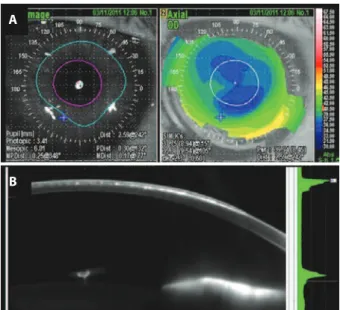
The uncorrected distance visual acuity (UDVA) was 20/80 and the corrected distance visual acuity (CDVA) was 20/30 with a manifest refraction of -0.75 -2.75 × 95 in the right eye. Slit lamp examination was unremarkable with a visual acuity of 20/20 in the left eye. In the right eye, slit lamp examination demonstrated a signiicant epithelial ingrowth extending from the inferior lap edge and threatening the visual axis (Figure 1 A). Corneal topography demonstrated central and inferior lattening of the cornea consistent with previous myopic ablation in both eyes (Figure 2 A). Scheimplug images demonstrated a wide side cut angle, indicating microkeratome-assisted lap prepa-ration in our patient (Figure 2 B).
The risks and beneits of various treatment options of managing epithelial ingrowth were discussed, and we proceeded with Nd-YAG laser treatment. Informed consent was observed. Laser treatment was performed under topical anesthesia. Nd-YAG laser was focused on the lap interface using the aiming beam of the laser system. We used a 1064-nm infrared Nd-YAG laser with an approximately 8-µm spot size with a 670-nm red diode laser as aiming beam (Visulas YAG III, Carl Zeiss Meditec Inc., USA). The treatment was started from the center of the epithelial ingrowth area. The energy level was set at 0.6 mJ and bubble formation was observed at the lap interface after treatment (Figure 1 B). The treatment was continued to cover the entire area of epithelial ingrowth. A total of 65 shots were performed. Topical luorometholone drops (FML, Allergan, Istanbul) q.i.d. was used for 2 weeks.
Localized flap melt after Nd-YAG laser treatment in recurrent post-LASIK
epithelial ingrowth
Derretimento localizado de
lap
após o tratamento por Nd-YAG laser para crescimento epitelial
recorrente pós-LASIK
Murat KucuKevcilioglu1, volKan HurMeric2
Submitted for publication: August 27, 2014 Accepted for publication: November 17, 2014
1 Department of Ophthalmology, Gulhane Military Medical School, Ankara, Turkey. 2 World Eye Hospital, Ankara, Turkey.
Funding: No specific financial support was available for this study.
Disclosure of potential conflicts of interest: None of the authors have any potential conflict of interest to disclose.
Corresponding author: Murat Kucukevcilioglu. GATA Goz Klinigi, Etlik, Ankara - Turkey E-mail: [email protected]
ABSTRACT
Neodymium: Yttrium-Aluminum-Garnet (Nd-YAG) laser treatment of epithelial in growth was found promising with high success rates in cases of primary post-LASIK epithelial ingrowth. However, the application range of this procedure is not well-known. For the irst time, the authors report the outcome of a patient treated with Nd-YAG laser for multiple recurrences of post-laser in situ keratomi-leusis epithelial ingrowth.
Keywords: Epithelium, corneal/surgery; Cornea/pathology; Cornea/surgery; Ke-ratomileusis, laser in situ; Postoperative complications; Laser, solid-state/therapeutic use; Humans; Case report
RESUMO
O tratamento com laser de neodímio: Ítrio-Alumínio-Granada (do inglês, Nd-YAG Laser) para o crescimento epitelial primário pós-LASIK demonstrou altas taxas de sucesso. No entanto, os limites deste procedimento não são completamente conhecidos. Pela primeira vez, os autores relatam os resultados de um olho tratado com Nd-YAG laser para múltiplo crescimento epitelial pós-LASIK recorrente que desenvolveu um derre-timento localizado do flap.
KucukevciliogluM, HurmericV
251
Arq Bras Oftalmol. 2015;78(4):250-1 One month after laser treatment the patient presented with total
regression of the epithelial ingrowth. There were stromal haze at the lap interface with epithelial ingrowth and localized melt at the peripheral part of the lap (Figure 1 C). There was no foreign body sensation in the right eye; UDVA was 20/40 and CDVA was 20/30 with -0.50 -2.50 × 90 correction. At the 15-month follow-up visit, slit lamp indings and visual acuity of the patient were unchanged (Figure 1 D). There was no recurrence of the ingrowth at the last follow-up.
DISCUSSION
Our case demonstrates that Nd-YAG laser treatment is efective in cases with recurrences of post-LASIK epithelial ingrowth. Nd-YAG laser treatment resulted in complete resolution of the ingrowth and achieved signiicant improvement of symptoms without recurrences in our patient. However, we have also noted a localized melting in the peripheral part of the lap.
Probst and Machat reported a classiication system classifying epithelial ingrowth into three grades: Grade 1, ingrowth limited to within 2.0 mm of the lap edge with no associated visual changes; Grade 2, thicker ingrowth at least 2.0 mm from the lap edge but with a normal edge anatomy; and Grade 3, pronounced ingrowth of
>2.0 mm from the lap edge, often with anatomic abnormalities in the edge itself(8). Although observation appears suicient for treating
Grade 1 lesions, treatment is generally recommended for Grade 2 and 3 epithelial ingrowth because these lesions may cause disabling visual symptoms. The clinical properties of our patient were compa-tible with Grade 3 epithelial ingrowth. The reported high success rate with Nd-YAG laser in cases of primary post-LASIK epithelial ingrowth encouraged us to proceed with this procedure(7). In their initial report,
80% of the eyes showed complete resolution and the remainder (20%) showed partial resolution without any complications. Retreat-ment was required in 40% of the cases. The main diferences between their and our cases were the history of multiple lap lifts performed and recurrences developing prior to Nd-YAG laser treatment. There are other reports showing promising results without any complica-tions related to recurrences of post-LASIK ingrowth(9,10). We herein for
the irst time report lap melting as a treatment-related complication. Recurrence of epithelial ingrowth and the presence of an excessi-ve amount of epithelial cells at the lap interface are known factors increasing the risk of lap melt in post-LASIK epithelial ingrowth. The role of Nd-YAG laser treatment in the development of lap melt is not clear. Nd-YAG laser functions on the principle of creating small vacuo-les at the focal point, which merge, thus producing large vacuovacuo-les, and the resulting acoustic waves disrupt the nearby tissue. The pro-posed mechanisms for lap melt as the disruption of the balance of proteolytic enzymes at cellular level and the damage to the nearby tissues related to microkeratome lap creation may be applied to Nd-YAG laser treatment(11,12). Laser energy levels or number of laser
shots performed in the same area may determine the development of lap melt in our patient. Flap melt likely could have been prevented by using more than one laser session with fewer laser shots.
In conclusion, Nd-YAG laser treatment is a promising alternative for treating recurrent post-LASIK epithelial ingrowth. However, the exact role of the Nd-YAG laser in the development of localized lap melt in our case could be elucidated. Therefore, we believe that this novel technique needs to be studied further to determine the limitations of indications and laser settings to prevent lap melt or other undesirable outcomes. Moreover, performing repeated laser shots in the same area may increase the risk of lap melt in this novel technique.
REFERENCES
1. Wang MY, Maloney RK. Epithelial ingrowth after laser in situ keratomileusis. Am J Ophthal-mol. 2000;129(6):746-51. Comment in: Am J OphthalOphthal-mol. 2001;131(3):402-3; J cataract Refract Surg. 2002;28(10):1884.
2. Kamburoğlu G, Ertan A. Epithelial ingrowth after femtosecond laser-assisted in situ keratomileusis. Cornea. 2008;27(10):1122-5.
3. Domniz Y, Comaish IF, Lawless MA, Sutton GL, Eckshtein R, Collins MB, et al. Epithelial ingrowth: causes, prevention, and treatment in 5 cases. J Cataract Refract Surg. 2001; 27(11):1803-11.
4. Spanggord HM, Epstein RJ, Lane HA, Candal EM, Klein SR, Majmudar PA, et al. Flap suturing with proparacaine for recurrent epithelial ingrowth following laser in situ keratomileusis surgery. J Cataract Refract Surg. 2005;31(5):916-21.
5. Haw WW, Manche EE. Treatment of progressive recurrent epithelial ingrowth with ethanol following laser in situ keratomileusis. J Refract Surg. 2001;17(1):63-8. 6. Narvaez J, Chakrabasty A, Chang K. Treatment of epithelial ingrowth after LASIK
enhan cement with a combined technique of mechanical debridement, lap suturing, and ibrin glue application. Cornea. 2006;25(9):1115-7.
7. Ayala MJ, Alio JL, Mulet ME, De La Hoz F. Treatment of laser in situ keratomileusis in terface epithelial ingrowth with neodymium:yytrium-aluminum-garnet laser. Am J Ophthalmol. 2008;145(4):630-4.
8. Probst LE 5th, Matchat JJ. Corneal subepithelial iniltrates following photorefractive
keratectomy. J Cataract Refract Surg. 1996;22(3):281-6. Comment in: J Cataract Refract Surg. 1995;21(5):516-8.
9. Kim JM, Goel M, Pathak A. Epithelial ingrowth - Nd:YAG laser approach. Clin Experiment Ophthalmol. 2014;42(4):389-90.
10. Lindield D, Ansari G, Poole T. Nd:YAG laser treatment for epithelial ingrowth after laser refractive surgery. Ophthalmic Surg Lasers Imaging. 2012;43(3):247-9. 11. Li DQ, Tseng SC. Three patterns of cytokine expression potentially involved in
epithe-lial-ibroblast interactions of human ocular surface. J Cell Physiol. 1995;163(1):61-79. 12. Vesaluoma MH, Petroll WM, Perez-Santonja JJ, Allió JL, TervoTM. Laser in situ kerato-mileusis lap margin: wound healing and complications imaged by in vivo confocal microscopy. Am J Ophthalmol. 2000;130(5):564-73.
A
C
B
D
Figure 1. Slit lamp images showing, A) epithelial ingrowth, B) bubbles created by Nd-YAG laser during treatment, C) regressed ingrowth and lap melt one month after treatment, D) no recurrence at the 15-month follow-up. (Asterisk, area of lap melt).
Figure 2. A) Preoperative topography demonstrating irregular astigmatism, B) Scheimplug image indicating prior LASIK lap preparation.
A