103
http://doi.org/10.1590/0004-282X20160195
ARTICLE
Upper limb function and functional
independence in patients with shoulder pain
after stroke
Função do membro superior e independência funcional em pacientes com ombro doloroso
após AVC
Renato Nickel1, Marcos Lange2, Diane Priscila Stoffel1, Elaine Janeczko Navarro3, Viviane F Zetola2
Shoulder pain often occurs in adults with hemiplegia and is known to contribute to functional disability1. Its etiology
remains uncertain, but it is multifactorial and causes changes in structure and function, including abnormal muscle tone, subluxation, and limited external rotation2,3,4.In addition,
these patients often need transfer assistance to gain mobil-ity, which can include the use of pulleys (e.g., the shoulder
wheel). hese techniques may be inappropriately provided,
which may make hemiplegic patients with shoulder pain vul -nerable to lesions3.
Prevention and treatment of shoulder pain in hemiplegic
adults is fundamental to patient independence because the
pain discourages patients from performing upper limb move
-ments, which subsequently impairs functional recovery5. his
study directly examined the efect of shoulder pain on up -per limb function and daily independence following a stroke.
1Universidade Federal do Paraná, Departamento de Terapia Ocupacional, Curitiba PR, Brasil; 2Universidade Federal do Paraná, Hospital de Clínicas, Divisão de Neurologia, Curitiba PR, Brasil; 3Hospital do Idoso Zilda Arns, Divisão de Terapia Ocupacional, Curitiba PR, Brasil.
Correspondence: Renato Nickel; Rua Lothário Meissner, 632/Bloco Didático II/Sala 1/4º Andar; 80210-170 Curitiba PR, Brasil; E-mail: [email protected] Conflict of interest: There is no conlict of interest to declare.
Received 18 May 2016; Received in inal form 10 October 2016; Accepted 31 October 2016.
ABSTRACT
Objective: To examine the frequency of shoulder pain following stroke. Methods: Stroke patient function was evaluated using the Functional Independence Measure (FIM) and Scale for Upper Limb Function in Stroke (SULFS). Function scores were examined and compared between the shoulder pain group (SPG) and the no shoulder pain group (No-SPG). Results: A total of 58 patients, 22 women (37.9%), were included in this study. The mean patient age was 49.2±10.8 years and study evaluations were done 3.52±2.26 months after stroke. A total of 16 patients (27.6%) were in the SPG and 42 patients (72.4%) were in the No-SPG. The SPG scored signiicantly lower on the FIM (SPG: 91.06±14.65
vs. No-SPG: 114.62 ± 2.27; p < 0.01) and SULFS (SPG median: 2 [range: 1-4], No-SPG median: 5 [range: 1-5]; p < 0.01) than the No-SPG.
Conclusion: Shoulder pain commonly occurs after stroke and is related to the affected upper limb function and functional independence in stroke patients.
Keywords: stroke; shoulder pain; rehabilitation; activities of daily living.
RESUMO
Objetivo: Identiicar a frequência de ombro doloroso após acidente vascular cerebral (AVC). Métodos: Avaliação funcional de pacientes pós-AVC foi realizada pela Medida de Independência Funcional (MIF) e pela Escala de Função de Membro Superior pós-AVC (EFMSA). As pontuações foram comparadas entre pacientes com ombro doloroso (PcOD) e pacientes sem ombro doloroso (PsOD). Resultados:
58 pacientes foram incluídos no estudo, sendo 22 (37,9%) mulheres. A idade média dos pacientes foi 49,2±10,8 anos e a avaliação foi realizada 3,52±2,26 após o AVC. Dezesseis (27,6%) pacientes foram incluídos no grupo PcOD e 42 (72,4%) no grupo PsOD. A MIF foi menor no grupo PcOD (91,06±14,65) quando comparados ao grupo PsOD (114,62 ± 2,27), p < 0.01. A EFMSA também foi menor no grupo PcOD (mediana: 2 [intervalo: 1-4] em comparação ao grupo PsOD (mediana: 5 [intervalo: 1-5], p < 0.01. Conclusão: Ombro doloroso é comum após AVC e afeta de forma signiicativa a função do membro superior e a independência funcional.
104 Arq Neuropsiquiatr 2017;75(2):103-106
In particular, the ability to perform daily activities and perfor -mance issues were examined.
METHODS
his descriptive study followed stroke patients cared for
at the Stroke Outpatient Clinic of the Hospital de Clínicas
at the Federal University of Paraná. All patient data was prospectively collected during routine clinic visits between September 2012 and December 2013. his study followed Resolution 466/2012/CNS and was approved by the Research
Ethics Committee at our institution (legal opinion number
107.805, CAAE 03585212.50000.0102). To be included in the study, the patient must have had only one previous stroke
(hemorrhagic or ischemic) and be older than 18 years of age.
Patients with other disabling diseases or previous shoulder
pain (prior to stroke) were excluded.
All patients were evaluated using the Functional Independence Measure (FIM), the modiied Ashworth Scale (MAS, measure of upper limb spasticity6), the Visual Numeric
Scale for pain (VNS)7, and the Scale for Upper Limb Function
in Stroke (SULFS). A semi-structured, biopsychosocial model of the World Health Organization, International Classiication
of Functioning, Disability and Health8 based questionnaire was
also administered to collect data on major activity limitations and restrictions. he VNS was determined by direct question
-ing and/or evaluation of passive movement of the impaired arm. he VNS is a 10-point scale with scores of 0 = no pain, 1–3 = mild pain, 4–7 = moderate pain, and 8–10 = severe pain. he SULFS was also scored based on direct observation of up
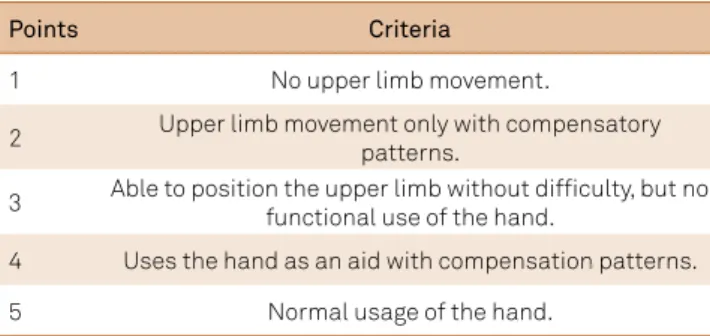
-per limb movement and hand function (Table 1).
Patients were divided into those who had shoulder pain (shoulder pain group [SPG]) and those who did not have shoulder pain (no shoulder pain group [No-SPG]). Frequency, descriptive, and correlative data were evaluated within and between groups. A chi-squared or Fisher’s exact test was used to compare categorical variables. he Mann-Whitney U-test and Student’s t-test were used to compare diferences in con
-tinuous variables. Spearman’s correlation coeicients were used to examine correlations between MAS and SULFS data.
Statistical analyses were performed using SPSS statistical
software (ver. 20, SPSS, Inc., Chicago, IL) and statistical sig
-niicance was deined as p < 0.05.
RESULTS
A total of 82 patients were considered for study inclusion, but only 58 patients (70.7%) met all inclusion criteria. Twenty-two
(37.9%) of the included patients were female. Ischemic stroke had occurred in 56 (96.6%) patients and the right side of the
body was afected in 45 patients (77.6%). Included patients had an average age of 49.2 ± 10.8 years and had study evaluations performed 3.52 ± 2.26 months after stroke.
he average FIM in all 58 patients was 108.12 ± 18.98. he main International Classiication of Functioning, Disability
and Health limitations and restrictions were “major life ar-eas” (d8) in 15 (25.9%) patients, “mobility” (d4) in 13 patients
(22.4%) patients, and “community, social, and civic life” (d9) in six patients (10.3%). Ten patients (17.2%) did not report problems with daily life activity performance or social par
-ticipation. he median MAS score was 1 (range: 0–2) for all
58 patients and none had neuropathic or thalamic pain.
A total of 19 (32.8%) patients reported pain. Of these,
16 (27.6%) reported shoulder pain, one (1.7%) reported knee pain, one reported lumbar spine pain (1.7%), and one (1.7%) reported
cervical region pain. he SULFS revealed that 28 patients (48.3%) had normal use of the afected hand, four (6.9%) had use of the afected hand as an aid (albeit with compensation patterns), two (3.4%) had no diiculty positioning the afected upper limb (no functional use of the hand), 14 (24.1%) had only upper limb move -ment with compensatory patterns, and 10 patients (17.2%) had
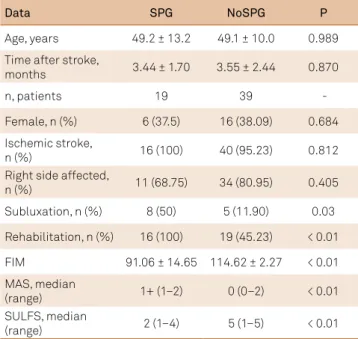
no upper limb movement. Table 2 summarizes the clinical char -acteristics of patients with and without shoulder pain.
Spearman correlation analysis revealed that the MAS and SULFS scores were signiicantly correlated (correlation coef
-icient = -0.861, p < 0.01). his indicated that patients with a
lower muscle tone had a higher limb function.
DISCUSSION
Shoulder pain occurred after stroke in 27.6% of our pa-tients. Patients with shoulder pain had reduced upper limb function and lower daily functional independence when
compared to patients without shoulder pain. he incidence
of shoulder pain following stroke reported here is similar that
reported by previous prospective studies1,5. Unfortunately,
shoulder pain is not characterized by a speciic deinition and the quality of care of these hemiplegic patients widely varies
by context and population3.It should be noted that our study
population was younger than that of previous studies1,5,9,10,11.
he causative mechanism for shoulder pain after stroke is not fully understood, but is multifactorial. his is supported by
Table 1. Scoring deinitions for the Scale for Upper Limb Function in Stroke (SULFS).
Points Criteria
1 No upper limb movement.
2 Upper limb movement only with compensatory patterns.
3 Able to position the upper limb without dificulty, but no functional use of the hand.
4 Uses the hand as an aid with compensation patterns.
105
Nickel R et al. Shoulder pain after stroke the fact that shoulder pain occurs on and of through difer
-ent recovery periods after stroke. During the laccid recovery stage, excessive and intense muscular stretching can occur, resulting in soft tissue lesions and consequent pain. During the spastic recovery stage, spasticity patterns (adduction and in -ternal rotation) may trigger pain12.In addition, subluxation and
the need for transfer assistance, which may result in inappro-priate pulley use, are important factors in shoulder pain after stroke2,3,4. Beside this, shoulder pain after stroke has been
asso-ciated with a slower improvement in movement after stroke12.
he most important indings of the present study are the
associations between shoulder pain and function of the
up-per limb and between shoulder pain and the level of func
-tional independence. Previous studies have shown a relation -ship between shoulder pain and upper limb limitations, but,
even though the FIM was used (as is in the current study), the
impact of shoulder pain on daily life limitations and restric-tions after stroke was not clear1,9,10,11. Furthermore, it is known
that patients who need more assistance, especially during
transfer, have a higher incidence of shoulder pain3. From this
perspective, it is possible that shoulder pain discourages up
-per limb use and activity -performance. It may also be assumed that the need for assistance, or a lower functional level, can re -sult in the onset of pain.
Evidence from this study and prior studiesindicates that pain generally begins within eight weeks of stroke5,8. he cur
-rent study also demonstrated that pain was moderate to
se-vere in intensity, which is in agreement with the literature9,
and that shoulder subluxation was more common in patients with shoulder pain. Subluxation is thought to be associated with motor function and muscle tone impairment and, in such cases, pain results from soft tissue injury3,10. hus, subluxation
may be a risk factor for developing shoulder pain5.
Interestingly, this study showed that all patients with
shoulder pain were receiving rehabilitation care. However, most patients without shoulder pain were not receiving re
-habilitation services. his inding may indicate that shoulder pain motivates care providers to refer a patient for treatment and maintenance rehabilitation services.
his study had several limitations. All patients were pa -tients at the same hospital-based outpatient clinic, which is
where all study examinations were performed. Additionally, our sample size was relatively small. A strength of our current study is that study evaluations were based on both patient information and physical examination. his is important be
-cause patients in previous studies denied pain when ques -tioned, but complained of pain during physical examination.
herefore, asking hemiplegic patients about their pain may not be suicient for identifying shoulder pain5.
In conclusion, the presence of shoulder pain in patients
after stroke is likely related to the function level of an afect
-ed upper limb. his pain discourages limb movement and af
-fects functional recovery. Although the current study indi -cated a possible correlation between shoulder pain and limb performance after stroke, the relationship between this
con-dition and activity/participation is not yet clear.
References
1. Joy AK, Ozukum I, Nilachandra L Khelendro T, Nandabir Y, Kunjabasi W. Prevalence of hemiplegic shoulder pain in post-stroke patients: a hospital based study. IJPMR. 2012;23(1):15-9.
2. Zorowitz RD, Hughes MB, Idank D, Ikai T, Johnston MV. Shoulder pain and subluxation after stroke: correlation or coincidence? Am J Occup Ther. 1996;50(3):194-201. http://doi.org/10.5014/ajot.50.3.194
3. Coskun Benlidayi I, Basaran S. Hemiplegic shoulder pain: a common clinical consequence of stroke. Pract Neurol. 2014;14(2):88-91. http://doi.org/10.1136/practneurol-2013-000606
4. Gilmore PE, Spaulding SJ, Vandervoort AA.Hemiplegic shoulder pain: implications for occupational therapy treatment. Can J Occup Ther. 2004;71(1):36-46. http://doi.org/10.1177/000841740407100108
5. Dromerick AW, Edwards DF, Kumar A. Hemiplegic shoulder pain syndrome: frequency and characteristics during inpatient stroke rehabilitation. Arch Phys Med Rehabil. 2008;89(8):1589-93. http://doi.org/10.1016/j.apmr.2007.10.051
6. Bohannon RW, Smith MB. Interrater reliability of a modiied Ashworth scale of muscle spasticity. Phys Ther. 1987;67(2):206-7.
7. Ciena AP, Gatto R, Pacini VC, Picanço VV, Magno IM, Loth EA. Inluência da intensidade da dor sobre as respostas nas escalas unidimensionais de mensuração da dor em uma população de idosos e de adultos jovens. Semin Ciênc Biol Saúde. 2008;29(2):201-12. http://doi.org/10.5433/1679-0367.2008v29n2p201
8. Organização Mundial da Saúde. CIF: Classiicação Internacional de Funcionalidade, Incapacidade e Saúde. São Paulo: EDUSP; 2003.
Table 2. Characteristics of patients with and without shoulder pain.
Data SPG NoSPG P
Age, years 49.2 ± 13.2 49.1 ± 10.0 0.989
Time after stroke,
months 3.44 ± 1.70 3.55 ± 2.44 0.870
n, patients 19 39
-Female, n (%) 6 (37.5) 16 (38.09) 0.684
Ischemic stroke,
n (%) 16 (100) 40 (95.23) 0.812
Right side affected,
n (%) 11 (68.75) 34 (80.95) 0.405
Subluxation, n (%) 8 (50) 5 (11.90) 0.03
Rehabilitation, n (%) 16 (100) 19 (45.23) < 0.01
FIM 91.06 ± 14.65 114.62 ± 2.27 < 0.01
MAS, median
(range) 1+ (1–2) 0 (0–2) < 0.01
SULFS, median
(range) 2 (1–4) 5 (1–5) < 0.01
106 Arq Neuropsiquiatr 2017;75(2):103-106
9. Lindgren I, Ekstrand E, Lexell J, Westergren H, Brogårdh C. Somatonsensory impairments are common after stroke but have only a small impact on post-stroke shoulder pain. J Rehabil Med. 2014;46(4):307-13. http://doi.org/10.2340/16501977-1274
10. Chae J, Mascarenhas D, Yu DT, Kirsteins A, Elovic EP, Flanagan SR et al. Poststroke shoulder pain: its relationship to motor impairment, activity limitation, and quality of life. Arch Phys Med Rehabil. 2007;88(3):298-301. http://doi.org/10.1016/j.apmr.2006.12.007
11. Lindgren I, Brogardh C. Poststroke shoulder pain and its association with upper extremity sensorimotor function, daily hand activities, perceived participation, and life satisfaction. PM R. 2014;6(9):781-9. http://doi.org/10.1016/j.pmrj.2014.02.015