Evaluation of functional independence after
discharge from the intensive care unit
INTRODUCTION
Functional independence can be deined as an individual’s ability to perform activities of daily living (ADLs). Autonomy in performing tasks ensures a person’s ability to live alone in a domiciliary context.(1,2) his ability may be diminished or even lost as a result of certain types of chronic illness or due to a traumatic, surgical, or acute pathological process.(2) Patients admitted to the intensive care unit (ICU) may exhibit decreased functional independence caused by neuromuscular blockers and the prolonged use of steroidal medication; however, the most important factor related to the impairment of functional independence is the length of the ICU stay and Juliane Curzel1, Luiz Alberto Forgiarini Junior1,2,
Marcelo de Mello Rieder1,3
1. Centro Universitário Metodista - IPA - Porto Alegre (RS), Brazil.
2. Airways and Lung Laboratory, Hospital de Clínicas de Porto Alegre - HCPA - Porto Alegre (RS), Brazil.
3. Hospital Cristo Redentor, Grupo Hospitalar Conceição - Porto Alegre (RS), Brazil.
This study was conducted in the Central Intensive Care Unit, Hospital Santa Clara, Complexo Hospitalar Santa Casa de Porto Alegre - Porto Alegre (RS), Brazil.
Conflicts of interest: None.
Submitted on January 18, 2013 Accepted on May 4, 2013
Corresponding author:
Marcelo de Mello Rieder Centro Universitário Metodista- IPA Curso de Fisioterapia
Rua Cel. Joaquim Pedro Salgado, 80 - Bairro Rio Branco
Zip code: 90420-060 - Porto Alegre (RS), Brazil E-mail: [email protected]
Objective: 1) To evaluate the
functional independence measures immediately after discharge from an intensive care unit and to compare these values with the FIMs 30 days after that period. 2) To evaluate the possible associated risk factors.
Methods: he present investigation
was a prospective cohort study that included individuals who were discharged from the intensive care unit and underwent physiotherapy in the unit. Functional independence was evaluated using the functional independence measure immediately upon discharge from the intensive care unit and 30 days thereafter via a phone call. he patients were admitted to the
Hospital Santa Clara intensive care unit during the period from May 2011 to August 2011.
Results: During the predetermined period of data collection, 44 patients met the criteria for inclusion in the study. he mean age of the patients was
55.4±10.5 years. Twenty-seven of the subjects were female, and 15 patients were admitted due to pulmonary disease. he patients exhibited an functional independence measure of 84.1±24.2. When this measure was compared to the measure at 30 days after discharge, there was improvement across the functional independence variables except for that concerned with sphincter control. here were no signiicant diferences when comparing the gender, age, clinical diagnosis, length of stay in the intensive care unit, duration of mechanical ventilation, and the presence of sepsis during this period.
Conclusion: Functional independence, as evaluated by the functional independence measure scale, was improved at 30 days after discharge from the intensive care unit, but it was not possible to deine the potentially related factors.
ABSTRACT
Keywords: Exercise; Personal
autonomy; Intensive care units; Respiration, artiicial/methods; Sepsis
Avaliação da independência funcional após alta da unidade de
terapia intensiva
the duration of invasive mechanical ventilation (IMV) to which the patient is subjected. hese factors can contribute to the post-discharge inability to perform tasks such as personal hygiene and feeding.(3)
he functional independence measure (FIM) is an evaluation tool designed to monitor individuals during the rehabilitation process. he evaluation does not focus attention on a person’s ability to perform tasks but instead analyzes his or her efectiveness in independently performing the daily routine.(4)
Functional independence after ICU discharge is one of the outcomes evaluated to verify patients’ development and to quantify their rehabilitation after hospitalization. Few studies have evaluated these long-term outcomes. (5,6) Consequently, there must be a better understanding
of the functional impairment resulting from a period of ICU stay in these patients and the impact that this hospitalization has on their functional independence.(7)
he aim of the present study was to evaluate the FIM immediately after discharge, to compare this value with the FIM 30 days thereafter, and to correlate the FIM to the length of the ICU stay, duration of IMV, and the presence of sepsis, as well as to verify the associations with the patients’ gender, age, and clinical diagnosis.
METHODS
he present investigation was a prospective observational study conducted in the central ICU of the
Hospital Santa Clara, Complexo Hospitalar Santa Casa de
Porto Alegre (CHSCPA). During the period from May
to August 2011, patients who were discharged from the ICU, met the inclusion criteria, and accepted the invitation to participate in the research were evaluated.
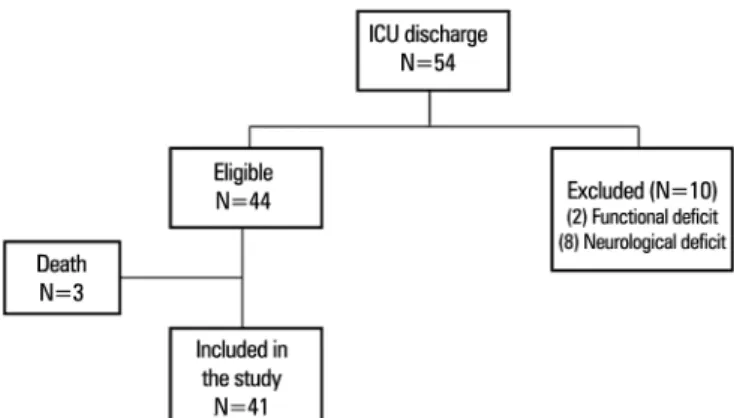
Adult patients of both genders, who were aged above 18 years, had been admitted to the ICU for more than 24 hours, had undergone IMV, and received physical therapy assistance in the unit were included in the study. Patients with neuromuscular diseases, subjects with motor impairment, and individuals who had functional impairments prior to admission were excluded (Figure 1). he patients received two daily physical therapy sessions (average duration of 30 minutes) that consisted of bronchial hygiene, lung expansion, and passive-motion exercises for the arms and legs. When possible, active exercises were performed. After ICU discharge, the patients commenced treatment in the hospital inpatient unit, where walking exercises were performed in addition to the above-described therapeutic activities.
his study was approved by the research ethics committees of the institutions involved (CHSCPA
- Protocol # 3505/11 and Centro Universitário
Metodista - IPA - Protocol # 54/2011). All of the
patients had previously signed and informed consent. On the irst day after discharge from the ICU, the evaluation form was completed in the hospital inpatient unit, and the following data were collected: patient identiication, clinical diagnosis, length of the ICU stay, duration of IMV, and whether sepsis occurred during the hospitalization. At this point, the FIM scale was applied, which evaluated 18 items related to self-care, sphincter control, mobility, locomotion, communication, and social cognition. he scale was applied in an interview format (always by the same evaluator), and the score obtained was correlated to the patient’s condition at that time.(4)
he total score of the FIM scale had a minimum of 18 points and maximum of 126 points. he individual scores for each scale item were deined as follows: 1 point when the patient required total assistance to perform the activity; 2 points when there was maximum assistance; 3 points when moderate care was necessary; 4 points for aid involving minimum contact from the assistant; 5 points when the patient performed his or her activities under supervision; 6 points when independence was contingent upon the aid of an object such as a handrail, crutches, etc.; and 7 points when the patient’s independence was complete, secure, and achieved within a normal timeframe.(4,8) Individual scores were obtained for each item and then added together to produce the inal score.
For the second evaluation using the FIM scale, the patient was located 30 days after discharge from the ICU and interviewed by telephone. All of the evaluations and interviews were conducted by the same examiner, who was blinded to the events that had occurred prior to evaluation. he quantitative variables were expressed using the mean and standard deviation or the median and interquartile range (25th-75th percentile). In comparing the characteristics
of the sample, Student’s t test was used for variables with a parametric distribution, and the Mann-Whitney test was employed for the nonparametric analyses. Student’s t
test was used for comparisons within and between the groups of quantitative variables. he Pearson chi-square test was employed to evaluate the categorical variables. he evaluation of correlations between symmetrical variables was performed via the Pearson correlation test, and the Spearman correlation test was used for correlations between the non-symmetrical variables. he Statistical Package for Social Sciences (SPSS) software version 18.0 was utilized, and a signiicance level of 5% was adopted.
RESULTS
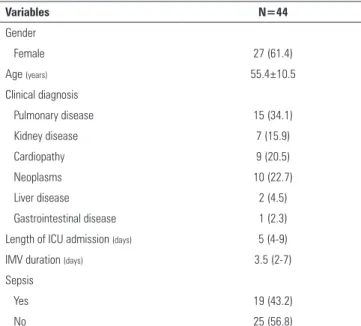
Fifty-four patients were discharged from the ICU during the predetermined period for data collection. Of these, 44 were eligible for the study, and 41 were included in the sample. he mean age of the patients was 55.4±10.5; 61.4% were female, and 15 were admitted due to pulmonary disease (Table 1).
Table 1 - Characteristics of patients included in the study
Variables N=44
Gender
Female 27 (61.4)
Age (years) 55.4±10.5 Clinical diagnosis
Pulmonary disease 15 (34.1)
Kidney disease 7 (15.9)
Cardiopathy 9 (20.5)
Neoplasms 10 (22.7)
Liver disease 2 (4.5)
Gastrointestinal disease 1 (2.3)
Length of ICU admission (days) 5 (4-9)
IMV duration (days) 3.5 (2-7)
Sepsis
Yes 19 (43.2)
No 25 (56.8)
ICU - intensive care unit; IMV - invasive mechanical ventilation. Results are expressed as the number (%), the mean ± standard deviation, or the median (25%-75%).
Table 2 - Evaluation of the functional independence measurement scale at discharge from the intensive care unit and after 30 days (N=41)
Variables Discharge After 30 days p value*
Self-care 23.7±10.5 39.8±4.5 <0.001
Sphincter control 12.3±3.3 13.1±1.8 0.065
Mobility 10.6±5.6 19.3±3.4 <0.001
Locomotion 7.2±3.7 12.7±2.3 <0.001
Communication 12.8±2.1 13.3±0.7 0.152
Social cognition 17.8±4.1 20.5±1.7 <0.001
Total 84.1±24.2 119.1±13.1 <0.001
Results are expressed as the mean ± standard deviation. * Student’s t-test for paired samples.
variables except for sphincter control (which was impaired in the patients prior to admission) and communication.
It was evident that the lowest scores on the scale, both at discharge and 30 days thereafter, were determined for the locomotion variable, for which the mean patient scores did not exceed 8 points and 13 points, respectively. he variable that was least afected by the imposed limitations was self-care, for which the scores were higher than for all other FIM variables.
Analysis of the total FIM score for the study variables revealed no signiicant diferences when comparing the gender, age, clinical diagnosis, length of the ICU stay, duration of IMV, and the presence of sepsis during the study period (Table 3).
Table 2 lists the FIM values at discharge and 30 days thereafter. he statistical analysis was performed, excluding the lost patients (N=3), who did not complete the second assessment due to death.
When the functional independence upon discharge was compared to the measure 30 days thereafter, there was signiicant improvement in the latter case for all of the FIM
Table 3 - Evaluation of the change in the total score of the functional independence measure, according to the study variables
Variables Δ FIM
(after 30 days - post-discharge)* p value
Gender
Male 41.3±17.7
0.078
Female 29.9±20.5
Age (years) - r 0.012 0.939
Clinical diagnosis 0.302
Pulmonary disease 27.5±17.6
Kidney disease 36.3±21.5
Cardiopathy 33.5±21.6
Neoplasms 45.1±20.2
Liver disease 11±0
Gastrointestinal disease 46±0
Length of ICU admission (days) - rs 0.218 0.170
IMV duration (days) - rs 0.272 0.086
Sepsis 0.690
Yes 35.5±19.9
No 33±20.6
Δ - difference in functional independence measure after the 30-day period; r - Pearson
related to health. he results of both questionnaires in this patient population revealed a low quality of life, with the main reason being the presence of diseases pre-hospitalization.(13,14) Wehler et al.(15) demonstrated that the pre-admission quality of life, age, and disease severity are factors that afect the quality of life in the long term. One possible explanation for this inding is that after departure from the unit, survivors experience a better quality of life and functional independence, although this level would still be below the population mean.(16) In our study, the patients’ quality of life was not evaluated, and this variable would demonstrate whether the quality of life is closely related to the functionality, as demonstrated by the studies cited.
An evaluation of the relationship between functionality and the presence of sepsis revealed no correlation between the variables. However, the presence of sepsis is a risk factor for critical illness polyneuropathy (CIP) with consequent muscle weakness, making it diicult to achieve functional and respiratory autonomy compared with patients without sepsis.(17)
One factor that may modify the functional outcomes of ICU patients is physical therapy, which aims to promote the recovery and preservation of functionality, thereby reducing the mechanical ventilation duration and weaning time and consequently shortening the hospital stay, which enhances the functionality and quality of life after discharge.(18)
Several studies(19-22) have demonstrated that early mobilization of ICU patients may be conducted by physical therapists to maintain the patients’ muscle mass and strength. his phenomenon was observed in the study of Dantas et al.,(23) who evaluated the efects of a systematic protocol of early mobilization on the respiratory and peripheral muscles of critically ill patients. he results revealed increased muscle strength in the treated patients.
An important point highlighted by the present study is the respiratory and motor therapy that was provided to all of the subjects, both in the ICU and after discharge from the unit, because physical therapy afects the independence of the individual
after discharge.(18,24) he present investigation
demonstrated a signiicant improvement at 30 days after discharge. his inding deserves further relection and interpretation, as physical therapy in the ICU and in the inpatient units up until discharge is a factor
DISCUSSION
he main inding of the present investigation was a functional improvement at 30 days after ICU discharge, which was not related to the length of the ICU stay, duration of IMV, or the presence of sepsis.
Due to the available technological resources and improvements in ICU care, chronically and critically ill patients now survive longer and consequently remain in the hospital environment for extensive periods, thus creating a population of chronically and critically ill patients.(9)
In a cohort study, van der Schaaf et al. evaluated 116 patients who had undergone IMV for a period greater than 48 hours, using the Sickness Impact Proile for a period of 3, 6, and 12 months after discharge from the ICU. he authors demonstrated that, 1 year after ICU discharge, 69% of the patients still experienced restrictions in their ADLs and only 50% of the patients had returned to their work-related activities.(10)
In another study(11) evaluating patients who had undergone IMV for prolonged periods, it was found that 1 year after hospital discharge, only 9% of the patients had achieved positive results with respect to independence from major functional and social-cognition limitations. According to those authors, this fact could be related to the duration of mechanical ventilation, which despite numerous beneits can produce systemic complications (such as changes in the mechanics of the lungs, muscles, and multiple organs) that cause high morbidity among these patients.
Other tools may be used to assess functional outcomes after discharge from the ICU. Some of these tools have been reported in the study of Secombe et al.,(12) who evaluated patients considered at high risk 6 months after discharge and performed a functionality analysis using the 6-minute walk test (6MWT) and the ability to perform ADLs. he authors demonstrated that the distance covered during the 6MWT did not improve 6 months after ICU discharge and that the values were below those predicted for the population.
that might have caused this outcome. Physical therapy in the ICU yields improved functional outcomes after discharge and a reduction in the duration of IMV, which may be observed in the study of Schweickert et al.,(25) who evaluated the combination of a daily break from sedation with physical therapy. he authors demonstrated that a return to functional independence occurred in 59% of the patients who underwent this protocol compared with 35% of the patients in the control group.
he strengths of the present investigation include the evaluation of a speciic population and the elucidation of the patients’ functional status after ICU discharge. he limitations of the study are related to sample heterogeneity with respect to the length of hospitalization and duration of IMV, as these factors may be linked to functional improvements; furthermore, the population did not consist of critically and chronically ill patients, as was the case in the other investigations. Furthermore, information such as the clinical severity scores (Acute Physiology and Chronic Health Evaluation II – APACHE and Simpliied Acute Physiology Score - SAPS) or the number of afected organs (Sequential
Organ Failure Assessment - SOFA) might have improved the characterization of the sample, along with being able to control for the medications used, which was not possible in this study. Another missing factor in the present investigation was the correlation of the number of physical therapy sessions and the improvement in FIM, corrected by the duration of admission; this analysis might possibly explain the real efect of physical therapy on the outcome of the study.
he results of this investigation suggest that ICU patients can beneit from a program of physical therapy and that functional limitations persist at 30 days after discharge from the unit.
CONCLUSION
Increased functional independence was observed 30 days after discharge from the clinical ICU. No correlation existed between the FIM and the length of the ICU stay, duration of IMV, or the presence of sepsis. Moreover, there was no association between improved functional independence and the gender, age, or clinical diagnosis.
RESUMO
Objetivo: Avaliar a medida de independência funcional após alta imediata da unidade de terapia intensiva e compará-la com a medida de independência funcional de 30 dias após esse pe-ríodo, além de avaliar possíveis fatores de risco a ela associados.
Métodos: Estudo de coorte-prospectivo que incluiu indiví-duos que receberam alta da unidade de terapia intensiva e que realizavam isioterapia nessa unidade. Foi avaliada a indepen-dência funcional por meio da medida de indepenindepen-dência fun-cional no momento da alta da unidade de terapia intensiva e 30 dias após esse período, por meio de telefonema. Os pacientes es-tiveram internados na unidade de terapia intensiva do Hospital Santa Clara (Complexo Hospitalar Santa Casa de Porto Alegre), no período de maio a agosto de 2011.
Resultados: Durante período preestabelecido de coleta de dados, 44 pacientes preencheram os critérios de inclusão no
estudo. A média de idade dos pacientes foi de 55,4±10,5 anos, 27 eram do gênero feminino e 15 dos casos internaram por doença pulmonar. Os pacientes apresentaram medida de in-dependência funcional de 84,1±24,2. Quando essa medida foi comparada à de 30 dias após alta, observou-se melhora da in-dependência funcional, exceto para a variável que dizia respeito a controle de esfíncteres. Não houve signiicância estatística ao se comparar em gênero, idade, diagnóstico clínico, tempo de internação na unidade de terapia intensiva, tempo de ventilação mecânica e a presença de sepse nesse período.
Conclusão: A independência funcional, avaliada por meio da escala de medida de independência funcional, mostrou-se melhor 30 dias após a alta da unidade de terapia intensiva, não sendo possível deinir possíveis fatores a ela relacionados.
Descritores: Exercício; Autonomia pessoal; Unidades de
REFERENCES
1. Nasraway SA, Button GJ, Rand WM, Hudson-Jinks T, Gustafson M. Survivors of catastrophic illness: outcomes after direct transfer from intensive care to extend care facilities. Crit Care Med. 2000;28(1):19-25. 2. Organização Mundial da Saúde. CIF: classificação internacional de
funcionalidade, incapacidade e saúde. 2003. [citado 2012 Set 1]. Disponível em: http://arquivo.ese.ips.pt/ese/cursos/edespecial/CIFIS.pdf 3. Borges VM, Oliveira LR, Peixoto E, Carvalho NA. Fisioterapia motora
em pacientes adultos em terapia intensiva. Rev Bras Ter Intensiva. 2009;21(4):446-52.
4. Riberto M, Miyazaki MH, Jucá SS, Sakamoto H, Pinto PP, Battistella LR. Validação da versão brasileira da Medida de Independência Funcional. Acta Fisiátrica. 2004;11(2):72-6.
5. Kuwabara K, Matsuda S, Fushimi K, Ishikawa KB, Horiguchi H, Fujimori K. J. Associations Between the Use of Critical Care Procedures and Change in Functional Status at Discharge. J Intensive Care Med. 2012 Jul 8. [Epub ahead of print].
6. Sacanella E, Pérez-Castejón JM, Nicolás JM, Masanés F, Navarro M, Castro P, et al. Functional status and quality of life 12 months after discharge from a medical ICU in healthy elderly patients: a prospective observational study. Crit Care. 2011;15(2):R105.
7. Short TG, Buckley TA, Rowbottom MY, Wong E, Oh TE. Long-term outcome and functional health status following intensive care in Hong Kong. Crit Care Med. 1999;27(1):51-7.
8. Riberto M, Pinto PP, Sakamoto H, Battistella LR. Independência funcional de pacientes com lesão medular. Acta Fisiátrica. 2005;12(2):61-6. 9. Nelson JE, Cox CE, Hope AA, Carson SS. Chronic critical Illness. Am J
Respir Crit Care Med. 2010;182(4):446-54. Review.
10. van der Schaaf M, Beelen A, Dongelmans DA, Vroom MB, Nollet F. Poor functional recovery after a critical illness: a longitudinal study. J Rehabil Med. 2009;41(13):1041-8.
11. Cox CE, Martinu T, Sathy SJ, Clay AS, Chia J, Gray AL, et al. Expectations and outcomes of prolonged mechanical ventilation. Crit Care Med 2009;37(11):2888-94; quiz 2904.
12. Secombe PJ, Stewart PC, Brown A. Functional outcomes in high risk ICU patients in Central Australia: a prospective case series. Rural Remote Health. 2013;13(1):2128.
13. Hurel D, Loirat P, Saulnier F, Nicolas F, Brivet F. Quality of life 6 months after intensive care: results of a prospective multicenter study using a generic health status scale and a satisfaction scale. Intensive Care Med. 1997;23(3):331-7.
14. Dowdy DW, Eid MP, Sedrakyan A, Mendez-Tellez PA, Pronovost PJ, Herridge MS, et al. Quality of life in adult survivors of critical illness: a systematic review of the literature. Intensive Care Med. 2005;31(5):611-20. Erratum in Intensive Care Med. 2005;31(7):1007.
15. Wehler M, Martus P, Geise A, Bost A, Mueller A, Hahn EG, et al. Changes in quality of life after medical intensive care. Intensive Care Med. 2001;27(1):154-9.
16. Moraes RS, Fonseca JM, di Leoni CB. Mortalidade em UTI, fatores associados e avaliação do estado funcional após a alta hospitalar. Rev Bras Ter Intensiva. 2005;17(2):80-4.
17. Amoateng-Adjepong Y, Jacob BK, Ahmad M, Manthous CA. The effect of sepsis on breathing pattern and weaning outcomes in patients recovering from respiratory failure. Chest. 1997;112(2):472-7.
18. França EE, Ferrari F, Fernandes P, Cavalcanti R, Duarte A, Martinez BP, et al. Fisioterapia em pacientes críticos adultos: recomendações do Departamento de Fisioterapia da Associação de Medicina Intensiva Brasileira. Rev Bras Ter Intensiva. 2012;24(1):6-22.
19. Clini EM, Crisafulli E, Antoni FD, Beneventi C, Trianni L, Costi S, et al. Functional recovery following physical training in tracheotomized and chronically ventilated patients. Respir Care. 2011;56(3):306-13.
20. Bourdin G, Barbier J, Burle JF, Durante G, Passant S, Vincent B, et al. The feasibility of early physical activity in intensive care unit patients: a prospective observational one-center study. Respir Care. 2010;55(4):400-7. 21. Morris PE. Moving our critically ill patients: mobility barriers and benefits.
Crit Care Clin. 2007;23(1):1-20.
22. Needham DM. Mobilizing patients in the intensive care unit: improving neuromuscular weakness and physical function. JAMA. 2008;300(14):1685-90.
23. Dantas CM, Silva PF, Siqueira FH, Pinto RM, Matias S, Maciel C, et al. Influência da mobilização precoce na força muscular periférica e respiratória em pacientes críticos. Rev Bras Ter Intensiva. 2012;24(2):173-8. 24. Porta R, Vitacca M, Gilè LS, Clini E, Bianchi L, Zanotti E, et al. Supported
arm training in patients recentIy weaned from mechanical ventilation. Chest. 2005;128(4):2511-20.