EXPOSURE TO SOUND PRESSURE LEVELS IN THE
CLASSROOM, ACOUSTIC IMMITTANCE AND SSW TEST IN
STUDENTS OF 3º AND 4º DEGREE OF ELEMENTARY SCHOOL
Exposição a níveis de pressão sonora em sala de aula, imitanciometria
e teste SSW em escolares de 3º e 4º ano do ensino fundamental
Juliana Feitosa dos Santos(¹), Lilian Seligman(2), Ana Paula Ramos de Souza(³), Ângela Garcia Rossi(4)
(1) Federal University of Santa Maria, Santa Maria, RS, Brazil. (2) Federal University of Santa Maria, Santa Maria, RS, Brazil. (3) Federal University of Santa Maria, Santa Maria, RS, Brazil. (4) Federal University of Santa Maria, Santa Maria, RS, Brazil.
Institution/Department: Federal University of Santa Maria/Gra-duate Program in Human Communication Disorders.
Conlict of interest: non-existent
conducted via brain stem, the transition between the medulla and pons, in order to achieve the cochlear nuclei, including the brain stem,
subcor-tical pathways and auditory cortex that receives,
analyzes and program the answer and so does your hearing have meant1.
Due to awareness that interactions of auditory processing occur in the peripheral and central and not just in certain anatomical lócus, scientists in Conference Bruton (2000) suggested that it was
modiied to its nomenclature, omitting the term
central, in order to cover the whole sequence of events, which in essence corresponds to decoding, organization and coding of auditory information2,3.
Therefore, whether they occur in behavioral disorganization phenomena in one or more modalities, such as localization and lateralization, auditory discrimination, auditory pattern recognition, temporal hearing (resolution, masking, integration
ABSTRACT
Purposes: to investigate the effects of high sound pressure levels in classrooms and changes on acoustic immittance on auditory skills of children in early literacy. Methods: quantitative and exploratory
study. Acoustic measurement, using the dosimeter, visual inspection of the external auditory canal,
tonal audiometry thresholds, speech recognition tests and acoustic immittance. The results of the acoustic measurements through the dosimeter in four schools in Santa Maria, RS, Brazil divided the sample of 87 children of 3 and 4 years of primary school, aged eight to ten years,into two groups –
group 1 / not exposed and group 2/ exposed to levels higher than 80dB(A). The sample was also
separated in 38 children without changes in acoustic immittance measurements and 49 with changes, measured in theirs listening skills for the dichotic test of alternate disyllabics – SSW. Results: the G1 has presented better results in DC and EC on both immittance terms, however without evidence of statistics difference; it was showed similar performance between the groups; the G1 has showed
better results in phonemic decoding, but worse results in codiication and organization sub proiles.
Conclusion: this study has demonstrated that high sound pressure levels in classrooms don´t interfere in children´s auditory skills in learning process tested using the SSW.
KEYWORDS: Hearing; Noise; School Health
INTRODUCTION
The central auditory processing corresponds to a sequence of events that are initiated by the entry
of the auditory stimulus (sound) in the external ear
to collect and direct sound energy to mechanical tympanic membrane; at the middle ear, to amplify the sound and lead to the inner ear which, in turn, promote sound transduction of mechanical impulses
in electrical. These speciic nerve stimuli reach the
Based on the Resolution CNS 196/96 research involving humans,before the start of data collection parents or guardians received detailed discussion about the nature of research, indicating objectives, methods, no risks and possible discomforts,
antici-pated beneits and conidentiality regarding the identiication of the children studied.
Those who agreed with the child’s participation under its responsibility signed the consent form. The Instrument of Consent was signed by the child, beyond obtaining authorization of Educational
Institutions and the Conidentiality Agreement
signed by the researchers.
The research developed is a quantitative nature,
as ield study, having as direct technical documen
-tation, with extensive and intensive direct obser -vation, with the use of questionnaires and tests.
According to the objectives, this was exploratory, more speciically exploratory-descriptive combined,
and deductive regarding the method for epidemio-logical approach.
Children were selected in four Municipal schools in Santa Maria (RS). The schools were selected by convenience, considering the location related to a noisy environment and silent environment, to perform acoustic measurements in situ.
In this research were employed the criteria adopted by CONAMA No. 001, according to the resolution citing regulatory NBR 10.152/2000, which establishes as level of acoustic comfort for
class-rooms, maximum values between 35 to 45 dB(A)
and accepchart noise level of 40 to 50dB(A) 9. In
addition to opt for split groups of children exposed and unexposed the high sound pressure levels,
based on NR 15 of Ordinance No. 3.214/1978 (regulatory norm it comes to unhealthy activities or operations of the desktop) 13, considering the limit
of tolerance for noise 85dB(A) as a preliminary hearing. However, when considering preventive measures determining that minimizes the likelihood
that exposure to high noise levels may harm hearing and in order to avoid that the limit is exceeded, was
adopted with the sound cutting 80dB(A) (action level) levels.
Through the measurement of sound pressure levels use was made of the dosimeter Model 4445 for measuring the Eastern Sound Level (Lavg,
average level), which is deined as the average of
the sound levels measured during measuring an elapsed time. The equipment was adjusted to scale clearing “A”, slow response speed (slow) placed on the collar of a student behavior calm and positioned over the center of the room. We used the warp
factor at Q = 5dB to the exposure time, according
to international values established recommended based on OSHA standards.
and temporal ordering) aspects, and performance in the presence of competing signals and degraded acoustic signals4, preventing analysis and
interpre-tation of sound patterns, without the presence of
signiicant hearing loss, it is suggested that there is
an auditory processing disorder (APD) 5.
An individual with APD presents dificulties
related to speech understanding in noisy environ-ments; short attention span; distraction; increased latency time; memory problems; disabilities for math or social studies; slowed response time / delayed; changes in the ability of speaking, writing and / or reading impaired6.
In the school context, a noisy environment
contributes to the non-understanding speech
teacher, and worsening of learning dificulties
primarily for the student who has a learning disorder coupled with auditory processing disorder7. The
scientiic evidence converge to a science that inds interrelationships between neural correlates
brainstem and cognitive aspects, justifying the inter-ference sound pressure levels high reading on and speech perception8.
As a rule,the National Council for the Environment (CONAMA) No. 001, according to the resolution which cites the regulatory norm NBR 10.152/2000,
establishes the maximum level for acoustic comfort
in classrooms, Values between 35-45dB (A)
and 40-50dB (A) as maximum acceptable level9,
however, if it is taken into consideration that the literature reveals, continuously, that the noise levels
in the classroom exceed the values determined by
legislation10,11, becomes necessary to rethink the
actions of prevention of school health.
In clinical practice audiological, an instrument used to detect auditory processing problems in children with learning demoted, is the SSW (Stagerred Spondaic Word Test) or Staggered Spondaic Word (Disyllabic Alternate),term used in the adaptation to the Portuguese. This evaluation allows to investigate how the tracks of the speech signal are used to recognize, analyze, interpret and understand the spoken message. Easy to apply, has the ability to assess the binaural separation and integration, divided attention and memory12.
According to this, this study aimed to inves-tigate the effects of high sound pressure levels in classroom and changes immitance on the hearing abilities of children in early literacy.
METHODS
This research was conducted at University Hospital after joining the Direction for Teaching,
Research and Extension at HU (GAP/CCS 027364)
immittance results, with 49 (56.32%) suggesting changes.
Applied the values established for noise levels with 80dB cut (A) (action level), by using criteria that encompass targeted speech intelligibility and the prevention of hearing integrity was found 80.46% of
unexposed children (G1) and 19.54% children under the exposed condition (G2), pertaining to class -rooms 1, 3:06. Being in G1 – 31 children without immittance changes and 39 with amendments. G2 – 7 children without immittance changes and 10 with amendments.
The groups were submitted to auditory processing where we applied the SSW test, audiometer in a soundproof booth mentioned above, with stereo Stereo Porchart coupled – Discman, Sony brand, model D –171, and use of CD (Compact Disc) to submit a list of forty items recorded on CD – Vol . 2/615 Track, containing two pairs of two-syllable
words paroxitone (trochee) in competitive and
non-competitive situation. The presentation mode
was conigured as a dichotic task and was applied
at an intensity of 50dB sensation level (NS). The child was asked to repeat a sequence of words
heard in both ears. The irst word is presented to
the right ear (RE) without competing message (Not Right Competitive – DNC); then two words simultaneously (Right Competitive – Competitive DC and Left – EC, respectively) and then a word in the left ear (LE) without competing message (Not Left Competitive – ENC) ie , half of the items begin with the OD and the other half by OE always alternately. The odd number of items begin with the OD and even-numbered items begin with the OE. The performance of the individual varies between hits, omission, substitution and distortion of the word heard16,17.
Was performed quantitative analysis in the competitive situation of DC, EC and total hits and qualitative analysis there were trends of answer the following15,18: Effect of Order (EO) – err more often
in the irst two words (high-low effect) or the last
two words (low-high end) of the test items; Auditory Effect (EA) – err more often when testing starts in OD (high end/low) or OE (low/high effect); Type A – a large number of bugs in the same column of the representative competitive condition which starts
the test and inally Inversion, when the words are
repeated an item out of order. Thus, occurrences
of auditory processing disorders were classiied into subproiles: Phonemic decoding (high/low and/
or EO low/EA); Gradual loss of memory (EA low/ high and/or EO high/low); Organization (higher than the estimated number of inversions) and Integration (Presence of Type A).
Once the acoustic measurements, we applied
the inclusion criteria explained below: age and
schooling, ie, children aged 8-10 years; participants of the 3rd and 4th year of elementary school, on
completion of the literacy process; of both sexes;
with good or poor school performance. The criteria
for exclusion were considered the unavailability
of parents and educators to collaborate with the research; the presence of learning disabilities and speech; neurological disorders; proven or reported hearing loss.
Thus, was performed by means of anamnesis, a careful investigation to raise the audiological and the child’s school. Then performed a visual inspection
of the external auditory canal, conventional audio -logic evaluation consists of pure tone audiometry (PTA), Speech Recognition Threshold (SRT),
Percentage Index Speech Recognition (SDT) and
Acoustic immittance measures (MIA). The test was conducted in a sound treated booth, digital two-channel audiometer, Madsen-GN Otometrics, Itera model, type II, with TDH-39 and calibrated according to ISO 11957-1986 standard. The acoustic impedance measurements were performed on a impedanciometer Interacoustics AZ-26 model, with supra-aural earphones TDH-39P, Telephonics brand HB and cushion-7 probe-tone with 256 Hz and calibration according to IEC 60645-5-1992.
From the above tests, selected children who met the following criteria: auditory thresholds of air up to 25dB frequencies in the 250-8000 Hz in both ears; LRF compatible with pure tone audiometry; SDT above 88%. Thus, the groups were divided as follows:
• GROUP I (GI) – Not exposed to higher noise
levels to 80dB.
• GROUP II (GII) – Exposed to noise levels greater
than 80dB.
In each of these tests a subdivision was
estab-lished: with modiication and without modiication
immittance, as follows: No change immittance – voted with normal standard when presented Type
A tympanogram and acoustic relex in both ears.
With amendment immittance – children who had other types of curva14 and/or contralateral acoustic
relexes and absent ipsilateral at one or more
and maximum. The crosses were performed
variables using the chi-square test adapted to the
Fisher exact test, with a signiicance level of p ≤
0.05.
RESULTS
According to the sound pressure levels scaled by Lavg in each classroom, it was found that the sound
levels exceed the values established for comfort
according to CONAMA 001, NBR 10.152/2000. As Figure 1, is demonstrated that the 12 classrooms, ie, 100% of the four schools studied not meet the criteria of the law9.
This research is part of the project submitted to the Research Ethics Committee, with data collection initiated after approval by February 9, 2011, being the case number (23081.020148/2010-93)
Certiicate of Presentation and Consideration for
Ethics (CAAE 0371.0.243. 000-10).
Regarding the statistical method and data analysis evaluation results were organized in spreadsheet calculation program written Microsoft
Ofice Excel 2003 and then statistically analyzed by
SAS – Statistical Analysis System 9.0. Descriptive statistics of variables was performed in study with the scores of auditory processing being analyzed by the standard deviation values , average, minimum
AMBIENCE Lavg AMBIENCE Lavg
Class 1 80,9 Class 7 70,2
Class 2 65,2 Class 8 74,6
Class 3 114 Class 9 63,1
Class 4 63,7 Class 10 72,8
Class 5 77,5 Class 11 60,3
Class 6 81,3 Class 12 51,9
Caption: Lavg = Medium Sound Level
Figure 1 – Measurement of sound pressure levels in classrooms
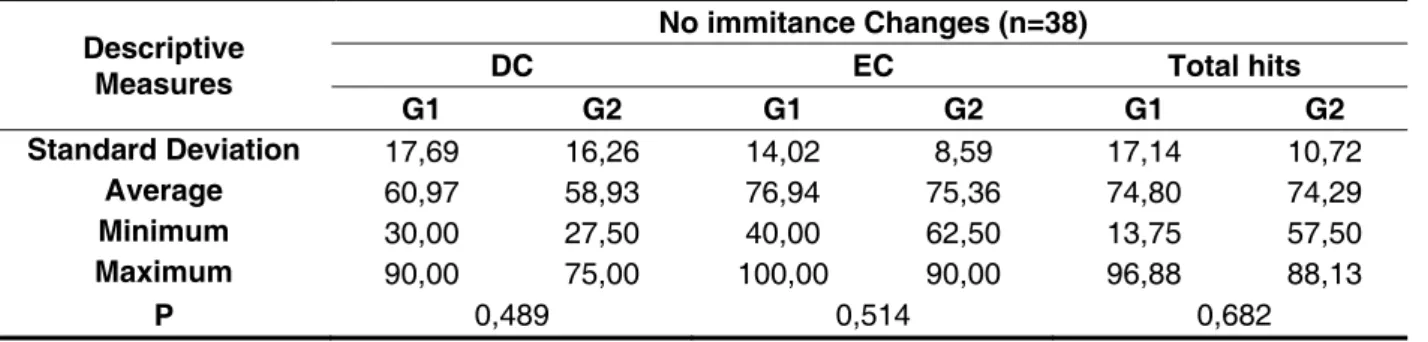
Descriptive Measures
No immitance Changes (n=38)
DC EC Total hits
G1 G2 G1 G2 G1 G2
Standard Deviation 17,69 16,26 14,02 8,59 17,14 10,72
Average 60,97 58,93 76,94 75,36 74,80 74,29
Minimum 30,00 27,50 40,00 62,50 13,75 57,50
Maximum 90,00 75,00 100,00 90,00 96,88 88,13
P 0,489 0,514 0,682
Table 1 – Distribution of standard deviations, mean, minimum and maximum values based on the DC conditions, EC and total hits for groups without immitance changes, expressed as percentage of correct responses (%)
Chi-square test
Caption: DC – right competitive, EC – left competitive; G1-G2 and non-exposed – exposed
Statistical signiicance (p ≤ 0.05)
Chart 1 illustrates the results of descriptive measures which give a quantitative analysis of the SSW test in competitive right conditions (M =
beyond the total of hits presented by children from G1 and G2 with immitance changes.
Chart 2 shows the results of the extracted
descriptive measures of quantitative analysis of the SSW test in competitive conditions right and left,
With immitance Changes (n=49)
DC EC Total hits
G1 G2 G1 G2 G1 G2
Standard Deviation 17,33 18,44 15,80 15,60 12,94 12,91
Average 63,23 53,00 79,35 73,50 78,53 74,10
Minimum 32,50 30,00 30,00 47,50 46,25 53,50
Maximum 92,50 82,50 100,00 97,50 96,25 94,38
P 0,812 0,523 0,813
In Charts 3 and 4 are demonstrated both typical and atypical of the SSW test results in relation to the quantitative variable ie DC , EC and/or both, with
distribution of the number of children for exposure to
sound levels and immitance conditions.
Table 2 – Distribution of standard deviations, mean, minimum and maximum values for the conditions DC, EC and total hits for groups with immitance changes, expressed as percentage of correct responses (%)
Chi-square test
Caption: DC – right competitive, EC – left competitive; G1-G2 and non-exposed – exposed
Statistical signiicance (p ≤ 0.05)
Exposure to noise levels DC EC DC e EC
Typical Atypical Typical Atypical Typical Atypical
G1 2 29 13 18 2 29
G2 0 7 2 5 0 7
Table 3 – Distribution of quantitative analysis in the SSW test of immittance change without children (n = 38) according to exposure to sound levels
Chi-square test
Caption: DC – right competitive, EC – left competitive; G1-exposed and non-G2 – exposed
Statistical signiicance (p ≤ 0.05)
ie, 100% showed lag, representing 18.42% of the total percentage. For the results of CE, it was found that of 31 children in G1 and G2 seven, respectively, 47.37% and 13.16% had Bad performance.
Exposure to noise levels DC EC DC e EC
Typical Atypical Typical Atypical Typical Atypical
G1 3 36 16 23 2 37
G2 1 9 3 7 1 9
Categorization (subprofiles) G1 G2 P
Typical Atypical Typical Atypical
No immitance changes (n = 38)
Decoding 17 14 4 3 0,91
Codification Gradual loss of memory 18 13 6 1 0,17
Integration 22 9 6 1 0,42
Organization 19 5 2 12 0,61
Two or more subprofiles 5 26 1 6 0,46
With immitance changes (n = 49)
Decoding 21 18 6 4 0,72
Codification Gradual loss of memory 23 16 6 4 0,17
Integration 25 14 7 3 0,72
Organization 23 16 10 0 0,01*
Two or more subprofiles 6 27 3 7 0,35
Considering the presence of category immitance changes related to DC the results showed that 39 children in G1, 73.47% had atypical DC, charac-teristic similar to 10 children of G2, with 18.37% of atypical results.
These data reveal that the majority of the
sample had a deicit in DC with a low percentage
of 5.26% typical for children without immitance
changes and 8.16% for those with modiications.
For the relationship between the results of children with immitance and EC changes, 39 children in G1
and 10 in G2, 46.94% of the selected sample and
14.29%, respectively, conirmed atypical EC. Thus,
highlights the superior performance of CE to the subjects of this study, with 39.47% of the total group of those without immitance changes and 38.77% for
those with, exhibiting characteristic results as the
reference criteria of analysis.
Below Chart 5 shows the decoding, encoding
and Organization subproiles based on trends of the
effect of errors of order auditory effect, inversions and standard type A.
Table 4 – Distribution of quantitative analysis in children with SSW immitance changes (n = 49) according to exposure to sound levels
Chi-square test
Caption: DC – right competitive, EC – left competitive; G1-unexposed and G2 – exposed
Statistical signiicance (p ≤ 0.05)
Table 5 – Distribution of qualitative analysis (subproiles) SSW test in children with and without immitance changes depending on the exposure to sound levels
Chi-square test
a S/N ratio in a poor environment and requires a more accurate auditory processing is evident in the
increased neuronal right auditory cortex in support
of HE23. Although the superiority of OD in individuals
with dominant HE be discussed until the present
day, in 1989 reported the clinical insigniicance of this inding in the SSW test24.
With respect to average total hits, G1 and G2 have equivalent performance. The literature differs in its results of total successful due to the particu-larity of each investigation. This research showed similarity with the values of all items reported by other studies, however, it is respectively of people
with learning dificulties25 and learning disorders26,
suggesting that children in this study have lag in the auditory short-changed compared to the perfor-mance of their peers. Resemblance to the group of lower middle socioeconomic and cultural level can also be found, where the mean score was 76.6%27.
Since the children in this study have the same social status, corroborates the assumptions that refer interference environment on auditory skills28.
Of the 87 children studied, 84 (96.55%) showed alterations in at least one embodiment of the test, were considered as having APD. The qualitative analysis of the SSW test showed that children had
errors in the four subproiles reviews.
By observing the values of average G2/no immitance the changes showed better performance than change, however, both have longer lag when
related to the unexposed group. In phonemic
decoding the individual components of a message
are identiied through closing skills, auditory discrim -ination, temporal processing, separation, binaural integration and sound localization. The bilateral
deicit or change in OD refers in this category and
affects the auditory analysis and synthesis, causing inability to assign meaning to phonemic information, ie, related to language comprehension29,20,18.
Assumption of this study was that the G2 would be required on your listening skills, since the greater the environmental challenges are, the greater the incentives for improvement of auditory processes
explained by neuroplasticity hearing, which provides
theoretical basis for the application of auditory training30, however, this hypothesis has not been
demonstrated in the results. However, the lag of G2/
immitance changes can be explained by the fact
that the condition immitance changes, indicative of a change in OM, interference in the transmission of sound produces inability of listening situations,
to cause dificulties to identify the speech signals,
even assuming a favorable opportunity to alleviate the discomfort and the ability of aggressive noise31.
When considering changes in the acoustic relex,
beyond its function to protect the inner ear against In the statistical treatment using chi-square test
there was no statistical signiicance between the data, ie, exposure to high sound pressure levels,
with or without amendments immitance and hearing abilities investigated by the SSW test, condition
except for deicits in auditory gnosis process
of organization (p = 0.01) in G1 with immitance
changes, which is expressed by the amount of errors
type inversions It can also be seen in the overall outcome of SSW to investigate the performance
of children in auditory processing test, signiicant
differences were observed for those with changes in impedance (p = 0.04) tests, therefore, showed 97.96 % of one or more disorders hearing abilities inves-tigated. Finally, regardless of the immittance test is
observed that the G2 has a signiicant percentage (p
= 0.03) for EC with atypical outcome for children as
the level of education, speciically in the third year.
DISCUSSION
In this research, the average DC and EC showed lower percentages than would be appropriate for this population, or 80% to 90% accuracy at 90% and 75%, respectively. Therefore, both groups
showed a deicit in the performance of the SSW
test, whichever results of CE compliant children at age eight years18. G1 got better rates in DC and
EC, immittance in both conditions, however this
difference did not prove signiicant ratio exposure to
high sound pressure levels of auditory processing. Contradicting these results, study showed higher
percentage of success in DC and EC exposed,
however, agree with this research by demonstrating that there was no statistical association to establish similar relationship19.
With regard to the “ear effect” it appears that the OE better results in this study, contradicting reports commonly described in the literature that attach to the greater amount of hits for RE, since most people are right-handed and have a higher representation in the left hemisphere (HE), so advantageously on the OD to verbal stimuli20. Factors related to
attention and structural brain asymmetry have
greater inluence on verbal auditory processing
although the perceptual asymmetry (dominance of dichotic tests in OD) is a source of controversial
investigations and scientists associate with difi -culties in reading decoding with caution21. In a study
on cerebral dominance, LSP test was applied, in monaural quality to VERIFY the effect of laterality in the presence of noise. The OD had worse results in both righties as lefties in demonstrating dissent in recognizing sentences as shown in the liter-ature22. Although HE is predominant in information
the quantitative aspect of this variable was not
expressed qualitatively. In return, if deemed Type A standard to the indings in Chart 1 and 2, wherein the
mean score is less for DC can thus infer agreement
with the quantitative indings.
In sub-proile organization, responsible for identifying the dificulty that the individual has for verbal sounds in sequence and cause dificulties
for the understanding of speech, it is observed that the G1/no immitance changes had worse
results. However, signiicance was demonstrated in the igures provided by the presence of G1 with
immitance changes. The sequence of acoustic events which happen in time is dependent on
short-term memory and the inluence functions of the
central auditory nervous system , and are important for written language35. Scientiic controversies have
relied on the fundamentals of stochastic resonance to conceive the idea that the noise is not always detrimental to cognitive performance. This model proposes that inattentive children and at risk for poor academic performance would be encouraged to pay attention to the content with improvement on episodic memory when added acoustic background noise (white noise) however, worsening the
perfor-mance of children without attention dificulties36.
Scholars call attention to the heterogeneous
nature of the DPAs, that coexist in parallel with
disorders of language processing, cognition, motor skills or learning and need to be investigated with the control of all its variables3. In concordance with the
authors, there are reports of the tests investigating
the auditory abilities can be inluenced by many extrinsic and intrinsic factors such as attention, auditory experiences, psychological, age, auditory
maturation and other factors37. Thus, the questions
of this research should be investigated in future more restricted samples in search of isolation stakeholder
aspects, in order to ind which factors have a direct inluence on auditory processing in a room acousti -cally unhealthy lesson with the greater purpose of modifying the environment and teaching practices in favor of a healthy school environment, although it is necessary to emphasize that the criteria of this research have made relatively homogeneous study population.
CONCLUSION
The present study showed that high levels of sound pressure in the classroom does not interfere with hearing abilities, tested with SSW, children in the learning process.
loud sounds, cannot rule out the mechanism of anti-masking stapedius, that attenuates the sounds of low frequency environmental or individual, and thus provides the ease of capture of speech sounds, improving the encoding of information by encour-aging speech intelligibility. Thus, we hypothesize
that changes in the acoustic relex can inluence
auditory processing abilities32. The literature reports
that children with a history of OM infections tend to present the worst performance when hearing tests
and the effects of luctuating hearing loss in speech and writing may extend throughout the school term33.
In both groups, yielded the largest amount
of typical relect the auditory effect. However, comparing G1 and G2 atypical, the irst group had worse outcomes, but without statistical signiicance. The sub-proile encoding, with regard to the gradual loss of memory demonstrates the dificulty that the
individual has to ignore background noise and to rescue immediate memory27. One study showed
that both children with normal hearing abilities, as the bearers of DPA are affected by irrelevant sounds in performance that requires the use of memory.
However, the dificulty caused by irrelevant sounds a tone – stimulus did not differ in dificulty among
those who presented DPA when the irrelevant sound was a speech (speech) contrary to what had children with the same age and full development, who felt most affected by irrelevant speech sounds
with content. Thus, the authors explained that the dificulty that patients with APD have to process
information in bad acoustic environment is because the speech processing occur to them in a different way34.
In sub-proile encoding type integration, the
results showed a lower amount of change children
in both groups, represent no difference in exposure to sound levels in the question would indicate difi -culty in associating sound – symbol. This category
represents the indings of the standard type A
(large number of errors in the competitive ear that starts the test – in this research, it was decided to initiate the OD) and their damage comes from the inability to integrate information, ie, due to poor inter – hemispheric transfer (via the corpus callosum)
18. Clinical evidence on verbal dichotic tests,
especially in the SSW, performance is degraded in OE. By observing the distribution of qualitative
indings relating to integration (see Chart 3 and 4)
e suas implicações educacionais. Rev. psicopedag. 2009;29(80):231-41.
8. Hornechil J, Chandrasekaran B, Zecher S, Kraus N. Auditory Braistem measures predict reading and speech-in-noise perception in school-aged children. Behav. Brain. Res. 2011;216(1):597-605.
9. Associação Brasileira de Normas Técnicas (ABNT). Níveis de Ruído para Conforto Acústico. CONAMA – NBR 10.152. Rio de Janeiro: 2000. 10. Dreossi RCF, Momensohn-Santos TM. A interferência do ruído na aprendizagem. Rev. Psicopedagogia. 2004;21(64):38-47.
11. Eniz A, Garavelli Sla. Contaminação acústica de ambientes escolares devido aos ruídos urbanos no Distrito Federal, Brasil.Holos Environ.2006;6(2): 137-50.
12. Câmara CC, Pereira LD, Borges ACLC. Teste de escuta dicótica – SSW – em crianças com e sem evidências de problemas escolares e/ ou alterações de habilidade auditivas. Fono atual. 2004;30(7):4-13.
13. BRASIL. Ministério do Trabalho. Atividades insalubres. Lei Nº 6515 – portaria n º 3214 NR 15. Atualização portaria SIT nº 203, 2011; p. 1-85.
14. Jerger J. Clinical Experience With Impedance
Audiometry. Arch Otorrinolaring. 1970;92:311-24. 15. Pereira LD, Schochat E. Processamento auditivo central: manual de avaliação. São Paulo: Lovise; 1997.
16. Borges ACL. de. Dissílabos Alternados – SSW. Em: Pereira LD, Schochat E. Processamento
REFERENCES
1. Baldo MVC. Audição. Em: Aires, MM. Fisiologia. 3. ed. Rio de Janeiro: Guanabara Koogan; 2008, p. 266-77.
2. Alvarez Amma, Zaidan E. Processamento
auditivo central e dislexia: novas abordagens em habilitação. Em: Associação Brasileira De Dislexia (org.). Dislexia – cérebro, cognição e aprendizagem.
São Paulo: Frôntis Editorial; 2000;1:5-9.
3. Chermak GD. Deciphering auditory processing disorders in children. Otolaryngol. Clin. N. AM. 2002;35(1):733-49.
4. American Speech-Language-Hearing Association (ASHA). (Central) Auditory Processing Disorders. Technical report. [periódico na internet]. 2005. [Acesso em 11 set 2011]; 17 p. Disponível em: < http://www.asha.org/docs/html/tr2005-00043.html>. 5. Aita ADC, Mesquita CDS, Campos CM, Fukuda MTH, Aita FS. Correlação entre as desordens
de processamento auditivo central e queixas de diiculdades escolares. J. Bras. Fonoaudiol.
2003;4(15):101-7.
6. Canto CR de L, Silveira SMB da. Alterações
no processamento auditivo e as diiculdades de
aprendizagem numa visão psicopedagógica. Virtus-Tubarão, 2003;3(1):61-73.
7. Pinheiro FH, Capellini SA. Desenvolvimento das habilidades auditivas de escolares com distúrbio de aprendizagem, antes e após treinamento auditivo,
RESUMO
Objetivo: investigar os efeitos dos níveis de pressão sonora elevados em sala de aula e das alte-rações imitanciométricas sobre as habilidades auditivas de crianças em fase inicial de letramento.
Métodos: estudo quantitativo e exploratório. Medições acústicas por meio de dosímetro; inspeção
visual do conduto auditivo externo; audiometria tonal e vocal; imitanciometria. Os resultados das men -surações acústicas realizadas por meio de dosímetro em quatro escolas de Santa Maria – RS, dividiu
a amostra de 87 crianças do 3º e 4º ano do ensino fundamental, na faixa etária de oito a dez anos em dois grupos – Grupo 1 / não expostos e Grupo 2 / expostos a níveis maiores que 80dB(A). A amostra
também foi separada em 38 crianças sem alterações imitanciométricas e 49 com alterações, avalia-das em suas habilidades auditivas pelo teste dicótico de Dissílabos Alternados – SSW. Resultados:
o G1 apresentou melhores resultados na DC e EC em ambas às condições imitanciométricas, sem evidenciar diferença estatística. Foi constatada maior quantidade de acertos para a OE; a média do total de acertos evidenciou desempenhos semelhantes entre os grupos; o G1 apresentou melhores
resultados na decodiicação fonêmica, porém piores resultados nos subperis codiicação e organiza -ção. Conclusões: o presente estudo demonstrou que níveis de pressão sonora elevados em sala de aula não interferem nas habilidades auditivas testadas por meio do SSW, de crianças em processo de aprendizagem.
distintos níveis sócio-econômico-culturais. Arq. Int. Otorrinolaringol. 2011;15(3):338-45.
28. Balen AS. Resolução temporal de crianças escolares. Rev. CEFAC. 2009;11(1):52-61.
29. Jacob LCBJ, Alvarenga KF, Zeilgeilbom BS. Avaliação audiológica do sistema nervoso auditivo central. Arq. Int. Otorrinolaringol. [periódico na internet]. 2000. [Acesso em 4 dezembro 2011];4(4):7 p. Disponível em: http://www.arquivosdeorl.org.br/ conteudo/acervo_port.asp?id=136.
30. Samelli AG, Mecca FFDN. Treinamento auditivo para transtorno do processamento auditivo: uma proposta de intervenção terapêutica. Rev. CEFAC. 2010;12(2):235-41.
31. Northern JL, Downs MP. Audição na infância. 5. ed. Rio de Janeiro: Guanabara Koogan, 2005. 32. Meneguello J, Domenico MLD, Costa MCM, Leonhardt FD, Barbosa LHF, Pereira LD. Ocorrência
de relexo acústico alterado em desordens do
processamento auditivo. Rev. Bras. Otorrinolaringol. 2001;67(6):830-5.
33. Lima-Gregio AM, Calais LL, Feniman MR. Otite média recorrente e habilidade de localização sonora em pré-escolares. Rev. CEFAC. 2010;12(6):1033-40.
34. Elliott EM, Bhagat SP, Lynn SD. Can children with (central) auditory processing disorders ignore irrelevant sounds? Res. Dev. Disabil. 2007;28:506-17.
35. Frota S, Pereira LD. Processamento auditivo: estudo em crianças com distúrbios da leitura e da escrita. Rev. Psicopedagogia. 2010;27(83):214-22. 36. Soderlung GBW, Sikstron S, Loftesnes JM, Sonuga-Barke EJ. The effects of background white noise on memory performance in inattentive orschool children. Behav. Brain Funct. 2010;6(55):1-10. 37. Costamilan CM. Processamento auditivo em escolares: um estudo longitudinal. [Dissertação]. Santa Maria (RS): Universidade Federal de Santa Maria. Pós-graduação em Distúrbios da Comunicação Humana; 2004.
Auditivo Central: manual de avaliação. São Paulo: Lovise; 1997, p. 169-78.
17. Rossi AG, Costamilan CM. Avaliação do
processamento auditivo. Caderno Didático de Fonoaudiologia, Santa Maria. Editora Gráica da
UFSM, 80, 2002.
18. Pereira LD, Schochat E. Testes auditivos comportamentais para avaliação do processamento auditivo central. Barueri, SP: Pró-fono, 2011. 19. Sola ER. Ruído Urbano: efeitos na saúde auditiva de escolares. Departamento de epidemiologia. [Dissertação]. São Paulo (SP): Universidade Federal de São Paulo. Pós-graduação em Saúde Pública; 2004.
20. Araujo NSS, Ruiz ACP, Pereira LD. SSW – Análise Qualitativa dos Erros: Inventário de atendimento de
2005. Rev. CEFAC.2009;11(1):44-51.
21. Felippe ACN. de. Processamento auditivo e problemas de leitura-escrita. Em: Aquino AMCM de.
(Org.). Processamento auditivo: eletroisiologia &
psicoacústica. São Paulo: Lovise; 2002, p.101-10. 22. Becker KT et al. O efeito da lateralidade em testes de fala no ruído em normo-ouvintes. Rev. CEFAC. [periódico na internet]. 2010. [Acesso em 4 dezembro 2011] 8 p. Disponível em: http://www. scielo.br/pdf/rcefac/2011nahead/126-10.pdf.
23. Stracke H, Okamoto H, Pantev C. Interhemispheric support during demanding auditory signal-in-noise processing. Cerebral Cortex June.
2009; 19(6):1440-7.
24. Lukas RA, Genchur-Lukas J. Teste de palavras espondaicas. Em: Katz J. Tratado de audiologia clínica. 4. ed. São Paulo: Ed. Manole; 1999.
25. Neves IF, Schochat E. Maturação do processamento auditivo em crianças com e sem
diiculdades escolares. Pró-fono R. Atual. Cient.
2005;17(3):313-20.
26. Pinheiro FH, Oliveira AM de, Cardoso ACV, Capellini SA. Testes de escuta dicótica em escolares com distúrbios de aprendizagem. Braz. J. Otorhinolaryngol. 2010;76(2):257-62.
27. Becker KT, Costa MJ, Lessa AH, Rossi AG. Teste SSW em escolares de 7 a 10 anos de dois
Recebido em: 01/05/2012 Aceito em: 02/09/2012
Endereço para correspondência: Juliana Feitosa dos Santos
Av. Esperança, 1416, Bairro Manaíra João Pessoa – PB
CEP: 58038-281