186
Rev Dor. São Paulo, 2015 jul-sep;16(3):186-9
ABSTRACT
BACKGROUND AND OBJECTIVES: he proile of victims
assisted by emergency units with severe pain and the satisfaction with analgesia should guide therapeutic approaches and care in such services. his study aimed at observing socio-demographic characteristics associated to severe pain in trauma victims and at evaluating whether there have been diferences in clinical appro-aches and satisfaction with analgesia for those with moderate or severe pain.
METHODS: his is a descriptive cross-sectional study carried out with 83 patients with acute, moderate or severe pain after physical trauma. Data were collected in October 2013 by me-ans of a structured tool with questions about socio-demographic proile and pain evaluation after initial medical assistance.
RESULTS: It was observed that 53.02% of respondents have classiied pain at admission as severe, which was associated to age between 18 and 49 years and education less than eight years. In-dividuals with severe pain had higher chances of simultaneously receiving non-pharmacological measures and intravenous drugs, have reported improvement only 30 minutes after their adminis-tration and were not happy with analgesia.
CONCLUSION: Most patients were young, with education less than eight years and have reported severe pain. Dissatisfaction with analgesia was more frequent among severe pain patients. Health professionals should be alert for age and education cha-racteristics when evaluating pain in trauma victims and should carefully evaluate clinical approaches to be used.
Keywords: Acute pain, Emergency medical services, Injuries, Pain handling, Pain measurement, Wounds.
Clinical approaches and satisfaction with analgesia of trauma victims
with severe pain*
Condutas clínicas e satisfação diante da analgesia em vítimas de trauma com dor intensa
Andrea Regina Martin1, Jamyle Rubio Soares1, Débora Comin Baronceli2, Sonia Silva Marcon3, Mayckel da Silva Barreto1,2,3
*Received from School of Philosophy, Sciences and Letters of Mandaguari, Mandaguari, PR, Brazil.
1. Faculdade de Filosoia, Ciências e Letras de Mandaguari, Mandaguari, PR, Brasil. 2. Faculdade Intermunicipal do Noroeste do Parana, Loanda, PR, Brasil. 3. Universidade Estadual de Maringá, Maringá, PR, Brasil.
Submitted in March 15, 2015. Accepted for publication in July 27, 2015.
Conlict of interests: none – Sponsoring sources: none.
Correspondence to: Andrea Regina Martin Rua Renê Táccola, 152 – Centro 86975-000 Mandaguari, PR, Brasil. E-mail: [email protected]
© Sociedade Brasileira para o Estudo da Dor
RESUMO
JUSTIFICATIVA E OBJETIVOS: O peril das vítimas de trau-ma atendidas nas unidades emergenciais com dor aguda inten-sa e a inten-satisfação com a analgesia empregada devem direcionar a conduta terapêutica e as atividades assistenciais nesses serviços. Os objetivos deste estudo foram veriicar as características sócio--demográicas associadas à ocorrência de dor intensa em vítimas de trauma e avaliar se houve diferença nas condutas clínicas e na satisfação com a analgesia para aqueles com dor moderada ou intensa.
MÉTODOS: Estudo descritivo e transversal realizado com 83 pacientes que apresentaram dor aguda, moderada ou intensa após trauma físico. Os dados foram coletados em outubro de 2013, mediante instrumento estruturado contendo questões so-bre o peril sócio-demográico e avaliação do quadro álgico, após o atendimento médico inicial.
RESULTADOS: Observou-se que 53,02% dos entrevistados classiicaram a dor na admissão como intensa, a qual esteve as-sociada à idade entre 18 e 49 anos e escolaridade menor que oito anos. Os indivíduos com dor intensa apresentaram maiores chances de receber, de forma concomitante, medidas não farma-cológicas e fármacos por via venosa, relataram melhora somente após 30 minutos da sua administração e não icaram satisfeitos com a analgesia.
CONCLUSÃO: A maioria dos pacientes era jovem, com escola-ridade menor que oito anos e relatou dor intensa. A insatisfação com a analgesia foi mais observada nos pacientes com dor inten-sa. Proissionais de saúde precisam estar atentos às características de idade e escolaridade ao avaliarem a dor em vítimas de trauma e devem analisar as condutas clínicas utilizadas cuidadosamente.
Descritores: Dor aguda, Ferimentos, Lesões, Manuseio da dor, Mensuração da dor, Serviços médicos de emergência.
INTRODUCTION
Trauma is a major and current challenge for security and public health sectors in Brazil and in different parts of the world because accidents and deaths due to external reasons are increasing in recent years1-3. Acute pain is one of the
most common consequences of trauma and its repercussions are considered potentially noxious for the body, being that the more severe and extensive is the injury, the higher is pain intensity4.
ORIGINAL ARTICLE
187
Clinical approaches and satisfaction with analgesia of trauma victims with severe pain
Rev Dor. São Paulo, 2015 jul-sep;16(3):186-9
Since the early 1990s, there is a broad and complex defini-tion of pain, which is characterized as an unpleasant sensory and emotional experience associated to real or potential tis-sue injury, or described in terms of such injury5. It is also
consensus that acute pain may trigger several neurovegetati-ve changes, such as increased blood pressure, increased heart rate and output, hypoventilation and decreased peripheral blood perfusion which, in case of trauma patients, tend to worsen their clinical presentation4.
However, even with deinitions and consensus established for decades, acute pain measurement in trauma victims has had little emphasis and applicability both in assistance practice and scientiic literature. his is primarily due to the fact that health professionals are still not convinced of the biological, humanitarian and ethical importance of acute pain measument to guide therapy and assistance, which certainly is re-lected in less patients’ satisfaction with analgesia6,7.
This study is justified by the fact that pain evaluation is im-portant during painful trauma victims’ assistance, and also because little is known about the profile of trauma victims assisted in first aid units with acute, moderate or mild pain, about most common clinical approaches and patients’ satis-faction with analgesia8. This poor knowledge brings
incon-sistency to available information, impairing health profes-sionals’ sensitization to plan actions, programs and material and human resources allocation in first aid units to evaluate, treat and control acute pain9.
In light of the above, this study aimed at evaluating socio--demographic characteristics associated to acute pain in trauma victims, and at evaluating whether there was been differences in clinical approaches and satisfaction with anal-gesia among those with moderate or severe pain.
METHODS
his is a descriptive, cross-sectional study carried out in a public irst aid unit in the South of Brazil. Interviews were carried out in a private place within the unit itself, after initial medical assistance and implementation of care and drug ad-ministration by the nursing team. A structured questionnaire was used with information about patients’ socio-demographic proile, the traumatic event and instituted treatment. Data on prescribed analgesics and non-pharmacological procedures for pain relief (local compression, immobilization and cryo-therapy) were collected from medical records.
To evaluate pain intensity and location, numeric pain scale (NPS), which varies from zero to 10 and allows the classi-fication of pain as absent (0), mild (1 to 3), moderate (4 to 7) and severe (8 to 10), and body diagram (drawing of the human body where patients indicate the site of pain) were applied.
Data were collected in October 2013, from Monday to Fri-day, from 7:00 a.m. to 1:00 p.m., being considered potential participants all individuals aged above 18 years who came to the service with diagnosis of trauma and acute pain (103 patients). Exclusion criteria were patients who were
intu-bated, sedated and unable to answer the questions due to trauma (8 cases) or those refusing to participate in the study (2 cases). In total, 93 patients were interviewed as from a non-probabilistic sample. Afterward, 10 more patients were excluded for presenting mild pain. It is believed that the distance between score 1 (onset of mild pain) and 7 (end of moderate pain) has prevented individuals to be included in the same group and that is why those with mild pain were excluded from the study.
Statistical analysis
Data were compiled by the program Microsoft Office Excel 2010® and statistically analyzed with the software Statisti-cal Analysis System – SAS®. To observe the association of
studied variables with the relevant outcome and to measu-re this association, Pearson non-parametric Chi-squameasu-re test was used with significance level of p<0.05 and Relative Risk (RR) was calculated.
This study was approved by the Permanent Ethics Commit-tee for Research Involving Human Beings of the State Uni-versity of Maringá (CAAE: 20517513.3.0000.0104-2013).
RESULTS
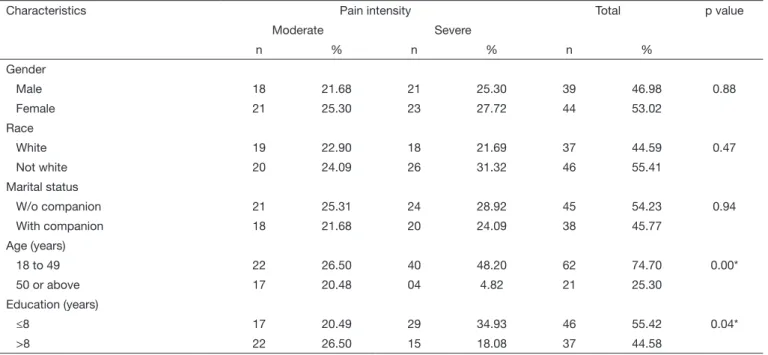
Sample was made up of 83 individuals being that at admis-sion, 44 (53.02%) had classified their pain as severe. With regard to socio-demographic characteristics, most were fe-males, not white, without companion, aged between 18 and 49 years and education level equal to or less than eight years (Table 1).
There has only been association between more severe pain and age and education level. RR calculation has shown that individuals aged 18 to 49 years and with education level less than eight years had, respectively, 3.4 (CI: 1.75-6.57) ti-mes and 1.6 (CI:1.02-2.38) titi-mes more chance of classifying their pain as severe.
All participants of the study were pharmacologically medi-cated for pain relief, being subcutaneous (SC) or intramus-cular (IM) the most common administration routes, with 63 cases (75.90%). However, among individuals with seve-re pain, intravenous (IV) administration was significantly more frequent (Table 2).
Slighly more than half the respondents (44 – 53.02%) have received non-pharmacological analgesia, being this signifi-cantly more prevalent among those with severe pain. Time for pain improvement after drug administration was more than 30 minutes for 55 (66.27%) patients and this time was significantly longer for those with severe pain, although for most individuals of this group pharmacological analgesia has been administered by IV route, being simultaneously applied non-pharmacological pain control measures such as local compression, immobilization and cryotherapy.
188
Martin AR, Soares JR, Baronceli DC, Marcon SS and Barreto MS Rev Dor. São Paulo, 2015 jul-sep;16(3):186-9
DISCUSSION
According to our results, it was observed that most respon-dents have classiied their pain as severe. his has to be hi-ghlighted because emergency service professionals have to pay attention to pain measurement and consider diferent pain levels, especially those classiied as severe by trauma patients. Within this perspective, a study carried out in a teaching irst aid unit in Southeastern Brazil with 309 patients with clini-cal and traumatic problems has observed that mean pain at admission was 8.12 according to NPS, which characterized it as severe10.
It is known that acute and severe pain is a major reason for
looking for irst aid services11. However, even being a frequent
symptom in this sector, there is a relative unpreparedness of health professionals to adequately deal with it, because they hardly consider socio-demographic characteristics when eva-luating pain level, which may predispose to inadequate tre-atment6.
It has been observed that most individuals with severe pain were females. In fact, females seem to have a diferent pain threshold as compared to males. A study carried out in En-gland and Libya, comparing males and females submitted to pain stimulation tests, has shown that males had higher tole-rance and have used lower NPS scores to manifest their pain intensity12.
Table 2. Distribution of pain relief characteristics and satisfaction with analgesia of trauma victims, according to pain level. Mandaguari, PR, 2013
Characteristics Pain intensity Total p value RR (CI)
Moderate Severe
n % n % n %
Administration route
Intramuscular & subcutaneous 34 40.96 29 34.94 63 75.90 0.02* 2.7
(1.14 – 6.21)
Intravenous 05 6.03 15 18.07 20 24.10
Non-pharmacological approaches
Yes 14 16.87 30 36.15 44 53.02 0.00* 1.9
(1.24 – 2.91)
No 25 30.12 14 16.86 39 46.98
Time to improve
≤30 minutes 24 28.91 04 4.82 28 33.73 0.00* 2.4
(1.69 – 3.30)
>30 minutes 15 18.07 40 48.20 55 66.27
Satisfaction with analgesia
Yes 33 39.75 29 34.95 62 74.70 0.00* 4.3
(2.32 – 7.91)
No 06 7.23 15 18.07 21 25.30
*p signiicant according to Chi-square test; RR = relative risk; (CI) = conidence interval.
Table 1. Socio-demographic characteristics of trauma victims according to pain level. Mandaguari, PR, 2013
Characteristics Pain intensity Total p value
Moderate Severe
n % n % n %
Gender
Male 18 21.68 21 25.30 39 46.98 0.88
Female 21 25.30 23 27.72 44 53.02
Race
White 19 22.90 18 21.69 37 44.59 0.47
Not white 20 24.09 26 31.32 46 55.41
Marital status
W/o companion 21 25.31 24 28.92 45 54.23 0.94
With companion 18 21.68 20 24.09 38 45.77
Age (years)
18 to 49 22 26.50 40 48.20 62 74.70 0.00*
50 or above 17 20.48 04 4.82 21 25.30
Education (years)
≤8 17 20.49 29 34.93 46 55.42 0.04*
>8 22 26.50 15 18.08 37 44.58
189
Clinical approaches and satisfaction with analgesia of trauma victims with severe pain
Rev Dor. São Paulo, 2015 jul-sep;16(3):186-9
Results of our study have shown that most trauma victims with severe pain had 18 to 49 years of age, were not white, without companion and with less than 8 years of education, proile also found in a diferent investigation10. Within these groups, it was
observed that most common trauma triggers were traic acci-dents, labor accidents and aggressions, which tend to be more severe leading to more intense painful processes1,2.
It has been observed that all individuals were medicated with analgesic drugs. Most common administration route was IM/ SC, being IV more common among those with severe pain. he explanation is based on the almost immediate pain re-lief when drugs are administered by this route. Drugs not sufering irst pass metabolism through the liver occupy most part of its receptors, peaking with a faster and more efective analgesia13.
More than half the respondents have also received non-phar-macological measures for pain relief, which were more signi-icantly applied to those with severe pain. A study in a Dutch emergency unit with 1407 people with pain complaints has observed that only approximately 25% had received non--pharmacological measures14. hese measures may increase
the chances of adequate pain control in trauma victims and are a possibility to be prescribed and implemented.
One should stress that in spite of lack of time and deicit of professionals in irst aid units, these measures, in addition to favoring pain control without potential risks for patients for being noninvasive measures, also decrease health service costs. Most respondents classifying pain as severe had higher chan-ces of improving only 30 minutes after drug administration. his deserves attention, since a North-American study, carried out with more than 1 thousand patients of a irst aid unit, has shown that pain diagnosis by professionals would take appro-ximately 55 minutes to be established. In addition, almost 60 minutes were elapsed before medical analgesic prescription and administration by the nursing team15. his observation
points to the compelling need for protocols allowing the de-cision-making by urgent measures aiming at solving this cri-tical bottleneck of assistance, related to the long time for pain diagnosis, treatment and control in emergency units.
It is worth stressing that even taking longer than 30 minutes for pain improvement, most respondents (74.70%) have re-ported being happy with analgesia. However, there has been less satisfaction among those with severe pain. A study car-ried out in a hospital from the Southeastern Brazil, with 309 patients, has shown that at hospital discharge approximately 70% of them still had pain, but even so, 60% have reported being happy with analgesia10.
Studies show a paradox between pain sensation and satisfac-tion with analgesia, although 50 to 76% of patients report being happy with the treatment they received for pain relief. It has to be considered that these studies, similar to our inves-tigation, were carried out inside health units, where some pa-tients were under observation. And the fact that respondents believed that they will would need again the health service in
the future may have inluenced their satisfaction with analge-sia, being this a limitation of our study.
Moreover, the fact that this study was carried out in just one emergency health unit, with a limited number of patients, circumscribe our indings and does not allow generalizations.
CONCLUSION
Most patients were young, with less than eight years of edu-cation and have reported severe pain. Dissatisfaction with analgesia was more frequent among severe pain patients. We suggest that further investigations including a higher number of participants and with diferent trauma triggers are carried out. his would provide a more useful knowledge of trauma victims’ proile, of most common clinical approaches and of users’ satisfaction with analgesia, which shall certainly guide the way in which health professionals assist trauma victims in emergency units, especially those classifying their pain as severe.
REFERENCES
1. Andrade-Barbosa TL, Xavier-Gomes LM, Barbosa VA, Caldeira AP. Mortalida-de masculina por causas externas em Minas Gerais, Brasil. Ciên SaúMortalida-de Coletiva. 2013;18(3):711-9.
2. Hsia RY, Srebotnjak T, Maselli J, Crandall M, McCulloch C, Kellermann AL. he association of trauma center closures with increased inpatient mortality for injured patients. J Trauma Acute Care Surg. 2014;76(4):1048-54.
3. Odhiambo FO, Beynon CM, Ogwang S, Hamel MJ, Howland O, van Eijk AM, et al. Trauma-related mortality among adults in Rural Western Kenya: characterizing deaths using data from a health and demographic surveillance system. PLoS One. 2013;8(11):e79840.
4. Sallum AM, Garcia DM, Sanches M. Dor aguda e crônica: revisão narrativa da litera-tura. Acta Paul Enferm. 2012;25(spe1):150.
5. International Association for Study of Pain (IASP). Consensus development confe-rence statement: the integrated approach to the management of pain. Accid Emerg Med. 1994;6(3):291-2. http://consensus.nih.gov/1986/1986PainManagement055ht ml.htm.
6. Berben SA, Schoonhoven L, Meijs TH, van Vugt AB, van Grunsven PM. Prevalen-ce and relief of pain in trauma patients in emergency medical serviPrevalen-ces. Clin J Pain. 2011;27(7):587-92.
7. Magalhães PA, Mota FA, Saleh CM, Dal Secco LM, Fusco SR, Gouvêa AL. Percep-ção dos proissionais de enfermagem frente à identiicaPercep-ção, quantiicaPercep-ção e tratamen-to da dor em pacientes de uma unidade de terapia intensiva de trauma. Rev Dor. 2011;12(3):221-5.
8. Ribeiro NC, Barreto SC, Hora EC, de Sousa RM. [he nurse providing care to trauma victims in pain: the ifth vital sign]. Rev Esc Enferm USP. 2011;45(1):146-52. Portu-guese.
9. Nascimento LA, Kreling MC. Assessment of pain as the ifth vital sign: opinion of nurses. Acta Paul Enferm. 2011;24(1):50-4.
10. Barreto RF, Gomes CZ, Silva RM, Signorelli AA, Oliveira LF, Cavellani CL, et al. Avaliação de dor e do peril epidemiológico, de pacientes atendidos no pronto-socorro de um hospital universitário. Rev Dor. 2012;13(3):213-9.
11. Garcia VM, Reis RK. Adequação da demanda e peril de morbidade atendida em uma unidade não hospitalar de urgência e emergência. Cienc Cuid Saude. 2014;13(4):665-73.
12. Alabas OA, Tashani OA, Johnson MI. Efects of ethnicity and gender role expectations of pain on experimental pain: a cross-cultural study. Eur J Pain. 2012;17(5):776-86. 13. Ehret GB, Daali Y, Chabert J, Rebsamen M, Wolf A, Forster A, et al. Inluence of
CYP2D6 activity on pre-emptive analgesia by the n-methyl-d-aspartate antagonist dextromethorphan in a randomized controlled trial of acute pain. Pain Physician. 2013;16(1):45-56.
14. Berben SA, Schoonhoven L, Meijs TH, van Vugt AB, van Grunsven PM. Prevalen-ce and relief of pain in trauma patients in emergency medical serviPrevalen-ces. Clin J Pain. 2011;27(7):587-92.