Prostate cancer – Therapy with radium-223
C
ÂNCER DE PRÓSTATA– T
ERAPIA COM RÁDIO-223
Authorship: Brazilian Society of Nuclear Medicine
Participants: Ana Emília Brito1, Bárbara Juarez Amorim2, Milena Martello3,
Wanderley Marques Bernardo3, Elba Etchebehere4
Final draft:December 11, 2017
1MD Real Nuclear – Real Hospital Português de Pernambuco, Recife, PE, Brazil
2MD, PhD Professor. Department of Nuclear Medicine, Hospital de Clínicas da Universidade Estadual de Campinas (Unicamp). Scientific Director of the Brazilian Society of Nuclear Medicine, Campinas, SP, Brazil 3AMB Guidelines Program
4MD, PhD Professor. Department of Nuclear Medicine, Hospital de Clínicas da Unicamp. MND Director, Campinas – MND Group, Campinas, SP, Brazil
http://dx.doi.org/10.1590/1806-9282.63.12.1019
The Guidelines Project, an initiative of the Brazilian Medical Association, aims to combine information from the medical field in order to standardize procedures to assist the reasoning and decision-making of doctors.
The information provided through this project must be assessed and criticized by the physician responsible for the conduct that will be adopted, depending on the conditions and the clinical status of each patient.
D
ESCRIPTION OF THE EVIDENCECOLLECTION METHOD
This guideline followed the standard of a systematic review with evidence retrieval based on evidence-based medicine (EBM), so that clinical experience is integrated with the ability to critically analyze and apply scientific information rationally, thus improving the quality of medical care.
We used the structured mode of formulating questions synthesized by the acronym PICO, where P stands for pa-tients with prostate cancer, I stands for indicator, i.e., ra-dium-223, and O stands for outcome, which is benefit.
Based on the structured question, we identified the descriptors that formed the basis of the search for evidence in the databases: Medline-Pubmed. Ninety-nine (99) stud-ies were retrieved and, after applying the eligibility criteria (inclusion and exclusion), 13 were selected to answer the clinical question (Annex I).
C
LINICAL QUESTIONWhat is the benefit of radium-223 therapy in prostate cancer?
G
RADES OF RECOMMENDATION AND LEVELSOF EVIDENCE
• A: Experimental or observational studies of higher consistency.
• B: Experimental or observational studies of lower consistency.
• C: Cases reports / non-controlled studies.
• D: Opinion without critical evaluation, based on con-sensus, physiological studies or animal models.
O
BJECTIVEThe aim of this guideline is to estimate the benefit of ra-dium-223 chloride therapy (Ra223) in patients with pros-tate cancer resistant to castration and bone metastases.
I
NTRODUCTIONRa223 has been approved by the Brazilian Health Surveil-lance Agency (Anvisa) to be used as a drug in the treatment of patients with bone metastases from metastatic castra-tion-resistant prostate cancer (mCRPC) without known visceral metastases.1
This treatment is indicated when patients with mCRPC have blastic bone metastases in an attempt to increase survival, but it is also applied in these condi-tions when patients have symptoms, such as pain (but not exclusively).
D
ATA EXTRACTIONSurvival
After evaluating 64 mCRPC patients eligible for radiation therapy due to bone pain, with mean follow-up time of 18 months, there was greater survival among patients treated with Ra223 (50 kBq/kg dosage) compared to a placebo. Median survival was 65.3 versus 46.4 weeks, re-spectively, significantly higher for Ra223 (50 kBq/kg dos-age) (p=0.006) compared to a placebo (HR=2.12, 95CI 1.12-3.98; p=0.020), indicating a higher risk of death for the placebo group.3 (A) After 2 years of follow-up of
these patients, the median survival of the Ra223-treat-ed group was 71 weeks versus 46.4 weeks in the placebo group (HR=0.445, 95CI 0.232-0.851).4 (A)
In the largest phase III multicenter controlled ran-domized trial evaluating 921 mCRPC patients, 614 re-ceived six injections of Ra223 (50 kBq/Kg dosage) and 307 received placebo injections. Those patients treated with Ra223 had greater survival compared to those treat-ed with placebo, with a mtreat-edian survival of 14.9 versus 11.3 months. The absolute increase in survival was 10.5 months (95CI 3.3-17.7). In this case, it is necessary to treat nine patients to have an increase in survival of 3.6 months (on average) in one patient.5 (A)
When this same population was stratified according to prior use of docetaxel, Ra223 continued to show an increase in survival, both in the group of prior use (HR=0.70, 95CI 0.56-0.88; p=0.002) compared to the group that had never used docetaxel (HR=0.69, 95CI 0.52-0.92; p=0.01).6 (A)
Bone event
In an initial study with 64 mCRPC patients, there was longer time until the first bone event in the Ra223-treat-ed group comparRa223-treat-ed to the placebo group (14 weeks versus 11 weeks) (HR=1.75, 95CI 0.96-3.19; p=0.065). However, there was no significant difference in the number of bone events (p=0.625).3 (B)
In the large ALSYMPCA study, evaluating 921 patients with mCRPC, patients treated with Ra223 had longer time until the first bone event compared to the placebo group. Median time until the first bone event was 15.6 months with Ra223 versus 9.8 months with a placebo (HR=0.66, 95CI 0.52-0.83; p<0.001).5 (A)
The data from the above study were further analyzed, focusing exclusively on the skeletal events of the mCRPC population.7 (A) The authors demonstrated that
symp-tomatic skeletal events occurred in 33% of patients in the Ra223 group and 38% in the placebo group. The Ra223 group required less use of radiotherapy to treat pain (HR=0.67, 95CI 0.53-0.85) and presented a lower
spinal compression rate (HR=0.52, 95CI 0.29-0.93). De-spite this, the use of Ra223 did not significantly reduce the risk of occurrence of bone events (HR=0.62, 95CI 0.35-1.09) nor the risk of surgical interventions (HR=0.72, 95CI 0.28-1.82).7 (A)
Another study stratified the population described above according to prior use of docetaxel or not. 352 patients who used docetaxel prior to Ra223 were evalu-ated versus 262 patients who used only Ra223. There was a reduction in time until the first bone event only in the group of patients taking Ra223 who had previously used docetaxel (p=0.0009).6 (A)
D
OSE TOXICITY AND SAFETYIn the initial randomized controlled multicenter phase II trial of 64 mCRPC, with patients divided into Ra223 and placebo groups, there was no significant difference in hematological toxicity. In addition, no patient discon-tinued treatment for this reason.3 (A)
The use of different doses of Ra223 (5 kBq/kg in 26 patients; 25 kBq/kg in 25 patients; 50 kBq/kg in 25 pa-tients; 100 kBq/kg in 24 patients) in 100 mCRPC patients showed no difference in adverse effects among the groups analyzed, and 97% of the patients reported at least one adverse effect. Adverse effects included nausea, fatigue, vomiting, diarrhea, constipation, bone pain, urinary tract infection and peripheral edema.8 (A)
Then, another study with a slightly larger casuistry (122 patients) was conducted to evaluate the efficacy and safety of different dosages of Ra223. The doses admin-istered were 25 kBq/kg in 41 patients, 50 kBq/kg in 39 patients and 80 kBq/kg in 42 patients, each of them undergoing a protocol of three applications every 4 weeks. The study demonstrated that dosages up to 80 kBq/Kg are safe. Ninety-two per cent (92%) of the patients had at least one adverse effect: diarrhea (21%), nausea (16%) and anemia (14%). There were no differences among the groups regarding survival, bone events, pain reduction or hema-tological events.9 (A)
In the ALSYMPCA study (N=921), the overall num-ber of adverse and hematological effects was lower in patients treated with Ra223 (93%) compared to placebo (96%), with 47% serious events in the first and 60% in the latter group. The number of grade 3 or 4 adverse hema-tological effects was not significantly higher in the group treated with Ra223.5 (A)
However, previous use of docetaxel led to a greater number of hematological adverse events in both Ra223 and pla-cebo patients. However, grade 3 and 4 myelosuppression rates were low, with differences only in thrombocytope-nia rates. In addition, previous use of docetaxel did not influence the number of non-hematological events.6 (A)
The main non-hematological adverse events reported in the studies were diarrhea, constipation, vomiting, nau-sea, fatigue, bone pain and peripheral edema.3,5,6,9,10 (A)
M
ARKERSEvaluating the different dosages of Ra223 (25, 50 and 80 kBq/kg) in a total of 122 patients, there was a better al-kaline phosphatase (AP) and prostate specific antigen (PSA) response in the groups receiving the highest doses (50 and 80 kBq/kg). No patient in the 25 kBq/kg group achieved a 50% reduction in PSA.9 (A)
In the ALSYMPCA study, there was a significant de-cline in AP and a longer time interval for elevation of this marker in patients treated with Ra223 compared to pla-cebo. There was also a significant reduction of PSA in the Ra223 (16%) versus placebo (6%) group, in addition to a longer time interval to raise this parameter.5 (A)
In both studies described above, the AP and PSA val-ues were analyzed after 12 weeks and the reduction was considered significant if greater than 30% of the initial value. This longer time to increase AP and PSA also oc-curred in the Ra223 group compared to placebo, regard-less of previous docetaxel use (p<0.05).6 (A)
I
MPROVEMENT OF PAIN AND QUALITY OF LIFEA study with 100 mCRPC patients aimed at evaluating different single doses of Ra223 (5, 25, 50 and 100 kBq/kg) and had as primary outcome improvement of pain with-in 16 weeks after treatment. In this study, the groups receiving the highest Ra223 dosages (50 and 100 KBq/Kg) required less of other forms of analgesia for pain control than the groups receiving lower Ra223 dosages (5 and 25 kBq/kg).8 (A)
In the analysis of pain reduction alone among the different doses of Ra223 (25, 50 and 80 kBq/kg) given to 122 patients, there was a tendency for better results using 50 kBq/kg.9 (A) Despite the dose-response effect on pain
reduction, there is no such analysis compared to placebo. A subgroup analysis of patients from the ALSYMPCA5
study evaluated the improvement of quality of life. More patients treated with Ra223 showed improvement in quality of life assessment tests compared to patients treated with placebo (29.2% versus 18.5%; p=0.004).10 (A)
H
OSPITALIZATION RATEAnother study evaluated the hospitalization rate within the 12 months following treatment with Ra223 compared to placebo-treated patients. Patients receiving Ra223 had a lower hospitalization rate than those treated with pla-cebo (37% and 45.5%, respectively), regardless of whether a skeletal event occurred. In addition, the number of days of hospitalization in the Ra223 group was lower than in the placebo group (4.4 versus 6.6 days; p=0.004).11 (A)
E
VIDENCE SUMMARYWe were able to perform a meta-analysis of two outcomes studied: survival and bone event. The other outcomes could not be investigated by meta-analysis due to the lack of neces-sary data or use of the same population in different studies.
S
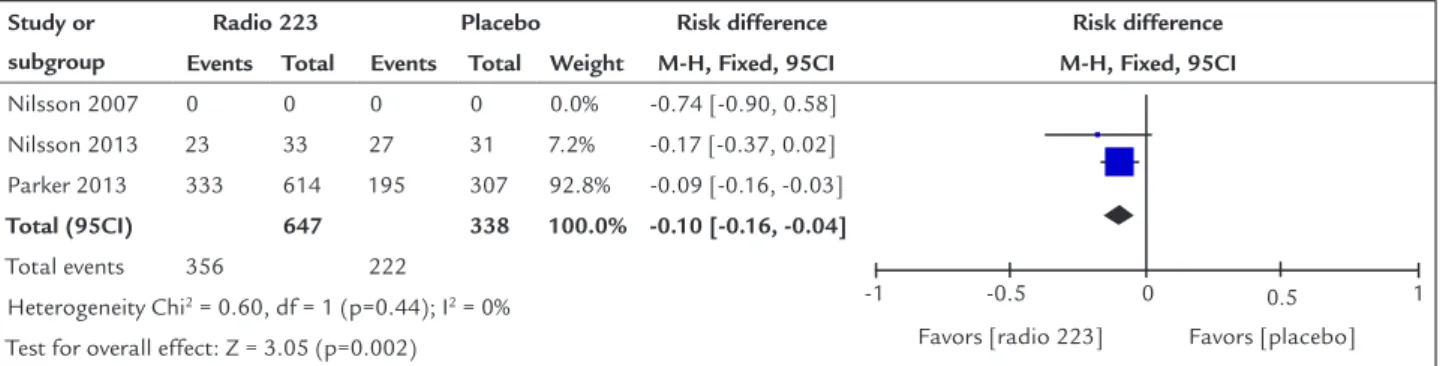
URVIVALTwo studies4,5 (A) totaling 985 patients (647 in the Ra223
group and 338 in the placebo group) were included in this analysis. In this comparison, at 0% heterogeneity, there was a 10% decline in mortality (95CI 4-16) in favor of Ra223 treatment.12 (A) Thus, 10 patients need to be treated to
avoid one death compared to no treatment (Figure 1).
B
ONE EVENTSTwo studies were included in the analysis3,7 (A) totaling
985 patients (647 treated with radium-223 and 338 with a placebo). In this comparison there is a non-significant reduction in the risk of bone events of 5% (95CI -1–11) in favor of treatment with Ra223 and heterogeneity is 0%. This means that there is no significant difference (p<0.05) in the risk of bone events when comparing treatment and non-treatment with radio-223 (Figure 2).
R
ECOMMENDATIONRa223 is effective for the treatment of patients with mCRPC, with a reduction in mortality of 10% and an increase in mean survival over 3 months. There is no re-duction in the number of bone events in these patients and no improvement in pain was observed except for the dose-response aspect.
Other benefits have been demonstrated, such as im-proved quality of life, increased time to skeletal events, reduced hospitalization and effect on markers such as PSA and AP.
Treatment with six doses of 55 kBq/Kg of intravenous Ra223 injections every 30 days is recommended for pa-tients with mCRPC and bone metastases.
D
ISCUSSION AND PERSPECTIVESAt the moment only five other medications, in addition to Ra223, which produce a demonstrated increase in survival in patients with mCRPC (docetaxel, cabazitaxel, abiraterone, enzalutamide, sipuleucel-T) are available. In view of this scenario, Ra223 stands out as a treatment with few contraindications and acceptable adverse effects, and an excellent option for mCRPC patients.
Although the studies presented here use a dose of 50 kBq/kg, the commercial dose was adjusted to 55 kBq/kg to meet the standardization criteria.13 (D)
Only one study carried out re-treatment with Ra223 in mCRPC patients.14 (B) Although it is a possibility, since
the study showed safety, we do not recommend repeat-ing the treatment until further studies are performed.
Studies are being conducted to validate the concomi-tant use of Ra223 with other therapies. We highlight the combination of Ra223 treatment with enzalutamide (phase III studies), abiraterone (phase II: NCT02097303), deno-sumab (phase II: NCT02366130), bicalutamide (phase II:
NCT02582749) and radiotherapy (phase II: NCT02484339). In addition, studies in asymptomatic patients are being performed (NCT03002220).
Ra223 is also being studied to treat other diseases such as osteosarcoma (NCT01833520), multiple myeloma (NCT02928029) and breast cancer (phase II: NCT02258451). As soon as these studies are available, we will update this guideline.
C
ONFLICT OF INTERESTThe authors state that there is no conflict of interest re-garding this review.
R
EFERENCES1. ANVISA. Registro ANVISA nº 170560104 – XOFIGO [cited 2017 Apr 9]. Available from: https://www.smerp.com.br/anvisa/?ac=prodDetail&anvisa Id=170560104.
2. Nilsson S. Radium-223 therapy of bone metastases in prostate cancer. Semin Nucl Med. 2016; 46(6):544-56.
3. Nilsson S, Franzén L, Parker C, Tyrrell C, Blom R, Tennvall J, et al. Bone-targeted radium-223 in symptomatic, hormone-refractory prostate cancer: a randomised, multicentre, placebo-controlled phase II study. Lancet Oncol. 2007; 8(7):587-94.
4. Nilsson S, Franz L, Parker C, Tyrrell C, Blom R, Tennvall J, et al. Two-year survival follow-up of the randomized, double-blind, placebo-controlled phase II study of radium-223 chloride in patients with castration-resistant prostate cancer and bone metastases. Clin Genitourin Cancer. 2013; 11(1):20-6.
FIGURE 1 Summary of the studies comparing the use of Ra223 versus placebo in the treatment of mCRPC regarding the outcome of
increased survival.
FIGURE 2 Summary of the studies comparing the use of Ra223 versus placebo in the treatment of mCRPC regarding the outcome of number of bone events.
Study or subgroup
Radio 223 Placebo Risk difference Risk difference
Events Total Events Total Weight M-H, Fixed, 95CI M-H, Fixed, 95CI
Nilsson 2007 17 33 18 31 7.2% -0.07 [-0.31, 0.18]
-1 -0.5 0 0.5 1
Favors [radio 223] Favors [placebo]
Sartor 2014 200 614 116 307 92.8% -0.05 [-0.11, 0.02]
Total (95CI) 647 338 100.0% -0.05 [-0.11, 0.01]
Total events 219 134
Heterogeneity Chi2 = 0.02, df = 1 (p=0.90); I2 = 0%
Test for overall effect: Z = 1.55 (p=0.12) Study or
subgroup
Radio 223 Placebo Risk difference Risk difference
Events Total Events Total Weight M-H, Fixed, 95CI M-H, Fixed, 95CI
Nilsson 2007 0 0 0 0 0.0% -0.74 [-0.90, 0.58]
-1 -0.5 0 0.5 1
Favors [radio 223] Favors [placebo]
Nilsson 2013 23 33 27 31 7.2% -0.17 [-0.37, 0.02]
Parker 2013 333 614 195 307 92.8% -0.09 [-0.16, -0.03]
Total (95CI) 647 338 100.0% -0.10 [-0.16, -0.04]
Total events 356 222
Heterogeneity Chi2 = 0.60, df = 1 (p=0.44); I2 = 0%
5. Parker C, Nilsson S, Heinrich D, Helle SI, O'Sullivan JM, Fosså SD, et al.; ALSYMPCA Investigators. Alpha emitter radium-223 and survival in metastatic prostate cancer. N Engl J Med. 2013; 369(3):213-23. 6. Hoskin P, Sartor O, O’Sullivan JM, Johannessen DC, Helle SI, Logue J, et al.
Efficacy and safety of radium-223 dichloride in patients with castration-resistant prostate cancer and symptomatic bone metastases, with or without previous docetaxel use: a prespecified subgroup analysis from the randomised, double-blind, phase 3 ALSYMPC trial. Lancet Oncol. 2014; 15(12):1397-406. 7. Sartor O, Coleman R, Nilsson S, Heinrich D, Helle SI, O'Sullivan JM, et al. Effect of radium-223 dichloride on symptomatic skeletal events in patients with castration-resistant prostate cancer and bone metastases: Results from a phase 3, double-blind, randomised trial. Lancet Oncol. 2014; 15(7):738-46. 8. Nilsson S, Strang P, Aksnes AK, Franzèn L, Olivier P, Pecking A, et al. A randomized, dose-response, multicenter phase II study of radium-223 chloride for the palliation of painful bone metastases in patients with castration-resistant prostate cancer. Eur J Cancer. 2012; 48(5):678-86. 9. Parker CC, Pascoe S, Chodacki A, O'Sullivan JM, Germá JR,
O'Bryan-Tear CG, et al. A randomized, double-blind, dose-finding, multicenter, phase 2 study of radium chloride (Ra 223) in patients with bone metastases and castration-resistant prostate cancer. Eur Urol. 2013; 63(2):189-97. 10. Nilsson S, Cislo P, Sartor O, Vogelzang NJ, Coleman RE, O'Sullivan JM,
et al. Patient-reported quality-of-life analysis of radium-223 dichloride from the phase III ALSYMPCA study. Ann Oncol. 2016; 27(5):868-74. 11. Parker C, Zhan L, Cislo P, Reuning-Scherer J, Vogelzang NJ, Nilsson S, et
al. Effect of radium-223 dichloride (Ra-223) on hospitalisation: an analysis from the phase 3 randomised Alpharadin in Symptomatic Prostate Cancer Patients (ALSYMPCA) trial. Eur J Cancer. 2017; 71:1-6.
12. Laupacis A, Sackett DL, Roberts RS. An assessment of clinically useful measures of the consequences of treatment. N Engl J Med. 1988; 318(26):1728-33. 13. U.S.NRC. Office of Nuclear Material Safety and Safeguards. 2010; 1:1-6. 14. Radium-223 (Ra-223) Re-treatment (Re-tx): first experience from an international, multicenter, prospective study in patients (Pts) with castration-resistant prostate cancer and bone metastases (mCRPC). Clin Adv Hematol Oncol. 2016; 14(4 Suppl 5):10-1.
15. Jadad AR, Moore RA, Carroll D, Jenkinson C, Reynolds DJ, Gavaghan DJ, et al. Assessing the quality of reports of randomized clinical trials: is blinding necessary? Control Clin Trials. 1996; 17(1):1-12.
16. Levels of Evidence and Grades of Recommendations – Oxford Centre for Evidence Based Medicine. Available from: http://cebm.jr2.ox.ac.uk/docs/old_levels.htm. 17. Goldet G, Howick J. Understanding GRADE: an introduction. J Evid
Based Med. 2013; 6(1):50-4.
A
NNEXI
Structured question
• P – Patients with prostate cancer resistant to castra-tion and bone metastases.
• I – Intravenous therapy with radium-223. • C – Placebo.
• O – Benefit or harm.
Search strategy PubMed-Medline
• #1 - (Prostate Neoplasms OR Prostate Neoplasm OR Prostatic Neoplasm OR Prostate Cancer OR Prostate Cancers OR Prostatic Cancer OR Prostatic Cancers) • #2 - (radium OR Xofigo OR Ra 223)
• #3 - random*
• 1st RETRIEVAL = #1 AND #2 AND #3 = 99
Articles retrieved
Ninety-nine (99) articles were retrieved. Of these, 19 were selected by title and 11 by summary. After a critical analysis by three nuclear physicians, 13 studies were selected, using as inclusion criteria randomized clinical trials, greater strength of evidence and outcomes perti-nent to the clinical doubt in question. The reason for excluding the other texts was that they were not random-ized studies.
The scientific database consulted was Medline via Pubmed. A manual search was performed based on refer-ences of the reviews (narrative or systematic), as well as the selected studies.
Inclusion criteria for selected studies
Increased survival was the main outcome analyzed in this guideline; however, during its elaboration, it was possible to evaluate other outcomes, which are also presented.
According to study design
The studies included in this guideline were classified according to the Jadad score.15 According to this
classi-fication, studies with Jadad less than three are inconsis-tent, while those with a score greater than three are con-sidered consistent.
Language
We included studies available in Portuguese, English or Spanish.
According to publication
Only full-text studies were considered for critical assessment.
Exposure of results
For results with available evidence, the population, inter-vention, outcomes, presence or absence of benefit and/or harm and controversies will be defined in a specific man-ner, whenever possible.
Recommendation
The recommendations will be elaborated by the authors of the review, with the initial characteristic of synthesis of the evidence, and later validated by all the authors who participate in the elaboration of this Guideline.