2014 Sept.-Oct.;22(5):792-800
DOI: 10.1590/0104-1169.3294.2482 www.eerp.usp.br/rlae
Copyright © 2014 Revista Latino-Americana de Enfermagem This is an Open Access article distributed under the terms of the Creative Commons Attribution Non-Commercial License (CC BY-NC).
This license lets others distribute, remix, tweak, and build upon your work non-commercially, and although their new works must also acknowledge you and be non-commercial, they don’t have to license their derivative works on the same terms.
Corresponding Author: Ardigleusa Alves Coelho
Universidade Estadual da Paraíba. Departamento de Enfermagem Rua Baraúnas, 351.
Bairro: Universitário
CEP: 58429-500, Campina Grande, PB, Brasil E-mail: [email protected]
1 Doctoral student, Universidade Federal do Rio Grande do Norte, Natal, RN, Brazil. Professor, Departamento de Enfermagem, Universidade
Estadual da Paraíba, Campina Grande, PB, Brazil.
2 Doctoral student, Universidade Federal do Rio Grande do Norte, Natal, RN, Brazil. Assistant Professor, Departamento de Saúde Coletiva,
Universidade Federal do Rio Grande do Norte, Natal, RN, Brazil.
3 PhD, Professor, Escola de Enfermagem de Ribeirão Preto, Universidade de São Paulo, WHO Collaborating Centre for Nursing Research
Development, Ribeirão Preto, SP, Brazil.
4 PhD, Associate Professor, Departamento de Saúde Coletiva, Universidade Federal do Rio Grande do Norte, Natal, RN, Brazil.
Tuberculosis care: an evaluability study
Ardigleusa Alves Coelho
1Cláudia Santos Martiniano
1Ewerton Willian Gomes Brito
2Oswaldo Gomes Corrêa Negrão
2Ricardo Alexandre Arcêncio
3Severina Alice da Costa Uchôa
4Objective: to verify whether the tuberculosis control program (TCP) is evaluable and to examine the
feasibility of building an evaluation model in apriority municipality for the control of tuberculosis. Method:
this evaluability study was conducted in a municipality in northeastern Brazil. For data collection,
documental analysis and interviews with key informants were performed. For indicator validation, the
nominal group technique was adopted. Results: the details of TCP were described, and both the logical
model and the classification framework for indicators were developed and agreed up on, with the goal
of characterizing the structural elements of the program, defining the structure and process indicators,
and formulating the evaluation questions. Conclusion: TCP is evaluable. Based on logical operational
analysis, it was possible to evaluate the adequacy of the program goals for the control of tuberculosis.
Therefore, the performance of a summative evaluation is recommended, with a focus on the analysis of
the effects of tuberculosis control interventions on decreasing morbidity and mortality.
Introduction
In the last decade, the incidence and mortality
rates of tuberculosis (TB) have decreased in the six geographical regions deined by the World Health Organization (WHO) and in most of the 22 countries
that account for 80% of TB cases worldwide, among
which Brazil occupies the 19th position. TB represents
a serious public health problem, with approximately 9
million new cases and 1.5 million deaths each year(1). In
Brazil, TB kills 4500 people annually and is the leading
cause of death among HIV/AIDS patients(2). Despite the
reduction in the number of cases in Brazil, the incidence
rates have increased substantially among vulnerable
population groups living in large cities(3).
TB has assumed the status of a global emergency(1)
and has been included in the government’s policy agenda
in several countries. To achieve the goal of decreasing
the global burden of TB (incidence and mortality) by
up to 50% by 2015 in comparison with the 1990 rate,
the Ministry of Health of Brazil—through the National
Tuberculosis Control Program (NTCP) and guided by the
STOP-TB strategy—has endorsed the implementation
and sustainability of the directly observed treatment
short-course (DOTS) to improve laboratory diagnosis,
conduct supervised treatments with the continuous
supply of drugs, and develop an adequate information
and registry system for program monitoring(2,4-6).
In conjunction with the national primary health care
policy, the NTCP aims to intensify the decentralization of
activities associated with the diagnosis and treatment
of TB in primary health care since 2006. Furthermore,
it aims to strengthen social control mechanisms and
ensure the sustainability of disease control actions(2).
Considering the epidemiological complexity of TB and
the challenges imposed on the health care system
and services for the eradication of the disease in the
21st century, the evaluation of the tuberculosis control
program (TCP) preceded by an evaluability study (ES)
becomes relevant. In this context, ES is an important
procedure to determine the feasibility of a systematic
evaluation of TCP performance(7). Internationally, the
use of ES in different programs, disciplines, and contexts
is evident(8). A previous study conducted in Canada(9)
examined the feasibility of evaluating a program for
survivors of torture. With regard to tuberculosis, the use of a logical model of the community action program for the prevention of TB in public health in Ontario, Canada, was mentioned when reporting the use of an intervention based on the Ottawa Charter for Health Promotion(10).
In Brazil, studies on public health are scarce.
Relevant studies include topics on human resource policies(11) and women’s health(12). Studies focused
on tuberculosis include the evaluation of TB control interventions established in Niterói, Rio de Janeiro(13),
and in the legal Amazon(14). Therefore, this study aimed to
verify whether the TCP is evaluable, verify the feasibility of building an evaluation model of the program, and propose recommendations for future evaluation studies.
Methods
This evaluability study or pre-evaluation(7) examined
the feasibility of building an evaluation model for TCP
and was conducted between August 2011 and June 2012
in the reference health unit for TB control in Campina
Grande, state of Paraíba (PB), Brazil. In accordance with
Resolution 196/96 of the National Health Council, the
study was approved by the Research Ethics Committee
of the State University of Paraíba under Protocol number
CAAE 0394.0.133.000.11.
Evaluability studies are essential to the description of speciic programs by identifying goals, objectives, and actions; structuring the logical models based on
resources, activities, expected impacts, and possible
correlations between program components; formulating
evaluative questions; designing evaluation models;
identifying the entities involved or interested in the
evaluations(9); and proposing recommendations to the
program and identifying the relevance of implementing
such evaluations.
A logical model was developed to systematically
identify the issues underlying the TCP by detailing the
resources, activities, expected results, and correlations
between these elements(7). During the process of deining the logical model, it is important to review it and, if necessary, to readjust it to incorporate new
aspects that were not previously addressed in its initial
conception, with the goal of making it a valuable tool when deining the focus of the evaluation(15).
During the building of the logical model,
documental analysis and interviews with key informants
were conducted. The documental analysis included
institutional technical documents available on the
website www.saude.gov.br the Recommendation Manual
for TB Control(2) and Directly Observed Treatment of
Tuberculosis in Primary Health Care– Nursing Protocol(16).
These documents allowed understanding of the theory
of the program by detailing the interventions, the
and the identiication and analysis of the program components.
The evaluation of the draft version of the logical
model aimed to identify its components and determine
whether the proposed model adequately represented
the program logic. The evaluation was performed in a
reference health unit by a doctor and nurse specializing
in TCP using semi-structured interviews, according to
the guidelines proposed by McLaughlin and Jordan(17). After building the logical model, the classiication framework for indicators was elaborated, and its criteria and indicators were identiied using the nominal group technique(18) with the help of eight TCP experts and researchers from the ield of evaluation. Moreover, averages were calculated to attribute importance to each
component analyzed, and the standard deviations (SD)
were calculated to evaluate the degree of consensus for
each criterion proposed.
The framework containing the evaluation questions
was constructed based on the literature search and on
the logical model. In the convergent phase, the questions
raised were related to the aims of the evaluation
(implementation phase of the TCP), considering both the
questions initially formulated in the study and interviews
with individuals interested in the evaluation (divergent
phase of the TCP)(19).
Results
The diversity of organizational characteristics
of access to tuberculosis diagnosis affect the proper
management of the disease(20) in local health services
and strengthen the performance of evaluation studies
centered in the operational aspects(2) of the TCP. From
this perspective, the city of Campina Grande–PB, where
the evaluability study was conducted, is one of the priority
cities for TB control in Brazil, and TB control interventions
in Campina Grande are performed in family health units
and by reference health unit. With regard to diagnosis and
treatment, the centralization of diagnostic procedures by
reference health units and the low effectiveness in the
achievement of the directly observed treatment (DOT)
by family health strategy (FHS) teams are evident.
The normative TCP documents analyzed to build
the logical model and the recommendation manual
for TB control provided details on the following
program components: planning and administration,
health care, strategic information, institutional and
human development, and social communication and
mobilization. In addition, the roles and responsibilities of
each administration level of the Brazilian Uniied Health System (Sistema Único de Saúde - SUS)involved in TB
control are described. During the construction of the
logical model, the program’s design, goals and actions
aimed at controlling TB were discussed.
The program was designed as a set of “innovative
strategies to expand and strengthen the DOTS, with a
focus on coordinating this strategy with other government
programs to further control TB and other comorbidities
such as HIV/AIDS”(2). Despite the decentralization of TB
control in primary health care to ensure free access to
diagnosis and treatment of TB patients, decentralization is
not clearly stated among the components of the program.
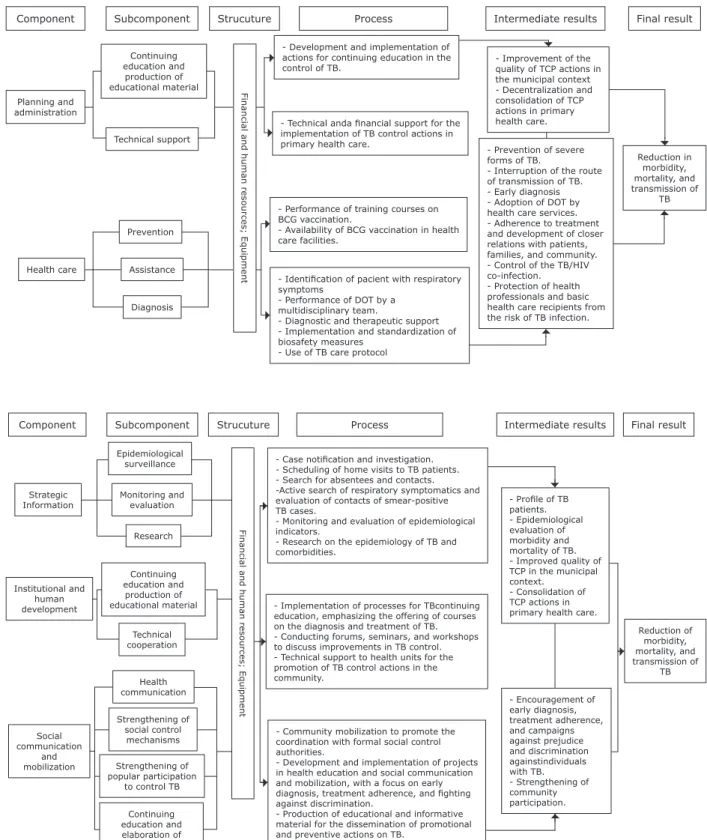
The logical model (Figure 1) allowed the identiication of the activities to be implemented at the municipal level for each program component, to
interrupt the route of TB transmission and to reduce morbidity and mortality. Certain speciic elements were considered, including the duties and responsibilities
of federal, state, and municipal authorities and the
proposed structuring of health care for TB patients to correlate activities compatible with the ive components with municipal management actions.
In addition to the subcomponents established
by the program for the components ‘health care’ and
‘strategic information’, new subcomponents were
added to the following components: Planning and
Administration, Institutional and Human Development,
and Social Communication and Mobilization (Figure 1)
to characterize the structure available and the actions to
be executed to achieve the aims and expected results.
As the components of the logical model were presented, the low of resources and results was determined using the following questions: do the resources planned allow
the activity to be completed? Are the proposed activities
tailored to the components? Do the proposed activities
enable the achievement of the results? Considering the
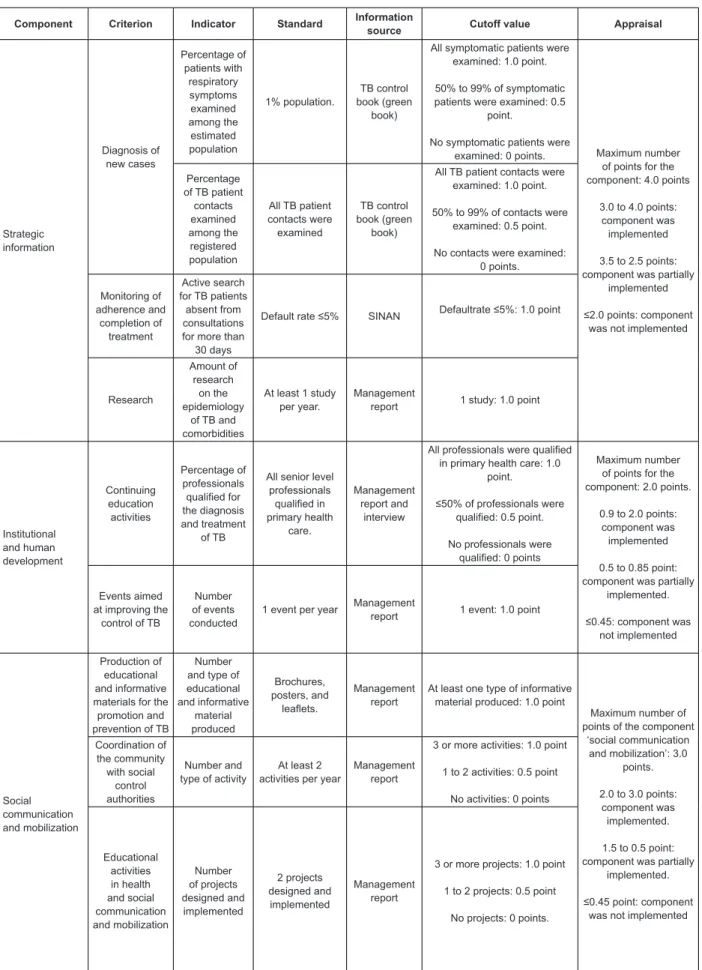
results achieved, does the program have an impact? The classiication framework for indicators (Figure 2) was constructed considering that a program
evaluation should be based on parameters(15) and, for
each model component, the criteria, indicators, and
standards related to the structure and process were
established. The evaluative questions derived from the
analysis of the logical model and from the interviews
were as follows: what can be changed in the local
context to favor executing the intervention? Do the
processes involved in the production and management
of TB control actions as well as the results provide an
Component Subcomponent Continuing education and production of educational material Planning and administration Technical support
- Technical anda inancial support for the
implementation of TB control actions in primary health care.
- Improvement of the quality of TCP actions in the municipal context - Decentralization and consolidation of TCP actions in primary health care. Reduction in morbidity, mortality, and transmission of TB - Prevention of severe
forms of TB.
- Interruption of the route of transmission of TB. - Early diagnosis - Adoption of DOT by health care services. - Adherence to treatment and development of closer relations with patients, families, and community. - Control of the TB/HIV co-infection. - Protection of health professionals and basic health care recipients from the risk of TB infection. - Performance of training courses on
BCG vaccination.
- Availability of BCG vaccination in health care facilities.
- Identiication of pacient with respiratory
symptoms
- Performance of DOT by a multidisciplinary team.
- Diagnostic and therapeutic support - Implementation and standardization of biosafety measures
- Use of TB care protocol
- Development and implementation of actions for continuing education in the control of TB.
F in a n ci a l a n d h u m a n r e sou rce s; E qu ipm e n t Prevention Assistance Health care Diagnosis
Strucuture Process Intermediate results Final result
Component Subcomponent
Epidemiological surveillance
Monitoring and evaluation
- Case notiication and investigation.
- Scheduling of home visits to TB patients. - Search for absentees and contacts. -Active search of respiratory symptomatics and evaluation of contacts of smear-positive TB cases.
- Monitoring and evaluation of epidemiological indicators.
- Research on the epidemiology of TB and comorbidities.
- Implementation of processes for TBcontinuing education, emphasizing the offering of courses on the diagnosis and treatment of TB. - Conducting forums, seminars, and workshops to discuss improvements in TB control. - Technical support to health units for the promotion of TB control actions in the community.
- Community mobilization to promote the coordination with formal social control authorities.
- Development and implementation of projects in health education and social communication and mobilization, with a focus on early
diagnosis, treatment adherence, and ighting
against discrimination.
- Production of educational and informative material for the dissemination of promotional and preventive actions on TB.
- Encouragement of early diagnosis, treatment adherence, and campaigns against prejudice and discrimination againstindividuals with TB. - Strengthening of community participation.
- Proile of TB
patients. - Epidemiological evaluation of morbidity and mortality of TB. - Improved quality of TCP in the municipal context.
- Consolidation of TCP actions in primary health care.
Reduction of morbidity, mortality, and transmission of TB Strategic Information Institutional and human development Social communication and mobilization Health communication Strengthening of social control mechanisms Strengthening of popular participation
to control TB
Continuing education and elaboration of educational material Continuing education and production of educational material Technical cooperation
Research Fina
n ci a l a n d h u m a n r e sou rce s; E qu ipm e n t
Strucuture Process Intermediate results Final result
Component Criterion Indicator Standard Information
source Cutoff value Appraisal
Planning and administration Continuing educational activities in primary health care Number of planned and implemented activities in primary health care
At least 80% of planned activities were
implemented
Management report
80% of activities were implemented: 1.0 point.
≤40% of activities
wereimplemented: 0.5 point.
No activities were implemented: 0 points.
Maximum number of points for the component: 2.0 points.
0.9 to 2.0 points: component was
implemented.
0.5 to 0.85 point: component was partially
implemented.
≤0.45 point: component
was not implemented Technical and
financial support
Amount of investment in
TB control in primary health
care
At least 1 investment in primary health care per year
Management
report Investment: 1.0 point.
Health care Organization of TB care Percentage of family health strategy (FHS) teams that used the TB care protocol.
All (100%)FHS teams used the TB care protocol
Interview
All FHS teams used the guideline: 1.0 point
50% to 99% FHS teams used the guideline: 0.5 point.
No FHS teams used the guideline: 0 points
Maximum number of points for the component: 6.0 points.
5.0 to 6.0 points: component was
implemented
4.0 to 3.0 points:
component was partially implemented.
≤3.5 points: component
was not implemented Percentage of laboratories and diagnostic imaging clinics that performed TB diagnosis All laboratories and diagnostic imaging clinics performed sputum smear microscopy, chest
X-ray, HIV test, and culture.
Management report
All laboratories/clinics diagnosed TB: 1.0 point
≤50% laboratories/clinics
diagnosed TB: 0.5 point.
No laboratories/clinics diagnosed TB: 0 points
Percentage of test results
delivered in 24
hours.
All sputum smear microscopy and
X-rays results were delivered in
24 hours
Management report and
interview
All test results were delivered in
24 hours: 1.0 point
50% to 99% of test results were
delivered in 24 hours: 0.5 point.
≤45% of test results were delivered in 24 hours: 0 points
Percentage of TB cases tested for HIV
All TB patients were tested for
HIV
Management report
All TB patients were tested for HIV: 1.0 point.
≤50% of TB patients were
tested for HIV: 0.5 point.
No patient was tested: 0 points
Percentage of TB patients
undergoing directly observed treatment (DOT) All patients underwent DOT
for at least 3 days
per week
Monitoring and interview
report of TB patients
All TB patients underwent DOT: 1.0 point
≤50% of TB patients underwent
DOT: 0.5 point
No patient underwent DOT: 0 points Continuing educational activities Percentage of professionals qualified in BCG vaccination All nursing professionals in primary health care Management report
All qualified professionals in primary health care: 1.0 point.
≤50% qualified professionals in
primary health care: 0.5 point.
No qualified professionals in primary health care: 0 points.
Component Criterion Indicator Standard Information
source Cutoff value Appraisal
Strategic information Diagnosis of new cases Percentage of patients with respiratory symptoms examined among the estimated population 1% population. TB control book (green book)
All symptomatic patients were examined: 1.0 point.
50% to 99% of symptomatic patients were examined: 0.5
point.
No symptomatic patients were
examined: 0 points. Maximum number of points for the
component: 4.0 points
3.0 to 4.0 points:
component was implemented
3.5 to 2.5 points:
component was partially implemented
≤2.0 points: component
was not implemented Percentage
of TB patient contacts examined among the registered population
All TB patient contacts were examined
TB control book (green
book)
All TB patient contacts were examined: 1.0 point.
50% to 99% of contacts were examined: 0.5 point.
No contacts were examined: 0 points. Monitoring of adherence and completion of treatment Active search for TB patients absent from consultations for more than
30 days
Default rate ≤5% SINAN Defaultrate ≤5%: 1.0 point
Research
Amount of research
on the epidemiology
of TB and comorbidities
At least 1 study per year.
Management
report 1 study: 1.0 point
Institutional and human development Continuing education activities Percentage of professionals qualified for the diagnosis and treatment of TB
All senior level professionals qualified in primary health care. Management report and interview
All professionals were qualified in primary health care: 1.0
point.
≤50% of professionals were
qualified: 0.5 point.
No professionals were qualified: 0 points
Maximum number of points for the component: 2.0 points.
0.9 to 2.0 points: component was
implemented
0.5 to 0.85 point: component was partially
implemented.
≤0.45: component was
not implemented Events aimed
at improving the control of TB
Number of events conducted
1 event per year Management
report 1 event: 1.0 point
Social communication and mobilization Production of educational and informative materials for the promotion and prevention of TB
Number and type of educational and informative material produced Brochures, posters, and leaflets. Management report
At least one type of informative material produced: 1.0 point
Maximum number of points of the component
‘social communication
and mobilization’: 3.0
points.
2.0 to 3.0 points:
component was implemented.
1.5 to 0.5 point: component was partially
implemented.
≤0.45 point: component
was not implemented Coordination of the community with social control authorities Number and type of activity
At least 2 activities per year
Management report
3 or more activities: 1.0 point
1 to 2 activities: 0.5 point
No activities: 0 points
Educational activities in health and social communication and mobilization Number of projects designed and implemented 2 projects designed and implemented Management report
3 or more projects: 1.0 point
1 to 2 projects: 0.5 point
No projects: 0 points.
Discussion
This study highlights the need to incorporate
new activities into the political and institutional
context to meet internationally established goals(1),
with an emphasis on the effective decentralization
of intervention strategies for family health care. The
logical model can be used as a tool for the assessment
and monitoring of the program and to evaluate its
effects(21-22). Accordingly, the elements addressed in
each component indicate an interdependence that
enables the achievement of the expected results. The
proposal of subcomponents—continuing education and
elaboration of instructional material, strengthening
of social control mechanisms, and strengthening of
popular participation to control tuberculosis—can
improve the participation and effective coordination
of the various authorities involved in TB control,
including intersectoral actions for the creation of
stronger bonds between patients and family health
strategy teams(23). The visual map of the TCP expands
its scope and reinforces the use of the logical model
proposed at the municipal level for the creation of an
evaluation model in the context of primary health care
that can improve control programs through including
decision-making processes. Importantly, the proposed
model can be reviewed to allow the incorporation
of new aspects in the light of improvements in TB
control policies.
Using the classiication framework for indicators comprising criteria, indicators, and previously
developed standards, it is possible to assess TCP
to verify whether the intervention results are being
achieved as planned and are reaching the target
population(13). Moreover, evaluation questions are
decisive for the success of the evaluation by deining what topics will be evaluated in conjunction with the
focus of the evaluation(15).
Conclusion
The tuberculosis control program is an evaluable
program when considering its structural elements.
Therefore, the deinition of structure and process indicators can contribute to the production of
knowledge, improve control measures, minimize
the negative social image, and control damage. By
comparing the logical model with reality, limitations
are evident in the operationalization of health care with
respect to the decentralization of basic health care. For
this reason, it is important to objectively identify the
means that are needed to achieve decentralization.
For the remaining components, the operational logical
analysis of the program indicates the adequacy of
the goals proposed for the resolution of these issues.
Furthermore, a summative evaluation focusing on
the analysis of the effects of the intervention on the
reduction of morbidity and mortality is recommended. We highlight the political and administrative dificulties in involving administrators in this study because
their participation favors the critical analysis of the
various stages of the study and affects the focus of
the program.
References
1. World Health Organization. Global Tuberculosis
Control: WHO Rapport 2012 [accessed on Jan 20,
2013]: Geneva: World Health Organization. Available at
http://www.who.int/tb/publications/global_report/en/.
2. Ministério da Saúde (BR). Manual de Recomendações
para o Controle da Tuberculose no Brasil. Programa
Nacional de Controle da Tuberculose. Brasília (DF):
Ministério da Saúde; 2011. 284 p.
3. Piller RVB. Epidemiology of Tuberculosis. Pulmão
RJ [internet]. 2012 [accessed on Apr 4, 2012];
21(1):4-9. Available at: http://www.sopterj.com.br/
revista/2012_21_1/02.pdf
4. Ruffino-Netto A. Tuberculose: a calamidade negligenciada.
Rev Soc Bras Med Trop. [Internet]. 2002 [accessed on
Nov 10, 2011]; 35(1):51-8. Available at: http://www.
scielo.br/scielo.php?script=sci_arttext&pid=S0037-86822002000100010&lng=en
5. World Health Organization. What is DOTS? A Guide
to Understanding the WHO-recommended TB Control
Organization; 1999 [accessed on April 29, 2012].
Available at http://www.who.int/tb/publications/1999/
en/.
6. World Health Organization. The Stop TB Strategy:
Building on and enhancing DOTS to meet the
TB-related Millennium Development Goals, Geneva: World
Health Organization; 2006 [accessed on Mar 20, 2011].
Available at: http://whqlibdoc.who.int/hq/2006/WHO_
HTM_STB_2006.368_eng.pdf.
7. Wholey JS, Hatry HP, Newcome KE. Handbook of
Practical Program Evaluation.[Internet].USA, John
Wiley; 2004 [accessed on Mar 20, 2012]. Available at:
http://scholar.google.com.br/scholar?hl=ptBR&q=Han
dbook+of+Practical+Program+Evaluation&btnG=&lr=.
8. Trevisan MS. Evaluability from 1986 to 2006. Am
J Eval. [Internet]. 2007 [accessed on Jan 31 2014];
28:290-303. Available at: http://aje.sagepub.com
9. Thurston WE, Ramaliu A. Evaluability assessment
of a survivors of torture program: lessons learned.
Can J Program Eval. [Internet]. 2005[accessed on Mar
20, 2012]; 20(2):1-25. Available at: http://cjpe.ca/
secure/20-2-101.pdf
10. Moyer A, Verhovsek H, Wilson VL, Facilitating the
Shift to Population-based Public Health Programs:
Innovation Through the Use of Framework and Logic
Model Tools. Can J Public Health. 1997;88(2):95-8.
11. Natal S, Samico I, Oliveira LGD, Assis AMJ. Estudo de
avaliabilidade da rede de formação de Recursos Humanos
da Secretaria de Vigilância em Saúde do Ministério da
Saúde. Cad. Saúde Coletiva. 2010;18(4):560-71.
12. Rocha BNGA, Uchoa SAC. Avaliação da Atenção
humanizada ao abortamento: um Estudo de
avaliabilidade. Physis. 2013;23(1):109-27.
13. Oliveira LGD, Natal S. Avaliação do Programa de
Controle de Tuberculose no município do Rio de Janeiro/
RJ. Rev Bras Pneumol Sanit. [Internet]. 2007. [accessed
on Jul 5, 2012]; 15 (1):29-38. Available at: http://
scielolab.iec.pa.gov.br/pdf/rbps/v15n1/v15n1a05.pdf
14. Natal S, Penna ML, Santos, EM, Hartz, Z, Sabroza
P, Cruz MM, et al. Avaliação do programa de controle da
tuberculose: estudo de casos na Amazônia Legal. Bol
Pneumol Sanit. 2005;12(2):91-109.
15. Cazarin G, Mendes MFM, Albuquerque, KM. Perguntas
Avaliativas. In: Samico I, Felisberto E, Figueiró AC, Frias
PG, organizers. Avaliação em Saúde – Bases Conceituais
e Operacionais. Rio de Janeiro: MedBook; 2010. p.
89-107.
16. Ministério da Saúde (BR). Tratamento Diretamente
Observado da Tuberculose na atenção básica – Protocolo
de Enfermagem. Programa Nacional de Controle da
Tuberculose . Brasília (DF): Ministério da Saúde; 2010.
17. MClaughlin JA, Jordan, GB. Logic Models: A Tool for
Telling Your Program’s Performance Story. Eval Program
Plann. 1999 [accessed on Mar 20, 2011]; 22(1):1-14.
Available at: http://www.pmn.net/wp-content/
18. Robinson VA, Hunter D, Samuel ED. Accountability in
Public Health Units:
Using a Modified Nominal Group Technique to Develop a
Balanced Scorecard for Performance Measurement. Can
J Public Health. [Internet]. 2003. [accessed on Apr 1,
2013]; 94(5): 391-6. Available at: http://journal.cpha.
ca/index.php/cjph/article/view/419/419.
19. Worthen BR, Sanders JR, Fitzparick JL. Avaliação de
Programas: concepções e Praticas. São Paulo: Gente;
2004. p. 341-71.
20. Scatena LM, Villa TCS, Rufino Netto A, Kritski AL,
Figueiredo TMR, Vendramini SHF, et al. Dificuldades
de acesso a serviços de saúde para diagnóstico de
tuberculose em municípios do Brasil. Rev. Saúde Pública
[internet]. 2009 [acesso 12 fev 2011]. 43: 389-397.
http://dx.doi.org/10.1590/S0034-89102009005000022
21. Alves CKA, Natal S, Felisberto E, Samico I.
Interpretação e Análise das informações: O Uso de
Matrizes, Critérios, Indicadores e Padrões. In: Samico I,
Felisberto E, Figueiró AC, Frias PG, organizers. Avaliação
em Saúde – Bases Conceituais e Operacionais. Rio de
Janeiro: MedBook; 2010. p. 89-107.
22. Hartz ZMA. Avaliação dos programas de saúde:
perspectivas teórico-metodológicas e político-institucionais.
Ciênc Saúde Coletiva. [Internet]. 1999 [accessed on Apr
1, 2013]; 4(2):341-53. Available at: http://www.scielo.br/
scielo.php?pid=S1413-81231999000200009&script=sci_
abstract&tlng=es
23. Santos Filho ET, Gomes ZMS. Estratégias de controle
da tuberculose no Brasil: articulação e participação da
Received: May 21th 2013 Accepted: Jun 17th 2014 [accessed on Jul 6, 2012]; 41 Supl 1:111-6. doi: