Copyright © 2014 Revista Latino-Americana de Enfermagem
This is an Open Access article distributed under the terms of the Creative Commons Attribution Non-Commercial License (CC BY-NC).
This license lets others distribute, remix, tweak, and build upon your work non-commercially, and although their new works must also acknowledge you and be non-commercial, they don’t have to license their derivative works on the same terms.
2014 Jan.-Feb.;22(1):144-9 DOI: 10.1590/0104-1169.3144.2394 www.eerp.usp.br/rlae
Corresponding Author: Rodrigo José Martins Cardoso Av. Bissaya Barreto, 98 3000-075, Coimbra, Portugal E-mail: [email protected]
Rodrigo José Martins Cardoso
1João Manuel Garcia de Nascimento Graveto
2Ana Maria Correia Albuquerque Queiroz
31 Doctoral student, Instituto de Ciências Biomédicas Abel Salazar, Universidade do Porto, Porto, Portugal.
2 PhD, Adjunct Professor, Escola Superior de Enfermagem de Coimbra, Unidade Científico-Pedagógica de Enfermagem Fundamental, Coimbra,
Portugal.
3 PhD, Retired Profesor, Escola Superior de Enfermagem de Coimbra, Coimbra, Portugal.
Objective: to describe the coverage of news concerning the nursing profession in the Portuguese
media: informative sites on the Internet and in print media. Method: a total of 1,271 health
news items were collected in September and October of 2011 (956 online news items and 325
news items originating from the press review of the Portuguese Order of Nurses). Statistical
analysis was used to characterize the variables. Results: nurses were the sources of information
in 6.6% of cases, suggesting limited media exposure. The health news collected is characterized
by a production based on limited information sources, that is, male and official sources, on
information disseminated by news agencies focused on economic and political issues in the health
field. Conclusion: the presence of nurses in the news concerning nursing health is reduced. We
suggest that nurses develop public communication skills to disseminate the importance of their
profession in society and their relationship with the media.
Descriptors: Nursing; News; Internet.
Introduction
Nurses are the largest professional group in the health ield in Portugal and have the responsibility to deliver safe and quality nursing care. The importance of these professionals has been conirmed by the production of scientiic evidence showing a connection between nursing care and reduced rates of
healthcare-associated infection, pressure ulcers, falls, deep venous
thrombosis, and other indicators of morbidity and
mortality(1-2).
Care provided by nurses, however, tends to become
blurred into the global delivery of healthcare, becoming
almost indistinguishable by society(3-4). Historical,
social and cultural constraints have led nurses not
to adequately disseminate the value of the care they
deliver, which results in a low level of participation by
these professionals in the public sphere (entertainment
programs, health news and discussions concerning
the delivery of healthcare and the healthcare system). Scientiic publications reveal that the low visibility of nurses is not limited to Portugal. Countries such as
England, the United States, Spain and Ireland also
experience this same situation(3-5).
This low exposure tends to emphasize the
ambiguity that exists between nursing’s social image and its recent development. The dificulty of nurses in talking in public is apparent and journalists seem
to be unaware of the profession, seldom establishing
contact with these professionals(6-7). Additionally, lack
of knowledge and existing stereotypes concerning
nurses hinder society from valuing and acknowledging
the work they perform. This lack of knowledge may negatively affect inancial support provided for research and professional practice, consequently harming the
health of citizens(7). Acknowledging this problem,
many authors argue that nurses should acquire public communication skills in order to reafirm the value and importance of the care they conceive, investigate
and provide(8-9).
The visibility of nurses in social communication
media, especially in the domain of health news in
Portugal, has been an object of study of little interest.
Some authors argue that the future of nursing is
jeopardized if nurses are not able to communicate with
the population and that the health of people will be at
risk as a consequence of lacking appropriate care(7-10).
Because health news constitutes information that can inluence the health choices of citizens, it is relevant to characterize the presence of nurses in the news.
Objectives
To describe the coverage of nursing professionals in
Portuguese media: informative Internet sites and print
media.
Method
This historical-documentary research study
included a descriptive study, the objective of which was
to describe the news coverage of the nursing profession
in the recent past. A documentary study was conducted
using as the primary source health news published
online and in the print media (through preview review
provided by the Portuguese Order of Nurses – OEP).
Data were collected from September 1st to October
20th of 2011 in alternate weeks, totaling 30 days.
Nine communication media outlets, the Internet
sites of which were the most frequently visited in the
semester prior to the data collection, were selected
in the initial phase. In addition to access and storage
capacity, which makes the Internet one of the privileged means to collect data, we veriied that online issues are very similar to their print versions(11).
Counts were made by means of Netscope, a
site-centric measurement system. The media websites
most frequently visited in the semester were: Jornal
Público (daily national newspaper); Jornal Expresso
(weekly national newspaper); Jornal Destak (free daily
newspaper); Revista Visão (weekly news magazine);
Radio and Television of Portugal – RTP (TV channel; its
website disseminates news produced by both RTP and
RTP Notícias); TVI 24 (Independent channel; its website
disseminates news from TVI and TVI 24); Sociedade
Independente de Comunicação – SIC Online (TV Channel;
its website disseminates news produced by both SIC and
SIC Notícias); Rádio Renascença and Telefonia Sem Fios
– TSF (these two stations are informative).
After selecting the media, we collected all the news
related to health in a printed format. Due to temporal
and methodological constraints, we did not include news
in audio and video format.
The theoretical framework used in this study was based on the work of experts in the ield(12-13). The variables of online health news items were established
based on this study and on a method of triangulation
with a panel of experts: theme (what motivated the
news publication); journalistic genre (news, interview,
article, and brief news); profession of the source of
information; gender of the source of information and
Rev. Latino-Am. Enfermagem 2014 Jan.-Feb.;22(1):144-9.
signs as the news item’s author). Variables were also deined on the online news concerning nursing: type of media (where the article was published); information
section (in which the article was published); theme;
journalist genre; gender of the source of information;
authorship (professional/organization that signs as the
article’s author); number of sources per news item
(nursing sources), and number of news items (nursing
news published per day, exposure in the news/day).
Since it is not the case that the entire Portuguese
population has access to the Internet and more than
70% read newspapers or magazines(14), we deemed it
important to broaden the spectrum of investigation.
According to a study conducted by the Observatory of
Communication, the percentage of readers of online newspapers is signiicantly lower compared to print formats(15). Therefore, we deined and applied a second
strategy to ensure representativeness of nursing news
that is published in print media. These were obtained
through press reviews provided by the OEP, available at
the organization’s website.
At the same time online news items were collected,
we consulted the press review, available at the OEP’s
website (in the information tab – Press Review). The
press review is obtained through articles available
by the clipping company (scanned from the press
segment in question). Then, the articles are sorted
and organized by the OEP’s Communication and Image Ofice. For the purpose of this investigation, only articles associated with the expression “Portuguese Order of
Nurses” are used.
In this context, we deined a set of variables to characterize health news: theme, type of
communication, number of sources and number of
news items. Similar to online news, the choice was
based on the literature and on the triangulation process
previously mentioned. We considered the variables deined by the clipping company itself: type of media and scope of publication.
Data were treated using the statistical software
Statistical Package for Social Sciences (SPSS) version
19. This software enabled the development of two
databases (concerning the two research strategies),
in which all the variables previously mentioned were
included, as well as data concerning each health
news items.
Ethical considerations concerning research
conducted with human subjects do not apply because
this study was solely based on health news.
Results
A total of 946 online health news items were
collected. Of these, 57.3% (n=542) addressed issues
concerning “Health Politics, Management and Economy”, 18.4% (n=174) concerned “Scientiic Investigation and Research”, and 8.9% (n=84) referred to “Public Health”.
The less frequently addressed themes were “Professional
Practice” (7.6%, n=72), “Other” (isolated themes
representing 3.5%, n=33), “Profession” (2.4%, n=23),
“Education” (1.6%, n=15) and “Quality” (0.3%, n=3).
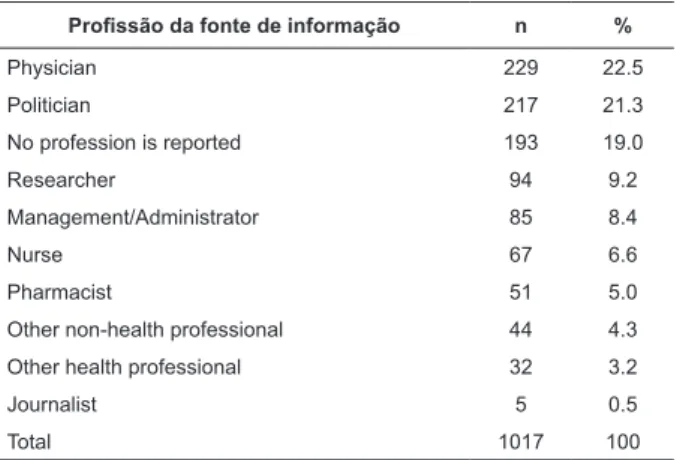
Physicians (22.5%, n=229) and politicians (21.3%,
n=217) were the main sources of information of
online health news, as shown in Table 1. Nurses were
ranked sixth among the primary sources of information
with 6.6% of the references (n=67). We created the
categories “other health professionals” and “other
non-health professionals” to group professions that are
seldom represented in health news. Some health news
items had more than one profession as a source of
information. For this reason, the number of professionals
(n=1,017) is higher than the number of health news
items (n=946).
Table 1 - Absolute and percentage distribution of the
professions that were sources of information of online
health news, Coimbra, Portugal, 2012
Proissão da fonte de informação n %
Physician 229 22.5
Politician 217 21.3
No profession is reported 193 19.0
Researcher 94 9.2
Management/Administrator 85 8.4
Nurse 67 6.6
Pharmacist 51 5.0
Other non-health professional 44 4.3
Other health professional 32 3.2
Journalist 5 0.5
Total 1017 100
In regard to the gender of the sources of information,
more than half were male (60%, n=562). Women alone
were mentioned in 13% of the news (n=126) and in
3% of the cases women were mentioned together with
men (n=31). The journalistic genres more frequently
observed were News (67.9%, n=642), followed by
News brief (that which occupies half a page or three
paragraphs, at most) with 32.1% (n=304). Online
health news items were credited to press agencies
published (36%, n=341) or by the journalist who wrote
the article (21%, n=195).
Only 61 online news items addressed nurses or
nursing; six were disregarded because their references
to professions did not enable the description of the
variables. Of these, 52.5% were published on websites
of print media (n=32), 39.3% was broadcasted on TV
(n=24) and 8.2% on the radio (n=5). News addressing
nursing was more frequently published in the “society”
(36.1%, n=22) or “health” (18%, n=11) sections, and on the “irst or last pages” (16.4%, n=10). In regard to the theme, we observe that nursing news mainly
addressed “health policies, management and economy”
issues (65%, n=40), followed by news concerning the
profession (15%, n=9) and research, with 11% (n=7).
The most frequent genre was News (65.6%, n=40),
followed by News brief with 34.4% (n=21). The gender
of the source of information was not available in 22
nursing news items (36%), while journalists tend to
use press releases. Despite this fact, we observed that
men are the main source of information (33%, n=20)
even though nursing is a profession in which women
predominate (26%, n=16). Press agencies are the most
frequent authors of nursing news items (55.7%, n=34),
followed by the media outlet itself (24.6%, n=15), and
journalists (19.7%, n=12). We observed that a reduced
number of information sources is used, with an average
of 1.41 sources per item, with a standard deviation (SD)
of 0.64 sources per news item. In regard to the number
of news items published per day, an average of 3.59
items was observed (SD=2.4).
The 325 nursing news items gathered through
OEP’s press review (on the same dates of the online
news versions), included part of the online publication
and the print media. About half of the news reviews
were published in regional newspapers (49.5%, n=161),
followed by national newspapers (23.7%, n=77), online
(23.7%, n=47) and other publications (8.3%, n=27).
In regard to the scope of publication, more than half of
the articles addressing nursing belonged to the regional
media (51.1%, n=166), followed by general information
(21.5%, n=70) and online information (18.8%, n=61).
The press reviews more frequently addressed
work-related and market issues (19.1%, n=62) and then inancial constraints in the health ield (10.8%, n=35). Issues concerning nursing education (10.8%,
n=35) and health education (8.6%, n=28) were also
addressed. Half of the nurses’ communications consisted
of statements provided by professional institutions and
individual nurses (49.5%, n=161). Of these, most
were from the OEP and unions, followed by profession/
professional brief citations (28.6%, n=93) and articles
written by nurses.
Nursing news items were obtained through the
OEP’s press review and an average of 1.46 sources per
news item was observed (SD=0.86), ranging from one to ive sources. In regard to the number of news items per day, we observed an average of 10.83 news items
published per day (SD=6.59).
Discussion
The literature shows a reduced exposure of
nurses in the media in various countries (England, the
United States, Canada, Australia and Turkey) and that
the discourse of nurses in health news is frequently
pushed to the background or becomes invisible to the
public eye(3,7,9,16).
This study’s indings are in agreement with those found in the literature to the extent that they suggest a
low exposure of Portuguese nurses in the media. These
professionals rank as the sixth most common source of
information of health news (6.6% of the total, n=67).
One study published in 1999 reports similar conclusions,
showing that nurses were mentioned in only 4% of health articles (only 1% in the speciic cases of magazines and industry publications)(12). A study that encompassed the
analysis of 2,781 articles published by the Portuguese
print media between 1990 and 2004, reports that nurses
were mentioned in 4.4% of titles (and were personally
mentioned in 1.7%) and were sources of information in
only 1.1% of the health articles(17). Finally, conirming the indings previously mentioned, studies on health sources of information report that journalists show no
interest in nurses and these are seldom mentioned
individually or as an organization(13,18-19).
This study suggests that physicians are the main
source of information of health news (22.5%, n=229). A similar inding is reported by a study that analyzed four Spanish newspapers in 2008. The author reports that the most cited sources in health articles were oficial or specialized sources, namely physicians(20).
Women were mentioned 13% of the time versus
60% of times in which men were cited. This information
is in agreement with a Portuguese study showing that
men were more frequently cited than women(13). In
this context, various authors argue that the continuing
male hegemony in the discourse present in the media
explains the low participation of women(13,18). The
Rev. Latino-Am. Enfermagem 2014 Jan.-Feb.;22(1):144-9.
(67.9%, n=642), which may be conditioned by the low
development of Portuguese informative media on the
Internet (low utilization of hypermedia and a belief in
the use of breaking news)(11).
Nursing news reveals aspects that are similar to
those observed in health news in regard to theme,
journalist genre, gender of the information sources and authorship of health news items. Scientiic investigation is addressed in only seven nursing news items, which
may hinder society from understanding that professional practice is based on scientiic evidence(7).
The genre most frequently seen is News (65.6%,
n=40) and men remain as the preferred sources of
information. We note that, even though 50,841 women
and 11,725 men were registered in the OEP, men are
more frequently mentioned (33%, n=20) in online news
(against the 26% that have cited women, n=16)(21).
News addressing health and disease tend to
be reproduced from communication agencies and
international agencies instead of being produced by the
media that publish these articles(13). The limited number
of sources of information (average of 1.41) used in
nursing news items suggests investigation in the course of the news process is shallow and relects a systematic use of press agencies as a source of health articles.
News provided by the OEP’s press review totaled
325 articles addressing nursing, which were published
in the regional and national print media and in some
online portals. Publications were concentrated in
regional (49.5%, n=161) and national (23.7%, n=77)
newspapers, which may be explained by partnerships
established by the OEP and some of these newspapers.
These news items more frequently address the job market and labor issues in the nursing ield (19.1%, n=62), responses to inancial cuts in healthcare (10.8%, n=35) and health policies (9.5%, n=31). The higher
concentration of these themes may be related to the
sociopolitical environment at the time of data collection
and is in agreement with other studies in which nursing
topics that are addressed by the media essentially focus
on problem-issues(10).
About half the citations concerning nursing were
based on the statements provided by professional
agencies, namely the OEP, unions, and nursing schools,
which is corroborated by studies showing the preference of journalists for oficial and specialized sources(13,19).
The average of 1.46 sources/news (SD=0.86) in
articles of the OEP’s press review is not very different
from the average observed for online nursing news.
These results suggest there is little confrontation among
opposite points of view and raise questions concerning
the importance given by journalists and regarding the
time they have available to dedicate to themes involving
the profession.
Despite the number of health news items analyzed
(1,271), one should be careful in generalizing data since
these concern a unique period in Portuguese history.
The social events in a given period represent factors that inluence the production of news, which may have conditioned these indings(22).
Conclusion
The coverage of nursing news in Portugal on
informative websites on the Internet and print media
suggest a low exposure of nurses in the media. Nurses
are seldom used as sources of information, while there is a preference for male sources from oficial institutions such as the OEP and unions. This investigation has limitations that implicate the need for critical relection on the indings: screening performed by the OEP before publishing the press review; and the establishment
of descriptors and historical and social constraints at
the time of data collection. Further research including
other media and analyzing the perception of social
communication of professionals and nurses concerning
the dissemination of nursing news would serve to conirm these indings.
The focus on health polities at the expense of
investigation and the value associated with nursing
care can impede society’s knowledge of the essential
contribution of these professionals to maintaining and
improving health, preventing complications and reducing
economic costs.
Nurses should break out of this spiral of silence
and develop communication skills to improve their
participation in public spaces. Only in this way will
society come to know the profession’s advancements,
its social mission and the gains in health it generates,
consequently enhancing the growth of a discipline
essential to the health sector.
References
1. Schubert M, Clarke S, Aiken L, De Geest S. Association
between rationing of nursing care and inpatient
mortality in Swiss hospitals. Int J Qual Health Care.
2012;24(3):230-8.
2. Doran D. Nursing Outcomes. The State of the
Science. 2nd. ed. Ontario: Jones & Bartlett Learning;
Received: Feb. 18th 2013 Accepted: Sept. 30th 2013 3. Valero, C. La imagen de la enfermera a través de los
medios de comunicación de masas: La prensa escrita.
Index Enferm 2009;18(2):95-8.
4. Baggio M, Erdmann A. (In)visibilidade do cuidado e da
profissão de enfermagem no espaço de relações. Acta
Paul Enferm. 2010;23(6):745-50.
5. Summers S, Summers H. Saving Lives. Why the
media’s portrayal of nurses puts us all at risk. New York:
Kaplan Publishing; 2009. 352 p.
6. Kemmer LF, Silva MJP. Nurses’ visibility according to
the perceptions of the communication professionals. Rev
Latino-am Enfermagem. 2007;15(2):191-8.
7. Rezaei-Adaryani M, Salsali M, Mohammadi E. Nursing
image: An evolutionary concept analysis. Contemp
Nurse. 2012;43(1):81-9.
8. Chaffee M. Health Communications: Nursing Education
for Increased Visibility and Effectiveness. J Prof Nurs.
2000;16(1):31-8.
9. Calvo M. Imagen social de las enfermeras y estrategias
de comunicación pública para conseguir una imagen
positiva. Index Enferm. 2011;20(3):184-8.
10. Cohen S, Bartholomew K. Our Image, Our Choice.
Perspectives on shaping, empowering and elevating the
nursing profession. Marblehead: HCPro; 2008. 139 p.
11. Canavilhas J. Os jornalistas online em Portugal.
Biblioteca on-line de ciências da comunicação. [Internet].
2005 [acesso 20 nov 2012]. Disponível em: http://www.
bocc.ubi.pt/pag/canavilhas-joao-jornalistas-online.pdf
12. Sigma Theta Tau International. The Woodhull Study
on Nursing and the Media: health care’s invisible partner
– Final Report. Revolution. 1998;8(2):64-70.
13. Lopes F, Ruão T, Marinho S, Araújo R. Jornalismo de
Saúde e Fontes de Informação, uma análise dos jornais
portugueses entre 2008 e 2010. Derecho a Comunicar.
2011;(2):100-20.
14. Grupo Marktest. 2ª vaga de 2011 do Bareme
Imprensa está disponível. [Internet]. 2011 [acesso 20
nov 2012]. Disponível em: http://www.marktest.com/
wap/a/n/id~17f1.aspx
15. Lima T. A Imprensa na Sociedade em Rede.
Obercom [Internet]. 2011 [acesso 22 nov
2012]. Disponível em: http://www.obercom.pt/
client/?newsId=548&fileName=fr_sr_julho_2011_
imprensa.pdf
16. Ertem G, Donmez Y, Oksel E. An Investigation of
Nursing News in Turkish Daily Newspapers. Soc Behav
Personal. 2010;38(5):577-82.
17. Silva PA. A Saúde nos Media. Representações do
Sistema de Saúde e das Políticas Públicas na Imprensa
Escrita Portuguesa. Lisboa: Mundos Sociais; 2011.
18. Lopes F, Ruão T, Pinto-Coelho Z. A doença em notícia:
linhas de um projecto sobre a construção e monitorização
da noticiabilidade sobre doenças. 8º LUSOCOM –
Comunicação, espaço global e lusofonia. [Internet].
14-18 abril 2009 [acesso 22 nov 2012]: p. 2190-203.
Disponível em: http://conferencias.ulusofona.pt/
index.php/lusocom
19. Lopes F, Ruão T, Marinho S. Gripe A na Imprensa
Portuguesa: uma doença em notícia através de uma
organizada estratégia de comunicação. Observatorio J.
2010;4(4):139-56.
20. Sanchéz C. Medicina y salud en la prensa: las
noticias de salud en los principales diarios de Galicia.
Rev Latina Comunic Soc. 2008;63:15-21.
21. Ordem dos Enfermeiros (PT). Dados Estatísticos
2000-2010. 2011. [acesso 30 out 2012]. Disponível em:
http://www.ordemenfermeiros.pt/membros/Documents/
OE%20Dados%20Estat%C3%ADsticos%20-%202000-2010.pdf
22. Correia J. O admirável Mundo das Notícias: Teorias e