(1) Pontifícia Universidade Católica de São Paulo – PUCSP, São Paulo, SP, Brasil. Source of inancial aid: CAPES/OBEDUC e CNPq
Conlict of interest: non-existent
Case study and its finalities for the speech and language clinic
O estudo de caso e suas finalidades para a clínica fonoaudiológica
Ariane Moulin Pedra(1) Ivana Correa Tavares-Oliveira(1) Mila Cruz do Valle(1) Thalita de Freitas Santana(1) Regina Maria Freire(1)
Received on: November 10, 2015 Accepted on: April 24, 2016
Mailing address: Ivana Corrêa Tavares Oliveira Rua Aiamopo Lobo, 43 São Paulo – SP – Brasil CEP:02320-140
E-mail: [email protected]
ABSTRACT
Purpose: to identify and analyze the characteristics of academic research under the rubric Case Report. Methods: we conducted an empirical-analytic research of papers published in Speech and Language magazines - DIC, CEFAC, CODAS and ACR, the years 2009-2013, a total of 151 papers.
Results: a) a certain predilection for the single case studies but a clear tendency to study up to ive cases compared to studies with larger numbers of subjects; b) regularity in one of the magazines, of the number of case reports published over the study period; progression in another and decrease in the other two; c) an hegemony of studies with children compared to other age groups; (e) balance between the number of case reports discussing diagnostic and those discussing intervention; (f) case reports that focused clini-cal procedures, those in which the diagnosis and therapeutic or intervention are associated occur in fewer. There was the need to critically analyze this inding, as far as Speech and Language Pathology, a clinical discipline, should avoid the separation of therapy and diagnosis. Clinical is a structure and as such, have their components in constant articulation so that the direction of intervention can be identiied, described and explained.
Conclusion: although the case report has constant presence in the analyzed publications, its importance to clinical reasoning is still quite underestimated.
Keywords: Speech, Language and Hearing Sciences; Case Studies; Case Reports; Referral and Consultation
RESUMO
Objetivo: identiicar e analisar as características da produção acadêmica sob a rubrica Relato de Caso. Métodos: realizou-se uma pesquisa empírico-analítica dos trabalhos publicados nas revistas de Fonoaudiologia – DIC, CEFAC, CODAS e ACR, dos anos de 2009 a 2014, perfazendo um total de 151 trabalhos.
Resultados: (a) uma certa predileção pelos estudos de caso único mas uma tendência clara de estudar até cinco casos em relação aos estudos com maior número de sujeitos; (b) regularidade, em umas das revistas, no número de relatos de casos publicados ao longo do período estudado; progressão em outra e decréscimo nas outras duas; (c) uma hegemonia de artigos no campo da linguagem quando se cruza número de publicações e especialidade da Fonoaudiologia; (d) uma hegemonia de estudos com crian-ças em relação às outras faixas etárias; (e) equilíbrio entre o número de relatos de casos que discutem diagnóstico e os que discutem intervenção; (f) os relatos de caso cujo foco são os procedimentos clíni-cos, aqueles em que o diagnóstico e a terapêutica ou intervenção estão associados, ocorrem em menor número. Observou-se a necessidade de analisar criticamente este achado, dado que a Fonoaudiologia, como disciplina clínica, deveria evitar a separação entre terapêutica e diagnóstico. A clínica é uma estru-tura e como tal, tem seus elementos componentes em articulação constante para que o sentido da inter-venção possa ser identiicado, descrito e explicado.
Conclusão: embora o relato de caso tenha presença constante nas publicações analisadas, sua impor-tância para o raciocínio clínico ainda é bastante subestimada.
INTRODUCTION
To substantiate this article whose theme is the purpose of the case study’s publication in the
Phonoaudiology ield, we initially chose to research
in other clinical practices the role of this modality of research and its structure.
The case study originates from the medical and
psychological ields, proposing a detailed analysis of
an individual case that would explain the dynamics and pathology of a given disease. It is through the
case study that we discover and ind new ideas that
allow intellectual progress, show new problems and solutions, and contribute to the advancement of medicine. The case study is key in discovering new diseases, treatments, unexpected effects, and side effects, and for teaching1.
The rules of scientiic journals in the medical ield
determine that the communication of a case report is relevant especially when the diagnosed entity is rare, the treatment is pioneering, or the result unusual2. If the case report brings the contributions already mentioned, such as exploration of new processes or diseases, through discovery and a different look on the ordinary, it also has limitations as a research strategy. Among
them would be the dificulty of generalizing the obtained
results, the risk of the researcher presenting a false certainty of conclusions for being deeply involved in the investigation and relying too closely on false evidence3.
In Nursing, we ind another deinition and implemen
-tation of guided research in case study. In this ield, it is also deined as the study of informal cases. These
are studies applied in direct nursing care, in order to conduct a thorough study of the patient’s problems and needs, family and community, providing subsidies to seek the most effective strategy to solve problems4. Another perspective of this research method is to give a solid base for the nursing actions, provide individual care where the patient is seen as unique and not as a set of signs and symptoms. It also makes a link with the
scientiic literature that will support the actions of the
nursing staff4.
Regardless of the branch of activity, structured research in the case study arises from the desire to understand complex social phenomena, allowing
an important resource for the execution of scientiic
research but also for the development of practices6.
The intensive exploration of a single case may enable the acquisition of new knowledge, which currently also makes this research methodology one of the main types of qualitative research in Human and Social Sciences3. Researchers who use this inves-tigation tool will obtain a qualitative approach with an original product based on the nature, history, and context of each case5.
We can also deine case study as the report of
a unique experience, written by a therapist to attest his meeting with a patient and endorse a theoretical progress1. Whether it is the description of a session, the development of a clinical story or the presentation of the life and symptoms of a patient, a case study is always a written text to be read and discussed. It is a text, which, through its narrative style, brings into play a clinical situation that, illustrates a theoretical elaboration. The
case study’s objective is to not only discuss or illus -trate a theoretical elaboration but also clarify the work
of speech therapy. In this ield, some authors suggest
that the case study relates to theory, the formation and evolution of symptoms with stories of individual lives. The authors point out that it is a research option that allows researchers to take language as the ultimate expression of individual subjectivity. They emphasize that, to be understood, language disorders need to be seen in clinical practice in a unique way, unlike what happens in the quantitative research that generalizes data7.
A case study has three functions: a didactic function, a metaphoric function and a heuristic function8. The didactic value of a case study is in the power of the clinical history to capture the imagination of the listener/ reader and lead him subtly without noticing, to discover a concept and develop others. The metaphorical function occurs when the clinical observation and the concept that it illustrates are so closely intertwined, that observation replaces the concept and becomes a metaphor. The heuristic function of a case study occurs when the case itself becomes a generator of concepts.
Finally, it is noteworthy that despite the identiied
functions, the report of a clinical session is never a true
From these deinitions and taking them as support
of our analysis, the aim of this paper is to identify and analyze the characteristics of academic production under the heading Case Report.
METHODS
To achieve the proposed goal we made a biblio-graphical survey of publications on the theme,
identiied as case report, in the past ive years, i.e.,
from 2009 to 2014, in the main Brazilian journals in the ield of Phonoaudiology, namely: ACR (Audiology
– Communication Research), CoDAS (formerly Journal of the Brazilian Phonoaudiology Society), CEFAC Journal (Speech, Language and Hearing Sciences and Education Journal) and DIC Journal (Communication Disorders). The ACR Journal, in the
Instructions to Authors section, deines case report: “it
describes unpublished, unusual or innovative cases or experiences which represent originality of conduct or treatment and illustrate infrequent situations with unique characteristics of interest for professional practice, describing its aspects, history, behaviors and observed results”9. The CEFAC Journal says that a case
study “reports rare or uncommon cases, particularly
interesting or that bring new knowledge and treatment techniques or considerations. They must be original and unpublished”10. CoDAS Journal deines case study
reports as “articles/papers presenting unique, unusual
or innovative cases or experiences with up to ten
subjects (or cases), unique characteristics of interest
to the professional practice, describing their aspects, history, behavior and observed results”11. One can
observe that the deinitions of case report are similar
and do not clash.
The DIC Journal12 does not have a section dedicated
just to the reports of clinical cases so that they can be
presented as original articles or other types of
publi-cation. In the case of this journal, our research used
the keywords: case presentation, case report and case study.
The cited journals do not report any criteria on the
percentage of research for each type or article or even
for each journal issue. There are some journal editions
where case report does not appear, but we did not ind
that other types of publication (original articles, commu-nications, reviews, abstract of thesis and dissertations, and so on) occurred.
When reading the abstracts of articles published
from 2009 to 2014 in major Brazilian journals of
Speech Therapy and Audiology, under the heading
Case Report, we identiied the need to critically review the place of this research modality in the scientiic ield,
as well as the quality of production, its general charac-teristics, and carry out a statistical survey, that is, a quantitative analysis.
Starting from the principle that the assessment of
current scientiic production helps to outline method -ological trends, themes and the evolution of knowledge of the area, this study may contribute to the construction of new perspectives in the production of knowledge.
The irst step of our research was to read the
abstracts of the articles found in the search. The articles
that were not conigured as case reports, despite being
entitled as such, were excluded and not counted in our results.
Virtual searches were made providing us with infor-mation on the number of cases involved in each report, the number of case reports by year of publication, the area of Speech Therapy and Audiology that the case
reports refer to, the age of the subjects involved, clinical procedures in the cases and the classiication as clinical
or non-clinical. We were also able to discuss the role of case reports in the Speech Therapy and Audiology
scenario in relation to the fulillment of its objectives,
presented in the introduction of this research.
RESULTS
To contextualize this research in a critically and
relective way, it was necessary to quantitatively
justiication for this preference for a smaller number of subjects would be, perhaps, the possibility to base
oneself on a unique interaction of the therapist with the patient and thus interfere in the structuring of his inter-ventions/diagnostics. If the purpose of the publication
of this experience were the academic and scientiic fomentation, this experience would fulill its didactical,
metaphoric and/or heuristic function7. Thus, the results indicate: (a) a certain preference for single case studies
(34%), but a clear tendency to study up to ive cases
(31%), compared to studies with larger numbers of
subjects (5%). While we agreed with the deinition that a case
study needs to be seen by the therapist as a unique experience that consolidates his encounter with the patient and that supports a theoretical advance7, we found, in our research, case reports that, in the
majority, dwell on the speech therapist’s relationship with more than one subject. Looking more closely
to see the difference between the approach and the scope of the single case and of the group sessions,
we did not ind a clear boundary between these two
modalities. On the other hand, reports based on one
or up to ive cases, largely surpass those that studied
more than 5 and even greater than 10 cases. The
Table 1. Number of cases per publication
JOURNAL 1 CASE 2-5 CASES 06-10 CASES ABOVE 10 TOTAL
ACR 17 18 4 1 40
CODAS 11 9 6 0 26
CEFAC 30 25 12 1 68
DIC 5 4 3 5 17
TOTAL: 63 56 25 7 151
Legend: ACR = Audiology- Communication Research; CODAS = Jornal da Sociedade Brasileira de Fonoaudiologia; CEFAC = Speech, Language, Hearing Sciences and Education Journal; DIC = Revista Distúrbios da Comunicação
0 10 20 30 40 50 60 70
ACR CODAS CEFAC DIC TOTAL:
Legend: ACR = Audiology- Communication Research; CODAS = Jornal da Sociedade Brasileira de Fonoaudiologia; CEFAC = Speech, Language, Hearing Sciences and Education Journal; DIC = Revista Distúrbios da Comunicação
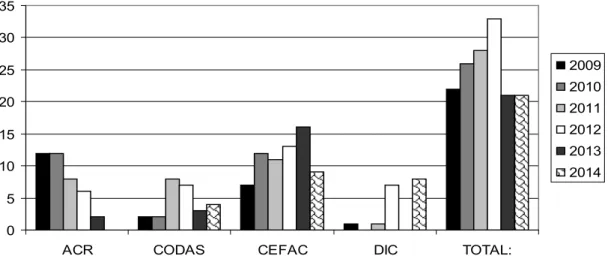
of submitted publications. A jump occurred in 2011
(30.7%) and 2012 (27%), decreasing in 2013 (11.5%) and 2014 (15.4%).
The CEFAC Journal was the one that showed greater regularity in the number of published case reports over the years: 2009: 10.3%; 2010: 17.6% and 16.2%; 2011: 19.2%; 2012: 23.5%, 2013 and 2014: 13.2%.
DIC Journal showed an increase in the number of publications over the study period. Both in 2009 and in 2011, we found published case reports, transcribed here as 5.9% of the research. In 2010 and 2013, no case reports were published but in 2012 and 2014, respectively, there was 41.2% and 47% of case reports published in relation to other types of publication in DIC Journal.
The number of articles published per year, as a case report, brings different contours depending on
the journal, although we do not ind any political justii
-cation for this inding.
In the ACR Journal, the publications of case reports showed a numerical regularity between the years 2009 to 2011, and then started a decline that extends until 2014. The data, translated into percentages, shows this situation more clearly when, in 2009 and 2010, the case
reports account for 30% of the indings in the survey. In
2011, this number shows a slight decrease (20%), with a more evident decrease in 2012 (15%) and 2013 (5%), reaching 2014 without any publication of this kind.
In the CoDAS Journal, the numbers initially show a slight progression that is not sustained over the years. In 2009 and 2010, the case reports represented 7.7%
Table 2. Relation number of articles per year of publication
JOURNAL 2009 2010 2011 2012 2013 2014 TOTAL
ACR 12 12 8 6 2 0 40
CODAS 2 2 8 7 3 4 26
CEFAC 7 12 11 13 16 9 68
DIC 1 0 1 7 0 8 17
TOTAL: 22 26 28 33 21 21 151
Legend: ACR = Audiology- Communication Research; CODAS = Jornal da Sociedade Brasileira de Fonoaudiologia; CEFAC = Speech, Language, Hearing Sciences and Education Journal; DIC = Revista Distúrbios da Comunicação
0 5 10 15 20 25 30 35
ACR CODAS CEFAC DIC TOTAL:
2009
2010
2011
2012
2013
2014
Legend: ACR = Audiology- Communication Research; CODAS = Jornal da Sociedade Brasileira de Fonoaudiologia; CEFAC = Speech, Language, Hearing Sciences and Education Journal; DIC = Revista Distúrbios da Comunicação
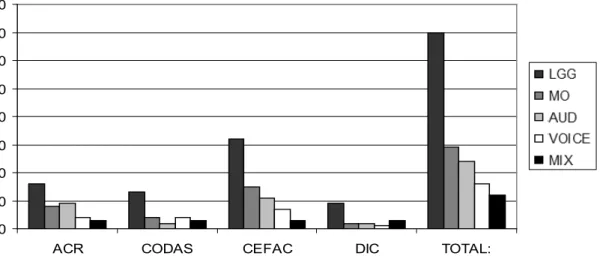
By observing the research results that link the article to the Speech Therapy and Audiology area, Language was the theme most found in the reports, followed by Orofacial Motricity, Audiology, Voice,
and inally, research involving, simultaneously, more than one clinical ield. There is no evidence that these numbers relect a greater interest of Speech Therapy
and Audiology for some of the specialties or for a greater demand for knowledge and dissemination of certain techniques or even the relationship between publications and a higher incidence of
complica-tions in any of the ields. Therefore, it seems that the
reports are published without any policy of privileging one area over another. Since Speech Therapy and Audiology study area covers the largest number of case reports found in this research, it could lead to
the conclusion that these ields/themes are of most
interest. Nevertheless, it also raises a question, when examining the published contents: does the reported clinical condition illustrate a theoretical elaboration
so that the case report meets its objective of being a
written text to be read and discussed by its narrative style7? It could be a session report, or the progress of
the subject’s history, or the exposition of his clinical life
and symptoms, but it should target the interest of the reader community. Later on we will look closer to see if this research can bring to the surface the loss of the uniqueness of the therapist/patient clinical situation, which is essential for the elaboration of such kind of
article, in favor of the journals concern of prioritizing the amount of scientiic production over its contents.
Table 3. Article relation with the specialty area
JOURNAL LGG MO AUD VOICE MIX TOTAL
ACR 16 8 9 4 3 40
CODAS 13 4 2 4 3 26
CEFAC 32 15 11 7 3 68
DIC 9 2 2 1 3 17
TOTAL: 70 29 24 16 12 151
Legend: LGG= Language; MO= Oral Motricity; AUD= Audiology; ACR = Audiology- Communication Research; CODAS = Jornal da Sociedade Brasileira de Fonoaudiologia; CEFAC = Speech, Language, Hearing Sciences and Education Journal; DIC = Revista Distúrbios da Comunicação
0 10 20 30 40 50 60 70 80
ACR CODAS CEFAC DIC TOTAL:
LGG
MO
AUD
VOZ
MISTO
Legend: LGG= Language; MO= Oral Motricity; AUD= Audiology; ACR = Audiology- Communication Research; CODAS = Jornal da Sociedade Brasileira de Fonoaudiologia; CEFAC = Speech, Language, Hearing Sciences and Education Journal; DIC = Revista Distúrbios da Comunicação
To analyze the data obtained in the present
investigation regarding the age of the subjects in the researched articles, we classiied the indings in the
following categories: baby, child, adult, elderly and mixed (when various age groups are involved).
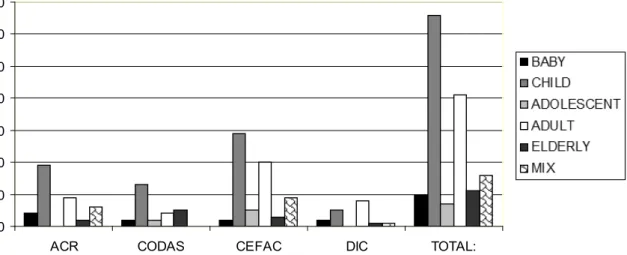
ACR, CoDAS and CEFAC Journals demonstrated the predominance of research involving children, the target audience, particularly in the study area of language. In the DIC Journal, exceptionally, elderly
people were more frequent in the category: subjects of
research.
In general analysis, making the sum without
considering the speciicity of each journal, research with children is the majority followed by research with
adults, mixed, elderly, baby and teenagers. The data reveals the need to encourage the production of case reports for the elderly, babies and teenagers, which are not included, but that also require Speech Therapy and Audiology interventions.
Table 4. Age group of the subjects
JOURNAL BABY CHILD ADOLESC ADULT ELDER MIX TOTAL
ACR 4 19 0 9 2 6 40
CODAS 2 13 2 4 5 0 26
CEFAC 2 29 5 20 3 9 68
DIC 2 5 0 8 1 1 17
TOTAL: 10 66 7 41 11 16 151
Legend: ACR = Audiology- Communication Research; CODAS = Jornal da Sociedade Brasileira de Fonoaudiologia; CEFAC = Speech, Language, Hearing Sciences and Education Journal; DIC = Revista Distúrbios da Comunicação
0 10 20 30 40 50 60 70
ACR CODAS CEFAC DIC TOTAL:
Legend: ACR = Audiology- Communication Research; CODAS = Jornal da Sociedade Brasileira de Fonoaudiologia; CEFAC = Speech, Language, Hearing Sciences and Education Journal; DIC = Revista Distúrbios da Comunicação
Figure 4. Age groups of the subjects
BEBÊ
CRI
AD
ADUL
IDO
can assign to the patient the position of agent in the discursive interaction, since dialogue is the essence of the therapeutic process1. Under this view, the speech therapist and the audiologist establish a relationship with the listening and the interpretation of the speech of the other, determining the recognition of the patient as
the subject.
Criticism is in order to those articles that clearly make this separation. On the other hand, incentive must
be given for future researches to consider the subject’s
speech about himself and his symptoms so that the diagnosis will not focus solely on the symptoms, but on
the involvement of the subject in the symptoms15.
DISCUSSION
At this stage of the research, we observe that in clinical procedures adopted by the researched articles, there is a balance between the number of case reports discussing diagnosis and intervention. Fewer in number are the procedures in which the diagnostic and the therapeutic or intervention are associated. This data shows that Speech Therapy and Audiology remains in a dependent relationship with clinical medicine, where the organic questions determine the functioning of language13. For the Speech Therapy and Audiology remains the therapeutic part, or rather, Propaedeutic or Deontology14. Under this view, Speech Therapy and Audiology seek to understand language symptom from a linear cause and effect relationship, quantifying it, sorting it, and describing it. There is a clear separation between diagnosis and intervention, which enables us
Table 5. Procedures
JOURNAL Diagnostics Intervention Diagnostics and
Intervention TOTAL
ACR 18 11 10 39
CODAS 15 6 6 27
CEFAC 26 42 0 68
DIC 10 5 2 17
TOTAL: 69 64 18 151
Legend: ACR = Audiology- Communication Research; CODAS = Jornal da Sociedade Brasileira de Fonoaudiologia; CEFAC = Speech, Language, Hearing Sciences and Education Journal; DIC = Revista Distúrbios da Comunicação
0 10 20 30 40 50 60 70 80
ACR CODAS CEFAC DIC TOTAL:
Legend: ACR = Audiology- Communication Research; CODAS = Jornal da Sociedade Brasileira de Fonoaudiologia; CEFAC = Speech, Language, Hearing Sciences and Education Journal; DIC = Revista Distúrbios da Comunicação
Figure 5. Procedures
Diagnos
Inter Inter
see that from 2009 to 2014 there is a total number of
151 case reports published in ive years. Regarding
the specialties of Speech Therapy, we found an almost
equal number of case reports in the ields of Language,
Oral Motor Skills and Audiology. Slightly smaller, the
ield of Voice is mentioned less than the others, but
still ahead of case reports in which symptoms of more
than one of the ields appears combined. Regarding the gender of the subjects mentioned in the studies,
we found a slight favoring of males, but it is not clear whether this is due to the greater number of cases
or simply to the interest in the study and the subjects available for analysis. The age of the subjects favors
the studies of children that appear twice as much in relation to case studies of adults, and in last place are the case reports of teenagers. One might question this relationship. It is known that children are the focus of
any study in the ield of Speech Therapy and Audiology
for they are in development and the intervention is more favorable in this age group. The concern of parents also interferes with this number as children come to the clinic brought by them. A balance between the number of reports on diagnosis and those on intervention was observed in our results. There is a far lesser number of case reports in which the diagnosis and the thera-peutic/intervention are associated, which leads us to question the position occupied by the patient since it is unthinkable, in a clinical discipline, that the formulation of the diagnosis is disassociated from the intervention and vice-versa. It must be remembered that Speech Therapy and Audiology is aimed at the treatment or the transformation of the suffering due to symptoms in speech or writing, in hearing, in oral and other motor functions. There was the need to critically analyze this
inding, as Speech Therapy and Audiology, as a clinical
discipline, should prevent separation between therapy and diagnosis. The clinical area is a structure and, as such, has its components in constant articulation so
that the direction of an intervention can be identiied,
described, and explained. For there to be interpretation of clinical data it is necessary that the method be clearly outlined in the body of the case studies because there is no spontaneous clinical fact; the facts always depend on the network in which they are captured16.
CONCLUSIONS
We conclude that, although the case report has a constant presence in the analyzed publications,
its importance to clinical reasoning is still much underestimated.
The constant tendency in the researched studies is to present the case without a discussion of its relevance or of the theoretical advance such study
brings to the ield. The greatest contribution would
be to allow the reader to resolve impasses in clinical
care cases, which are considered dificult although not
rare. Parents who bring multiple demands and express enormous suffering in their search for a diagnosis could be a priority theme in clinical care of cases of delayed speech, which are so common in children and so frequent in clinical practice, as pointed out by the
indings.
The single case would also allow the recognition of the patient’s uniqueness and his/her special needs,
requiring a critical and speciic look, allowing the emergence of speciic transforming actions.
Finally, the systematic presence of those case
reports surveyed in journals indicates, on the one
hand, its relevance, and secondly, that a more detailed
discussion of its purpose and objectives could be beneicial for a clinical ield, committed to a constant
review of its methods and practices.
REFERENCES
1. Kienle GS, Kiene H. Como escrever um relato de caso. Arte Med Ampl 2011;31(2):34-7.
2. Yoshida WB. Redação do relato de caso. J Vasc Bras. 2007;6(2):112-3.
3. Ventura MM. O estudo de caso como modalidade de pesquisa. Rev. SOCERJ. 2007;20(5):383-6. 4. Galdeano LE, Rossi LA, Zago MMF. Roteiro
instrucional para a elaboração de um estudo de caso clínico. Rev. Latino-am Enfermagem. 2003;11(3):371-5.
5. Yin R K. Estudo de caso: planejamento e métodos. 2ª ed. Porto Alegre: Bookman; 2001.
6. Peres SR, Santos MA. Considerações gerais e orientações práticas acerca do emprego de
estudos de caso na pesquisa cientíica em
psicologia.Interações. 2005;10(20):109-26.
7. Cunha MC, Palladino RRR, Silva MF. Estudo de caso clínico na pesquisa fonoaudiológica: da cena clínica às formulações teóricas. Dist Com. 2015;27(1):192-5.
9. Rev CEFAC. Instrução aos autores, Tipos de trabalhos. [acesso em 2014 out 15 ].Disponível em: http://www.revistacefac.com.br/instrucoes_pt.php 10. CoDAS. Instrução aos autores. [acesso em 2014
out 15 ]. Disponível em: http://www.scielo.br/ revistas/codas/iinstruc.htm
11. Audiol Commun Res. Instrução aos autores, Relatos de casos originais . [acesso em 2014 out 15 ]. Disponível em : http://www.audiolcommres. org.br/_1/normas.pdf
12. Rev DIC. Diretrizes para autores, artigos originais. [acesso em 2014 out 15] Disponível em http://revistas.pucsp.br/index.php/dic/about/ submissions#authorGuidelines
13. Gouvêa G, Freire R, Dunker C. Sanção em Fonoaudiologia: um modelo de organização dos sintomas de linguagem. Cad. Est. Ling. 2011;53(1):8-25.
14. Freire R. A fundação da Clínica Fonoaudiológica. In: Gonçalves N, Fonte R (ed). Aquisição de
linguagem, seus distúrbios e especiicidades:
diferentes perspectivas. Curitiba: CRV; 2011. p. 87-96.
15. Figueiredo AC, Tenorio F. O diagnóstico em psiquiatria e psicanálise. Rev Latinoam Psicopat Fund. 2002;1:29-43.