Genotype 1 of human parvovirus B19 in clinical cases
MARIA ISABELDE OLIVEIRA1*, ANA MARIA SARDINHA AFONSO2, SUELY PIRES CURTI1, PATRÍCIA EVELIN SILVA2, TAMYRIS FERNANDA BARBOSA2,
ELIAN REIS SILVA JUNIOR2, CRISTINA ADELAIDE FIGUEIREDO1
1PhD, Scientiic Researcher, Núcleo de Doenças Respiratórias, Instituto Adolfo Lutz, São Paulo, SP, Brazil 2MSc Student, Núcleo de Doenças Respiratórias, Instituto Adolfo Lutz, São Paulo, SP, Brazil
S
UMMARYStudy conducted at Núcleo de Doenças Respiratórias, Instituto Adolfo Lutz, São Paulo, SP, Brazil
Article received: 7/7/2016 Accepted for publication: 7/9/2016
*Correspondence: Instituto Adolfo Lutz, Núcleo de Doenças Respiratórias
Address: Av. Dr. Arnaldo, 355 São Paulo, SP – Brazil Postal code: 01246-902 [email protected]
http://dx.doi.org/10.1590/1806-9282.63.03.224
Introduction: Virus surveillance strategies and genetic characterization of human parvovirus B19 (B19V) are important tools for regional and global control of viral outbreak. In São Paulo, Brazil, we performed a study of B19V by monitoring the spread of this virus, which is an infectious agent and could be mistakenly reported as a rash and other types of infection.
Method: Serum samples were subjected to enzyme immunoassay, real time
polymerase chain reaction, and sequencing.
Results: From the 462 patients with suspected cases of exanthematic infections, the results of the 164 serum samples were positive for B19V immunoglobulin M. Among these cases, there were 38 patients with erythema infections and B19--associated with other infections such as encephalitis, hydrops fetalis, chronic anemia, hematological malignancies. These samples were sequenced and identi-ied as genotype 1.
Conclusion: This study showed patients with infections caused by B19V and
sequencing genotype 1. Continuous monitoring is necessary to detect all known genotypes, and the emergence of new genotypes of these viruses for case management in public health control activities.
Keywords: human parvovirus B19, B19V genotype, surveillance.
I
NTRODUCTIONHuman parvovirus B19 (B19V) is a member of the Parvo-viridae family. It is further classiied into the subfamily Parvovirinae, genus Erythrovirus, and species Parvovirus
B19. B19V causes erythema infectiosum, a clinical form most commonly seen in children and adolescents, al-though it may occur at any age in pregnant women, caus-ing serious or even fatal complications to the fetus. Dam-age in the erythroid progenitor cells caused by B19V can result in severe anemia, particularly in immunocompro-mised patients. In addition, B19V infection has been as-sociated with many clinical symptoms, such as neuro-logical and myocardial infections, among others.1-3 B19V infection is often associated with fever and rash, and many times can be mistakenly reported as measles, rubella or other very common exanthema infections.4
Based on the phylogenetic analysis of the B19V, it was proposed into three distinct genotypes: 1; 2; and 3 groups. To determine which genotypes of B19V are present in São
Paulo city, clinical samples were analyzed, and carried out the genetic characterization of the circulating strains causing exanthematic diseases. That are important tools for regional and global control of viral outbreak.
M
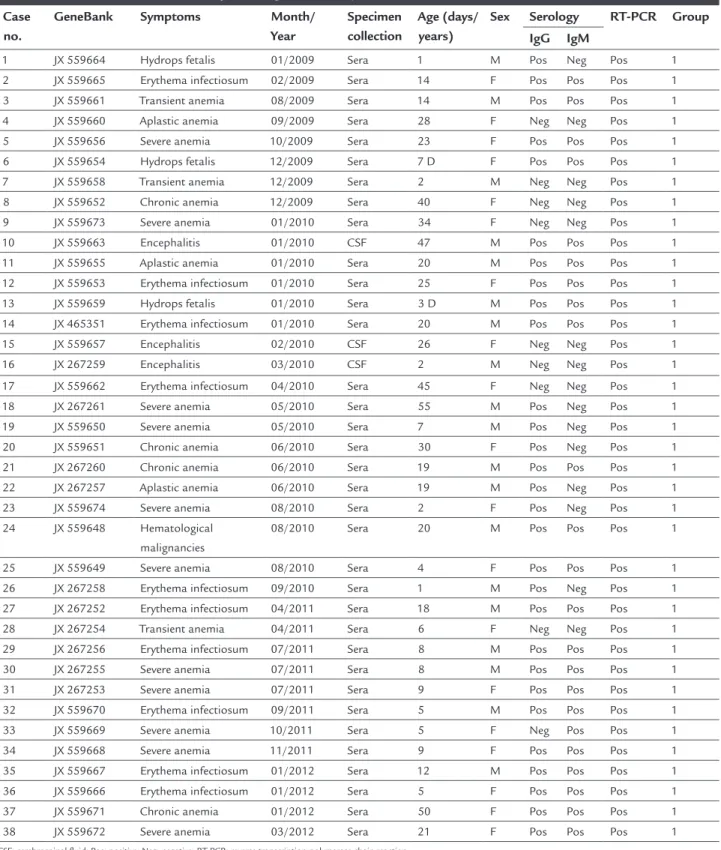
ETHODand probes were designed to sequence the fragment region of the NS1-VP1 gene, encoding for the B19V non-struc-tural protein (position 1399 to 1659), as previously de-scribed by Takano & Yamada,6 using QIAamp® DNA Blood Mini Kit (Qiagen, Hilden, Germany). The samples were sequenced by nested-PCR using primers described by Servants.5 The ampliied products were puriied with PureLink PCR Puriication Kit (Invitrogen/Life Tech-nologies, Carlsbad, CA) and sequenced using the ABI Prism Big Dye Terminator v3.1 Cycle Sequencing Kits (Applied Biosystems, Foster City, CA) according to the manufacturer’s protocol. The sequences obtained were analyzed by CLUSTAL X and BioEdit version 7.0 phylo-genetic analysis applications. The sequence generated from the erythrovirus HPV B19 sample was submitted to Blast searches in the GenBank accession numbers, sample from, locations, isolation years, and genotype of the se-quences utilized as presented in Table 1. Alignment was used with prototype sequences of genotype 1: strain Pvbua (Acc.Number M13178), genotype 2: prototype strain Lali (Acc. Number AY044266), and genotype 3: prototype strain V9 (Acc. Number AY647977) by the Clustal X program (http://www-igbmc.u-strasbg.fr/BioInfo/ClustalX/) and analyzed by the Megalign, DNAstar, Inc. software.
R
ESULTSIn order to detect the presence of B19V, an immunoassay of the 462 suspected cases of exanthematic infections was done: 164 (36%) serum samples were positive for B19V IgM and 298 (64%) were positive for B19V IgG. Of the 498 samples analyzed by qPCR, 148 (32%) were found to be positive for B19V protein expression. The infection was equally distributed between male and female patients under the age of 20.
Among the positive samples, 38 with erythema infec-tion and B19-associated were sequenced. The results of the immunoassay (IgG and IgM antibodies) showed 21 samples were positive for both IgM/IgG antibodies, six were negatives IgM/IgG antibodies, seven were positive for IgG antibodies only, and one was positive for IgM only (Table 1). Among the three samples collected from the cerebrospinal luid (CSF), one was positive while the re-maining two were negative for both IgM/IgG antibodies. The 15 samples clinically negative for IgM and/or IgG antibodies, but positive for the same according to DNA analysis, were collected from patients within 3-5 days after the onset of symptoms. In total, 38 sequences were obtained (eight from samples collected in 2009, 18 from
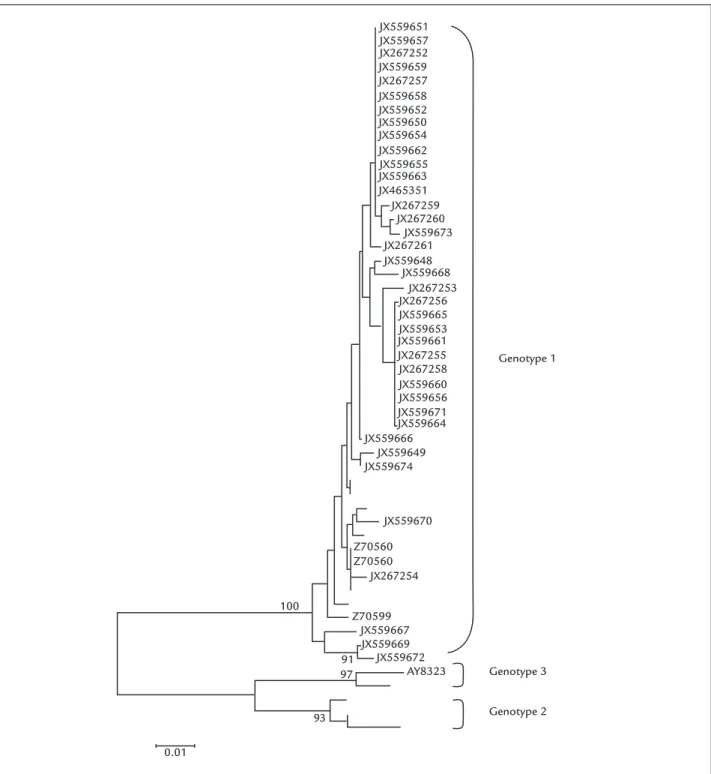
comparison of the nucleotide sequences of the different strains showed a high level of identity. Nucleotide pair-wise identity among the different strains ranged from 97 to 99.1% in genotype 1, 86.8 to 88% in genotype 2, and 87.2 to 88.5% in genotype 3. The sequences within geno-type 1 were found to be similar (statistical deviation within group, 1.7%).
D
ISCUSSIONIn our study, we observed that 36% of the serum samples were positive for B19V IgM and 64% were positive for B19V IgG. In the article described by Candotti et al.,7 the percent-age of positivity for IgG and IgM was similar to our ind-ings. Clinical symptoms of B19 infection in 39.8% of the patients exhibiting B19-speciic IgM were found in patients from Rio de Janeiro and the same results were obtained.8
B19V infection causes a benign disease, and neurologi-cal complications have been seen but are not usually inves-tigated in encephalitis.3 Among the cases where the geno-type was analyzed, three cases of encephalitis were observed. This was particularly evident in a young man, from whose B19V from CSF was ampliied and showed genotype 1.
TABLE 1 Characteristics of B19V subjected to genetical analyses.
Case no.
GeneBank Symptoms Month/ Year
Specimen collection
Age (days/ years)
Sex Serology RT-PCR Group
IgG IgM
1 JX 559664 Hydrops fetalis 01/2009 Sera 1 M Pos Neg Pos 1 2 JX 559665 Erythema infectiosum 02/2009 Sera 14 F Pos Pos Pos 1
3 JX 559661 Transient anemia 08/2009 Sera 14 M Pos Pos Pos 1 4 JX 559660 Aplastic anemia 09/2009 Sera 28 F Neg Neg Pos 1 5 JX 559656 Severe anemia 10/2009 Sera 23 F Pos Pos Pos 1
6 JX 559654 Hydrops fetalis 12/2009 Sera 7 D F Pos Pos Pos 1 7 JX 559658 Transient anemia 12/2009 Sera 2 M Neg Neg Pos 1 8 JX 559652 Chronic anemia 12/2009 Sera 40 F Neg Neg Pos 1 9 JX 559673 Severe anemia 01/2010 Sera 34 F Neg Neg Pos 1
10 JX 559663 Encephalitis 01/2010 CSF 47 M Pos Pos Pos 1 11 JX 559655 Aplastic anemia 01/2010 Sera 20 M Pos Pos Pos 1 12 JX 559653 Erythema infectiosum 01/2010 Sera 25 F Pos Pos Pos 1
13 JX 559659 Hydrops fetalis 01/2010 Sera 3 D M Pos Pos Pos 1 14 JX 465351 Erythema infectiosum 01/2010 Sera 20 M Pos Pos Pos 1 15 JX 559657 Encephalitis 02/2010 CSF 26 F Neg Neg Pos 1
16 JX 267259 Encephalitis 03/2010 CSF 2 M Neg Neg Pos 1
17 JX 559662 Erythema infectiosum 04/2010 Sera 45 F Neg Neg Pos 1
18 JX 267261 Severe anemia 05/2010 Sera 55 M Pos Neg Pos 1 19 JX 559650 Severe anemia 05/2010 Sera 7 M Pos Neg Pos 1 20 JX 559651 Chronic anemia 06/2010 Sera 30 F Pos Neg Pos 1
21 JX 267260 Chronic anemia 06/2010 Sera 19 M Pos Pos Pos 1 22 JX 267257 Aplastic anemia 06/2010 Sera 19 M Pos Neg Pos 1 23 JX 559674 Severe anemia 08/2010 Sera 2 F Pos Neg Pos 1
24 JX 559648 Hematological malignancies
08/2010 Sera 20 M Pos Pos Pos 1
25 JX 559649 Severe anemia 08/2010 Sera 4 F Pos Pos Pos 1
26 JX 267258 Erythema infectiosum 09/2010 Sera 1 M Pos Neg Pos 1 27 JX 267252 Erythema infectiosum 04/2011 Sera 18 M Pos Pos Pos 1 28 JX 267254 Transient anemia 04/2011 Sera 6 F Neg Neg Pos 1
29 JX 267256 Erythema infectiosum 07/2011 Sera 8 M Pos Pos Pos 1 30 JX 267255 Severe anemia 07/2011 Sera 8 M Pos Pos Pos 1 31 JX 267253 Severe anemia 07/2011 Sera 9 F Pos Pos Pos 1 32 JX 559670 Erythema infectiosum 09/2011 Sera 5 M Pos Pos Pos 1
33 JX 559669 Severe anemia 10/2011 Sera 5 F Neg Pos Pos 1 34 JX 559668 Severe anemia 11/2011 Sera 9 F Pos Pos Pos 1 35 JX 559667 Erythema infectiosum 01/2012 Sera 12 M Pos Pos Pos 1
36 JX 559666 Erythema infectiosum 01/2012 Sera 5 F Pos Pos Pos 1 37 JX 559671 Chronic anemia 01/2012 Sera 50 F Pos Pos Pos 1 38 JX 559672 Severe anemia 03/2012 Sera 21 F Pos Pos Pos 1
Currently, there are three B19V genotypes with as-sociated subtypes, genotype 1a, 1b, 2, 3a, and 3b.16 The genotypes show ∼10% nucleotide divergence on the whole genome.5 The most prevalent B19V genotype in Northern Europe is genotype 1a. Genotype 2 appears to be
restrict-Brazil.17 Some studies have shown that B19V genetic di-versity may depend on the geographical location and the year of isolation in patients. In this study, all isolates be-longed to genotype 1.17 In Brazil, all three genotypes have been identiied, although genotype 1 is the most
com-JX559651 JX559657 JX267252 JX559659 JX267257 JX559658 JX559652 JX559650 JX559654 JX559662 JX559655 JX559663 JX465351 JX267259
JX267260 JX559673 JX267261 JX559648
JX559668 JX267253 JX267256 JX559665 JX559653 JX559661 JX267255 JX267258 JX559660 JX559656 JX559671 JX559664 JX559666
JX559649 JX559674
JX559670
Z70560
Z70599 Z70560
JX267254
JX559669 JX559672
AY8323 Genotype 3
Genotype 1
Genotype 2 91
97 100
0.01
93
JX559667
In addition, genotype 1 is predominant in the Midwest, South and Southeast regions of Brazil.19,20
This work shows the presence of B19V genotype 1. Continuous monitoring is necessary to detect all known genotypes, and the emergence of new genotypes related to infection as the cause of virus spread.
C
ONFLICT OF INTERESTThe authors declare no conlict of interest.
R
ESUMOGenótipo 1 do parvovírus humano em casos clínicos
Introdução: Estratégias de vigilância para o parvovírus humano B19 e caracterização genética são ferramentas importantes para o controle regional e global do surto viral. Em São Paulo, Brasil, foi realizado um estudo de parvovírus B19, monitorando a disseminação desse vírus, que é um agente infeccioso e poderia ser erronea-mente relatado como uma erupção cutânea e outros tipos de infecções.
Método: As amostras de soro foram submetidas ao
ensaio imunoenzimático, PCR quantitativo em tempo real e sequenciamento.
Resultados: Dos 462 pacientes com casos suspeitos de
infecções exantemáticas, os resultados das 164 amostras de soro foram positivos para parvovírus B19 imunoglo-bulina M. Entre eles, 38 pacientes com eritema infeccioso apresentaram B19 associado com outras infecções, como encefalite, hidropisia fetal, anemia crônica, doenças he-matológicas malignas. Essas amostras foram sequenciadas e identiicadas como genótipo 1.
Conclusão: Os pacientes foram infectados com
parvoví-rus B19 e apresentaram genótipo 1. Monitoração contínua é necessária para detectar todos os genótipos conhecidos e o surgimento de novos genótipos para o controle de casos em saúde pública.
Palavras-chave: parvovírus humano B19, genótipo
B19V, vigilância.
R
EFERENCES1. Figueiredo CA, Oliveira MI, Afonso AMS, Andrade JQ, Brizot ML, Zugaib M, et al. Detection of human parvovirus B19 in cases of hydrops fetalis in São Paulo, Brazil. J Bras Patol Med Lab. 2008; 44(6):423-7.
2. Young NS, Brown KE. Parvovirus B19. N Engl J Med. 2004; 350(6):586-97. 3. Watanabe T, Kawashima H. Acute encephalitis and encephalopathy associat-ed with human parvovirus B19 infection in children. World J Clin Passociat-ediatr. 2015; 4(4):126-34.
4. Rezaei F, Sarshari B, Ghavami N, Meysami P, Shadad A, Salimi H, et al. Prevalence and genotype characterization of Human Parvovirus B19 in children with measles- and rubella-like illness in Iran. J Med Virol. 2016; 88(6):947-53. 5. Servant A, Laperche S, Lallemand F, Marinho V, De Saint Maur G, Meritet JF, et al. Genetic diversity within human erythroviruses: identiication of three genotypes. J Virol. 2002; 76(18):9124-34.
6. Takano T, Yamada K. Quantiication of human parvovirus B19 DNA by real-time polymerase chain reaction. Pediatr Int. 2007; 49(4):459-62. 7. Candotti D, Etiz N, Parsyan A, Allain JP. Identiication and characterization
of persistent human erythrovirus infection in blood donor samples. J Virol. 2004; 78(22):12169-78.
8. Wermelinger MC, Oelemann WM, Lima de Mendonça MC, Naveca FG, von Hubinger MG . Detection of human parvovirus B19 infection: a study of 212 suspected cases in the state o Rio de Janeiro, Brazil. J Clin Virol. 2002; 25(2):223-30.
9. de Jong EP, de Haan TR, Kroes ACM, Beersma MFC, Oepkes D, Walther FJ. Parvovirus B19 infection in pregnancy. J Clin Virol. 2006; 36(1):1-7. 10. Dijkmans AC, de Jong EP, Dijkmans BA, Lopriore E, Vossen A, Walther FJ,
et al. Parvovirus B19 in pregnancy: prenatal diagnosis and management of fetal complications. Curr Opin Obstet Gynecol. 2012; 24(2):95-101. 11. Adam O, Makkawi T, Reber U, Kirberg H, Eis-Hübinger AM. The
seroprevalence of parvovirus B19 infection in pregnant women in Sudan. Epidemiol Infect. 2015; 143(2):242-8.
12. Slavov SN, Kashima S, Silva-Pinto AC, Covas DT. Genotyping of Human parvovirus B19 among Brazilian patients with hemoglobinopathies. Can J Microbiol. 2012; 58(2):200-5.
13. Modrow S, Dorsch S. Antibody responses in parvovirus B19 infected patients. Pathol Biol (Paris). 2002; 50(5):326-31.
14. Rogo LD, Mokhtari-Azad T, Kabir MH, Rezaei F. Human parvovirus B19: a review. Acta Virol. 2014; 58(3):199-213.
15. Ishikawa A, Yoto Y, Tsugawa T, Tsutsumi H. Quantitation of human parvovirus B19 DNA in erythema infectiosum and aplastic crisis. J Med Virol. 2014; 86(12):2102-6.
16. Enders M, Weidner A, Zoellner I, Searle K, Enders G. Fetal morbidity and mortality after acute human parvovirus B19 infection in pregnancy: prospective evaluation of 1018 cases. Prenat Diagn. 2004; 24(7):513-8. 17. Servant-Delmas A, Lefrère JJ, Morinet F, Pillet S. Advances in human B19
erythrovirus biology. J Virol. 2010; 84(19):9658-65.
18. Toan NL, Duechting A, Kremsner PG, Song le H, Ebinger M, Aberle S, et al. Phylogenetic analysis of human parvovirus B19, indicating two subgroups of genotype 1 in Vietnamese patients. J Gen Virol. 2006; 87(Pt 10):2941-9. 19. Mendonça MC, Ferreira AM, Santos MG, Oviedo EC, Bello MS, Siqueira
MM, et al. Genotyping of human parvovirus B19 in clinical samples from Brazil and Paraguay using heteroduplex mobility assay, single-stranded con-formation polymorphism and nucleotide sequencing. Mem Inst Oswaldo Cruz. 2011; 106(4):502-4.