Dialectics of a medical provision policy in priority areas in Brazil
CÉSAR AUGUSTO TRINTA WEBER1*1MD, MSc, PhD. Department of Neurosciences and Behavioral Sciences, Faculdade de Medicina de Ribeirão Preto, Universidade de São Paulo, Ribeirão Preto, SP, Brazil
S
UMMARYArticle received: 6/27/2016
Accepted for publication: 7/2/2016
*Correspondence:
Address: Av. Ecoville, 190, casa 7 Porto Alegre, RS – Brazil
Postal code: 91150-400 [email protected]
http://dx.doi.org/10.1590/1806-9282.63.03.268
Introduction: The people living in vulnerable areas that are dificult to access
in Brazil represent a portion of the population that has proven very sensitive to lack of medical and health services. The government, seeking to solve the situation urgently, implemented the More Doctors Program [Programa Mais Médicos, in the Portuguese original] in 2013.
Objective: To discuss the More Doctors Program, with the purpose of contributing to the debate on the provision of medical policies in Brazil.
Method: Study based on the review of oficial documents: Programa Mais Médicos – dois anos: mais saúde para os brasileiros, 2015 [More Doctors Program – two years:
more health for Brazilians, 2015]; Operational Audit Report, TC Nº 005391/2014-8, the Court of Auditors of Brazil; and Medical Demography in Brazil 2015.
Results: The import of exchange physicians without diploma revalidation has cast a shadow on the technical quality of services offered to the population. In terms of infrastructure, the reduction of resources paralyzed works and made the care network maintenance projects impossible. The creation of new medical schools has created uncertainty about the possibility of quality education being offered, with minimum and suficient structure including laboratories, clinics and teaching hospitals indispensable to medical training.
Conclusion: The regional inequalities of concentration and dispersion of physicians,
showed by studies on medical demography in Brazil, stem from several factors, including the lack of a career path and working conditions. There is no point in having physicians if they do not have safe and ethical conditions to establish the diagnosis and a treatment plan, as well as to monitor the rehabilitation of the patient.
Keywords: primary health care, physicians distribution, public health policy,
vulnerable populations, uniied health system.
I
NTRODUCTIONBrazil’s condition of being a continental country, in addi-tion to the historical background of its colonizaaddi-tion and its public policies for Development, Infrastructure, Educa-tion and Health,1 as well as other areas, contributed sig-niicantly, especially in the case of the Uniied Health Sys-tem (SUS, in the Portuguese acronym), to the dificulties it has today to guarantee the population’s access to health services and actions2 in a universal, integral, resolutive and hierarchical way, divided according to levels of complexity and decentralized. These constitute the organizational and philosophical principles of the public health system, which have been regulated by Laws 8.080/903 and 8.142/90.4
From then on, normative and administrative acts of the Ministry of Health began to shape the process of
implemen-tation and operationalization of the SUS, particularly regard-ing its decentralization/municipalization guideline. One of the immediate implications of the decentralization was that the municipalization of health services and actions was, at the time, 1991,5 for the vast majority of Brazilian munici-palities, a major challenge in terms of planning, organization and control of the municipal health system through mini-mally professionalized management.
policies, by not favoring the optimum use of the various modalities, miss the focus required for operational ef-iciency and effectiveness of this system, reinforcing the peripheral condition of these regions.6
Another aspect associated with the previous one is that the geographical dimension is an aggravating fac-tor that converges directly to the lack of local and re-gional basic infrastructure. Cumulatively, this makes the broad and complex sociocultural, environmental and climatic diversity – a characteristic of the great ter-restrial extensions – less stimulating and inviting for physicians to live in these places.2
In this scenario, the constitutional guarantee of health as a fundamental right7 has encountered several barriers for the citizens to be supported by the social medicine developed by the SUS – weakened by insuficient inanc-ing1,8 and by unprofessional management –, as it does not guarantee quality and resolution for health actions and services. In the words of Gastão Wagner de Souza Campos, governments that, following the populist trend of sev-eral municipalities, invented degraded primary care for the poor: Ready Care Units (UPAs), one of the social spaces that we will embarrass ourselves in the future, a sign of human perversity.1
Without neglect, it is important to draw attention to the reality of medical demography in Brazil, which relects the poor distribution of physicians between rural and urban areas, and between capital and the interior.9 The concentration and dispersion of physicians in the differ-ent regions of the country respond directly to the condi-tions and the quality of life in these places. Although the concept of quality of life is a subjective construct and therefore does not represent an etymological consensus, it can be considered as the perception individuals have regarding their position in life in the context of the culture and value system in which they live and in relation to their goals, expectations, standards and concerns.10
The evolution of the Brazilian health system, with a greater supply of medical jobs and greater demand for health services, coupled with the expansion of medical undergraduation courses, explains the increase in the number of doctors in Brazil over the years. This growth, however, did not beneit the population in a homogeneous way.9 The Federal Medical Board points out that although the total number of physicians in certain states is greater on account of the professionals located in the capital, the division between capitals and the interior exposes striking differences. Major cities do attract more professionals.9
Populations living in vulnerable and dificult-to-access areas represent a portion of the population that has been
very sensitive to the lack of doctors and health services. Epidemiological indicators of these areas show that these are the priority target for interventions within the SUS system, especially in the access and quality of primary care in Brazil.11
The Brazilian government, seeking to respond urgently to this situation, implemented the More Doctors Program (PMM, in the Portuguese acronym) by means of Provision-al Measure no 621,12 published on July 8, 2013, transformed three months later into Law n° 12.871,13 aiming at training human resources in the medical ield to work within the SUS system, in summary, with the following objectives:
[...] I – To reduce the shortage of doctors in the priority regions [...]; II – Strengthen the provision of basic health care services [...]; III – Improve medical training and provide greater experience in the ield of medical practice during the training process; IV – To expand the insertion of physicians in training in the SUS [...]; V – Strengthen the policy of permanent education by integrating teaching and service provision [...]; VI – Promote the exchange of knowledge and experiences between Brazilian health professionals and doctors trained in foreign institutions; VII – Improve medical training for action in public health policies [...]; and VIII – Encourage the development of research applied to the SUS.13
With the PMM, the Ministry of Health intends, in gen-eral lines, to increase the current number of physicians in Brazil from 374,000 to 600,000 by 2026, reaching the goal of 2.7 medical doctors per 1,000 inhabitants. For that, 11,500 new vacancies will be offered for undergrad-uate students until 2017, as well as 12,400 new residency positions for the training of specialists, with new courses open in the interior of the country.14
The topic of providing and setting up doctors in vul-nerable and difficult-to-access areas as a strategy to strengthen the SUS has become a fertile ground for new investigations under the most different approaches. This should be stimulated not only to encourage discussion and technical-scientiic production on the subject, but also to serve as a theoretical and technical substrate for monitoring and improving public policies in the SUS.
M
ETHODDon-nangelo and Pereira,16 who investigated medical labor and the diversiication of specializations within hospitals, based on the Social Sciences approach; Gonçalves,17 who discussed the process of labor based on a Marxist perspec-tive of the production process; Merhy,18 who analyzed the micropolitics of labor as a living act in health; Campos,19 who criticized the hegemonic management approach and taylorism; Carvalho and Sousa,20 who analyzed how Bra-zil has sought to face a chronic problem in the SUS, which is the lack of physicians in work in public health services, especially in Primary Health Care, as well as other articles and researchers.
For the intellectual exercise described in this manu-script, the concept of problematization is being used based on the teachings of Foucault for whom:
[...] Problematization does not mean representation of a preexisting object, nor the creation by discourse of an object that does not exist. It is the set of discursive or non-discursive practices that makes something enter the game of the true and the false and constitutes it as an object for thought (whether in the form of moral relection, scientiic knowledge, political analysis, etc.).21
According to the Ministry of Health, the three opera-tional dimensions of the PMM are the structuring axes of this policy. For the federal power the Law of the PMM, as a whole, shows, in summary, that:
[...] The irst axis would be the Emergency Provision, called “Project More Doctors for Brazil,” which aims to promote Primary Care in priority regions of the SUS system [...]. The second axis is that of Investment in Infrastructure of the Network of Basic Health Services [...] Requaliication Program for Basic Health Units [...] Computerization of Basic Health Units [...]. The third axis is related to Medical Training in Brazil. [...] creation of medical courses, public and private, [...] creation of the National Register of Specialists [...] and measures for the qualiication of medical training both in the scope of undergraduate programs and medical residency.14
In this perspective, these operational dimensions/structur-ing axes of the PMM were analyzed based on oficial docu-ments from the Ministry of Health (Programa Mais Médicos – dois anos: mais saúde para os brasileiros, 2015 [More Doctors Program – two years: more health for Brazilians, 2015]);14 Court of Auditors of Brazila(Operational Audit Report TC no
a We chose to use the documentation of the Court of Auditors of Brazil as representative of the users because this Court is an
005.391/2014-8)22 and University of São Paulo’s Medical School (FMUSP), the Regional Medical Board of São Pau-lo and the Federal Medical Board (Demograia Médica no Brasil2015 [Medical Demography in Brazil 2015]).9 All of these publications were selected by identiication and rec-ognition – as a technical and legal corpus – representing the players of the health sector, respectively, the public administration, users and sector entities.
R
ESULTS AND DISCUSSION Project More Doctors for Brazil (PMMPB)The Brazilian government, pressured to respond to the population’s obstacles to access to health services and actions by the SUS, implemented the Project More Doc-tors for Brazil13 (PMMPB), in the context of other measures such as the previous Primary Care Professional Appre-ciation Program23 (PROVAB), created in 2011, which aimed at repressing a growing wave of dissatisfaction and vertiginous drop in government popularity.
The PROVAB was created by a joint initiative of the Ministry of Health and the Ministry of Education, with the purpose of stimulating and valuing the health profes-sional who works in multiprofesprofes-sional teams in the scope of Primary Care and Family Health Strategy.23 In other words, to expand access to health for the poor, encourag-ing newly trained health professionals to work in regions marked by the scarcity of physicians (periphery of large cities, riverine populations, quilombolas, indigenous peoples, remote areas of the legal Amazon, and the north-eastern semi-arid region).20
As a stimulus to joining this program, newly trained professionals, in particular physicians, besides improving their professional training and getting to know the real-ity of SUS users, earn the right to an additional 10% in medical residency tests.20,23 This became a decisive factor for access to specialization, making the PROVAB a step-ping stone between undergraduate and graduate pro-grams.23 As a possibility to keep physicians in priority areas for more than a year, as originally planned, vacancies for PROVAB were incorporated into the PMMPB.
The ineficiency of the SUS care network is widely known. The slowness of its solutions has led people to suffering and preventable sequelae, if not death. This sce-nario left no alternative, in the short term, to the Ministry
of Health, but to provide priority areas with physicians for primary health care to these populations.
The PMMPB caused a great reaction of medical enti-ties, due to several aspects. A irst aspect that deserves to be highlighted is the creation of the igure of the exchange doctor as a possibility for medical care in areas classiied as priorities by the Ministry of Health.24,25 The exchange doctor is one who, according to the norm that instituted it, graduated in foreign higher education institutions through international medical exchange.13
However, the fact that the Brazilian Government did not require the revalidation of the diploma (Revalida) of the exchange physicians was strongly contested based on the argument that without the proper proof by Brazil-ian universities of the minimum knowledge required in Brazil for medical practice, the health of the population assisted by such professionals could be put at risk. This is a requirement in many countries to prove technical capacity for professional practice, further thickening the irst controversy of the project by its non-compliance or permissiveness, if so preferred. According to the PMMPB:
[...] The participation of the exchange physician in the Proj-ect More Doctors for Brazil, attested by the coordination of the Project, is a necessary and suficient condition for the practice of Medicine in the scope of said project, and article 17 of Law 3.268, dated September 30, 1957, is not applicable.13
Another aspect criticized by medical associations is lan-guage. Proiciency in the Portuguese language is necessary for proper communication between doctor and patient that ensures full understanding between the interlocutors. Although most of the exchange doctors come from
coun-tries where Spanish is the language spoken and written, one should not ignore that the Portuguese spoken in Brazil has speciicities that can be decisive for the success or failure of a health intervention. There are too many risks of poor communication.
A third aspect to be mentioned is Brazil’s agreement with the Pan American Health Organization (PAHO), which provides for the arrival of 4,000 Cuban doctors to work as exchange physicians, with an investment of R$ 511 million. The initiative to bring Cuban doctors through PAHO may have been one of the measures that causing most controversy and outrage since the announcement and implementation of the project. The amount of R$ 10,000.00 paid as a scholarship by the federal government to the exchange doctors proved to be much higher than the amounts paid, for example, for medical training in the
country by the medical residency services funded by the Ministry of Education and Culture or the average salaries paid by local administrations for Brazilian doctors work-ing in primary care.
This fact alone would by itself displease the Brazilian medical community, as it lacks a convincing explanation from the federal government to justify this wage policy. On top of this, the warning made of the risk that there might be the dismissal of Brazilian doctors hired in the municipalities that received exchange physicians ended up being conirmed, a fact that contributed to generate even more problems.
By bringing in exchange doctors without the labor guarantees in force in the country, the Brazilian govern-ment has turned its back on the historic achievegovern-ments of workers who sought to establish and guarantee an ethical relationship between capital and labor. As an aggravating circumstance, the fact that the exchange physicians receive only the equivalent of 20% of the value paid by the grant, around US$ 600, and the remaining 80% is passed on to the Government of Cuba as compensation for the cost of academic training of these professionals, casts a shadow on the project’s objectives.
In this dialectical game, we cannot lose sight of the thesis defended by medical institutions that the poor distribution of physicians in Brazil is a consequence, among other things, of the lack of infrastructure and health equipment in areas other than capitals and of a national career plan with positions and salaries for physi-cians in the SUS (PCCV/SUS, in the Portuguese acronym). It should be noted that the complaint is prior to the implementation of the PMM. In the view of medical enti-ties, this would be the most prudent and effective gov-ernmental measure to solve the problem.
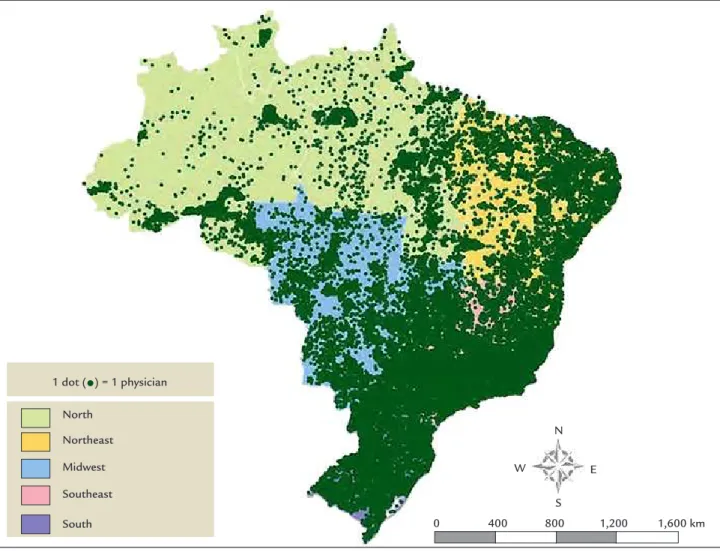
Figure 19 shows the distribution of physicians per Bra-zilian region in 2014. In order to better illustrate the med-ical distribution presented here, the following aspects should be highlighted, among other characteristics of the medical population in the country: a) number of registered doctors: 419,224; b) Brazilian population: 201,032,714 inhabitants; c) ratio physician per 1,000 inhabitants: 2.09. It is important to show some of the main results of the evaluations made by the Ministry of Health to assess the two years of implementation of the PMMPB8 and the audit conducted by the Court of Auditors of Brazil22 in the Ministries of Education and Health; in the government of the Federal District; and in local administrations in the states of Bahia, Minas Gerais, Pernambuco, São Pau-lo, Ceará, Maranhão, Pará and Rio Grande do Norte.
For the Ministry of Health, the results achieved by the program, as well as its approval by the population that uses the SUS, already demonstrate the success of this broad and
innovative initiative. This would be enough to prove that the most immediate dimension of the project – that of emergency provision of professionals – has been success-fully achieved.
[...] Currently, the PMM offers a total of 18,240 positions in 4,058 municipalities across the country, covering 73% of Brazilian cities and 34 Indigenous Special Sanitary Districts (DSEIs). In just two years, all the demand from the local administrations that adhered to the Program has been met, and with this, 63 million Brazilian citizens are already ben-eiting from the presence of physicians in 4,058 munici-palities throughout the country. The Ministry of Health estimates that, by the end of 2018, 70 million Brazilians will be cared for by the More Doctors Program.14
The Court of Auditors of Brazil in an operational audit22 performed in the PMM focused on the period between
FIGURE 1 Distribution of physicians according to region in Brazil, 2014. Source: Scheffer et al.9
W E
N
0 400 800 1,200 1,600 km S
1 dot (•) = 1 physician
North
Northeast
Midwest
Southeast
June 2013 and March 2014 detected, among other errors, the fragility of supervision and mentoring of doctors in the PMMPB. The risk of absence of supervising physicians or disregard of the ratio of exchange physicians per super-visor was strongly pointed out by the Federal Board of Medicine and the 27 Regional Boards due to its potential of endangering the health of the population:
[...] By act or omission, characterized by malpractice, reck-lessness or negligence; – indication of procedure, even with the participation of several physicians, that results in dam-age; – the non-use in the patient’s favor of all available means of diagnosis and treatment, scientiically recognized and within reach; – or the cover-up of unethical conduct in disfavor of the patient.22
According to the Court of Auditors of Brazil, exchange
physicians in the PMMPB as foreseen by Law no
12871/2013 were able to participate in the program even without their diplomas being revalidated, under the con-dition of having their work supervised. Thus, when su-pervision does not occur, even if envisaged by law, and revalidation of the diploma is not done, this could, in fact, be a typical case of illegal medical practice.22
As for mentoring, it was found that the insuficient number of mentors would lead to the accumulation of physicians by mentor, a fact that contributes to the pre-cariousness of the mentoring with damages to the aca-demic guidance and even, in some places, the absence of monitoring for several physicians who are in the project.22
Another inding of the audit by the Court of Auditors of Brazil concerns the inconsistencies found in the Reception Module26,27 which allowed for the approval and effective performance of physicians who did not meet the minimum performance adequacy criteria set forth in Joint Ordinance no 1/2014.26 According to the norm, this module would include content related to the legislation governing the Bra-zilian health system, the functioning and attributions of the SUS system, notably regarding Primary Health Care, the clinical protocols for care deined by the Ministry of Health, the Portuguese language and the code of medical ethics.
The seriousness of the inconsistencies registered by the auditing authority largely reinforces the reasons for the public’s disbelief in the PMM as a whole and the risks arising from its implementation, especially in the absence of a guarantee of technical quality of the profes-sional services rendered. It should be noted that a number of exchange physicians did not demonstrate suficient knowledge to practice medicine or did not prove the
com-mand of the language, in addition to being exempted from revalidating the diploma in the country.22
A inal note from the Court of Auditors of Brazil to be mentioned in this section, due to the limitations agreed for the size of this manuscript, deals with the existence of failures in the distribution of physicians of the PMMPB, that is, the lack of care in municipalities in need or with dificulty to maintain physicians of the Family Health Teams. For the Court of Auditors of Brazil, some situa-tions could justify the inding that:
[...] the way the selection process of the participating municipalities occurs can be pointed out as one of the causes for this poor distribution of the physicians in the project. The fact that it is necessary for the municipality to express its interest and indicates the vacancies existing for doctors could lead to a large number of doctors directed to municipalities with better planning and articulation capacity to the detriment of smaller, needy municipalities. The lack of prioritization by the Ministry of Health of municipalities with the greatest shortage of physicians and that are located in areas which are dificult to access and provide for this professional.22
Infrastructure
In 2001, the Ministry of Health created the Program for the Rehabilitation of Basic Health Units (Requaliica UBS), having almost tripled its budget in 2013, the year of the launch of the More Doctors Program, when it became one of the axes of the program, beneiting 4,949 munici-palities throughout Brazil.
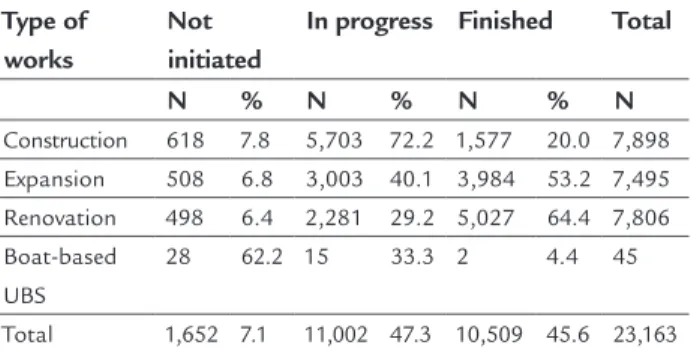
Table 1 shows the status of development and comple-tion of the infrastructure works inanced by the program, in June 2015.
According to the Ministry of Health, the improvement of the infrastructure of Primary Care in Brazil has been due to the construction of new basic health units and the
TABLE 1 Status of the infrastructure works – PMM/
June 2015.
Type of works
Not initiated
In progress Finished Total
N % N % N % N
Construction 618 7.8 5,703 72.2 1,577 20.0 7,898 Expansion 508 6.8 3,003 40.1 3,984 53.2 7,495 Renovation 498 6.4 2,281 29.2 5,027 64.4 7,806 Boat-based
UBS
28 62.2 15 33.3 2 4.4 45
renovation and expansion of existing units. These are investments of more than R$ 5 billion to inance 26,000 works in almost 5,000 municipalities, of which approxi-mately 10,500 are ready and other 10,000 are in progress.8 All these efforts are being made in order to ensure the
necessary structure for SUS physicians to care for the population with the highest quality and motivation.
Almost two-thirds (65%) of the total of 10,987 construction, expansion and renovation works of UBS that are in progress have more than 50% of the project carried out [...]. Preliminary results of researches still in progress have shown that the new UBS centers offer a greater diversity of services to the users, that is, present a wider range of practices. This meets the objective of solving more problems in the UBS by expanding not only the quantity of the same actions, but also performing actions that, before, the user had to look for another service to perform [...].14
Although the results presented by the Ministry of Health may appear to be welcome, the history of budget cuts and the contingency of resources that impede investments, paralyze works and make projects for maintenance, re-covery and expansion of health services and actions im-possible reinforce and justify the feeling of dissatisfaction with the success of the measures already announced and others that will follow.
The picture of the SUS health care network leaves no doubt as to its fragility due to insuficient equipment and inputs for the promotion, prevention, care and rehabilita-tion of health, as well as the poor equipment and the limited human resources indispensable for full function-ing. A recent example of the policy of expansion and for qualiication of the assistance network is the construction of UPAs, which is disastrous both for the uninished works and for those that have been closed due to lack of person-nel, equipment and supplies.1
Medical training in Brazil, medical courses and medical residency
The Ministry of Health feels it is through this axis that it will be possible to solve, permanently, the problem of the lack of professionals. Thus, the program includes an expansion plan for undergraduate and medical resi-dency courses and important changes in the way doctors and specialists are trained. The goal of the Federal Gov-ernment is to create 11.5 thousand new vacancies in undergraduate courses and 12.4 thousand positions for medical residency until 2017. Of these, over 5,000 under-graduate vacancies have already been authorized and nearly 5,000 for residency.
[...] Plan and regulate the expansion of medical education in Brazil [...]. New National Curriculum Guidelines for Medical Courses. [...] Implementation of the progressive evaluation for medical students of the second, fourth and sixth years provided for in Law no. 12871/2013. [...] Implementation of the Organizational Contracts for Public Action of Health Teaching [...] Caring for SUS users by physicians who have already been awarded their undergraduate degree and who will be doing their specialization in General Family and Community Medicine. [...] Guarantee of universalization of access to medical residency for all medical graduates who inished their undergraduate programs in the previous year up to 2018. [...] Training of one or two years for all physicians who want to follow another specialty other than the nine mentioned in Law no. 12871/2013. [...] National Register of Specialists in the second half of 2018, with the orientation and planning of the offer of medical residency directed as needed [...]. In the international context, the PMM proposes the institutionalization of a new cycle of reforms in the scope of Brazilian medical education, integrating these processes with the policies of permanent education established in the context of the SUS.14
For medical entities, the creation of new medical schools is unnecessary if one takes into account that Brazil is the second country in the world with the largest number of medical schools, behind India, only. If we use the popula-tion criterion, Brazil comes irst – India has 1.2 billion inhabitants and 272 schools, Brazil has 190 million peo-ple and 175 medical schools. China has 150 schools and 1.35 billion inhabitants. Brazil leaves even the US behind, with its 130 medical schools for approximately 300 mil-lion people.28
Chart 19 shows the increase in the number of medical doctors registered in the Regional Boards of Medicine be-tween 2000 and 2014, and the projections of new vacancies in medical undergraduation courses, according to the fore-casts of the Ministry of Education, between 2015 and 2020. The creation of new medical schools rose doubts and uncertainties about the possibility of quality education being offered as well as minimum and suficient structure for medical students including laboratories, outpatient clinics and teaching hospitals for service training indis-pensable to the physician. For the Federal Board of Med-icine, most of these new projects do not meet current needs, curriculum guidelines, and minimum conditions for physician training. This will result in poorly trained doctors, which compromises the quality of care.28
has stricto sensu training, with that of a medical doctor recognized in the ield for his or her professional skills. The latter in relation to the former is not synonymous with ability, talent or vocation to the teaching profession, and is no guarantee of pedagogical technique.
The practice of medicine in Brazil evokes a mosaic, which makes it even more complex to ind answers about the ideal proile and number of physicians to respond to the demands and health needs of the population. The signiicant increase in the number of doctors in the last decades, with more and more professionals entering the labor market each year – which might become more evident with the opening of more medical courses – has not yet been accompanied by spontaneous improvement in the distribution of doctors or a reduction of inequalities in terms of the population’s access to medical care. The continued existence of medical “deserts” is paradoxical in a country that strongly invests to increase the number of practicing doctors, without repercussions so far in terms of improving the distribution of such professionals.9
F
INAL REMARKSThe regional inequalities of concentration and dispersion of physicians, demonstrated by studies on medical de-mography in Brazil, are due to several factors, including the lack of a career plan and working conditions. To
improve health in the country, the SUS system needs much more than physicians. The igure of a physician is pointless if there are no safe and ethical conditions to reach a diagnosis, to establish the therapeutic plan and monitor the rehabilitation of the patient. The citizens will continue to be left abandoned by the State, robbed from their right to health, if there is no adequate number of consultations in primary and specialized care units, medicines, laboratory and imaging exams, emergency care and hospital beds.
Local government funding has ended. Both state and federal governments need to invest more. Professional management tends to reduce the ineficiency of the actions and services provided, in addition to hindering the his-torically capillary corruption in the public machine.
The lack of suficient studies, whose results can en-sure the effectiveness of the PMM, notably by improving health indicators of the population and by assessing SUS user satisfaction, should serve as fuel for deepening the debate and to make future investigations more accurate in every sense.
Therefore, it is not a question of ignoring the merits and advances deriving from the PMM, but rather of seek-ing to contribute to the absolutely uninished debate by drawing attention to the possibility of being able to think of it as an object of thought in political analysis to under-stand it as a biopolitical device for population control.29,30
CHART 1 Increase in the number of new physicians, based on new registrations and projection of new vacancies in medical undergraduate programs – Brazil, 2015.
Source: Scheffer et al.9
New registrations New vacancies
35,000
30,000
25,000
20,000
15,000
10,000
5,000
2000 01 02
12,481 12,092 13,771
14,386
17,267
20,799 21,109
23,959
32,476
27,129
22,039 20,899
19,359 17,900
14,399 12,764
12,456 11,698
12,120
11,414 11,245
R
ESUMODialética de uma política de provimento médico em áreas prioritárias no Brasil
Introdução: As populações que vivem em áreas vulnerá-veis e de difícil acesso no Brasil representam uma parcela da população que vem se mostrando bastante sensível à falta de médicos e de serviços de saúde. O governo, bus-cando responder em caráter emergencial a essa situação, instituiu o Programa Mais Médicos, em 2013.
Objetivo: Problematizar o Programa Mais Médicos, com o propósito de contribuir para o debate sobre as políticas de provimento médico no Brasil.
Método: Ensaio a partir da revisão dos documentos oi-ciais: Programa Mais Médicos – dois anos: mais saúde para os brasileiros, 2015; Relatório de Auditoria Operacional TC
nº 005.391/2014-8, do Tribunal de Contas da União, e
Demograia Médica no Brasil 2015.
Resultados: A importação de médicos intercambistas, que não passaram por revalidação do diploma, deixou dúvidas sobre a qualidade técnica dos serviços ofertados à população. Na infraestrutura, o contingenciamento de recursos paralisou obras e inviabilizou projetos de manutenção da rede assistencial. A criação de novas faculdades de medicina gerou incertezas quanto à pos-sibilidade de ser oferecido um ensino de qualidade, com estrutura mínima e suiciente de laboratórios, ambu-latórios e hospitais-escola, indispensáveis à formação do médico.
Conclusão: As desigualdades regionais de concentração e dispersão de médicos, mostradas por estudos sobre a demograia médica no Brasil, decorrem de vários fatores, como falta de um plano de carreira e de condições de trabalho. De nada adianta ter o médico se este não dis-puser de condições seguras e éticas para elaborar o diag-nóstico, a terapêutica e acompanhar a reabilitação de seu paciente.
Palavras-chave: atenção primária à saúde, distribuição de médicos, política pública de saúde, populações vulne-ráveis, sistema único de saúde.
R
EFERENCES1. Campos GWS. Desaios políticos e organizacionais do SUS: vinte anos de política pública. Cad Saúde Pública. 2008; 24(10):2200-1.
2. Koga D. Territórios de vivência em um país continental. Serv Soc Saúde. 2015; 14(1):9-26.
3. Lei n. 8.080, de 19 de setembro de 1990. Dispõe sobre as condições para a promoção, proteção e recuperação da saúde, a organização e o funcionamento dos serviços correspondentes e dá outras providências. Diário Oicial da União, 19 Sep 1990.
4. Lei n. 8.142, de 28 de dezembro de 1990. Dispõe sobre a participação da comunidade na gestão do Sistema Único de Saúde e sobre as transferências intergovernamentais de recursos inanceiros na área da saúde e dá outras providências. Brasília: Diário Oicial da União; 28 Dec 1990.
5. Instituto Nacional de Assistência Médica da Previdência Social. Resolução n. 273, 7 de janeiro de 1991. Brasília; 1991.
6. Barat J. Logística, transporte e desenvolvimento econômico. São Paulo: CLA Editora; 2007. v. 4.
7. Brasil. Constituição (1988). Constituição da República Federativa do Brasil. Brasília: Senado Federal; 1988.
8. Campos GWS. Reforma política e sanitária: a sustentabilidade do SUS em questão? Ciênc Saúde Coletiva. 2007; 12(2):301-6.
9. Scheffer M, coordinator. Demograia Médica no Brasil 2015. São Paulo: Departamento de Medicina Preventiva, Faculdade de Medicina da USP. Conselho Regional de Medicina do Estado de São Paulo. Conselho Federal de Medicina; 2015. Available from: http://www.lip3d.com.br/web/temp_ site/edicao-c6a01432c8138d46ba39957a8250e027.pdf.
10. Fleck MPA. O instrumento de avaliação de qualidade de vida da Organização Mundial da Saúde (WHOQOL-100): características e perspectivas. Ciênc Saúde Coletiva. 2000; 5(1):33-8.
11. Oliveira Neto JCDC, Pires MCDC. Indicador municipal de saúde: Uma análise dos Sistemas Municipais de Saúde no Brasil. Planej Políticas Públicas. 2006; (29):79-99.
12. Brasil. Medida Provisória n. 621, de 8 de julho de 2013. Institui o Programa Mais Médicos. Brasília: Diário Oicial da União; 8 Jul 2013.
13. Lei n. 12.871, de 22 de outubro de 2013. Institui o Programa Mais Médicos, altera as Leis n. 8.745, de 9 de dezembro de 1993, e n. 6.932, de 7 de julho de 1981, e dá outras providências. Brasília: Diário Oicial da União; 22 Oct 2013.
14. Ministério da Saúde. Secretaria de Gestão do Trabalho e da Educação na Saúde. Programa mais médicos – dois anos: mais saúde para os brasileiros. Brasília; 2015.
15. Donnangelo MCF. Medicina e sociedade: o médico e seu mercado de trabalho. São Paulo: Pioneira; 1975.
16. Donnangelo MCF, Pereira L. Saúde e sociedade. 2. ed. São Paulo: Duas Cidades; 1979.
17. Gonçalves RBM. Práticas de saúde: processos de trabalho e necessidades. São Paulo: Cadernos Cefor, Secretaria Municipal de Saúde de São Paulo; 1992.
18. Merhy EE. Um ensaio sobre o médico e suas valises tecnológicas: contribuições para compreender as reestruturações produtivas do setor Saúde. Interface (Botucatu). 2000; 4(6):109-16.
19. Campos GWS. Um método para análise e co-gestão de coletivos: a constituição do sujeito, a produção de valor de uso e a democracia das instituições: o método da roda. São Paulo: Hucitec; 2000.
20. Carvalho MS, Sousa MF. Como o Brasil tem enfrentado o tema provimento de médicos? Interface (Botucatu). 2013; 17(47):913-26.
21. Foucault M. O cuidado com a verdade. In: Foucault M. Ditos & Escritos V: Ética, sexualidade, política. Rio de Janeiro: Forense Universitária; 2010. 22. Tribunal de Contas da União. Relatório de Auditoria. TC n.
005.391/2014-8. Ata n. 7/2015, de 4 de março de 2015. Brasília: Plenário TCU; 4 Mar 2015. 23. Brasil. Portaria Interministerial n. 2.087, de 1º de setembro de 2011. Institui o Programa de Valorização do Proissional da Atenção Básica. Brasília: Diário Oicial da União; 1 Sep 2011.
24. Brasil. Portaria MS n. 1.377, de 13 de Junho de 2011. Estabelece critérios para deinição das áreas e regiões prioritárias com carência e diiculdade de retenção de médico integrante de equipe de saúde da família oicialmente cadastrada e das especialidades médicas prioritárias de que tratam o inciso II e o § 3º do art. 6º-B da Lei n. 10.260, de 12 de julho de 2001, no âmbito do Fundo de Financiamento Estudantil (FIES) e dá outras providências. (Redação dada pela PRT GM/MS n. 203 de 08.02.2013). Brasília: Diário Oicial da União; 13 Jun 2011.
médico integrante de equipe de saúde da família oicialmente cadastrada e das especialidades médicas prioritárias de que tratam o inciso II e o § 3º do art. 6º-B da Lei n. 10.260, de 12 de julho de 2001, no âmbito do Fundo de Financiamento Estudantil (FIES) e dá outras providências. Brasília: Diário Oicial da União; 8 Feb 2013.
26. Brasil. Portaria Conjunta SGTES/MS n. 1, de 21 de janeiro de 2014. Dispõe sobre o Módulo de Acolhimento e Avaliação de médicos intercambistas nas ações educacionais e de aperfeiçoamento desenvolvidas no âmbito do Projeto Mais Médicos para o Brasil. Brasília: Diário Oicial da União; 21 Jan 2014.
27. Brasil. Portaria Conjunta SGTES/MS-SESU/MEC n. 31, de 5 de junho de 2015. Dispõe sobre o Módulo de Acolhimento e Avaliação do Projeto Mais Médicos para o Brasil. Brasília: Diário Oicial da União; 5 Jun 2015. 28. Conselho Federal de Medicina. Radiograia do ensino médico. Boletim
on-line. Brasília: CFM; 2015.
29. Weber CAT. Programa de Saúde da Família: educação e controle da população. Porto Alegre: AGE; 2006.