Elisabeth Meloni Vieira Luiz de Souza
Departamento de Medicina Social. Faculdade de Medicina de Ribeirão Preto. Universidade de São Paulo. São Paulo, SP, Brasil
Correspondence:
Elisabeth Meloni Vieira
Av. dos Bandeirantes 3900 – Bairro Monte Alegre
14049-900 Ribeirão Preto, SP, Brasil E-mail: [email protected] Received: 04/03/2008 Revised: 08/15/2008 Approved: 10/12/2008
Access to surgical sterilization
through the National Health
System, Ribeirão Preto,
Southeastern Brazil
ABSTRACT
OBJECTIVE: To characterize the profi le of individuals who were unable to obtain the surgical contraception procedure, and associated factors.
METHODS: This was a cross-sectional study conducted in Ribeirão Preto (Southeastern Brazil) in 2004, on 230 individuals who were unable to obtain sterilization surgery through the National Health System (SUS) between 1999 and 2004. A questionnaire on sociodemographic information, use of contraceptive methods, aspects of sterilization and desire to undergo sterilization in the future was applied. The variables of sex, age, religion, per capita income, marital status and schooling level were compared between the total number of individuals who were unable to obtain this procedure and 297 individuals who were sterilized.
RESULTS: Among the 230 interviewees, 21.3% were men and 78.7% were women. Most of them were married, white and Catholic and had had at least four years of schooling. The median monthly per capita income was R$ 140.00. Twenty-three of them (10%) had hopes of undergoing the operation. The remaining 207 were classifi ed in two groups: 71% had decided to postpone the operation and 29% had faced obstacles in relation to gaining access to sterilization. The latter group was associated with being female, young and black. After logistic regression, being black was the only factor that remained associated with inability to obtain sterilization. Comparison with individuals who were able to obtain the procedure showed that being female, older, evangelical and single were associated with inability to obtain sterilization, while higher income and schooling levels favored access.
CONCLUSIONS: Few of the individuals studied had not had access to sterilization. Most had postponed the procedure and a smaller proportion had encountered institutional obstacles. Blacks encountered more barriers than whites did.
DESCRIPTORS: Sterilization, Reproductive. Urogenital Surgical Procedures. Health Service Access. Equity of Access. Socioeconomic Factors. National Health System (SUS). Health Inequalities.
INTRODUCTION
According to law 9.263a and the Ministry of Health’s
ordinance 144,b the Brazilian National Health System
(Sistema Único de Saúde, SUS) must offer all contra-ceptive methods, including surgical sterilization, with adequate counseling.
In Ribeirão Preto (Southeastern Brazil), surgical ster-ilization through SUS started to be offered in 1999. This provision consisted of several actions, including establishing a maternity hospital as a referral center that was properly certifi ed to carry out sterilization surgery (vasectomy and tubal ligation), and a process of continuing capacitation for health professionals within the primary healthcare network, so that they could give guidance and counseling regarding contraception.c
Five years after implementation, an assessment was conducted on various aspects of the provision of surgi-cal methods,c with the aim of improving the quality of
the service. According to Bruce2 (1990), improvement
of the service produces a clientele that adheres better to the use of contraceptives in family planning and is more committed towards and satisfi ed with their use. This assessment took into account access to and satis-faction with the counseling and sterilization, the pres-ence of pelvic pain and the degree of sexual satisfaction among sterilized women.5 Among the preliminary
results, it was concluded that some of the individuals who had asked for sterilization through SUS in Ribeirão Preto did not obtain the procedure.c The reasons for not
obtaining it might be related to giving up the idea of the operation or postponing it, consequent to counseling, or they might be related to obstacles due to failings of the healthcare system.
The aim of the present study was to characterize the profi le of individuals who did not obtain the surgical contraception procedure within SUS and factors as-sociated with this.
METHODS
This was a cross-sectional study conducted in Ri-beirão Preto (Southeastern Brazil) on individuals who had sought surgical sterilization through a primary healthcare unit (PHU) between October 1999 and May 2004, but did not obtain it. Their names appeared in an index book for candidate registrations, but not on a list of individuals who underwent the operation up to May 2004, supplied by the referral center. There were initially 2,631 registrations in the index book, and these individuals were identifi ed by four research
a Brasil. Lei no 9.263, de 20 de agosto de 1997. Diário Ofi cial da União. Jan 15, 1996. This regulates § 7º of article 226 of the Federal
Constitution, which deals with family planning, and establishes penalties and makes other provisions.
b Ministério da Saúde. Portaria no. 144 de 20 de novembro de 1997. Diário Ofi cial da União. Nov 27, 1997. This makes provisions regarding
general rules for family planning.
c Vieira EM. A avaliação da oferta de métodos cirúrgicos no planejamento familiar em Ribeirão Preto [thesis for the promotion to the rank of
associate professor]. Ribeirão Preto: Faculdade de Medicina de Ribeirão Preto da USP; 2005.
assistants over a four-month period (May to August 2004). Starting from the record of the procedure in the index book, the candidate’s name was checked on two specifi c lists: the vasectomy and tubal ligation lists. If neither the candidate’s name nor the partner’s name appeared on these lists, the names and personal data were checked in the Municipal Health Department’s computerized system (Hygia) to confi rm whether there was an entry in the system. In cases of the same name or incomplete names, confi rmation was sought through other data (date of birth, parents’ names or partner’s name, among others).
Out of a total of 392 names identifi ed in the index book, of individuals who did not obtain the procedure (14.9%), 230 (58.7%) were interviewed, 148 (37.8%) could not be found and fi ve (1.3%) had died between 1999 and 2004. Nine (2.3%) refused to participate in the study, of whom fi ve said they had never sought the sterilization service.
The interviews were conducted in the participants’ homes, by means of a questionnaire containing 41 questions divided into three sections: sociodemo-graphic information, use of contraceptive methods and factors relating to sterilization (reasons for not undergoing sterilization, satisfaction with the counsel-ing) and remaining desire to undergo sterilization. In an open question, the interviewees were asked to indicate the positive and negative points in their counseling. They were also asked whether they had received the hospitalization form that would allow them to arrange a date for the surgery.
The questionnaire was pretested on SUS users. The interviews for the study were held between August and December 2004, and the interviewees had received prior training. Up to three attempts to fi nd individuals in their homes were made. Forty-seven interviews (20% of the questionnaires) were randomly reapplied for quality control purposes.
The characteristics of the candidates who did not obtain the procedure and the reported reasons for this were analyzed using the chi-squared test. The variables were evaluated by means of multiple logistic regres-sion in order to identify the risk of impediments to the operation.
a Associação Brasileira de Empresas de Pesquisa. Critério de Classifi cação Econômica Brasil. São Paulo; 2003 [cited 2005 Oct 11]. Available
from: http://www.abep.org/codigosguias/ABEP_CCEB_2003.pdf
This study was approved by the Research Ethics Com-mittee of the Centro de Saúde Escola da Faculdade de Medicina de Ribeirão Preto (Health Center School of the Ribeirão Preto School of Medicine), University of São Paulo (Protocol no. 0066/03). The participants signed a free and informed consent statement.
RESULTS
Out of the 230 individuals interviewed, 49 (21.3%) were men and 181 (78.7%) were women. Their mean age at the time of requesting sterilization was 31.9 years for the women and 34.4 years for the men.
A majority of them (107; 46.5%) were formally mar-ried, while 75 (32.6%) were cohabiting. Only 24 (10.4%) were single, 19 (8.3%) were separated or divorced and fi ve (2.2%) were widowed.
In relation to skin color, 112 (53.0%) said that they were white, 78 (33.9%) mixed (black and white) and 29 (12.6%) black, and only one individual self-reported as Asian.
With regard to schooling, four (1.7%) were illiterate, 28 (12.2%) had not completed primary education (years 1 to 4), 108 (47.0%) had completed four years of education, 62 (27.0%) had completed eight years of elementary education, 26 (11.3%) had concluded high school education and only two (0.9%) had concluded university-level education.
Concerning socioeconomic condition, the Brazilian criteria were used.a These combine schooling level with
the presence of consumer goods in interviewees’ homes in order to classify them into fi ve groups. The major-ity of the interviewees (138; 60%) were classifi ed in category D, while 79 (34.4%) were in category C, eight (3.5%) in category B and fi ve (2.2%) in category E. The mean monthly family income was R$ 720.55, with a minimum of R$ 50.00 and a maximum of R$ 3,000.00. Five interviewees stated that their families did not have any income. The mean monthly per capita family income was calculated as R$ 177.50, with a minimum of R$ 7.78 and a maximum of R$ 666.67. The median monthly per capita income was R$ 140.00. With regard to religion, 137 (59.6%) said that they were Catholics, 77 (33.5%) evangelicals and seven (3.0%) spiritualists, while four (1.7%) had other religions and fi ve (2.2%) said that they did not have a religion.
The number of members of the family living in the same household ranged from one to 15 (mean and median of fi ve). The number of children still alive ranged from one to 14, with a mean of 3.3 and median
of 3.0. One interviewee said that he did not have any children that were alive.
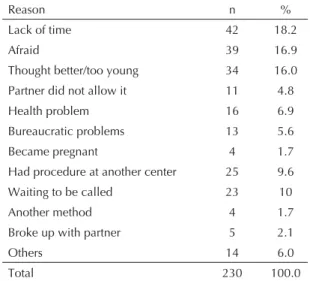
The reasons for not obtaining surgery are presented in Table 1. Among the reasons, 23 individuals (10%) said that they were still waiting to be called. The remaining 207 individuals were divided into two groups: the fi rst group (147/71.0%) gave reasons for voluntarily giv-ing up the idea of surgery or postpongiv-ing it; while the second group (60/29.0%) gave reasons outside of their control for not obtaining the procedure. Out of the 147 individuals who gave reasons for not undergoing the operation, 34 (23.1%) mentioned the defi nitive nature of the operation and that they were too young to make such a decision, 42 (28.6%) said that they had not had time available for undergoing the operation; 39 (26.5%) said that they were afraid of surgery; fi ve (3.4%) had broken up with their partners during the counseling process; four (2.7%) had decided to use other methods; nine (6.1%) mentioned health problems and 14 (9.5%) presented other reasons.
Among those who said that they were afraid of surgery, most of them indicated the risks of anesthesia or fear of pain or complications. Only two men mentioned fear of sexual impotence.
Among those who gave other reasons, the following were cited as impediments: inability to take time off work to undergo the surgery, getting the dates mixed up, losing the appointment card, accidentally tearing up the referral form, moving to another city and religious reasons, among others.
Out of the 16 (7.7%) interviewees who mentioned that a health problem had stopped them from having the op-eration, nine (56.3%) were allocated to the fi rst group, because they had been examined by a physician and had received the form for the surgery. The remaining seven were allocated to the second group.
The second group was formed by 60 individuals (29.0%), who indicated the following other reasons for the decision not to undergo sterilization: 13 (6.2%) reported problems relating to the healthcare system, 11 (5.3%) were forbidden to do it by their partners and four (6.7%) became pregnant during the process.
Twenty-fi ve individuals (12%) who underwent the operation at another place because of dissatisfaction with the service were included in this group.
and medical fi les gone astray in the maternity hospital. There were two cases in which the physician should have performed tubal ligation during the cesarean, since there was a risk to health, but the physician did not want to do it, according to the interviewees.
All of the 230 individuals who did not obtain surgery were asked whether they had been satisfi ed with the counseling that they received: 213 (92.6%) answered yes, while the remaining 17 (7.4%) said that they were dissatisfi ed because they thought that the counseling was unnecessary and was a very slow process. When asked to indicate the positive and negative points of the counseling, 216 subjects gave an answer. Most of them (162; 75.0%) were satisfi ed with the counseling, while 54 (25.0%) made some criticisms.
Among the positive points, it was emphasized that the counseling enabled clarifi cation of doubts regarding the surgery and about contraceptive methods; that this knowledge was necessary; and that they enjoyed the counseling. Among the negative points, they cited the delay in being called for surgery and the waiting time at the referral service, thus indicating that the attendance was not good. Several participants managed to present both negative and positive points, while the majority only presented positive points.
Two hundred and seven individuals were asked about how they made the decision to postpone the operation following counseling. Out of the 182 who answered this question, 127 (69.8%) said that they had made the decision themselves and, out of these, four (2.2%) said that they had been convinced, 27 (14.8%) said that they felt forced to give up the idea and 24 (13.2%) said that they had decided to give up the idea or postpone
the operation for “other reasons”, among which fear, lack of time or health problems. When asked if they had received the form for making the appointment for the surgery, 159 (69.1%) said that they had received it, while 71 (30.9%) had not. Around one third (80; 35%) told the professional doing the counseling that they had given up the idea of undergoing the procedure. When asked whether they still intended to undergo the operation, 147 (64%) said that they wanted to do so in the near future and 23 (10%) in the more distant future. Forty-fi ve individuals (19.5%) said that they did not think it was necessary any more, while 25 (10.5%) had already undergone surgery in another place.
Comparison between the individuals who apparently gave up the idea (n= 147) and those who did not obtain the procedure (n= 60) did not show any associations in relation to schooling, marital status, socioeconomic condition, income or religion. However, there were associations in relation to sex, age and color/race. A greater percentage of women did not obtain the pro-cedure for reasons outside of their control, along with younger individuals and those with self-reported black skin color (Table 2).
In the multiple logistic regression, the only signifi cant factor was color/race. Being black produced a risk of impediments relating to obtaining surgery that was 2.2 times greater (95% CI: 1.2;4.2).
Comparing the 230 individuals who did not obtain sur-gery and the sample of 297 individuals who underwent surgery, there were signifi cant differences in relation to the variables of sex, age, religion, per capita income, marital status and schooling (Table 3). The variable of skin color was not included because it did not appear in the medical fi les.
Table 2. Distribution of frequencies of individuals who gave
up the idea of sterilization and individuals who did not obtain sterilization, according to sex, age and skin color. Municipality of Ribeirão Preto, Southeastern Brazil, 1999-2004.
Variable Gave up Did not obtain p
n % n %
Sex
Male 38 84.4 7 15.6 0.025 Female 109 67.3 53 32.7
Age (years)
23-29 26 66.7 13 33.3 0.005 30-39 79 66.4 40 33.6 40 or over 42 85.7 7 14.3
Skin color
White 91 79.1 24 20.9 0.010 Mixed 42 63.6 24 36.4 Black 14 58.8 12 46.2
Table 1. Distribution of frequencies of reasons presented
for not having obtained the surgical sterilization procedure through the National Health System. Municipality of Ribeirão Preto, Southeastern Brazil, 1999-2004.
Reason n %
Lack of time 42 18.2
Afraid 39 16.9
Thought better/too young 34 16.0 Partner did not allow it 11 4.8
Health problem 16 6.9 Bureaucratic problems 13 5.6 Became pregnant 4 1.7 Had procedure at another center 25 9.6 Waiting to be called 23 10
Another method 4 1.7 Broke up with partner 5 2.1
Others 14 6.0
Among the individuals who did not obtain the proce-dure, 78.7% were women. In the group of greater age (more than 39 years), there were more individuals who had not obtained the operation (22.2%) than who had (12.5%). Evangelical religion, higher per capita income and being single were associated with not obtaining the procedure. Greater schooling level made it more likely that the surgical procedure would be chosen.
DISCUSSION
Most of the candidates for surgical sterilization through SUS are characterized as married, white, Catholic, low schooling and income levels and belonging to social categories C or D.
The results from the present study confi rm that women are younger than men when they seek surgical steriliza-tion, as has already been mentioned in a previous study.8
With regard to religion, contrary to what the Catholic church preaches, sterilization is not a method that is little sought among the church’s followers.a This could
be related to the fact that surgery is a unique event in life and is preferable to continuous use of contraceptives. Less than 15% of the candidates did not obtain surgery over the study period. The principal two reasons for not undergoing sterilization that were identifi ed were: giving up the idea, which a majority of the interviewees indicated (and which for many of them meant postpon-ing the procedure); and the barriers of the healthcare system itself, which impeded access. Postponement of the procedure might suggest good-quality counseling. On the other hand, almost one fi fth of the candidates (18%) said that fear was an impediment to surgery. Less than one third of the individuals who did not obtain surgery mentioned problems outside of their control. Among such problems were impediments coming from the spouse: these were considered to be gender prob-lems when the man did not agree to sign the woman’s form requesting sterilization from the health services. Other barriers related to the healthcare system and, among these, the long waiting time was the most impor-tant problem. This probably made 10% give up waiting and seek another health center. In the sample of 297 individuals who obtained the procedure, the mean wait-ing time was around eight months.b The long waiting
time had already been mentioned as a factor denoting low quality of the service by other authors.1,7
The three home visits on weekdays and at weekends made it possible to locate almost 60% of the candidates who had not obtained the procedure. However, this is one of the limits of the present study that needs to be taken into account. The individuals selected may have been those who were in a better socioeconomic situa-tion with greater stability of employment. Furthermore, the diffi culties in locating SUS users in Ribeirão Preto may have related to the local labor market, which is cyclical because of the agricultural harvest seasons. Several studies have presented this cyclical character-istic of the population.4,5 On the other hand, the refusal
rate was low (2.3%).
The individuals who suffered impediments most often were young people, women and blacks. In multivariate analysis, race/color was the main impediment. This is in agreement with a study on health service use con-ducted within the National Household Sampling Survey (Pesquisa Nacional por Amostra de Domicílios, PNAD,
Table 3. Distribution of the frequencies of the variable tested,
comparing individuals who obtained the surgical sterilization procedure with individuals who did not obtain it. Municipality of Ribeirão Preto, Southeastern Brazil, 1999-2004.
Variable
With procedure
Without procedure p
n % n %
Sex
Male 85 28.6 49 21.3 <0.002 Female 212 71.4 181 78.7
Age (years)
<29 77 25.9 41 17.8 29-39 183 61.6 138 60.0
>39 37 12.5 51 22.2 <0.001 Religion
Catholic 182 70.0 137 64.0 Evangelical 78 30.0 77 36.0 0.031
Per capita income
≤R$ 150.00 213 71.7 136 59.1
>R$ 150.00 84 28.3 94 40.9 <0.001 Marital status
Married 159 53.5 107 46.5 Living together 108 36.4 75 32.6
Singlea 30 10.1 48 20.9 <0.001
Schooling levelb
Low 166 56.1 140 60.9 Medium 74 25.0 62 27.0 High 56 18.9 28 12.2 0.002
aSeparated and widowed individuals were considered as
singles.
bLow schooling level: elementary education incomplete;
medium schooling level: elementary education completed and high school education incomplete; high schooling level: high school education completed and university-level education incomplete and completed.
a Ribeiro L. Anticoncepção e Comunidades Eclesiais de Base. In: Costa AO, Amado T, organizadores. Alternativas escassas: saúde, sexualidade
e reprodução na América Latina. São Paulo: Fundação Carlos Chagas/Editora 34; 1994. p. 143-73.
b Vieira EM. A avaliação da oferta de métodos cirúrgicos no planejamento familiar em Ribeirão Preto [thesis for the promotion to the rank of
2003) in which 4% of the Brazilians who did not obtain access to SUS were adults with black or mixed skin color, and with low schooling and income levels.6
Regarding the inequalities that affect health, Krieger (2005)3 indicated institutional discrimination as one of
the several forms of racial discrimination that could be
revealed through poorer healthcare for certain groups. In this respect, the Ministry of Health’s ordinance No. 719 is opportune and necessary.a This has made it
obligatory to include the question of color in all outpa-tient and hospital information systems, thereby enabling healthcare evaluations and actions towards diminishing the inequalities experienced by blacks.
a Ministério da Saúde. Portaria nº.719 de 28 de dezembro de 2007. Diário Ofi cial da União. Dec 31, 2007. This makes provisions regarding
the inclusion of the “race/color” fi eld in the Outpatient and Hospital Information Systems. 1. Berquó E, Cavenaghi S. Direitos reprodutivos de
mulheres e homens face à nova legislação brasileira sobre esterilização voluntária. Cad Saude Publica.
2003;19(Supl 2):441-53. DOI: 10.1590/S0102-311X2003000800025
2. Bruce J. Fundamental elements of the quality of care: a simple framework. Stud Fam Plann. 1990;21(2):61-91. DOI:10.2307/1966669
3. Krieger N. Embodying inequalities: a review of concepts measures and methods for studying health consequences of discrimination. Int J Health Serv. 1999;29(2):295-352.
4. Marinheiro ALV, Vieira EM, Souza L. Prevalência da violência contra mulher usuária do serviço de saúde.
Rev Saude Publica. 2006;40(4):604-10. DOI: 10.1590/ S0034-89102006000500008
5. Pacagnella RC, Rodrigues Jr OM, Souza C, Vieira EM.
Adaptação Transcultural do Indice de Função Sexual Feminina (Female Sexual Function Index-FSFI). Cad Saude Publica. 2009;25(3). No prelo.
6. Ribeiro MCSA, Barata RB, Almeida MF, Silva ZP. Perfi l sócio-demográfi co e padrão de utilização de serviços de saúde para usuários e não-usuários do SUS-PNAD 2003. Cienc Saude Coletiva. 2006;11(4):1011-22. DOI:10.1590/S1413-81232006000400022
7. Vieira EM, Ford NJ. Provision of female sterilization in Ribeirão Preto, São Paulo, Brazil. Cad Saude Publica. 2004;20(5):1201-10. DOI: 10.1590/S0102-311X2004000500013
8. Vieira EM, Fábio SV, Gueleri W, Picado MP, Yoshinaga EH, Souza L. Características dos candidatos à esterilização cirúrgica e fatores associados ao tipo de procedimentos. Cad Saude Publica. 2005;21(6):1785–91. DOI: 10.1590/S0102-311X2005000600026
REFERENCES