Skin lesions in the intraoperative
period of cardiac surgery:
incidence and characterization
*LESÕES DE PELE NO INTRA-OPERATÓRIO DE CIRURGIA CARDÍACA: INCIDÊNCIA E CARACTERIZAÇÃO
LESIONES DE PIEL EN EL INTRAOPERATORIO DE CIRUGÍA CARDÍACA: INCIDENCIA Y CARACTERIZACIÓN
* Extracted from the thesis “Lesões de pele no intra-operatório de cirurgia cardíaca: incidência, caracterização e fatores de risco”, University of São Paulo, Nursing School, 2009. 1 RN. MSc in Nursing, University of São Paulo, Nursing School. Specialist nurse in surgical center, material sterilization center, and
anesthetic recovery. São Paulo, SP, Brazil. [email protected] RN. Professor, University of São Paulo, Nursing School, Medical-Surgical Nursing Department.
O
RIGINAL
A
R
TICLE
RESUMO
Neste estudo exploratório, descritivo e de coorte o objetivo principal foi verificar a inci-dência de pacientes submetidos à cirurgia cardíaca que desenvolveram lesões de pele no período intra-operatório, caracterizar as lesões. A coleta de dados foi realizada no Cen-tro Cirúrgico (CC) de um hospital público de ensino, de atenção terciária à saúde, predo-minantemente cirúrgico, especializado em cardiologia no Município de São Paulo. A amostra do estudo foi de 182 pacientes. O estudo foi feito com um p significativo (<0,05) frente aos testes estatísticos não-paramétri-cos. Quanto à incidência de pacientes subme-tidos à cirurgia cardíaca, que desenvolveram lesões de pele em decorrência do período intra-operatório, obteve-se incidência de 20,9%. Tivemos que 19,2% das lesões apre-sentaram-se como Úlceras por Pressão (UP) no estágio I; 1,1% das lesões caracterizaram-se como abrasão; 1,1% feridas incisas; 0,5% laceração; 0,5% queimadura elétrica superfi-cial e 0,5% UP no estágio II.
DESCRITORES
Cirurgia torácica
Enfermagem perioperatória Período intra-operatório Pele
Ferimentos e lesões Úlcera por pressão
Geisa Aguiari Carneiro1, Rita de Cássia Burgos de Oliveira Leite2
ABSTRACT
The main objective of this exploratory, de-scriptive cohort study was to verify the in-cidence of patients submitted to cardiac surgery who developed skin lesions during the intraoperative period, and characterize the lesions. Data collection was performed at the Surgery Department of a public teaching hospital, of tertiary health care, mostly surgical, specialized in cardiology, and located in São Paulo. The study sample consisted of 182 patients. The study was performed with a significant p (<0.05) in nonparametric statistical tests. The inci-dence found for patients submitted to car-diac surgery who developed skin lesions due to the preoperative period was 20.9%. It was observed that 19.2% of lesions were Pressure Ulcers (PU) in stage I; 1.1% of le-sions were abrasive; 1.1% incisive; 0.5% lacerative; 0.5% superficial electrical burns; and 0.5% PU in stage II.
DESCRIPTORS
Thoracic surgery Perioperative nurse Intraoperative period Skin
Wounds and injuries Pressure ulcer
RESUMEN
Estudio exploratorio, descriptivo y de cor-te, que objetivó principalmente verificar la incidencia de pacientes sometidos a ciru-gía cardíaca que desarrollaron lesiones de piel en período intraoperatorio, y caracte-rizar tales lesiones. Recolección de datos realizada en Centro Quirúrgico (CC) de hos-pital público de enseñanza, de atención ter-ciaria de salud, predominantemente quirúr-gico, especializado en cardiología, del mu-nicipio de San Pablo. La muestra se consti-tuyó con 182 pacientes. El estudio se reali-zó con un p significativo (<0,05) frente a tests estadísticos no paramétricos. Respec-to a incidencia de pacientes sometidos a cirugía cardíaca que desarrollaron lesiones de piel derivadas del período intraoperato-rio, se obtuvo incidencia de 20,9%. El 19,2% de las lesiones se presentaron como Úlcera por Presión (UP) en estadío I; 1,1% de las lesiones correspondieron a abrasión; 1,1% a heridas por incisión; 0,5% laceraciones; 0,5% quemadura eléctrica superficial y 0,5% UP en estadío II.
DESCRIPTORES
Cirugía torácica
Enfermería perioperatoria Periodo intraoperatorio Piel
INTRODUCTION
Maintenance of coetaneous integrity is a care action to be individually provided to each patient jointly with other care procedures in the intra-operative period, using tech-nical and scientific knowledge. The prevention of skin inju-ries is associated with clinical aspects related to patients, mechanical, chemical and electrical accidents, as well as with procedures performed during the intra-operative pe-riod. The nursing team should pay attention to patients’ position while in surgery.
Perioperative nursing is grounded on six principles: in-tegrality, individuality, participation, continuity, documen-tation and assessment. Documendocumen-tation needs to be con-sidered a goal in any modality of care. Considering that a surgical patient remains for a certain period of time in a condition of absolute dependency on nursing care, records of actions performed are extremely important from an ethi-cal and legal point of view(1).
A patient who has undergone cardiac surgery requires nursing care in the perioperative period. The
nurse identifies the care required after a detailed assessment of the patient’s data. A care plan is devised based on the patient’s relevant diag-noses, such as: immobility, high risk of lesions due to surgical position and high risk of lesions regarding tissue integrity related to Extra Cor-poreal Circulation (ECC) and hypothermia.
LITERATURE REVIEW
The maintenance of patients’ skin integ-rity was identified by the American Nurses Association as an important indication of the
quality of nursing care. Other organizations, including the Association of Perioperative Registered Nurses (AORN) de-veloped guidelines and recommended practices focused on the care and integrity of patients’ skin(2).
Nursing care promoted to the patient in the intra-op-erative period reflects on the post-opintra-op-erative period(3). Many skin lesions begin in the surgical room and end up aggra-vated in the post-surgical period(4). The national literature is still in an incipient phase in relation to studies address-ing skin lesions that develop and are observed in the intra-operative period.
Surgical patients are the first candidates for tissue is-chemia due to diminished capillary blood flow caused by a prolonged time of immobility and pressure. Intentional or non-intentional episodes of hypotension confer on the pa-tient increased intolerance to pressure(4). Studies indicate
that the onset of skin lesions such as pressure ulcers (PU) are inherent to the intra-operative period due to dimin-ished sensorial perception, prolonged immobility and the impossibility of moving the patient during the surgery(2,5).
OBJECTIVE
•
To characterize the sample in relation to socio-demo-graphic and clinical variables of patients who have experi-enced cardiac surgery•
To verify the incidence of patients who have experi-enced cardiac surgery and who developed skin lesions in the intra-operative period and healing processMETHOD
This exploratory, descriptive, cohort study was con-ducted in the surgical center of a university public hospital. It provides tertiary health care, predominantly surgical care specialized in cardiology, in the city of São Paulo, SP, Brazil. The study was approved by the Research Ethics Committee for analysis of research projects (Protocol No. 0570/08). Free and informed consent forms was read and signed by all the participants and each kept one copy.
Data collection was carried out between October 2009 and February 2009. A total of 222 patients were selected to participate in the study, 36 of which did not agree to par-ticipate, two others had their surgery can-celled, and two could not be evaluated in all the study’s phases. Hence, the sample was composed of 182 patients.
Two instruments were used in data collection: Instrument 1 – Data collection in the immediate pre-operative period; Instrument 2 –post surgery data collection in the surgery room. One nurse was specifically trained to evaluate patients and to complete the instruments. The level of significance was fixed at = 0.05 for non-parametric statistical tests.
RESULTS
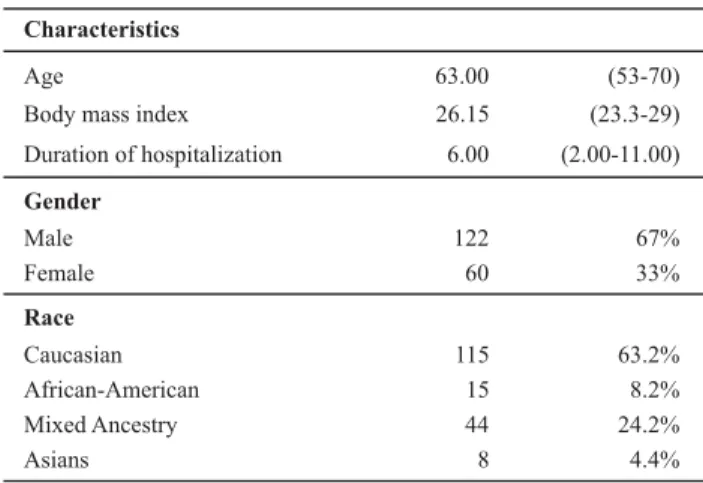
As shown in Table 1, most of the studied patients were male (67%), aged on average 63 (53 – 70) years old. The participants were predominantly Caucasian (63.2%) fol-lowed by those of mixed ancestry (24.2). The patients dis-played a Body Mass Index (BMI) average of 26.15 (23.3 – 29) and their duration of hospitalization had a median of six days (2 – 11).
The prevention of skin injuries is associated
with clinical aspects related to patients, mechanical, chemical
and electrical accidents, as well as
Table 1 - Characteristics of the sample concerning socio-demo-graphic profile of patients submitted to cardiac surgery - São Paulo, SP, Brazil - 2008-2009
Age 63.00 (53-70) Body mass index 26.15 (23.3-29) Duration of hospitalization 6.00 (2.00-11.00)
Gender
Male 122 67%
Female 60 33%
Race
Caucasian 115 63.2% African-American 15 8.2% Mixed Ancestry 44 24.2% Asians 8 4.4%
Characteristics
Note: (n=182). Data expressed in median (Lower quartiles - upper quartiles) and absolute (n) and relative (%) frequency
This study presented an incidence of 20.9% (38) of pa-tients who developed skin lesions due to the intra-opera-tive period of cardiac surgery (Table 2).
Table 2 - Incidence of patients who presented skin lesions due to the intra-operative period - São Paulo, SP, Brazil - 2008-2009
Total of patients
in the sample 144 (79.1%) 38 (20.9%) 182 (100.0%)
Incidence of patients who presented skin lesions
No N%
Yes
N% N%
Total
Table 3 lists the characteristics of skin lesions and their frequency found in this study’s sample. A total of 35 (19.2%) lesions were PU in stage I; two (1.1%) were skin abrasions; two (1.1%) incision wounds; one (0.5%) laceration; one (0.5%) superficial electrical burn and one (0.5%) PU stage II.
Table 3 - Characterization of skin lesions during the intra-operative period and their frequency - São Paulo, SP, Brazil - 2008-2009
Type of lesion Frequency %
PU Stage I 35 19.2
Abrasion 2 1.1
Incision wounds 2 1.1
Laceration 1 0.5
Superficial electrical burn 1 0.5
PU Stage II 1 0.5
Table 4 presents the site of lesions, the frequency and type of lesion at each site.
In relation to the site of lesions: 20 (11%) were located on the sacrum coccyx; six (3.3%) on the left buttocks; four (2.2%) on the right hand; three (1.6%) were located on the left leg; two (1.1%) on the left chest and one lesion (0.5%) was found on the left hand, right scapula, left malleolus, right arm, right eyelid, mouth and right chest.
Table 4 - List of sites of skin lesions due to the intra-operative period, frequency and characteristics of lesions - São Paulo, SP, Brazil - 2008-2009
Site of lesions Frequency Type
Sacrum coccyx 20 PU-I
Left buttocks 4 PU-I
Left buttocks 1 PU-II
Left buttocks 1 Superficial burn
Right hand 4 PU-I
Left leg 3 PU-I
Left chest 1 Incision wound
Left chest 1 Laceration
Left hand 1 PU-I
Right scapula 1 PU-I
Left malleolus 1 PU-I
Right arm 1 PU-I
Right eyelid 1 Abrasion
Mouth 1 Incision wound
Right chest 1 Abrasion
DISCUSSION
Data in table 1 show that the median age in the sample was 63 years old (53-70). The World Health Organization(6) chronologically classifies elderly individuals as those older than 65 years old in developed countries and older than 60 years old in developing countries. This classification is justifi-able given the increased life expectancy of the Brazilian popu-lation and the world popupopu-lation in general in recent decades and the prevalence of heart disease among elderly individu-als. The incidence of unstable angina and arterial vascular disease affect lower limbs and carotid arteries, and also the proportion of myocardial revascularization surgeries, isolated or combined with valvulopathy, is significantly higher among older individuals(7).
In relation to days of hospitalization prior to the surgi-cal procedure, a median of six days (2-11) was identified. Many patients were hospitalized the day before the sur-gery because they already had preoperative exams while others required several days for taking exams and preop-erative preparation. In a study addressing skin care pro-vided to patients who underwent cardiac surgery, the au-thor indicates a high duration of hospitalization as an im-portant factor in the development of skin lesions(8).
impor-tant factor of morbidity, increasing by 2-4 times the risk of coronary artery disease (CAD) in exposed patients(9). Risk factors, related to the use of alcohol and smoking, were present in 20.9% and 13.2% respectively.
In relation to the characteristics of patients’ skin evalu-ated in the preoperative period relevalu-ated to color: most pre-sented pale pink skin (76.4%); texture of skin was predomi-nantly normal (56%) followed by thin skin (35.7%). In the assessment concerning skin turgor, 67% of the sample pre-sented normal turgor and 33% diminished turgor. Assessment of skin moisture indicated 61.5% of patients had normally moist skin; 37.9% dry skin and 0.5% had skin diaphoresis.
The sample in this study presented predominantly pink-ish clear skin (76.4%) within the normal parameters in rela-tion to texture (56%), turgor (67%) and moisture (61.5%). Clinical studies addressing PU do not mention the charac-teristics of patients’ skin in relation to skin color, texture, turgor or moisture(10-12).
In the discussion of data presented in Table 2, incidence studies are frequently performed to convey the importance of the problem and the study and to compare results. The rate of incidence is determined by the number of new cases that appeared in a period divided by the number of people exposed to risk in the same period. The sample of this study that included 182 patients exposed to the risk of lesions and the incidence found of patients who presented skin lesions in to the intra-operative period was 20.9% (38).
In a study with patients having cardiac surgery, the au-thors report an incidence of 21.6% of PU in patients de-tected in the immediate postoperative period(13). An experi-mental study with surgical patients reported that 21.5% of the patients developed PU six days post surgery(14). Another study found 21.2% of patients experienced PU two days post surgery(15).
In a study that addressed lesions in the sacral region of patients who have had cardiac surgery, the author found an incidence between 12% and 17%(16), similar to the re-sults of other studies with surgical patients that report an incidence of 12% and 15.6%(1,17).
A study conducted with 337 patients addressing risk fac-tors for PU in patients after cardiac surgery reports that all patients left the surgery room with intact skin and 4.7% (16) of these patients presented lesions four days subse-quent to the surgery. This result shows an incidence below what was found in this study, though the author infers that one of the causes for the low incidence was that the nurs-ing team increased care in relation to the risks of develop-ing lesions durdevelop-ing the follow-up of patients for the study(4).
In relation to the characterization of lesions presented in Table 3, 35 (19.2%) out of the 38 lesions presented char-acteristics that indicated PU in stage I, two (1.1%) were abrasion lesions, two (1.1%) had the characteristics of inci-sion wounds, one (0.5%) was a laceration, one (0.5%) was
a lesion with characteristics of a superficial electrical burn and one (0.5%) had characteristics of PU in stage II.
Another study identified PU with 62% in stage I, 29% in stage II and 4% in stage III(8). Another study found that 45% of PU were in stage I(18). Other studies report a higher oc-currence of pressure ulcers in stage I(13-14,17). In the study with PU preventive devices in surgical patients found a higher incidence of PU in stage II(19). Studies addressing PU in surgical patients indicate that a lesion in stage I is the most frequent, data corroborated by this study.
Many skin lesions begin in the surgical room and are aggravated in the post surgical period(2). The nursing team should be very attentive at the time to position the patient for surgery, check whether there are folds in the sheets, whether all resources are being used to provide appropri-ate protection, and whether the accessories available in the facility are being used.
A lesion with characteristics of stage I PU is not always considered in the daily routine of surgical environments. The importance of noting this type of early lesion is that it is a powerful piece information to prevent it from worsen-ing. Care should be provided by the nursing staff in the postoperative period such as changing the patient’s posi-tion, using devices to reduce pressure and monitor the pro-gression of the lesion. Studies report that most of the stage I PU lesions improve with the region’s overall skin integrity; that is, postoperative care is crucial to the improvement of skin lesions(2,8,14,17-18).
Table 4 presents the lesion sites during the intra-opera-tive period. Most of the lesions found in the study’s sample were located in the sacrum coccygeal (20), followed by the region of the left buttock (six), right hand (four), left leg (three) and others.
It is worth noting that the areas of skin pressure most frequently occur in the dorsal position, which is the most common position. This position permits access to body cavi-ties (cranial, thoracic and abdominal) and the four limbs(20).
Patients composing this study’s sample and who had surgery remained in the dorsal position during the entire procedure in 100% of cases. The dorsal position favors greater pressure in the sacral region due to the bony promi-nence and because it is a central point of an individual’s weight distribution. Usually, the areas susceptible to le-sions are directly related to bad surgical positioning, pro-tection resources and position accessories.
lesions occurred in the sacral region, with an incidence of 57.2%, followed by 21.41% of lesions on the back, and 14.2% on the heels(13).
A study addressing the immediate postoperative period, with an incidence of 15.6% (65), found 39 lesions in the sacral region, 40 on the buttocks and 16 on the heels(17). In another study with surgical patients, 29.7% were on the heels and 18.9% on the sacral region(15).
Most of the lesions that occurred on the sacral region had characteristics of PU in stage 1. In the dorsal position the potential areas of pressure are occipital, scapular, sac-ral and calcaneal areas. These offer greater interface be-tween the surgical table while these regions are prone to the development of lesions, especially PU(22). All the study’s patients were positioned in the dorsal position due to the access required for cardiac surgery.
CONCLUSION
This study’s main objective was to verify the incidence of patients undergoing cardiac surgery who developed skin lesions in the intra-operative period and to characterize lesions developed by patients, not their causes. In this con-text the results related to the sites and characteristics of lesions are presented though the causes that determined the lesions were not investigated, whether they were caused
by pressure, electrical or monitoring devices, or by chemi-cal solutions.
Further research addressing this subject is extremely important. As previously described, studies related to skin lesions mentioned in this study showed evidence of pres-sure ulcers. This study focused on the importance of evalu-ating patients in order to identify other types of skin le-sions resulting from the intra-operative period. Hence, in-dividualized nursing care can bolster the prevention of skin lesions in the intra-operative period.
Much has been studied regarding skin integrity related to the prevention of pressure ulcers but there are few stud-ies focusing on skin lesions in the intra-operative period. This study reveals the incidence of skin lesions in the intra-opera-tive period in a small number of patients but prompts nurses to consider more carefully the type of care to be provided to patients. Moreover, it indicates the need for studies address-ing the subject since some variables could not be deeply in-vestigated and others still need to be addressed.
Nurses should be concerned to be with patients in the in-tra-operative period and provide the best care possible, en-suring the safety of their patients. Patients need to be reevalu-ated throughout their entire stay in the surgical environment. Documentation and records concerning the entire care pro-vided, mobilization of patients, protection used and where they were used, as well as clinical condition, are all essential.
REFERENCES
1. Castellanos BEP, Jouclas VMG. Assistência de enfermagem perioperatória: num modelo conceitual. Rev Esc Enferm USP. 1990;24(3):359-70.
2. Cruz EA, Soares E. O centro cirúrgico como espaço do cuidado
na relação enfermeira/ paciente.Rev SOBECC. 2004;9(2):11-6.
3. Lewicki LJ, Mion L, Splane KG, Samstag D, Secic M. Patient risk factors for pressure ulcers during cardiac surgery. AORN J. 1997;65(5):933-42.
4. Byers PH, Carta SG, Mayrovitz HN. Pressure ulcer research issues in surgical patients. Adv Skin Wound Care. 2000;13(3 Pt 1):115-21.
5. Organização Mundial da Saúde (OMS). Obesidade: prevenindo e controlando a epidemia global. São Paulo: Roca; 2004.
6. Alves L Jr, Rodrigues AJ, Évora PRB, Basseto S, Scorzoni AF, Luciano PM, et al. Fatores de risco em septuagenários ou mais idosos submetidos à revascularização do miocárdio e ou ope-rações valvares. Rev Bras Cir Cardiovasc. 2008;23(4):550-5.
7. Pokorny ME, Koldjeski D, Swanson M. Skin care intervention for patients having cardiac surgery. Am J Crit Care. 2003;12(6): 535-44.
8. Martins SK, Santos MA, Tirado FHP, Martins FCE Jr, Malat HF, Jatene AD, et al. Revascularização do miocárdio com emprego de ambas artérias mamárias internas em pacientes com diabe-tes mellitus. Rev Bras Cir Cardiovasc. 2007;22(3):291-6.
9. Costa IG. Incidência de úlcera de pressão e fatores de risco re-lacionados em pacientes de um Centro de Terapia Intensiva [dis-sertação]. Ribeirão Preto: Escola de Enfermagem, Universida-de Universida-de São Paulo; 2003.
10. Rogenski NMB, Santos VLCG. Estudo sobre incidência de úl-cera por pressão em um hospital universitário. Rev Lat Am Enferm. 2005;13(4):474-80.
11. Serpa LF.Capacidade preditiva da sub escala de nutrição da
Escala de Braden para avaliar o risco de desenvolvimento de ulcera por pressão [tese]. São Paulo: Escola de Enfermagem, Universidade de São Paulo; 2006.
13. Zimmer M, Ribeiro FG, Camargo A, Hayashi ELO. Incidence and risk factors related to Pressure Ulcer (PU) in patients submitted to Coronary Artery Bypass Graft (CABG) [abstract]. In: 50º Annual Association of PeriOperative Registred Nurses (AORN) Congress; Chicago, US; 2003.
14. Schultz A, Bien M, Drumond K, Brown K, Myers N. Etiology and incidence of pressure ulcers in surgical patients. AORN J. 1999;70(3):434-49.
15. Silva SS, Millidiú V, Urbaneto JS, Gustavo AS, Hax G. Indicador assistencial de enfermagem: incidência de úlceras de pres-são em adultos hospitalizados. Rev Graduação [Internet]. 2007 [citado 2008 fev. 11];1(1):17-21. Disponível em: http:// revistaseletronicas.pucrs.br/ojs/index.php/graduacao/article/ view/2776/2119
16. Kemp MG, Keithley JK, Smith DW, Morreale B. Factors that contribute to pressure sores in surgical patients. Res Nurs Health. 1990;13(5):293-301.
17. Nixon J, Brown J, Mc Elvenny D, Mason S, Bond S. Prognostic factors associated with pressure sore development in the immediate post-operative period. Int J Nurs Stud. 2000; 37(4):279-89.
18. Grous CA, Reilly NJ, Gift AG. Skin integrity in patients undergoing prolonged operations. J Wound Ostomy Continence Nurs. 1997;24(2):86-91.
19. Aronovitch SA, Wilber M, Slezak S, Martin T, Utter D. A comparative study of an alternating air mattress for the prevention of pressure ulcers in surgical patients?. Ostomy Wound Manage. 1999;45(43):34-44.
20. Ricker LE. Posicionamento do paciente para a cirurgia. In: Meeker MH, Rothrock JC. Alexander: cuidados de enferma-gem ao paciente cirúrgico. 10ª ed. Rio de Janeiro: Guanabara Koogan; 1997. p. 90-105.
21. Silveira, CT. A assistência da equipe de enfermagem no posi-cionamento cirúrgico do paciente durante o período intra-operatório [dissertação]. São Paulo: Escola de Enfermagem, Universidade de São Paulo; 2008.