Quality of Life and Mortality Assessment in Patients
with Major Cardiac Events in the Postoperative Period
Fernando José Abelha
1, Miguela Botelho
2, Vera Fernandes
2, Henrique Barros
3Summary: Abelha FJ, Botelho M, Fernandes V, Barros H – Quality of Life and Mortality Assessment in Patients with Major Cardiac Events in the Postoperative Period.
Background and objectives:Cardiovascular complications in the postoperative period are associated with high mortality and morbidity. Few studies have assessed the degree of dependence in these patients and their perception of health. The objective of this study was to assess the mortality and the quality of life in patients who developed major cardiac events (MCE) in the postoperative period.
Method: Retrospective study carried out in a Surgical Intensive Care Unit (SICU), between March 2006 and March 2008. The patients were assessed regarding the occurrence of CE. Six months after the hospital discharge, the Short-Form-36 (SF-36) questionnaire was filled out and dependence was assessed in relation to activities of daily living (ADL). The comparisons between independent groups of patients were carried out using Student’s t test. The comparison between each variable and the occurrence of CE was carried out by logistic regression and included all patients.
Results:Of the 1,280 patients that met the inclusion criteria, 26 (2%) developed MCE. The univariate analysis identified as independent determinants for the development of major cardiac events: ASA physical status, hypertension, ischemic heart disease, congestive heart disease and score of the Revised Cardiac Risk Index (RCRI). The six-month mortality after the SICU discharge was 35%. Of the 17 surviving patients, 13 completed the questionnaires. Thirty-one percent of them reported that their general health was better on the day they answered the questionnaire, when compared to 12 months before. Sixty-nine percent of the patients were dependent in instrumental ADL e 15% in personal ADL.
Conclusions:The development of MCE has a significant impact on the duration of hospital stay and mortality rates. Six months after the dischar-ge from the SICU, more than 50% of the patients were dependent in at least one instrumental ADL.
Keywords: COMPLICATIONS: morbidity, mortality, postoperative; SURGERY, Cardiac: quality of life.
[Rev Bras Anestesiol 2010;60(3): 268-284] ©Elsevier Editora Ltda.
INTRODUCTION
The high prevalence of cardiac disease in the population has major implications in the postoperative setting, and the risk of adverse cardiac events can be significant for patients un-dergoing major surgery. For instance, cardiac death, myocar-dial infarction, myocarmyocar-dial ischemia, congestive heart failure and arrhythmias are associated with increased mortality and morbidity and result in longer hospital stay and substantially higher treatment costs 1. In the early postoperative period, cardiac events may occur without symptoms or distinctive electrocardiographic changes and may go unrecognized, so accurate assessment of perioperative cardiac risk can guide
Received from Serviço de Anestesiologia Unidade Pós-Anestésica do Hospital de São João, Porto, Portugal
1. Anesthesiology and Intensive Care – Chief of the Service of Anesthesiology 2. Anesthesiologist
3. Department of Hygiene and Epidemiology, Faculdade de Medicina do Porto – Director of the service; PhD, Professor
Submitted on October 7, 2009 Approved on February 8, 2010
Correspondence to: Dr. Fernando José Abelha Serviço de Anestesiologia Hospital de São João
Alameda Professor Hernani Monteiro, Porto, Portugal E-mail: [email protected]
prophylactic treatment, perioperative management, location and intensity of postoperative care and early detection of car-diac complications.
Some perioperative studies have focused on patients with or at risk of cardiac disease 2,3, but few on unselected pa-tients subjected to all types of non-cardiac surgery 4. Lee et al. 5 evaluated 4,315 patients aged 50 years with expected pos toperative length of stay equal or higher than 2 days, but excluded patients undergoing emergency surgery.
Low functional status puts patients at higher risk. Patients with no or only minor clinical predictors but with poor func-tional capacity are recommended to undergo noninvasive testing prior to surgery. The ability to care for oneself and live independently is considered a measure of functional outcome after hospitalization15. Functional status refers to the level of involvement in activities and is often used as a synonym for performance in Activities of Daily Living (ADL) 16. ADL appraisal scales consider functional and instrumental activi-ties. The ability of patients to handle these activities has been assessed by generic or disease-specific tests. Katz’s ADL Scale 16 and the Lawton Instrumental ADL 17 have been used for critical care survivors.
The aim of the present study was to evaluate outcome, quality of life and autonomy in ADL in patients who develop major cardiac events (MCE) after major surgery.
METHODS
This retrospective cohort study was conducted at a multidis-ciplinary Post-Anesthesia Care Unit (PACU). Included in the PACU is a Surgical Intensive Care Unit (SICU) with five beds, in which critically ill surgical patients are admitted and closely monitored and treated.
All postoperative patients admitted to the SICU area of the PACU, aged 18 years or over, who underwent scheduled or emergency surgery between 1 March 2006 and 1 March 2008 with an overnight admission and more than 12 h of PACU stay were eligible for inclusion in the study. Patients readmit-ted during the study period were enrolled in relation to the time of their first admission. Patients subjected to cardiac or pulmonary surgery were excluded.
The following variables were recorded on admission to the PACU: age, gender, body mass index (BMI), American Society of Anesthesiologists physical status (ASA-PS) 18, emergency or scheduled surgery, preadmission comorbidities (specifically ischemic heart disease, congestive heart failure, cerebrovascular disease, hypertension, renal insufficiency, diabetes, hyperlipidemia), duration and type of anesthesia, core temperature and blood troponin I levels. Intraoperative data recorded for each case included administration of crys-talloids, colloids, erythrocytes and fresh frozen plasma.
Postoperative cardiac troponin I (cTnI) and the occurrence of major cardiac events (MCE) were recorded. Intraoperative and PACU data were collected as well as hospital length of stay (LOS). Mortality was recorded for all patients. The Acute Physiology and Chronic Health Evaluation (APACHE) II 19 and the Simplified Acute Physiology Score II (SAPS II) 20 were cal-culated using standard methods. Six months after discharge, patients were contacted to complete a Short Form-36 ques-tionnaire (SF-36) and to have their dependency in activities of daily living (ADL) evaluated.
Using a classification scheme developed by Lee and colle-agues to predict cardiac risk, we calculated a Revised Cardiac Risk Index (RCRI) score for each patient, assigning one point for each of the following risk factors: high risk surgery
(thora-cic, abdominal, or pelvic vascular e.g. aorta, renal, mesente-ric), history of ischemic heart disease, history of congestive heart failure, history of cerebrovascular disease, preoperative treatment with insulin, and preoperative serum creatinine > 2.0 mg.dL-15.
Acute myocardial infarction, pulmonary edema, ventricular fibrillation or primary cardiac arrest and complete heart block were recorded during PACU stay and considered to be Major Cardiac Events (MCE).
Acute myocardial infarction was diagnosed according to the criteria of the European Society of Cardiology/Ameri-can College of Cardiology 21, considering the following two criteria sufficient for diagnosis of acute, evolving or recent myocardial infarction: (i) a typical increase and gradual de-crease in cTnI concentrations or more rapid inde-crease and decrease in creatine kinase-MB concentration in combina-tion with at least one of the following: (a) typical ischemic symptoms, (b) development of pathological Q waves in ECG, (c) ECG changes indicative of myocardial ischemia (ST segment elevation or depression), and (d) coronary ar-tery intervention; and (ii) pathological findings of an acute myocardial infarction.
Immediately after arriving postoperatively in the ICU and every day during their stay in PACU, samples for creatine kinase-MB (CK-MB) and cTnI were collected from all patients. Samples were collected and twelve-lead ECG was performed whenever symptoms of myocardial events occurred.
All patients had continuous acquisition of leads II and V ECG to monitor and diagnose possible arrhythmias.
We also recorded PACU and hospital LOS. For mortality, we recorded PACU mortality, hospital mortality and mortality at six months after PACU discharge.
Functional capacity before surgery was evaluated in ter-ms of the patient’s ability to handle personal and instrumental ADL within the first 24 h after PACU admission. All eligible consenting patients were interviewed directly by a trained in-vestigator. When the patient was unable to respond, the ques-tionnaire was completed by a close family member living in the same household as the patient.
and general health) and a mental health summary scale (vitali-ty, social functioning, emotional role and mental health) 6.
The answers to the question about self-reported changes in health status (“compared to one year ago, how would you rate your health in general now?”) were categorized as: better, about the same or worse than one year ago.
To minimize distress to the next of kin, each patient’s recor-ds were checked on the hospital information system after six months to ascertain whether he or she was still alive. A copy of a formal letter was sent to all known survivors accompa-nied by a return envelope and a validated Portuguese SF-36 self-report form 13,14. This version had been validated for the population of the city of Porto from which the subjects of this report were drawn 22. Scores for all domains obtained for pa-tients who developed MCE were compared with the published urban population values for Porto 17.
We also compared the scores in all SF-36 domains obtai-ned for MCE patients with those obtaiobtai-ned for PACU patients who did not develop MCE after surgery.
The questionnaire used to assess dependency was based on the Katz Index of Independence in ADL 22 and Lawton Instrumen-tal ADL scale. The Lawton InstrumenInstrumen-tal ADL scale is an easily administered assessment instrument that provides self-reported information about the functional skills necessary for living in the community. Deficits in the instrumental Lawton scale were scored and a summary score ranging from 0 (low function, dependent) to 7 (high function, independent) was obtained. The Katz ADL scale assesses basic personal activities of daily living and ranks adequacy of performance in six functions. Dependency in each personal activity was evaluated and a summary score ranging from 0 (independence in all activities) to 6 (dependency in all activities) was obtained. The personal ADL (P-ADL) considered were bathing, dressing, going to the toilet, transferring from bed to chair, continence and feeding. The instrumental ADL (I-ADL) considered were cleaning, food shopping, public transportation and cooking. Answers were categorized into two groups: able or unable to perform each activity and group of activities. Patients were considered dependent if they were dependent in at least one I-ADL or P-ADL.
The outcome endpoints considered were: (1) Functional capacity and ADL. Patients were considered dependent if they were dependent in at least one I-ADL or P-ADL. (2) Quality of life. Quality of life was evaluated at six months after PACU discharge. (3) Mortality. Patients were considered survivors if they were alive six months after PACU discharge.
Descriptive analyses of variables were used to summari-ze data and the Mann-Whitney U test was used to compare continuous variables between groups of subjects; chi-square or Fischer’s Exact test were used to compare proportions be-tween two groups of subjects.
To evaluate the determinants of postoperative MCE and to identify independent predictors of hospital mortality, univariate analyses was performed using simple binary logistic regression with an odds ratio (OR) and its 95% Confidence Interval (CI) with the following independent variables: age, gender, BMI, ASA-PS, type of surgery, comorbidities, RCRI score, type of anesthesia, intraoperative fluid administration, blood troponin
I levels at admission, length of anesthesia and temperature at admission (and MCE for mortality model). To prevent the infla-tion of type I error we controlled the significance level for multi-ple comparisons by applying Bonferroni’s correction (test-wise significance level divided by the number of tests performed). All variables were deemed significant if p ≤ 0.001.
Multiple regression binary logistics with forward condi-tional elimination were used to examine covariate effects for each factor in order to identify independent predictors of hospital mortality. In these models, covariates with p ≤ 0.001 in the respective univariate analysis were entered (applying Bonferroni’s correction for multiple comparisons).
A t test for independent groups was used to compare popu-lation means. The SF-36 scores for the MCE popupopu-lation were compared with the urban population of Porto using a t test.
SPSS for Windows version 16.0 (SPSS, Chicago, IL) was used to analyze the data.
RESULTS
There were 1,597 adult PACU admissions during the study period and 1,280 patients met the inclusion criteria and were followed for the development of MCE after admission. One hundred and ninety-six patients were excluded because they stayed less than 12 h and were not admitted overnight, 52 be-cause they were less than 18 years old, and 44 bebe-cause they were admitted more than once to the PACU; 13 were admitted after pulmonary surgery and 12 were not surgical patients.
Twenty-six patients (2%) developed MCE during their PACU stay. The MCE cases comprised 19 acute myocardial infarctions, five cardiac arrests/ventricular fibrillation and two pulmonary edemas.
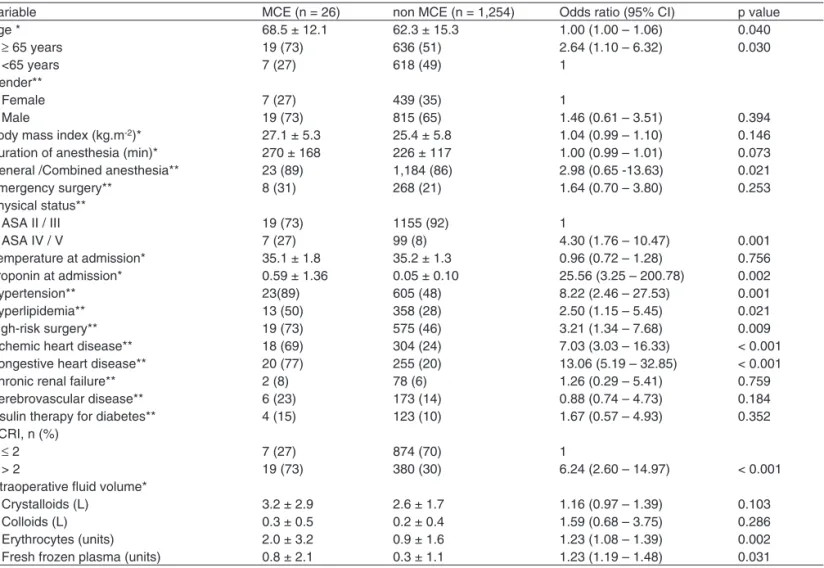
The characteristics of patients admitted to the PACU, and a comparison between the patients who did and did not deve-lop MCE, are summarized in Table I. Patients who devedeve-loped MCE were older (median age 72 versus 65 years, p < 0.025), more likely to be ASA-PS IV/V (27% versus 8%, p = 0.004) and had RCRI scores > 2 (73% versus 30%, p < 0.001), had higher troponin I levels at admission (0.59 ± 1.36 versus 0.05 ± 0.10, p < 0.001), more frequently had hypertension (89% versus 48%, p < 0.001) and hyperlipidemia (50% versus 28%, p = 0.018), were more likely to have been subjected to high-risk surgery (73% versus 46%, p = 0.005), more frequently had ischemic heart disease (69% versus 24%, p < 0.001) and congestive heart disease (77% versus 20%, p < 0.001) and had received higher volumes of fluids intraoperatively (2.0 ± 3.2 versus 0.7 ± 1.6, p < 0.001, for erythrocyte packed units, and 0.8 ± 2.1 versus 0.3 ± 1.1, p = 0.016 for units of fresh frozen plasma).
Table I – Patient Characteristics and Outcomes
Variable All patients (n = 1,280) MCE (n = 6) No MCE (1,254) p value
Age in years * 65 (54 – 74) 72 (57 – 78) 65 (54 – 74) 0.025b
Age group ** 0.018a
≥ 65 years 655 (51) 19 (73) 636 (51)
< 65 years 625 (49) 7 (27) 618 (49)
Sex ** 0.263a
Male 834 (65) 19 (73) 815 (65)
Female 446 (35) 7 (27) 439 (35)
Physical status ** 0.004a
ASA I / II / III 1,174 (92) 19 (73) 1,155 (92)
ASA IV / V 106 (8) 7 (27) 99(8)
Body mass index (kg.m-2) * 25 (22 – 28) 26 (24 – 29) 25 (22 – 28) 0.071b
General / Combined anesthesia ** 1107 (87) 23 (89) 1184 (86)
Duration of anesthesia (min) * 200 (150 – 300) 240 (128 – 360) 200 (150 – 300) 0.284b
Temperature at admission on PACU *** 35.22 ± 1.31 35.14 ± 1.28 35.22 ± 1.31 0.089b
Troponin I at admission *** 0.07 ± 0.31 0.59 ± 1.36 0.05 ± 0.10 < 0.001b
Hypertension ** 628 (49) 23 (89) 605 (48) < 0.001a
Hyperlipidemia ** 371 (29) 13 (50) 358 (28) 0.018a
Non-elective surgery ** 276 (22) 8 (31) 268 (21) 0.178a
High-risk surgery ** 594 (46) 19 (73) 575 (46) 0.005a
Ischemic heart disease ** 322 (25) 18 (69) 304 (24) < 0.001a
Congestive heart disease ** 275 (22) 20 (77) 255 (20) < 0.001a
Chronic renal failure ** 80 (6) 2 (8) 78 (6) 0.491a
Cerebrovascular disease ** 179 (14) 6 (23) 173 (14) 0.144a
Insulin therapy for diabetes ** 127 (10) 4 (15) 123 (10) 0.253a
RCRI <0.001a
≤ 2 881 (69) 7 (27) 874 (70)
> 2 399 (31) 19 (73) 380 (30)
Intraoperative fluid volume
Crystalloids (L) # 2.6 ± 1.8 ( 1.2 – 3.4) 3.2 ± 2.9 (1.2 -3.9) 2.6 ± 1.7 (1.2 -3.4) 0.102b
Colloids (L) * 0.2 ± 0.4 (0 – 0.5) 0.3 ± 0.5 (0 – 0.5) 0.2 ± 0.4 (0 – 0.5) 0.389b
Erythrocytes (unit) # 0.8 ± 1.7 (0 – 1) 2.0 ± 3.2 (0 – 3) 0.7 ± 1.6 (0 – 1) < 0.001b
Fresh frozen plasma (unit) # 0.3 ± 1.1 (0 – 0 ) 0.8 ± 2.1 ( 0 – 0 ) 0.3 ± 1.1 (0 – 0 ) 0.016b
Katz scale *** 0.33 ± 1.21 0.42 ± 1.41 0.33 ± 1.21 0.729b
Dependency in I-ADL ** 101 (8) 2 (8) 99 (8) 0.664a
Lawton I-ADL scale *** 5.95 ± 2.20 5.50 ± 2.52 5.96 ± 2.19 0.307b
Dependency in P-ADL ** 250 (20) 4 (15) 246 (20) 0.192a
a Pearson χ2 or Fisher’s exact test; b Mann-Whitney U test.
* – median (P25-75); ** – n (%); *** – mean ± sd; # – (P25 – P75) – are the 25th and 75th percentiles.
MCE – Major Cardiac Events; RCRI – revised cardiac risk index; I-ADL – instrumental activities of daily living; P-ADL – personal activities of daily living; PACU – post anesthesia care unit.
Table II – Severity of Disease Scores, PACU and Hospital Length of Stay and Mortality
Variable All patients (n = 1,280) MCE (n = 26) No MCE (1,254) p value b
SAPS II * 18 (13 – 27) 30 (23 – 42) 18 (12 – 27) < 0.001
APACHE II * 8 (5 – 11) 14 (11 – 15) 8 (5 – 11) < 0.001
PACU length of stay (hours) * 25 (21 – 46) 80 (38 – 170) 25 (21 – 45) < 0.001
Hospital length of stay (days) * 14 (7 – 29) 26 (13 – 39) 14 (7 – 28) 0.108
Mortality in PACU ** 33 (3) 3 (12) 30 (2) 0.027
Mortality in hospital ** 72 (6) 6 (23) 66 (5) 0.002
Mortality at 6 months follow-up ** 176 (14) 9 (35) 167 (13) 0.005
* – median (P25-75); ** – , n (%); b – Mann-Whitney U test
MCE – major cardiac events; SAPS II – Simplified Acute Physiology Score; APACHE II – Acute Physiology and Chronic Health Evaluation; PACU – Post Anesthesia Care Unit; P25 and P75 are the 25th and 75th percentiles.
without MCE (35% versus 13%, p = 0.005). The difference was even greater for hospital mortality (23%, versus 5%, p = 0.002) and PACU mortality (12% versus 2%, p = 0.027).
Univariate analyses for determinants of MCE and their rele-vant p-values are summarized in Table III. The following
congestive heart disease (OR 13.06, 95% CI 5.19-32.85, p < 0.001) and RCRI score (OR 6.24, 95% CI 2.60 – 14.97, p < 0.001 for RCRI > 2).
Univariate analysis for severity of disease, LOS and mor-tality are summarized in Table IV. Severity of disease scores SAPS II and APACHE II were significantly higher in patients who developed MCE (OR 1.05, 95% CI 1.03-1.07, p < 0.001 and OR 1.14, 95% CI 1.08-1.21, p < 0.001 respectively). The perioperative occurrence of MCE was associated with signi-ficantly greater PACU LOS (OR 1.21, 95% CI 1.10-1.31, p < 0.001), higher hospital mortality (OR 5.40, 95% CI 2.10-13.90, p < 0.001 and higher mortality at six months follow-up (OR 3.45, 95% CI 1.51-7.86, p = 0.003).
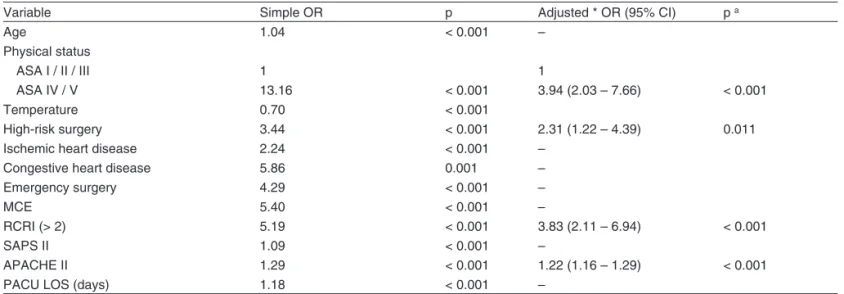
Multiple logistic regression analyses were used to examine the covariate effects of each factor in hospital mortality (Table V). The regression model included all variables with statistical significance in the univariate analysis for determinants of hos-pital mortality. This analysis showed that the development of MCE after surgery was a risk factor for hospital mortality (OR 5.40, p < 0.001). After adjustment for age, ASA-PS, temperature at admission, high-risk surgery, congestive heart failure, emer-gency surgery, SAPS II, APACHE II, PACU LOS and RCRI, the independent predictors of hospital mortality were ASA-PS (OR
Table III – Univariate Analysis for Determinants of Major Cardiac Events
Variable MCE (n = 26) non MCE (n = 1,254) Odds ratio (95% CI) p value
Age * 68.5 ± 12.1 62.3 ± 15.3 1.00 (1.00 – 1.06) 0.040
≥ 65 years 19 (73) 636 (51) 2.64 (1.10 – 6.32) 0.030
<65 years 7 (27) 618 (49) 1
Gender**
Female 7 (27) 439 (35) 1
Male 19 (73) 815 (65) 1.46 (0.61 – 3.51) 0.394
Body mass index (kg.m-2)* 27.1 ± 5.3 25.4 ± 5.8 1.04 (0.99 – 1.10) 0.146
Duration of anesthesia (min)* 270 ± 168 226 ± 117 1.00 (0.99 – 1.01) 0.073
General /Combined anesthesia** 23 (89) 1,184 (86) 2.98 (0.65 -13.63) 0.021
Emergency surgery** 8 (31) 268 (21) 1.64 (0.70 – 3.80) 0.253
Physical status**
ASA II / III 19 (73) 1155 (92) 1
ASA IV / V 7 (27) 99 (8) 4.30 (1.76 – 10.47) 0.001
Temperature at admission* 35.1 ± 1.8 35.2 ± 1.3 0.96 (0.72 – 1.28) 0.756
Troponin at admission* 0.59 ± 1.36 0.05 ± 0.10 25.56 (3.25 – 200.78) 0.002
Hypertension** 23(89) 605 (48) 8.22 (2.46 – 27.53) 0.001
Hyperlipidemia** 13 (50) 358 (28) 2.50 (1.15 – 5.45) 0.021
High-risk surgery** 19 (73) 575 (46) 3.21 (1.34 – 7.68) 0.009
Ischemic heart disease** 18 (69) 304 (24) 7.03 (3.03 – 16.33) < 0.001
Congestive heart disease** 20 (77) 255 (20) 13.06 (5.19 – 32.85) < 0.001
Chronic renal failure** 2 (8) 78 (6) 1.26 (0.29 – 5.41) 0.759
Cerebrovascular disease** 6 (23) 173 (14) 0.88 (0.74 – 4.73) 0.184
Insulin therapy for diabetes** 4 (15) 123 (10) 1.67 (0.57 – 4.93) 0.352
RCRI, n (%)
≤ 2 7 (27) 874 (70) 1
> 2 19 (73) 380 (30) 6.24 (2.60 – 14.97) < 0.001
Intraoperative fluid volume*
Crystalloids (L) 3.2 ± 2.9 2.6 ± 1.7 1.16 (0.97 – 1.39) 0.103
Colloids (L) 0.3 ± 0.5 0.2 ± 0.4 1.59 (0.68 – 3.75) 0.286
Erythrocytes (units) 2.0 ± 3.2 0.9 ± 1.6 1.23 (1.08 – 1.39) 0.002
Fresh frozen plasma (units) 0.8 ± 2.1 0.3 ± 1.1 1.23 (1.19 – 1.48) 0.031
* – mean ± sd; ** – n (%)
MCE – major cardiac events; RCRI – revised cardiac risk index.
3.94, 95% CI 2.03-7.66, p < 0.001, for ASA-PS IV/V patients), high-risk surgery (OR 2.31, 95% CI 1.22-4.39, p = 0.011), RCRI (OR 3.83, 95% CI 2.11-6.94, p < 0.001 for RCRI > 2) and APA-CHE II (OR 1.22, 95% CI 1.16-1.29, p < 0.001).
Three patients (12%) died during PACU stay, six (23%) died before hospital discharge and nine (35%) died before fol-low-up at six months. Of the remaining 17 patients, four (24%) did not answer the questionnaires at six months follow-up but were known to be alive.
For the patients who developed MCE the response rate was 76% (13 out 17 survivors at six months follow-up) and there were no statistically significant differences between participants and non-participants regarding any of the variables studied. For pa-tients who did not develop MCE the response rate was 68% (737 out of 1078 survivors at six months follow-up).
Functional Capacity and ADL
Table IV – Univariate Analysis for Severity of Disease, Length of Stay and Mortality
Variable MCE (n = 26) non MCE (n = 1,254) Odds ratio (95% CI) p Value
SAPS II* 33.6 ± 16.2 21.1 ± 12.7 1.05 (1.03 – 1.07) < 0.001
APACHE II* 13.8 ± 5.5 8.7 ± 5.0 1.14 (1.08 – 1.21) < 0.001
PACU stay (days)* 4.6 ± 3.6 1.8 ± 2.1 1.21 (1.10 – 1.31) < 0.001
Hospital stay (days)* 25 ± 27 24 ± 32 1.01 (0.99 – 1.02) 0.115
Mortality in the PACU** 3 (12) 30 (2) 5.32 (1.52 – 18.70) 0.009
Mortality in the hospital** 6 (23) 66 (5) 5.40 (2.10 – 13.90) < 0.001
Mortality at 6 months** 9 (35) 167 (13) 3.45 (1.51 – 7.86) 0.003
* – mean ± sd; ** – n (%)
MCE, Major Cardiac Events; SAPS II, Simplified Acute Physiology Score; APACHE II, Acute Physiology and Chronic Health Evaluation; PACU, Post Anesthesia Care Unit; CI, Confidence Interval.
in at least one P-ADL was higher six months after PACU dis-charge. The Lawton scale score was significantly lower after surgery, indicating greater dependency, but the percentages of dependency in at least one I-ADL were not different.
Quality of Life Measures
Overall, 31% stated that their level of health in general was better on the day they completed the SF-36 questionnaire
Table V – Multivariate Regression Analysis for Predictors of In-Hospital Mortality
Variable Simple OR p Adjusted * OR (95% CI) p a
Age 1.04 < 0.001 –
Physical status
ASA I / II / III 1 1
ASA IV / V 13.16 < 0.001 3.94 (2.03 – 7.66) < 0.001
Temperature 0.70 < 0.001
High-risk surgery 3.44 < 0.001 2.31 (1.22 – 4.39) 0.011
Ischemic heart disease 2.24 < 0.001 –
Congestive heart disease 5.86 0.001 –
Emergency surgery 4.29 < 0.001 –
MCE 5.40 < 0.001 –
RCRI (> 2) 5.19 < 0.001 3.83 (2.11 – 6.94) < 0.001
SAPS II 1.09 < 0.001 –
APACHE II 1.29 < 0.001 1.22 (1.16 – 1.29) < 0.001
PACU LOS (days) 1.18 < 0.001 –
a Logistic regression analysis with stepwise forward method was used with an entry criterion of p < 0.05 and a removal criterion of p > 0.1.
MCE – major cardiac events; PACU – post anesthesia care unit; LOS – length of stay; SAPS – Simplified Acute Physiology Score; APACHE II – Acute Physiology and Chronic Health Evaluation; RCRI – Revised Cardiac Risk Index; OR – Odds Ratio; CI, Confidence Interval.
*Adjusted for age, ASA physical status, High-risk surgery, Ischemic heart disease, Congestive heart failure, Emergency surgery, MCE, SAPS II, APACHE II and PACU LOS.
than 12 months earlier, while 31% considered it to be worse (six months before PACU discharge).
Compared to values observed for the urban population of Porto, the SF-36 sub-scores of all patients who developed MCE were worse in all domains except bodily pain and men-tal health (Table VII).
Patients who developed MCE did not differ in any of the SF-36 domains from the other PACU patients who did not have MCE (Table VIII).
Table VI – Dependency and Self-Reported Changes in Health in General, Six Months after Post Anesthesia Care Unit Discharge (n = 13)
Activities of daily living Before surgery 6 months after PACU discharge p value Personal activities of daily living
Katz scale * 0.0 ± 0.0 0.54 ± 1.66 0.266
Dependency in P-ADL ** 0 (0) 2 (15) 0.018
Instrumental activities of daily living
Lawton scale * 7.0 ± 1.7 5.0 ± 2.9 0.003
Dependency in I-ADL ** 3 (23) 9 (69) 0.294
DISCUSSION
This study evaluated the occurrence of major cardiac compli-cations after all types and magnitudes of noncardiac surgery, enrolling patients with all types of clinical risk.
The differential risk associated with various surgical pro-cedures has been well recognized and different operations are associated with different cardiac risks 23. We excluded pa-tients submitted to cardiac or pulmonary surgery because the predicted incidence of MCE for these patients is higher 24 and because at our hospital they are admitted to other ICU.
The low incidence (2%) of serious postoperative cardiac events in our study was similar to that observed by Mangano (3%) 25 and Lee (2%) 5.
Postoperative MCE remains a leading cause of morbidity, mortality, prolonged hospital stay and increased hospital cost. In this study, we attempted to correlate and predict factors (preoperative, intraoperative and early postoperative) predis-posing to MCE. The findings may enable us to predict those at high risk, so interventional measures might be planned in advance to improve outcome following such a complication, achieving a better outcome and a more efficient use of hospi-tal and intensive care resources.
We have measured postoperative Troponin I levels for ev-ery patient although the role of the troponins for the evaluation of patients after non cardiac surgery remains unclear. Mea-surement of troponin I facilitates the recognition of myocardial damage but the Guidelines of the American College of Cardi-ology and American Heart Association for evaluating cardiac
risk for noncardiac surgery do not recommend their routine measurement 26.
As determinants for the occurrence of MCE this study iden-tified five independent risk factors: ASA-PS, hypertension, ischemic heart disease, congestive heart failure and RCRI.
The ASA-PS score, a preoperative evaluation used rou-tinely for every patient, was never intended as a perioperative risk score, but all large-scale studies have suggested that a high ASA-PS score is one of the best predictors of postopera-tive morbidity 27,28. This indicator depends on a more generic classification of diseases that may be present, and in itself indicates the presence of comorbidities. ASA-PS classifica-tion is a strong predictor of the development of postoperative medical complications for patients in a perioperative setting.
The RCRI is a tool for predicting major cardiac complications after noncardiac surgery 29,30. It was developed to predict cardiac risk on the basis of six independent prognostic factors: high risk surgery, ischemic heart disease, congestive heart disease, his-tory of cerebrovascular disease, insulin therapy for diabetes and preoperative serum creatinine > 2.0 mgdL-1. The RCRI score is based on predictors that are independently and significantly as-sociated with cardiovascular events. A high score means that patients with pre-existing cardiovascular disease have an in-creased perioperative risk of developing MCE in postoperative period. The present study corroborated the finding by Lee et al. 5 confirmed by others 31 that the presence of two or more of the
RCRI factors identified patients with increased risk for cardiac complications. In our study, RCRI was an independent predic-tor for development of MCE, and so were some of the facpredic-tors
Table VII – F-36 after Major Cardiac Event and in a General Population
SF-36 domains 6 months after MCE General population p valuea
Physical function 61.5 ± 33.0 75.4 ± 23.6 0.035
Role physical 51.4 ± 32.5 76.7 ± 26.1 < 0.001
Bodily pain 52.3 ± 29.7 65.7 ± 26.2 0.067
General health perception 38.8 ± 18.3 59.5 ± 19.8 < 0.001
Vitality 32.7 ± 17.1 57.2 ± 21.1 < 0.001
Social functioning 60.6 ± 27.4 76.0 ± 24.1 0.021
Role emotional 48.7 ± 32.6 76.9 ± 25.8 < 0.001
Mental health 61.2 ± 41.6 66.1 ± 22.8 0.445
Values expressed as Mean ± Standard deviation; a – t test SF-36, Short-form 36.
Table VIII – SF-36 after Major Cardiac Event and in a Surgical Population
SF-36 domains 6 months after MCE (n = 13) PACU surgical patients (n = 737) p valuea
Physical function 61.5 ± 33.0 53.4 ± 31.3 0.352
Role physical 51.4 ± 32.5 46.2 ± 34.3 0.583
Bodily pain 52.3 ± 29.7 57.0 ± 29.8 0.580
General health perception 38.8 ± 18.3 46.4 ± 27.6 0.319
Vitality 32.7 ± 17.1 34.5 ± 16.6 0.705
Social functioning 60.6 ± 27.4 57.4 ± 30.6 0.709
Role emotional 48.7 ± 32.6 50.4 ± 34.8 0.867
Mental health 61.2 ± 41.6 50.1 ± 22.1 0.081
included in the index such as ischemic heart disease and con-gestive heart failure. The contribution of heart failure to the RCRI 5 is consistent with previous studies that showed heart failure to
be an important risk factor for postoperative cardiac complica-tions 32. Heart failure has been identified in several studies as associated with a poorer outcome when noncardiac surgery is performed and it is associated with a substantially increased risk during noncardiac surgery 33.
Although hypertension is common, and treatment has been shown to be associated with decreased rates of death due to stroke and congestive heart disease, the Guidelines of the American College of Cardiology and American Heart Association for evaluating cardiac risk for noncardiac surgery 23 considered hypertension a minor predictor, a recognized
marker for cardiovascular disease that has not been proven to increase perioperative risk independently. In our study, ho-wever, hypertension appears as an independent risk factor for MCE, conflicting with numerous studies that have shown hypertension not to be independent risk factor for perioperati-ve cardiovascular complications 33-35.
In the population studied, the occurrence of an MCE was considered a risk factor for higher mortality and longer PACU stay, and therefore worse outcome. This reinforces the impor-tance of identifying myocardial injury because it can be asso-ciated with subsequent cardiac events that carry a significant burden to the patient 36. Similarly, Venkataraman et al. 37 re-cently showed that perioperative cardiac events contributed significantly to morbidity and mortality.
In this study, patients with postoperative MCE had signi-ficantly higher hospital mortality than patients without MCE. Patients with MCE had a hospital mortality of 23%, nearly five times the mortality rate of those without.
We examined the impact of the occurrence of MCE on quality of life and independence in activities of daily living. To study the impact on quality of life we used the self-evaluated health transition item in the SF-36 questionnaire. This item is not used in scoring the scales but has been shown to be use-ful for estimating average change in health status during the year prior to administration of the questionnaire 38. Only 31% of patients with postoperative MCE stated that their quality of life was better than before surgery, indicating that only a few of the patients who developed MCE had an improved subjec-tive perception of quality of life after surgery.
Comparisons with a general population (taken as “control”) are difficult to interpret because this population was not ad-justed for age or comorbidities and because surgical patients who develop MCE may view themselves as chronically ill. Thus, our finding that quality of life was worse in almost all domains in MCE patients than in the general population was not totally unexpected. PACU patients from the same urban area with similar demographic characteristics seemed more appropriate for comparison with MCE patients; for this com-parison we found no differences between the two populations in any of the SF-36 domains.
The patients in our study showed higher degrees of de-pendency in instrumental and personal ADL after surgery. These results may be influenced by the presence of co-morbidities and concurrent diseases, and as implied by the higher SAPS II and longer PACU LOS among the MCE pa-tients this could reflect the burden still imposed by the acu-te changes in these patients even six months afacu-ter PACU discharge.
This study has several limitations. We did not apply the SF-36 questionnaire before surgery so it was not possible to compare the quality of life of patients before and after sur-gery as in the study by Lloyd 39. Nevertheless, we used the SF-36 question about self-reported changes in health status (“compared to one year ago, how would you rate your health in general now?”) to infer that the level of health in general was better for most patients on the day they completed the SF-36 than before surgery.
In summary, this study supports the conclusion that ASA-PS, hypertension, ischemic heart disease, congestive heart failure and RCRI are determinants of MCE after major non-cardiac surgery. The occurrence of MCE after surgery is a risk factor for mortality and patients who developed MCE had higher mortality rates and higher PACU LOS.
Only 31% of patients who survived after surgery showed a subjective positive perception of HRQOL six months after discharge from the PACU.
Patients who developed MCE did not differ in any SF-36 domain from PACU patients who did not.