REVISTA DE
ODONTOLOGIA
DA UNESP
Rev Odontol UNESP. 2014 July-Aug; 43(4): 241-244 © 2014 - ISSN 1807-2577
ORIGINAL ARTICLE
Doi: http://dx.doi.org/10.1590/rou.2014.039
Longevity of atraumatic restorations performed by
undergraduate dentistry students
Longevidade de Restaurações Atraumáticas realizadas por graduandos de Odontologia
Luale Leão FERREIRA
a, Naiara de Paula FERREIRA-NÓBILO
a,
Cristina GIBILINI
a, Maria da Luz Rosário de SOUSA
aaFaculdade de Odontologia, UNICAMP – Universidade Estadual de Campinas, Piracicaba, SP, Brasil
Resumo
Introdução: O Tratamento Restaurador Atraumático (ART) possibilita o tratamento de cárie com o auxílio de
instrumentos manuais e sem anestesia, em locais onde o acesso a consultórios é impossibilitado, e é considerada uma técnica de fácil execução. Objetivo: Avaliar a efetividade do ART realizado pelos estudantes de graduação de odontologia em escolares de 4 a 11 anos de idade de Piracicaba-SP nos anos de 2009 e 2010, na dentição decídua, e a longevidade das restaurações em 6 e 12 meses. Método: A análise dos dados foi descritiva, e para avaliar diferença entre os grupos foi utilizado teste qui-quadrado (intervalo de confiança de 95%). Resultado: O sucesso das restaurações atraumáticas realizadas foi de 51,90% aos 6 meses e 47% aos 12 meses. A efetividade do ART variou segundo o tipo de restauração aos seis meses e aos 12 meses de reavaliação, apresentando maior sucesso em restaurações Classe I do que em restaurações Classe II (p<0,001). Conclusão: O sucesso do ART realizado por alunos de graduação foi próximo de 50% aos 6 e 12 meses, sendo significativamente melhor em cavidades Classe I nas duas avaliações.
Descritores: Cárie dentária; saúde pública; cimentos de ionômeros de vidro.
Abstract
Introduction: Atraumatic restorative treatment (ART) is a simple technique that enables the treatment of caries with hand tools and without anesthesia where clinic access is lacking. Objective: To evaluate the effectiveness of ART conducted in the primary dentition of 4-11-year-olds in 2009 and 2010 by graduate dental students in Piracicaba, SP, and the longevity of restorations at 6 and 12 months. Method: Descriptive data analysis was performed. Differences between groups were assessed using the chi-squared test with a 95% confidence interval. Result: The success rates of ART were 51.90% at 6 months and 47% at 12 months. Class I ARTs were more successful than class II ARTs at 6 and 12 months (p < 0.001). Conclusion: Approximately 50% of ART performed by undergraduates students have succeeded and was significantly better for class I carious lesions at both evaluation time points.
Descriptors: Dental caries; public health; glass ionomer cement.
INTRODUCTION
he World Health Organization (WHO) has recommended the application of atraumatic restorative treatment (ART) when the lack of dental oices prevents traditional restoration1,2. ART
is indicated for adults and children, in deciduous and permanent teeth, independent of socioeconomic conditions, and should not be considered a procedure of oral diseases, since restoring produced can be considered deinitive3.
he technique is well accepted for fearful patients because it eliminates the use of anesthesia4,5. It can be applied in rural
or suburban areas and disadvantaged communities (including those in which minority groups live), and can be used to treat patients in nursing homes, day care centers, and orphanages1. It
also enables care provision to groups resistant to conventional
treatment and provides access to regular care for people who lack basic dental care services.
ART was developed in the 1980s as a method of preserving decayed teeth in individuals of all ages in developing countries and underserved communities, with a strong focus on reducing oral contamination1. It is thus considered to be a technique for the
treatment of carious lesions in public health contexts6. Hand tools
are used to partially remove dentin afected by caries, followed by the sealing of the cavity with glass ionomer cement5. he
242 Ferreira, Ferreira-Nóbilo, Gibilini et al. Rev Odontol UNESP. 2014; 43(4): 241-244
is thus minimally invasive and reduces the likelihood of the need for future endodontic treatment and extraction. It is also very practical because it does not require the use of traditional dental equipment, local anesthesia, or electricity, and is considered to be more comfortable for the patient than traditional restoration8.
To promote the application of ART, the Piracicaba Dental School (FOP) of the University of Campinas (UNICAMP), Brazil, was incorporated in 2009 to the extramural stage, the inal year of graduation. Students perform ART in 4-11-year-olds in school environments. In addition to providing technical introduction to graduate students, this service meets a demand of the population that is not otherwise addressed.
Despite the ease of implementation5, the longevity of
restorations performed using this minimally invasive technique must be evaluated to verify its success. Reported success rates of atraumatic class I and class II restorations in primary teeth range from 43.4% to 96.7% and from 12.2% to 83.3%, respectively3. A
study in which permanent molars were evaluated 10 years ater ART demonstrated the validity and potential of this approach for the restoration and preservation of posterior permanent teeth9.
he aim of this prospective study was to evaluate the efectiveness of ART in deciduous teeth conducted by undergraduate FOP students in 2009 and 2010, and the longevity of restorations at 6 and 12 months.
METHOD
his study was conducted in accordance with the rules and ethical guidelines of Resolution No. 196/1996 of the National Board of Health, Ministry of Health, and approved by the local research ethics committee (protocol no. 77/2010). Caretakers of all participants provided written informed consent to their children’s inclusion in the study.
FOP-UNICAMP implemented the National Program for the Reorientation of Vocational Training in Health (ProHealth) in 2008, and six family health units (FHU) were selected as partners for the development of extramural activities. Eighty college graduates conducted activities aiming to integrate academic knowledge with routine public health care work in the FHUs for 1 week per semester. Students performed ART under the direct supervision of professional dentists at schools and kindergartens in rooms made available for that purpose. he primary purpose of this activity was to present the ART technique within the setting of a broader educational program in which the schools and kindergartens were already participating.
Before ART was performed, 10 dental college graduates trained by an experienced epidemiologist (MLRS) conducted epidemiological surveys of caries (LECs) in early 2009 in 10 bound FHUs at six public schools to evaluate the indication for ART in the primary teeth of students aged 4-11 years. Students attended lectures and participated in practical exercises (12 h total) in preparation for the LECs. he surveys were conducted using WHO-recommended criteria and indices. A total of 3731/4465 eligible children (83.6% response rate) were examined. he
percentage of intra-examiner agreement was 84.20% [κ = 0.84 (conidence interval, 0.80-0.89)].
ART was performed in deciduous teeth according to the standard evidence-based protocol10. Infected dentin sotened
and consistency was irreversibly removed using hand tools under relative isolation without local anesthesia. Each cavity was then sealed with glass ionomer cement (Ketac Molar).
Calibrated graduate students assessed the efectiveness and longevity of atraumatic restorations at 6 and 12 months post-treatment (between August 2009 and December 2010) using a mirror and a WHO-621 explorer with a 0.5-mm ball at its tip, which allows the measurement of restoration maladaptation. he clinical evaluation followed criteria adapted from Taifour et al.11,
as follows: 0 = satisfactory ART, 1 = margin of 0.5 mm, 2 = partial loss of restorative material, 3 = total loss of restorative material, and X = missing or exfoliated tooth. In the present study, a score of 0 was considered to indicate successful ART and a score of 1-3 was considered to indicate treatment failure.
Descriptive data analysis was performed using Excel and
BioStat 5.3 sotware. he Chi-square test was used to assess diferences betweengroups, with a 95% conidence interval.
RESULT
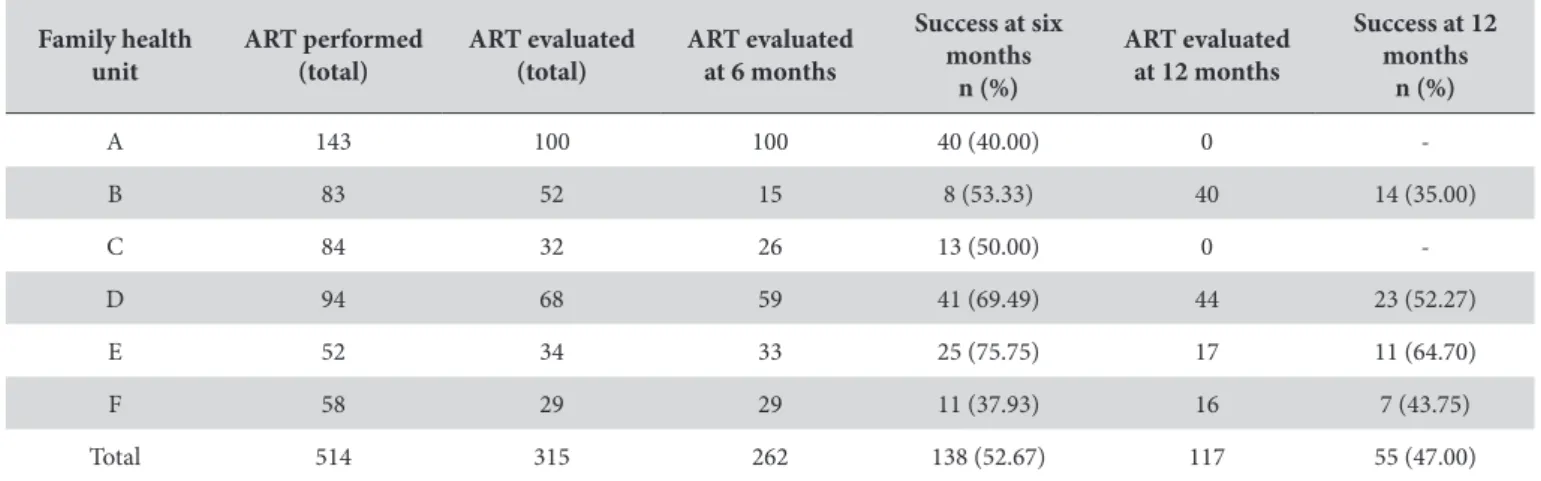
he dental school graduates performed a total of 514 restorations using the ART technique. Of these, 315 (61.28%) teeth were assessed at least once. A total of 43 teeth were exfoliated between the ART procedure and evaluations (21 teeth before 6 months and 22 teeth before 12 months). Table 1 shows the numbers of teeth treated and evaluated, and ART success rates at 6 and 12 months.
Table 2 shows the success of atraumatic class I and class II restorations at 6 and 12 months. he success rate difered according to restoration class, being signiicantly better for class I in both evaluations (6 and 12 months).
DISCUSSION
About half of ARTs performed by dental school graduates remained in the oral cavity at the 12-month assessment. his success rate falls within the large range (30-98%) of previously reported rates11. Given that these ARTs represent the students’
initial experience with the technique, and that the success rate is similar to those reported for some experienced professionals at 12 months9, we consider this degree of success to be appropriate.
Regardless of treatment success, ART involves the removal of irreversibly infected and decayed tissue, promoting decontamination. he exposure of afected dentin to glass ionomer, a restorative material used in ART that booking and releases luoride, positively interferes with caries activity12. he
retention of these restorations for even a brief period of time allows the remineralization of afected dentin, increasing hardness and reducing susceptibility to demineralization12. ART thus improves
Rev Odontol UNESP. 2014; 43(4): 241-244 Longevity of atraumatic restorations… 243
care centers in the ART intervention of the FOP-UNICAMP educational program, in association with ProHealth.
ART is indicated primarily for small carious lesions involving a single face, due to the biomechanical properties of the restorative material13. In the present study, the type of restoration was
dichotomized as class I or II. he 6-month success rate was higher in restorations involving only one face than in those involving multiple faces. hese results corroborate those of Franca et al.3,
who noted greater success of class I than class II restorations at 6 months.
he number of teeth in which ART was classiied as failed at 12 months may have been underestimated. Because ART evaluation was performed as an internal control of the students’ performance, restorations considered to be unsuccessful at 6 months were not reassessed at 12 months, and thus were not included in the analysis of 12-month data.
Given the longitudinal nature of this study, only 262 (50.98%) and 115 (22.37%) restorations were evaluated at 6 and 12 months, respectively. his sample loss was due mainly to students’ absence at the time of assessment, due to a change of school or for other reasons.
Dentists continue to resist the use of ART, which generally involves the use of glass ionomer cement to provisionally restore buccal lesions11. hus, the importance of extramural activities in
dental education should be emphasized. Such activities introduce dental students to public health contexts and provide experience
with the Uniied Health System, ofering a diferent perspective on the practical applications of ART. he ART intervention is one of several activities included in FOP-UNICAMP’s ProHealth program, and it addresses an otherwise unmet dental health need of schoolchildren, thereby directly beneitting the community. hus, in addition to being introduced to the technique in a public health context, graduate students observed the practicality of ART application and the high impact of this treatment in the population served. hey observed the acceptance of this technique in a school or family health environment and the ability to avoid pain and rotary instrument use, which can cause aversion to dental care in schoolchildren. Ater the activity, graduate students discussed with participating dental students the relevance and implications of the technique in public health, and the impact on the community in terms of reduced caries risk6.
his study allowed us to observe the efectiveness of ART performed by graduate students in a real-world context. Whereas the main objective of the activity was to introduce the ART technique to graduating students, evaluation of the longevity of restorations performed during their initial experience allowed us to assess the role of professional experience in the success of restoration. he students’ inexperience may have negatively inluenced the results, especially with regard to sample loss throughout the follow-up period, which may stand in contrast to evaluation by a professional in the Family Health Strategy.
In conclusion, approximately 50% of ART was succeeded, and the longevity performed by dental school graduates was
Table 2. Success and failure of class I and class II ARTs at 6 and 12 months in Piracicaba, SP, Brazil†
Evaluation
Total
ART Class I ART Class II ART
p OR 95% CI
n n Success
n (%)
Failure
n (%) n
Success n (%)
Failure n (%)
6 months 241 77 51
(66.23)
26
(33.76) 164 85 (51.82)
79
(48.17) <0.0001 1.81 1.17–1.79
12 months 93 21 (71.42)15 (28.57)6 72 39 (54.16) (45.83)33 <0.0001 2.40 1.10–5.73
ART, atraumatic restorative treatment; OR, odds ratio; CI, conidence interval. †Exfoliated teeth were excluded from analyses. Source: Extramural Internship. Faculty
of Dentistry of Piracicaba-UNICAMP (2009-2010).
Table 1. ART implementation and evaluation at 6 and 12 months seconds family health units, 2009-2010, Piracicaba, SP, Brazil
Family health unit
ART performed (total)
ART evaluated (total)
ART evaluated at 6 months
Success at six months
n (%)
ART evaluated at 12 months
Success at 12 months
n (%)
A 143 100 100 40 (40.00) 0
-B 83 52 15 8 (53.33) 40 14 (35.00)
C 84 32 26 13 (50.00) 0
-D 94 68 59 41 (69.49) 44 23 (52.27)
E 52 34 33 25 (75.75) 17 11 (64.70)
F 58 29 29 11 (37.93) 16 7 (43.75)
Total 514 315 262 138 (52.67) 117 55 (47.00)
244 Ferreira, Ferreira-Nóbilo, Gibilini et al. Rev Odontol UNESP. 2014; 43(4): 241-244
signiicantly superior in class I (one involved tooth surface) than in class II (multiple involved surfaces) carious lesions. Beyond providing experience and the opportunity to acquire expertise to undergraduate students participating in ProHealth, the inclusion of the ART intervention in dental education could contribute efectively to the otherwise unmet demands for dental care and treatment in schoolchildren in Piracicaba, SP, Brazil.
REFERENCES
1. Tascón J. Restauración atraumática para el control de la caries dental: historia, características y aportes de la técnica. Rev Panam Salud Publica. 2005;17(2):110–5. http://dx.doi.org/10.1590/S1020-49892005000200007
2. Navarro MFL, Modena KCS, Freitas MCCA, Fagundes TC. Transferring ART research into education in Brazil. J Appl Oral Sci. 2009;17(suppl):99-105. PMid:21499663. http://dx.doi.org/10.1590/S1678-77572009000700017
3. Franca C, Colares V, Van Amerongen E. Two-year evaluation of the atraumatic restorative treatment approach in primary molars class I and II restorations. Int J Paediatr Dent. 2011;21(4):249–53. PMid:21401749. http://dx.doi.org/10.1111/j.1365-263X.2011.01125.x 4. Leal SC, Abreu DMM, Frencken JE. Dental anxiety and pain related to ART. J Appl Oral Sci. 2009;17(Suppl):84-8. PMid:21499661. http://
dx.doi.org/10.1590/S1678-77572009000700015
5. Abreu DMM, Leal SC, Mulder J, Frencken JE. Pain experience ater conventional, atraumatic, and ultraconservative restorative treatments in 6- to 7-yr-old children. Eur J Oral Sci. 2011;119(2):163–8. PMid:21410557. http://dx.doi.org/10.1111/j.1600-0722.2011.00806.x 6. Gibilini C, Paula JC, Marques R, Sousa MLR. Atraumatic Restorative Treatment used for caries control at public schools in Piracicaba,
SP, Brazil. Braz J Oral Sci. 2012;11(1):14-8.
7. Franca C, Colares V, Van Amerongen E. he operator as a factor of success in ART restorations. Braz J Oral Sci. 2011;10(1):60-4. 8. Lima DC, Saliba NA, Moimaz SAS. Tratamento Restaurador Atraumático e sua utilização em saúde pública. RGO – Rev Gaúcha
Odontol. 2008;56(1):75-9.
9. Zanata RL, Fagundes TC, Freitas MCCA, Lauris JRP, Navarro MFL. Ten-year survival of ART restorations in permanent posterior teeth. Clin Oral Invest. 2011; 15(2):265–71. PMid:20140470 PMCid:PMC3055991. http://dx.doi.org/10.1007/s00784-009-0378-x
10. Frencken JE, Pilot T, Songpaisan Y, Phautumvanit P. Atrumatic restorative treatment (ART): ratiole, technique and development. J Public Health Dent. 1996;56(3 Spec No):135-40; discussion 161-3.
11. Taifour D, Frencken JE, Beiruti N, van’t Hof MA, Truin GJ. Efectiveness of glass-ionomer (ART) and amalgam restorations in the deciduous dentition: results ater 3 years. Caries Res. 2002;36(6):437-44. http://dx.doi.org/10.1159/000066531
12. Massara ML, Alves JB, Brandão PR. Atraumatic restorative treatment: clinical, ultrastructural and chemical analysis. Caries Res. 2002;36(6):430-6. http://dx.doi.org/10.1159/000066534
13. Gibilini C, Ramalho DF, Sousa MLR. Avaliação da autopercepção do tratamento restaurador atraumático pelo paciente infantil. RFO. 2011;16(1):18-24.
CONFLICTS OF INTERESTS
he authors declare no conlict of interest.
CORRESPONDING AUTHOR
Maria da Luz Rosário de Sousa
Av. Limeira, 901, Areião, 13414-018 Piracicaba - SP, Brasil e-mail: [email protected]