Simulation of the aluminum alloy A356 solidification cast in cylindrical
permanent molds
BENCOMO, A.I ; BISBAL, R.I ; MORALES, R.II ;
IEscuela de Ingeniería Metalúrgica y Ciencia de los Materiales. Facultad de Ingeniería. Universidad Central de
Venezuela. Apdo. 47750. Caracas 1041-A. Venezuela. e-mail: [email protected],[email protected]
IIEscuela Superior de Ingeniería Química e Industrias Extractivas. Instituto Politécnico Nacional. Apdo. 75-874.
México DF, CP 07300. México. e-mail: [email protected]
ABSTRACT
A mathematical model based on the control volume method with fixed mesh was selected in order to simulate the solidification of cylindrical castings poured in permanent steel mold. The latent heat was incorporated using the effective specific heat. The application of the model allowed us to obtain the solidification front and the temperature fields at any time from the pouring. The mold was made of the SAE 1010 steel. Two mold temperatures were evaluated: 25°C and 300°C. The mathematical model showed sensitivity to changes in mold temperatures. For the casting poured with an initial mold temperature of 300°C, the solidification time was greater than that of the casting poured in the mold at 25°C. When the perfect contact condition between the mold and the metal was considered, the theoretical solidification times were shorter than the experimental results. When the imperfect contact supposition was assumed, this resulted in longer times of solidification very close to the experimental data. A reasonable fitting was reached when the heat transfer coefficient between mold and casting surfaces in the range of 100 to 500 W/m2 °K was used for the experiments with the mold at 25°C.
Keywords: casting, mathematical simulation, control volume, cylinder, aluminium.
1 INTRODUCTION
The viability of the industry of the foundry depends strongly on the quality and efficiency offered in its products. Through the years several methods have been used with the purpose of analyzing the solidification of foundry pieces. At the beginning, analytic methods were used. Later, researchers turned to the employment of numerical methods. At the present time the variety of methods used to simulate the metallic solidification is numerous, depending on the type of the outlined problem, the geometry, etc. MANJHI S.P. et al. [1] applied the method of control volume to the simulation of the solidification and thermal treatment of steel ingots. This article is about the use of the method of Control Volume to build an algorithm that allows us to study some aspects of the solidification of castings.
2 MATHEMATICAL FORMULATION
U
w
w
w
w
w
w
w
wT
w
wT
w
w
w
w
U
w
w
Cp
T
t
r r
kr
T
r
r
k
T
z
k
T
z
L
fs
t
§
©¨
·
¹¸
§
©¨
·
¹¸
§
©¨
·
¹¸
1
1
2 (1)
Assuming that the flow of heat is only present in the radial and axial directions, and that the thermal conduction coefficient is constant in the space, then one has that the Equation (1) is simplified to
U
Cp
w
w
T
w
w
w
w
w
w
U
w
w
t
k
r
T
r
T
r
T
z
L
fs
t
§
©
¨
·
¹
¸
1
2 2 2 2 (2)With the following boundary conditions:
- Convective condition in the boundary in contact with the air and the floor:
(
)
e
T
Cp V
kA T
hA T
T
t
U
fw
w
(3)where V and A are the volume and the area of control volume on the boundary, respectively.
- -Radioactive and convective conditions in the surface of the metal and mold in contact with the air:
4 4
(
)
(
e
T
Cp V
kA T
hA T T
A
T
T
t
U
w
fH
V
f)
w
(4)k
§
©¨
T
·
¹¸
r
w
w
0
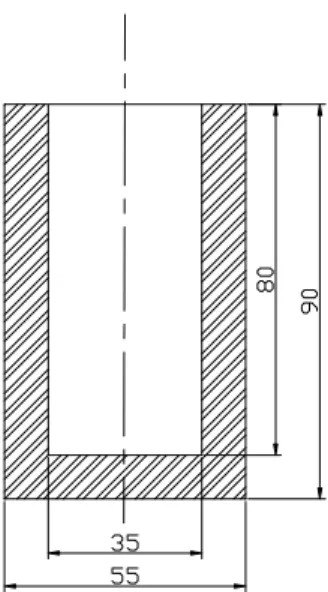
(5)In Fig. 1 is shown a schematic drawing of the mold used in the experiments. The domain is composed of half of the cylinder and the mold. The applied method of Control Volume consists of integrating the heat equation with respect to space and time t (PATANKAR [2]):
2
2
0 0 0 0 0 0
r R z H t t r R z H t t r R z H t t
r z t t r z t t r z t t
T
k
T
T
Cpe
drdzdt
drdzdt
k
drdzdt
t
r
r
r
w
w
w
U
w
w
w
' ' '
§
·
¨
¸
©
¹
³ ³ ³
³ ³ ³
³ ³ ³
2
2 0 0
r R z H t t
r z t t
T
k
drdzdt
z
w
w
'³ ³ ³
(6)
Where Cpe is the effective specific heat, defined by:
Cpe Cp L
fs
t
w
w
(7)For the solid fraction some models can be used, such as the lever rule and the Scheil relation. In this work we employ the lever rule:
fs
k
T
T
T
T
o f f l§
©
¨
·
¹
¸
ª
¬
«
«
º
¼
»
»
1
1
(8)Once the integral of the Equation (6) is resolved and then, by employing the boundary conditions, one could obtain a system of algebraic equations of the type:
P E E W W N N S S
a
a T
a T
a T
a T
b
(9)where:
a
k
z
r r
E e e e'
G
(10)a
k
z
r r
W w w w'
G
(11)a
k r r
z
S s s
s
'
G
(13)a
Pa
Ea
Wa
Na
Sa
0P (14)0 e
P
Cp
r z
a
t
U
' '
'
(15)Figure 2: Mesh with 264 control volumes.
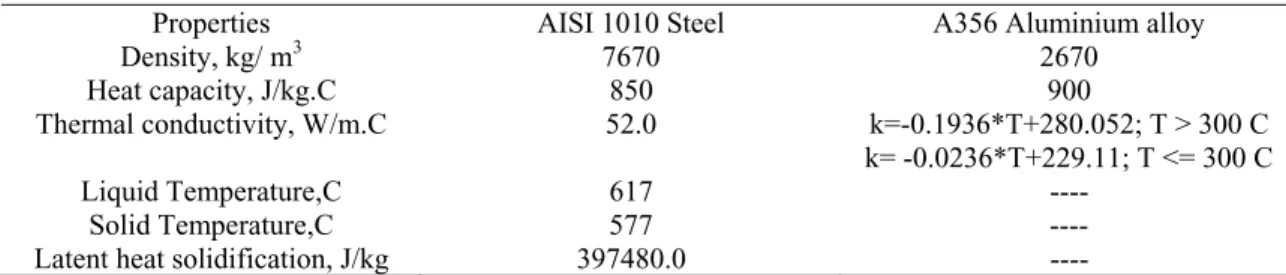
The physical properties used in this work are shown in the Table 1.
Table 1: Physical properties
Properties AISI 1010 Steel A356 Aluminium alloy
Density, kg/ m3 7670 2670
Heat capacity, J/kg.C 850 900
Thermal conductivity, W/m.C 52.0 k=-0.1936*T+280.052; T > 300 C k= -0.0236*T+229.11; T <= 300 C
Liquid Temperature,C 617 ----
Solid Temperature,C 577
3 EXPERIMENTAL
The experimental procedure consisted of the cast of some cylindrical ingots, of 35 mm in diameter and a height of 80 mm, in a steel mold of the carbon steel AISI 1010. The aluminum alloy was poured to 720°C. The initial temperatures of the mold were 25°C and 300°C.
To carry out the numerical simulations a computational algorithm was elaborated in the Borland® C++ Version 5.02 language. A fixed mesh of 264 control volumes was used, just as it is illustrated in Fig. 2. The results were plotted using the commercial software 3dField®.
(a) (b)
(c) (d)
(a) (b)
( c) (d)
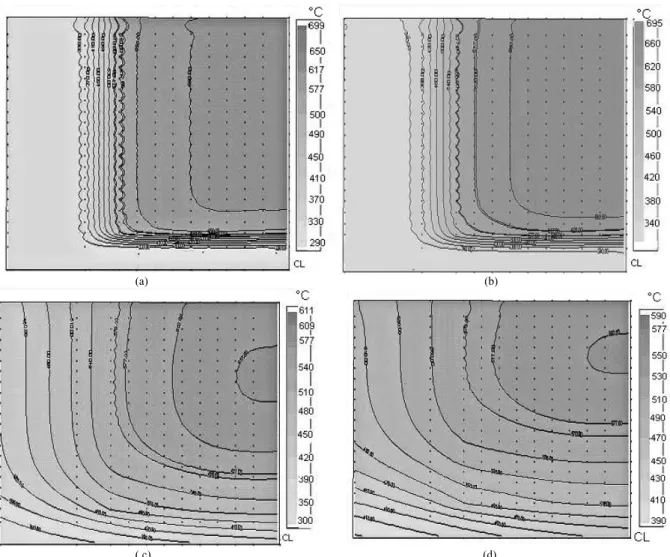
Figure 4: Temperature mapping for: a) 0.25 s; b) 0.50 s; c) 5.0 s and d) 10.0 s. Mold to 300 °C.
4 RESULTS AND DISCUSSION
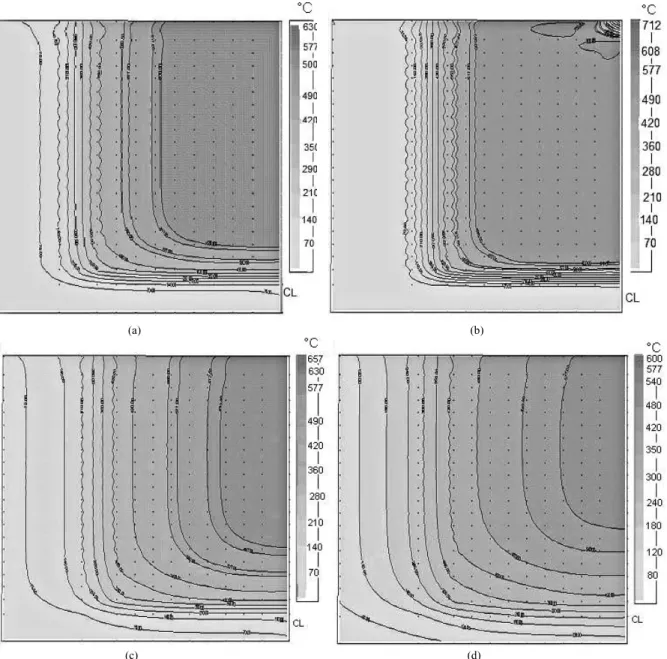
The results are shown in Figs. 3 to 6. They correspond to simulations in which the perfect contact condition between the mold and the metal is considered. Figs. 3a, 3b, 3c and 3d show the results of the temperature fields in the metal and mold, for an initial temperature of the mold of 25°C and times between 0.25 and 2 s. One can observe the position of the isotherms of the liquid and solid for the values of isotherms of 617°C and 577°C.
In Figs. 4a, 4b, 4c and 4d are illustrated the temperature fields for the mold and metal, for times of 0.25 s to 10 s, when the metal is poured in a metallic mold preheated at 300°C. It can be shown that the solidification of the piece is slower in this case and requires more time.
interpreted in terms of the variation of the heat transfer coefficient between the metal and the mold, just as it has been suggested by authors such as GRIFITH [3], BROWNE and O'MAHONEY [4], and TAHA et al. [5].
0 100 200 300 400 500 600 700 800
0 10 20 30 40 50 60
tim e (s)
Temperat
ure (
°C
)
Experimental
Theoretical perfect contact
Theoretical, h = 200 W/m2°K
Theoretical, h = 50 W/m2°K
Figure 5: Experimental and theoretical cooling curves, for the center of the cylinder cast in the mold to 25 °C.
Figure 6: Experimental and theoretical cooling curves, for the center of the cylinder cast preheated to 300 °C.
5 CONCLUSIONS
The model developed allowed us to simulate the solidification of cylindrical ingots. According to the results obtained with this model for the mold preheated at 300°C, the times of solidification are longer than those corresponding to the mold preheated to 25°C.The behavior of the theoretical cooling curves, assuming some values of the of heat transfer coefficient between the metal and mold, shows evidence of the existence of a variable heat transfer coefficient.
6 ACKNOWLEDGES
7 REFERENCES
[1] MANJHI, S.P., RAMACHANDRAN, N., NALLA, R.N., BAJPAI, M.K., TRIPATHI, P.K., “Mathematical model for predicting solidification and cooling of steel inside mould and in air”, In: Proceedings CAMNE, pp. 69-80 Jamshedpur, India, 1996.
[2] PATANKAR, S.V., Numerical Heat Transfer and Fluid Flow, New York, Hemisphere Publishing Corporation, 1980.
[3] GRIFFITHS, W.D., “Modelled heat transfer coefficients for Al-7 wt-%Si alloy castings unidirectionally solidified horizontally and vertically downwards”, Materials Science & Technology, v. 16, pp. 255-260,2000.
[4] BROWNE, D.J., O'MAHONEY, D., “Interface heat transfer in investment casting of aluminium alloys”, Metallurgical and Materials Transactions A, v. 32, pp. 3055-3063, 2001.
[5] TAHA, M.A., EL-MAHALLAWY, N.A., EL-MESTEKAWI, M.T., HASSAN, A.A., “Estimation of air gap and heat transfer coefficient at different faces of Al and Al castings solidifying in permanent mold”, Materials Science & Technology, v. 17, pp. 1093-1101, 2001.
8 NOMENCLATURE
A: area
Cp: specific heat
Cpe: effective specific heat fs: solid metal fraction H: cylinder height k: themal conductivity ko: solute partition coefficient
L: solidification latent heat r: radial variable
R: cylinder radius t: time
T: temperature
Tf: solvent fusion temperature Tl: liquid temperature
ș: angular variable