Normativity and
Situativity in The Class
Ana Flávia Lopes Magela GerhardtI IUniversidade Federal do Rio de Janeiro (UFRJ), Rio de Janeiro/RJ – Brazil
ABSTRACT – Joint Commitment, Normativity and Situativity in The Class1. Considering the triadic and situated perspective of human cognition and the concepts of joint commitment, normativity and situativity, we approach the facts and characters presented in the film The Class, specially the be-havior of the student-character called Esmeralda. The interaction between students and teachers is observed in terms of its purpose, which, differently from the idealization that the goal of teaching is learning, is shown to be focused on approval. This differentiation brings about the understanding that people’s real roles and actions in the classroom are very distinct from what is idealized for them in our society. Such assumptions are commented on when it comes to the teaching and learning of Portuguese as a mother tongue in Brazil.
Keywords: Joint Commitment. Normativity. Situativity. Cognition. Portu-guese Teaching-learning.
RESUMO – Comprometimento Conjunto, Normatividade e Situatividade Entre os Muros da Escola. Considerando a perspectiva situada e triádica da cognição humana e os conceitos de comprometimento conjunto, nor-matividade e situatividade, abordam-se os fatos e personagens presentes no filme Entre os muros da escola, em especial o comportamento da perso-nagem-aluna Esmeralda. Observa-se a interação entre alunos e professores em termos do seu objetivo, o qual, diferentemente da idealização que supõe o aprendizado como a finalidade do ensino, mostra-se estar voltado para a aprovação; essa diferenciação acarreta o entendimento de que os reais pa-péis e ações das pessoas em sala de aula diferenciam-se muito dos que têm sido idealizados na sociedade. Tais postulações são comentadas em relação ao ensino do português como língua materna no Brasil.
In 2008 the Cannes Film Festival, a showcase for acclaimed di-rectors as well as for new names and vanguard projects, bestowed the Palme D’Or, its highest award, on the French film The Class, directed by Laurent Cantet and starred by François Bégaudeau, a Paris teacher and author of the book on which the film is based2. With the valuable
sup-port of an amateur cast, including teenagers that at the time attended the French public education system, Cantet draws a dismal picture of the limited possibilities of public school faced with the transformations that not only the French society but the globalized world as a whole un-dergoes: scene by scene we follow Cantet and Bégaudeau as they witness the tragic experiences of professional frustration, institutional failure and pupils’ non-learning , which ultimately result in empty classrooms. A film with a melancholy, hopeless end.
Among the many artistic qualities of this film, it presents a half-fictional, half-documentary portrait of the current French public school system: little different from the Brazilian reality, except that the French school has to deal with the cultural melting pot that is the European continent nowadays – countless ethnicities, religions and languages oc-cupying the same physical space: French, Arabs, Africans, Turks, Chi-nese; Christians, Muslims, Jews; French, but also Arabic, Farsi, Turkish, Swahili, among other languages, spoken in situations that are at best bilingual, but often monolingual.
If the Brazilian school has not faced such conditions – and be-cause of our historical reality it is unlikely that it will ever do – the same cannot be said about the behavior of the young characters in the film, who in the course of an academic year display contempt for the classes and serious relationship problems. A Brazilian teacher is likely to watch The Class under constant tension, anxiously observing the unfolding of the plot as someone who follows the countdown of a time bomb that finally explodes with an aftermath that fails to surprise anyone familiar with the public education system.
The similarities between the film and the Brazilian school reality prompt us to inspect the interesting characters created by Bégaudeau. Among them, we find the girl Esmeralda, clearly intelligent, but also provocative, immature, irritating, foulmouthed, and very little inter-ested in the topics of the class.
Although there are in the film other pupils whose school and per-sonal experiences give rise to reflection, it is in Esmeralda and in her clashes with her teacher François that the film builds one of its central conflicts, which grows in complexity and danger to the point that, in the third act, the teacher will capitulate and give in to the girl’s pressure, which will cost him dearly.
film that she has already read by her own spontaneous interest Plato’s Republic. Her confession takes us by surprise: contrary to what we have thought, Esmeralda is interested in learning, interested in reading and in knowledge, and during the whole film this was not even conjectured by her teacher François or by us. She read without any external imposi-tion a work that no teacher in his or her right mind would recommend to primary or secondary education pupils. Because of her personal in-terest in reading, Esmeralda, despite her explosive teenager personal-ity, is the pupil any teacher wishes for. Faced with this fact, the more skeptical among us would argue that Esmeralda is a character, not a real person; but the teacher François, when writing the plot for the book and for the film, certainly did not create it purely out of his imagination: he must have found an Esmeralda in one of his classes. Esmeralda, we must agree, is a likely person. Every teacher must have met one.
Perhaps what is disturbing about Esmeralda is precisely that: the fact that she exists, that she has been in some classroom, and the teach-er did nothing for hteach-er. Howevteach-er, maybe even more disturbing, much more than what the school fails to see in Esmeralda, is what Esmeralda fails to see in the school. Now, we have always supposed that the school is a place of knowing, of knowledge, particularly of the knowledge sanc-tioned by it; therefore, this knowledge is valued there, and whoever has it also accrues equivalent value. And Esmeralda shows that she recog-nizes the social privilege that a reader of Plato enjoys: “It’s not a skank’s book”, she says. We admire and encourage students the way Esmeralda turns out to be by the end of the movie – pupils that study and read with-out being told to – especially when they know and discuss what we take to be the quintessential erudition, such as Plato and other celebrated philosophers.
Nevertheless, and despite this perception that is common to us all, teachers and students alike, and also to Esmeralda, since she makes her revelation very likely in response to a personal insult she suffered, it did not seem important to her during the whole film to tell the teacher that she was a reader of an important work. As to that, we may conjec-ture whether at some point it occurred to her that such revelation might help in some way in the classroom. If this was the case, we might even think that she did not care about singularizing herself before her col-leagues and teacher – a singularization more significant and impact-ing then just childish reactions and the odd threat and provocation. To show knowledge, to reveal knowledge she brings from her daily life, the interests she keeps outside school, do not seem as important actions for her.
have achieved much more easily: all she had to do was to present herself as someone interested in the knowledge legitimized by the school. We assume that whatever may be surmised as the motive for Esmeralda’s omission can help to think about improving the quality of relationships among people at school. Equally, we assume that pupils like Esmeralda are scattered in large numbers throughout Brazil, but that similarly to her teacher François, we have been unable to see them, and neither do they care to make themselves known to us because something was lost (if it was ever there) in school practice, and that the researcher in educa-tion needs to find ways of recognizing that. This search will be made as an effort to understand how the mind of a pupil works at the moment in which he or she assumes a self and a cognitive behavior situated within a highly institutionalized context such as that of the school.
In what follows we shall find general definitions about joint com-mitment, the organizing conceptual axis of this article, as well as about two other concepts related to it and that allow the definition of how human cognition works in general terms, and of how it needs to work so that the intersubjectivity conditions in the classroom can stimulate learning. We assume in this article that joint commitment, despite the fact that it was not proposed by Gilbert (1996) and Carassa et al. (2008) within the context of explanations related to education, is a formulation that characterizes excellently, in terms of cognitive behavior, the con-text of the classroom, allowing to understand and seek alternatives to the hapless actions of Esmeralda and her teacher François.
We use this conceptual basis without ignoring that the institu-tionalized contracts of cognitive behavior in the classroom constitute a microcosm that materializes the tensions, diversities, inequalities and prejudices built throughout the history of societies. From the point of view of the studies in cognition that recognize the subject as situated (Chaiklin; Lave, 1996; Walkerdine, 1997; Sinha, 1999; Sawyer; Greeno, 2009, among many others), the discussion of the issue approached in this article on such conceptual basis allows us to face the challenge of ultimately contributing to the bigger task of awakening in the pupils the interest for knowledge and for the school – joining forces with many teachers and researchers in this effort. Clearly, in order to think about how students conceptualize in the classroom, and about how, from that point onwards, they and their teachers build meanings in joint action, we have also to understand how the school agents must behave cog-nitively to contribute to the success of this relation. In this sense, the knowledge about our pupils inevitably will bring us self-knowledge, to us, their teachers, as subjects also situated.
Joint Commitment and Normativity
Normativity is present in the very existence of the school institu-tion, which exists because of the socio-historical convention that dur-ing the first years of their lives people must attend spaces previously built, to be under the authority of people instituted to a special type of command, and that they must make contact with knowledges regarded as important in other to be accepted without reserve in their commu-nity. The simple mention of this fact validates strongly the investigation about the effects of the normative nature of education with respect to the agents, the contents and, what interests most to the present article, the cognitive behaviors that are part of the school universe.
The normative character of school opens possibilities for the use in educational studies of the concept of joint commitment: to Carassa et al. (2008) it is a configuration for the relationship between people de-fined by the fact that the interactants must establish in a mutual, but not necessarily equivalent, form rights and obligations that regulate the relations they agree among themselves. The joint commitment is built in a specific context and is developed through objectives that are also specific, in such a way that, when dealing with it, we arrived necessarily at its nature which, apart from being normative, is also situated. This corollary encourages the use of such theoretical apparatus in the task of assessing the cognitive behaviors linked to the human relations built at school (about this, see also Ames, 1992).
This encouragement is also related to the fact that Carassa et al. describe joint commitment as a kind of deontic normativity grounded in rights and duties that people assume with respect to themselves and to others. The deontic normativity constitutes what the authors denom-inate, borrowing a phrase from Tomasello and Rakoczy (2003), collective intentionality acquired and consolidated in the human ontogenesis at approximately the age of three. What singularizes the deontic norma-tivity in comparison with other forms of joint action is precisely the sys-tem of mutual rights and duties that we mentioned above:
[...] a we-intention essentially involves some basic form of commitment to acting together, analogous to the indi-vidual commitment of actors in solitary actions, but dif-ferent in that not only my own desires and intentions pro-vide reasons for further intentions and actions, but now the collaborator’s actions and intentions provide reasons for me to act accordingly in the course of the joint action (Carassa et al., 2008, p. 191).
of people engaged in interactions in the classroom, in the terms – pro-posed by Sinha (1999) – that “we learn to be learners”, in the sense that the school teaches how to cognize in order to succeed within its walls (about this, see also Gerhardt, 2006). This relates to the pupil, but also to the teacher who, similarly, learns to be a teacher, that is to say, learns to adopt a given cognitive behavior which, obviously, is not the same as that of the pupil, because the relation between them is asymmetrical, since they are given non-equivalent social places.
Having taken this premise, in this article we describe the cogni-tive behavior of a teacher and his pupils situated in the normatized con-text of the classroom – defining what are their rights and their obliga-tions –, and to what extent the meanings created through this relation can advance or obstruct the fundamental purpose of the school institu-tion – the learning.
For that we must first define to what end are those people gath-ered in the space of the classroom. According to Gilbert (1996), it is typical of the joint commitment that the rights and obligations of the parts are established through an “expectation of future conformity”, an anticipatory planning that includes the establishment of the objectives of the relation. In this aspect, what is defined mutually as the objec-tive of the joint action also outlines its norms, as well as the cogniobjec-tive and linguistic behaviors attached to it, and if one of the parts breaks the commitment the relation fails. However, we can propose from that that, if there is agreement, the failure to follow such determinations would bring a different kind of relation, with different norms, rights and duties – and, of course, other cognitive actions. Such consented breach of the agreement may have its origin in a change in the objectives of the rela-tion: therefore, by changing the objectives, the norms also change and, of course, the rights and duties and the forms of cognition.
To Carassa et al., these processes take place at the interactional dimension, that is, they relate and are limited to the actions and inten-tions defined within the interaction itself. However, one cannot ignore that the subjects are not constituted only individually and interaction-ally, but also collectively and the micro (contextual) and macro (cul-tural) planes, when constituting themselves, interfere mutually (Sinha, 1999; Tummolini; Castelfranchi, 2006). Therefore, people in the class-room are bound by what is defined not only in the interaction, but also at the institutional level. Thus, it is impossible to discuss issues related to interactional norms without taking into account that they are histori-cally constituted.
case is translated into a selection of contents, teaching methodologies and forms of evaluation. Indeed, there is no possibility of understand-ing the construction of meanunderstand-ing or anythunderstand-ing related to social facts and communication without taking into account, in an ecological way (as described, for instance, in Neisser (1976) and Bronfenbrenner, 1979), the complex conditions of intersubjectivity identified in the institutional environments.
Rather, to institutionalize meanings means to attribute different values to them, in most cases associated to power relations (Tummolini; Castelfranchi, 2006, p. 311), and that is what happens with all informa-tion that has some value, representainforma-tion or meaning outside the school and is brought into it, being transformed into a content, integrating a series of procedures that include assessment and approval. Therefore, all information in the school is supposed to bring in itself a specific kind of power: the power to bring approval, through assessment, to whomev-er has it (Kvale, 1996). This is a factor that constitutes the asymmetrical joint commitment in the classroom, where students and teacher occupy the same physical space, but different epistemic spaces.
This observation becomes even more forceful if we look at the school as a universe strongly marked socio-culturally. These marks re-fer to the cognitive behaviors established in the contracts between pu-pils and school agents, so that the interactional and institutional roles get mixed up, to the extent that the interactants run at all times the risk of being de-subjectivated, in other words, of casting aside their personal selves in the classroom (Geraldi, 1995; Brito, 1985). As we argue in this article, the silencing of Esmeralda about her interests as a reader, which shows the estrangement between her school life and her daily life, is evi-dence of that: that her identity as a public school pupil and the countless stereotypes attached to it precede her, in the sense of how she is seen by the institution, and they build expectations about how she will behave in the classroom and about what meanings are legitimized and allowed in that space.
Based on the concepts above, this article makes the hypothesis that there is a certain form of joint commitment in the classroom, but that it does not lead to cognitive behaviors that are conducive to learn-ing. This hypothesis is grounded in works about cognition and school performance that deconstruct the idea that the pupil is in the classroom acquiring information about concepts that exist outside it (Jackson, 1986; Ames, 1992; Chaiklin; Lave, 1996; Gerhardt, 2006). We propose in this article that the chain of events that lead to non-learning can also be identified in terms of psychological reality, which is suffused, im-pregnated by the several other dimensions of observation in education: interactional, cultural, historical, political, economic, ideological.
learned nothing by the end of the academic year, although many of them have been approved. This situation, also common in the Brazil-ian school, is closely related to Esmeralda’s attitude of concealing from the teacher that she had read Plato: there is a certain system of norms of cognitive behavior that, under a triadic perspective of cognition, relates to the teacher, to the pupil, and to the school contents, and that under-lies a joint commitment whose norms do not recognize the previous knowledge of the pupil, do not legitimize the meanings that he or she might bring to the interaction in the classroom, and therefore prevent them from learning. This hypothesis will be further developed with the evaluation of the situated nature of joint commitment, which is made in the next section.
Joint Commitment and Situativity
A situation described in a series of studies focused on the knowl-edge of how the human mind works when it builds and deals with so-cially shared meanings, situativity is, like normativity, constitutive of every form of cognition (Sinha, 1999; Sawyer; Greeno, 2009; Gerhardt et al., 2009). Situativity is related to joint commitment because people create knowledge structures in order to, among other purposes, begin and sustain relationships with their co-specifics that allow everyone to be together in the world, sharing common universes that open possi-bilities of mutual understanding (Sinha and Jensen de Lopez, 2008; To-masello, 2009). And, given that these relationships are presented under different forms, the parameters of their structures are equally diverse.
It is in this sense that we can investigate what is the specific cog-nitive-situated pattern of the learning context, and what are the partic-ular cognitive roles of each member of the process, taking into account that each context, in itself and in that which particularizes it, “also sig-nifies” (Salomão, 1997; see also Sinha, 2010). Such observation can per-haps be articulated to the discussion about the classroom as a physical space and its implications in educational terms (see Kress et al., 2005, particularly chapter 4).
Based on the proposal of envisaging mind as situated, and of the cognizing as a mental action that does not take place without the con-course of the multiple domains in which it happens, it is possible to es-tablish a series of presuppositions about the facts and objects related to the pedagogical practice.
By being characterized as an asymmetric relation par excellence, the specific situation of the classroom necessarily maintains the teach-er as the primary speakteach-er, and requires a pteach-erception of what must be the form of joint attention most conducive to learning. Its origins in hu-man ontology are adequately described in Tomasello (1999), and point towards the polished construction of joint commitment postulated by Carassa et al.:
[...] the child understands her own and the adult’s goals in the situation, which enables her to infer the relevance of the adult’s language to those goals, which leads to in-ferences about her precise focus of attention. [...] mothers who used their language in attempts to follow into their child’s attention (i.e., to talk about an object that was al-ready the focus of the child’s interest and attention) had children with larger vocabularies than mothers who used their language in attempts to direct the child’s attention to something new (Tomasello, 1999, p. 110).
Based on what has been explained by Tomasello we can postu-late, in situated, dialogical and triadic terms, what will be the cognitive conditions of the scenario of joint commitment conducive to learning. This postulation is built upon the belief that the context appropriate to learning is one in which one starts from the knowledges and meanings that pupils bring to the school (“that which is already a focus of interest and attention”, in the saying of Tomasello), an attitude that translates into the recognition, on the part of the teacher, of the pupil’s daily life knowledges, and in taking these knowledges as facilitators of the neces-sary conceptual integration between their daily lives knowledges, well-known and given, and the knowledges related to the school universe, in order to build their own concepts (Gerhardt, 2010).
This approving look and the opening of dialogue with the pupil’s knowledges, apart from promoting greater linguistic competence, as suggested by Tomasello, stimulate the conceptual integration and the learning. They manifest the interest of the teacher in what the pupil thinks, a necessary condition for the consequent interest of the pupil in the knowledges that the teacher has to present and to the possibility that the pupil will cognize in a form productive and conducive to learn-ing.
terms, the observance of these norms leads to the fulfilment of the general properties of learning as the appropriation of practices, instru-ments and behaviors specific to the classroom. In this way, a successful interactional negotiation based on the general norms of functioning of a class affords a transformation of the people involved and a qualita-tive transformation also of the context itself (Wertsch, 1998; Sawyer; Greeno, 2009), here including, under a triadic perspective, the objects of knowledge:
[...] learning occurs through situated social practices that have emerged in the culture to facilitate learning. Indi-vidual learning is almost impossible to understand apart from these situated social practices. Learning always oc-curs in historically unique social and cultural settings, with historically and culturally created social practices. Even formal classrooms are constructive social practices [...] (Sawyer; Greeno, 2009, p. 353).
The information above allow us to define the joint commitment in the classroom, in terms of situativity and learning, as the asymmetric interactional condition that leads to the existence of a primary speaker whose social identity is based on the cognitive behavior (in fact, a cog-nitive duty) of recognizing and validating the previous semioses and knowledges of his/her interactant, so that the latter can equally recog-nize and validate not only his/her own knowledges and semioses, but also those transmitted by the primary speaker, in order to integrate them conceptually and construct new concepts. This condition is es-sential to characterize and particularize the social identity of the class-room as a space of joint commitment and learning.
We can characterize schematically the two cognitive movements/ moments related to the situation conducive to learning. This scheme is a regularity that appears throughout the scenery of joint attention re-lated to learning, independently of the age of the apprentice. It charac-terizes the primacy of the teacher’s look upon the pupil in the direction of envisioning his/her previous knowledge (“to take an interest in it”, as suggested by Tomasello), as well as the teacher’s situation as a primary speaker (that is why the pupil is represented as smaller than the teacher, only as a means to better visualize the teacher’s condition).
and teacher alike, adjusts perfectly to the hypotheses in education that reinforce the need of valuing the pupil’s knowledge (see also Oliveira, 1999), and is an adaptation of what is found in Tomasello (1999, p. 104).
Figures 1 and 2 – Cognitive Movements/Moments Conducive to Learning in Asymmetric Relations
This scheme is situated because it is specific of the relation of an asymmetric kind that occurs in the classroom. It is normatized in de-ontic terms because it comprises establishing rights and duties of the parts involved. It can also be said to be intersubjectival because people are there constituting what Gilbert (1996) denominates a plural subject, in a relationship of interdependence and simultaneity, because the ful-filment of the role of the teacher as a primary speaker is one of the req-uisites for the pupil to behave cognitively in a way to integrate concepts and learn.
Joint Commitments for Learning and for Approval
We have already suggested in this article that in order to be suc-cessful at school a person must, in the words of Chris Sinha, “learn to be a learner”, that is, learn to take part in a normatively structured envi-ronment as a learning context, so as to be able to deal with school con-cepts and build his/her own concon-cepts. Learning to be a learner implies acting cognitively before a demand for learning that includes a negotia-tion of meanings, and not just the mere transmission of static concepts, taken as ready and finished. The forms of understanding and action of the pupils in this locus are knowledges that need to be included in the pedagogical methodologies.
domains of reality in which they are validated and, ultimately, would lead them to rethink their condition as individuals, as persons. Instead, the cognitive behavior they incorporate has led them primarily to the objective of approval – which, incidentally, has been reached with rela-tive success, since pupils, intelligent as they are, soon realize what is expected of them.
There is, of course, much more to be said, well beyond the scope of this article, about what makes pupils appropriate not the curriculum contents but planning strategies of cognitive actions – or better saying, metacognitive strategies – that allow them to produce meanings legiti-mized by the school and to advance their approval. It is a question of how the conditions for joint commitment in the classroom have been historically constructed, of how their idealizations clash against eco-nomic, political, and cultural impossibilities, and of the socially and politically viable conditions at a given moment. Such contexts do not harbor forms conducive to the success of the relation between teach-ers and pupils, which in practice have remained in domains of reality disparate and apart, articulated only in appearance by dint of their oc-cupying the same physical space. They do not understand each other; they do not listen to each other.
This idea becomes very interesting when compared to what we take to be the objective of teaching – the learning. According to com-plaints from many teachers, including the teacher François, learning is not achieved. It is not that learning does not happen because the strate-gies to reach it fail; the truth is that learning is not the real objective of the school. But the lack of distinction made between the real objective and the idealized objective gives to the conclusion of the process the appearance of failure.
This is what happens in the movie The Class: by the end of the academic year, when asking the pupils what they had learned, François is sad to hear from two pupils, one of them Esmeralda, that they had learned nothing. It does not seem, however, that they had flunked, on the contrary; but how is it possible that a pupil is approved without hav-ing learned anythhav-ing? Nevertheless, this is real: teachers in fact pass many pupils despite being certain that their approval has nothing to do with learning, but they feel impotent to restructure this state of affairs by themselves.
One of the consequences of the naturalization of the pupil (Sinha, 1999), that is, of the idea that the pupil learns naturally as long as good contents are offered, is the perception that the interest in learning needs to come naturally from the pupils, an idea that exempts teachers from the role of primary speakers and stimulators of joint attention.
oc-curs. With respect to that, works in Evolutionary Anthropology attest to the learning context and the presence of a primary speaker within its boundaries – with this speaker always being the mediator of the learn-ing process – as a conceptualization related to our constitution as a spe-cies (Premack; Premack, 1996; Csibra; Gergely, 2006).
The teacher that leaves his place as stimulator of joint attention in-verts the positions in the asymmetric relation of the classroom, since it is no longer up to the pupils to recognize primarily the objects of knowl-edge they need to appropriate. This inversion of roles, this expectation that pupils will make the first moves, is bound to fail completely, so that any teacher, as long as he is unaware of his role as primary speaker, will only be more and more frustrated.
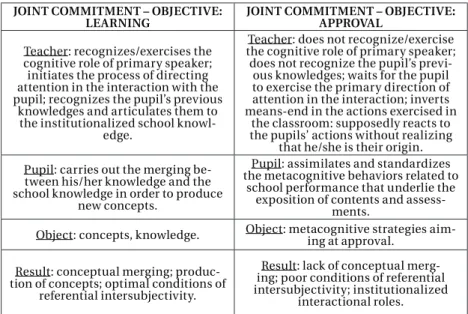
Approval is the objective that defines in the classroom the forms of joint commitment between teachers and pupils, and this commit-ment is in agreecommit-ment with the construction of an educational project that does not correspond to what societies imagine about the school, which for them still retains the aura of a seat of learning. Perhaps learn-ing has never been the real objective of any educational institution, but it was kept at an idealized level, never truly realized because of the strength, the efficiency and attractions of the real objective. From it, forms of interaction and cognition were built, which became natural-ized in such a way that they easily get the institutional seal of approval and are disguised as something else. And if that is so it is because there is an agreement between the parts: the pupil, on the one hand, and in-stitution on the other. What we see in the microcosm of the classroom is simply the materialization of that.
Table 1 – Comparison between Idealized Objective and Real Objective in the Classroom Interaction in Terms of Joint Commitment
JOINT COMMITMENT – OBJECTIVE:
LEARNING JOINT COMMITMENT – OBJECTIVE: APPROVAL
Teacher: recognizes/exercises the cognitive role of primary speaker; initiates the process of directing attention in the interaction with the pupil; recognizes the pupil’s previous
knowledges and articulates them to the institutionalized school
knowl-edge.
Teacher: does not recognize/exercise the cognitive role of primary speaker; does not recognize the pupil’s
previ-ous knowledges; waits for the pupil to exercise the primary direction of attention in the interaction; inverts means-end in the actions exercised in
the classroom: supposedly reacts to the pupils’ actions without realizing
that he/she is their origin. Pupil: carries out the merging
be-tween his/her knowledge and the school knowledge in order to produce
new concepts.
Pupil: assimilates and standardizes the metacognitive behaviors related to
school performance that underlie the exposition of contents and
assess-ments.
Object: concepts, knowledge. Object: metacognitive strategies aim-ing at approval.
Result: conceptual merging; produc-tion of concepts; optimal condiproduc-tions of
referential intersubjectivity.
Result: lack of conceptual merg-ing; poor conditions of referential intersubjectivity; institutionalized
interactional roles.
In the real joint commitment in the classroom, namely, that which aims at approval, there is no learning of contents because, among other reasons, the pupil is denied the right to merge his cognitive experience and daily life meanings to the school experience in order to form new concepts and meanings. Now, this merging will only take place if the pupils can conceptualize the universe of realities – facts, phenomena, objects – at play in school, visualizing them in the same clear way in which they visualizes the objects, facts and phenomena of their daily lives. This visualization has not happened not because the pupil is in-capable of it, but because school materials and school agents are not concerned with bringing the pupil’s knowledges to the classroom and presenting the school conceptual reality as distinct from the daily life conceptual reality.
because they are not included among the so-called “public uses of lan-guage” related to the written modality and to the communication be-tween distant and unknown interlocutors (Brasil, 1997; 1998).
Now, we have said in this article that the conditions for the valida-tion and teaching of contents are directly subjected to the relavalida-tions of power and subjectivation as a function of the time and historic reality in which the school values are constituted and instituted. Such conditions somehow lead the contents of the Disciplines to a process of natural-ization (Foucault, 1989; Itkonen, 2008), in the sense that their presence in school is not questioned, and to a framing of knowledges within the mold of the natural sciences.
From functional regularities defined according to situated pa-rameters of use, the norms came to be taken as rules of conduct, and, in step with the natural sciences, the normative descriptions acquired the status of empirical proofs and ultimately of unique truths. In this sense, a problem that needs to be identified with respect to school real-ity is precisely the naturalization conferred to normatized knowledges, whence issue, in the case of the teaching of the language, the static and rarefied concepts of right-wrong that applied linguists fight so hard against, and which prevent pupils from being heard when they ques-tion the reason why they have to study standardized and/or obsolete linguistic uses – as did François’ pupils.
inclusion, since, judging by the arguments in this article, it is highly un-likely that, particularly in Brazilian public schools, there has ever been any true inclusion.
Final Considerations
It is fitting, at the end of this article, to go back to the question that gave rise to it, whose answer must be limited to a partial conclu-sion, after all the only possible position of anyone who reflects upon a given problem, conceptually or not: why did Esmeralda fail to men-tion to her teacher François that she had already read Plato, even know-ing that pupils who brknow-ing socially legitimized previous knowledge are valued at school? The considerations presented in this article allow us to answer this question assuming that Esmeralda’s silence is part of a school-institutional reality where the pupil is tabula rasa, and that her knowledge is not seen as a component of the pedagogical process. Es-meralda silenced about herself because she did not expect to be heard.
It is not without reason that studies in teaching assume that the classroom is a context in which pupils display learning performances of a quality inferior to what they can achieve outside it (Walkerdine, 1988; Chaiklin; Lave, 1996; Kleiman, 2006; Gerhardt; Silva, 2009): a sce-nario that the film The Class tried, very successfully, to approach. But this performance can improve as we understand how the human mind works in the classroom if it is a real context of production of meaning in interaction, in the encounter of realities and sharing of information. This proposal opposes a reality of education that fails to offer working conditions for a teacher to even elaborate her own materials – excessive workload, large classes etc., which increase even more the work volume and the high stress inherent to the exercise of teaching nowadays.
It is possible to find studies that attest to the centrality of the fig-ure of the teacher in the process of construction of cognitive behaviors at school (see Jackson, 1986; Chaiklin; Lave, 1996). Their knowledge, their experience and, above all, their prerogative of direct contact with the pupils are evidence of that. For this reason the consequences of school failure (in fact, failure of the school, as described in Soares, 2005) fall upon them more heavily.
This situation appears well represented by the teacher François: Esmeralda, by the end of the academic year, returns home without real-izing what has been denied to her. The teacher François, on the other hand, is aware of his “failure”. However, he does not seem able to realize that, in fact, other objectives were in place and that, because of that, instead of failure there was, indeed, success, albeit in a different enter-prise, this one nefarious because, apart from precluding any singular-ity, it is veiled, masked.
primordial objectives, which probably were never established in prac-tice, but whose absence the modernity and the deconstruction of tra-ditional values bring to surface in all societies in which there is formal education. This movement, however, has to be an integral and funda-mental part of a larger educational project, of public policies and ethical transformations that truly seek to bring real learning to the youth not just of Brazil or France, but of the whole world.
Received on 29th April 2013.
Accepted on 10th February 2014.
Notes
1 This article presents some of the findings of a research conducted – as a postdoctoral fellow – in the area of Applied Linguistics at the University of Portsmouth, UK, funded by CAPES (Coordination of Improvement of Higher Education Personnel) – Brazil.
2 Due to space restrictions, the book has not been used as a reference for the present text.
References
AMES, Carole. Classrooms: goals, structures and student motivation. Journal of Educational Psychology, Washington, v. 84, n. 3, p. 261-271, set. 1992.
BORTONI-RICARDO, Stella-Maris. Nós Cheguemu na Escola: e agora?: sociolin-guística e educação. São Paulo: Parábola, 2005.
BRASIL. Ministério da Educação. Parâmetros Curriculares Nacionais (1ª a 4ª séries). Brasília: MEC/SEF, 1997, 10 volumes.
BRASIL. Ministério da Educação. Parâmetros Curriculares Nacionais (5ª a 8ª séries). Brasília: MEC/SEF, 1998, 10 volumes.
BRITO, Percival. Em terra de surdos-mudos: um estudo sobre as condições de produção de textos escolares. In: GERALDI, João Wanderley (Org.). O Texto na Sala de Aula: leitura e produção. 2. ed. Cascavel: Assoeste, 1985. P. 109-119. BRONFENBRENNER, Urie. The Ecology of Human Development. Harvard: University Press, 1979.
CARASSA, Antonella; COLOMBETTI, Marco; MORGANTI, Francesca. The role of joint commitment in intersubjectivity. In: MORGANTI, Francesca; CARAS-SA, Antonella; RIVA, Giuseppe (Org.). Enacting Intersubjectivity: a cognitive and social perspective on the study of interactions. Amsterdam: IOS Press, 2008. P. 187-201.
CHAIKLIN, Seth; Lave, Jean. Understanding Practice: perspectives on activity and context. Cambridge: University Press, 1996.
CSIBRA, Gergely; GERGELY, György. Social Learning and Social Cognition: the case for pedagogy. In: MUNAKATA, Yuko; JOHNSON, Mark (Org.). Processes of
Change in Brain and Cognitive Development. Attention and Performance, XXI.
Oxford: University Press, 2006. P. 249-274.
GERALDI, João Wanderley. Portos de Passagem. São Paulo: Martins Fontes, 1995.
GERHARDT, Ana Flávia. Uma Visão Sócio-Cognitiva da Avaliação em Textos Es-colares. Educação e Sociedade, Campinas, v. 27, n. 97, p. 1181-1203, set./dez. 2006. GERHARDT, Ana Flávia. Integração Conceptual, Formação de Conceitos e Aprendizado. Revista Brasileira de Educação, Rio de Janeiro, v. 16 n. 44, p. 247-263, maio/ago. 2010.
GERHARDT, Ana Flávia; ALBUQUERQUE, Camila; SILVA, Igor. A Cognição Situada e o Conhecimento Prévio em Leitura e Ensino. Ciências e Cognição, Rio de Janeiro, v. 14, n. 2, p. 074-091, jul. 2009.
GERHARDT, Ana Flávia; SILVA, Alexandre. A Intersubjetividade Referencial e a Interação em Sala de Aula. In: CONGRESSO DE LEITURA DO BRASIL. Anais...
Campinas: Universidade de Campinas/Associação de Leitura do Brasil, 2009. Disponível em: <http://www.alb.com.br/anais17/>. Acesso em: 12 jan. 2010. GILBERT, Margaret. Living Together: rationality, sociality and obligation. Lan-ham: Rowman & Littlefield, 1996.
ITKONEN, Esa. The central role of normativity in language and in linguistics. In: ZLATEV, Jordan; RACINE, Timothy; SINHA, Chris; ITKONEN, Esa (Org.). The
Shared Mind: perspectives on intersubjectivity. Amsterdam: John Benjamins,
2008. P. 279-305.
JACKSON, Philip. Life in Classrooms. New York: Teachers College Press, 1986. KLEIMAN, Angela. Leitura e Prática Social no Desenvolvimento de Competên-cias no Ensino Fundamental. In: BUNZEN, Clecio; MENDONÇA, Márcia (Org.).
Português no Ensino Médio e Formação do Professor. Rio de Janeiro: Parábola, 2006.
KVALE, Steinar. Examinations Reexamined: certification of students or certi-fication of knowledge? In: CHAIKLIN, Seth; LAVE, Jean (Org.). Understanding Practice: perspectives on activity and context. Cambridge: University Press, 1996. P. 215-240.
NEISSER, Ulric. Cognition and Reality. San Francisco, Ca: W. H.Freeman and Company, 1976.
OLIVEIRA, Marta Kohl de. Jovens e Adultos como Sujeitos de Conhecimento e Aprendizagem.Revista Brasileira de Educação, Rio de Janeiro, n. 12, p. 59-73, set. 1999.
ORLANDI, Eni Pucinelli. A Língua Brasileira. Trabalhos em Linguística Apli-cada, Campinas, Unicamp, v. 23, p. 29-36, 1994.
PREMACK, David; PREMACK, Ann James. Why Animals lack Pedagogy and some Cultures have more if than Others. In: OLSON, David; TORRANCE, Nancy.
Education and Human Development. New York: Blackkwell 1996. P. 302-323.
REDDY, Michael. A Metáfora do Conduto: um caso de conflito de enquadra-mento na nossa linguagem sobre a linguagem. Cadernos de Tradução UFRGS, Porto Alegre, n. 9, p. 5-47, 2000 [1979].
SALOMÃO, Maria Margarida Martins. Gramática e Interação: o enquadre pro-gramático da hipótese sócio-cognitiva sobre a linguagem. Veredas: Revista de Estudos Lingüísticos, Juiz de Fora, v. 1, n. 1, p. 23-39, 1997.
SINHA, Chris. Situated Selves: learning to be a learner. In: BLISS Joan; SÃLJÕ, Roger; LIGHT, Paul (Org.). Learning Sites: Social and Technological Resources for Learning.Oxford: Pergamon, 1999. P. 32-48.
SINHA, Chris. Cognitive Linguistics, Psychology and Cognitive Science. In: GEERAERTS, Dirk; CUYCKENS, Hubert (Org.). The Oxford Handbook of Cogni-tive Linguistics. Oxford: University Press, 2001. P. 1266-1294.
SINHA, Chris. Objects in a Storied World: Materiality, Normativity, Narrativity.
Journal of Consciousness Studies, v. 16, n. 6-8, 2009.
SINHA, Chris; RODRíGUEZ, Cíntia. Language and the Signifying Object: from convention to imagination. In: ZLATEV, Jordan; RACINE, Timothy; SINHA, Chris; ITKONEN, Esa (Org.). The Shared Mind: perspectives on intersubjectiv-ity. Amsterdam: John Benjamins, 2008. P. 357-378.
SOARES, Magda. Linguagem e Escola: uma perspectiva social. 17. ed. São Pau-lo: Ática, 2005.
TOMASELLO, Michael. The Cultural Origins of Human Cognition. Harvard: University Press, 1999.
TOMASELLO, Michael; RAKOCZY, Hannes. What Makes Human Cognition Unique? From individual to shared to collective intentionality. Mind and Lan-guage, n. 18, p. 121-147, 2003.
TREVARTHEN, Colwyn. Communication and Cooperation in Early Infancy: a description of primary intersubjectivity. In: BULLOWA, Margaret (Org.). Before Speech. Cambridge: Cambridge University Press, 1979. P. 321-347.
TUMMOLINI, Luca; CASTELFRANCHI, Cristiano. The Cognitive and Behavior-al Mediation of Institutions: towards an account of institutionBehavior-al actions. Cogni-tive Systems Research, v. 7, p. 307-323, jun. 2006.
WALKERDINE, V. The Mastery of Reason: cognitive development and the pro-duction of rationality. London: Routledge, 1988.
WALKERDINE, Valerie. Redefining the Subject in Situated Cognition Theory. In: KIRSHNER, David; WHITSON, James (Org.). Situated Cognition: social, se-miotic and psychological perspectives. 2. ed. London: Routledge, 1997. P. 57-70. WERTSCH, James.Mind as Action. Oxford: University Press, 1998.
Ana Flávia Lopes Magela Gerhardt Portuguese is a Professor at the School of Languages of the Universidade Federal do Rio de Janeiro (UFRJ) and a researcher of cognition and teaching of Portuguese as a mother tongue. She a faculty member of the Graduate Programs of Vernacular Languages and Applied Linguistics in the same University, and is also a faculty member of the Professional Master’s program PROFLETRAS, CAPES - Brazil.
E-mail: [email protected]