ABSTRACT
Objective: To determine whether there are signiicant differences between rapid-eye-movement (REM)-related obstructive sleep apnea (OSA) and non-REM (NREM)-related OSA, in terms of the demographic, anthropometric, and polysomnographic characteristics of the subjects. Methods: This was a retrospective study of 110 patients (75 males) with either REM-related OSA (n = 58) or NREM-related OSA (n = 52). To deine REM-related and NREM-related OSA, we used a previously established criterion, based on the apnea-hypopnea index (AHI): AHI-REM/AHI-NREM ratio > 2 and ≤ 2, respectively. Results: The
mean age of the patients with REM-related OSA was 49.5 ± 11.9 years, whereas that of the patients with NREM-related OSA was 49.2 ± 12.6 years. The overall mean AHI (all sleep stages combined) was signiicantly higher in the NREM-related OSA group than in the REM-related OSA group (38.6 ± 28.2 vs. 14.8 ± 9.2; p < 0.05). The mean AHI in the supine position (s-AHI) was also signiicantly higher in the NREM-related OSA group than in the REM-related OSA group (49.0 ± 34.3 vs. 18.8 ± 14.9; p < 0.0001). In the NREM-related OSA group, the s-AHI was higher among the men. In both groups, oxygen desaturation was more severe among the women. We found that REM-related OSA was more common among the patients with mild-to-moderate OSA, whereas NREM-related OSA was more common among those with severe OSA. Conclusions: We found that the severity of NREM-related OSA was associated mainly with s-AHI. Our indings suggest that the s-AHI has a more signiicant effect on the severity of OSA than does the AHI-REM. When interpreting OSA severity and choosing among treatment modalities, physicians should take into consideration the sleep stage and the sleep posture. Keywords: Sleep, REM; Sleep stages; Sleep apnea, obstructive; Apnea; Sleep apnea syndromes.
Obstructive sleep apnea related to
rapid-eye-movement or non-rapid-eye-rapid-eye-movement sleep:
comparison of demographic, anthropometric,
and polysomnographic features
Aysel Sunnetcioglu1, Bunyamin Sertogullarından1, Bulent Ozbay2,
Hulya Gunbatar1, Selami Ekin1
Correspondence to:
Aysel Sunnetcioglu. Pulmonology Department, Yuzuncu Yil University, School of Medicine, Van, Turkey. Tel.: 905071130581. Fax: 904322167519. E-mail: [email protected]
INTRODUCTION
Obstructive sleep apnea (OSA) is a common sleep disorder, characterized by recurrent episodes of com-plete or partial upper airway collapse, accompanied by intermittent hypoxemia and recurrent arousals from sleep. Whereas upper airway collapse can occur during rapid-eye-movement (REM) and non-REM (NREM) sleep, the withdrawal of excitatory noradrenergic and serotonergic inputs to the upper airway motor neurons during REM sleep further reduces the pharyngeal muscle activity and substantially increases the propensity for such collapse.(1) Therefore, in patients with OSA, REM
sleep is typically associated with an increased frequency of obstructive events that are often prolonged and are accompanied by severe oxygen desaturation. In some patients, respiratory events occur predominantly during REM sleep.(1-4) A commonly used diagnostic criterion
is the ratio between the apnea-hypopnea index (AHI) during REM sleep and the AHI during NREM sleep (the AHI-REM/AHI-NREM ratio), an AHI-REM/AHI-NREM ratio > 2 indicating a predominance of disordered breathing during REM sleep, or REM-related OSA.(5) The reported
prevalence of REM-related OSA in clinical studies varies widely, ranging from 10% to 36%.(1-4) That variability
is due, in part, to differences in sample characteristics and in the deinition of REM-related OSA.(2) It is well
known that OSA is more common in the elderly, in males, in individuals with a high BMI, and in individuals who sleep in the supine position.(4,6) However, REM-related
OSA is reported to occur more commonly in younger individuals, women, children, and patients with mild or moderate OSA.(2,5,7-9) The main aim of our study was to
compare patients with REM-related OSA and patients with NREM-related OSA, in terms of their demographic, anthropometric, and polysomnography characteristics.
METHODS
This was a retrospective study of 110 patients (58 with REM-related OSA and 52 with NREM-related OSA) who underwent polysomnography in a sleep laboratory operated by the Pulmonology Department of the Yuzuncu Yil University School of Medicine, in the city of Van, Turkey, between January of 2013 and March of 2014. Patients with a sleep eficiency < 40% were excluded,
1. Pulmonology Department, Yuzuncu Yil
University School of Medicine, Van, Turkey.
2. Pulmonology Department, Muğla Sıtkı Koçman University School of Medicine, Muğla, Turkey.
Submitted: 24 January 2015. Accepted: 08 August 2015.
as were those with an AHI < 5 events/h, those in whom REM sleep accounted for < 15% of the total sleep time, and those who were under 15 years of age. For all patients, the AHI was calculated for total sleep time, for REM sleep (AHI-REM), and for NREM sleep (AHI-NREM), as well as for sleep in the supine position (s-AHI) and sleep in the lateral position (lateral AHI, right-hip and left-hip). We also collected the following data: age; gender; level of daytime sleepiness; BMI; neck circumference; total sleep time; REM sleep and NREM sleep, as percentages of the total sleep time; the mean oxygen desaturation time; and the minimum SaO2. We then attempted to determine whether any of those parameters differed between the REM-related OSA and NREM-related OSA groups.
Polysomnography
We performed polysomnography using a 16-channel polysomnograph (Embla; Medcare Flaga, Reykjavik, Iceland), with continuous monitoring by a technician. The system consists of four electroencephalography channels, two electrooculography channels, tibial/ submental electromyography, and electrocardiography, as well as monitoring of oronasal airlow, thoracic movements, abdominal movements, SaO2, and body position. Polysomnographic recordings were manually interpreted over 30-s intervals in accordance with the guidelines established by the American Academy of Sleep Medicine.(10) Apnea was deined as the complete cessation of airlow for more than 10 s. Hypopnea was deined as a ≥ 30% reduction in respiratory airlow lasting for more than 10 s, accompanied by a ≥ 4% decrease in SaO2. Arousal was deined as a sudden change in the electroencephalography frequency, consisting of alpha and theta activity or waveforms with frequencies > 16 Hz (although not sleep spindles) and a duration of 3-15 s. Respiratory effort-related arousals occur when there is a sequence of breaths that last for at least 10 s, characterized by increased respiratory effort or lattening of the nasal pressure waveform, followed by arousal from sleep, which does not meet the criteria for an apnea or hypopnea event.(11) We determined the average overall AHI,
expressed as the number of events per hour of sleep. For each patient, OSA was classiied as mild (AHI, 5-15 events/h), moderate (AHI, 16-30 events/h), or severe (AHI, > 30 events/h).
In accordance with a previous report,(5) we identiied
respiratory disorders predominantly restricted to REM sleep by calculating the AHI-REM/AHI-NREM ratio. Patients with an AHI-REM/AHI-NREM ratio > 2 were categorized as having REM-related OSA, whereas those with an AHI-REM/AHI-NREM ratio ≤ 2 were categorized as having NREM-related OSA.(5) The subjective level of daytime sleepiness was quantiied with a self-report questionnaire, the Epworth Sleepiness Scale.(12)
Statistical analysis
The results are expressed as mean ± standard deviation. Student’s t-tests were used in order to
compare the means of two independent variables such as gender and group (REM-related OSA vs. NREM-related OSA). Age was included in the model as a covariate to remove extraneous inluences from the dependent variable, thus decreasing the variance within the group, and to adjust the means of the groups. Chi-square and Fisher’s exact tests were used in order to test the independence of categorical variables. Pairwise Pearson correlation tests were carried out in order to estimate the linear relationship between the characteristics. All statistical calculations were performed using the Statistical Analysis System software, version 9.3 (SAS Institute, Cary, NC, USA). Values of p < 0.05 were considered statistically signiicant.
RESULTS
Of the 110 OSA patients evaluated, 58 met the criteria for REM-related OSA, whereas 52 met the criteria for NREM-related OSA. The mean age of the patients with REM-related OSA was 49.5 ± 11.9 years, compared with 49.2 ± 12.6 years for those with NREM-related OSA (Table 1). There was a predominance of males in our study sample (68%), and the proportion of males was higher in the NREM-related OSA group than in the REM-related OSA group (84.6% vs. 53.4%; Table 1).
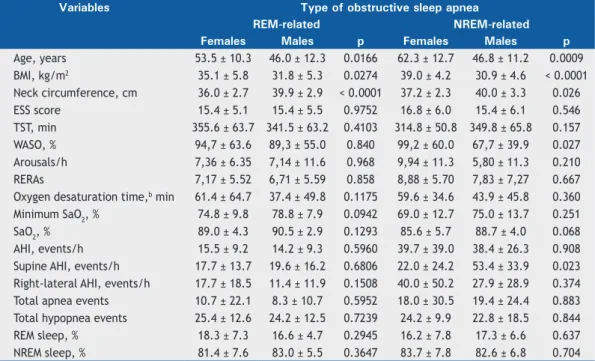
There was no statistically signiicant difference between the REM-related and NREM-related OSA groups in terms of the mean BMI (33.3 ± 5.7 kg/m2 vs. 32.2 ± 5.4 kg/m2; p = 0.97). As can be seen in Figure 1, the AHI value correlated positively with the BMI in the REM-related OSA group (r = 0.343; p < 0.01). In the NREM-related OSA group, the mean BMI was signiicantly higher in the females than in the males (39.0 ± 4.2 vs. 30.9 ± 4.6; p < 0.05). There was no signiicant difference in AHI between the genders, in either group (Table 2). There was also no statistically signiicant difference between the two groups in terms of the mean Epworth Sleepiness Scale score (15.4 ± 5.3 vs. 15.6 ± 6.8; p = 0.94).
The mean AHI was significantly lower in the REM-related OSA group than in the NREM-related OSA group (14.8 ± 9.2 vs. 38.6 ± 28.2; p < 0.05). In the REM-related OSA group, the OSA was classiied as mild in 36 (62.1%) of the 58 patients, moderate in 16 (27.6%), and severe in 6 (10.3%), compared with 12 (23.1%), 15 (28.9%), and 25 (48.1%), respectively, for the NREM-related group. In the REM-related OSA group, the AHI correlated positively with age (r = 0.344; p < 0.05) and with BMI (r = 0.343; p < 0.05). The AHI also correlated positively with BMI in the NREM-related OSA group, although the difference was not signiicant.
men, whereas the right- and left-lateral AHI were both higher among women.
There were no differences between the REM-related and NREM-related OSA groups in terms of the wake after sleep onset and arousal values (Table 1). However, in the NREM-related OSA group, the wake after sleep onset value was signiicantly lower among the men than among the women (67.7 ± 39.9 vs. 99.2 ± 60.0; p = 0.027; Table 2).
There was no signiicant difference between the REM-related and NREM-related OSA groups in terms of the mean oxygen desaturation time (48.5 ± 58.0 vs. 46.3 ± 44.3; p = 0.990). However, oxygen desaturation was more severe among the women than among the men, in both groups (Table 2). We also found that, in REM-related OSA, oxygen desaturation correlated positively with age (r = 0.355; p < 0.05) and with BMI (r = 0.287; p < 0.05).
There were no differences between the two groups with regard to comorbidities (Table 1). In the REM-related and NREM-related OSA groups, 13 and 12 patients, respectively, had one or more comorbidities, including COPD (in 5 and 4 patients, respectively), coronary artery disease (in 2 NREM-related OSA group patients), hypertension (in 7 and 2 patients, respectively), and diabetes mellitus (in 4 and 3 patients, respectively). As expected (given the lack of any differences in terms of comorbidities), there were also no differences between
the two groups with regard to the medications taken by the patients.
DISCUSSION
In the present study, severe OSA was more common among the patients with NREM-related OSA than among those with REM-related OSA and was found to be associated mainly with the s-AHI. We also found that the prevalence of REM-related OSA was higher among the female patients, and that the female patients with REM-related OSA were younger and less obese than were those with NREM-related OSA.
During sleep, the most pronounced decrease in muscle tone typically occurs during REM sleep, causing atony, and the loss of tone in the dilator muscles makes it more likely that disordered breathing will occur. Such events, which occur during the night, can be associated with sleeping in the supine position or with REM sleep. Punjabi et al. found that the REM-AHI was higher than the NREM-AHI only in patients with an AHI of < 30 events/h.(13) In another study, similar
to the present study, REM-related OSA was found to be more common in patients with moderate OSA than in those with severe OSA.(14) That is in agreement with our indings that the AHI values were lower in the patients with REM-related OSA than in those with NREM-related OSA (the initial phase of REM-related OSA in the literature),(15) and that the prevalence of
Table 1. Demographic, anthropometric, and polysomnographic features of patients with obstructive sleep apnea.a
Variables Type of OSA p
REM-related NREM-related
(n = 58) (n = 52)
Age, years 49.5 ± 11.9 49.2 ± 12.6 > 0.05
Malesb 31 (53.4) 44 (84.6) < 0.05
BMI, kg/m2 33.3 ± 5.7 32.2 ± 5.4 0.974
Neck circumference, cm 38.1 ± 3.4 39.6 ± 3.3 0.589
ESS score 15.4 ± 5.3 15.6 ± 6.8 0.943
TST, min 348.1 ± 63.3 344.2 ± 63.8 0.931
WASO, % 89.9 ± 55.2 82.8 ± 52.7 0.656
Arousals/h 7.16 ± 11.1 7.71 ± 11.7 0.756
RERAs 6.79 ± 5.50 8.45 ± 6.29 0.343
Oxygen desaturation time,c min 48.5 ± 58.0 46.3 ± 44.3 0.990
Minimum SaO2, % 77.0 ± 9.0 74.1 ± 16.3 0.102
SaO2, % 89.8 ± 3.7 88.3 ± 4.4 0.017
AHI, events/h 14.8 ± 9.23 38.6 ± 28.2 < 0.0001
Supine AHI, events/h 18.8 ± 14.9 49.0 ± 34.3 < 0.0001
Left-lateral AHI, events/h 15.8 ± 13.8 27.0 ± 32.8 0.031
Right-lateral AHI, events/h 14.0 ± 15.2 29.8 ± 32.6 0.001
Total apnea events 9.4 ± 16.8 19.2 ± 25.1 0.016
Total hypopnea events 24.8 ± 12.4 23.0 ± 17.4 0.524
REM sleep, % 17.4 ± 6.3 17.3 ± 16.7 0.874
NREM sleep, % 34.4 ± 19.5 42.4 ± 29.0 0.851
Comorbid disordersb 13 (22.4) 12 (23.1) 0.934
OSA: obstructive sleep apnea; REM: rapid-eye-movement (sleep); NREM: non-rapid-eye-movement (sleep); ESS: Epworth Sleepiness Scale; TST: total sleep time; WASO: wake after sleep onset; RERAs: respiratory effort-related arousals; and AHI: apnea/hypopnea index. aValues expressed as mean ± SD, except where otherwise indicated. bValues expressed as n (%). cSaO
REM-related OSA was higher among the women in our sample.
Various studies have shown that NREM-related OSA is more common among patients with high AHI values (≥ 30 events/h). (15-17) Oksenberg et al.(18) reported
that, of their patients with NREM-related OSA, 49.1% had severe OSA, similar to the 48.1% observed in our study. The effects that high NREM-AHI values (due to subnormal REM sleeping times) and sleeping in the supine position had on the overall AHI values were large, because NREM occupies a majority of the sleep time, even under normal conditions.
Despite the negative effects that sleeping in the supine position has on upper airway patency, many people prefer sleeping in that position.(19) In patients
with positional OSA, the frequency and severity of respiratory events depend on how long the patient lies in the supine position.(20) During polysomnography,
patients with OSA spend 46-51% of their total sleep time on their backs.(21) The supine position has been
consistently associated with more severe OSA in adults. (22,23) Sunnergren et al. also reported that the
majority of subjects experienced more obstructive events when in the supine position than when in other positions.(24) Sleep posture has different effects on
REM sleep than on NREM sleep.(25) Speciically, the
effects of sleeping in the supine and lateral positions differ between REM and NREM sleep, as reported by George et al.(6) However, those authors found that the
difference in AHI between the two sleep postures was much greater in patients NREM-related OSA. Pevernagie Table 2. Features of patients with obstructive sleep apnea, by predominant sleep stage and by gender.a
Variables Type of obstructive sleep apnea
REM-related NREM-related
Females Males p Females Males p
Age, years 53.5 ± 10.3 46.0 ± 12.3 0.0166 62.3 ± 12.7 46.8 ± 11.2 0.0009
BMI, kg/m2 35.1 ± 5.8 31.8 ± 5.3 0.0274 39.0 ± 4.2 30.9 ± 4.6 < 0.0001
Neck circumference, cm 36.0 ± 2.7 39.9 ± 2.9 < 0.0001 37.2 ± 2.3 40.0 ± 3.3 0.026
ESS score 15.4 ± 5.1 15.4 ± 5.5 0.9752 16.8 ± 6.0 15.4 ± 6.1 0.546
TST, min 355.6 ± 63.7 341.5 ± 63.2 0.4103 314.8 ± 50.8 349.8 ± 65.8 0.157
WASO, % 94,7 ± 63.6 89,3 ± 55.0 0.840 99,2 ± 60.0 67,7 ± 39.9 0.027
Arousals/h 7,36 ± 6.35 7,14 ± 11.6 0.968 9,94 ± 11.3 5,80 ± 11.3 0.210
RERAs 7,17 ± 5.52 6,71 ± 5.59 0.858 8,88 ± 5.70 7,83 ± 7,27 0.667
Oxygen desaturation time,b min 61.4 ± 64.7 37.4 ± 49.8 0.1175 59.6 ± 34.6 43.9 ± 45.8 0.360
Minimum SaO2, % 74.8 ± 9.8 78.8 ± 7.9 0.0942 69.0 ± 12.7 75.0 ± 13.7 0.251
SaO2, % 89.0 ± 4.3 90.5 ± 2.9 0.1293 85.6 ± 5.7 88.7 ± 4.0 0.068
AHI, events/h 15.5 ± 9.2 14.2 ± 9.3 0.5960 39.7 ± 39.0 38.4 ± 26.3 0.908
Supine AHI, events/h 17.7 ± 13.7 19.6 ± 16.2 0.6806 22.0 ± 24.2 53.4 ± 33.9 0.023
Right-lateral AHI, events/h 17.7 ± 18.5 11.4 ± 11.9 0.1508 40.0 ± 50.2 27.9 ± 28.9 0.374
Total apnea events 10.7 ± 22.1 8.3 ± 10.7 0.5952 18.0 ± 30.5 19.4 ± 24.4 0.883
Total hypopnea events 25.4 ± 12.6 24.2 ± 12.5 0.7239 24.2 ± 9.9 22.8 ± 18.5 0.844
REM sleep, % 18.3 ± 7.3 16.6 ± 4.7 0.2945 16.2 ± 7.8 17.3 ± 6.6 0.637
NREM sleep, % 81.4 ± 7.6 83.0 ± 5.5 0.3647 83.7 ± 7.8 82.6 ± 6.8 0.704
REM: rapid-eye-movement (sleep); NREM: non-rapid-eye-movement (sleep); ESS: Epworth Sleepiness Scale; TST: total sleep time; WASO: wake after sleep onset; RERAs: respiratory effort-related arousals; and AHI: apnea/ hypopnea index. aValues expressed as mean ± SD. bSaO
2 < 90%.
50.0 40.0 30.0 20.0 10.0 0.0
AHI 50.0
45.0
40.0
35.0
30.0
25.0
20.0
BMI
r = 0.343 (p < 0.01)
150.0 120.0 90.0 60.0 10.0 0.0
Supine AHI 100.0
80.0
60.0
40.0
20.0
0.0
AHI
r = 0.343 (p < 0.01)
Figure 1. Correlation between the apnea-hypopnea index (AHI) and BMI in rapid-eye-movement-related obstructive sleep apnea.
et al. reported that, among OSA patients, AHI values were higher in the supine position than in the lateral position only during NREM sleep.(25) Cartwright et
al.(26) reported that OSA patients tend to sleep in the
lateral position more often during REM sleep than during NREM sleep, a difference that we found to be signiicant in males but not in females. Previous studies have conirmed that women are more prone than are men to show higher AHI values during REM sleep than during NREM sleep, regardless of the sleep posture.(27)
In our study, s-AHI values were higher among men, whereas lateral AHI values were higher among women.
Patients with OSA experience luctuations in oxygen levels during sleep. Sato et al.(28) demonstrated that the
drop in SaO2 is particularly dramatic in patients with severe OSA. A number of factors have been reported to affect the severity of oxygen desaturation during an apnea/hypopnea event, such factors including sleep posture,(29) sleep stage,(30) and age,(31) as well
as gender and obesity.(32) In addition, comorbidity with
COPD has been shown to increase the frequency and severity of oxygen desaturation in OSA.(33) Bednarek
et al.(34) compared patients in whom OSA and COPD
overlapped (i.e., patients with overlap syndrome) and patients with OSA only, in terms of polysomnographic variables. The authors reported that the patients in the overlap syndrome group had a lower mean oxygen saturation and spent more time in oxygen desaturation than did those in the OSA group.
Muraki et al.(17) found that, in OSA patients, the
minimum SaO2 was signiicantly lower during REM sleep than during NREM sleep, as has been reported elsewhere.(3) In the present study, although there were
no differences between our two groups in terms of the minimum SaO2 or oxygen desaturation, the mean SaO2 was lower in the NREM-related OSA group than in the REM-related OSA group. We also found that, in REM-related OSA, oxygen desaturation correlated positively with age and BMI.
The termination of an apnea event is associated with arousal or awakening. Different levels or intensities of arousal can have quite different effects on sleep and breathing.(35) In the present study, some of the effects
of REM-related OSA were mitigated by a decrease in the time spent in REM sleep in parallel with increasing AHI-REM. This could be due to an increased number of events during REM sleep, leading to arousals and decreasing the time spent in REM sleep. In our study, there was no difference between the REM-related and NREM-related OSA groups, in terms of the number of arousals.
Punjabi et al.(13) found that the AHI-REM was
associated with greater daytime sleepiness, whereas the AHI-NREM was not. However, Haba-Rubio et al., using an objective instrument (the Maintenance of Wakefulness Test), found no difference between patients with REM-related OSA and those with NREM-related OSA, in terms of excessive daytime sleepiness.(5)
Although OSA is a common chronic condition in all adults, its prevalence and severity are higher among men than among women.(29,36) However, a number
of studies have shown that REM-related OSA is more common among women.(7-9) We ind it interesting
that the AHI-REM has been shown to be comparable between men and women.(37) In our study, there was no signiicant difference between genders in terms of the prevalence of REM-related OSA. However, we found that REM-related OSA was more common than was NREM-related OSA among the women in our sample, whereas NREM-related OSA was more common among the men. In a study conducted by O’Connor et al.,(27) OSA
was found to be milder in the women than in the men. The authors reported that the signiicant respiratory events recorded in the women were associated with REM sleep and therefore concluded that REM-related OSA is more common in women.
Some studies have shown that REM-related OSA is more common among younger patients,(8) whereas
others have found no such age-related difference.(5,38) In the present study, there was no signiicant difference between the REM-related and NREM-related OSA groups, in terms of age. However, in both groups, the women were older than were the men, although the female patients with REM-related OSA were younger than were those with NREM-related OSA, especially in the younger (< 60 year) age group. Koo et al.(7)
stated that, in REM-related and NREM-related OSA, the hormonal changes that occur with age in females have a protective effect against the respiratory problems that occur during NREM sleep. Among the women in our sample, REM-related OSA was more common than was NREM-related OSA, as well as being more common in the younger women.
In another study, Koo et al. showed that, with each passing decade of life, the NREM-AHI and REM-AHI increase by 11.2% and 9.0%, respectively, in men, compared with 16.0% and 5.7%, respectively, in women. (8) The authors also showed that each 5-unit
increase in BMI results in increases of 13.0% and 17.1% in the NREM-AHI and REM-AHI, respectively, in women, compared with a 24.2% decrease for both in men.(8) In our study, there was no difference between
the REM-related and NREM-related OSA groups in terms of the BMI. However, in both groups, the women were signiicantly heavier than were the men. We also found that, in the REM-related OSA group, the AHI showed a signiicant positive correlation with age and BMI. The AHI also correlated positively with BMI in the NREM-related OSA group, although the difference was not signiicant.
parameters changed from night to night. A decrease in the proportion of REM sleep has been associated with the irst night effect, and a total lack of REM sleep can occur in split-night polysomnography studies.(39) Either
of those scenarios could lead to an underestimation of AHI in patients with REM-related OSA.
In conclusion, it appears that REM-related OSA is more common among patients with mild-to-moderate OSA,
whereas NREM-related OSA is more common among those with severe OSA, the latter being associated mainly with s-AHI. Our indings indicate that s-AHI has a more signiicant effect on the severity of OSA than does REM-AHI. When determining OSA severity and choosing among treatment modalities, physicians should take into consideration not only sleep stage but also sleep posture.
REFERENCES
1. Fenik VB, Davies RO, Kubin L. REM sleep-like atonia of hypoglossal (XII) motoneurons is caused by loss of noradrenergic and serotonergic inputs. Am J Respir Crit Care Med. 2005;172(10):1322-30. http:// dx.doi.org/10.1164/rccm.200412-1750OC
2. Conwell W, Patel B, Doeing D, Pamidi S, Knutson KL, Ghods F, et al. Prevalence, clinical features, and CPAP adherence in REM-related sleep-disordered breathing: a cross-sectional analysis of a large clinical population. Sleep Breath. 2012;16(2):519-26. http://dx.doi. org/10.1007/s11325-011-0537-6
3. Findley LJ, Wilhoit SC, Suratt PM. Apnea duration and hypoxemia during REM sleep in patients with obstructive sleep apnea. Chest. 1985;87(4):432-6. http://dx.doi.org/10.1378/chest.87.4.432 4. Quera-Salva MA, Guilleminault C, Partinen M, Jamieson A.
Determinants of respiratory disturbance and oxygen saturation drop indices in obstructive sleep apnoea syndrome. Eur Respir J. 1988;1(7):626-31.
5. Haba-Rubio J, Janssens JP, Rochat T, Sforza E. Rapid eye movement-related disordered breathing: clinical and polysomnographic features. Chest. 2005;128(5):3350-7. http://dx.doi.org/10.1378/ chest.128.5.3350
6. George CF, Millar TW, Kryger MH. Sleep apnea and body position during sleep. Sleep. 1988;11(1):90-9.
7. Koo BB, Dostal J, Ioachimescu O, Budur K. The effects of gender and age on REM-related sleep-disordered breathing. Sleep Breath. 2008;12(3):259-64. http://dx.doi.org/10.1007/s11325-007-0161-7 8. Koo BB, Patel SR, Strohl K, Hoffstein V. Rapid eye movement-related
sleep-disordered breathing: inluence of age and gender. Chest. 2008;134(6):1156-61. http://dx.doi.org/10.1378/chest.08-1311 9. Resta O, Carpanano GE, Lacedonia D, Di Gioia G, Giliberti T, Stefano
A, et al. Gender difference in sleep proile of severely obese patients with obstructive sleep apnea (OSA). Respir Med. 2005;99(1):91-6. http://dx.doi.org/10.1016/j.rmed.2004.05.014
10. Iber C, Ancoli-Israel S, Chesson A, Quan SF. The AASM Manual for the Scoring of Sleep and Associated Events: Rules, Terminology and Technical Speciications. Westchester, IL: American Academy of Sleep Medicine; 2007.
11. Berry RB, Budhiraja R, Gottlieb DJ, Gozal D, Iber C, Kapur VK, et al. Rules for scoring respiratory events in sleep: update of the 2007 AASM Manual for the Scoring of Sleep and Associated Events. Deliberations of the Sleep Apnea Deinitions Task Force of the American Academy of Sleep Medicine. J Clin Sleep Med. 2012;8(5):597-619.
12. Johns MW. A new method for measuring daytime sleepiness: The Epworth sleepiness scale. Sleep. 1991;14(6):540-5.
13. Punjabi NM, Bandeen-Roche K, Marx JJ, Neubauer DN, Smith PL, Schwartz AR. The association between daytime sleepiness and sleep-disordered breathing in NREM and REM sleep. Sleep. 2002;25(3):307-14.
14. Campos-Rodríguez F, Fernández-Palacín A, Reyes-Núñez N, Reina-González A. Clinical and polysomnographic features of rapid-eye-movement-speciic sleep-disordered breathing [Article in Spanish]. Arch Bronconeumol. 2009;45(7):330-4. http://dx.doi.org/10.1016/j. arbres.2008.12.003
15. Kutbay Özçelik H, Akkoyunlu ME, Bostanlı P, Bayram M, Atahan E, et al. The frequency and properties of REM related obstructive sleep apnea among the patients with mild related obstructive sleep apnea [Article in Turkish]. Tuberk Toraks. 2013;61(4):283-7. http://dx.doi. org/10.5578/tt.6208
16. Liu Y, Su C, Liu R, Lei G, Zhang W, Yang T, et al. NREM-AHI greater than REM-AHI versus REM-AHI greater than NREM-AHI in patients with obstructive sleep apnea: clinical and polysomnographic features. Sleep Breath. 2011;15(3):463-70. http://dx.doi.org/10.1007/
s11325-010-0358-z
17. Muraki M, Kitaguchi S, Ichihashi H, Haraguchi R, Iwanaga T, Kubo H, et al. Apnoea-hypopnoea index during rapid eye movement and non-rapid eye movement sleep in obstructive sleep apnoea. J Int Med Res. 2008;36(5):906-13. http://dx.doi.org/10.1177/147323000803600506 18. Oksenberg A, Arons E, Nasser K, Vander T, Radwan H. REM-related
obstructive sleep apnea: the effect of body position. J Clin Sleep Med. 2010;6(4):343-8.
19. Oksenberg A, Silverberg DS, Arons E, Radwan H. Positional vs nonpositional obstructive sleep apnea patients: anthropomorphic, nocturnal polysomnographic, and multiple sleep latency test data. Chest. 1997;112(3):629-39. http://dx.doi.org/10.1378/ chest.112.3.629
20. Dempsey JA, Veasey SC, Morgan BJ, O’Donnell CP. Pathophysiology of sleep apnea. Physiol Rev. 2010;90(1):47-112. http://dx.doi. org/10.1152/physrev.00043.2008
21. Metersky ML, Castriotta RJ. The effect of polysomnography on sleep position: possible implications on the diagnosis of positional obstructive sleep apnea. Respiration. 1996;63(5):283-7. http://dx.doi. org/10.1159/000196561
22. Menon A, Kumar M. Inluence of body position on severity of obstructive sleep apnea: a systematic review. ISRN Otolaryngol. 2013;2013:670381. http://dx.doi.org/10.1155/2013/670381 23. Eiseman NA, Westover MB, Ellenbogen JM, Bianchi MT. The impact
of body posture and sleep stages on sleep apnea severity in adults. J Clin Sleep Med. 2012;8(6):655-66A. http://dx.doi.org/10.5664/ jcsm.2258
24. Sunnergren O, Broström A, Svanborg E. Positional sensitivity as a confounder in diagnosis of severity of obstructive sleep apnea. Sleep Breath. 2013;17(1):173-9. http://dx.doi.org/10.1007/s11325-012-0666-6
25. Pevernagie DA, Slanson AW, Sheedy PF 2nd, Daniels BK, Shepard JW Jr. Effects of body position on the upper airway of patients with obstructive sleep apnea. Am J Respir Crit Care Med. 1995;152(1):179-85. http://dx.doi.org/10.1164/ajrccm.152.1.7599821
26. Cartwright Rd, Diaz F, Lloyd S. The effects of sleep posture and sleep stage on apnea frequency. Sleep. 1991;14(4):351-3.
27. O’Connor C, Thornley KS, Hanly PJ. Gender differences in the polysomnographic features of obstructive sleep apnea. Am J Respir Crit Care Med. 2000;161(5):1465-72. http://dx.doi.org/10.1164/ ajrccm.161.5.9904121
28. Sato M, Suzuki M, Suzuki J, Endo Y, Chiba Y, Matsuura M, et al. Overweight patients with severe sleep apnea experience deeper oxygen desaturation at apneic events. J Med Dent Sci. 2008;55(1):43-7.
29. Oksenberg A, Khamaysi I, Silverberg DS, Tarasiuk A. Association of body position with severity of apneic events in patients with severe nonpositional obstructive sleep apnea. Chest. 2000;118(4):1018-24. http://dx.doi.org/10.1378/chest.118.4.1018
30. Sériès F, Cormier Y, La Forge J. Inluence of apnea type and sleep stage on nocturnal postapneic desaturation. Am Rev Respir Dis. 1990;141(6):1522-6. http://dx.doi.org/10.1164/ajrccm/141.6.1522 31. George E, Katerina V, Maria S, Lambros B, Konstantina N, Dimitrios
G. Clinical features and polysomnographic indings in Greek male patients with obstructive sleep apnea syndrome: differences regarding the age. Sleep Disord. 2012;2012:324635. http://dx.doi. org/10.1155/2012/324635
33. Marin JM, Soriano JB, Carrizo SJ, Boldova A, Celli BR. Outcomes in patients with chronic obstructive pulmonary disease and obstructive sleep apnea: the overlap syndrome. Am J Respir Crit Care Med. 2010;182(3):325-31. http://dx.doi.org/10.1164/rccm.200912-1869OC 34. Bednarek M, Plywaczewski R, Jonczak L, Zielinski J. There is no
relationship between chronic obstructive pulmonary disease and obstructive sleep apnea syndrome: a population study. Respiration. 2005;72(2):142-9. http://dx.doi.org/10.1159/000084044
35. Farney RJ, Walker LE, Jensen RL, Walker JM. Ear oximetry to detect apnea and differentiate rapid eye movement (REM) and non-REM (NREM) sleep. Screening for the sleep apnea syndrome. Chest. 1986;89(4):533-9. http://dx.doi.org/10.1378/chest.89.4.533 36. Catcheside PG, Jordan A. Relex tachycardia with airway opening
in obstructive sleep apnea. Sleep. 2013;36(6):819-21. http://dx.doi. org/10.5665/sleep.2698
37. Martinez D, Lumertz MS, Lenz Mdo C. Dimensions of sleepiness and their correlations with sleep-disordered breathing in mild sleep apnea. J Bras Pneumol. 2009;35(6):507-14. http://dx.doi.org/10.1590/ S1806-37132009000600003
38. Su CS, Liu KT, Panjapornpon K, Andrews N, Foldvary-Schaefer N. Functional outcomes in patients with REM-related obstructive sleep apnea treated with positive airway pressure therapy. J Clin Sleep Med. 2012;8(3):243-7. http://dx.doi.org/10.5664/jcsm.1902 39. Toussaint M, Luthringer R, Schaltenbrand N, Nicolas A, Jacqmin A,