Licenciado sob uma Licença Creative Commons DO): http://dx.doi.org. . / - . . .AR
[T]
Disability after stroke: a systematic review
[)]
Incapacidade após acidente vascular
cerebral: uma revisão sistemática
[A]
Julia Fabres do Carmo[a], Renato Lirio Morelato[b], Hudson Pereira Pinto[a], Elizabete Regina Araujo de Oliveira[a]*
[a] Universidade Federal do Espírito Santo UFES , Vitória, ES, Brazil
[b] Escola de Medicina da Santa Casa de Misericórdia de Vitória EMESCAM , Vitória, ES, Brazil
[R] Abstract
Introduction: Stroke is the most common cause of disability in Western countries, yet there is no consensus in the literature on how to measure and describe disability from stroke. Objective: To conduct a systematic litera-ture review on disability in stroke survivors. Method: Observational studies published in the PubMed, L)LACS and SciELO online databases were selected, to evaluate disability in adults and in the elderly after stroke in the period – . The Downs and Black checklist for non-randomized studies was used to assess the quality of the articles. Results: articles were found from which were selected to compose the study. The mean age of participants was years, and disability affected % to % of the population evaluated. With regard to measurement instruments, % of the studies analyzed presented results of disability by means of the modi-fied Rankin Scale; % by means of the World (ealth Organization’s )nternational Classification of Functioning, Disability and (ealth; % by means of Katz’ )ndex of )ndependence in Activities of Daily Living; . % by means
* JFC: MSc, e-mail: [email protected]
408
of the London (andicap Scale; . % by means of the Barthel )ndex; and . % by means of the Functional )ndependence Measure. Conclusion: Literature is not uniform as regards means of measuring disability after stroke, but considering the preference of articles in assessing physical performance in activities of daily living, it can be concluded that a quarter to half of the population that survives stroke has some degree of disability. [P]
Keywords: Stroke. Disabled persons. Disability evaluation. [B]
Resumo
Introdução: O acidente vascular cerebral (AVC) é a causa mais comum de incapacidade nos países ocidentais, e ainda não existe na literatura um consenso na forma de mensurar e descrever tal incapacidade. Objetivo: Realizar uma revisão sistemática da literatura sobre a incapacidade nos sobreviventes do AVC. Métodos: Foram selecionados estudos observacionais que avaliaram incapacidade na população adulta e idosa após AVC publi-cados na base de dados LILACS e nas bibliotecas virtuais PubMed e SciELO no período de 2002 a 2012. Para avaliação da qualidade dos artigos foi utilizado o critério de Downs e Black. Resultados: Foram encontrados 212 artigos e selecionados 16 para compor o banco de dados. A média de idade dos participantes foi de 67 anos e a incapacidade atingiu de 24% a 49% da população avaliada. Com relação aos instrumentos de mensuração, 31% dos estudos analisados apresentaram os resultados de incapacidade por meio do Modified Rankin Scale, 19% por meio da Classificação Internacional de Funcionalidade, 19% por meio do Katz, 12,5% por meio do London Handicap Scale, 12,5% por meio do Barthel e 6,25% por meio da Medida de Independência Funcional. Conclusão: A literatura não é uniforme quanto à forma de mensurar a incapacidade após AVC, mas considerando a preferên-cia dos artigos em avaliar o desempenho físico nas atividades de vida diária, pode-se concluir que de um quarto à metade da população que sobrevive ao AVC apresenta algum grau de incapacidade. [K]
Palavras-chave: Acidente vascular cerebral. Pessoas com deficiência. Avaliação da deficiência.
an indicator of disability, assessed by means of physi-cal performance in daily activities , . Alves also brings together a variety of measurement instru-ments, demonstrating that in the literature there is still no single standard defined to measure disability.
Previous systematic reviews sought to identify predictive variables of good functional performance along with measurement instruments used to assess participation in survivors of stroke; however, no study searched by functional disability, considered a good indicator of disability , , . The objec-tive of this study was to systematically review the literature on disability after stroke, seeking to iden-tify functional disability, variables associated with it, and disability measurement instruments used in this population.
Method
This was a systematic review of observational studies that adhered to the Cochrane Collaboration’s Introduction
Stroke is the term used for a group of diseases that have abrupt onset and cause neurological dam-age, and is the most common cause of disability in Western countries , , . )t is estimated that % to % of the million stroke survivors in the world have some physical, cognitive or emotional deficiency, and require partial or complete assistance to carry out activities of daily living ADL . )n re-cent years, advances in treatment of stroke reduced mortality rates, which, added to the phenomenon of aging, resulted in growth of the population that survives stroke - .
online course recommendation of a prior search for systematic reviews on the topic in order to evaluate the need for the study. The search for reviews was performed in the Cochrane library and online using MEDL)NE, with the following keywords: systematic review , stroke and disabled person .
Search strategy
The search strategy for this review included research in three online databases: MEDL)NE via PubMed National Library of Medicine and National )nstitutes of (ealth ; L)LACS Latin American and Caribbean (ealth Sciences Literature and SciELO Scientific Electronic Library Online . The key words used were matched in English and Portuguese, and registered in the National Library of Medicine’s con-trolled vocabulary thesaurus MeS( and the (ealth Sciences Descriptors Decs trilingual thesaurus: stroke and disabled persons in English, and aci-dente vascular cerebral” and “pessoa com deficiência” in Portuguese. The terms disability and functional disability were not used as descriptors because they were not registered in the Decs. The search period was January through December , with no restriction on language.
Selection of studies
Titles and abstracts were read for initial selec-tion of the articles identified. The full articles were then read, and those that met the inclusion criteria were included in the data collection phase, per-formed by means of a standardized form Annex . )dentification and selection of the studies was per-formed by two researchers working independently.
Eligibility criteria
The articles selected were observational and cross-sectional or cohort, with the aim of evaluat-ing the disability or level of assistance required in adults and elderly individuals after suffering stroke. Studies that evaluated other outcomes in addition to disability were included; however, those that associated stroke with other clinical situations, or
that compared specific interventions and methods of rehabilitation, were excluded. Articles that were not published in English, Portuguese or Spanish, and those that were not found even after attempting to contact the author were also excluded.
Quality assessment
The studies included were initially divided ac-cording to study design, and the longitudinal studies were evaluated for quality by adapting the Downs and Black checklist for non-randomized studies, using only the items relating to assessment of cohort studies. Adaptation of the Downs and Black instru-ment has already been used in other reviews in or-der to identify relevant methodological features of observational studies , , .
Results
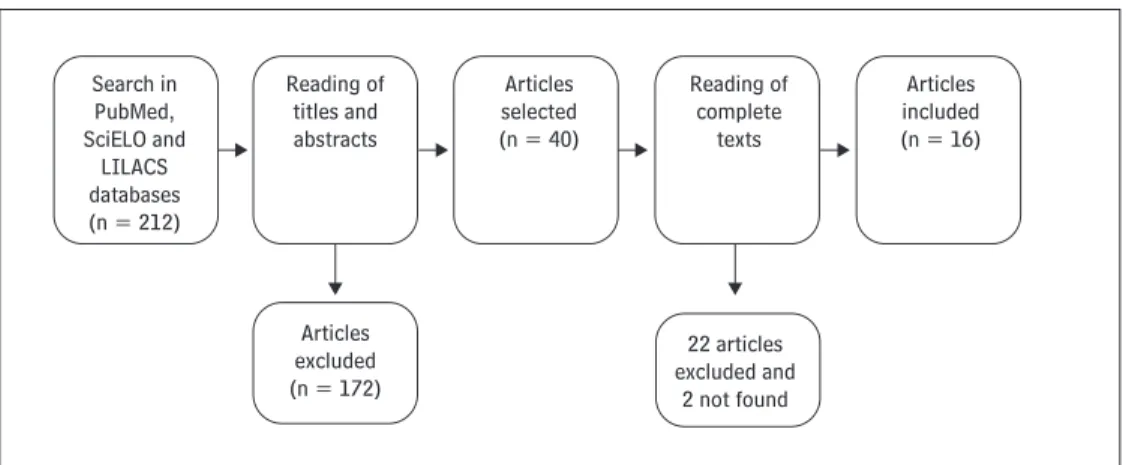
The initial search yielded documents; of these, were selected. After reading each article in full, were excluded for not meeting the eligibility criteria, leaving a total of articles analyzed and submitted to the data collection phase of this review Figure .
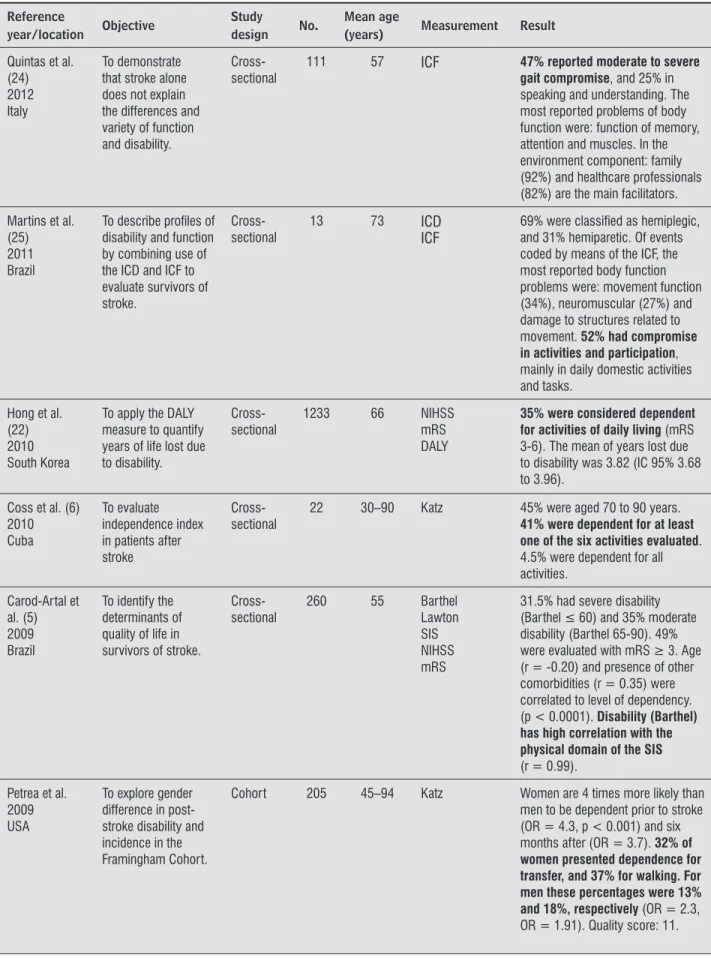
Among the studies analyzed, . % were pub-lished since . The articles were listed in descend-ing order by year of publication in Table , in which general data such as author/year, objective, study de-sign, sample, participant age, instruments and results were summarized. Eight studies were cross-sectional, two of which presented results from the same )talian population. Eight studies were prospective longitu-dinal, of which two presented the results from one Australian cohort five and ten years after stroke.
410
(To be continued)
Figure 1 - Flowchart of the article inclusion process in the systematic review Search in
PubMed, SciELO and
LILACS databases (n = 212)
Reading of titles and abstracts
Articles excluded (n = 172)
22 articles excluded and
2 not found Articles
selected (n = 40)
Reading of complete
texts
Articles included (n = 16)
)nstitute of (ealth Stroke Scale N)(SS ; Carod-Artal et al. used the Trial of Org in Acute Stroke Treatment TOAST ; and Patel et al. applied the Oxfordshire Community Stroke Project OCSP . Three studies did not mention diagnostic criteria used , , .
Four articles % set out to evaluate quality of life QOL in addition to disability, and found strong positive association between the physical domain of QOL instruments and disability , , , . Of the studies analyzed, % five articles presented the result of disability by means of the modified Rankin Scale mRS , , , , ; % three arti-cles by means of the )nternational Classification of Functioning, Disease and (ealth )CF , one of which used the World (ealth Organization Disability Assessment Schedule W(ODAS . , , ; % three articles by means of the Katz )ndex of )ndependence in Activities of Daily Living , , ;
. % two articles by means of the London (andicap Scale , ; . % two articles by means of the Barthel )ndex , ; and . % one article according to the Functional )ndependence Measure F)M .
Considering functional disability as an indicator of disability measured by means of instruments such as the Katz and Barthel scales and the mRS, the result of of the selected articles can be assembled as follows: in the first two years after stroke, disability affected % to % of the population evaluated; three to five years after stroke, that number was be-tween % and %; and ten years after, % of the population had some level of disability.
The evaluation of quality applied to the cohort studies had a mean methodological score of . , and the studies that obtained the highest score were (ardie et al. and Lin et al. . The score of each study can be found in Table .
Table 1- Characteristics of studies selected
Reference
year/location Objective
Study
design No.
Mean age
(years) Measurement Result Cerniauskaite
et al. (7) 2012 Italy
To assess impact of stroke on quality of life and disability, and the relationship between both.
Cross-sectional
111 57 SF-36
WHODAS 2.0
Reference
year/location Objective
Study
design No.
Mean age
(years) Measurement Result Quintas et al.
(24) 2012 Italy
To demonstrate that stroke alone does not explain the differences and variety of function and disability.
Cross-sectional
111 57 ICF 47% reported moderate to severe gait compromise, and 25% in speaking and understanding. The most reported problems of body function were: function of memory, attention and muscles. In the environment component: family (92%) and healthcare professionals (82%) are the main facilitators.
Martins et al. (25) 2011 Brazil
To describe profi les of disability and function by combining use of the ICD and ICF to evaluate survivors of stroke.
Cross-sectional
13 73 ICD
ICF
69% were classifi ed as hemiplegic, and 31% hemiparetic. Of events coded by means of the ICF, the most reported body function problems were: movement function (34%), neuromuscular (27%) and damage to structures related to movement. 52% had compromise in activities and participation, mainly in daily domestic activities and tasks.
Hong et al. (22) 2010 South Korea
To apply the DALY measure to quantify years of life lost due to disability.
Cross-sectional
1233 66 NIHSS
mRS DALY
35% were considered dependent for activities of daily living (mRS 3-6). The mean of years lost due to disability was 3.82 (IC 95% 3.68 to 3.96).
Coss et al. (6) 2010 Cuba
To evaluate independence index in patients after stroke
Cross-sectional
22 30–90 Katz 45% were aged 70 to 90 years.
41% were dependent for at least one of the six activities evaluated. 4.5% were dependent for all activities.
Carod-Artal et al. (5) 2009 Brazil
To identify the determinants of quality of life in survivors of stroke.
Cross-sectional
260 55 Barthel
Lawton SIS NIHSS mRS
31.5% had severe disability (Barthel ≤ 60) and 35% moderate disability (Barthel 65-90). 49% were evaluated with mRS ≥ 3. Age (r = -0.20) and presence of other comorbidities (r = 0.35) were correlated to level of dependency. (p < 0.0001). Disability (Barthel) has high correlation with the physical domain of the SIS
(r = 0.99).
Petrea et al. 2009 USA
To explore gender difference in post-stroke disability and incidence in the Framingham Cohort.
Cohort 205 45–94 Katz Women are 4 times more likely than
men to be dependent prior to stroke (OR = 4.3, p < 0.001) and six months after (OR = 3.7). 32% of women presented dependence for transfer, and 37% for walking. For men these percentages were 13% and 18%, respectively (OR = 2.3, OR = 1.91). Quality score: 11.
Table 1- Characteristics of studies selected
412
Reference
year/location Objective
Study
design No.
Mean age
(years) Measurement Result Gall et al. (28)
2008 Australia
To defi ne standard and level, and identify risk factors of disability fi ve years after stroke.
Cohort 352 75 Barthel LHS;
IDA
45% of the cohort survived 5 years after stroke. Of those who survived, 70% are among the deciles representing disability (LHS < 90), mainly in the domains of physical independence, leisure and occupation. 47% showed dependence in some BADL (Barthel). Increasing age and recurrence of stroke are factors associated with greater disability. Quality score: 9.
Lo et al. (18) 2008 China
To investigate changes in levels of disability in survivors of stroke, and identify their determinants.
Cohort 268 77 Barthel Lawton
MMSE GDS LHS
Three months after stroke, 24% were dependent in more than one BADL (Barthel < 14) and 30% was in the range 15 to 19.
19% were institutionalized. In the multilevel analysis, depression (GDS), functional disability (Barthel) and advancement of age were strongly associated with disability and severity (LHS) p < 0.001. Quality score: 10.
Appelros et al. (20)
2006 Sweden
To verify the living scenario and need for assistance for ADL before and one year after stroke.
Cohort 253 75 Barthel
FAI mRS GDS MMSE NIHSS
37% of the cohort presented MRS
≥ 3. Before the stroke, 13% lived in institutions; one year after the stroke, 20% lived in institutions, and the factors associated with this change were prior dependency (OR = 17), cognitive impairment (OR = 12) and depression (OR = 4.5) p < 0.001. One year after the event, 36% of stroke survivors needed some help with BADL, and 59% required help with BADL. Quality score: 10.
Patel et al. (19) 2006
England
To estimate level of disability and quality of life three years after stroke, and examine the relationship between the two domains.
Cohort 490 71 Barthel
FAI SF-36
Three years after the stroke,
34% were independent and 26% were moderately to severely disabled (Bar thel < 15). 51% were inactive (FAI < 15). Strong correlation (r = 0.79) between FAI and Bar thel and strong correlation (r > 0.70) between the physical domain of the HRQOL and disability (Barthel). Quality score: 11.
(To be continued)
Reference
year/location Objective
Study
design No.
Mean age
(years) Measurement Result Martins et al.
(17) 2006 Portugal
To evaluate the impact of stroke on quality of life and functional capacity nine months after hospital discharge.
Cross-sectional
273 69 Barthel
FAI mRS
COOP/WONCA
36% of the sample was independent in BADL (Barthel), 47% had disability (mRS ≥ 3), and 29% were self-employed in IADL (FAI). Perception of quality of life (QOL) is strongly associated (0.70, p < 0.01) with functional capacity, the domain physical
fi tness was the most affected in the assessment of QOL.
Lin et al. (29) 2005 China
To identify predictors of degree of disability one year after stroke.
Cohort 109 62 FIM The group classifi ed with severe
and very severe disability (59%)
presented a mean FIM score of 65 and the group with mild to moderate disability (41%) showed mean FIM score of 87. In the regression model, bilateral involvement (OR = 10.8) and low FIM score (OR = 7.6) were associated with the highest level of disability. Quality score: 12
Hardie et al. (23) 2004 Australia
To determine frequency of recurrence of stroke and disability 10 years after fi rst stroke.
Cohort 45 72 mRS 10 years after the fi rst stroke:
approximately 15% were institutionalized, 46% were incapacitated. The risk of suffering from another stroke among the subjects of the cohort was 6 times greater than the general population, even after adjusting for sex and age (95% IC -4.5-7.4).Quality score: 12.
Widar et al. (26) 2002 Sweden
To describe disability and pain in everyday life of survivors who cite pain after stroke.
Cross-sectional
43 33–82 Katz
MPI-S
46% were dependent for one or more BADL (Katz). 52% reported diffi culties walking, and 50% depended on mobility equipment. 63% reported moderate pain, 37% reported severe pain.
Hankey et al. (21) 2002 Australia
To describe disability and dependence fi ve years after stroke in the city of Perth.
Cohort 277 73 Barthel
FAI mRS MotrInd
19% had some disability before the stroke. 45% of the cohort had died fi ve years after the fi rst stroke, 17.7% of the survivors were institutionalized, and 36% had some dependency for BADL. The cumulative risk of a new and greater disability was 36%. The prognostic factors of disability were old age (OR = 5.7 in the age range 75-84), recurrence of stroke and apathy in the fi rst evaluation. Quality score: 9.
Note: SF-36 = Short Form Health Survey; WHODAS 2.0 = World Health Organization Disability Assessment Schedule 2.0; ICF = Interna-tional Classifi cation of Functioning, Disability and Health; ICD = International Classifi cation of Diseases; NIHSS = National Institute of Health Stroke Scale; mRS = modifi ed-Rankin Scale; DALY = disability adjusted life year; SIS = Stroke Impact Scale; LHS = London Handicap Scale; IDA = Irritability, Depression and Anxiety; MMSE = Mini-Mental State Examination; GDS = Geriatric Depression Scale; FAI = Frenchay Activities Index; COOP/WONCA = Primary Care Cooperative Information Project/World Organization of National Colleges Academies; MPI-S = Multidimensional Pain Inventory; MotrInd = Motricity Index.
(Conclusion)
414
Discussion
Measurement instruments and results of disability
The studies applied various measurement instru-ments. Appelros et al. used the Barthel )ndex, but presented the result of the disability by means of the mRS, concluding that % of the cohort was disable mRS - . Martins et al. used the same methodology, and concluded that % of the sample was independent in Basic Activities of Daily Living BADL through Barthel )ndex, but % had disability mRS .
(ong et al. applied the disability-adjusted life year (DALY measure to survivors of stroke, and used the results of the mRS for the calculation. As % of participants were disabled mRS - , the mean number of years of life lost due to disability was . C) % . to . . (ankey et al. and (ardie et al. also used the modified Rankin Scale mRS to present the results of disability.
Of the seven studies that applied the Barthel )ndex B) , five used a modified version of the instrument with scoring from to , , , , . Despite being the most applied instrument among the studies, only two presented the results of disability using the B): the English cohort of Patel et al. showed % with severe disability B) < , % moderate B) - , % mild - , whereas % were independent B) = . The Brazilian study by Carod-Artal et al. used the original scoring proposal from
to , and determined that % of the subjects were independent, % had severe disability B)
, and % moderate disability B) = - . The other studies used the B) to classify level of dependence, including Lo et al. , who showed results of disability with the London (andicap Scale, but classified dependence in two levels: % had B) < , which is dependency in more than one BADL, and % were in the Barthel range - .
The Australian studies by Gall et al. and (ankey et al. evaluated people five years after the first stroke, and also used other instruments to present disability; however, they applied the B) and defined as dependent those subjects who had a score < , and found % and % of their subjects dependent in some BADL, respectively.
Petrea et al. , Coss et al. and Widar et al. used the Katz )ndex in their reviews, and re-spectively found that %, % and % of their samples was dependent on at least one of the six ac-tivities evaluated. Lin et al. used the Functional )ndependence Measure F)M , and classified % of the sample with severe and very severe disability mean score of , and % with moderate and mild disability mean score of . )n addition to evaluat-ing the need for assistance with BADL and mobility, the F)M also evaluates communication and cognition. The )nternational Classification of Functioning, Disability and (ealth )CF was used in three studies , , . Quintas et al. showed that body func-tion problems most frequently reported by subjects that suffer from stroke are: difficulties with memory more than % of the sample , attention approxi-mately % and muscle function strength % of the sample . Furthermore, % reported moderate to severe gait impairment. Martins et al. observed that % of subjects had difficulty in functions relat-ed to movement, and % had limitations in activities and participation, especially in domestic activities.
Disability in time
Functional capacity decreases with time, whereas the risk of developing a chronic condition increases . The debilitating process proceeds through the evolution of the chronic condition associated with other factors such as lifestyle, behavior, and biologi-cal, social and demographic characteristics .
Four cohorts followed the patients during the first year after stroke. Petrea et al. found that three months after the event, the level of incapacity was greater than when compared after six months. Lo et al. had a similar result, and concluded that its participants were less disabled after one year than in the third month, suggesting that functionality can improve between the third and twelfth month after stroke. This finding is consistent with previous ar-ticles that report a recovery between the third and sixth month after stroke , .
Most of the cross-sectional studies did not define the exact moment after stroke, and assessed subjects at various times , , , , while %, four cohorts, investigated long-term disability. (ankey et al. stated that disability and institutionalization are the most common long-term results, affecting one-third and one-seventh of the survivors respectively. These authors also consider that the most important modifi-able prognostic factors for these results are the low levels of physical activity and recurrence of stroke. Patel et al. found that five years after stroke, % of the survivors of their cohort were dependent in some way. Gall et al. found a similar result, where % of the survivors were dependent for some ADL after five years.
Evaluation of methodological quality and limitations of the study
The methodological variation between the studies, such as period evaluated, measurement instruments used and the form of data presentation made it dif-ficult to gather the results of the articles. Although the eight longitudinal studies evaluated had good methodological quality within the criteria of Downs and Black, the studies with cross-sectional design were not evaluated due to lack of scale or criterion for this purpose, which can be considered a limitation
Variables associated with disability and types of analysis
The results of four cohorts brought variables that were predictive or associated with disability. Gall et al. , by means of multivariate regression analysis, found that five years after stroke, increas-ing age and the recurrence of stroke P < . were associated with greater disability. The Perth cohort also identified advanced age OR = . in the age range - ; C) % . - . , stroke recurrence OR = . , C) % C) . - , and moderate hemi-paresis OR = . ; C) % . - . as prognostic fac-tors of disability, using logistic regression analysis adjusting the sex .
Using the logistic regression model, Lin et al. found that bilateral compromise OR = . , p < : and low F)M score OR = . , p < . are the main variables associated with disability. Lo et al. used the multilevel analysis and concluded that depression, advancing age and level of dependence are strongly associated with disability and severity
p < . .
Petrea et al. explored gender difference in post-stroke disability in Framingham’s cohort, by means of bivariate analysis and logistic regression for variable adjustments considered risk factors for stroke according to Framingham. The authors found that women are four times more likely to be dependent prior to stroke than men OR = . , p < . , and six months after stroke the chances of dependency remain higher in women OR = . , p < . .
416
. Carod-Artal FJ, Trizotto DS, Coral LF, Moreira CM. De-terminants of quality of life in Brazilian stroke survi-vors. J Neurol Sci. ; - : - .
. Coss P, Bell RMR, Armenteros JP, Batista LER. Índice de independencia de paciente con Accidente Vascular Encefálico. Rev Cubana Enferm. ; : - . . Cerniauskaite M, Quintas R, Koutsogeorgou E, Meucci P,
Sattin D, Leonardi M, et al. Quality-of-life and disabil-ity in patients with stroke. Am J Phys Med Rehabil.
; Suppl : - .
. Nagi SZ. An epidemiology of disability among adults in the United States. Milbank Mem Fund Q (ealth Soc.
; : - .
. Organização Mundial da Saúde. C)F: Classificação )n-ternacional de Funcionalidade, )ncapacidade e Saúde. São Paulo: EDUSP; . p. - .
. Alves LC, Leite )C, Machado CJ. Conceituando e men-surando a incapacidade funcional da população ido-sa: uma revisão de literatura. Ciênc Saúde Coletiva.
; : - .
. Baptista DBDA. )dosos no município de São Paulo: expectativa de vida ativa e perfis multidimension-ais de incapacidade a partir da SABE [dissertação]. Belo (orizonte: Universidade Federal de Minas Gerais; .
. Veerbeek JM, Kwakkel G, Van Wegen EE, Ket JC, (ey-mans MW. Early prediction of outcome of activities of daily living after stroke: a systematic review. Stroke.
; : - .
. Tse T, Douglas J, Lentin P, Carey L. Measuring partici-pation after stroke: a review of frequently used tools. Arch Phys Med Rehabil. ; : - .
. Castro AA, Saconato (, Guidugli F, Clarck OAC. Curso de revisão sistemática e metanálise [internet]. São Paulo: LED-D)S/UN)FESP; [cited , Jun ]. Available from: http://www.virtual.epm.br/cursos/ metanalise
. Downs SA, Black N .The feasibility of creating a check-list for the assessment of the methodological quality both of randomised and non-randomised studies of health care interventions. J Epidemiol Community (ealth. ; : - .
of this study. )n addition, four articles were excluded from the study, two because they were not found, and two due to language.
Conclusion
This systematic review revealed heterogeneity in the literature when the subject is disability among stroke survivors. Most studies evaluated aspects of disability, failing to include all domains involved in this phenomenon. Furthermore, there is still no con-sensus as to the instrument to be used.
Wagering on functional disability as a reliable indicator of disability, it is possible to conclude that % to % of the population that survives stroke has some level of disability, which can vary accord-ing to age, stroke recurrence, time of evaluation and instrument applied. Most of the studies present dis-ability by means of instruments that measure physi-cal performance in activities of daily living, affirm-ing functional disability as the most used indicator to define disability in people after suffering stroke. The Barthel )ndex was the instrument most used in the articles; however, the modified Rankin Scale was preferred to present results of disability.
References
. Zivin JA. Abordagem das doenças cerebrovasculares. )n: Goldman L, Ausiello D, editores. Cecil: tratado de medicina interna. . ed. Rio de Janeiro: Elsevier;
. p. - .
. Roger VL, Go AS, Lloyd‐Jones DM, Benjamin EJ, Berry JD, Borden WB, et al. (eart disease and stroke statis-tics — update: a report from the American (eart Association. Circulation. ; :e -e . . Rosamond W, Flegal K, Furie K, Go A, Greenlund K,
(aase N, et al. (eart disease and stroke statistics — update: a report from the American (eart As-sociation Statistics Committee and Stroke Statistics Subcommittee. Circulation. ; : e - . . Miller EL, Murray L, Richards L, Zorowitz RD, Bakas T,
. Widar M, Ahlström G. Disability after a stroke and the influence of long-term pain on everyday life. Scand Journal Caring Sci. ; : - .
. Petrea RE, Beiser AS, Seshadri S, Kelly-(ayes M, Kase CS, Wolf PA. Gender differences in stroke incidence and poststroke disability in the Framingham heart study. Stroke. ; : - .
. Gall SL, Dewey (M, Sturm JW, Macdonell RA, Thrift AG. (andicap years after stroke in the North East Mel-bourne Stroke )ncidence Study. Cerebrovasc Dis.
; : - .
. Lin J(, Tsai AY, Lo SK, Chang JJ, (uang M(. Predicting the grade of disability year after stroke following re-habilitation. Kaohsiung J Med Sci. ; : - . . Guccione AA. Fisioterapia geriátrica. Rio de Janeiro:
Guanabara Koogan; . p. - .
. Alves LC. Condições de saúde e a incapacidade fun-cional dos idosos no Brasil em [tese]. Rio de Janeiro: Fundação Oswaldo Cruz; .
. Federici S, Meloni F, Mancini A, Lauriola M, Olivetti Belardinelli M. World (ealth Organization Disability Assessment Schedule )): Contribution to the )talian validation. Disabil Rehabil. ; : - . . Organização Mundial da Saúde. Envelhecimento ativo:
uma política de saúde. Trad. Suzana Gontijo. Brasília: Organização Pan-Americana da Saúde; . . Brasil. Ministério da Saúde. Secretaria de Atenção à
Saúde. Envelhecimento e saúde da pessoa idosa. Bra-sília: Ministério da Saúde; .
. Jorgensen (S, Nakayama (, Raaschou (O, et al. Out-come and time course of recovery in stroke. Part : Outcome. The Copenhagen Stroke Study. Arch Phys Rehabil. ; : - .
. Wade DT, (ewer RL. Functional abilities after stroke: measurement, natural history and prognosis. J Neurol Neurosurg Psychiatry. ; : - .
Received: / / Recebido: / /
Approved: / / Aprovado: / / . Silva MC, Fassa AG, Domingues MR, Kriebel D.
Gonal-gia entre trabalhadores e fatores ocupacionais asso-ciados: uma revisão sistemática. Cad Saúde Pública.
; : - .
. Martins T, Ribeiro JP, Garrett C. Disability and quality of life of stroke survivors: evaluation nine months after discharge. Rev Neurol. ; : - . . Lo RS, Cheng JO, Wong EM, Tang WK, Wong LK, Woo J,
et al. (andicap and its determinants of change in stroke survivors: one-year follow-up study . Stroke.
; : - .
. Patel MD, Tilling K, Lawrence E, Rudd AG, Wolfe CD, McKevitt C. Relationships between long-term stroke disability, handicap and health-related quality of life. Age Ageing. ; : - .
. Appelros P, Nydevik ), Terént A. Living setting and utilisation of ADL assistance one year after a stroke with special reference to gender differences. Disabil Rehabil. ; ; : - .
. (ankey GJ, Jamrozik K, Broadhurst RJ, Forbes S, An-derson CS. Long-term disability after first-ever stroke and related prognostic factors in the Perth Community Stroke Study, - . Stroke. ; : - . . (ong KS, Saver JL, Kang DW, Bae (J, Yu K(, Koo J, et
al. Years of optimum health lost due to complications after acute ischemic stroke: disability-adjusted life-years analysis. Stroke. ; : - . . (ardie K, (ankey GJ, Jamrozik K, Broadhurst RJ,
An-derson C. Ten-year risk of first recurrent stroke and disability after first-ever stroke in the Perth Commu-nity Stroke Study. Stroke. ; : - . . Quintas R, Cerniauskaite M, Ajovalasit D, Sattin D,
Bon-coraglio G, Parati EA, et al. Describing functioning, disability, and health with the )nternational Classifi-cation of Functioning, Disability, and (ealth Brief Core Set for Stroke. Am J Phys Med Rehabil. ; Suppl : - .
418
Annex 1
Data collection form
Information of studies included
Title:
Publication date: References:
Methods
Research Question: Objective:
Study type:
)nstrument used to determine outcomes: Study location:
Sample representation:
Calculation of statistical power:
Participants
Age: Sex:
)nclusion criteria: Exclusion criteria: Diagnostic criteria: Number of participants:
Outcomes