Licenciado sob uma Licença Creative Commons DO): http://dx.doi.org. . / - . . .AO
[T]
Functional capacity, pulmonary and respiratory muscle
strength in individuals undergoing hemodialysis
[)]
Capacidade funcional, pulmonar e força muscular
respiratória de indivíduos submetidos à hemodiálise
[A]
Simone Regina Posser, Sheila Cristina Cecagno-Zanini, Fabiana Piovesan, Camila Pereira Leguisamo*
Universidade de Passo Fundo UPF , Passo Fundo, RS, Brazil
[R]
Abstract
Introduction: )ndividuals with chronic kidney disease CKD undergoing hemodialysis (D present low
cardiorespiratory itness and functional capacity. Metabolic changes, due to the disease, can result in a va-riety of pathophysiological conditions that favor the development of respiratory muscle weakness. (owever, very little is known about the performance of the respiratory muscles and the in luence of (D on them.
Aim: To evaluate and correlate pulmonary function, functional capacity and respiratory muscle strength in
patients with CKD undergoing (D. Methods: Cross-sectional study comprising patients with CKD, that
met the following inclusion criteria: patients of both genders, who perform (D three times a week for a minimum period of three months. Respiratory muscle strength was evaluated using a respiratory pressure meter, lung function through spirometry and functional capacity through the -minute walk test MWT before the (D session. Results: All patients were male and mean age was . ± . years. The median
duration of (D was . to . years. The mean values obtained in comparison to those predicted were M)P% . ± . , MEP% . ± . , FVC% . ± . , FEV % . ± . , FVC/VEF % . ± . , and
*SRP: MSc, e-mail: [email protected] SCCZ: MSc, e-mail: [email protected]
MWT% . ± . . A statistically signi icant positive correlation was observed between the MWT and M)P r = . , p =. and MEP r = . , p < . , between the M)P and MEP r =. , p < . and between the FEV and FVC r = . , p < . . Conclusion: Patients with CKD undergoing (D present changes in
respiratory muscle strength, with the predicted values decreasing for age and gender, as well as the distan-ce covered in the MWT, although, with normal spirometric values. Functional capacity was dependent on respiratory muscle strength, as well as the values of M)P and MEP, and the values of FVC and FEV .
Keywords: Chronic kidney failure. Renal dialysis. Spirometry. Muscle strength. Physical itness.
Resumo
Introdução: Indivíduos com doença renal crônica (DRC) submetidos a hemodiálise (HD) apresentam baixa capacidade cardiorrespiratória e funcional. As alterações metabólicas, devido a patologia, podem resultar em uma variedade de condições ϔisiopatológicas que favorecem o desenvolvimento de fraqueza muscular respira-tória. No entanto, muito pouco é conhecido sobre o desempenho dos músculos respiratórios e a inϔluência da HD sobre eles. Objetivo: Avaliar e correlacionar à função pulmonar, a capacidade funcional e a força muscular respiratória em pacientes com DRC submetidos à HD. Materiais e métodos: Estudo transversal composto por 23 pacientes com DRC, que se enquadravam nos seguintes critérios de inclusão: pacientes de ambos os sexos, que realizam HD três vezes por semana, por um período mínimo de três meses. Foi avaliada a força muscular respiratória através de manovuometria, função pulmonar por espirometria e a capacidade funcional pelo teste de caminhada dos 6 minutos (TC6) antes da sessão de HD. Resultados: Todos pacientes eram do sexo mascu-lino e idade média de 50,2 ± 15,8 anos. O tempo mediano de HD era 3 (1,5 – 6,0) anos. Os valores médios alca-nçados de acordo com o previsto foi de %PImáx média foi 36,0±13,6, %PEmáx 49,5 ± 15,8, %CVF 93,8 ± 21,1, %VEF1 93,7 ± 21,1, %CVF/VEF1 104,1±10,3, %TC6 66,33 ± 20,53. Observou-se correlação estatisticamente signiϔicativa, positiva, entre o TC6 e PImáx (r = 0,63, p = 0,001), PEmáx (r = 0,67, p < 0,001) e entre PImax e PEmax (r = 0,79, p < 0,001) e VEF1 e CVF (r = 0,91, p < 0,001). Conclusão: Indivíduos portadores de DRC em HD sofrem alterações na força muscular respiratória, com diminuição dos valores previstos para sexo e idade, assim como na distância percorrida no TC6, porém, com os valores espirométricos dentro da normalidade. A capacidade funcional mostrou-se dependente da força muscular respiratória, assim como os valores entre PImáx e PEmáx e VEF1 e CVF.
Palavras-chave: Falência renal crônica. Diálise renal. Espirometria. Força muscular. Aptidão ϔísica.
Introduction
The increasing incidence of chronic diseases in the population is a known fact and has led to much dis-cussion about the issue. Noncommunicable diseases are the leading cause of death in the world, account-ing for % of the million deaths that occurred in
, with the majority of these deaths million being assigned to cardiovascular diseases and dia-betes, cancers and chronic respiratory diseases . Chronic kidney disease CKD has received increas-ing attention from the international scienti ic commu-nity, with its high prevalence having been demonstrated in recent studies . This disease may be associated with hypertension, diabetes mellitus, as well as com-plications of the cardiopulmonary, cardiovascular and
other systems: nervous, respiratory, musculoskeletal, immune, and endocrine/metabolic - .
One of the main treatments for CKD is hemodialy-sis (D , which is a therapeutic process capable of re-moving catabolites from the body and correcting the modi ications of the internal environment, by means of circulating the blood through equipment appropri-ate for this purpose. Patients with CKD undergoing (D present impaired quality of life, due to limited cardiorespiratory itness and decreased functional capacity which may impair performance in leisure activities, work and social life - .
RMS to be obtained. Chronic kidney disease and its metabolic changes may result in a variety of patho-physiological conditions that favor the development of respiratory muscle weakness, however, very little is known about the performance of the respiratory muscles and the in luence of (D on them , .
The aim of this study was to evaluate and correlate the PF, the FC and the RMS in CKD patients undergo-ing hemodialysis.
Materials and methods
This transversal and descriptive study was per-formed in an (D reference sector of a large hospital in the city of Passo Fundo-RS. The sample consisted of patients with CKD that ful illed the following inclusion criteria: patients of both genders, who had performed (D three times a week for a minimum of three months and that signed the informed consent form )CF . )ndividuals that ful illed one or more of the following criteria were excluded from the study: hemodynamic instability, amputation, deep vein thrombosis, severe dyspnea, femoral istula, precor-dial pain, unstable angina, orthopedic impairments, musculoskeletal, neurological and /or cognitive changes that compromised participation in the study, and those individuals who refused to sign the )CF.
)nitially, patients were invited to participate in the study. Of these, agreed to participate, with the refusals being due to unavailability of time and/or lack of interest. Overall, four additional losses were considered: two due to death and two withdrawals of the )CF. The study was approved by the Research Ethics Committee of the University of Passo Fundo CAAE: . . . and by the (ospital in which the data was collected.
The clinical and anthropometric characteristics of the participants were veri ied through prior evaluation and analysis of the medical records, with the applica-tion of a quesapplica-tionnaire to verify the sociodemographic characteristics. To evaluate the RMS, maximal inspira-tory pressure M)P and maximal expirainspira-tory pressure
MEP were assessed using an analog respiratory pres-sure meter Commercial Médica®
, support class model B-ABNT , calibrated in cm(2O with operational limit
of ± , prior to the start of the treatment, on the second day of dialysis. The M)P was measured from the residual volume RV , while the MEP was measured from the total lung capacity TLC .
All individuals performed the maneuvers three times for at least one to two seconds . For the analysis, using the equation of Neder et al. , the highest values obtained for inspiration and expira-tion were used. These could not exceed the nearest value by more than %, with the values obtained being compared with the predicted values for the Brazilian population.
The evaluation of the submaximal functional ca-pacity SMFC was carried out through the -min-ute walk test MWT , according to the American Thoracic Society . )n a lat meter corridor, with markings every meters, the patient was instructed to walk as quickly as possible, without slowing down, and to complete as many lengths as possible. The following variables were measured at the beginning and immediately after minutes of the test: blood pressure BP , heart rate (R , respiratory rate RR , oxygen saturation SO and perceived exer-tion through the modi ied Borg scale . Every minute the patient was encouraged, through verbal commands, always by the same examiner, to walk as fast as possible.
The PF was evaluated by spirometry, using an MR spirometer Spirodoc® model, )taly . Spirometric lung volumes, such as forced vital capacity FVC , forced expiratory volume in one second FEV and the Tiffeneau index FEV /FVC , were measured from the total lung capacity. Both tests were performed with the patient seated, and followed the recommen-dations of the Guidelines for Pulmonary Function Tests , .
The numerical variables were expressed as mean ± standard deviation and median percentile - percentile , according to whether they presented normal or non-normal distribution. The correlations between spirometric variables, RMS and SMFC, ex-pressed as percentage of that predicted for age and gender, were evaluated using Pearson’s linear cor-relation coef icient. Tests with p-values <. were considered to be statistically signi icant.
Results
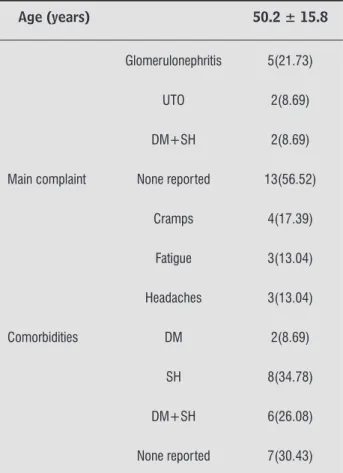
smoker. Among the former and current smokers, the median time of smoking was . . to . years. The majority were retired . % , . % presented no complaints, however, some of the patients reported cramps - . % , fa-tigue - . % and headaches - . % . The etiological cause of higher incidence was hyperten-sion - . % , followed by diabetes mellitus -
. % Table .
Table shows the predicted values and those ob-tained by the patients for RMS, PF and MWT. The mean M)P% was . ± . , MEP% . ± . , FVC% . ± . , FEV % . ± . , FEV /FVC%
. ± . , and MWT% . ± . .
Table describes the correlations between spi-rometric variables, RMS and SMFC expressed as a percentage of that predicted for age and gender.
There was a statistically signi icant positive corre-lation between the MWT and M)P r = . , p = . and MEP r =. , p <. . There was no statistically signi icant association between the MWT and FVC r =. , p =. , FEV r =. , p =. and FEV / FVC r =- . , p =. .
There was a signi icant correlation between M)P and MEP r =. , p <. and between FEV and FVC r = . , p < . .
Table 1- Sociodemographic and clinical characteristics
Age (years) 50.2 ± 15.8
Time of HD
(years) 3 (1.5-6.0)
Smoking Never smoked 11(47.8)
Ex-smoker 11(47.8)
Smoker 1(4.3)
Time of smoking
(years) 25(8.8-38.8)
Occupation Retired 15(65.21)
Unemployed 8(34.78)
Etiological cause DM 5(21.73)
SH 9(39.13)
Table 1- Sociodemographic and clinical characteristics
Age (years) 50.2 ± 15.8
Glomerulonephritis 5(21.73)
UTO 2(8.69)
DM+SH 2(8.69)
Main complaint None reported 13(56.52)
Cramps 4(17.39)
Fatigue 3(13.04)
Headaches 3(13.04)
Comorbidities DM 2(8.69)
SH 8(34.78)
DM+SH 6(26.08)
None reported 7(30.43)
Note: HD Hemodialysis; DM - Diabetes Mellitus; SH - systemic hypertension; UTO - Urinary tract obstruction; Values as mean ± standard deviation; Absolute value(%); Time of HD and smoking as median (minimum value-maximum value).
Table 2 - Characteristics of the predicted and obtained data
Predicted Obtained (% ± SD)
MIP (cmH2O) 197.2 36.0±13.6
MEP (cmH2O) 207.4 49.5±15.8
FVC (l/min) 3.9 93.8±21.1
FEV1 (l/min) 3.11 93.7±21.1
FEV1/FVC (l/min) 76.8 104.1±10.3
6MWT (m) 711.2 66.33±20.53
Note: MIP - maximum inspiratory pressure; MEP - maximal expiratory pressure; FVC - forced vital capacity; FEV1 - Forced expiratory volume in one second; FEV1/FVC - Tiffeneau Index; 6MWT - 6-minute walk test. (To be continued)
Despite a general improvement in care for the risk factors such as hypertension, diabetes mellitus and smoking, the proportion of Americans with CKD has been mainly attributed to the aging of the population . )n adults over years, the glomerular iltration rate decreases by about % per year and older adults have higher rates of DM, S( and other risk factors for CKD . As noted in the present study, the popula-tion was constituted by adults of average age and elderly people, of whom almost half had smoked in the past and one individual still smoked.
The study showed, as one of the main results, correla-tion between RMS and SMFC. Overall, the patients pre-sented a decrease in RMS of < % of that predicted . The results also showed that the majority of the patients presented spirometric values within normal limits . The muscles responsible for respiration, such as the diaphragm and intercostals, among others, are classi ied as skeletal muscles and may present decreased strength and muscle endurance properties resulting from uremic myopathy. Some authors have studied the impairment of uremia in the diaphragm and concluded that there is loss of strength with severe uremia. The ventilatory de icit resulting from this compromise in the respiratory muscles, combined with other lung tissue compromises, impairs the function of this system, contributing to de-creased lung capacity , .
Discussion
The etiological cause of higher incidence among patients with terminal CKD in this study was S( fol-lowed by DM, as con irmed in other studies with large population bases, in which, among adults that devel-oped CKD, the vast majority of cases > % were due to these pathologies , . A large body of evidence from clinical trials and epidemiological studies indicates that hypertension is a major risk factor for CKD . )n one study, more than , men were monitored over a period of years, in which, the initial BP was quantitatively presented as a predictor of risk for CKD, with a twofold increase in risk, even among men with BP within the normal range of values . )n observational studies, it was found that the relationship between BP and progression of CKD is direct and progressive .
Recent studies suggest that CKD affects approxi-mately % of patients with type DM and % of patients with type DM . The time from diagnosis of the disease is another risk factor for the develop-ment of CKD, even though prevalence studies are dif-icult to interpret . )t is estimated that in the United Kingdom approximately one third of patients with CKD developed the disease due to DM . Men seem to be at greater risk of developing nephropathy than women , , as shown in the present study, where all the individuals who agreed to participate were male.
Table 3- Correlations between spirometric variables, RMS and SMFC expressed as a percentage of that predicted for age and gender (n=23)
MIP MEP FVC FEV1 FEV1/FVC 6MWT
MIP — r =.79 r =.11 r =-.03 r =-.03 r =.63
p< .001 p =.618 p =.880 p =.160 P = .001
MEP — r =-.01 r =-.16 r =-.28 r =.67
p =.964 p =.475 p =.204 p< .001
FVC
— r =.91 r =-.23 r =.22
p< .001 p =.287 p =.317
FEV1
— r =.18 r =.09
p =.400 p =.674
FEV1/FVC — r =-.26
p =.234
approximately % in the distance covered in rela-tion to the predicted values . ± . vs. . ± . ; p <. .
)n the present study, a statistically significant positive correlation was observed between the MWT and M)P r =. , p =. , which shows that performance in the MWT is proportional to that found in relation to inspiratory muscle strength. A similar result was found by Jatobá et al. r =. , p =. .
Exercise intolerance is an essential clinical as-pect in a wide range of diseases, including CKD, and is closely associated with deterioration in the quality of life and increased morbidity and mortality, due to cardiovascular disease. Patients with CKD undergoing (D present low exercise tolerance and deconditioning, despite advances in dialysis procedures.
Muscular weakness is a complication of CKD and the loss of muscle mass is the most signi icant pre-dictor of mortality in patients undergoing (D . Furthermore, longer periods of (D treatment are associated with decreased RMS . The symp-toms of muscle involvement translate into fatigue, weakness, atrophy, irritability and cramps . )n patients with chronic renal failure requiring (D, RMS and PF are directly linked to their body mass index, especially when associated with a longer (D treatment period and with the period between ses-sions . )ndividuals with CKD, when compared to healthy subjects, present pulmonary disorders, such as decreased air low, obstructive disorders, reduced lung diffusion capacity, and decreased strength and RMS - .
Conclusion
)ndividuals with CKD undergoing (D present changes in respiratory muscle strength, with de-creasing values for gender and age, as well as in the distance covered in the MWD, however, with spiro-metric values within normal limits. Functional capac-ity was found to be dependent on respiratory muscle strength, as well as the values of M)P and MEP and the values of FVC and FEV . When one value decreased, the other followed this trend. Despite advances in dialysis procedures, these patients show low exercise tolerance, which leads to physical deconditioning and poor health related quality of life.
Since the measures of M)P and MEP are easily obtained, and taking into account that the values allow a relatively precise evaluation of the func-tional status of the respiratory muscles, it would be important to assess not only the degree of im-pairment at baseline, but also the influence of the hemodialysis session .
)n the study by Dipp et al., patients showed a re-duction of MEP and MWD compared to the predicted values, representing, respectively, expiratory muscle weakness and decreased functional capacity, which is in agreement with the present study. This inding may be explained by the occurrence of uremic my-opathy that intensely alters the skeletal muscular system, changing the type ) and type )) muscle ibers, especially those of type )) .
)n the present study, the presence of a signi icant correlation between M)P and MEP allows the assump-tion that one is dependent on the other and, when one value is lower than that predicted, the other will follow this trend.
)n a study by Moreira and Barros, with pa-tients undergoing dialysis, muscle strength was decreased by % to % compared to normal subjects, which was related to structural and meta-bolic changes . For Vieira et al., the etiology of muscle weakness is multifactorial, however, the main cause is vitamin D deficiency . Studies with terminal CKD individuals have demonstrated RMS and the PF variables below the normal range . )n the present study, only the RMS values were found to be lower than expected M)P% . ± . , MEP% . ± . , as was the case in the study of Jatobá et al., in which the M)P and MEP were found to be . % and % below the minimum expected values, respectively .
)ndividuals with CKD, when compared to healthy subjects, present pulmonary disorders, such as decreased airflow, obstructive disorders, reduced lung diffusion capacity, and decreased strength and RMS - .
. Wilson RC, Jones PW. A comparison of the visual analogue scale and modi ied Borg scale for the mea-surement of dyspnea during exercise. Clin Sci. ;
: - .
. Pereira CAC. Espirometria. J Pneumol. ; :S - . . Souza RB. Pressões respiratórias estáticas
máxi-mas. J Pneumol. ; : S - .
. National chronic kidney disease fact sheet. Atlanta GA : Centers for Disease; [cited Sept]. Available from: http://www.cdc.gov/diabetes/pubs/ pdf/kidney_factsheet.pdf.
. Kiefer MM, Ryan MJ. Primary Care of the Patient with Chronic Kidney Disease. Med Clin North Am. ;
: - .
. Schaefer F, Mehls O. (ypertension in chronic kidney disease. )n: Portman RJ, Sorof JM, )ngel inger JR, edi-tors. Pediatric hypertension. Totowa: (umana Press;
. p. – .
. Klag MJ, Whelton PK, Randall BL, et al. Blood pressure and end-stage renal disease in men. (ypertension.
; : – .
. Gansevoort RT, Correa-Rotter R, (emmelgarn BR, Ja-far T(, (eerspink (J, Mann JF, et al. Chronic kidney disease and cardiovascular risk: epidemiology, mech-anisms, and prevention. Lancet. ; :
– .
. American Diabetes Association. Nephropathy in Dia-betes. Diabetes Care. ; Suppl :S -S . . Eboh C, Chowdhury TA. Management of diabetic renal
disease. Ann Transl Med. ; : .
. Liew BS, Perry C, Boulton-Jones JM, Simpson K, Pater-son K. Diabetic nephropathy: an observational study on patients attending a joint diabetes renal clinic. QJM.
; : - .
. Burden AC, McNally PG, Feehally J, Walls J. )ncreased incidence of end stage renal failure secondary to dia-betes mellitus in Asian ethnic groups in the United Kingdom. Diabet Med. ; : - .
. Cowie CC, Port FK, Wolfe RA, Savage PJ, Moll PP, (aw-thorne VM. Disparities in incidence of diabetic end stage renal disease according to race and type of dia-betes. N Engl J Med. ; : - .
References
. W(O - World (ealth Organization. Non communicable Diseases: Country Pro iles. Geneva; .
. Bastos MG, Kirsztajn GM. Doença renal crônica: im-portância do diagnóstico precoce, encaminhamento imediato e abordagem interdisciplinar estruturada para melhora do desfecho em pacientes ainda não sub-metidos à diálise. J Bras Nefrol. ; : - . . Kusumoto, L, Marques S, (ass, VJ, Rodrigues RAP.
Adultos e idosos em hemodiálise: avaliação da quali-dade devida relacionada à saúde. Acta Paul Enferm.
; Especial : - .
. Machado LRC, Car MR. A dialética da vida cotidiana de doentes com insu iciência renal crônica: o inevitável e o casual. Rev Esc Enferm USP. ; : - . . Terra FS, Costa AMDD, Figueiredo ET, Morais AM,
Costa MD, Costa RD. As principais complicações apre-sentadas pelos pacientes renais crônicos durante as sessões de hemodiálise. Rev Bras Clin Med ;
: - .
. Cunha MS, Andrade V, Guedes CAV, Meneghetti C(Z, Aguiar AP, Cardoso AL. Avaliação da capacidade fun-cional e da qualidade de vida em pacientes renais crônicos submetidos a tratamento hemodialítico. Fisioter Pesq. ; : - .
. Oh-Park M, Fast A, Gopal S, Lynn R, Frei G, Drenth R, et al. Exercise for the dialyzed. Aerobic and streng training during hemodialysis. Am J Phys Med Rehabil.
; : - .
. Pellizzaro CO, Thomé FS, Veronese FV. Effect of periph-eral and respiratory muscle training on the functional. Ren Fail. ; : - .
. Rocha CBJ, Araújo S. Avaliação das pressões respi-ratórias máximas em pacientes renais crônicos nos momentos pré e pós hemodiálise. J Bras Nefrol. ;
: - .
. Neder JA, Andreoni S, Lerario MC, Nery LE. Reference values for lung function tests. )). Maximal respiratory pressures and voluntary ventilation. Braz J Med Biol Res. ; : - .
. Karacan O, Tutal E, Colak T, Sezer S, Eyüboğlu FO, (aberal M. Pulmonary function in renal transplant recipients and end-stage renal disease patients un-dergoing maintenance dialysis. Transplant Proc. ;
: - .
. Schardong TJ, Lukra ka JL, Garcia VD. Avaliação da função pulmonar e da qualidade de vida em paci-entes com doença renal crônica submetidos à he-modiálise. J Bras Nefrol. ; : - .
. Sietsema KE, Amato A, Adler SG, Brass EP. Exercise capacity a predictor of survival among ambulatory patients with end stage renal disease. Kidney )nt.
; : - .
. Knight EL, Ofsthun N, Teng M, Lazarus JM, Curhan GC. The association between mental health, physi-cal function, and hemodialysis mortality. Kidney )nt.
; : - .
. Baumgarten MCS, Dipp T, Silva VG, Giacomazzi CM, Segatto K, Pereira GA, et al. Percepção subjetiva e desempenho ísico de pacientes com doença renal crônica em hemodiálise. Rev. Acta Bras Mov (um.
; : - .
. Cheema BS, Smith BC, Singh MA. A rationale for intra-dialytic exercise training as standard clinical practice in ESRD. Am J Kidney Dis. ; : - . . Kovelis D, Pitta F, Probst VS, Peres CPA, Del ino VDA,
Mocelin AJ,et al. Função pulmonar e força muscular respiratória em pacientes com doença renal crônica submetidos à hemodiálise. J Bras Pneumo. ;
: - .
. Riella MC, Pecoits-Filho, R. )nsu iciência renal crônica: isiopatologia da uremia. )n: Riella MC. Princípios de nefrologia e distúrbios hidroeletrolíticos. Rio de Ja-neiro: Guanabara Koogan; . p. - .
Receveid: / /
Recebido: 02/11/2013
Approved: / /
Aprovado: 30/09/2015
. (oyert D, Xu J. Deaths: Preliminary data for . National Vital Statistics Reports, vol. . (yattsville MD : National Center for (ealth Statistics; [cit-ed Sept]. Available from: ttp://www.cdc.gov/ nchs/data/nvsr/nvsr /nvsr _ .pdf.
. Dall'Ago P, Chiappa GR, Guths (, Stein R, Ribeiro JP. )nspiratory muscle training in patients with heart fail-ure and inspiratory muscle weakness: a randomized trial. J Am Coll Cardiol. ; : - .
. Kemp GJ, Crowe AV, Anijeet (K, Gong QY, Bimson WE, Frostick SP, et al. Abnormal mitochondrial function and muscle wasting, but normal contractile ef iciency, in haemodialysed patients studied non-invasively in vivo. Nephrol Dial Transplant. ; : - . . Sakkas GK, Sargeant AJ, Mercer T(, Ball D, Koufaki
P, Karatzaferi C et al. Changes in muscle morphology in dialysis patients after months of aerobic exer-cise training. Nephrol Dial Transplant. ; :
- .
. Dipp T, Silva AMV, Signori LU, Strimbam TM, Nicolodi G, Sbruzzi G. et al. Força muscular respiratória e capa-cidade funcional na insu iciência renal terminal. Rev Bras Med Esporte. ; : - .
. Moreira PR, Barros EG. Revisão/Atualização em Diálise: capacidade e condicionamento ísico em pa-cientes mantidos em hemodiálise. J Bras Nefrol. ;
: - .
. Vieira WP, Gomes KWP, Frota NB, Andrade JEBA, Vieira RMRA, Moura FEA, et al. Manifestações mus-culoesqueléticas em pacientes submetidos à he-modiálise. Rev Bras Reumatol. ; : - . . Coelho CC, Aquino ES, Lara KL, Peres TM, Barja PR,
Lima EM. Repercussões da insu iciência renal crônica na capacidade de exercício, estado nutricional, função pulmonar e musculatura respiratória de crianças e adolescentes. Rev Bras Fisioter. ; : - . . Jatobá JPC, Amaro WF, Andrade APA, Cardoso FPF,