Submitted9 March 2016 Accepted 1 September 2016 Published6 October 2016
Corresponding author Stefania Casagrande, [email protected]
Academic editor Simon Griffith
Additional Information and Declarations can be found on page 11
DOI10.7717/peerj.2512
Copyright 2016 Casagrande et al.
Distributed under
Creative Commons CC-BY 4.0
OPEN ACCESS
Positive effect of dietary lutein and
cholesterol on the undirected song
activity of an opportunistic breeder
Stefania Casagrande1,2, Rianne Pinxten2,3, Erika Zaid2,4and Marcel Eens2
1Evolutionary Physiology Group, Max Planck Institute for Ornithology, Seewiesen, Germany
2Department of Biology, Behavioural Ecology and Ecophysiology Group, University of Antwerp, Antwerp, Belgium
3Faculty of Social Sciences, Antwerp School of Education, University of Antwerp, Antwerp, Belgium 4Department of Zoology, School of Life Sciences, La Trobe University, Melbourne, Victoria, Australia
ABSTRACT
Song is a sexually selected trait that is thought to be an honest signal of the health condi-tion of an individual in many bird species. For species that breed opportunistically, the quantity of food may be a determinant of singing activity. However, it is not yet known whether the quality of food plays an important role in this respect. The aim of the present study was to experimentally investigate the role of two calorie-free nutrients (lutein and cholesterol) in determining the expression of a sexually selected behavior (song rate) and other behaviors (locomotor activity, self-maintenance activity, eating and resting)
in male zebra finches (Taeniopygia guttata). We predicted that males supplemented
with lutein and cholesterol would sing at higher rates than controls because both lutein and cholesterol have important health-related physiological functions in birds and birdsong mirrors individual condition. To control for testosterone secretion that may upregulate birdsong, birds were exposed to a decreasing photoperiod. Our results showed that control males down-regulated testosterone in response to a decreasing photoperiod, while birds treated with lutein or cholesterol maintained a constant singing activity. Both lutein- and cholesterol-supplemented groups sang more than control groups by the end of the experiment, indicating that the quality of food can affect undirected song irrespective of circulating testosterone concentrations. None of the other measured behaviors were affected by the treatment, suggesting that, when individuals have full availability of food, sexually selected song traits are more sensitive to the effect of food quality than other behavioral traits. Overall the results support our prediction that undirected song produced by male zebra finches signals access to high-quality food.
SubjectsAnimal Behavior, Ecology, Zoology
Keywords Carotenoid, Birdsong, Undirected song, Testosterone, Photoperiod, Food quality
INTRODUCTION
to assess the ‘‘quality’’ (sensuWilson & Nussey, 2010) of the emitter (Duffy & Ball, 2002; Garamszegi, Møller & Erritzøe, 2003; Møller, Henry & Erritzøe, 2000; Nowicki & Searcy, 2004;Tregenza et al., 2006). Song can be an expression of quality because its production is a finely-tuned process easily limited by several factors (reviewed inGil & Gahr, 2002). Although the matter is still debated (e.g.,Ophir, Schrader & Gillooly, 2010;Ward, 2004), the existence of direct costs sustained by the increase of oxygen consumption associated with singing activity, suggests that it is an energetically demanding task (Franz & Goller, 2003; Hasselquist & Bensch, 2008;Zollinger, Goller & Brumm, 2011; but seeWard, 2004), which must be traded-off with other activities. For example, it has been observed that birdsong decreases along with lowering temperatures, probably resulting from an increased need to maintain thermostasis (Dunn & Zann, 1996). Even more convincing is the evidence from
the link between food availability and singing. For example, male pied flycatchers (Ficedula
hypoleuca) provided with supplemental food sang more and had more complex songs
than controls (Lampe & Espmark, 2002). Similarly, dunnock males (Prunella modularis)
supplemented with additional food sang at higher rates than control males (Davies & Lundberg, 1984). Other species, such as the European starling (Sturnus vulgaris) sing at higher rates when they have a better nutritional status as suggested by high levels of cholesterol and albumin in the plasma (Van Hout et al., 2012). The association between the nutritional state of singing birds and their song performance can be explained by the activation of the metabolic pathways that are needed to exhibit an energy demanding activity such as singing (Hasselquist & Bensch, 2008). On the other side, food shortage can have a
negative impact on birdsong. In the zebra finch (Taeniopygia guttata),Lynn et al. (2010)
found a reduction in the expression of undirected song and courtship behavior following 4 h
of fasting. Similarly,Ritschard & Brumm (2012)found that zebra finches kept under food
restriction performed a lower rate of undirected song than controls. Another study reported
that this relationship was mediated by male condition (indicated by body mass;Geberzahn
& Gahr, 2011). Despite the existence of a clear association between the nutritional state and song performance, studies on how food quality can affect song remain very rare (but seeCasagrande et al., 2015;Casagrande et al., 2014;Van Hout, Eens & Pinxten, 2011).
(Dunn & Zann, 1996;Dunn & Zann, 1997). Laboratory experiments show that undirected song is indeed attractive to female zebra finches (Holveck & Riebel, 2007;Jesse & Riebel, 2012;Tomaszycki & Adkins-Regan, 2005). Studies carried out in free-living zebra finches (Taeniopygia guttata) revealed that undirected song is performed at high levels throughout the year and that it is more frequent than directed song with clear signaling functions even related to sexual behavior (Dunn & Zann, 1996). For example, higher rates of undirected song performed near the nest correlate with the presence of the females in the nest, suggesting a within-pair function of undirected song (Dunn & Zann, 1996). Even though undirected song can also be produced independently of sex steroids (Pröve, 1974) or an active reproductive state (Perfito et al., 2008), it can respond to androgens similarly to
directed song (Pröve & Immelmann, 1982; Walters, Collado & Harding, 1991), but may
have a much lower threshold for hormonal activation (Pröve, 1974).
It has now been repeatedly shown that dietary lutein, which is a calorie-free micronutrient, promotes the undirected song duration of male European starlings
(Casagrande et al., 2014;Van Hout, Eens & Pinxten, 2011), even in males that were coping
with an inflammatory response (Casagrande et al., 2015). Lutein is a hydroxy-carotenoid synthetized by autotrophic organisms that, besides acting as a pigment and as an enhancer of the immune system (Svensson & Wong, 2011), is known mostly for its antioxidant properties (Hill & Johnson, 2012;Vinkler & Albrecht, 2010;Pérez-Rodríguez, 2009;Casagrande et al., 2014). As with all carotenoids, lutein cannot be synthetized by animals and thus represents a potentially limited resource obtained only by eating lutein-rich food. Consequently, it is generally expected that, since lutein is a limited resource with beneficial effects on the oxidative status, and since birdsong can mirror oxidative condition (Casagrande, Pinxten & Eens, 2016), birds with access to lutein-rich food can potentially improve their singing performance and, consequently, fitness outcome.
Another multi-functional molecule that can be acquired through the diet, but that also can be synthesized endogenously is cholesterol, a calorie-free sterol which is known to determine the structure and functionality of the animal cells’ membrane. It has also been demonstrated that within certain concentrations cholesterol has clear antioxidant functions that improve the health status of vertebrates (Brown & Galea, 2010;Casagrande et al., 2014; Murphy & Johnson, 2008;Smith, 1991). Recently, a relationship has also been reported between cholesterol and the expression of song in European starlings, where circulating cholesterol levels were positively associated with song rate (Van Hout et al., 2012).
The general aim of the present study was to experimentally investigate the effect of these calorie-free micronutrients on the duration of undirected song. Specifically, our study aimed at determining whether a potentially ecologically relevant cue such as food quality can affect undirected singing behavior.
We addressed this question in the zebra finch, a granivorous, non-territorial and colonial species adapted to breed opportunistically (Zann, 1996), but that in more temperate regions of its range (Australia and Indonesia) is more sensitive to photoperiodic fluctuations
(Zann, 1996;Zann et al., 1995). This opportunistic species has evolved in unpredictable
It has also been recently discovered that the structure of the neural song system shows a seasonal-like variation that may be related to the reproductive state (testis volume), although investigations of the relationship between song nuclei and circulating sex steroids are still missing (Perfito et al., 2015).
Birds were kept under a dynamically decreasing photoperiod, as sex steroids are predicted to decrease with the shortening of daylight also in this opportunistic species (Bentley et al., 2000;Perfito et al., 2008). We determined the hormonal profile of individuals by measuring circulating testosterone. Since this hormone can regulate a wide array of behavioral patterns related to the breeding state, and since sexually selected and naturally selected traits can have different sensitivity to both hormones and micronutrients (Cotton, Fowler & Pomiankowski, 2004;Johnstone, Rands & Evans, 2009;Van Hout, Eens & Pinxten, 2011), we recorded the effect of our treatments on singing behavior, as well as on other observed behaviors (see below). We expected that: 1. Birds would decrease undirected song when T concentrations decrease when kept on a standard diet; 2. Lutein and cholesterol would positively affect singing activity, but not other behaviors, because the positive effect of micronutrients will be more pronounced on a sexual trait such as undirected song.
MATERIALS & METHODS
Experimental design and food manipulation
The study was approved by the ethical committee for animal experiments (ECD) of the University of Antwerp (ID number: 2014-21). Forty-three adult zebra finch males of similar age were acquired from a local authorized pet shop with certified origin. Birds were allowed to acclimatize for three weeks before the onset of the experiment. Each male was housed in
an individual cage (L×W×H: 60×25×35 cm) equipped with 3 perches, birds’ grit and
ad libitumaccess to food, water and cuttlefish bone. Extra water for bathing was offered on a weekly basis to allow the birds to accomplish natural self-maintenance activities. The cages were adjacent to each other, arranged against two opposite walls of an animal-approved indoor room at the campus Drie Eiken of the University of Antwerp, where birds (only males were present in the room) were in constant visual and auditory contact with each other. Males of different treatments were randomly positioned in one of the 43 cages in order to avoid any bias imputable to the location of the cage. Birds were exposed to
constant temperature (about 20◦C) and short decreasing photoperiod resembling the
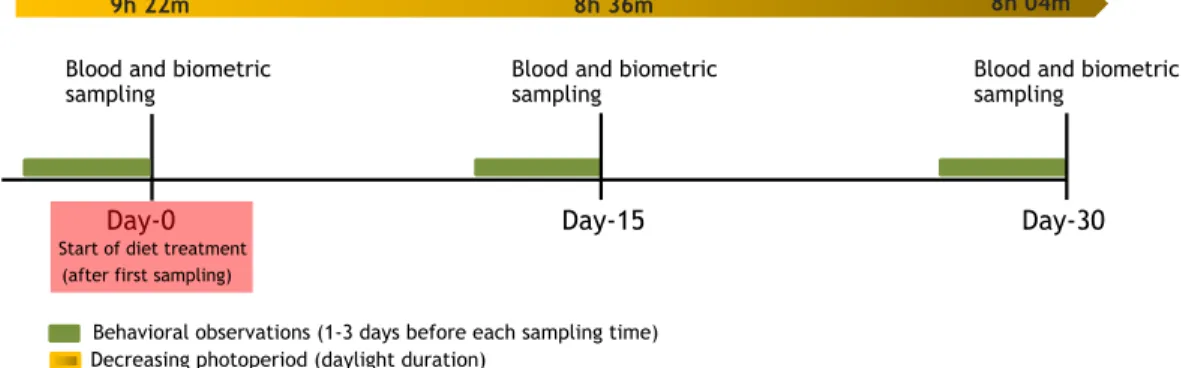
photoperiod variation observed in Antwerp during the course of the experiment (variation in duration of daylight between 6 November and 6 December 2012: 9 h 22 m–8 h 04 m). The light was switched on and off by an automatic system and included a gradual change of light to mimic twilight that lasted 30 min after ‘lights on’ and 30 min before ‘lights off’. The modification of the day length was performed manually daily by the researchers.
All birds, irrespective of the treatment, were fed anad libitum diet of water and a mix
of seeds for finches containing about 2.75µg*g−1of lutein and zeaxanthin (respectively
10:1) (Casagrande et al., 2011) and free of cholesterol. Since zebra finches usually consume at least about 3 g of seeds/day (Perfito et al., 2008), the baseline average amount of lutein
Day-0 Day-15 Day-30 Blood and biometric
sampling
Blood and biometric sampling
Blood and biometric sampling
Start of diet treatment (after first sampling)
9h 22m 8h 36m 8h 04m
Behavioral observations (1-3 days before each sampling time) Decreasing photoperiod (daylight duration)
Figure 1 Timing of the experiment.
On day 0, three different groups were created (Controls, Caro-males and Chol-males)
for the four weeks of the experiment (seeFig. 1for the timing of the experiment). Fourteen
randomly selected males (Caro-males) received an additional 15µg*ml−1of lutein (ORO
GLOTM; Kemin Industries Inc., Des Moines, Iowa, USA; extracted from marigoldsTagetes
erecta) in drinking water provided in an opaque dispenser to prevent photo-oxidation (Alonso-Alvarez et al., 2004;Blount et al., 2003;McGraw & Ardia, 2003). Considering a daily average intake of 2 ml of water per zebra finch fed the baseline seed diet of the studied colony and of other colonies kept under the same conditions (McGraw & Ardia, 2003),
the daily dose of lutein assumed during the experiment by each individual was 38µg/day,
approximately five times the amount of lutein eaten by the 14 controls birds (C birds). Other 15 males (Chol-males) were fed seeds enriched with 2% powdered cholesterol (Product code: 14606-100G-F; Sigma-Aldrich) following the protocol described by previous studies
in the same species (Allen & Wong, 1993;McGraw & Parker, 2006). Seeds provided to C
and Caro birds were cholesterol free. Based on a previous study, it is known that the provided concentration nearly doubles blood cholesterol levels in zebra finches over the course of 3–4 weeks (McGraw & Parker, 2006).
Behavioral observations and analysis of recordings
We video-recorded the behavior of birds for 4 h starting one hour after morning twilight, one to three days before each sampling day (day 0, day 15 and day 30, respectively; see also
recordings as during this period the behavior may still have been potentially affected by the presence of the researchers that had installed the camera. The activities were quantified as the total duration (in seconds) of resting (perching and standing on the ground), self-maintenance activities (preening, scratching, and beak rubbing), locomotor activity (hopping and flying), eating and singing undirected song, respectively. Although directed and undirected songs are structurally very similar, undirected song is, by definition, not directed toward a female and it is not associated with specific behavioral patterns related to the breeding condition (Sossinka & Boehner, 1980).
On day 0 (start of treatment, first measure before food manipulation), day 15 and day 30 birds were weighed to the nearest gram to examine the effect of dietary treatments on the body mass. Just before the measurement, males were blood sampled by venipuncturing
the brachial vein collecting 80µL of blood with heparinized microcapillary tubes. Plasma
was removed from centrifuged blood and stored at−80◦C in 1.5 mL Eppendorf tubes for
T and lutein analyses (four months later).
Hormonal assay
T concentrations were determined using enzyme immonoessay (EIA) kits (Cat. No. ADI-901-065; Enzo Life Sciences, Farmingdale, New York, USA) following a diethyl ether
extraction of 25 µL sample volume. After drying the extract under N2 stream, 250µL
of Assay Buffer was added (1:10 dilution), and the samples were allowed to reconstitute
overnight at 4◦C. A stripped plasma sample spiked with a known amount of T (2 ng*mL−1)
as well as one blank sample containing only assay buffer were taken through the entire assay
procedure. The next day, 100 µL of each sample (in duplicate) was added to individual
wells on the assay plate alongside a standard curve with 5 points ranging from 7.81 pg to
2,000.00 pg*mL−1. The samples were distributed randomly within and across plates but an
individual’s repeated samples were always included on the same plate. The plate was read on a microplate reader (VersaMax; Molecular Devices Inc., Sunnyvale, California, USA) at 405 nm with a correction wavelength set at 570 nm. The average extraction efficiency was 70% and final values were corrected accordingly. The average lower sensitivity of the assays
was at 3.25 pg*ml−1. The mean intra-plate CV was 2.87%, while the inter-plate CV were
calculated for three different concentrations of the standard curve and were, respectively,
4.73% (2,000 pg*ml−1), 0.7% (124 pg*ml−1) and 2.77% (7.8 pg*ml−1).
Data analysis
We tested the effect of lutein and cholesterol supplementation on each recorded behavior, on circulating T and on body mass, by using a full factorial general linear mixed model. Treatment (carotenoid treated—Caro; cholesterol treated—Chol; controls—C) and time (day 0, day 15 and day 30) were included as fixed factors, while a random intercept was specified for individual. Significant differences between and within groups were ascertained
by pairwise differences of least square means (Student’s t-test) expressed by confidence
intervals (reported in square brackets). After checking the normality of residuals and homogeneity of variance, only song duration (square root) and T (log) were transformed,
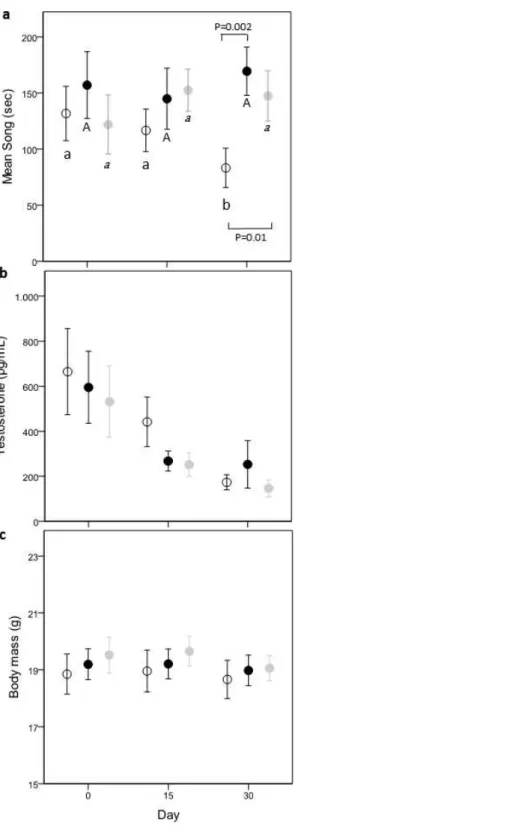
but original values are reported inFig. 2. All statistical analyses were performed with SAS
RESULTS
Singing activity
There was a nearly significant interaction effect between treatment and time (time × treatment, F(4,80)=2.32,p=0.06; treatment,F(2,80)=1.64,p=0.20; time,
F(2,80)=0.11,p=0.89). Since singing activity can be affected by the quantity of food eaten, we controlled for this variable introducing eating behavior as covariate. The new model showed a significant time×treatment effect (time×treatment,F(4,80)=2.64,p=0.04; treatment,F(2,80)=2.22,p=0.12; time,F(2,80)=0.49,p=0.62) and a significant effect of the total time spent eating behavior (F(1,119)=9.54,p=0.0025, ß= −0.0079±0.003). Comparisons within groups showed that C-males decreased their singing activity with time (day 0–day 30;−2.76±1.20 [−5.15,−0.36]; day 15–day 30:−2.66±1.22 [−5.08,−0.24]),
while this was not the case in Caro- and Chol-males (post-hoc results shown inFig. 2A).
Both Chol- and Caro-males sang significantly more than C-males during day 30 (Caro- vs. C-males:−4.60±1.49 [−7.55,−1.64]; Chol- vs. C-males:−3.46±1.46, [−6.36,−0.56]),
while on day 0 singing activity did no differ between the three treatment groups (Fig. 2A).
Testosterone
Circulating T concentrations decreased over time (F(2,80)=28.80,p<0.0001) in all groups independently from food treatments (time×treatment,F(4,80)=0.34,p=0.85; treatment,
F(2,80)=0.64,p=0.53;Fig. 2B) reaching very low values on day 30 (about 200µg/ml). Males of the three treatments did not differ in T levels on day 0.
Body mass
Treatment and time had no effect on body mass (time×treatment,F(4,80)=0.28,p=0.89; treatment,F(2,80)=0.27,p=0.77; time,F(2,80)=2.89,p=0.06) (Fig. 2C). Body mass did not differ among the 3 treatment groups before the start of the food supplementation (all p>0.43).
Other activities
The time spent eating did not vary between groups (time×treatment,F(4,80)=0.75,p= 0.56; treatment,F(2,80)=1.03,p=0.36; time,F(2,80)=2.12,p=0.13), neither did the duration of resting behavior (time, F(2,80)=2.65,p=0.08, (time×treatment,F(4,80)= 0.66,p=0.62; treatment,F(2,80)=0.26,p=0.77). Birds did not change their locomotor activity during the experiment (time ×treatment, F(4,80)=1.45,p=0.23; treatment,
F(2,80)=1.51,p=0.23, time,F(2,80)=2.41,p=0.10).
The total time spent on self-maintenance activities increased over time, irrespectively of the treatment (time, F(2,80)=20.35,p<0.0001; day 0: 56.53 ± 9.54 s, day 15: 139.51 ±17.79 s, day 30: 190.89±18.02 s; time×treatment,F(4,80)=0.99,p=0.42). Although birds did not differ in the duration of self- maintenance activities on day 0 (all p>0.38), there was an effect of treatment (F(2,80)=4.49,p=0.01; C: 88.07±8.79
s, Caro: 163.06±23.12 s, Chol: 137.33±16.57 s), as overall, Caro birds spent more
time than C birds in performing this activity (74.99±25.46 [23.54, 126.44]), while any
difference emerged between Chol- and C-males (49.26±25.03 [−1.32,99.85]) or
DISCUSSION
Our study showed that male zebra finches exposed to a decreasing short photoperiod down-regulated both their song activity and T level. This decreased song activity was not observed in males that received extra lutein or cholesterol, with males of both groups maintaining a constant song activity compared to the pre-treatment condition, although T levels were decreasing. As expected, in the treated birds circulating T decreased with the decreasing photoperiod but it was unrelated to undirected song. Overall, the results show for the first time that zebra finch song is influenced by food quality independently from caloric content.
Our results showed that birds eatingab libitumfood but without any dietary enrichment
decrease their song activity in parallel with the decrease of circulating testosterone, but birds treated with lutein or cholesterol did not. Generally, the reproductive state of an individual and the associated hormonal profiles are important for the expression of birdsong. In several species the neural system of birdsong is modulated by T (Nottebohm, 2005), but undirected
song can be unrelated to reproduction and be T-independent (Bernard & Ball, 1997;Eens,
1997;Pinxten et al., 2002;Riters et al., 2002). For example, male European starlings perform
undirected song year-round, including periods when T is very low (Eens, 1997;Pinxten
et al., 2002;Casagrande et al., 2014). This does not preclude that undirected song can be regulated by T in certain contexts. For example, starlings treated with exogenous T outside of the breeding season sing more frequently than non-treated individuals (Van Hout, Eens & Pinxten, 2011), indicating that T modulates this complex signal.
(Casagrande et al., 2014) kept in outdoor aviaries and exposed to a short and decreasing photoperiod identical to the artificially one created in the present study. In line with this is another study on the same species showing that male song can convey information about the oxidative status of the individual (Costantini et al., 2015). In the present study we could not determine the oxidative status of birds, because the small size of the species did not allow us to collect enough blood volume to assess both hormone concentrations and oxidative status. In contrast to the results obtained in male starlings, where the dietary effect on song expression was already present after one week, the effect in zebra finches was present only after one month. This difference in timing could be due to differences in the housing conditions between the two studies, which were in large outdoor aviaries for starlings and in individual indoor cages for zebra finches. Starlings had been exposed to the lutein treatment in winter, when the ambient temperature was very low and when an amelioration of their condition with the consumption of antioxidants would have a greater impact in comparison with the situation of a constant environmental temperature
of 20◦C, as was the case for zebra finches. Indeed, we observed an increase of oxidative
damage during the experiment in starlings, supporting this possibility. However, additional studies are needed to further support this explanation.
CONCLUSIONS
None of the behaviors measured during the present study, except song activity, were significantly affected by the treatments, showing that birdsong is more sensitive to an improvement of the nutritional or physiological conditions than are other behavioral traits (Cotton, Fowler & Pomiankowski, 2004;Johnstone, Rands & Evans, 2009). Our data here suggest that the condition of the signaler, here related to the physiological condition of
the individual (sensuHill, 2011), can be affected by the quality of the environment and
in particular the nutritional value of food ingested, and that song activity can therefore potentially deliver information about the quality of the territory or about the foraging skills of the signaler. It has been demonstrated that singing activity is very sensitive to food availability (e.g.,Ritschard & Brumm, 2012), but studies showing the effect of food quality independent of caloric content are only starting to emerge (Van Hout, Eens & Pinxten, 2011;Casagrande et al., 2014). This is particularly important for species that sing year round, for which seasonal changes in food quality can be a potential limiting factor in their singing performance. For example, carotenoids are produced mostly by photosynthetic organisms that usually show marked fluctuations between vegetative and non-vegetative phases. The availability of micronutrients like carotenoids can indeed significantly fluctuate during time and space (Eeva et al., 2011). Eeva and colleagues found that in deciduous or
mixed forests eggs laid by the pied flycatchersFicedula hypoleucabefore leaf unfolding of
ACKNOWLEDGEMENTS
The authors are very grateful to Michaela Hau and Sue Anne Zollinger for revising a previous version of the manuscript and for providing highly valuable comments. We thank Peter Scheys and Geert Eens for their assistance in many steps of the experiment and for solving several logistic issues. We thank Pralle Kriengwatana and one anonymous reviewer for raising very constructive comments in the revision process, contributing to improve the quality of the manuscript.
ADDITIONAL INFORMATION AND DECLARATIONS
Funding
SC was supported by a FWO post-doctoral Pegasus Marie Curie Fellowship (grant 05-05-1.2.205.13N). RP and ME were supported by the University of Antwerp (TOPBOF) and FWO-Flanders. EZ was supported by an Erasmus Placement program. The funders had no role in study design, data collection and analysis, decision to publish, or preparation of the manuscript.
Grant Disclosures
The following grant information was disclosed by the authors:
FWO post-doctoral Pegasus Marie Curie Fellowship: 05-05-1.2.205.13N. University of Antwerp (TOPBOF).
FWO-Flanders.
Erasmus Placement program.
Competing Interests
The authors declare there are no competing interests.
Author Contributions
• Stefania Casagrande conceived and designed the experiments, performed the
experiments, analyzed the data, contributed reagents/materials/analysis tools, wrote the paper, prepared figures and/or tables.
• Rianne Pinxten and Marcel Eens conceived and designed the experiments, contributed
reagents/materials/analysis tools, reviewed drafts of the paper.
• Erika Zaid performed the experiments, reviewed drafts of the paper.
Animal Ethics
The following information was supplied relating to ethical approvals (i.e., approving body and any reference numbers):
The study was approved by the ethical committee for animal experiments (ECD) of the University of Antwerp (ID number: 2014-21).
Data Availability
The following information was supplied regarding data availability:
Edmond Repository, Max Planck Digital Library:http://edmond.mpdl.mpg.de/imeji/
Supplemental Information
Supplemental information for this article can be found online athttp://dx.doi.org/10.7717/
peerj.2512#supplemental-information.
REFERENCES
Allen PC, Wong HYC. 1993.Effect of atherogenic diet on chicken plasma lipids and
lipoproteins.Poultry Science72:1673–1678DOI 10.3382/ps.0721673.
Alonso-Alvarez C, Bertrand S, Devevey G, Gaillard M, Prost J, Faivre B, Sorci G. 2004.
An experimental test of the dose-dependent effect of carotenoids and immune
activation on sexual signals and antioxidant activity.The American Naturalist
164:651–659DOI 10.1086/424971.
Bentley GE, Spar BD, MacDougall-Shackleton SA, Hahn TP, Ball GF. 2000.
Photope-riodic regulation of the reproductive axis in male zebra finches,Taeniopygia guttata.
General and Comparative Endocrinology 117:449–455DOI 10.1006/gcen.1999.7430.
Bernard DJ, Ball GF. 1997.Photoperiodic condition modulates the effects of testosterone
on song control nuclei volumes in male European starlings.General and Comparative
Endocrinology105:276–283DOI 10.1006/gcen.1996.6829.
Blount JD, Metcalf NB, Birkhead R, Surai PF. 2003.Carotenoid modulation of immune
function and sexual attractiveness in zebra finches.Science300:125–127
DOI 10.1126/science.1082142.
Brown AJ, Galea AM. 2010.Cholesterol as an evolutionary response to living with
oxygen.Evolution64:2179–2183DOI 10.1111/j.1558-5646.2010.01011.x.
Casagrande S, Dijkstra C, Tagliavini J, Goerlich VC, Groothuis TGG. 2011.Differential effects of testosterone, dihydrotestosterone and estradiol on carotenoid deposition in
an avian sexually selected signal.Journal of Comparative Physiology. A, Neuroethology,
Sensory, Neural, and Behavioral Physiology197:1–13
DOI 10.1007/s00359-010-0579-4.
Casagrande S, Pinxten R, Eens M. 2016.Honest signaling and oxidative stress: the special
case of avian acoustic communication.Frontiers Ecology EvolutionEpub ahead of
print May 11 2016 DOI 10.3389/fevo.2016.00052.
Casagrande S, Pinxten R, Zaid E, Eens M. 2014.Carotenoids, birdsong and oxidative status: administration of dietary lutein is associated with an increase in song rate and circulating antioxidants (albumin and cholesterol) and a decrease in oxidative
damage.PLoS ONE9:e115899DOI 10.1371/journal.pone.0115899.
Casagrande S, Pinxten R, Zaid E, Eens M. 2015.Birds receiving extra carotenoids keep
singing during the sickness phase induced by inflammation.Behavioral Ecology and
Sociobiology69:1029–1037DOI 10.1007/s00265-015-1916-y.
Catchpole CK, Slater PJB. 2008.Bird song: biological themes and variations. Second edition. Cambridge: Cambridge University Press.
stress in a songbird species.Behavioral Ecology and Sociobiology69:829–839
DOI 10.1007/s00265-015-1899-8.
Cotton S, Fowler K, Pomiankowski A. 2004.Do sexual ornaments demonstrate height-ened condition-dependent expression as predicted by the handicap hypothesis? Proceedings of the Royal Society of London B: Biological Sciences271:771–783
DOI 10.1098/rspb.2004.2688.
Davies NB, Lundberg A. 1984.Food distribution and a valriable mating system in the
dunnock, Prunella modularis.Journal of Animal Ecology53:895–912
DOI 10.2307/4666.
Duffy DL, Ball GF. 2002.Song predicts immunocompetence in male European starlings (Sturnus vulgaris).Proceedings of the Royal Society of London B: Biological Sciences
269:847–852DOI 10.1098/rspb.2002.1956.
Dunn AM, Zann R. 1996.Undirected song in wild zebra finch flocks: contexts and effects
of mate removal.Ethology102:529–539DOI 10.1111/j.1439-0310.1996.tb01145.x.
Dunn AM, Zann RA. 1997.Effects of pair bond and presence of conspecifics on singing
in captive zebra finches.Behaviour 134:127–142DOI 10.1163/156853997X00313.
Eens M. 1997.Understanding the complex song of the European starling: an integrated
ethological approach.Advances in the Study of Behavior26:355–434
DOI 10.1016/S0065-3454(08)60384-8.
Eeva T, Ruuskanen S, Salminen J-P, Belskii E, Järvinen A, Kerimov A, Korpimäki E, Krams I, Moreno J, Morosinotto C, Mänd R, Orell M, Qvarnström A, Siitari H, Slater FM, Tilgar V, Visser ME, Winkel W, Zang H, Laaksonen T. 2011. Geo-graphical trends in the yolk carotenoid composition of the pied flycatcher (Ficedula
hypoleuca).Oecologia165:277–287DOI 10.1007/s00442-010-1772-4.
Franz M, Goller F. 2003.Respiratory patterns and oxygen consumption in singing zebra
finches.Journal of Experimental Biology206:967–978 DOI 10.1242/jeb.00196.
Garamszegi LZ, Møller AP, Erritzøe J. 2003.The evolution of immune defense and song
complexity in birds.Evolution57:905–912DOI 10.1111/j.0014-3820.2003.tb00301.x.
Geberzahn N, Gahr M. 2011.Undirected (solitary) birdsong in female and male blue-capped cordon-bleus (Uraeginthus cyanocephalus) and its endocrine correlates. PLoS ONE6:e26485DOI 10.1371/journal.pone.0026485.
Gil D, Gahr M. 2002.The honesty of bird song: multiple constraints for multiple traits. Trends in Ecology & Evolution17:133–141DOI 10.1016/S0169-5347(02)02410-2.
Hasselquist D, Bensch S. 2008.Daily energy expenditure of singing great reed warblers
Acrocephalus arundinaceus.Journal of Avian Biology39:384–388
DOI 10.1111/j.0908-8857.2008.04427.x.
Hill GE. 2011.Condition-dependent traits as signals of the functionality of vital cellular
processes.Ecology Letters14:625–34DOI 10.1111/j.1461-0248.2011.01622.x.
Hill GE, Johnson JD. 2012.The vitamin A-redox hypothesis: a biochemical basis
for honest signaling via carotenoid pigmentation.The American Naturalist
Holveck MJ, Riebel K. 2007.Preferred songs predict preferred males: consistency and
repeatability of zebra finch females across three test contexts.Animal Behavior
74:297–309DOI 10.1016/j.anbehav.2006.08.016.
Jarvis ED, Scharff C, Grossman MR, Ramos JA, Nottebohm F. 1998.For whom the bird
sings: context-dependent gene expression.Neuron21:775–788
DOI 10.1016/S0896-6273(00)80594-2.
Jesse F, Riebel K. 2012.Social facilitation of male song by male and female conspecifics in
the zebra finch,Taeniopygia guttata.Behavioural Processes91:262–266
DOI 10.1016/j.beproc.2012.09.006.
Johnstone RA, Rands S, Evans MR. 2009.Sexual selection and condition-dependence. Journal of Evolutionary Biology22:2387–2394DOI 10.1111/j.1420-9101.2009.01822.x.
Lampe HM, Espmark YO. 2002.Mate choice in pied flycatchers Ficedula hypoleuca:
can females use song to find high-quality males and territories?Ibis145:E24–E33
DOI 10.1046/j.1474-919X.2003.00144.x.
Lopes PC, Wingfield JC, Bentley GE. 2012.Lipopolysaccharide injection induces rapid decrease of hypothalamic GnRH mRNA and peptide, but does not affect GnIH in
zebra finches.Hormones and Behavior62:173–179 DOI 10.1016/j.yhbeh.2012.06.007.
Lynn SE, Stamplis TB, Barrington WT, Weida N, Hudak C. 2010.Food, stress, and reproduction: short-term fasting alters endocrine physiology and reproductive
behavior in the zebra finch.Hormones and Behavior58:214–222
DOI 10.1016/j.yhbeh.2010.03.015.
McGraw KJ, Ardia DR. 2003.Carotenoids, immunocompetence, and the information
content of sexual colors: an experimental test.The American Naturalist162:704–712
DOI 10.1086/378904.
McGraw KJ, Parker RS. 2006.A novel lipoprotein-mediated mechanism controlling
sexual attractiveness in a colorful songbird.Physiology and Behavior87:103–108
DOI 10.1016/j.physbeh.2005.09.001.
Møller aP, Henry PY, Erritzøe J. 2000.The evolution of song repertoires and immune defence in birds.Proceedings of the Royal Society B: Biological Sciences267:165–169
DOI 10.1098/rspb.2000.0982.
Murphy RC, Johnson KM. 2008.Cholesterol, reactive oxygen species, and the formation
of biologically active mediators.Journal of Biological Chemistry283:15521–15525
DOI 10.1074/jbc.R700049200.
Nottebohm F. 2005.The neural basis of birdsong.PLoS Biology3:0759–0761
DOI 10.1371/journal.pbio.0030164.
Nowicki S, Searcy W. 2004.Song function and the evolution of female preferences:
why birds sing, why brains matter.Annals of the New York Academy of Sciences
1016:704–723DOI 10.1196/annals.1298.012.
Ophir aG, Schrader SB, Gillooly JF. 2010.Energetic cost of calling: general constraints
and species-specific differences.Journal of Evolutionary Biology23:1564–1569
DOI 10.1111/j.1420-9101.2010.02005.x.
Pérez-Rodríguez L. 2009.Carotenoids in evolutionary ecology: re-evaluating the
Perfito N, Bentley G, Hau M. 2006.Tonic activation of brain GnRH immunoreactivity despite reduction of peripheral reproductive parameters in opportunistically
breed-ing zebra finches.Brain Behavior and Evolution67:123–134DOI 10.1159/000090977.
Perfito N, Kwong JMY, Bentley GE, Hau M. 2008.Cue hierarchies and testicular development: is food a more potent stimulus than day length in an opportunistic
breeder (Taeniopygia g. guttata)?Hormones and Behavior 53:567–572
DOI 10.1016/j.yhbeh.2008.01.002.
Perfito N, Zann Ra, Hau M, Bentley GE. 2015.Seasonal-like variation in song control
system volume of wild zebra finches.Journal of Experimental Zoology Part A:
Ecological Genetics and Physiology 323:586–591DOI 10.1002/jez.1956.
Pinxten R, De Ridder E, Balthazart J, Eens M. 2002.Context-dependent effects of
castration and testosterone treatment on song in male European starlings.Hormones
and Behavior42:307–318DOI 10.1006/hbeh.2002.1824.
Prior NH, Soma KK. 2015.Neuroendocrine regulation of long-term pair
main-tenance in the monogamous zebra finch.Hormones and Behavior76:11–22
DOI 10.1016/j.yhbeh.2015.04.014.
Pröve E. 1974.Der Einfluss von Kastration und Testosteronsubstitution auf das
Sexu-alverhalten männlicher Zebrafinken (Taeniopygia guttatacastanotis Gould).Journal
für Ornithologie115:338–347DOI 10.1007/BF01644328.
Pröve E, Immelmann K. 1982.Behavioral and hormonal responses of male zebra finches
to antiandrogens.Hormones and Behavior16:121–131
DOI 10.1016/0018-506X(82)90013-7.
Riebel K. 2009.Song and female mate choice in zebra finches: a review.Advances in the Study of Behavior 40:197–238DOI 10.1016/S0065-3454(09)40006-8.
Riters LV. 2011.Pleasure seeking and birdsong.Neuroscience and Biobehavioral Reviews
35:1837–1845DOI 10.1016/j.neubiorev.2010.12.017.
Riters LV, Eens M, Pinxten R, Ball GF. 2002.Seasonal changes in the densities of alfa2— noradrenergic receptors are inversely related to changes in testosterone and the
volumes of song control nuclei in male European starlings.Journal of Comparative
Neurology444:63–74DOI 10.1002/cne.10131.
Ritschard MH, Brumm H. 2012.Zebra finch song reflects current food availability. Evolutionary Ecology26:801–812DOI 10.1007/s10682-011-9541-3.
Smith LL. 1991.Another cholesterol hypothesis: cholesterol as antioxidant.Free Radical Biology and Medicine11:47–61DOI 10.1016/0891-5849(91)90187-8.
Sossinka R, Boehner J. 1980.Song types in the zebra finch Poephila futtata castanotis. Journal of Comparative Ethology53:123–132.
Svensson PA, Wong BBM. 2011.Carotenoid-based signals in behavioural ecology: a
review.Behaviour148:131–189DOI 10.1163/000579510X548673.
Tregenza T, Simmons LW, Wedell N, Zuk M. 2006.Female preference for male
courtship song and its role as a signal of immune function and condition.Animal
Behavior 72:809–818DOI 10.1016/j.anbehav.2006.01.019.
Van Hout AJM, Eens M, Pinxten R. 2011.Carotenoid supplementation positively affects
the expression of a non-visual sexual signal.PLoS ONE6:e16326
DOI 10.1371/journal.pone.0016326.
Van Hout AJ-M, Pinxten R, Geens A, Eens M. 2012.Non-breeding song rate reflects
nutritional condition rather than body condition.PLoS ONE 7:e36547
DOI 10.1371/journal.pone.0036547.
Vinkler M, Albrecht T. 2010.Carotenoid maintenance handicap and the physiology of
carotenoid-based signalisation of health.Naturwissenschaften97:19–28
DOI 10.1007/s00114-009-0595-9.
Von Schantz T, Bensch S, Hasselquist D, Wittzell H. 1999.Good genes, oxidative stress
and condition-dependent sexual signals.Proceedings of the Royal Society of London B:
Biological Sciences266:1–12DOI 10.1098/rspb.1999.0597.
Walters MJ, Collado D, Harding CF. 1991.Oestrogenic modulation of singing in male
zebra finches: differential effects on directed and undirected songs.Animal Behavior
42:445–452DOI 10.1016/S0003-3472(05)80043-0.
Ward S. 2004.Singing is not energetically demanding for pied flycatchers, Ficedula
hypoleuca.Behavioral Ecology15:477–484DOI 10.1093/beheco/arh038.
Wilson AJ, Nussey DH. 2010.What is individual quality? An evolutionary perspective. Trends in Ecology & Evolution25:207–214DOI 10.1016/j.tree.2009.10.002.
Zann R. 1996.The Zebra finch: a synthesis of field and laboratory studies. Oxford: Oxford University Press.
Zann RA, Morton SR, Jones KR, Burley NT. 1995.The timing of breeding in zebra
finches in relation to rain-fall.Emu98:208–222DOI 10.1071/MU9950208.
Zollinger SA, Goller F, Brumm H. 2011.Metabolic and respiratory costs of increasing
song amplitude in zebra finches.PLoS ONE6:e23198