Immunogenicity of a 23-valent
pneumococcal polysaccharide
vaccine in Brazilian elderly
1Seção de Bacteriologia, Instituto Adolfo Lutz, São Paulo, SP, Brasil 2Fundação Oswaldo Cruz, Rio de Janeiro, RJ, Brasil
3Fundação Nacional de Saúde, São Paulo, SP, Brasil 4Instituto Butantan, São Paulo, SP, Brasil
5Organização Panamericana de Saúde, Washington, DC, USA
6Faculdade de Medicina, Universidade de São Paulo, São Paulo, SP, Brasil
V. Simonsen1,
A.P. Brandão2,3,
M.C.C. Brandileone1,
T.I. Yara4, J.L. Di Fabio5,
M.H. Lopes6 and
W. Jacob Filho6
Abstract
Serum antibodies specific for the capsular polysaccharides of Strepto-coccus pneumoniae provide protection against invasive pneumococ-cal infection. In Brazil, this vaccine has been used for people over 65 years with clinical risk to develop pneumococcal infection since 1999. We evaluated the immune response of 102 elderly subjects (75.5% females and 24.5% males) with a mean age of 71 years, and 19 young healthy adults (63.2% females and 36.8% males) with a mean age of 27 years. The elderly study group consisted of outpatients who re-ceived follow-up care in the Geriatric Department of General Hospi-tal, Faculty of Medicine, University of São Paulo. None had acute illness at the time of vaccination. Both groups were immunized with one intra-deltoid injection with 0.5 ml of a 23-valent pneumococcal polysaccharide vaccine. The total IgG specific antibody concentra-tions to capsular polysaccharides 1, 3, 5, 6B, 8, and 14 were deter-mined against pre- and 1-month post-vaccination sera. All samples were analyzed according to the second-generation pneumococcal polysaccharide ELISA protocol. We observed that the pneumococcal polysaccharide vaccine evoked consistent antibody increase for sero-types 1, 5, 6B, 8, and 14 (geometric mean concentration increase of 2.46 in the elderly and 2.84 in the young adults). Otherwise, we observed no increase in antibody concentration for serotype 3 in both groups.
Correspondence
V. Simonsen
Avenida Dr. Arnaldo, 355, 9º andar 01246-902 São Paulo, SP Brasil
E-mail: [email protected]
Research supported by the Adolfo Lutz Institute, Brazil, and the Pan-American Health Organization.
Publication supported by FAPESP.
Received March 29, 2004 Accepted January 3, 2005
Key words
•Streptococcus pneumoniae •Vaccine
•Pneumococcal
polysaccharide vaccine
•Immune response •Elderly subjects
Introduction
Streptococcus pneumoniae is an impor-tant bacterial pathogen of children and adults worldwide, causing infection of the respira-tory tract, bacteremia, and meningitis. Mor-bidity and mortality resulting from pneumo-coccal infection are high among the elderly,
who are at higher risk for invasive pneumo-coccal infections than the general population (1). Diseases caused by influenza and pneu-mococci, taken together, are the fifth leading cause of death for persons aged 65 years and
older (2).The annual incidence of invasive
pneumococcal disease has been estimated to
elderly in developed countries, whereas in Latin America and other developing
coun-tries the incidence is unknown (1,3).
Be-cause of the high risk of morbidity and mor-tality associated with respiratory infections in the elderly, the World Health Organiza-tion recommends pneumococcal and influ-enza vaccination in this age group. The 23-valent pneumococcal polysaccharide vac-cine is about 50-80% effective in preventing invasive pneumococcal disease among older persons (4). In Brazil, this vaccine was intro-duced in a national campaign initiated in 1999, and is administered to institutional-ized elderly subjects and to those recently hospitalized because of pneumonia (5,6).
The aim of the present study was to as-sess the immune response of elderly persons immunized with the 23-valent pneumococ-cal vaccine. Specific antibodies to six pneu-mococcal capsular antigens that are among the major invasive serotypes for this age group were measured. In addition, we com-pared the immune response of this popula-tion with that of young healthy adults vacci-nated at the same time.
Material and Methods
Study group
The study group consisted of 102 elderly outpatients who received follow-up care in the Geriatric Department of the General Hospital, Faculty of Medicine, University of São Paulo. The study was approved by the Ethics Committee and every participant signed the written informed consent. Sev-enty-seven subjects were females (75.5%) with a mean age of 71 years (range: 61 to 87 years) and 25 were males (24.5%) with a mean age of 72 years (range: 60 to 95 years). All outpatients had stable chronic illnesses and were monitored in a primary care clinic. None had acute illness at the time of
vacci-nation or had previous vaccivacci-nation against S.
pneumoniae.
Control group
The control group consisted of 19 healthy young adults with a mean age of 27 years (range: 22 to 38 years). In this group there were 12 females (63.2%) and 7 males (36.8%). None had a history of pneumonia or previous vaccination with the 23-valent vaccine.
Immunization and serum collection
Each subject (N = 102 + 19) received one intra-deltoid injection with 0.5 ml of the same lot of pneumococcal vaccine contain-ing 25 µg of the followcontain-ing serotypes: 1 to 5, 6B, 7F, 8, 9N, 9V, 10A, 11A, 12F, 14, 15B, 17F, 18C, 19A, 19F, 20, 22F, 23F, and 33F. Blood for serum analysis was obtained prior to immunization and 1 month after immuni-zation. Serum samples were stored at -70ºC until the time for assay for capsule pneumo-coccal polysaccharide-specific IgG.
Enzyme immunoassay (ELISA)
Antibody concentrations are reported as µg/ml calculated on the basis of the offi-cially assigned IgG concentrations for 89-SF reference serum. Antibody concentrations were calculated by comparison of the pre-and post-vaccination sera with 89-SF using a four-parameter logistic ELISA program (9). Two additional serum samples known to contain high and low levels of pneumococ-cal capsule specific antibodies were used as controls to ensure assay reproducibility.
Statistical analysis
Differences in log-transformed concen-trations of capsule specific IgG antibodies between pre- and post-vaccination sera of both groups were calculated by analysis of variance for repeated measures. Correlation coefficients were calculated by the method of Pearson for linearity. Differences between groups in IgG increases and fold increases were determined by the Pearson chi-square and two-tailed Fisher exact tests. All P val-ues were two-tailed and the level of
signifi-cance was set at P ≤ 0.05. Statistics were
calculated with the use of the Statistical Software for Windows (Stata Corporation, College Station, TX, USA).
Results
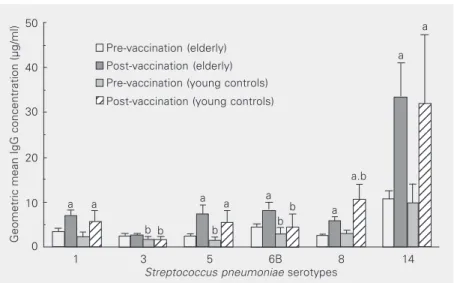
Prior to immunization, elderly and young adults had appreciable levels of specific IgG antibodies to the six serotypes analyzed. Both groups showed a wide variation in serum concentration of type-specific total IgG. As an example, the absolute concentration of serotype 14 specific antibody ranged from 2.3 to 120.2 µg/ml in the elderly and 2.1 to 36.0 µg/ml in the young adults. The geomet-ric mean concentration (GMC) of the specif-ic antibodies to the six serotypes in pre-vaccination sera varied among all subjects, ranging from 2.5 to 10.8 µg/ml in the elderly and from 1.7 to 9.8 µg/ml in the young adults (Figure 1). Before vaccination, the GMC of
type-specific antibody to polysaccharide types 3, 5, and 6B was significantly higher in the elderly than in the young group. Among all polysaccharides analyzed, GMC to sero-type 14 was the highest in pre-vaccination sera of both age groups (Figure 1). As a group, more than 90% of the elderly had more than 1 µg/ml IgG specific for serotypes 1, 3, 5, and 8, and all of them had at least this concentration for serotypes 6B and 14. In the
young adult group, all subjects had ≥1 µg/ml
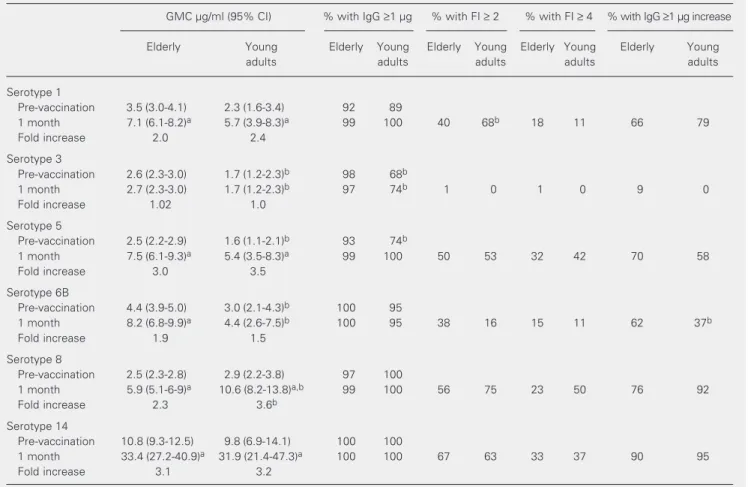
IgG specific for serotypes 8 and 14, and about 30% of them did not have 1 µg/ml IgG antibody to serotypes 3 and 5. The young adult group presented the lowest percentage of subjects (68%) with an IgG concentration of less than 1 µg/ml in pre-immunization sera against serotype 3 (Table 1).
Following immunization, all subjects had a significant increase in antibody responses to the serotypes analyzed, with the exception of type 6B for the young adult group and type 3 for both groups (Figure 1). We also observed wide variation in the concentration of type-specific total IgG elicited. For ex-ample, the absolute concentration of sero-type 14 specific antibodies ranged from 4.7
Figure 1. Geometric mean concentration and 95% confidence intervals of IgG specific for pneumococcal capsular polysaccharide in serum samples from 102 elderly and 19 young adults, pre- and post-vaccination. aP < 0.05 for pre-vaccination sera compared to post-vaccination sera; bP < 0.05 for young adults compared to elderly subjects (analyses of variance for repeated measures).
Geometric mean IgG concentration (µg/ml)
50
40
30
20
10
0
1 3 5 6B 8 14
Streptococcus pneumoniae serotypes Pre-vaccination (elderly)
Post-vaccination (elderly) Pre-vaccination (young controls) Post-vaccination (young controls)
12 12 12 12
123 123
12 12 12 12
12 12 12
123 123 123 123 123 123 123
12 12 12 12 12 12 12 12 12 12 12 12 12 12 12 12 12 12 12
12 12
a a
b b
a a
b
a b
b a
a.b a
to 952.8 µg/ml in the elderly and from 3.6 to 112.7 µg/ml in the young adults. Specific antibody GMC increased after vaccination by more than 3 µg/ml for five of the six serotypes analyzed in the elderly and for four of the six serotypes in the young adults. Serotype 14 elicited the highest GMC and the highest absolute increase in total anti-body concentrations (more than 20 µg/ml) for both groups (Figure 1).
Having established that pneumococcal vaccination generated a specific and appre-ciable response against five serotypes in both age groups, we determined whether the im-mune response of the elderly differed from that of young people. In the elderly group,
the post-vaccination GMCs were higher to serotypes 1, 3, 5, 6B, and 14, with P < 0.05 for serotypes 3 and 6B. On the other hand, the younger controls developed a signifi-cantly higher humoral response to serotype 8, although both groups had similar baseline responses to this serotype (Figure 1). The fold increases in serotype-specific IgG against serotypes 1, 3, 5, 6B, and 14 were compa-rable between the two groups (Table 1). The young adults, however, had a significantly higher fold increase against serotype 8. The mean increase in type-specific antibody af-ter vaccination was greaaf-ter than two-fold for serotypes 1, 5, 8, and 14 in both groups. Serotypes 3 and 6B elicited lower increases
Table 1. Geometric mean concentration (GMC) and increases of IgG antibodies to 6 polysaccharides of Streptococcus pneumoniae in elderly (N = 102) and young adults (N = 19).
GMC µg/ml (95% CI) % with IgG ≥1 µg % with FI ≥ 2 % with FI ≥ 4 % with IgG ≥1 µg increase
Elderly Young Elderly Young Elderly Young Elderly Young Elderly Young
adults adults adults adults adults
Serotype 1
Pre-vaccination 3.5 (3.0-4.1) 2.3 (1.6-3.4) 92 89
1 month 7.1 (6.1-8.2)a 5.7 (3.9-8.3)a 99 100 40 68b 18 11 66 79
Fold increase 2.0 2.4
Serotype 3
Pre-vaccination 2.6 (2.3-3.0) 1.7 (1.2-2.3)b 98 68b
1 month 2.7 (2.3-3.0) 1.7 (1.2-2.3)b 97 74b 1 0 1 0 9 0
Fold increase 1.02 1.0
Serotype 5
Pre-vaccination 2.5 (2.2-2.9) 1.6 (1.1-2.1)b 93 74b
1 month 7.5 (6.1-9.3)a 5.4 (3.5-8.3)a 99 100 50 53 32 42 70 58
Fold increase 3.0 3.5
Serotype 6B
Pre-vaccination 4.4 (3.9-5.0) 3.0 (2.1-4.3)b 100 95
1 month 8.2 (6.8-9.9)a 4.4 (2.6-7.5)b 100 95 38 16 15 11 62 37b
Fold increase 1.9 1.5
Serotype 8
Pre-vaccination 2.5 (2.3-2.8) 2.9 (2.2-3.8) 97 100
1 month 5.9 (5.1-6-9)a 10.6 (8.2-13.8)a,b 99 100 56 75 23 50 76 92
Fold increase 2.3 3.6b
Serotype 14
Pre-vaccination 10.8 (9.3-12.5) 9.8 (6.9-14.1) 100 100
1 month 33.4 (27.2-40.9)a 31.9 (21.4-47.3)a 100 100 67 63 33 37 90 95
Fold increase 3.1 3.2
FI = fold increase expressed as geometric means of individually calculated increase. 95% CI = 95% confidence interval.
aP < 0.05 for pre-vaccination vs one month. bP < 0.05 for elderly vs young adults (analyses of variance for repeated measures and Pearson
(<2) in both age groups.
Because GMC and mean fold increase may not accurately indicate differences in immune responses between the two popula-tions, we compared the proportion of elderly and young adults who achieved at least two-fold and four-two-fold increases in antibody lev-els against the serotypes analyzed. Vaccina-tion produced a two-fold rise in specific antibody in 50% or more of all subjects against serotypes 5, 8, and 14, with compa-rable proportions of elderly and young adult subjects. More young adults (68%) had a two-fold response to serotype 1 than the elderly (40%). Although type 6B is consid-ered to be a poor immunogen (10), 38% of elderly subjects had two-fold increases in specific antibody after vaccination and only 16% of young subjects could set up this response. The proportion of subjects achiev-ing a four-fold response was similar for the two age groups: more than 30% of all sub-jects presented this increase for serotypes 5, and 14 and less than 18% of all subjects could set up a four-fold response to sero-types 1 and 6B. Although we observed a considerable proportion of young adults (50%) that set up a four-fold rise to serotype 8, the response was not significantly differ-ent between the two age groups (Table 1).
As an arbitrary estimate of protective concentrations of pneumococcal capsular antibodies, we analyzed the cut-off value of 1 µg/ml, as usually done for anticapsular
antibodies to Haemophilus influenzae typeb
(11,12).After vaccination, almost all elderly
subjects achieved at least 1 µg/ml of total IgG specific for all six serotypes analyzed. Among the young adults, we also observed a
good response, all of them achieving a ≥1
µg/ml response to serotypes 1 and 5. The lowest percentage (74%) was observed in response to serotype 3 (Table 1). When all six serotypes were analyzed, vaccination in-creased the overall average of the elderly
with an antibody concentration ≥1 µg/ml
from 97 to 99% and this increase varied from
88 to 95% in the young adult group. When the immune response was assessed
for a type-specific IgG increase ≥1 µg/ml
after vaccination, more than 60% of all eld-erly subjects showed this increase in re-sponse to all serotypes, except type 3. In both groups, the lowest percentage of
sub-jects with an IgG increase ≥1 µg/ml was
observed for serotype 3. A statistically sig-nificant difference between the two age groups was seen for serotype 6B, in response to which the young adults had a significant lower percentage (37%) than the elderly sub-jects (62%) who achieved this increase (Table 1).
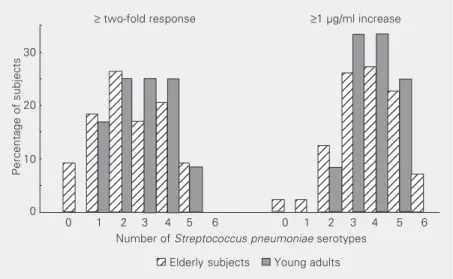
We also evaluated the number of sero-types for which each subject achieved an
increase ≥1 µg/ml and a two-fold rise in IgG
concentration after vaccination (Figure 2). The elderly and the young adults had compa-rable frequencies of these immune response parameters. None of the subjects achieved a two-fold response to all six serotypes simul-taneously, but 7% of the elderly had an
increase ≥1 µg/ml for the six antigens. When
five serotypes were analyzed, 9% of the elderly and 8% of the young adults achieved a two-fold response, and about 25% of all
Percentage of subjects
12 12 12 12 12 12 12 12 12 12 12 12 12 12 12 12 12 12 12 12 12 12 12 12 12 12 12 12 12 12 12 12 12 12 12 12 12 12 12 12 123 123 123 123 123 123 123 123 123 123 123 123 123 12 12 12 12 12 12 12 12 12 12 12 12 12 12 12 123 123 123 123 123 123 123 123 123 123 123 123 123 12 12 12 12 12 12 12 12 12 12 12 12 12 12 12 12 12 12 12 12 12 12 12 12 12 12 12 12 12 12 12 12 12 12 12 12 12 12 12 12 12 12 12 12 12 12 12 12 12 12 12 12 12 12 12 12 12 12 12 12 12 12 12 12 12 12 12 12 12 12 12 12
≥ two-fold response ≥1 µg/ml increase
12
Elderly subjects Young adults
0 1 2 3 4 5 6 0 1 2 3 4 5 6
Number of Streptococcus pneumoniae serotypes 30
10
0 20
subjects had an increase ≥1 µg/ml. Among the elderly, 9 and 2%, respectively, did not achieve a two-fold response or an increase
≥1 µg/ml for any of the six serotypes. In the
younger group we did not detect a null re-sponse.
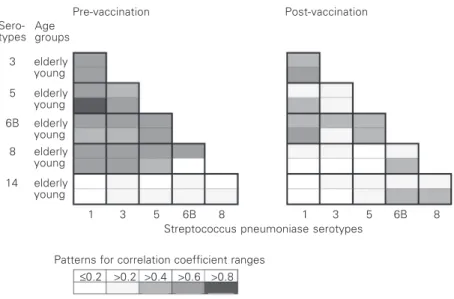
In an attempt to determine if there was a relationship between specific antibody con-centrations for any two serotypes, we per-formed all pairwise comparisons of antibody concentrations for both age groups, as
sug-gested by Coughlin et al. (13).In Figure 3,
we present the correlation coefficients for pre- and post-immunization sera obtained for each group. In pre-immunization sera, the comparison of each elderly subject’s antibody level by cluster analysis revealed a
considerable correlation (r ≥ 0.57) between
the concentrations of specific IgG for sero-types 1, 3, 5, 6B, and 8. Serotype 14 corre-lated distinctly more poorly (r < 0.26) with the other serotypes. In the analysis of post-immunization sera, the correlation coeffi-cients decreased for all pairwise compari-sons of type-specific antibody concentra-tion, with the exception of serotype 14. We obtained similar results in the young adult group.
Discussion
Protection after immunization is thought to be dependent upon the production of cir-culating pneumococcal type-specific anti-bodies that act alone or in concert with complement proteins to opsonize bacteria and promote their phagocytosis. Antibodies
specific for the capsular polysaccharide of S.
pneumoniae are an important part of the human host defense, protecting against inva-sive pneumococcal disease. Consequently, the measurement of antibodies specific for pneumococcal polysaccharides is important in estimating vaccine-induced immune pro-tection.
We measured type-specific antibodies against 5 pneumococcal polysaccharide an-tigens (1, 3, 5, 6B, and 14) that belong to the most common serotypes causing invasive infections in the elderly in Brazil (14). Al-though serotype 8 is less common in Brazil, this antigen was included because, like sero-types 2, 9, and 14, it has reproducible immu-nogenicity as defined by a two-fold increase in antibody titers obtained for normal
con-trols (15,16). All six serotypes analyzed in
the present study are included in the 23-valent vaccine.
ELISA has been widely used to measure immunity to pneumococci and the immuno-genicity of pneumococcal vaccines. Corre-lation between this method and opsonophago-cytic (functional) activity has been consid-ered reasonably good in post-immunization serum samples from adults and infants (17-19).
When we initiated the immunoassays in the late 90’s we used the second-generation standardization of pneumococcal ELISA. This protocol was recommended by the World Health Organization at that time and was extensively used by experts (7,8,20). The pneumococcal capsular polysaccharide preparations used in the present ELISA are contaminated with a common cell wall (C-PS), and therefore antibodies to C-PS should
Sero-types
3 elderly young Age groups
elderly young elderly young elderly young
elderly young 5
6B
8
14
Pre-vaccination Post-vaccination
1 3 5 6B 8 1 3 5 6B 8
Streptococcus pneumoniase serotypes
Patterns for correlation coefficient ranges
≤0.2 >0.2 >0.4 >0.6 >0.8
be absorbed to improve the specificity of the ELISA (21). However, recent reports have shown that the second-generation ELISA was found to have insufficient specificity when serum samples from unimmunized sub-jects were analyzed (13). Furthermore, sev-eral investigators reported that, despite the C-PS absorption, antibodies cross-reactive with several types of pneumococcal poly-saccharides are still measured (17,18,22). As reported elsewhere (17,18,23), cross-re-active antibodies are found more often in the sera of non-immunized infants and adults than in the sera of infants or adults immu-nized with pneumococcal vaccines, suggest-ing that the majority of the antibodies in-duced by vaccination are polysaccharide type or group specific. At the present time a third-generation assay format has been adopted by experts (24) and an additional step is per-formed for the removal of cross-reactive antibodies. This additional absorption step, using 22F polysaccharide antigen, improves the correlation between ELISA and opsono-phagocytic activity, the two methodologies widely used to characterize the immune re-sponse (25).
In our analysis, the pre-vaccination sera of the majority of elderly and young adults had detectable levels of antibody for the six polysaccharides analyzed in pre-vaccination sera. Considering the limitation of the ELISA used in our study, this measurement may reflect antibodies cross-reactive with sev-eral types of pneumococcal polysaccharides, antibodies acquired during life as a result of
colonization, previous infection with S.
pneu-moniae, or other cross-reactive organisms.
Nevertheless, the basal anti-specific capsu-lar polysaccharide IgG concentrations found in our study were in agreement with previous reports on elderly people from industrialized countries (26) analyzed by second-genera-tion ELISA.
In general, the elderly and the young adults developed a significant mean increase of antibody levels for 5 of 6 and 4 of 6
capsular polysaccharides, respectively. The present study demonstrated that, at 1 month after immunization, the sera of elderly per-sons had levels of specific capsular anti-bodies similar to those of healthy younger persons, as reported elsewhere (16,27). For both groups, serotypes 3 and 6B elicited lower increases (<2) and, by this criterion, these antigens appeared to be less immuno-genic in both groups (10,26). The finding that most elderly subjects responded satis-factorily to the pneumococcal vaccine agrees with the results of other studies (27-29). It is still possible that healthy elderly adults, such as those in our study, respond normally to pneumococcal polysaccharide antigens, but that their response is reduced with the ill effects of aging and the increase of co-mor-bid conditions. As reported elsewhere (20), the response to certain polysaccharides may be reduced, with a more marked reduction in persons >85 years of age. In our study we found that serotype 3 was poorly immuno-genic, eliciting the lowest absolute IgG con-centration and fold increase in specific anti-bodies for both groups. In a similar
serum-conversion study, Rubbins et al. (26)
ob-served that serotypes 3 and 4 account for many of the vaccine failures seen in clinical trials, suggesting that future vaccines for use in the elderly must be improved for these antigens.
Actu-ally, the concentration of anti-polysaccha-ride 8 IgG in 89-SF serum had not been assigned at the time of our study, and there-fore we performed the cross-standardization method of Conception and Frasch (31). The assigned IgG antibody value for serotype 8 defined in our study did not differ from that found later by Quataert et al. (32). We con-firmed the usefulness of the cross-standard-ization method to calibrate unknown IgG concentrations to pneumococcal serotypes.
It has been often stated that a normal antibody response to vaccination should in-clude at least a two-, three-, or four-fold increase in antibody titer to the antigens analyzed. Traditional criteria for the inter-pretation of the immune response to pneu-mococcal polysaccharide have been proposed based on the difference between the post-and pre-immunization antibody concentra-tions regardless of the increase after immu-nization (15,30). In the present study, the percentage of vaccinees attaining a two-fold rise in IgG antibody was similar for the two age groups for 5 of the 6 serotypes analyzed. Only for serotype 1 was the percentage of elderly subjects that achieved a two-fold response lower than that of young adults. It should be noted that some investigators found a lower percentage of institutionalized eld-erly subjects who responded to serotypes 6B and 14 (20). When we compared the four-fold rise in specific IgG antibody concentra-tion for the two groups, the percentage of young adult and elderly subjects was similar for all serotypes.
In a study of post-vaccinal immune re-sponse in the elderly, Rubbins et al. (26) concluded that only 3.7% of the elderly had two-fold increases in antibody for all 23 serotypes, 48% had two-fold increases for 15 or more serotypes, and 80% responded to 6 or more vaccinal serotypes. In our study we could not find in either group subjects who set up simultaneously a two-fold im-mune response against the 6 pneumococcal capsular antigens analyzed. Although some
investigators try to characterize the poor re-sponders (16,26), we were not able to iden-tify them due the small number of polysac-charides analyzed.
As reported elsewhere (13,26), we ob-served that pre-vaccination levels of anti-bodies to serotypes 1, 3, 5, 6B, and 8 were considerably correlated in the elderly. As discussed earlier, this event may be observed when the assay is not specific, and may be due to an antigenic stimulus common to these serotypes, most likely a cross-reactive antigen. On the other hand, serotype 14 showed the lowest correlation coefficient, confirming the considerably type-specific measurement of antibodies to serotype 14 by ELISA demonstrated in several studies (13,17,22,23,25). However, after vaccina-tion, all pairwise correlations showed a con-sistent decrease, with the exception of sero-type 14. These data suggest an improvement in antibody specificity to serotypes 1, 3, 5, 6B, and 8. As reported by others (13,23,26), lower correlation coefficients for antibody concentration with other serotypes could mean the absence of cross-reactive antigens. The increase of correlation for serotype 14 in post-vaccinal sera may suggest an overall increase in total IgG concentration. We ob-served similar correlations in the pre- and post-vaccination sera of young adults.
have overestimated the IgG concentration in pre-immunization sera, since the second-gen-eration ELISA we performed may not be optimal for measuring type-specific anti-bodies, especially in non-immune serum samples. Our laboratory is currently using the protocol recommended for the third-gen-eration pneumococcal antibody ELISA (http:/ /www.vaccine.uab.edu).
Acknowledgments
We gratefully acknowledge the construc-tive criticism of Dr. Moon H. Nahm, Univer-sity of Alabama, Birmingham, USA, Dr. Carl E. Frasch, FDA, USA, for kindly providing reference serum 89-SF and Dr. Luiz Jacintho da Silva, Coordenação dos Institutos de Pes-quisa, Secretaria de Estado da Saúde de São Paulo, for the support of this publication.
References
1. Vlasich C (2001). Pneumococcal infection and vaccination in the elderly. Vaccine, 19: 2233-2237.
2. Mieczkowisk TA & Wilson SA (2002). Adult pneumococcal vaccina-tion: a review of physician and patients. Vaccine, 20: 1383-1392. 3. Fedson DS, Scott JA & Scott G (1999). The burden of pneumococcal
disease among adults in developed and developing countries: what is and is not known. Vaccine, 17: S11-S18.
4. Fedson DS (1999). The clinical effectiveness of pneumococcal vac-cination: a brief review. Vaccine, 17: S85-S90.
5. Toniolo-Neto J, Weckx LW, Halker E, Lopes CH, de Menezes Succi RC, de Paiva TM, Ishida MA & Forleo-Neto E (1999). Safety of simultaneous pneumococcal and influenza vaccination in elderly patients in Brazil. Drugs and Aging, 15 (Suppl 1): 43-45.
6. Aranda CMSS (1999). Vacinação para o idoso no ano de 1999.
Revista CIP - Ações em Saúde, 3: 13-18.
7. Plikaytis BD, Goldblat D, Frasch CE et al. (2000). An analytical model applied to a multicenter pneumococcal enzyme linked immunosor-bent assay study. Journal of Clinical Microbiology, 38: 2043-2050. 8. Quataert SA, Kirch CS, Quackenbush LJ, Phipps DC, Strohmeyer S,
Cimino CO, Skuse J & Madore DV (1995). Assignment of weight-based antibody units to a human antipneumococcal standard refer-ence serum, lot 89-S. Clinical and Diagnostic Laboratory Immunol-ogy, 2: 590-597.
9. Plikaytis BD, Holder PF & Carlone GM (1995). Program ELISA for Windows User’s Manual, Version 1.00. Centers for Disease Control and Prevention, Atlanta, GA, USA.
10. Shelley MA, Jacoby H, Riley GJ, Graves BT, Pichichero M & Treanor JJ (1997). Comparison of pneumococcal polysaccharide and CRM-197 conjugated pneumococcal oligosaccharide vaccines in young and elderly adults. Infection and Immunity, 65: 242-247.
11. Kayhty H, Ahman H, Ronnberg PR, Tillikainen R & Eskola J (1995). Pneumococcal polysaccharide-meningococcal outer membrane pro-tein complex conjugate vaccine is immunogenic in infants and children. Journal of Infectious Diseases, 172: 1273-1278. 12. Sankilampi U, Honkanen PO, Bloigu A, Herva E & Leinonen M
(1996). Antibody response to pneumococcal capsular polysaccha-ride vaccine in the elderly. Journal of Infectious Diseases, 173: 387-393.
13. Coughlin RT, White AC, Anderson CA, Carlone GM, Klein DL & Treanor J (1998). Characterization of pneumococcal specific anti-bodies in healthy unvaccinated adults. Vaccine, 16: 1761-1767. 14. Brandileone MC, Andrade AL, Di Fabio JL, Guerra ML & Austrian R
(2003). Appropriateness of a pneumococcal conjugate vaccine in
Brazil: potential impact of age and clinical diagnosis, with emphasis on meningitis. Journal of Infectious Diseases, 187: 1206-1212. 15. Go ES & Ballas ZK (1996). Anti-pneumococcal antibody response in
normal subjects: a meta analysis. Journal of Allergy and Clinical Immunology, 98: 205-215.
16. Rubbins JB, Puri AKG, Loch J, Charboneau D, MacDonald R, Opstad N & Janoff EM (1998). Magnitude, duration, quality and function of pneumococcal vaccine responses in elderly adults. Journal of Infec-tious Diseases, 178: 431-440.
17. Soininen A, van den Dobbelsteen G, Oomen L & Kayhty H (2002). Are the enzyme immunoassays for antibodies to pneumococcal capsular polysaccharides serotype specific? Clinical and Diagnostic Laboratory Immunology, 7: 468-476.
18. Soininen A, Karpala M, Wahlman SL, Lehtonen H & Kayhty H (2002). Specificities and opsonophagocytic activities of antibodies to pneu-mococcal capsular polysaccharides in sera of unimmunized young children. Clinical and Diagnostic Laboratory Immunology, 9: 1032-1038.
19. Romero-Steiner S, Libutti D, Pais LB, Dykes J, Anderson P, Whitin JC, Keyserling HL & Carlone GM (1997). Standardization of an opsonophagocytic assay for the measurement of functional anti-body activity against Streptococcus pneumoniae using differenti-ated HL-60 cells. Clinical and Diagnostic Laboratory Immunology, 4: 415-422.
20. Romero-Steiner S, Musher DM, Cetron MS, Pais LB, Groover JE, Fiore AE, Plykaytis BD & Carlone G (1999). Reduction in functional antibody activity against Streptococcus pneumoniae in vaccinated elderly individuals highly correlates with decreased IgG antibody avidity. Clinical Infectious Diseases, 29: 281-288.
21. Koskella M (1987). Serum antibodies to pneumococcal C polysac-charide in children: response to acute pneumococcal otites media or to vaccination. Pediatric Infectious Disease, 6: 519-526. 22. Yu X, Sun Y, Frasch C, Conception N & Nahm MH (1999).
Pneumo-coccal capsular polysaccharide preparations may contain non-C polysaccharide contaminants that are immunogenic. Clinical and Diagnostic Laboratory Immunology, 6: 519-524.
23. Soininen A, Pursiainen H, Kilpi T & Kayhty H (2001). Natural develop-ment of antibodies to pneumococcal polysaccharide depends on the serotype: association with pneumococcal carriage and acute otitis media in young children. Journal of Infectious Diseases, 184: 569-575.
pneumococcal polysaccharides. Clinical and Diagnostic Laboratory Immunology, 10: 514-519.
25. Conception N & Frasch C (2001). Pneumococcal type 22 F polysac-charide absorption improves the specificity of a pneumococcal-polysaccharide enzyme-linked immunosorbent assay. Clinical and Diagnostic Laboratory Immunology, 8: 266-272.
26. Rubbins JB, Alter M, Loch J & Janoff EN (1999). Determination of antibody responses of elderly adults to all 23 capsular polysaccha-rides after pneumococcal vaccination. Infection and Immunity, 67: 5979-5989.
27. Musher DM, Groover JE, Graviss EA & Baughn RE (1996). Lack of association between aging and post vaccination levels of IgG anti-body capsular polysaccharides of Streptococcus pneumoniae. Clini-cal Infectious Diseases, 22: 165-167.
28. Musher DM, Groover JE, Rowland JM, Watson DA, Struewing JB, Baughn RE & Mufson MA (1993). Antibody to capsular polysaccha-rides of S. pneumoniae: prevalence, persistence and response to revaccination. Clinical Infectious Diseases, 17: 66-73.
29. Sankilampi U, Honkanen PO, Bloigu A & Leinonen M (1997). Persis-tence of pneumococcal capsular polysaccharide vaccine in the eld-erly. Journal of Infectious Diseases, 176: 1100-1104.
30. Sorensen RU, Leiva LE, Javier III FC, Sacerdote DM, Bradford N, Butler B, Giangrosso PA & Moore C (1998). Influence of age on the response to S. pneumoniae in patients with recurrent infections and normal immunoglobulin concentrations. Journal of Allergy and Clini-cal Immunology, 102: 215-221.
31. Conception N & Frasch C (1998). Evaluation of previously assigned antibody concentrations in pneumococcal polysaccharide reference serum 89-SF by the method of cross-standardization. Clinical and Diagnostic Laboratory Immunology, 5: 199-204.