BGD
12, 15157–15184, 2015
Environmental controls on leaf wax
δD ratios X. Huang et al.
Title Page
Abstract Introduction
Conclusions References
Tables Figures
◭ ◮
◭ ◮
Back Close
Full Screen / Esc
Printer-friendly Version
Interactive Discussion
Discussion
P
a
per
|
Discussion
P
a
per
|
Discussion
P
a
per
|
Discussion
P
a
per
|
Biogeosciences Discuss., 12, 15157–15184, 2015 www.biogeosciences-discuss.net/12/15157/2015/ doi:10.5194/bgd-12-15157-2015
© Author(s) 2015. CC Attribution 3.0 License.
This discussion paper is/has been under review for the journal Biogeosciences (BG). Please refer to the corresponding final paper in BG if available.
Environmental controls on leaf wax
δ
D
ratios in surface peats across the
monsoonal region of China
X. Huang1,2, J. Xue1,2, X. Wang1,2, and P. A. Meyers3
1
State Key Laboratory of Biogeology and Environmental Geology, China University of Geosciences, Wuhan 430074, China
2
School of Earth Sciences, China University of Geosciences, Wuhan 430074, China
3
Department of Earth and Environmental Sciences, The University of Michigan, Ann Arbor, MI 48109-1005, USA
Received: 9 August 2015 – Accepted: 1 September 2015 – Published: 14 September 2015 Correspondence to: X. Huang ([email protected])
BGD
12, 15157–15184, 2015
Environmental controls on leaf wax
δD ratios X. Huang et al.
Title Page
Abstract Introduction
Conclusions References
Tables Figures
◭ ◮
◭ ◮
Back Close
Full Screen / Esc
Printer-friendly Version
Interactive Discussion
Discussion
P
a
per
|
Discussion
P
a
per
|
Discussion
P
a
per
|
Discussion
P
a
per
Abstract
Leaf wax molecular and isotopic ratios are generally considered robust isotopic pale-ohydrologic proxies. Here we evaluate the proxy value of the molecular distributions and hydrogen isotopic compositions of long chainn-alkanes (δDalk) in surface peats collected from peatlands across a range of annual air temperatures from 1 to 15◦C
5
and a range of annual mean precipitation from 720 to 2070 mm in the monsoonal re-gion of China. The alkane ratios (ACL and CPI) andδDalk values show relatively large variations in multiple samples from a single site, highlighting the complexity of these ratios at a small spatial scale. In the montane Zoigê peatland, the apparent fractiona-tion between precipitafractiona-tion andδDalk is more positive than in the other six sites, which
10
is possibly an effect of the higher conductivity of the water in this high elevation site (3500 m a.s.l.). At a larger spatial scale, the site-averaged CPI ratios and theδDalk val-ues ofn-C29 and n-C31 alkanes show significant correlation with the air temperature and precipitation. These results support the application of the CPI ratio and theδDalk ratios ofn-C29 and n-C31 alkanes as sensitive paleohydrologic proxies on millennial
15
and larger timescales.
1 Introduction
Paleohydrologic reconstructions are a very important component in the study of Qua-ternary paleoclimate changes. During the past several decades, leaf wax hydrogen isotopic compositions have been proven as a powerful isotopic paleohydrologic tool
20
(Sachse et al., 2012 and associated references). Leaf waxδD values generally follow the isotopic compositions of locally meteoric water (δDp), which is major water source for plant photosynthesis (Sachse et al., 2012). Therefore, leaf waxδD values can imply theδDpvalues and their associated environmental factors.
In low latitude areas, the δDp values are mainly affected by the “amount effect”
25
BGD
12, 15157–15184, 2015
Environmental controls on leaf wax
δD ratios X. Huang et al.
Title Page
Abstract Introduction
Conclusions References
Tables Figures
◭ ◮
◭ ◮
Back Close
Full Screen / Esc
Printer-friendly Version
Interactive Discussion
Discussion
P
a
per
|
Discussion
P
a
per
|
Discussion
P
a
per
|
Discussion
P
a
per
|
recording the precipitation amount or the relative humidity (e.g. Tierney et al., 2008; Schefuß et al., 2011). A few studies have tried to consolidate such an interpretation by using modern surface soils or recent lake sediments (Garcin et al., 2013). In contrast, at high latitude regions, the “temperature effect” mainly controls the δDpvalues. Modern lake sediment investigations in west Europe (Sachse et al., 2004) and North America
5
(Hou et al., 2011; Thomas et al., 2012; Shanahan et al., 2013) have confirmed that leaf waxδD values could record past temperature changes. In the middle-latitude regions, such as the monsoonal region of China, Rao et al. (2009) studied theδD compositions of long chainn-alkanes across a climate gradient and concluded that theδD values of long chainn-alkanes have the potential to record theδD of meteoric water. To date,
10
however, our knowledge about the dominant controllers on leaf waxδD values in this region is still limited.
Peatlands are waterlogged continental settings whose evolutions are closely asso-ciated with hydrological conditions. Hence, this kind of archive is well-suited for pa-leohydrological reconstructions (Charman, 2002). As examples of leaf wax isotopic
15
studies in peatlands, Xie et al. (2000) first described a two-century-long leaf waxδD sequence from the Bolton Fell Moss, Cumbria, UK. Nichols et al. (2010) discussed the differences in hydrogen isotopic ratios of Sphagnum and vascular plant biomark-ers in common cores from boreal ombrotrophic peatlands. In the monsoonal region of China, Seki and colleagues (2009, 2011) applied the leaf waxδD records from peat
20
sequences to reconstruct paleoclimate changes since the late deglaciation.
In China, peatlands are mainly clustered in the Northeast and Southwest, with a few scattered ones in the vast eastern lowland (Chai et al., 1981). Due to greater human impacts in the eastern lowland, very few sub-alpine peatlands have been preserved in relatively pristine conditions. In this study, we selected seven peatlands, all with
25
BGD
12, 15157–15184, 2015
Environmental controls on leaf wax
δD ratios X. Huang et al.
Title Page
Abstract Introduction
Conclusions References
Tables Figures
◭ ◮
◭ ◮
Back Close
Full Screen / Esc
Printer-friendly Version
Interactive Discussion
Discussion
P
a
per
|
Discussion
P
a
per
|
Discussion
P
a
per
|
Discussion
P
a
per
2 Material and methods
2.1 Sampling
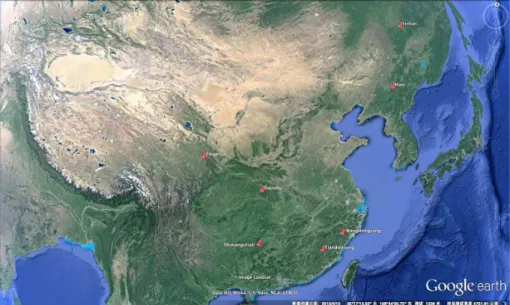
Surface samples (0–2 cm) were collected at Yichun (272 m above sea level (m a.s.l.), 48◦48′N, 129◦22′E) in August 2011, Dajiuhu (1700 m a.s.l., 31◦28′N, 110◦00′E) in July 2012, Tiandouyang (1196 m a.s.l., 25◦55′N, 117◦29′E) in October 2012,
Wang-5
dongyang (1398 m a.s.l., 27◦41′N, 119◦38′E) in November 2012, and the other three sites, Hani (900 m a.s.l., 42◦13′N, 126◦31′E), Shiwangutian (1690 m a.s.l., 26◦05′N, 110◦22′E), Zoigê (3450 m a.s.l., 33◦49′N, 102◦44′E), in August 2013 (Fig. 1). In the climate zonation of China, Zoigê is characterized as sub-humid, whereas the other six sites are all characterized as humid (Liu and Tian, 2010).
10
For sampling site descriptions of Hani, Zoigê, Dajiuhu and Shiwangutian, please refer to Huang et al. (2015). For the other three sites (Yichun, Wangdongyang, Tian-douyang), the surface peats were all collected underSphagnumlawns.
The pH, conductivity (Cond), and oxidation-reduction potential (ORP) of the water of the peatlands were measured in the field using portable electrodes (Mettler Toledo,
15
Swiss; Table 1). The depth of the water level was measured as the depth from the water surface to the top of the peat surface (DWT; Table 1). The water levels reported here are based on a single observation for each sample. These data from Hani, Zoigê, Dajiuhu and Shiwangutian have been published in Huang et al. (2015).
2.2 Lipid extraction
20
The surface peat samples were first freeze-dried and then ground and sieved through an 80-mesh sieve (0.2 mm). About 0.5 g dried powdered peat was ultrasonically ex-tracted 3×with dichloromethane/methanol (9 : 1,v/v) for 10 min. An internal standard of 5β(H)-cholane (Chiron, Norway) was added before extraction. After solvent removal under reduced pressure, the extract was fractionated into aliphatic, aromatic and polar
BGD
12, 15157–15184, 2015
Environmental controls on leaf wax
δD ratios X. Huang et al.
Title Page
Abstract Introduction
Conclusions References
Tables Figures
◭ ◮
◭ ◮
Back Close
Full Screen / Esc
Printer-friendly Version
Interactive Discussion
Discussion
P
a
per
|
Discussion
P
a
per
|
Discussion
P
a
per
|
Discussion
P
a
per
|
fractions using silica gel column chromatography. The aliphatic fraction analyzed here was eluted withn-hexane.
2.3 Instrumental analysis
The aliphatic fraction containingn-alkanes was analyzed in a Shimadzu GC-2010 gas chromatograph (GC) equipped with a flame ionization detector (FID) and a DB-5
col-5
umn (30 m×0.25 mm i.d., 0.25 µm film thickness). The sample was injected in splitless mode with the injector temperature set at 300◦C. The initial oven temperature was 70◦C and held for 1 min, and then ramped to 210◦C at a rate of 10◦C min−1, and finally ramped to 300◦C at a rate of 3◦C min−1and kept isothermal for 25 min. Quantification was calculated by comparison of peak areas with the internal standard (cholane) and
10
adjusted with the relevant response factors. The alkane concentration results of the batch of surface peats collected from the Dajiuhu peatland were published in Huang et al. (2014).
Compound-specific hydrogen isotope compositions of n-alkanes were determined using a Trace GC coupled with a Delta V advantage isotope ratio mass
spectrome-15
ter. The sample was injected in splitless mode with the injector temperature at 300◦C. The GC oven temperature was initiated at 50◦C and held for 1 min, and then ramped to 210◦C at a rate of 10◦C min−1 (kept 2 min), and further raised to 300◦C at a rate of 6◦C min−1 (kept 2 min), and finally ramped to 310◦C at a rate of 10◦C min−1 and kept isothermal 25 min. The high temperature conversion (HTC) system was operated
20
at 1400◦C. The HTC tube was conditioned with methane. During the sample running interval, the H+3 factor varied between 3.30 and 3.10. To check the system stability, an n-alkane mixture (n-C23, n-C25, n-C27, n-C29 and n-C31 alkane) and the Indiana A4 mixture with known δD values were run between every two samples. Squalane (δD−167 ‰) was used as the internal standard. Standard deviation for hydrogen
iso-25
BGD
12, 15157–15184, 2015
Environmental controls on leaf wax
δD ratios X. Huang et al.
Title Page
Abstract Introduction
Conclusions References
Tables Figures
◭ ◮
◭ ◮
Back Close
Full Screen / Esc
Printer-friendly Version
Interactive Discussion
Discussion
P
a
per
|
Discussion
P
a
per
|
Discussion
P
a
per
|
Discussion
P
a
per
2.4 Apparent fractionation calculation
The apparent fractionation (εalk/p) betweenn-alkaneδD (δDalk) and precipitation (δDp) was calculated using the following equation (Bowen et al., 2005):
εalk/p=[(δDalk+1)/(δDp+1)]−1 (1)
whereδDpis estimated using the precipitation isotope calculator (http://wateriso.utah.
5
edu/waterisotopes/pages/data_access/oipc.html).
3 Results and discussion
3.1 Spatial variations of long chainn-alkanes in peatlands
Long chain n-alkanes ranging from C21 to C35 are the dominant constituents of the aliphatic fractions in all surface peat samples (Fig. 2). These long chain n-alkanes
10
show strong odd-over-even predominance, indicating their principal origin from the leaf waxes of in situ peat-forming plants (Pancost et al., 2002; Huang et al., 2014). In six of these seven peatlands,Sphagnumspp. are present; plants of this type are absent only at the sampling region of the Zoigê peatland. Even though most surface samples were collected underSphagnumlawns in these six peatlands, thePaq values vary in a large
15
range, with low average values at Hani (0.16±0.05) and Dajiuhu (0.18±0.07) to values as high as 0.72 and 0.74 in two samples from Yichun. PublishedSphagnum n-alkane results (Baas et al., 2000; Pancost et al., 2002; Nichols et al., 2006; Bingham et al., 2010; Ortiz et al., 2011), including those from our previous studies in Dajiuhu (Huang et al., 2010, 2014), almost always support highPaq values as a characteristic feature
20
BGD
12, 15157–15184, 2015
Environmental controls on leaf wax
δD ratios X. Huang et al.
Title Page
Abstract Introduction
Conclusions References
Tables Figures
◭ ◮
◭ ◮
Back Close
Full Screen / Esc
Printer-friendly Version
Interactive Discussion
Discussion
P
a
per
|
Discussion
P
a
per
|
Discussion
P
a
per
|
Discussion
P
a
per
|
higher than those of freshSphagnum(Pancost et al., 2002; Huang et al., 2014), to the peat distributions. Another possibility is that the intermediate chain n-C23 and n-C25 alkanes have suffered preferential degradation relative to their long chain counterparts, although more information is required to evaluate the latter possibility. Either way, the new and previous results suggest caution in using thePaq values of bulk peat samples
5
as evidence of the contribution fromn-alkanes to moss in peat deposits, even though
Sphagnum can be an important constituent of modern plant assemblages.
Further-more, the relatively highPaq values in the non-SphagnumZoigê highlight the possible major contribution of medium chain n-C23 and n-C25 alkanes from vascular aquatic plants in peat deposits, especially in relatively cold settings like Zoigê.
10
In the four peatlands (Hani, Zoigê, Dajiuhu and Shiwangutian) in which more than ten samples were collected, the possible relations between major alkane ratios (CPI,
Paq, and ACL) and peat water chemistry can be explored (Tables 2–5). Only in Shi-wangutian does the ACL show a strong correlation with peat water chemistry, evident in a strong negative correlation with pH (r =−0.76, p <0.01), and a strong positive
15
correlation with the DWT (r=0.72,p <0.01; Table 5). In both Shiwangutian and Zoigê, the CPI values in the surface peat samples vary closely with DWT but in opposite ways. A positive correlation exists between CPI and DWT in Zoigê (r =0.45,p <0.05; Table 2), whereas a negative correlation exists in Shiwangutian (r=−0.56, p <0.05; Table 5). In the Hani peatland, the CPI values correlate positively with pH (r =0.58,
20
p <0.05) and negatively with ORP (r=−0.67,p <0.05; Table 3). In the batch of sur-face peats collected from the Dajiuhu peatland, the correlation between alkane ratios and peat water chemistry is always quite weak (Table 4). CPI values are considered to be controlled mainly by microbial activity, which is in turn affected by environment conditions, especially temperature and relative humidity (Xie et al., 2003; Rao et al.,
25
2009). Our results imply that at a small spatial scale, such as within a peatland, the main influences on the CPI values may be site-dependent and hence complicated.
BGD
12, 15157–15184, 2015
Environmental controls on leaf wax
δD ratios X. Huang et al.
Title Page
Abstract Introduction
Conclusions References
Tables Figures
◭ ◮
◭ ◮
Back Close
Full Screen / Esc
Printer-friendly Version
Interactive Discussion
Discussion
P
a
per
|
Discussion
P
a
per
|
Discussion
P
a
per
|
Discussion
P
a
per
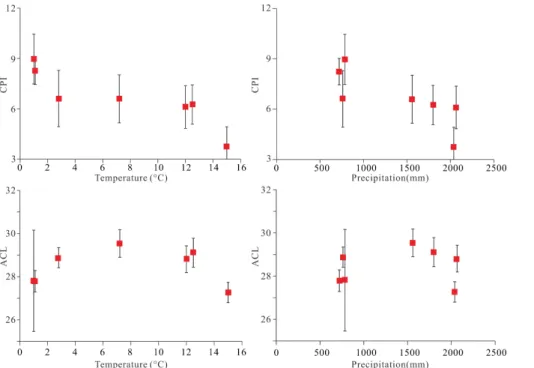
CPI values is related to increasing annual mean air temperature (Fig. 3). The north-ernmost site (Yichun) and the higher altitude site (Zoigê) have the highest CPI values (8–9), whereas the southernmost site (Tiandouyang) has low averaged CPI values (3.8; Fig. 3). Previous studies have observed a similar trend between CPI of long chain
n-alkanes and mean air temperature in surface soils along an eastern China transect
5
(Rao et al., 2009) and also along a transect from southeastern China to the north mar-gin of the Loess Plateau (Luo et al., 2012). Such a close relation between CPI and air temperature probably results from differences in the extent of microbial degradation of long chainn-alkanes. In the warm and humid conditions such as those in the southern peatlands, microbial degradation will decrease the CPI values. In contrast, microbial
10
activity is inhibited in cool and wet conditions such as Yichun and Zoigê, which will preserve plantn-alkanes and yield relatively higher CPI values. In this study, CPI has a weaker correlation with the mean precipitation (r =−0.79, p=0.04) than with the mean temperature (r =−0.87,p=0.01; Fig. 3).
We calculated ACL values over the same range of C21to C33as we used for the CPI
15
calculations so that contributions from mosses and aquatic plants would be included. Unlike the CPI, the ACL values display a parabolic trend across the temperature gradi-ent (Fig. 3). Relatively low values occur at both the northernmost/high altitude and the southernmost sites. Previous studies have argued that the ACL values should increase as a plant water management response to increasing temperature or decreasing
pre-20
cipitation (Poynter et al., 1989; Schefuß et al., 2003; Hughen et al., 2004). In modern geographic conditions in the monsoonal region of China, mean annual temperature and mean annual precipitation vary closely together. Consequently, our field-based study cannot separate the influences of temperature and precipitation on derivedn-alkane ratios like the CPI and the ACL. Instead, we interpret the complex relation between
25
BGD
12, 15157–15184, 2015
Environmental controls on leaf wax
δD ratios X. Huang et al.
Title Page
Abstract Introduction
Conclusions References
Tables Figures
◭ ◮
◭ ◮
Back Close
Full Screen / Esc
Printer-friendly Version
Interactive Discussion
Discussion
P
a
per
|
Discussion
P
a
per
|
Discussion
P
a
per
|
Discussion
P
a
per
|
3.2 Differences in long chainn-alkaneδD values in peatlands across the
monsoonal region of China
3.2.1 Intra-peatland differences in long chainn-alkaneδD values
Here we focus on comparisons of the δD values of the n-alkanes in the four peat-lands with surface peat samples>10. In the batch of samples (n=20) collected from
5
the Zoigê peatland, theδD values of individualn-alkane have a relatively large range (Fig. 4). Then-C23 andn-C25 alkanes have more negativeδD values than theirn-C29 andn-C31homologues, a difference that suggests that the two shorter chain molecules may have different precursors to the longer chain ones. In this non-Sphagnum peat-land, relatively highPaq values (0.36±0.08) indicate that then-C23 andn-C25 alkanes
10
mainly originate from floating aquatic plants. In relation to the water level and chemistry, theδDalk values of the four alkanes correlate significantly only with the DWT (Table 2). The close relation between δDalk and water level in the Zoigê peatland strongly sug-gests thatδDalkvalues could be a robust proxy for paleohydrological conditions at this location.
15
The δDalk value distribution is quite different in the batch of surface peats (n=12) collected from the Hani peatland (Fig. 4, Table 3). The range of values is small, then -C23 andn-C25 alkanes haveδD values similar to those in the Zoigê peatland, and the
n-C29 andn-C31 alkanes have more negativeδD values than their counterparts in the Zoigê peatland. In addition, the δDalk values of the n-C23 and n-C25 alkanes in Hani
20
peatland do not correlate closely with the n-C29 and n-C31 alkanes (Table 3). Such a pattern probably results from their different sources. The n-C23 and n-C25 alkanes may principally originate fromSphagnum, whereas then-C29 andn-C31alkanes prob-ably come from vascular plants. In the batch of Hani surface peats, theδDalk values correlate poorly with water level and water chemistry; only theδD31 has a moderately
25
negative correlation with water pH (Table 3).
BGD
12, 15157–15184, 2015
Environmental controls on leaf wax
δD ratios X. Huang et al.
Title Page
Abstract Introduction
Conclusions References
Tables Figures
◭ ◮
◭ ◮
Back Close
Full Screen / Esc
Printer-friendly Version
Interactive Discussion
Discussion
P
a
per
|
Discussion
P
a
per
|
Discussion
P
a
per
|
Discussion
P
a
per
of these two compounds. Unlike in the Zoigê and Hani peatlands, theδD value ofn-C29 alkane does not correlate well with those ofn-C31alkane in the two southern peatlands (Dajiuhu and Shiwangutian; Tables 4 and 5). This difference between the northern and southern peatlands highlights that the southern peatlands in sub-tropical conditions may have a more complex mixture of sources for their long chainn-alkanes.
5
This study reveals large amplitudes of theδD values of a single compound within a peatland. A recent study demonstrated that lipid and soil waterδD ratios in a salt-marsh differed by up to 35 ‰ (Eley et al., 2014). Such a large variation of δD ratios may result from the microtopographical variability within a peatland.
3.2.2 Differences in the long chainn-alkaneδD values in the different
10
peatlands
Although the dominant influences on the δDalk values appear to be site-dependent within each peatland, the major controls on the δDalk values peatlands across the monsoonal regional of China may be climate-dependent. As shown in Fig. 5, the site-averaged δD values of n-C29 and n-C31 alkanes follow closely the annual mean air
15
temperature and precipitation. An exception is the Zoigê site, which shows relatively less negativeδDalk values. On the basis of its latitude (33◦49′N) and high elevation (3500 m a.s.l.), this site should have more negative δDp and hence more negative
δDalk values than the other six sites. Evaporation is probably not the primary rea-son for the less negative δDalk values in the Zoigê site. The annual precipitation is
20
around 700 mm in Zoigê County, while the annual evaporation is about 260 mm (Guo and Li, 2007). In addition, theδDalk sequence in a Hongyuan peat core (3505 m a.s.l., 32◦46′N, 102◦30′E; quite near our Zoigê sampling site) was more negative (−20 to −30 ‰) than that of the Hani peat core (42◦13′N, 126◦31′E) at the same temporal epoch (Seki et al., 2009, 2011). Also different from the six other sites, Zoigê site has
25
es-BGD
12, 15157–15184, 2015
Environmental controls on leaf wax
δD ratios X. Huang et al.
Title Page
Abstract Introduction
Conclusions References
Tables Figures
◭ ◮
◭ ◮
Back Close
Full Screen / Esc
Printer-friendly Version
Interactive Discussion
Discussion
P
a
per
|
Discussion
P
a
per
|
Discussion
P
a
per
|
Discussion
P
a
per
|
pecially Ca2+, Mg2+ and HCO−3. The higher conductivity could play a role in the larger
n-alkaneδD values in the Zoige peat.
Previous studies have demonstrated that salinity is an important environmental influ-ence on theδD values of lipids in marine and coastal conditions (e.g. Schouten et al., 2006; Sachse and Sachs, 2008). In higher salinity settings, the restricted exchange
5
with extracellular water would result in less hydrogen isotope fractionation during lipid biosynthesis (see Sachse et al., 2012 for a review). The dominant plants surrounding our sampling points at Zoigê peatland are some halophytes (Glaux maritima,
Puccinel-lia sp., Halerpestes sp.), together with Juncus effuses and Pedicularis sp. Thus it is
possible that the relatively less negativeδDalkvalues in the surface peat samples
col-10
lected from Zoigê peatland result from a physiological adaption similar to halophytes to high salinity conditions. However, the salinity in the batch of Zoigê peat samples is less than the detection limitation. Future studies need to investigate why hydrogen isotope fractionation seems to be restricted in this freshwater setting having a high conductivity and a basic pH.
15
In the six peatlands with relatively low and uniform conductivity, the site-averaged
δD values of the n-C29 and n-C31 alkanes correlate positively with air temperature (r=0.88, 0.82, p <0.05) and precipitation (r =0.93, 0.76, p≤0.01). The δD values of then-C23 andn-C25 alkanes also show increasing trends with air temperature and precipitation (Fig. 5) but the smaller number of these data fails to pass the significance
20
test. The positive correlation between temperature and theδD29 and δD31 values is consistent with the so-called “temperature effect” (Dansgaard, 1964), which has been observed prominently across regions outside the tropics, including Europe (Sachse et al., 2004) and North America (Hou et al., 2007). In contrast, the positive correlation between precipitation andδD29and δD31 is inverse with the so-called “amount effect”
25
BGD
12, 15157–15184, 2015
Environmental controls on leaf wax
δD ratios X. Huang et al.
Title Page
Abstract Introduction
Conclusions References
Tables Figures
◭ ◮
◭ ◮
Back Close
Full Screen / Esc
Printer-friendly Version
Interactive Discussion
Discussion
P
a
per
|
Discussion
P
a
per
|
Discussion
P
a
per
|
Discussion
P
a
per
The Zoigê site has the least negativeεalk/pvalues ofn-C29 andn-C31alkanes (−126 and−120 ‰; Fig. 6). In contrast, the other six sites display near constantεalk/pvalues of n-C29 and n-C31 alkanes (C29 −143–−158 ‰; C31 −148–−162 ‰; Fig. 6). In the six sites with low conductivity, the vegetation is dominated by Sphagnum and some herb plants (Bu et al., 2011; Luo et al., 2015). In these case, vegetation life forms
5
would not be expected to be a primary effect on theεalk/pvalues in this study (Sachse et al., 2012). Hence, the fairly narrow range ofεalk/pvalues ofn-C29andn-C31alkanes in these six locations suggests that evapotranspiration and biosynthesis are not the dominant factors to control the site-averagedδD values ofn-C29 and n-C31 alkanes. Instead, theδD value of the water source, i.e.δDp, is probably the first order control
10
on the large spatial variations of theδDalkvalues.
It is interesting to note that theεalk/pvalues of then-C29alkane in this study are more negative than those in surface soil samples across a similar latitude transect in the eastern part of China (−130 to −140 ‰; Rao et al., 2009). This difference may result from plant physiologic responses to environmental factors in geographically different
15
habits. Alternatively, it may be caused by the different influence of the relatively humidity (RH) on leaf waxδD (Sachse et al., 2012). In peatlands, such as the montane Dajiuhu peatland, the RH is normally high. For example, our monitoring of RH at Dajiuhu in 2014 showed that the RH was almost>70 %, even in the warm interval at late July when the water table dropped nearly 1 m (unpublished data).
20
Relative to then-C29 andn-C31 alkanes, the medium chain length homologues (n -C23 andn-C25 alkanes) have more scattered but generally more negativeεalk/pvalues (Fig. 6). This pattern is inconsistent with the hypothesis that the different hydrogen isotope ratios ofSphagnumand vascular plant biomarkers could be used as a quanti-tative proxy for precipitation–evaporation balance (Nichols et al., 2010). In fact, the peat
25
BGD
12, 15157–15184, 2015
Environmental controls on leaf wax
δD ratios X. Huang et al.
Title Page
Abstract Introduction
Conclusions References
Tables Figures
◭ ◮
◭ ◮
Back Close
Full Screen / Esc
Printer-friendly Version
Interactive Discussion
Discussion
P
a
per
|
Discussion
P
a
per
|
Discussion
P
a
per
|
Discussion
P
a
per
|
4 Conclusions
We determined the molecular distributions andδD ratios of long chainn-alkanes in sur-face peats collected from seven peatlands across gradients of mean annual air temper-ature of 1 to 15◦C and mean annual precipitation of 720 to 2070 mm in the monsoonal region of China. Our results reveal that alkane ratios such as ACL and CPI andδDalk
5
values can have relatively large variations within a single peatland, suggesting that the dominant factors controlling these ratios may be site dependent on a small scale. This finding highlights the complexity of interpreting both alkane ratios andδDalkvalues on the small spatial scale as paleoclimate proxies. In the batch of surface peats collected from the high elevation Zoigê peatland, theδDalk values of long chainn-alkanes
cor-10
relate significantly with water level. In addition, theδDalk values in Zoigê peatland are probably affected by the higher conductivity and/or higher pH of this bog, resulting in relatively less negativeδDalk values in this high elevation setting.
At a larger spatial scale, the site-averaged CPI ratio and the δDalk values of then -C29 and n-C31 alkanes show a significant correlation with local air temperature and
15
precipitation. These results support use of the CPI ratio and theδDalk values of the
n-C29 and n-C31 alkanes as sensitive proxies for past climate changes on millennial and larger timescales.
Acknowledgements. This work was supported by 973 Program (2011CB808800), the 111 Project (grant B08030), NSFC (41130207, 41330103, 41472308), and the fundamental
re-20
search funds for the central universities (CUG150618). Yangmin Qin, Yansheng Gu, Zhiqi Zhang, Weihua Ding, Canfa Wang, and Liangyin Huang are thanked for their help in the field.
References
Baas, M., Pancost, R., van Geel, B., and Sinninghe Damsté, J. S.: A comparative study of lipids inSphagnumspecies, Org. Geochem., 31, 535–541, 2000.
25
BGD
12, 15157–15184, 2015
Environmental controls on leaf wax
δD ratios X. Huang et al.
Title Page
Abstract Introduction
Conclusions References
Tables Figures
◭ ◮
◭ ◮
Back Close
Full Screen / Esc
Printer-friendly Version
Interactive Discussion
Discussion
P
a
per
|
Discussion
P
a
per
|
Discussion
P
a
per
|
Discussion
P
a
per
Sphagnumspecies: implications for palaeoclimate reconstruction in ombrotrophic peat bogs, Org. Geochem., 41, 214–220, 2010.
Bowen, G. J., Wassenaar, L. I., and Hobson, K., A.: Global application of stable hydrogen and oxygen isotopes to wildlife forensics, Oecologia, 143, 337–348, 2005.
Bu, Z., Rydin, H., and Chen, X.: Direct and interaction-mediated effects of environmental
5
changes on peatland bryophytes, Oecologia, 166, 555–563, 2011.
Bush, R. T. and McInerney, F. A.: Leaf waxn-alkane distributions in and across modern plants: implications for paleoecology and chemotaxonomy, Geochim. Cosmochim. Ac., 117, 161– 179, 2013.
Cai, X.: The formation and types of peat in China and the law of governing its distribution, Acta
10
Geograph. Sin., 36, 237–253, 1981 (in Chinese).
Charman, D.: Peatlands and Environmental Change, John Wiley and Sons, Chichester, 2002. Chen, X., Liu, R., Wang, Y., and Zhang, H.: Research on algal diversity in Zoigê alpine wetland,
Chinese J. Environm. Sci., 33, 979–986, 2012 (in Chinese with English abstract). Dansgaard, W.: Stable isotopes in precipitation, Tellus, 16, 436–468, 1964.
15
Eley, Y., Dawson, L., Black, S., Andrews, J., and Pedentchouk, N.: Understanding2H/1H sys-tematics of leaf waxn-alkanes in coastal plants at Stiffkey saltmarsh, Norfolk, UK, Geochim. Cosmochim. Ac., 128, 13–28, 2014.
Ficken, K. J., Li, B., Swain, D. L., and Eglinton, G.: Ann-alkane proxy for the sedimentary input of submerged/floating freshwater aquatic macrophytes, Org. Geochem., 31, 745–749, 2000.
20
Garcin, Y., Schwab, V. F., Gleixner, G., Kahmen, A., Todou, B., Sene, O., Onana, J. M., Achoundong, G., and Sachse, D.: Hydrogen isotope ratios of lacustrine sedimentary n -alkanes as proxies of tropical African hydrology: insights from a calibration transect across Cameroon, Geochim. Cosmochim. Ac., 79, 106–126, 2012.
Guo, J. and Li, G.: Climate change in Zoigê Plateau marsh wetland and its impact on wetland
25
degradation, Plateau Meteorol., 26, 422–428, 2007 (in Chinese with English abstract). Jonhson, K. R. and Ingram, B. L.: Spatial and temporal variability in the stable isotope
system-atics of modern precipitation in China: implications for paleoclimate reconstructions, Earth Planet. Sc. Lett., 220, 365–377, 2004.
Hou, J., Huang, Y., Oswald, W. W., Foster, D. R., and Shuman, B.: Centennial scale
compound-30
BGD
12, 15157–15184, 2015
Environmental controls on leaf wax
δD ratios X. Huang et al.
Title Page
Abstract Introduction
Conclusions References
Tables Figures
◭ ◮
◭ ◮
Back Close
Full Screen / Esc
Printer-friendly Version
Interactive Discussion
Discussion
P
a
per
|
Discussion
P
a
per
|
Discussion
P
a
per
|
Discussion
P
a
per
|
Huang, X., Wang, C., Xue, J., Meyers, P. A., Zhang, Z., Tan, K., Zhang, Z., and Xie, S.: Oc-currence of diploptene in moss species from the Dajiuhu Peatland in southern China, Org. Geochem., 41, 321–324, 2010.
Huang, X., Meyers, P. A., Xue, J., Wang, X., and Zheng, L.: Cryptic abundance of long-chain
iso andanteiso methylalkanes in the Dajiuhu peat deposit, Org. Geochem., 66, 137–139,
5
2014.
Huang, X., Meyers, P. A., Xue, J., Gong, L., Wang, X., and Xie, S.: Environmental factors af-fecting the low temperature isomerization of homohopanes in acidic peat deposits, central China, Geochim. Cosmochim. Ac., 154, 212–228, 2015.
Hughen, K. A., Eglinton, T. I., Xu, L., and Makou, M.: Abrupt tropical vegetation response to
10
rapid climate changes, Science, 304, 1955–1959, 2004.
Liu, M. and Tian, Z.: Atlas of Physical Geography of China, 3rd edn., Sinomaps Press, Beijing, 2010.
Luo, P, Peng, P., Lu, H., Zheng, Z., and Wang, X.: Latitudinal variations of CPI values of long-chainn-alkanes in surface soils: evidence for CPI as a proxy of aridity, Sci. China Earth Sci.,
15
55, 1134–1146, 2012.
Luo, T., Lun, Z., Gu, Y., Qin, Y., Zhang, Z., and Zhang, B.: Plant community survey and ecolog-ical protection of Dajiuhu Wetlands in Shennongjia Area, Wetland Sci., 13, 153–160, 2015 (in Chinese with English abstract).
Nichols, J. E., Booth, R. K., Jackson, S. T., Pendall, E. G., and Huang, Y.: Paleohydrologic
20
reconstruction based onn-alkane distributions in ombrotrophic peat, Org. Geochem., 37, 1505–1513, 2006.
Nichols, J., Booth, R. K., Jackson, S. T., Pendall, E. G., and Huang, Y.: Differential hydrogen isotopic ratios of Sphagnum and vascular plant biomarkers in ombrotrophic peatlands as a quantitative proxy for precipitationevaporation balance, Geochim. Cosmochim. Ac., 74,
25
1407–1416, 2010
Nott, C. J., Xie, S., Avsejs, L. A., Maddy, D., Chambers, F. M., and Evershed, R. P.:n-Alkane distribution in ombrotrophic mires as indicators of vegetation change related to climatic vari-ation, Org. Geochem., 31, 231–235, 2000.
Ortiz, J. E., Díaz-Bautista, A., Aldasoro, J. J., Torres, T., Gallego, J. L. R., Moreno, L., and
30
BGD
12, 15157–15184, 2015
Environmental controls on leaf wax
δD ratios X. Huang et al.
Title Page
Abstract Introduction
Conclusions References
Tables Figures
◭ ◮
◭ ◮
Back Close
Full Screen / Esc
Printer-friendly Version
Interactive Discussion
Discussion
P
a
per
|
Discussion
P
a
per
|
Discussion
P
a
per
|
Discussion
P
a
per
Pancost, R. D., Baas, M., van Geel, B., and Sinninghe Damsté, J. S.: Biomarkers as proxies for plant inputs to peats: an example from a sub-boreal ombrotrophic bog, Org. Geochem., 33, 675–690, 2002.
Poynter, J. G., Farrimond, P., Brassell, S. C., and Eglinton, G.: Aeolian-derived higher plant lipids in the marine sedimentary record: links with paleoclimate, in: Palaeoclimatology and
5
Palaeometeorology: Modern and Past Patterns of Global Atmosphere Transport, edited by: Leinen, M. and Sarnthein, M. (Eds.), Kluwer, Dordrecht, 435–462, 1989.
Ren, M., Yang, R., and Bao, H.: An Outline of China Physical Geography, China Books and Periodicals, Beijing, 1985.
Sachse, D. and Sachs, J. P.: Inverse relationship between D/H fractionation in cyanobacterial
10
lipids and salinity in Christmas Island saline ponds, Geochim. Cosmochim. Ac., 72, 793–806, 2008.
Sachse, D., Radke, J., and Gleixner, G.: Hydrogen isotope ratios of recent lacustrine sedimen-taryn-alkanes record modern climate variability, Geochim. Cosmochim. Ac., 68, 4877–4889, 2004.
15
Sachse, D., Billault, I., Bowen, G. J., Chikaraishi, Y., Dawson, T. E., Feakins, S. J., Free-man, K. H., Magill, C. R., McInerney, F. A., van Der Meer, M. T. J., Polissar, P., Robins, R. J., Sachs, J. P., Schmidt, H.-L., Sessions, A. L., White, J. W. C., West, J. B., and Kahmen, A.: Molecular paleohydrology: interpreting the hydrogen-isotopic composition of lipid biomarkers from photosynthesizing organisms, Annu. Rev. Earth Pl. Sci., 40, 221–249, 2012.
20
Schefuß, E., Ratmeyer, V., Stuut, J.-B. W., Jansen, J. H. F., and Sinninghe Damsté, J. S.: Carbon isotope analyses of n-alkanes in dust from the lower atmosphere over the central eastern Atlantic, Geochim. Cosmochim. Ac., 67, 1757–1767, 2003.
Schefuß, E., Kuhlmann, H., Mollenhauer, G., Prange, M., and Pätzold, J.: Forcing of wet phases in southeast Africa over the past 17,000 years, Nature, 480, 509–512, 2011.
25
Schouten, S., Ossebaar, J., Schreiber, K., Kienhuis, M. V. M., Langer, G., Benthien, A., and Bijma, J.: The effect of temperature, salinity and growth rate on the stable hydrogen iso-topic composition of long chain alkenones produced byEmiliania huxleyiandGephyrocapsa oceanica, Biogeosciences, 3, 113–119, doi:10.5194/bg-3-113-2006, 2006.
Seki, O., Meyers, P. A., Kawamura, K., Zheng, Y., and Zhou, W.: Hydrogen isotopic ratios of
30
BGD
12, 15157–15184, 2015
Environmental controls on leaf wax
δD ratios X. Huang et al.
Title Page
Abstract Introduction
Conclusions References
Tables Figures
◭ ◮
◭ ◮
Back Close
Full Screen / Esc
Printer-friendly Version
Interactive Discussion
Discussion
P
a
per
|
Discussion
P
a
per
|
Discussion
P
a
per
|
Discussion
P
a
per
|
Seki, O., Meyers, P. A., Yamamoto, S., Kawamura, K., Nakatsuka, T., Zhou, W., and Zheng, Y.: Plant-wax hydrogen isotopic evidence for postglacial variations in delivery of precipitation in the monsoon domain of China, Geology, 39, 875–878, 2011.
Shanahan, T. M., Hughen, K. A., Ampel, L., Sauer, P. E., and Fornace, K.: Environmental con-trols on the2H/1H values of terrestrial leaf waxes in the eastern Canadian Arctic, Geochim.
5
Cosmochim. Ac., 119, 286–301, 2013.
Thomas, E. K., McGrane, S., Briner, J. P., and Huang, Y.: Leaf waxδ2H and varve-thickness climate proxies from proglacial lake sediments, Baffin Island, Arctic Canada, J. Paleolimnol., 48, 193–207, 2012.
Tierney, J. E., Russell, J. M., Huang, Y. S., Sinninghe Damsté, J. S., Hopmans, E. C., and
10
Cohen, A. S.: Northern Hemisphere controls on tropical southeast African climate during the past 60,000 years, Science, 322, 252–255, 2008
Rao, Z., Zhu, Z., Jia, G., Henderson, A. C. G., Xue, Q., and Wang, S.: Compound specific
δD values of long chainn-alkanes derived from terrestrial higher plants are indicative of the
δD of meteoric waters: evidence from surface soils in eastern China, Org. Geochem., 40,
15
922–930, 2009.
Tian, Y. and Xiong, M.: Water quality assessment of national nature reserve in Ruoergai wet-land, Sichuan, China, J. Hubei Agr. College, 24, 161–165, 2004 (in Chinese with English abstract).
Xie, S., Nott, C. J., Avsejs, L. A., Volders, F., Maddy, D., Chambers, F. M., Gledhill, A.,
20
Carter, J. F., and Evershed, R. P.: Palaeoclimate records in compound-specificδD values of a lipid biomarker in ombrotrophic peat, Org. Geochem., 31, 1053–1057, 2000.
Xie, S., Guo, J., Huang, J., Chen, F., Wang, H., and Farrimond, P.: Restricted utility ofδ13C of bulk organic matter as a record of paleovegetation in some loess-paleosol sequences in the Chinese Loess Plateau, Quaternary Res., 62, 86–93, 2004.
BGD
12, 15157–15184, 2015
Environmental controls on leaf wax
δD ratios X. Huang et al.
Title Page
Abstract Introduction
Conclusions References
Tables Figures
◭ ◮
◭ ◮
Back Close
Full Screen / Esc
Printer-friendly Version
Interactive Discussion
Discussion
P
a
per
|
Discussion
P
a
per
|
Discussion
P
a
per
|
Discussion
P
a
per
Table 1.Water chemistry and water level for surface peat samples from Yichun (labeled as YC-), Wangdongyang (labeled as WDY-) and Tiandouyang (labeled as TDY-).
Sample pH ORPa (mv)
DWT-Pb (cm)
DWT-Mc (cm)
YC-1 4.78 129.4 n.d.d 22.0
YC-2 5.15 109.4 n.d. 23.0
YC-3 4.35 156.4 n.d. 9.0
YC-4 3.93 180.9 n.d. 11.5
YC-5 4.37 155.5 n.d. 11.5
WDY-1 4.47 274.0 5.0 17.0
WDY-2 5.93 224.0 7.0 11.0
WDY-3 n.d. n.d. n.d. n.d.
WDY-4 5.29 247.0 10.5 13.5
WDY-5 5.70 232.0 3.0 13.0
WDY-6 4.84 238.0 9.5 18.5
TDY-1 5.45 210.0 7.0 21.5
TDY-2 6.13 225.0 7.5 14.5
TDY-3 5.70 272.0 0 8.0
TDY-4 6.07 243.0 15.0 19.0
BGD
12, 15157–15184, 2015
Environmental controls on leaf wax
δD ratios X. Huang et al.
Title Page
Abstract Introduction
Conclusions References
Tables Figures
◭ ◮
◭ ◮
Back Close
Full Screen / Esc
Printer-friendly Version
Interactive Discussion
Discussion
P
a
per
|
Discussion
P
a
per
|
Discussion
P
a
per
|
Discussion
P
a
per
|
Table 2.Correlation analysis among theδD values of long chainn-alkanes and water chemistry in the batch samples collected from Zoigê peatland.
δD23 δD25 δD29 δD31 pH Cond ORP
δD25 0.89∗∗
δD29 0.79∗∗ 0.90∗∗
δD31 0.76∗∗ 0.89∗∗ 0.87∗∗ pH −0.19 0.04 −0.28 0.08
Cond 0.31 −0.02 0.21 0.02 −0.72∗∗
ORP −0.31 −0.15 −0.35 −0.06 0.75∗∗ −0.63∗∗
BGD
12, 15157–15184, 2015
Environmental controls on leaf wax
δD ratios X. Huang et al.
Title Page
Abstract Introduction
Conclusions References
Tables Figures
◭ ◮
◭ ◮
Back Close
Full Screen / Esc
Printer-friendly Version
Interactive Discussion
Discussion
P
a
per
|
Discussion
P
a
per
|
Discussion
P
a
per
|
Discussion
P
a
per
Table 3.Correlation analysis among theδD values of long chainn-alkanes and water chemistry in the batch samples collected from Hani peatland.
δD23 δD25 δD29 δD31 pH Cond ORP
δD25 0.77∗
δD29 0.06 0.07
δD31 0.46 0.26 0.88∗∗
pH −0.40 −0.43 −0.49 −0.56∗
Cond −0.34 −0.41 −0.34 −0.32 0.80∗∗
ORP 0.58 0.51 −0.02 0.05 −0.80∗∗ −0.69∗∗
BGD
12, 15157–15184, 2015
Environmental controls on leaf wax
δD ratios X. Huang et al.
Title Page
Abstract Introduction
Conclusions References
Tables Figures
◭ ◮
◭ ◮
Back Close
Full Screen / Esc
Printer-friendly Version
Interactive Discussion
Discussion
P
a
per
|
Discussion
P
a
per
|
Discussion
P
a
per
|
Discussion
P
a
per
|
Table 4.Correlation analysis among theδD values of long chainn-alkanes and water chemistry in the batch samples collected from Dajiuhu peatland.
δD29 δD31 pH Cond ORP
δD31 0.33
pH 0.45∗ 0.20
Cond 0.39∗ 0.19 0.50∗
BGD
12, 15157–15184, 2015
Environmental controls on leaf wax
δD ratios X. Huang et al.
Title Page
Abstract Introduction
Conclusions References
Tables Figures
◭ ◮
◭ ◮
Back Close
Full Screen / Esc
Printer-friendly Version
Interactive Discussion
Discussion
P
a
per
|
Discussion
P
a
per
|
Discussion
P
a
per
|
Discussion
P
a
per
Table 5.Correlation analysis among theδD values of long chainn-alkanes and water chemistry in the batch samples collected from Shiwangutian peatland.
δD29 δD31 pH Cond ORP
δD31 0.52
pH −0.10 −0.09 Cond −0.03 0.06 0.39
ORP −0.42 −0.30 0.13 −0.31
BGD
12, 15157–15184, 2015
Environmental controls on leaf wax
δD ratios X. Huang et al.
Title Page
Abstract Introduction
Conclusions References
Tables Figures
◭ ◮
◭ ◮
Back Close
Full Screen / Esc
Printer-friendly Version
Interactive Discussion
Discussion
P
a
per
|
Discussion
P
a
per
|
Discussion
P
a
per
|
Discussion
P
a
per
|
BGD
12, 15157–15184, 2015
Environmental controls on leaf wax
δD ratios X. Huang et al.
Title Page
Abstract Introduction
Conclusions References
Tables Figures
◭ ◮
◭ ◮
Back Close
Full Screen / Esc
Printer-friendly Version
Interactive Discussion
Discussion
P
a
per
|
Discussion
P
a
per
|
Discussion
P
a
per
|
Discussion
P
a
per
BGD
12, 15157–15184, 2015
Environmental controls on leaf wax
δD ratios X. Huang et al.
Title Page
Abstract Introduction
Conclusions References
Tables Figures
◭ ◮
◭ ◮
Back Close
Full Screen / Esc
Printer-friendly Version
Interactive Discussion
Discussion
P
a
per
|
Discussion
P
a
per
|
Discussion
P
a
per
|
Discussion
P
a
per
|
Figure 3.Trends of the site-averaged alkane molecular ratios (CPI, ACL) along the temperature and precipitation gradients.
CPI=1 2
[C
21]+[C23]+[C25]+[C27]+[C29]+[C31]
[C22]+[C24]+[C26]+[C28]+[C30]+[C32]+
[C23]+[C25]+[C27]+[C29]+[C31]+[C33]
[C22]+[C24]+[C26]+[C28]+[C30]+[C32]
ACL=21×[C21]+23×[C23]+25×[C25]+27×[C27]+29×[C29]+31×[C31]+33×[C33]
BGD
12, 15157–15184, 2015
Environmental controls on leaf wax
δD ratios X. Huang et al.
Title Page
Abstract Introduction
Conclusions References
Tables Figures
◭ ◮
◭ ◮
Back Close
Full Screen / Esc
Printer-friendly Version
Interactive Discussion
Discussion
P
a
per
|
Discussion
P
a
per
|
Discussion
P
a
per
|
Discussion
P
a
per
BGD
12, 15157–15184, 2015
Environmental controls on leaf wax
δD ratios X. Huang et al.
Title Page
Abstract Introduction
Conclusions References
Tables Figures
◭ ◮
◭ ◮
Back Close
Full Screen / Esc
Printer-friendly Version
Interactive Discussion
Discussion
P
a
per
|
Discussion
P
a
per
|
Discussion
P
a
per
|
Discussion
P
a
per
|
BGD
12, 15157–15184, 2015
Environmental controls on leaf wax
δD ratios X. Huang et al.
Title Page
Abstract Introduction
Conclusions References
Tables Figures
◭ ◮
◭ ◮
Back Close
Full Screen / Esc
Printer-friendly Version
Interactive Discussion
Discussion
P
a
per
|
Discussion
P
a
per
|
Discussion
P
a
per
|
Discussion
P
a
per
Figure 6.The site-averaged apparent fractionation (εalk/p) between the n-alkaneδD (δDalk)