Gabriela Favaro Faria Guerrer
I, Antônio Fernandes Costa Lima
II, Valéria Castilho
III Universidade de São Paulo, School of Nursing, Postgraduate Program in Nursing Management. São Paulo-SP, Brazil.
II Universidade de São Paulo, School of Nursing, Department of Professional Guidance. São Paulo-SP, Brazil.
How to cite this article:
Guerrer GFF, Lima AFC, Castilho V. Study of billing audits in a teaching hospital. Rev Bras Enferm. 2015;68(3):358-63. DOI: http://dx.doi.org/10.1590/0034-7167.2015680306i
Submitted: 12-10-2014 Approved: 03-30-2015
ABSTRACT
Objectives: to determine which component items of hospital bills, examined by nurse auditors, were adjusted the most during pre-analysis; to identify the impact upon revenue caused by the adjustments to bills analyzed by physician and nurse auditors; and to identify disallowances related to items checked by the audit team. Method: quantitative, exploratory, descriptive, single-case study. Results: after analysis of 2,613 bills, it was found that the item most included by nurses was gas (90.5%) and the most excluded was inpatient drugs (41.2%). Hemodynamics materials, gases and equipment had the greatest impact on upward adjustments. Downward adjustments were the result of improper entries on bills and did not generate revenue losses. Of total disallowances, 52.24% were related to the pre-analysis of nurses and 47.76% to that of physicians. Conclusion: this study of the pre-analysis process provides input that enhances knowledge about hospital bill audits.
Keywords: Cardiology; Audit; Documentation; Billing.
RESUMO
Objetivos: verifi car os itens componentes das contas hospitalares, conferidos por enfermeiros auditores, que mais recebem ajustes no momento da pré-análise; identifi car o impacto dos ajustes no faturamento das contas analisadas por enfermeiros e médicos auditores e identifi car as glosas relacionadas aos itens conferidos pela equipe de auditoria. Método: pesquisa quantitativa exploratória, descritiva, do tipo estudo de caso único. Resultados: após a análise de 2.613 contas constatou-se que o item mais incluído por enfermeiros foram gases (90,5%) e o mais excluído medicamentos de internação (41,2%). Materiais de hemodinâmica; gases e equipamentos foram os que mais impactaram nos ajustes positivos. Os ajustes negativos decorreram de lançamentos indevidos nas contas e não geraram prejuízos de faturamento. Do total de glosas 52,24% referiu-se à pré-análise dos enfermeiros e 47,76% a dos médicos. Conclusão: a presente investigação do processo de pré-análise fornece subsídios que contribuem para o avanço no conhecimento sobre a auditoria de contas hospitalares.
Descritores: Cardiologia; Auditoria; Documentação; Faturamento.
RESUMEN
Objetivos: comprobar los elementos que componen las cuentas del hospital, controladas por enfermeras auditores que reciben más ajustes en el momento de pre-análisis, identifi car el impacto de los ajustes a la facturación de las cuentas examinadas por las enfermeras y los médicos auditores; identifi car las glosas relacionadas con los puntos otorgados por equipo de auditoría. Método: estudio cuantitativo, exploratorio, descriptivo, tipo de investigación de caso único. Resultados: después de análisis de 2613 cuentas se encontró que el elemento más incluido por el enfermeros fue gas (90,5%) y lo más excluido fue hospitalización medicamentos (41,2%). Materiales de gases y equipos hemodinámicamente fueron los más afectados en los ajustes positivos. Los ajustes negativos fueron el resultado de errores en las cuentas y no generan pérdidas de ingresos. El rechazo total fue de 52,24% en relación a la análisis de las enfermeras y de 47,76% de los médicos. Conclusión: esta investigación del proceso de pre-análisis proporciona subsidios que contribuyen al avance de los conocimientos sobre la auditoría de las cuentas de los hospitales. Palabras clave: Cardiología; Auditoría; Documentación; Facturación.
Study of billing audits in a teaching hospital
Estudo da auditoria de contas em um hospital de ensino
Estudio de la auditoría de cuentas en un hospital de enseñanza
INTRODUCTION
Health audits can be carried out in various sectors and by different professionals, especially physician and nurse auditors, who despite working in different areas, share the same common goals to ensure quality care, avoid waste and help control costs(1).
Increased costs have become a point of concern for hospi-tal managers, health professionals and payers of care, whether the Unified Health System (SUS) or the Supplementary Health System (SHS), through health plan operators (HPO)(2).
Public and private hospitals that provide services to HPOs in-vest in hospital bill audits to ensure adequate remuneration for the care provided. In the study field hospital (SFH), which has 500 beds for patients, with treatment funded by the SUS (80%) and HPO/private patients (20%), monthly revenue is approximately 50% from the SUS and 50% from HPO and private patients.
Given this relevant financial fact, during pre-analysis, the SFH physician and nurse auditors checked all the items from the hospital bills for HPO or private patients, against the re-spective medical records, in order to make corrections.
Such corrections – upward adjustments (inclusions) or downward adjustments (exclusions) –are the basis for charg-ing procedures and avoidcharg-ing the occurrence of disallowances. A disallowance is defined as the cancellation, partial or total rejection of a bill, account or budget due to being considered illegal or improper, in relation to items that HPO auditors do not deem appropriate for payment(3).
In conducting a hospital bill pre-analysis, medical records constitute one of the primary work tools of the audit team to prove that procedures were performed and to facilitate reim-bursement from payer sources.
Nursing actions directly affect the results of hospital bill audits, because care processes generate revenue through the recording of actions performed(4). It is noteworthy that a
sig-nificant portion of the payment for materials, drugs and pro-cedures is tied to the records of health professionals, which are generally inconsistent, illegible and subjective, resulting in the disallowance of items from billing(5), errors in charging
and, consequently, financial loss to health institutions(6).
Bearing in mind that nursing team professionals may be held accountable for the financial losses of the audited institu-tion, it is important that their records are standardized, taking into account prevailing ethical and legal aspects(7).
From this perspective, the SFH physician and nurse auditors frequently noted that entries were missing in the medical records, which generates discrepancies between the documentation of the care provided to patients and the items charged in the hospital bill.
Therefore, this study was conducted in light of the need of health services, engaging in hospital bill audits, to assess the occurrence of disallowances and, consequently, loss of revenue, in order to maintain financial stability. It was also de-veloped in response to the lack of knowledge on this subject.
OBJECTIVES
• Determine which items on the bills of HPO and pri-vate patients, checked by nurses, receive the most
adjustments – upward (inclusions) and downward (ex-clusions) – during pre-analysis;
• Identify the impact upon revenue caused by the adjust-ments to bills examined by the audit team after pre-anal-ysis; and
• Identify disallowances in inpatient bills related to the items checked by the audit team.
METHOD
This is a quantitative, exploratory, descriptive, single-case study(8), carried out in the SFH, after authorization by the
Board of the Supplementary Health Unit (SHU) and approval by the Research Ethics Committee of the applicant institu-tion (Certificate of Submission for Ethical Appraisal - CAAE: 24831713.3.0000.5392; Opinion: 12980).
In the SFH, there is an average monthly flow of 300 bills, di-vided into three subgroups: clinical, surgical and diagnostic or therapeutic procedures performed in the Hemodynamics Service.
As soon as a patient, from one of the 34 accepted health plans or on a private basis, is admitted to one of the hospital units, the hospital bill process is initiated in the Billing Department (BD). For this purpose, an accounting record is opened, for storing all the debit notes for items used, as well as guides and authoriza-tions, wrappings with the labels containing the description of the material, invoice number, supplier, manufacturer, National Health Surveillance Agency code, batch and serial number of high-cost materials consumed during hospitalization.
For long-term stays, partial bills are prepared every 10 days to facilitate the checking of hospital bills and to minimize the time for submitting them to the payer sources. In the case of pri-vate patients, bills are issued every four days, with a concurrent audit being carried out in the unit where the patient is hospital-ized, since the billing table for fees and services is extensive.
There is also another form of billing that is governed by agreements between the SFH and HPOs, called packages. The package includes payment of high frequency and low variabil-ity procedures in care processes, with prices fixed in advance by the service provider, based on average prices charged in the market. In the packages, there is no breakdown of items being charged, since a fixed price is established to perform each given procedure, with a specified length of hospitaliza-tion. However, should clinical complications occur as a result of the procedure, extending the patient’s stay in the hospital, partial and final bills need to be opened.
When performing a pre-analysis of bills, the SHU auditors store the data obtained on separate spreadsheets that have com-mon items (hospital record, name, HPO, start and end date of the bill, initial amount of the bill sent by the BD and amount of the adjusted bill, type of hospitalization) and specific items (only nurses document pre- and post-analysis data, adjustments and disallowances; physicians only record the total disallowance).
performed. At the end of the negotiations between the SHU and the HPOs, disallowances are identified and the bills are sent to the BD for final adjustments, which only contain the items agreed between the internal and external auditors, for issuance of the invoice and collection.
Population
From January to December 2011, 3,436 bills of HPO or pri-vate patients were sent to the SHU for pre-analysis. Of these, 823 were excluded since they contained items not filled in on the auditors’ spreadsheets or due to being packages, resulting in a total of 2,613 bills in this study.
Data collection and analysis
For data collection, a structured spreadsheet was used, based on spreadsheets utilized by the SHU auditors of the SFH. In the descriptive analysis of categorical variables, the absolute frequencies, relative frequencies and confidence intervals (CI) were presented. In the descriptive analysis of continuous vari-ables, the mean, standard deviation (SD), CI, median and mini-mum (min) and maximini-mum (max) values were presented.
RESULTS
A total of 2,613 (100%) bills sent to the SHU for pre-anal-ysis by the audit team, from January to December 2011, were analyzed. Most of them (91.7%) corresponded to hospitaliza-tions of patients for clinical treatment, paid by HPOs. Four HPOs predominated, among the 34 accepted by the SFH, rep-resenting 62.9% of total billing.
According to Table 1, the items examined by nurses that were adjusted upwards the most (inclusions) during pre-analy-sis were gases (90.5%), materials used in inpatient units (85%) and nursing services (83.2%).
The items with the largest financial impact on upward ad-justments were materials used in the Hemodynamics Service, gases and equipment.
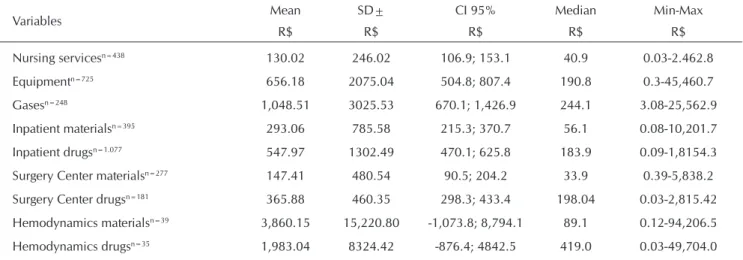
Based on the data showed in Table 2, drugs used in inpatient units (41.2%), equipment (28%) and nursing services (17%) are the items that were adjusted downwards (exclusions) the most.
The items with the greatest impact on downward adjust-ments were materials and medicines used in Hemodynamics Service and gases.
Table 1 - Distribution of the inclusion of component items of hospital bills audited by nurses from the SHU - SFH, São Paulo, 2011
Variables Mean SD± CI 95% Median Min-Max
R$ R$ R$ R$ R$
Nursing servicesn=2.175 275.63 491.66 249.8; 301.4 104.54 0.02-8,399.4
Equipmentn=1.888 689.42 1,145.2 619.5; 759.4 247.91 0.39-10,173.8
Gasesn=2.365 707.91 843.95 657.5; 778.3 403.20 0.06-11,565.5
Inpatient materialsn=2.218 224.68 1,307.61 163.4; 285.9 63.43 0.03-51,964.9
Inpatient drugsn=1.536 286.88 777.84 238.8; 334.9 90.72 0.01-13,882.6
Surgery Center materialsn=231 404.57 1,080.65 227.8; 581.3 121.36 0.12-10,560.6
Surgery Center drugsn=323 383.74 520.04 301.8; 465.7 297.12 0.30-4,634.2
Hemodynamics materialsn=786 1,055.90 3,953.45 6.91; 2.194.8 51 0.82-26,557.3
Hemodynamics drugsn=768 524.64 463.50 427.0; 622.3 370.17 4.0-1,900.0
Table 2 - Distribution of the exclusion of component items from hospital bills audited by nurses from the SHU - SFH, São Paulo, 2011
Variables Mean SD± CI 95% Median Min-Max
R$ R$ R$ R$ R$
Nursing servicesn=438 130.02 246.02 106.9; 153.1 40.9 0.03-2.462.8
Equipmentn=725 656.18 2075.04 504.8; 807.4 190.8 0.3-45,460.7
Gasesn=248 1,048.51 3025.53 670.1; 1,426.9 244.1 3.08-25,562.9
Inpatient materialsn=395 293.06 785.58 215.3; 370.7 56.1 0.08-10,201.7
Inpatient drugsn=1.077 547.97 1302.49 470.1; 625.8 183.9 0.09-1,8154.3
Surgery Center materialsn=277 147.41 480.54 90.5; 204.2 33.9 0.39-5,838.2
Surgery Center drugsn=181 365.88 460.35 298.3; 433.4 198.04 0.03-2,815.42
Hemodynamics materialsn=39 3,860.15 15,220.80 -1,073.8; 8,794.1 89.1 0.12-94,206.5
In relation to the impact of upward and downward adjust-ments, the billing of nurse auditors accounted for the inclu-sion of R$ 1,877,168.64 and excluinclu-sion of R$ 1,155,351.36, and of physician auditors for the inclusion of R$ 563,927.46 and exclusion of R$ 657,190.19.
A total of 2389 hospital bills (91.42%) were adjusted – 57.59% related to inclusions and 33.83% to exclusions of items. The variation in total upward adjustment was from R$ 0.40 to R$ 30,024.60; with a mean of R$ 1,340.75 (SD±2,502.93); and median of R$ 440.00. The total downward adjustment ranged from R$ 0.47 to R$ 133,906.00; with a mean of R$ 1,571.58 (SD±5,990.51) and median of R$ 329.17.
Medical disallowances ranged from R$ 0.02 to R$ 12,832.80, with a mean of R$ 311.94 (SD±646.86); median of R$ 173.50, and nursing disallowances were from R$ 0.36 to R$ 44,418.00, with a mean of R$ 255.84 (SD±1,636.76) and median of R$ 29.44.
Considering that disallowances occurred in items exam-ined by nurses or physicians, as well as in items analyzed by both, each disallowance corresponded, on average, to R$ 380.51 (SD±1533.05), with a median of R$ 117.07. Total disallowances amounted to R$ 527,013.43 (100%), of which R$ 275,282.52 (52.24%) corresponded to the pre-analysis of nurses and R$ 251,730.91 (47.76%) to that of physicians.
Table 3 shows that materials and drugs used in the inpa-tient unit as well as hemodynamics materials accounted for the highest disallowances in the nursing audit.
The items with the greatest impact on disallowances were equipment, followed by gases and inpatient drugs. In the bills au-dited by physicians it was not possible to differ disallowed items from those with greater financial impact since this entry was not contained in the specific electronic spreadsheet they used.
DISCUSSION
In this study, it was noted that bills were primarily from HPOs (91.7%) as opposed to private patients (8.3%). In 2006, 19.8% of the Brazilian population had healthcare plans, dis-tributed evenly throughout the regions of the country, with a
higher predominance in urban centers and states with greater income and more jobs, such as Vitória (67.6%), São Paulo (59.2%) and Rio de Janeiro (49%)(9).
Although the SFH works with 34 HPOs, the concentration of billing among only four of them stands out, which could have created financial dependence and affected income if proper payment had not been made. This underscores the need to spread hospital billing among various HPOs to ensure the economic viability of the institution.
Gases (90.5%), inpatient materials (85%) and nursing ser-vices (83.2%) were the hospital bill items analyzed by nurses that were adjusted upward the most. However, hemodynam-ics materials, gases and equipment had the largest financial impact on the inclusions.
Patients with heart and lung diseases may need oxygen, compressed air and nitric oxide, prescribed separately or in a combined manner, according to clinical and therapeutic in-dications. The consumption of these items is entered by the nursing staff on the medical record. In the bills analyzed, a constant inclusion of inpatient materials was noted. The con-sumption of these materials is supposed to be registered in a debit note by the nurse or nursing assistant, but documenta-tion does not occur properly. This may be due to the fact that most of the patients at the SFH come from the SUS, where strict documentation of materials to prove use is not required, in order to facilitate payment from financing sources.
There are still few studies that address the relationship be-tween adequate nursing documentation and hospital billing. A study(10) which estimated the billing generated by nursing
proce-dures in an ICU and calculated the percentage of billing gener-ated by nursing in relation to total billing of the unit showed that nursing professionals were responsible for 15.1% of total billing, of which 11.3% arises from nursing prescriptions.
In the upward adjustments (inclusions), hemodynamic ma-terials had the greatest financial impact due to their high cost. Patients hospitalized in the SFH generally use infusion pumps, heart monitors, oximeters and telemetry, among other equip-ment, which demands proper documentation in terms of pre-scription and nursing notes, but which often failed to occur. Table 3 - Distribution of the disallowances of component items from hospital bills audited by nurses - SFH, São Paulo, 2011
Variables Mean
R$
SD R$
CI 95% R$
Median R$
Min-Max R$
Nursing servicesn=133 50.23 112.65 30.9; 69.6 17.72 1.00-863.0
Equipmentn=98 392.75 1.019.36 188.4; 597.1 83.30 1.50-8,331.9
Gasesn=65 292.33 523.70 162.6; 422.1 84.48 5.70-3,329.5
Inpatient materialsn=541 42.52 192.95 26.2; 58.8 9.60 0.20-3,864.0
Inpatient drugsn=336 238.62 2.450.30 -24.3; 501.6 24.54 0.40-44,418.0
Surgery Center materialsn=225 47.25 132.67 29.8; 64.7 11.46 0.40-1,561.2
Surgery Center drugsn=87 200.28 377.43 119.8; 280.7 58.98 0.50-2,468.3
Hemodynamics materialsn=250 30.96 369.22 -15.0; 77.0 2.73 0.40-5,825.0
The rates of use of these equipment devices correspond to the amount charged for its use and depreciation. Their use is charged according to different set contracts: use per hour; per day or per period, such as up to four hours, in which case a medical prescription is not required. Therefore, as stated earlier, nursing documentation for hospital billing is clearly important.
Items that were adjusted downwards (exclusions) were in-patient drugs (41.2%), equipment (28%) and nursing services (17%). The items that had the greatest financial impact due to exclusions were materials and drugs for hemodynamics and gases. As previously mentioned, hemodynamics materials, such as catheters for pulmonary valvuloplasty, guidewire, tem-porary electrodes or diagnostic angiographic catheters, are ex-pensive. For example, balloon catheters used in angioplasty that were excluded from the hospital bill of a single patient, due to a mistaken entry, generated an impact of R$ 94,373.
Exclusions in reference to drugs used in the Hemodynamics Service occurred due to incorrect billing entries, such as the re-quest of a nurse auditor for the inclusion of 150 ml of sevoflurane (liquid inhalation anesthetic agent), but the Billing Department en-tered 150 bottles, thereby warranting an exclusion of R$ 49,704. Therefore, improper entries in patients’ bills were characterized as exclusions and did not cause loss of revenue in the SFH.
During pre-analysis of bills, it was noted that there is no uniformity in recording, particularly with respect to incom-plete nursing notes and debit notes filled in incorrectly. In the documentation routine of nursing professionals, this informa-tion is usually recorded at the end of each shift in an unreli-able way, which undermines the quality of the data.
The impact of these billing adjustments indicated that the audit team added R$ 628,554.55 that would have been lost had a pre-analysis not been performed.
Of the audited bills, 91.42% were adjusted upwards or downwards. The mean inclusions made by the audit team was R$ 1,340.75, whereas for exclusions it was R$ 1,571.58.
There were differences between items checked by nurse and physician auditors, both in terms of amounts and respec-tive values. The items under the responsibility of physicians had higher financial values, having been excluded more. However, it can be noted that the quantity of items included by nurses had a greater financial impact on hospital billing during the period in question.
Items that were disallowed on hospital bills after the audit were also taken into account in this study. However, while dis-allowances in the nursing audit were registered on the nurses’ spreadsheet in an overall manner, the physicians’ spreadsheet did not contain disallowances related to the items they au-dited, i.e., only the amounts corresponding to total ances were documented. Therefore, to calculate the disallow-ances for items audited by physicians (mean of R$ 311.94), the amounts referring to nursing disallowances were excluded from the total disallowance.
In the absence of documentation for disallowed items au-dited by physicians, an auditor (physician) from the SHU was consulted who, based on his experience in hospital bill audits, highlighted lack of records: of clinical changes on medical re-cords, especially by clinical physicians when the patient is in
the ICU and by critical care physicians not on duty; of clinical changes on inter-consultation medical records; of surgical de-scriptions of procedures performed at patients’ bedsides or in the ICU, such as insertion of catheters, cardioversions, drain-ages; of notes in the anesthetic file in Hemodynamics; of de-velopments by physician nutrition specialists; of requests and or justifications of diagnostic tests; of isolation prescription.
The most prevalent items in nursing disallowances (mean of R$ 255.84) were inpatient materials and drugs and hemo-dynamics materials, similar to the results obtained in another study(11) where 86% of the disallowed items corresponded to
materials and 11.6% to drugs. However, despite disallowed items being on the spreadsheet of nurse auditors, it was not possible to determine the materials and drugs that had a greater impact, since they were not specified. It is extremely important for SHU audit teams to document in detail the items disallowed by HPOs, in order to support the development of educational activities in the institution aimed at the proper recording of ac-tivities performed, by the entire health team, in patient care and establishing joint strategies to avoid impaired billing.
The items audited by nurses which had a greater financial impact were equipment (mean of R$ 392.75), gases (mean of R$ 292.33) and inpatient drugs (mean of R$ 238.62).
In a study conducted in 2011 by nurse auditors from the SHU, disallowances for equipment occurred due to lack of re-cords of use, especially infusion pumps. The gas with the most disallowances was oxygen, due to the absence of medical pre-scriptions and records related to the date and time treatment started and ended. This was likewise noted in another study which identified the determining factors and consequences of flaws registered in nursing care(12).
With regard to nursing records, besides being an important source of information for the audit process, their purpose is to establish communication between the nursing and multidis-ciplinary teams involved in the care of patients, as well as to provide continuity of care; assist in the preparation of the care plan; assess the quality of services provided; serve as a legal document for both the patient and the institution; and be a source of information for teaching and research(13).
It should be emphasized that, in addition to joint investments in educational programs, knowledge regarding the costs of ma-terials, equipment and procedures performed is essential for the nursing staff and can contribute to improve records of care pro-vided and decrease billing losses and disallowances(14).
CONCLUSION
The component items of hospital bills, checked by nurses, that were adjusted upwards (inclusions) the most, during pre-analysis, were gases (90.5%); inpatient materials (85%) and nursing services (83.2%).
The items with a greater financial impact on upward adjust-ments were hemodynamics materials with a mean of R$ 1,055.90 (SD±3,953.45), gases with a mean of R$ 707.91 (SD±843.95) and equipment with a mean of R$ 689.42 (SD±1,145.20).
of revenue to the SFH. The most excluded items were inpa-tient drugs (41.2%), equipment (28%) and nursing services (17%). Among them, those with the greatest financial impact were hemodynamics materials with a mean of R$ 3,860.15 (SD±15,220.80); drugs used in Hemodynamics Services with a mean of R$ 1,983.04 (SD±8,324.42) and gases with a mean of R$ 1,048.51 (SD±3,025.53).
If the audit team had not performed the pre-analysis, there would have been a loss of R$ 628,554.55 in hospital bill revenue.
On average, each disallowance of items analyzed by phy-sician or nurse auditors, as well as items examined by both, was R$ 380.51 (SD±1,533.05). Total disallowances were R$ 527,013.43 (100%), of which R$ 275,282.52 (52.24%) corre-sponded to the pre-analysis of the nurses and R$ 251,730.91 (47.76%) to that of the physicians.
This study may represent a possibility to enhance the knowledge of hospital bill audits in that it investigated the pre-analysis process performed by a team of auditors comprised of nurses and physicians.
REFERENCES
1. Paim CRP, Ciconelli RM. [Audit to assess the quality of he-alth care services]. Rev Adm Saúde. 2007 [cited 2014 Dec 10];9(36):85-91. Available from: http://www.institutocons-cienciago.com.br/blog/wp-content/uploads/2012/11/Tex to-Auditoria.pdf Portuguese.
2. Castilho V, Castro LC, Couto AT, Maia FOM, Sasaki NY, Nomura FH, et al. Survey of the major sources of waste in the health care units of a teaching hospital. Rev Esc Enferm USP [Internet]. 2011 [cited 2014 Dec 10];45(Spec No):1613-20. Available from: http://www.scielo.br/pdf/ reeusp/v45nspe/en_v45nspea12.pdf
3. Francisco MTR. Auditoria em enfermagem: padrões, critérios de avaliação e instrumentos. 3. ed. São Paulo: Cedas; 1993. 4. Rodrigues VA, Perroca MG, Jericó MC. [Hospital gloss: the
importance of nursing annotation]. Arq Ciênc Saúde [Inter-net]. 2004 Oct-Dec [cited 2014 Dec 10];11(4):210-4. Avail-able from: http://www.rdconsultoria.com.br/Downloads/Edu ca%C3%A7%C3%A3o%20Continuada/Administra%C3% A7%C3%A3o%20Hospitalar/Glosas%20Hospitalares.pdf Portuguese.
5. Silva MVS, Silva LMS, Dourado HHM, Nascimento AAM, Moreira TMM. [Limits and possibilities of the nursing au-ditory and its theoretical and practical aspects]. Rev Bras Enferm [Internet]. 2012 Jun [cited 2014 Dec 10];65(3):535-8. Available from: http://www.scielo.br/pdf/reben/v65n3/ v65n3a21.pdf Portuguese.
6. Scarparo AF, Ferraz CA, Chaves LDP, Rotta CSG. [Con-ceptual and methodological approach and the purpose of nursing audit]. Rev RENE [Internet]. 2009 [cited 2014 Dec 10]; 10(1):124-30. Available from: http://www.revista rene.ufc.br/revista/index.php/revista/article/view/452/pdf Portuguese.
7. Buzatti CV, Chianca TC. [Nursing audit: mistakes and charg-es involved in notcharg-es]. Nursing (São Paulo). 2005 [cited 2014 Dec 10];8(90):518-22. Available from: http://bases.bireme. br/cgi-bin/wxislind.exe/iah/online/?IsisScript=iah/iah.xis&s
rc=google&base=LILACS&lang=p&nextAction=lnk&exp rSearch=522500&indexSearch=ID Portuguese.
8. Yin RK. Estudo de caso, planejamento e métodos. 4. ed. São Paulo: Bookman; 2010.
9. Albuquerque C, Piovesan MF, Santos IS, Martins ACM, Fonseca AL, Sasson D, et al. [The current situation of the private health plans and insurance market in Brazil and trends for the future]. Cienc Saude Colet [Internet]. 2008 Oct [cited 2014 Dec 10];13(5):1421-30. Available from: http://www.scielo.br/pdf/csc/v13n5/08.pdf Portuguese. 10. Zunta, RSB, Castilho V. Faturamento de procedimentos
de enfermagem em uma Unidade de Terapia Intensiva. Rev Lat Am Enfermagem [Internet]. 2011 [cited 2014 Dec 10];19(3):573-80. Available from: http://www.scielo.br/ pdf/rlae/v19n3/pt_17.pdf
11. Lobbadia LL, Adami NP. [Evaluation of the quality of nurs-ing documentation though the review of patient medical records]. Acta Paul Enferm [Internet]. 2004 [cited 2014 Dec 10];17(1):55-62. Available from: http://www.scielo. br/pdf/ape/v22n3/en_a12v22n3.pdf Portuguese.
12. Souza V, Moura FL, Flores ML. [Causes and consequences factors of errors in nursing care: a education process]. Rev Min Enferm [Internet]. 2002 [cited 2014 Dec 10];6(1/2):30-4. Available from: http://www.reme.org.br/artigo/detalhes/ 794 Portuguese.
13. Mira VL, Minami LF, Ferrari CRS, Ortiz DCF, Follador NN. Anotação de Enfermagem. In: Cianciarullo TI, Gual-da DMR, Melleiro MM, Anabuki MH. Sistema de Assis-tência de Enfermagem (SAE): evolução e tendências. 5. ed. São Paulo: Ícone; 2012. p. 259-72.