in Midway Atoll could be combustion. The benzo[a]pyrene equivalent concentration (BaPeq) in most of the study area (86.5%) was less than 40mg kg21BaPeqand total incremental lifetime cancer risks of PAHs ranged from 1.00610210 to 9.2061026with a median value of 1.2461027, indicating a minor carcinogenic risk of PAHs in Midway Atoll.
Citation:Yang Y, Woodward LA, Li QX, Wang J (2014) Concentrations, Source and Risk Assessment of Polycyclic Aromatic Hydrocarbons in Soils from Midway Atoll, North Pacific Ocean. PLoS ONE 9(1): e86441. doi:10.1371/journal.pone.0086441
Editor:Jonathan H. Freedman, NIEHS/NIH, United States of America
ReceivedJune 28, 2013;AcceptedDecember 3, 2013;PublishedJanuary 23, 2014
Copyright:ß2014 Yang et al. This is an open-access article distributed under the terms of the Creative Commons Attribution License, which permits unrestricted use, distribution, and reproduction in any medium, provided the original author and source are credited.
Funding:This work was supported in part by The U.S. Fish and Wildlife Service (QXL), the National Institute on Minority Health and Health Disparities grant G12 MD007601 (QXL), and Open Funding Project of the Key Laboratory of Aquatic Botany and Watershed Ecology (JW). The funders had no role in study design, data collection and analysis, decision to publish, or preparation of the manuscript.
Competing Interests:The authors have declared that no competing interests exist.
* E-mail: [email protected] (QXL); [email protected] (JW)
Introduction
Polycyclic aromatic hydrocarbons (PAHs) are an important group of environmental pollutants. They are introduced into the environment from both natural (e.g., oil seeps, forest fires and volcanic activity) and anthropogenic sources (e.g., petrochemical industrial effluents, coal tar processing wastes, combustion processes) [1–3]. PAHs may accumulate in the organisms due to their low solubility and high octanol-water partition coefficient and undergo long-range transport [4–6]. Furthermore, PAHs present potential carcinogenic risks to residents [7]. Thus, 16 PAHs are selected as the priority pollutants due to their frequency and/or risk by the U.S. Environmental Protection Agency [8].
Soil is the primary steady reservoir and sinks for PAHs in the terrestrial environment, because PAHs are readily absorbed by organic matter in soil and difficult to degrade [9]. Furthermore, the accumulation of PAHs in soil may lead to contamination of food chains, which could cause a potential risk to human health [10,11]. Therefore, concentrations of PAHs in soil have been widely investigated in urban, rural, industrial and agricultural areas of mainland [1,12,13]. However, less data on concentrations of PAHs in soils of atolls and islands have been reported. Such data are required for understanding the potential risk to biota inhabiting the island and global distribution of PAHs.
Midway Atoll is located in the North Pacific Ocean, approx-imately 1100 miles northwest of Oahu, Hawaii. The atoll is comprised of two main islands, Sand and Eastern, and one smaller islet, enclosed within a reef approximately 8 km long. It is the home to a variety of seabirds, Hawaiian green sea turtles,
Hawaiian monk seals, and spinner dolphins. It played a historical role in World War II and was altered very heavily by the military during the war and afterwards. This study intends to be a comprehensive study on PAHs in soils of Midway Atoll. The main objectives were: (1) to determine concentrations and compositions of PAHs; (2) to elucidate potential sources by PAHs diagnostic ratio analysis; and (3) to evaluate the possible carcinogenic risk of PAHs in the soil of Midway Atoll.
Materials and Methods
Study Area and Sample Collection
225uC. All samples were collected under the permit of the U.S. Fish and Wildlife Service.
Sample Preparation, Extraction and Cleanup
To determine PAHs in soils, an amount of 5 g soil was extracted with a supercritical fluid extractor SFX 220 (Isco, Inc., Lincoln, NE) according to the procedure previously described [14]. The extract was dried with anhydrous sodium sulfate (3 g) and rinsed with hexane (3 ml). The concentrated extract in hexane was cleaned up through an 8 mm i.d. aluminum/silica column. The column was packed with neutral silica (4.0 g, 3% deactivated), neutral alumina (2.0 g, 6% deactivated) and anhydrous sodium sulfate (1 cm) from the bottom to the top [15]. The column was eluted with 20 ml of solvent mixture (methylene chloride/hexane 1:1) to yield a fraction containing PAHs. The samples were concentrated to 20mL under a gentle stream of high purity nitrogen.
Analysis of PAHs
The samples were analyzed on a Varian Saturn 2000 (Palo Alto, CA) gas chromatograph with mass spectrometric (ion trap) detection (GC/ITMS). The PAHs were separated by a capillary column DB-5MS (J and W Scientific Inc., 30 m, 0.25 mm i.d., 0.25mm film thickness). The oven temperature was started at
50uC for 3 min, increased to 200uC at a rate of 10uC min21, and
increased to 280uC at a rate of 5uC min21and held for 8 min. The
injector temperature was set at 280uC. Helium was used as the carrier gas at a constant flow rate of 1 ml min21
. External calibration was done for each PAH using a certified mixture to determine 16 US-EPA priority PAHs.
Quality Assurance and Quality Control (QA/QC)
Average PAH recoveries and relative standard deviation (RSDs) were first obtained to evaluate the method performance by multiple analyses of 10 soil samples spiked with PAH standard (Accustandard, New Haven, CT), which contained 16 priority PAHs. The 16 PAHs were naphthalene (Nap), acenaphthylene (Acy), acenaphthene (Ace), fluorene (Flr), phenanthrene (Phn), anthracene (Ant), fluoranthene (Fla), pyrene (Pyr), benz[a ]anthra-cene (BaA), chrysene (Chy), benzo[b]fluoranthene (BbF), benzo[k ]-fluoranthene (BkF), benzo[a]pyrene (BaP), dibenz[a,h]anthracene (DibA), benzo[ghi]perylene (BghiP) and indeno[1,2,3-cd]pyrene (InP). The spike level of each PAH was approximately 50–500mg kg21
. A solvent blank and matrix blank were analyzed through the entire procedure prior to and after every 10 samples. Standard solutions of PAHs were run at the beginning of sample analysis to determine the relative response factors and evaluate peak resolution. Each sample was analyzed in triplicate unless otherwise stated.
Limits of detection (LOD) were determined as signals 3 times the background signal. Peaks that were smaller than 3 times the signal-to-noise ratio were not considered. The LOD for PAHs ranged from 10 to 500 pg g21
. The average recoveries of PAHs were 85–115% for 10 soil samples varying with the physicochem-ical properties of individual PAH.
PAH Diagnostic Ratios Analysis
PAH diagnostic ratios have recently come into common use as a tool for identifying and assessing pollution sources. These ratios distinguish PAH pollution originating from petroleum products, petroleum combustion and biomass or coal burning, such as Ant/
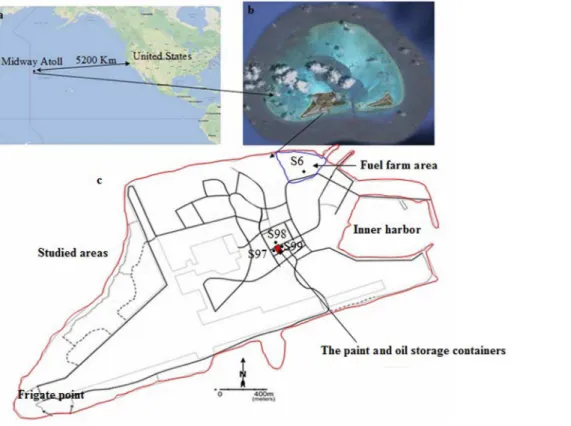
Figure 1. Locations of study area on Midway Atoll, the Pacific Ocean (a: The location of Midway Atoll in the Pacific Ocean; b: The Sand Island and Eastern Island of Midway Atoll; c: The main island of Midway Atoll (Sand Island) was the studied areas (Red line); Red area in the figure: The paint and oil storage containers; Blue line in the figure: Fuel farm area).
(Phn+Ant), Fla/(Pyr+Fla), InP/(InP+BghiP) [16,17]. The com-pounds involved in each ratio have the same molar mass, so it is assumed they have similar physicochemical properties. Based on the PAH isomer ratios in source identification compiled by Yunker et al [18], the Fla/(Fla+Pyr) ratio,0.4 indicates petroleum input
as a source; 0.4–0.5 indicates petroleum (liquid fossil fuel, vehicle and crude oil); and .0.5 indicates combustion of biomass and coal. In addition, an Ant/(Phe+Ant) ,0.1 implies a petroleum source,.0.1 implies combustion as a source [10,18].
Risk Assessment
Toxicity equivalent (TEQ) method was used to assess the ecotoxicological risk at a specific site. The total BaP equivalent concentration (BaPeq) was calculated by the sum of BaPeqfor each
PAH using toxicity equivalent factors [19].
About 20 people live on Midway Island, but they form a complete and mutually interdependent community. Therefore, the incremental lifetime cancer risk (ILCR) was employed to evaluate the potential risk of PAHs in soils of Midway Atoll for human health in this study. The ILCRs for adults in terms of direct ingestion, dermal contact, and inhalation were calculated using the following equations [5]:
ILCRSIngestion
~CS|(CSFIngestion|
ffiffiffiffiffiffiffiffiffiffiffiffiffiffiffiffiffiffiffi
(BW=70)
3
p
)|IRsoil|EF|ED
BW|AT|cf
ð1Þ
BbF 0.1 ND 339 20.5 2.26 89.2% HMW 1000
BkF 0.1 ND 150 8.68 1.11 85.6% HMW 1000
BaP 1.0 ND 197 13.6 3.20 92.8% HMW 1000
InP 0.1 ND 170 6.58 0.16 55.0% HMW 1000
DibA 1.0 ND 30.2 1.85 0.00 45.0% HMW 1000
BghiP 0.01 ND 169 6.59 1.23 65.7% HMW –
LMW PAHs 2.86 374 33.1 19.2
HMW PAHs ND 2830 165 21.1
gPAHs 3.55 3200 198 42.4
LMW/HMW 0.05 16.9 1.52 0.62
Total BaPeq ND 324 21.2 4.38
gBaPeqof 10 PAHs ND 262 17.2 3.79
LMW PAHs denote low molecular weight 2–3 ring PAHs; HMW PAHs denote high molecular weight 4–6 ring PAHs; TEF denotes toxic equivalency factor [33]; BaPeq denotes Bap equivalent concentration. ND: not detected.
Soil guidelines: guidelines for residential and parkland soil, NOAA-National Oceanic and Atmospheric Administration. gBaPeqof 10 PAHs: Nap, Phn, Ant, Fla, Chy, BaA, BaP, BkF, InP, BghiP.
doi:10.1371/journal.pone.0086441.t001
Figure 2. The logarithmic plot of LMW and HMW PAH concentrations of sampling sites on Midway Atoll.
ILCRSDermal
~CS|(CSFDermal|
ffiffiffiffiffiffiffiffiffiffiffiffiffiffiffiffiffiffiffi
(BW=70)
3
p
)|SA|AF|ABS|EF|ED
BW|AT|cf
ð2Þ
ILCRSInhalation
~CS|(CSFInhalation|
ffiffiffiffiffiffiffiffiffiffiffiffiffiffiffiffiffiffiffi
(BW=70)
3
p
)|IRair|EF|ED
BW|AT|PEF|cf
ð3Þ
where CS is the PAH concentration of soils (mg kg21), which was
obtained by converting concentrations of PAHs according to toxic equivalents of BaP using the toxic equivalency factor (TEF in Table 1) [20]. The carcinogenic slope factor (mg kg21day21)21 (CSF) was based on the cancer-causing ability of BaP: CSFingestion,
CSFDermal and CSFInhalation of BaP were 7.3, 25 and 3.85 (mg
kg21
day21
)21
, respectively [13]. BW is body weight (kg): 70 kg; AT is average life span (year): 70 years; EF is exposure frequency (days year21): 350 days year21; ED is the exposure duration (year): 30 years; IRsoilis the soil intake rate (kg day21): 0.0001 kg day21;
IRairis the inhalation rate (m 3
day21
): 20 m3day21
; SA is the dermal surface exposure (cm2day21
): 5000 cm2day21
; cf is the conversion factor: 106; AF is the dermal adherence factor (kg cm22): 0.00001 kg cm22; ABS is the dermal adsorption fraction (unitless): 0.1; and PEF is the soil dust produce factor (m3kg21): 1.326109m3kg21[5,8]. The total risks were the sum of risks of ILCRs in terms of direct ingestion, dermal contact, and inhalation.
Results and Discussion
PAH Profiles in Soils of Midway Atoll
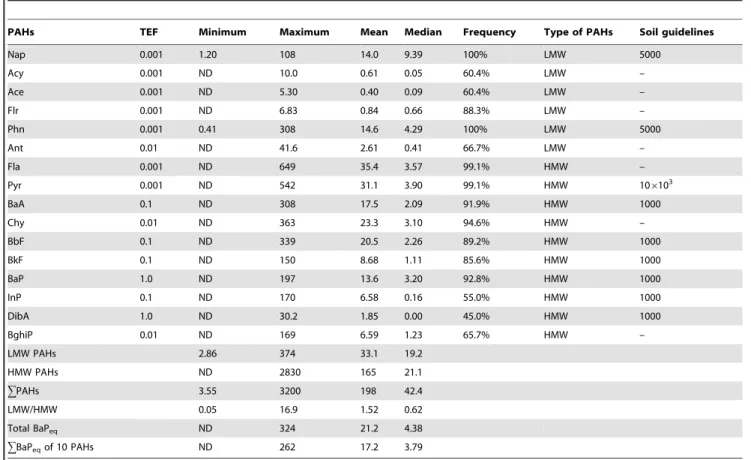
Table 1 shows the descriptive statistics for concentrations of PAHs in soils from Midway Atoll. The overall concentration of 16 US EPA priority PAHs in surface soils ranged from 3.55 to 3200mg kg21dry weight with a mean concentration of 198mg kg21. The detection frequencies of Nap and Phn were the highest (100%), followed by Fla (99.1%) and Pyr (99.1%). The detection frequency of DibA was the lowest among the 16 PAHs at a detection rate of 45.0%. The concentrations of lower molecular weight PAHs (LMW, i.e., 2–3 ring PAHs) in soils ranged from 2.86 to 374mg kg21with a mean concentration of 33.1mg kg21. The
concentrations of higher molecular weight PAHs (HMW, 4–6 ring PAHs) in soils ranged from ND (not detected) to 2830mg kg21
with a mean concentration of 165mg kg21
. Most of the sampling sites (107 sites) had concentrations of LMW PAHs of ,150mg kg21and HMW PAHs of,1000mg kg21(Fig. 2). Only 4 sites (S6, S97, S98 and S99) had concentrations of LMW PAHs of.150mg
kg21
and HMW PAHs of.1500mg kg21. The high total PAH
concentrations (S97, S98 and S99) were observed around the paint and oil storage on Midway Atoll. Site S6 having high total PAH concentrations located in fuel farm area (Fig. 1). Most of total PAH concentrations were distributed in the low concentration range with 50% of the samples showed concentrations less than 42.4mg
kg21
(Median values in Table 1). The concentrations of individual PAH also showed a similar statistical characteristic for distribution, i.e., the median values were less than the average values. Compared with the established soil quality guidelines those from the National Oceanography and Atmospheric Administration (NOAA), concentrations of individual PAHs in soils of Midway Atoll were less than the guideline values (Table 1).
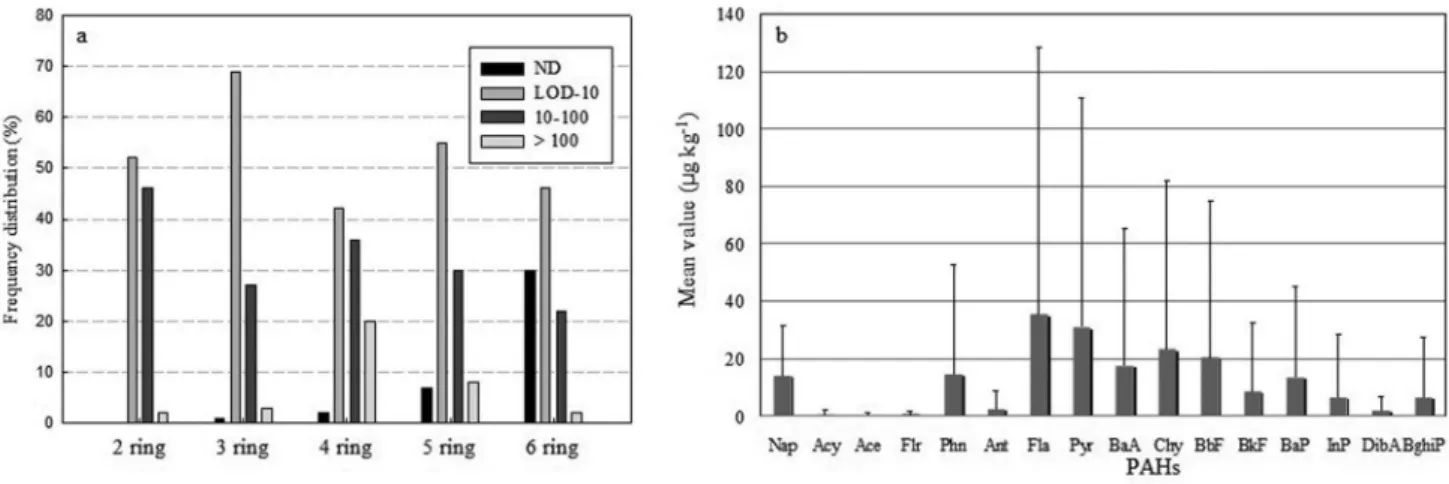
Fig. 3a shows frequency distribution for the concentration of different PAHs analogs in all soil samples from Midway Atoll, indicating that most of soil samples had levels of different PAH analogs ranging from LOD to 10mg kg21. A two-ring PAH (Nap) was detected in all soil samples. The frequency distribution of three-rings PAHs in the range of LOD-10mg kg21even reached
69%. It was notable that six-ring PAHs was not detected in 30% of the samples. However, 20% of the samples had levels of four-ring PAHs more than 100mg kg21. Fig. 3b shows that Fla, Pyr, Chy and BbF were found to be the main soil pollutants in Midway Atoll with mean value more than 20mg kg21, which were four-ring
PAHs except BbF.
Soils and sediments were considered as the primary steady sinks for PAHs in the environment. Table 2 summarizes PAHs concentrations (mg kg21 dry weight) in soils/sediments from islands and bays. Low contents of PAHs were found on the islands which were less disturbed by human activities, such as James Ross Island in Antarctica [21] and Admiralty Bay in King George Island [22]. LMW PAHs had a high prevalence in James Ross Island, indicating long-range atmospheric transport was the main source for PAHs contamination [21]. High content of PAHs were found in sediments and/or soils of the densely populated areas of islands, such as Coastal areas in the Shetland and Orkney Islands [23] and Island of Bermuda [24]. In this study, the concentrations of PAHs in Midway Atoll soils were found to be higher than those
Figure 3. The frequency distribution of different ring PAHs (a) and mean concentrations of individual PAHs (b) on Midway Atoll.
of James Ross Island, but lower than those of densely populated Bermuda. Midway Atoll had been used as military bases. Human activities in Midway Atoll may play an important role in PAHs contamination. Through the Baseline Realignment and Closure process, the US Navy undertook a cleanup operation to remove many environmental contaminants that resulted from 90 years of military operations [25]. Contaminants included polychlorinated biphenyls (PCBs), PAHs, petroleum hydrocarbons, asbestos, pesticides such as dichlorodiphenyltrichloroethane (DDT) and dichlorodiphenyldichloroethylene (DDE), and numerous metals. The results of this study suggest that several areas require continued monitoring for possible further remediation, such as S6, S97, S98 and S99.
Potential Source of PAHs in Midway Atoll
The concentrations and patterns of PAHs in soils could reflect the source characteristics [26]. The ratios of LMW/HMW higher
than 1 indicated the contaminations were mainly due to the petrogenic sources (hydrocarbon compounds associated with petroleum). On the other hand, the pyrogenic PAHs (hydrocarbon compounds associated with the combustion of petroleum, wood and coal) often showed to be at a LMW/HMW ratio less than 1.0 [27]. The LMW/HMW ratios in Midway Atoll soils ranged from 0.05 to 16.9 with a mean value 1.52. Among all 111 samples, 44 sites had a ratio greater than 1, indicating existence of petrogenic sources of PAHs (Fig. 2). Furthermore, recent pollution of petrogenic PAHs could occur at these 44 sites of predominance of low ring PAHs, because LMW PAHs were more biodegradable and less lipophilic than HMW PAHs. Similar results were also found for the PAHs in soils from Beijing, Tianjin and surrounding areas, North China [28]. Pyrogenic PAHs may be the main source at the other 67 sites with a ratio of LMW/HMW less than 1, such as S6, S97, S98 and S99 (Fig. 2).
**No detail information.
doi:10.1371/journal.pone.0086441.t002
Figure 4. Cross plots for the ratios of Fla/(Pyr+Fla) and Ant/(Phn+Ant) (Fla: fluoranthene; Pyr: pyrene; Ant: anthracene; Phn:phenanthrene).
In the present study, the values of Fla/(Pyr+Fla) ranged from 0.40 to 0.64 and the values of Ant/(Phn+Ant) were between 0.0 to 0.54. Fig. 4 shows the cross plot of Fla/(Pyr+Fla) and Ant/ (Phn+Ant), indicating that the sources of PAHs in soils could be classified into four distinct groups. About 15% and 45% of the sampling sites exhibited the typical characteristics of petroleum (liquid fossil fuel, vehicle and crude oil) combustion (Fig. 4D) and the signature of biomass and coal combustion (Fig. 4B), respec-tively. The remaining sites showed the signature of a mixture containinng petroleum and combustion (Fig. 4A and 4C). Hence, the primary source of PAHs in Midway Atoll could be considered as combustion. Midway Atoll is still an important military site and more than 90 years of military activities occurred on this island. The PAH sources of 55% of the sampling sites (Fig. 4A, 4C and 4D ) were related with petroleum, indicating petroleum played an important role for energy and military activities in this island. This result was different from James Ross Island, which was in Antarctic Peninsula and far from human activities. The LMW PAHs dominated the PAH contamination in James Ross Island, indicating the long-range atmospheric transport was the primary source [21].
Risk Assessment of PAHs in Midway Atoll
Toxicity equivalent (TEQ) method was used to assess the ecotoxicological risk at a specific site. BaPeqwas calculated by the
sum of BaPeqfor each PAH using toxicity equivalent factors [19].
In the present study, the total BaPeqof 16 PAHs in soil samples
were in the range of ND-324mg kg–1BaPeqwith a mean value of
21.2mg kg–1BaPeq(Table 1). An half of all samples showed total
BaPeqconcentrations less than 4.38mg kg–1BaPeqand 86.5% of
the samples had an exposure risk of less than 40mg kg–1 BaPeq.
According to the Canadian soil quality guidelines, soils containing
,0.1 mg kg–1BaP are considered uncontaminated, soils contain-ing 0.1–1.0 mg kg–1BaP are considered slightly contaminated and
soils containing 1–10 mg kg–1 BaP are considered to be significantly contaminated [29]. In the present study, 95.5% of sample sites contained less than 0.1 mg kg–1BaPeqand only 5 sites
had concentrations in the range 0.1–0.4 mg kg–1BaPeq, indicating
most of soils in Midway Atoll could be considered uncontaminat-ed. The Dutch standards are environmental pollutant reference values (i.e., concentrations in an environmental medium) used in environmental remediation, investigation and cleanup. The target values for the various substances are related to a national background concentration that was determined for the Nether-lands [30]. The total BaPeq concentrations of 10 PAHs of the
Dutch standards(i.e., Dutch target value) were in the range of ND-262mg kg–1BaPeq. Approximately one tenth of the sampling sites
(11.3%) had values higher than the reference value 32.96mg kg–1 BaPeq[31,32], indicating that 13 sampling soils of Midway Atoll
had potential risk to human health.
Incremental lifetime cancer risk is a carcinogenic risk used to evaluate the human health risk. Generally, an ILCR between 1026
and 1024
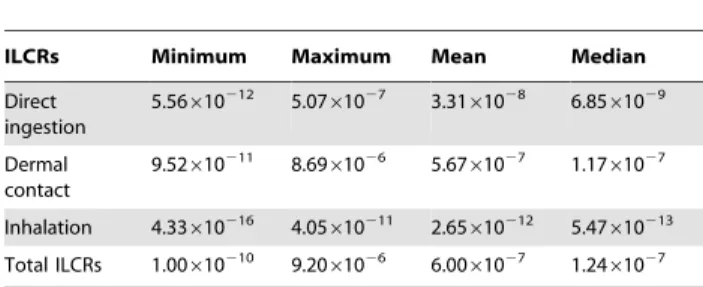
indicates a potential risk [8]. Table 3 shows the ILCRs levels calculated in the Midway Atoll soils, indicating a low human health risk from the exposure of direct ingestion and inhalation. The ILCRs values of dermal contact with soils ranged from 9.52610211
to 8.6961026
with a mean value of 5.6761027
and 13.5% of the sampling sites exhibited ILCRs values of dermal contact exceeding 1026
, indicating a low potential carcinogenic risk via dermal contact at 15 sampling sites in Midway Atoll. The highest values of ILCRs was found in site S97, followed by S99, S98 and S6. This was accord with that highest concentrations of PAHs were found at these sites. Most of the total ILCRs were distributed in the low range and 86.5% of the samples showed the values less than 1.061026, indicating a negligible carcinogenic risk of PAHs in Midway Atoll.
Conclusion
PAHs are widely distributed in the soils collected from Midway Atoll, in which HMW PAH concentrations ranged from ND to 2830mg kg–1 with a mean concentration of 165mg kg–1,
accounting for 83.3% of the total PAH mass. The main PAH pollutants in Midway Atoll were found to be fluoranthene, pyrene, chrysene, benzo[b]fluoranthene and benzo[a]anthracene. Com-bustion of coal, petroleum and biomass was potentially the main source for PAH contamination in Midway Atoll. Majority of the sampling sites (95.5%) exhibited PAH concentrations less than 0.1 mg kg–1BaPeq, which could be considered uncontaminated.
The ILCRs of PAHs showed that PAH concentrations in most of the sampling areas in Midway Atoll are likely harmless to human health. However, the soil sites that contain an exhibiting carcinogenic risk still need management strategies.
Author Contributions
Conceived and designed the experiments: LAW JW QXL. Performed the experiments: YY LAW JW. Analyzed the data: JW. Contributed reagents/ materials/analysis tools: LAW JW QXL. Wrote the paper: YY JW QXL.
References
1. Masih A, Taneja A (2006) Polycyclic aromatic hydrocarbons (PAHs) concentrations and related carcinogenic potencies in soil at a semi-arid region of India. Chemosphere 65: 449–456.
2. Nam JJ, Song BH, Eom KC, Lee SH, Smith A (2003) Distribution of polycyclic aromatic hydrocarbons in agricultural soils in South Korea. Chemosphere 50: 1281–1289.
3. Seo JS, Keum YS, Harada RM, Li QX (2007) Isolation and characterization of bacteria capable of degrading polycyclic aromatic hydrocarbons (PAHs) and organophosphorus pesticides from PAH-contaminated soil in Hilo, Hawaii. Journal of Agricultural and Food Chemistry 55: 5383–5389.
4. Inomata Y, Kajino M, Sato K, Ohara T, Kurokawa JI, et al. (2012) Emission and Atmospheric Transport of Particulate PAHs in Northeast Asia. Environ-mental Science and Technology 46: 4941–4949.
5. Peng C, Chen WP, Liao XL, Wang ME, Ouyang ZY, et al. (2011) Polycyclic aromatic hydrocarbons in urban soils of Beijing: Status, sources, distribution and potential risk. Environmental Pollution 159: 802–808.
6. Zhao Z-Y, Chu Y-l, Gu J-D (2012) Distribution and sources of polycyclic aromatic hydrocarbons in sediments of the Mai Po Inner Deep Bay Ramsar Site in Hong Kong. Ecotoxicology 21: 1743–1752.
7. Olsson AC, Fevotte J, Fletcher T, Cassidy A, ‘t Mannetje A, et al. (2010) Occupational exposure to polycyclic aromatic hydrocarbons and lung cancer
Table 3.Descriptive statistics of data on incremental lifetime cancer risks (ILCRs) in soils from Midway Atoll.
ILCRs Minimum Maximum Mean Median
Direct ingestion
5.56610212 5.07
61027 3.31
61028 6.85 61029
Dermal contact
9.52610211 8.6961026 5.6761027 1.1761027
Inhalation 4.33610216 4.05610211 2.65610212 5.47610213
Total ILCRs 1.00610210 9.2061026 6.0061027 1.2461027
polychlorinated biphenyls in marine species from French Frigate Shoals, North Pacific Ocean. Science of the Total Environment 257: 17–28.
15. Wang J, Caccamise SAL, Wu LJ, Woodward LA, Li QX (2011) Spatial distribution of organochlorine contaminants in soil, sediment, and fish in Bikini and Enewetak Atolls of the Marshall Islands, Pacific Ocean. Chemosphere 84: 1002–1008.
16. Tobiszewski M, Namies´nik J (2012) PAH diagnostic ratios for the identification of pollution emission sources. Environmental Pollution 162: 110–119. 17. Zhang XL, Tao S, Liu WX, Yang Y, Zuo Q, et al. (2005) Source Diagnostics of
Polycyclic Aromatic Hydrocarbons Based on Species Ratios: A Multimedia Approach. Environmental Science and Technology 39: 9109–9114. 18. Yunker MB, Macdonald RW, Vingarzan R, Mitchell RH, Goyette D, et al.
(2002) PAHs in the Fraser River basin: a critical appraisal of PAH ratios as indicators of PAH source and composition. Organic Geochemistry 33: 489–515. 19. Wickramasinghe AP, Karunaratne DGGP, Sivakanesan R (2012) PM10-bound polycyclic aromatic hydrocarbons: Biological indicators, lung cancer risk of realistic receptors and ‘source-exposure-effect relationship’ under different source scenarios. Chemosphere 87: 1381–1387.
20. Liao CM, Chiang KC (2006) Probabilistic risk assessment for personal exposure to carcinogenic polycyclic aromatic hydrocarbons in Taiwanese temples. Chemosphere 63: 1610–1619.
21. Kla´nova´ J, Matykiewiczova´ N, Ma´cˇka Z, Prosˇek P, La´ska K, et al. (2008) Persistent organic pollutants in soils and sediments from James Ross Island, Antarctica. Environmental Pollution 152: 416–423.
28. Wang WT, Simonich SLM, Xue MA, Zhao JY, Zhang N, et al. (2010) Concentrations, sources and spatial distribution of polycyclic aromatic hydrocarbons in soils from Beijing, Tianjin and surrounding areas, North China. Environmental Pollution 158: 1245–1251.
29. CCME (2008) (Canadian Council of Ministers of the Environment) Guidelines for Carcinogenic and Other Polycyclic Aromatic Hydrocarbons (Environmental and Human Health Effects). Scientific Supporting Document. pp. 218. 30. Friday GP (1999) Ecological Screening Values for Surface Water, Sediment, and
Soil. WSRC-TR-98–00110; United States WSRC-TR-98–00110; United States. 31. Crnkovic D, Ristic M, Jovanovic A, Antonovic D (2007) Levels of PAHs in the soils of Belgrade and its environs. Environmental Monitoring and Assessment 125: 75–83.
32. Van Brummelen TC, Verweij RA, Wedzinga SA, Van Gestel CAM (1996) Enrichment of polycyclic aromatic hydrocarbons in forest soils near a blast furnace plant. Chemosphere 32: 293–314.
33. Nisbet ICT, Lagoy PK (1992) Toxic Equivalency Factors (Tefs) for Polycyclic Aromatic-Hydrocarbons (Pahs). Regulatory Toxicology and Pharmacology 16: 290–300.
34. Lodygin ED, Chukov SN, Beznosikov VA, Gabov DN (2008) Polycyclic aromatic hydrocarbons in soils of Vasilievsky Island (St. Petersburg). Eurasian Soil Science 41: 1321–1326.