276
Rev Bras Enferm [Internet]. 2016 mar-apr;69(2):276-84. http://dx.doi.org/10.1590/0034-7167.2016690213iSocial network of adolescents under probation
from the perspective of public health
Rede social de adolescentes em liberdade assistida na perspectiva da saúde pública
Red social de adolescentes en libertad condicional en la perspectiva de la salud pública
Marilene Rivany Nunes
I, Maria das Graças Carvalho Ferriani
I, Deborah Carvalho Malta
II,
Wanderlei Abadio de Oliveira
I, Marta Angélica Iossi Silva
II Universidade de São Paulo, Ribeirão Preto College of Nursing,
Postgraduate Program in Public Health Nursing. Ribeirão Preto, São Paulo, Brazil.
II Universidade Federal de Minas Gerais, College of Nursing,
Department of Mother-Child and Public Health Nursing. Belo Horizonte, Minas Gerais, Brazil.
How to quote this article:
Nunes MR, Ferriani MGC, Malta DC, Oliveira WA, Silva MAI. Social network of adolescents under probation from the perspective of public health. Rev Bras Enferm [Internet]. 2016;69(2):276-84. DOI: http://dx.doi.org/10.1590/0034-7167.2016690213i
Submission: 04-06-2015 Approval: 09-07-2015
ABSTRACT
Objective: to analyze the meaning of the social networks of adolescents who are under probation and to identify the essential components of these networks. Method: an exploratory study with a qualitative approach. Twenty-six teenagers, aged 13 to 18, participated in the study. For data gathering, the authors chose semi-structured interviews and network maps. Results: it became evident that social networks are essential for adolescents, with the family in a central position – especially the mothers – as well as the Centro de Referência Especializadode Assistência Social (Center for Specialized Reference of Social Assistance – CREAS) for social promotion and construction of new life projects, away from juvenile offending. However, adolescents reported no ties to health workers. Conclusion: the authors observed the need for nurses, as workers in primary health care, to practice in a way that is intersectoral and interdisciplinary, with the aim of strengthening the social networks of adolescents at confl ict with the law. Key words: Vulnerable Populations; Adolescent Behavior; Adolescent Health; Social Support; Nursing.
RESUMO
Objetivo: analisar o sentido da rede social de adolescentes que cumprem Liberdade Assistida e identifi car os componentes essenciais dessa rede. Método: estudo exploratório, de abordagem qualitativa. Participaram do estudo 26 adolescentes com idade de 13 a 18 anos. Para a coleta dos dados, optou-se por entrevista semiestruturada e construção de mapas de rede. Resultados: evidenciou-se a essencialidade da rede social para os adolescentes, destacando-se a importância da família – especialmente a mãe –, e do Centro de Referência Especializado de Assistência Social, para promoção social e construção de um novo projeto de vida, sem envolvimento com atos infracionais. Todavia, os adolescentes não revelaram vínculos com profi ssionais de saúde. Conclusão: observou-se a necessidade do enfermeiro, enquanto profi ssional da atenção primária à saúde, atuar de forma intersetorial e interdisciplinar, no sentido de fortalecer a rede social de adolescentes em confl ito com a lei. Descritores: Populações Vulneráveis; Comportamento do Adolescente; Saúde do Adolescente; Apoio Social; Enfermagem.
RESUMEN
CORRESPONDING AUTHOR Marilene Rivany Nunes E-mail: [email protected]
INTRODUCTION
According to the Statute of the Child and Adolescent (Esta-tuto da Criança e Adolescente – ECA), adolescence is a phase of human development ranging from 12 to 18 years. Studies(1-2)
show that this phase is marked by socially conflicting behav-iors, which leads some researchers(3-4) to defend the need for
a protection network for adolescents, composed of a variety of agents. This network must promote their social rights and conditions for handling and overcoming daily difficulties, thus avoiding situations that may lead to offending acts.
A report published by the Fundo das United Nations Chil-dren’s Fund (UNICEF)(5) shows that adolescents involved in
of-fending acts generally come from low-income families, with low access to essential public policies such as education and healthcare and, additionally, are often involved in drug use. Thus, the authors notice the lack of a support network capable of amplifying protective factors for these individuals.
However, when adolescents are involved in offending acts, they are liable to undergo social-educational measures, which have the aim of resocializing them and engaging them so-cially. Thus, the social-educational measure called probation has been applied to those who commit offending acts as a measure for social protection and guarantee of rights(6). This
measure is carried out by Centers of Specialized Reference of Social Assistance (Centros de Referência Especializada da As-sistência Social – CREAS).
Basically, probation is a process of monitoring, by a coun-selor, of adolescents at conflict with the law, lasting at least six months. Counselors supervise their social promotion, offer-ing them a real chance for change through education, profes-sional training, and hope for a new life project and, as conse-quence, for a better future, away from new offenses(7). To that
end, these measures prioritize daily routines with families, communities, schools, and health services. Probation is moni-tored by high-level technical workers, such as psychologists, pedagogues, lawyers, and social workers.
The authors’ observe that these measures are based on the logic of comprehensive care for adolescents, because proba-tion considers their responsibility in the offending act and so-cial integration based on the construction of Individual Plans (IP) for intersectoral attention. In healthcare, for example, there must be an IP for assisting adolescents under probation. At the level of primary attention, the tool Projeto Terapêutico Singu-lar (SinguSingu-lar Therapeutic Project) has the aim of providing ac-tions based on the perspectives and needs of adolescents and the construction of life projects that go beyond addressing the
offending act. In primary healthcare, the use of light technol-ogy(8) favors the empowerment of families so that they can
sup-port the process of social reinsertion, offering community and emotional support, which prevents crime and delinquency and promotes health and the development of both individual adolescents and groups(9).
Therefore, studies that investigate how the social networks of adolescents under probation are created and how they can be essential for preventing offending acts and promoting so-cial engagement are important for understanding protective factors. These studies should have the aim of creating a pool of scientific knowledge so that actions in different areas, such as public health, from the perspective of intersectoriality and integrality, are put into practice concerning the strengthening of the social networks of these adolescents(4,10-11).
In this sense, the authors presuppose that a social network with strong ties enables the regulation of offending behavior in adolescents under probation, offering social promotion and possibilities for a healthy and responsible life, away from crime.
Therefore, the aim of this investigation was to analyze the meaning of the social networks of adolescents that are under social-educational probation measures in the city of Patos de Minas, state of Minas Gerais, and to identify essential com-ponents for this network. The relevance of this study is in the problematization of how these social networks can contribute to the social engagement and health of these adolescents un-der probation, based on evidence. This is to favor the con-struction – in healthcare in general, but especially in nursing – of a practice that is egalitarian and dedicated to the defense of the individual and collective lives of adolescents under probation.
METHOD
The authors conducted an exploratory, descriptive study with a qualitative approach. Twenty-six adolescents aged be-tween 13 and 18 took part in the research. They underwent social-educational measures of probation at CREAS in Patos de Minas. Inclusion criteria were: age between 12 and 18 and undergoing social-educational measures of probation in 2012, independently of how much they had already completed.
The study was carried out in the first semester of 2014. Initially, the authors conducted a meeting with workers from CREAS to present the research and its aims. Then, the authors identified possible candidates who met the inclusion criteria. Considering the need for more closeness and ties between de Referencia Especializado de Asistencia Social, para promoción social y construcción de un nuevo proyecto de vida, sin participación en actos delictivos. Sin embargo, los adolescentes no expresaron vínculos con profesionales de salud. Conclusión: se observó necesidad de los enfermeros, como profesionales de atención primaria de salud, de actuar de manera intersectorial e interdisciplinaria, con el objeto de fortalecer la red social de adolescentes en conflicto con la ley.
278
Rev Bras Enferm [Internet]. 2016 mar-apr;69(2):276-84.researcher and participants, the authors periodically visited CREAS and participated in its activities.
The authors then asked those adolescents over the age of 18 for consent through a free and informed consent form (FICF). For those under the age of 18, the authors asked for agreement and the consent of their parents or legal counselors through the terms of the Agreement and a FICF, respectively.
Following this, the authors scheduled interviews accord-ing to their availability. The interviews were conducted by the researcher in a private room at CREAS. In order to participate in the study, each adolescent chose a fictional name. This was done to ensure their anonymity. Some of the names were Friendship (Adolescent 1), Adventure (Adolescent 2), and White (Adolescent 3).
The authors adopted two techniques to gather data: per-sonal network mapping and semi-structured interviews. Per-sonal network mapping, adapted from Sluzki(12), was used with the adolescents in order to learn about their social net-works. This graphical representation is comprised of three concentric circles, divided into four parts, which refer to family, friendships, work and school relations, as well as re-lations with the community and health services, and social agencies. On the map, the core of the circle represents the subject, and the first circle is smaller, representing intimate relationships of closeness; the second circle, social relations with less closeness; and the third circle refers to relations with acquaintances(12).
The authors used various line designs for better identifica-tion of the meaning of ties: 1) continuous line – meaningful ties, such as trustful relationships, friendships, solidarity, reci-procity and intimacy; 2) intermittent line – fragile ties, with ten-uous relations; and 3) broken line – severed or nonexistent ties. For network mapping, the authors offered the subjects pen-cils and a printed copy of the instrument, so that they could record the names of individuals and institutions in each di-mension. This procedure, along with the interview, lasted for 30 minutes on average. The authors used the social network map to generate an infographic image that provided access to the list of individuals and institutions with which these adoles-cents had relationships. It was possible to identify protective factors in the resulting illustrations.
After completing the social network maps, authors con-ducted the interviews with the aim of learning about the ado-lescents’ social and demographic profile, in addition to the meanings they attributed to their social networks. Interviews were recorded in audio and transcribed later.
Individual interviews and network mapping were carried out when the adolescents were at CREAS to receive assistance in order to avoid disrupting or disturbing the team’s technical attention.
The authors used the interpretation of meanings(13)
tech-nique for data analysis, following the steps: a) comprehensive and profound reading, seeking to understand the speeches and the apprehension of particularities of the gathered materi-al; b) identification and problematization of ideas explicit and implicit in the data; c) identification and thematic definition of the speeches of adolescents under probation; d) search for
broader meanings (social-cultural) that articulate the speeches of the adolescents and signs of their social networks; e) dialog between attributed meanings, information from other studies addressing the theme, and the theoretical references of the study; and f) creation of an interpretative synthesis, relating the aim of the study to its theoretical bases and empirical data.
The maps were also assessed according to Sluzki’s proposi-tions(12). Thus, the networks could be assessed in the
dimen-sion of its structural characteristics, the functions of ties, and the attributes of each tie(12).
Results obtained from maps and those categorized by terviews were analyzed together in order to establish an in-terpretative synthesis, seeking to relate the described and ana-lyzed themes according to the aims and presuppositions of the study.
The research followed the recommendations and guidelines of Resolution 466/2012 of the National Council of Health and was approved by the Human Research Ethics Committee of the Ribeirão Preto College of Nursing (EERP/USP), according to resolution Nº 163/2013.
RESULTS
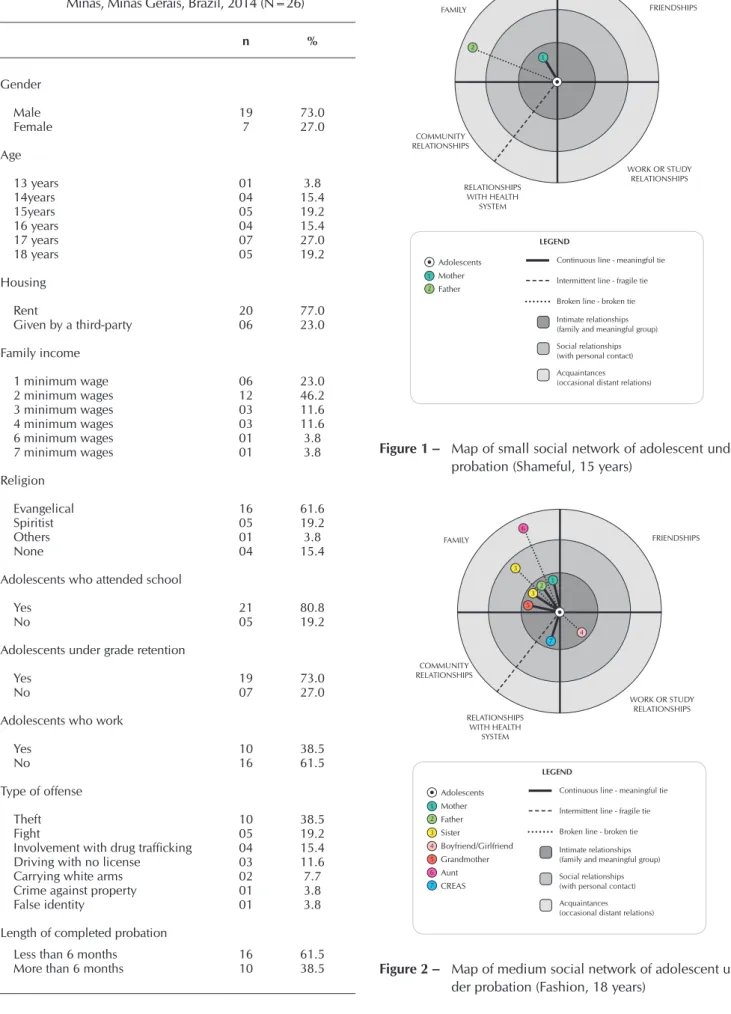
Data showed that the sociodemographic profile of the ado-lescents was mostly male, aged between 15 and 18, with a history of grade retentions, and with theft as the predominant infraction (Table 1).
For 17 adolescents, network size was significantly small (composed of fewer than seven individuals). Five adolescents reported average networks (between eight to 10 individuals) and four reported large networks (more than 10 individuals). In general, the composition of the networks of the 26 adoles-cents showed a marked presence of family members, CREAS, and friends, while school and work had low presence, as shown in Figures 1, 2, and 3. Community and health services were not part of their social maps.
Figures 1, 2, and 3 illustrate these analyzed dimensions and show other assessed elements, as follows.
Analysis of relationships with higher intimacy showed the maternal figure as the most frequently mentioned, followed by siblings, friends, CREAS, psychologists, and fathers. The fragile ties of seven adolescents, broken ties of two, and non-existent ties of eight to their fathers stood out. Density analysis – which measures the intensity of ties among members of a network – shows the presence of meaningful ties, especially with the maternal figure, with psychologists, siblings, and the CREAS institution following. These ties have the function of offering material assistance and services, cognitive guidance and counseling, emotional support, and regulation and social control. Although friends establish fragile ties to the adoles-cents, they show up as performing roles of social companion-ship and emotional support. Ties to school and work present low support.
Table 1 – Profile of adolescents under probation, Patos de Minas, Minas Gerais, Brazil, 2014 (N=26)
n % Gender Male Female 19 7 73.0 27.0 Age 13 years 14years 15years 16 years 17 years 18 years 01 04 05 04 07 05 3.8 15.4 19.2 15.4 27.0 19.2 Housing Rent
Given by a third-party
20 06
77.0 23.0
Family income
1 minimum wage 2 minimum wages 3 minimum wages 4 minimum wages 6 minimum wages 7 minimum wages
06 12 03 03 01 01 23.0 46.2 11.6 11.6 3.8 3.8 Religion Evangelical Spiritist Others None 16 05 01 04 61.6 19.2 3.8 15.4
Adolescents who attended school
Yes No 21 05 80.8 19.2
Adolescents under grade retention
Yes No 19 07 73.0 27.0
Adolescents who work
Yes No 10 16 38.5 61.5
Type of offense
Theft Fight
Involvement with drug trafficking Driving with no license
Carrying white arms Crime against property False identity 10 05 04 03 02 01 01 38.5 19.2 15.4 11.6 7.7 3.8 3.8
Length of completed probation Less than 6 months More than 6 months
16 10
61.5 38.5
Figure 1 – Map of small social network of adolescent under probation (Shameful, 15 years)
Figure 2 – Map of medium social network of adolescent un-der probation (Fashion, 18 years)
2 1
FAMILY FRIENDSHIPS
WORK OR STUDY RELATIONSHIPS COMMUNITY RELATIONSHIPS RELATIONSHIPS WITH HEALTH SYSTEM Adolescents Mother Father
Continuous line - meaningful tie
lntermittent line - fragile tie
Broken line - broken tie
Intimate relationships (family and meaningful group)
Social relationships (with personal contact)
Acquaintances (occasional distant relations) LEGEND 2 1 2 3 4 5 6 7 1 FAMILY FRIENDSHIPS
WORK OR STUDY RELATIONSHIPS COMMUNITY RELATIONSHIPS RELATIONSHIPS WITH HEALTH SYSTEM Adolescents Mother Father Sister Boyfriend/Girlfriend Grandmother Aunt CREAS
Continuous line - meaningful tie
lntermittent line - fragile tie
Broken line - broken tie
Intimate relationships (family and meaningful group)
Social relationships (with personal contact)
280
Rev Bras Enferm [Internet]. 2016 mar-apr;69(2):276-84.Figure 3 – Map of large social network of adolescent under probation (Piercing, 17 years)
Essential nature of social networks for adolescents under probation
The authors understand that the social network is essential to the life of adolescents who are part of this study, because without it they could be involved in situations of higher vul-nerability or contravention, in addition to not being able to ad-vance their life projects, because one of their main reasons to be is exactly the support they receive. The following speeches are examples of this analysis.
Help is essential, because with no help, no one is able to live. (Partner)
Help is important, because it is good to me and makes me happy.… Without them [parents], I wouldn’t have love and attention. (White)
Support related to guidance and counseling, especially by the family, with a focus on the maternal figure, showed essentiality in the life of adolescents under probation. Moth-ers, especially, were shown to be responsible for pointing out what is right and what is wrong, for guiding them in case of difficulties, and listening to what they have to say.
My father, he helps with everything, as if he was a friend, I can always count on him… No matter what, he is always there, he talks to me to check how things are going… If there is something bad, if I can talk to him, then I do. My mother helps the same way, but I am more intimate with my
mother. With my father, I talk about things from the world in general, but my mother is sweeter. My father also… my father helps financially, calls my attention when he has to.
(Acoustic Guitar)
I listen to advice from my mother, my father, my uncles and aunts, my friends, who also give great advice.… Advice re-ally helps.… You gather a lot of good stuff, then, afterwards, if you study, you remember things… (Drive)
The family is presented as the center of support, but wom-en dealt with issues related to affection and care, while mwom-en, especially fathers, handled material issues. However, the au-thors observed that in this scenario of rapidly changing family dynamics, the feminine figure, the mother in this case, also emerges as provider of material resources, according to what is expressed in the following.
My mother helps a lot, financially, also support. My aunt also gives me lots of advice; she also helps me financially if I need her. (Church)
I get everything from my mother. She gives me food, clothes, and school supplies, these things we need in order to live.
(Capoeira)
I get many things from my mother. She gives me clothes, shoes, a place for me to live. (Adventure)
CREAS workers were also shown to be essential in the lives of adolescents under probation. In addition to provid-ing emotional and material support, counselprovid-ing and control, they were essential to provide access to new contacts and to enlarge the social networks of interviewed subjects:
Today I feel better in society, because I am opening the doors to see better. Today I have freedom of speech, I did not have this before, and I built that with CREAS’s help.
(Fashion)
… receiving attention from the psychologist and social worker … they would help to avoid crime. (Soccer – re-flecting on what would help adolescents to avoid getting involved in infractions)
Here at CREAS I can participate in theater once a week. It is good. I even make new friends. (Brunette)
I can even have guitar lessons. And I get to talk with my guitar instructor. Sometimes he finds places for me to sing. (Singer)
As expressed in the speeches of adolescents under proba-tion, relationships with CREAS workers influence the outcome of social-educational measures and are an important element of support and of various types of attention.
DISCUSSION
Smaller social networks can overload their members, draining resources. The problem with small networks is that the absence 2
3 4 5 6 7 1
2
2 3 3
4 4
5 5 6 7
1
FAMILY FRIENDSHIPS
WORK OR STUDY RELATIONSHIPS COMMUNITY
RELATIONSHIPS
RELATIONSHIPS WITH HEALTH
SYSTEM
Adolescents Mother Sister Cousin Friends Schoolmates Psychologist - CREAS CREAS
Continuous line - meaningful tie
lntermittent line - fragile tie
Broken line - broken tie
Intimate relationships (family and meaningful group)
Social relationships (with personal contact)
of any one of its members can cause a significant loss(13).
How-ever, some authors(5,14-15) understand that the influence of the
network varies according to the type of intensity of the tie, independently of the number of individuals in it, because what counts is the perception of having someone to truly rely upon. On the other hand, medium networks(15) in
child-hood and adolescence have been presented as ideal in the literature because they lessen the problems that large and small networks have and because they are efficient in dis-tributing overload in support. Large networks have the pos-sibility of not being effective, because members can always suppose that someone else is already handling the problem, which leads to higher disengagement. Therefore, in the end, when everybody presupposes that others have already of-fered due care and support, nobody acts effectively.
In the composition of networks, the presence of family members, CREAS, and friends had higher visibility, while school and work were not highly represented. The authors observed fragile ties between adolescents and fathers. In the family context, the paternal figure has a complex role, which, when not present in the life of the adolescent, can be a risk factor for their involvement in offending behavior and against their healthy development. This is because the authors notice that this figure is essential for the transposi-tion of individual matters to the collective space, in regards to social living and relationships with authority figures(16).
On the other hand, meaningful ties to maternal figures, psychologists, siblings, and the institution CREAS have the role of offering material and service help, cognitive guid-ance and counseling, emotional support and regulation and social control. Other studies(17) show that family is an
important group not only because of the social support of-fered to adolescents, but also in the prevention of behaviors that jeopardize their health. Practices that promote health and well-being in family members, as well as an increase in vulnerability, are influenced by experiences in the family context and its set of values, beliefs, and knowledge. For ex-ample, in the National Research for School Children Health (Pesquisa Nacional de Saúde dos Escolares), the authors found that, in 2012, family – especially family supervision by the parents – had a protective effect against tobacco, al-cohol, and drug abuse during adolescence. This approach evidences the importance of family ties as support and as-sistance capable of decreasing vulnerability and increasing social integration(18-19). These results corroborate the
litera-ture(16), because there are signs that families and their
mem-bers, followed by friends, are the figures most frequently present in the social networks of adolescents.
However, the frequent mentions of CREAS as part of the social networks of the adolescents got our attention. At the same time, the absence of members of the communities and health services is worrying. In this sense, the authors emphasize that both communities and health services can help adolescents adopt positive behaviors, because they are able to offer opportunities for experiences of social belong-ing(16). In the case under study, these quadrants indicate
ex-plicit signs that the adolescents do not identify with social
resources and individuals that are part of their daily lives around their homes, such as primary health care workers and neighbors.
The authors understand, especially concerning primary health services, that health care workers do not get closely involved with the communities and individuals from the rel-evant areas. This noticeable absence shows a gap in the ado-lescents’ accessibility to health services, especially access to integral care that is intersectoral and interdisciplinary(20).
For nursing, this debate is especially important, because its practice, designed to be social, must seek to advance and overcome the challenge of resignifying actions in health and nursing, according to a praxis of quality, critique, reflection, problematizing knowledge, and processes that see health as a right. In this dimension, the process of nursing work, especially in the management of teams and services, can create strategies that involve other workers and communi-ties to minimize the situation of vulnerability of adolescents under probation, as well as to break from stigmas and avoid an increase in social inequality(20-21).
Because nurses are trained to practice in many areas, such as integral assistance for adolescents under probation, it is necessary to introduce them into comprehensive care. These workers can and must practice systematically in assisting ado-lescents under probation and their families. This should be done through actions in the Health at School Program (Pro-grama Saúde na Escola – PSE); at the Intersectoral Center for the Prevention of Violence and the Promotion of the Culture of Peace (Núcleo Intersetorial da Prevenção da Violência e da Promoção da Cultura da Paz); at the Center of Psychoso-cial Attention (Centro de Atenção PsicossoPsychoso-cial – CAPS); in the creation of the Singular Therapy Project (Projeto Terapêutico Singular – PTS); and in the Health Territory Project (Projeto Território Saúde – PTS) in conjunction with workers from the Center for Support of Family Health (Núcleo de Apoio à Saúde da Família – NASF). These actions can help establish comprehensive care for adolescents involved in offenses, of-fering singular and unique assistance, increasing their social network, and fostering their ties to health services.
Therefore, when health workers are part of the social net-work of adolescents, they have to perform various roles in this space, carefully promoting the subjects’ development and offering different types of support. From this perspec-tive, it is extremely important for institutions that offer ser-vices for adolescents to have adults that positively bond with the subjects. Thus, technicians and workers in these institutions perform central roles in social networks and can represent a protective factor for the development and health of adolescents(15,22).
282
Rev Bras Enferm [Internet]. 2016 mar-apr;69(2):276-84.part of a support network that contributes to structure and to putting into motion individual and social resources with the goal of handling adversities(15,23). At the same time, the
process of adolescence depends on positive experiences with meaningful figures that respond to personal, material, affective, and social necessities(22).
In a study(24) conducted with a focus on the
comprehen-sion of success or lack of success in the process of social-educational probation through characteristics of social networks, the authors found that, by using social networks maps, they could learn the importance of families, with mothers being the central source of support and meaning-ful ties. In this study(22), girlfriends also emerged as relevant
to the network. The fact that mothers and other women are more present to offer support for adolescents under proba-tion can also be understood as resulting from social aspects of gender and of how the role of care and support still is, in our society, associated more frequently with the female gen-der. This was also frequently measured by the absence of fathers or of male figures that could help women in house-hold chores or even taking care of the children.
Moreover, it is the adolescents’ perception that if there is an environment of love, affection, and safety, there will be no involvement with “things” or “wrong people.” In this sense, a study(25) pointed to parental support as a protective
factor, with the possibility to help keep adolescents away from offending acts. Therefore, the authors notice that the support offered to these adolescents is composed of not only subjective aspects, but also of material and informa-tional support. Still on this subject, the literature(14-16,24)
as-serts that social ties, allotted to strategic positions, facilitate possibilities, because they considerably foster access to re-sources available through the networks. From there comes the essential role of CREAS in the lives of these adolescents under probation. For them, a well-delineated network is an important contribution for changes in life projects and is even necessary support for leaving situations of vulnerabil-ity, which lead to offending acts.
Lastly, the analysis carried out in this study agrees with studies(26-27) whose results show that stimulating adolescents
to enlarge their social networks by creating meaningful ties with other people and institutions reinforces their intention to build new life projects for a happy future, different from their perspectives related to infractions. This is the meaning that is learned from their speeches and drawings in this study. Social networks, therefore, are essential for these individuals because they offer a new perspective that goes beyond crime, and possibilities of change through education, work, and hope for a new life project that leads to a better future.
However, these results must be seen through the lenses of two main limitations. First, the participation of adoles-cents as informants results in the exclusive representation of their perceptions, which may differ from objective real-ity. The inclusion of different participants, such as family members and health workers, might reveal aspects and per-spectives that go unnoticed by the adolescents. Secondly, results reflect a particular context, which requires caution
and evaluation when transferring interpretations to other re-gions and services.
New research is necessary, with different designs and ap-proaches, to explore the experiences and social networks of adolescents under probation. Research should also seek to understand how public services interact with and are part of these networks. At the same time, different investigations can contemplate different perspectives from adolescents, family members, and workers in order to enable the com-parison of differences and experiences in the networks. This would favor the identification of strategies to improve health and assistance experiences, for example.
The authors emphasize that the model of networks of ad-olescents under probation can still enable reflections about practices, especially in the health field, not mentioned by the adolescents as part of their networks. For example, pri-mary health care teams can think about strategies for re-ception and accessibility to this public based on their un-derstanding of comprehensive care. Direct actions, such as workshops and coexistence groups in the units, also favor the growth of feelings of community belonging, the adop-tion of healthy life habits, and changes in life projects. This new paradigm challenges the logic behind the organization of services, the training of workers, and models of episodic attention, which are limited to specific clinical demands. In another direction, public policies must also favor inter-locution between different areas so that care is operation-alized under diverse perspectives, gathering professionals from health, education, and social assistance. This would be easier if the logic behind networks was consistent with the logic behind the organization of services, and if information was shared.
FINAL CONSIDERATIONS
In general, the authors’ found that the social networks of adolescents under probation had a small size, emphasizing ties with family members and CREAS members. The adoles-cents’ main ties were with mothers. Health services, edu-cation, and communities were absent from their networks. The authors assessed that probation goes beyond its politi-cal and institutional dimensions, with workers who have the task of carrying it out being part of the social networks of ad-olescents, both affectively and meaningfully. In this sense, it is an assertive political strategy for control of associated damage, favoring quality and defense of their lives.
REFERENCES
1. Bazon MR, Komatsu AV, Panosso IR, Estevao R.
Ado-lescentes em conflito com a lei, padrões de comporta-mento infracional e trajetória da conduta delituosa: um modelo explicativo na perspectiva desenvolvimental. Rev Bras Adolesc Conflit [Internet]. 2011[cited 2015 Apr 02];5(2):59-87. Available from: http://pgsskroton.com.br/ seer/index.php/adolescencia/article/view/258
2. Bazon MR, Silva JL, Ferrari RM. [School trajectories of adolescents in conflict with the law]. Educ Rev [Internet]. 2013[cited 2015 Apr 02];29(2):175-99. Available from: http://www.scielo.br/pdf/edur/v29n2/08.pdf Portuguese.
3. Carmo DRP, Padoin SMM, Paula CC, Terra MG, Souza
IEO. [Adolescents under semi-freedom social-educative measure: everyday ways of being and possibilities for nursing]. Rev Gaúcha Enferm [Internet]. 2011[cited 2015 Apr 02];32(3):472-8. Available from: http://www.scielo. br/pdf/rgenf/v32n3/06.pdf Portuguese.
4. Alexandre AMC, Labronici LM, Maftum MA, Mazza VA.
[Map of the family social support network for the promo-tion of child development]. Rev Esc Enferm USP [Internet]. 2012[cited 2015 Aug 28];46(2):272-9. Available from: http:// www.scielo.br/pdf/reeusp/v46n2/a02v46n2.pdf Portuguese.
5. Fundo das Nações Unidas para a Infância – UNICEF. O di-reito de ser adolescente: Oportunidade para reduzir vulnera-bilidades e superar desigualdades. Brasília: UNICEF; 2011. 182p.
6. Sousa LEEM, Almeida RO. Sob o signo do medo: o sig-nificado da Liberdade Assistida na vida de adolescentes em conflito com a lei. Rev Plural [Internet]. 2011[cited 2015 Apr 02];18(2):27-51. Available from: http://www. revistas.usp.br/plural/article/view/74494/78110
7. Silva IRO, Salles LMF. [Adolescent in assisted freedom and the school]. Estud Psicol [internet]. 2011[cited 2015 Apr 02];28(3):353-62. Available from: http://www.scielo. br/pdf/estpsi/v28n3/a07v28n3.pdf Portuguese.
8. Costa RF, Queiroz MVO, Zeitoune RCG. [Care to adoles-cents in primary care: comprehensive perspectives]. Esc Anna Nery [Internet]. 2012[cited 2015 Aug 21];16(3):466-72. Available from: http://www.scielo.br/pdf/ean/v16n3/06. pdf Portuguese.
9. Senna MSRC, Dessen MA. [Contributions of human
de-velopment theories to a contemporary concept of adoles-cence]. Psicol Teor Pesq [Internet]. 2012[cited 2015 Apr 02];28(1):101-8 Available from: http://www.scielo.br/pdf/ ptp/v28n1/13.pdf Portuguese.
10. Fonseca FF, Sena RKR, Santos RLA, Dias OV, Costa SM. The vulnerabilities in childhood and adolescence and the Brazilian public policy intervention. Rev Paul Pediatr [In-ternet]. 2013[cited 2015 Apr 02];31(2):258-64. Available from: http://www.scielo.br/pdf/rpp/v31n2/en_19.pdf
11. Morais AC, Malfitano APS. [Socio educational measures in São Paulo: services and technicians]. Psicol Soc [In-ternet]. 2014[cited 2015 Apr 02];26(3):613-21. Available from: http://www.scielo.br/pdf/psoc/v26n3/a10v26n3.pdf Portuguese.
12. Sluzki CE. Redes pessoais sociais e saúde: implicações conceituais e clínicas de seu impacto recíproco. Fam Sist Saúde. 2010;28(1):1-18.
13. Gomes, R. Pesquisa qualitativa em saúde. São Paulo: In-stituto Sírio-Libanês de Ensino e Pesquisa, 2014. 45p.
14. Squassoni CE, Matsukura TS, Pinto MPP. Apoio social e desenvolvimento socioemocional. Rev Ter Ocup [In-ternet]. 2014[cited 2015 Apr 02];25(1):27-35. Available from: http://www.revistas.usp.br/rto/article/view/62651
15. Monteiro EMLM, Almeida FAJ, Brandão NW, Brady CL, Freitas RBN, Aquino JM. [Challenges and perspectives in the reeducation and social reintegration of adolescents in semi-liberty: subsidies for Nursing]. Rev Enf Ref [In-ternet]. 2011[cited 2015 Apr 13];3(3):37-46. Available from: http://www.redalyc.org/pdf/3882/388239962005. pdf Portuguese.
16. Goswami H. Social Relationships and children’s sub-jective well-being. Soc Indic Res [Internet]. 2012[cited 2015 Apr 13];107:575-88. Available from: http://eric. ed.gov/?id=EJ968040
17. Nardi FL, Dell’Aglio DD. [Young Offenders: perceptions about families]. Psic: Teor Pesq [Internet]. 2012[cited 2015 Apr 13];28(2):181-91. Available from: http://www. scielo.br/pdf/ptp/v28n2/06.pdf Portuguese.
18. Malta DC, Porto DL, Melo FCM, Monteiro RA, Sardinha LMV, Lessa BH. Family and the protection from use of to-bacco, alcohol, and drugs in adolescents, National School Health Survey. Rev Bras Epidemiol [Internet]. 2011[Cited 2015 Jul 22];14(Suppl1):166-77. Available from: http:// www.scielo.br/pdf/rbepid/v14s1/en_a17v14s1.pdf
19. Malta DC, Oliveira-Campos M, Prado RR, Andrade SSC, Mello FCM, Dias AJR, et al. Psychoactive substance use, fam-ily context and mental health among Brazilian adolescents, National Adolescent School-based Health Survey (PeNSE 2012). Rev Bras Epidemiol [Internet]. 2014[cited 2015 Jul 22];17(Suppl1):46-61. Available from: http://www.scielo.br/ pdf/rbepid/v17s1/1415-790X-rbepid-17-s1-00046.pdf
20. Santos CC, Ressel LBO. [Adolescents in the Brazilian health servisse]. Adolesc Saúde [Internet]. 2013[cited 2015 Apr 13];10(1):53-5. Available from: http://www. adolescenciaesaude.com/detalhe_artigo.asp?id=355 Portuguese.
21. Monteiro EMLM, Nascimento CAD, Almeida FAJ, Araújo AKA, Carmo DRB, Gomes IMB. [Perception of juvenile delinquents submitted to socio-educational action on health care]. Esc Anna Nery [Internet]. 2011[cited 2015 Apr 13];15(2):323-30. Available from: http://www.scielo. br/pdf/ean/v15n2/v15n2a15.pdf Portuguese.
22. Iazus CB, Ramires VRR. [Depression in adolescence: an issue of bonds]. Psicol Estud [Internet]. 2012[cited 2015 Apr 13];17(1):83-9. Available from: http://ref.scielo.org/ xq63b9 Portuguese.
284
Rev Bras Enferm [Internet]. 2016 mar-apr;69(2):276-84.reintegração social de apenados. Rev Bras Econ Dom. 2012;23(1):147-69.
24. Dias ACG, Arpini DM, Simon BR. Um olhar sobre a famí-lia de jovens que cumprem medidas socioeducativas. Psi-col Soc. 2011; 23(3):526-35.
25. Dong B, Krohn MD. Exploring intergenerational discon-tinuity in problem behavior: bad parents with good chil-dren. Youth Viol Juv Just [Internet]. 2015[cited 2015 Apr 13];13(2):99-122. Available from: http://www.ncbi.nlm. nih.gov/pubmed/26097437 Portuguese.
26. Nunes MC, Antunes AGS, Andrade NM. Adolescentes em conflito com a lei e família: um estudo de revisão sistemáti-ca da literatura. Context Clín [Internet]. 2013[cited 2015 Apr 13];6(2):144-56. Available from: http://revistas.unisinos.br/ index.php/contextosclinicos/article/view/ctc.2013.62.07