383
DOI: http://dx.doi.org/10.1590/S1980-65742016000100006a
ERRATUM
In the article “ Effects of 22 weeks of training on functional markers and match performance of young soccer players”, published in volume 22, number 2, 2016.
For characterization of the participants, body composition (body mass, body fat, height), O2MAX and the peak height velocity were evaluated according to previous studies (Léger & Lambert, 1982; Mirwald, Jones, Bailey, & Beunen, 2002; Machado, Oikawa & Barbanti, 2013).
Should read:
For characterization of the participants, body composition (body mass, body fat, height), VO2max and the peak height velocity were evaluated according to previous studies (Léger & Lambert, 1982; Mirwald, Jones, Bailey, & Beunen, 2002; Machado, Oikawa & Barbanti, 2013).
page 94, Methods
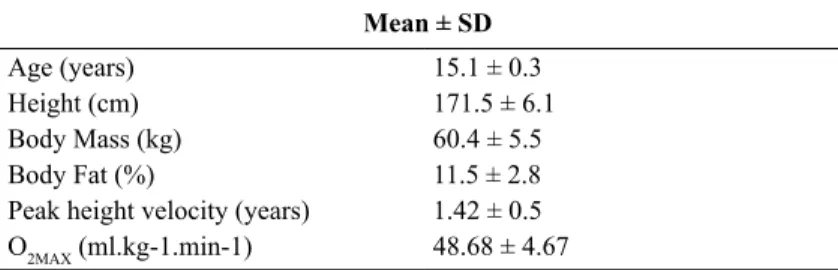
Table 1. Sample characteristics expressed in mean ± sd of age, height, body mass, body fat, peak height velocity and O2MAX.
Mean ± SD
Age (years) 15.1 ± 0.3
Height (cm) 171.5 ± 6.1
Body Mass (kg) 60.4 ± 5.5
Body Fat (%) 11.5 ± 2.8
Peak height velocity (years) 1.42 ± 0.5 O2MAX (ml.kg-1.min-1) 48.68 ± 4.67
Should read:
Table 1. Sample characteristics expressed in mean ± sd of age, height, body mass, body fat, peak height velocity and VO2max.
Mean ± SD
Age (years) 15.1 ± 0.3
Height (cm) 171.5 ± 6.1
Body Mass (kg) 60.4 ± 5.5
Body Fat (%) 11.5 ± 2.8
Peak height velocity (years) 1.42 ± 0.5 VO2max (ml.kg-1.min-1) 48.68 ± 4.67
Determination of Anaerobic Power
To measure the aerobic power (fatigue index, minimum power, peak power and average power) of the players, the Running-based Anaerobic Sprint Test – RAST (Zacharogiannis, Paradisis, & Tziortzis, 2004) was used.
Should read:
Determination of Anaerobic Power
To measure the anaerobic power (fatigue index, minimum power, peak power and average power) of the players, the Running-based Anaerobic Sprint Test – RAST (Zacharogiannis, Paradisis, & Tziortzis, 2004) was used.
page 95, Determination of Anaerobic Power
Determination of O2MAX and VMAX
Should read:
Determination of VO2max and Vmax
page 95, Determination of O2MAX and VMAX
The last stage was computed for the O2MAX determination (Krustrup et al., 2006). The Kuipers, Verstappen, Keizer, Geurten, and Kranenburg (1985) equation was used to calculate the maximum intensity (VMAX) reached during the protocol as shown below:
VMAX = Ecom + (t/DE) * I
Should read:
The last stage was computed for the VO2max determination (Krustrup et al., 2006). The Kuipers, Verstappen, Keizer, Geurten, and Kranenburg (1985) equation was used to calculate the maximum intensity (Vmax) reached during the protocol as shown below:
Vmax = Ecom + (t/DE) * I
page 95, Determination of O2MAX and VMAX
The training session to develop aerobic power during the preparatory stage in the 1st and 2nd weeks was consisted of ive series of three minutes at 90% of VMAX with 90 seconds of active recovery. The 3rd, 4th and 5th weeks were consisted by three sets of ive minutes at 95% of VMAX with 90 seconds of active rest.
Should read:
The training session to develop aerobic power during the preparatory stage in the 1st and 2nd weeks was consisted of ive series of three minutes at 90% of Vmax with 90 seconds of active recovery. The 3rd, 4th and 5th weeks were consisted by three sets of ive minutes at 95% of Vmax with 90 seconds of active rest.
Figure 3. RAST test results.
Average Power (AP) – A, Peak Power (PP) – B, Minimium Power (MP) – C and Index of Fatigue (IF) – D during the periodiza-tion. A – a = T0 x T1 (p < 0.001); b = T0 x T2 (p < 0.001); c = T0 x T3 (p < 0.001). B – a = T0 x T1 (p = 0.001); b = T0 x T2 (p < 0.001); c = T0 x T3 (p < 0.001). C – a = T0 x T1 (p < 0.001); b = T0 x T2 (p < 0.001); c = T0 x T3 (p < 0.001); d = T1 x T2 (p = 0.04). D – a = T0 x T2 (p = 0.005); b = T0 x T3 (p = 0.008).
Should read:
Figure 3. Average Power (AP) – A, Peak Power (PP) – B, Minimium Power (MP) – C and Index of Fatigue (IF) – D during the periodization.
A – a = T0 x T1 (p < 0.001); b = T0 x T2 (p < 0.001); c = T0 x T3 (p < 0.001). B – a = T0 x T1 (p = 0.001); b = T0 x T2 (p < 0.001); c = T0 x T3 (p < 0.001). C – a = T0 x T1 (p < 0.001); b = T0 x T2 (p < 0.001); c = T0 x T3 (p < 0.001); d = T1 x T2 (p = 0.04). D – a = T0 x T2 (p = 0.005); b = T0 x T3 (p = 0.008).
page 97, Figure 3
Figure 5 illustrates the average values of O2MAX (A) and VMAX (B). Both variables revealed similar behavior for both indicators.
Should read:
Figure 5 illustrates the average values of VO2max (A) and Vmax(B). Both variables revealed similar behavior for both indicators.
page 97
Figure 4. Performances in jumps.
Horizontal Jump (HJ) – A and Countermovement Jump (CMJ) – B tests during the periodization. A – a = T0 x T2 (p = 0.006); b = T0 x T3 (p < 0.001); c = T1 x T2 (p = 0.02); d = T1 x T3 (p < 0.001); e = T2 x T3 (p < 0.001). B – a = T0 x T2 (p = 0.01); b = T0 x T3 (p < 0.001); c = T1 x T2 (p = 0.04); d = T1 x T3 (p < 0.001); e = T2 x T3 (p = 0.006).
Should read:
Figure 4. Horizontal Jump (HJ) – A and Countermovement Jump (CMJ) – B tests during the periodization.
A – a = T0 x T2 (p = 0.006); b = T0 x T3 (p < 0.001); c = T1 x T2 (p = 0.02); d = T1 x T3 (p < 0.001); e = T2 x T3 (p < 0.001). B – a = T0 x T2 (p = 0.01); b = T0 x T3 (p < 0.001); c = T1 x T2 (p = 0.04); d = T1 x T3 (p < 0.001); e = T2 x T3 (p = 0.006).
page 97, Figure 4
Therefore, it is possible to report that preparatory stage was eficient to promote improvements in O2MAX and VMAX.
Should read:
Therefore, it is possible to report that preparatory stage was eficient to promote improvements in VO2max and Vmax.
Figure 5. O2MAX and VMAX during the periodization.
Should read:
Figure 5. VO2max and Vmax during the periodization.
page 98, Figure 5
In relation to O2MAX and VMAX values, it was found a signiicant increase after the preparatory stage, occurring the mainte-nance of the values in competitive stages I and II.
Should read:
In relation to VO2max and Vmax values, it was found a signiicant increase after the preparatory stage, occurring the mainte-nance of the values in competitive stages I and II.