Parasites of the Flatfish
Paralichthys adspersus
(Steindachner, 1867) (Pleuronectiformes) from Northern
Chile
Marcelo E Oliva/
+, Raúl E Castro
*, Rodrigo Burgos
*Instituto de Investigaciones Oceanologicas *Departamento de Acuicultura, FAREMAR, Universidad de Antofagasta, Casilla Postal 170, Antofagasta, Chile
Three species of protistan and 22 species of metazoan parasites were obtained from a sample of
179 flatfish, (
Paralichthys adspersus
) taken-off Antofagasta, northern Chile. Prevalence of infection
of seven parasites (Protista: 1, Copepoda: 2, Digenea: 1, Acantocephala: 1, Nematoda: 2) was
sig-nificantly and positively correlated with host size. Host’s sex do not seem to affect prevalence of
infection, except for
Nybelinia surmenicola
,
Capillaria
sp. and
Anisakis
sp. (prevalence of infection
significantly greater in males than females) and
Philometra
sp. (prevalence higher in females). Mean
abundance is correlated with size in nine species (Protista: 1, Copepoda: 2, Digenea: 3, Acantocephala:
1, Nematoda: 2). Host’s sex do not affect mean abundance, except for
Cainocreadium
sp. and
Philometra
sp.(mean abundance higher in females) and
Nybelinia surmenicola
,
Capillaria
sp. and
Anisakis
sp. (mean abundance higher in males).
Key word: parasites - marine fishes - ecology - northern Chile
Paralichthys adspersus
is a flatfish inhabiting
the Pacific coast of South America, from Paita
(northern Perú) to Lota (central Chile) (Chirichigno
1974). Parasite fauna of
P. adspersus
, like other
flatfishes from Chile is poorly known. Currently,
the copepods
Lepeophtheirus edwardsii
Castro &
Baeza, 1980 and
Neobrachiella paralichthyos
Castro & Baeza 1986 are the only known parasites
of this fish in Chilean waters. The objective of this
study is to examine the impact of host’s sex and
size on some demographic characteristics of the
infection, such as prevalence and abundance.
MATERIALS AND METHODS
A total of 179 flatfish were collected between
April 1993 and June 1994 from sandy beaches near
Antofagasta (23° 24' S 70° 36' W) with gill nets,
beach seine, or hand line. Fishes were carried to
laboratory, dissected, and examined for ecto and
endoparasites. Each fish was measured (total length
to nearest mm) and the sex was determined. A
record of parasites (species, number and location
in host) for each fish was made. Quantification of
protistan was made according to an empirical scale
obtained from the average of counts of spores in at
least five fields of a microscope at 400
magnifica-tions: 1 (less 5 spores), 2 (6 to 10 spores) and 3
(more than 11 spores). An ANOVA was performed
to test if mean size of male and female flatfishes
were significantly different. The Mann-Whitney
“U” test and the log-likelihood “G” test were
per-formed to evaluate if abundance and prevalence
of infection were affected by host’s sex,
respec-tively. Finally, the Spearman correlation coefficient
was calculated to evaluate if mean abundance and
prevalence are affected by host’s sex. Significance
was considered at
α
= 0.05. Statistical analysis
fol-lows Willkinson (1990). Ecological terminology
follows Margolis et al. (1982)
RESULTS
One hundred and seventy six flatfish were
ana-lyzed. The size of three fishes could not be
accu-rately determined because injuries in the tail, thus
those fishes were eliminated from quantitative but
not qualitative analysis. Females were significantly
greater than males (females 34.2 cm, males 31.2
cm F= 12.79, GL= 1,174, P < 0.001). Twenty five
parasitic species were obtained (Protista: 3,
Meta-zoan: 22). Parasite species, developmental stages,
location in host body, prevalence and mean
abun-dance are presented in Table I. Statistical analysis
were performed only for those parasites
consid-ered common (prevalence of infection
≥
5%).
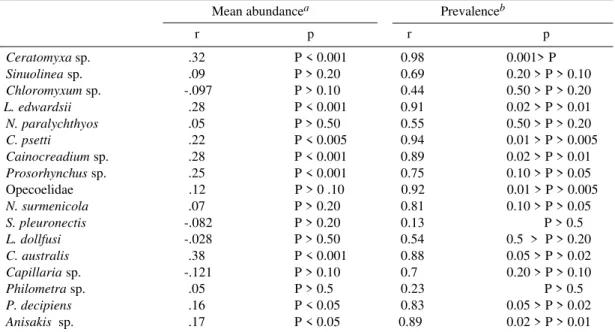
Val-ues of Spearman correlation coefficients for the
relation size-abundance (Table II) show positive
Supported by DINV - Universidad de Antofagasta+Corresponding author. Fax: 56-55-24.7542
TABLE I
Parasites, developmental stage, location in the host, prevalence and mean abundance
Parasite Stage Location Prevalence Mean
abundance
PROTISTA
Ceratomyxa sp. T P S Gb 67.9 0.79
Sinuolinea sp. T P S Ub 48.2 0.58
Chloromyxum sp. T P S Ub 11.3 0.13
Monogenea
Entobdella hippoglossi A Bs 3.4 0.06
Copepoda
Lepeophtheirus edwardsii A C Bs G 18.8 0.43
Neobrachiella paralichyos A G Mo 8.0 0.17
Bomolochus sp. A Mo G O 2.1 0.05
Chondracanthus psetti A Mo G 12.5 0.18
Isopoda
Aeglidae gen. sp. A Mo 2.3 0.02
Annelida
Hirudinea gen sp. A Bs 2.1 0.01
Digenea
Cainocreadium sp. A In Pc 54.5 3.96
Prosorhynchus sp. A In Pc 18.2 3.12
Opecoelidae M G Cc S 21.6 1.7
Eucestoda
Pseudophyllidea gen. sp. A In 4.5 0.07
Nybelinia surmenicola L Cc Mu G 9.1 0.12
Scolex pleuronectis L In 5.7 0.29
Lacistorhynchus dollfussi L Mu G Cc 8.0 1.58
Acantocephala
Corynosoma australis L In S Cc 56.3 11.37
Unidentied Acantocephala A In 0.56 0.006
Nematoda
Anisakis physeteris L Mu Cc 2.1 0.01
Capillaria sp. A S 18.8 2.37
Philometra sp. A Go 17.6 0.57
Pseudoterranova decipiens L Mu Cc 9.1 0.26
Hysterothylacium sp. L S 1.7 0.05
Anisakis sp. L In S 16.5 0.33
T: trophozoite, P: plasmodia, S: spore, A: adult, L: larvae, C: chalimus, M: metacercariae, Gb: gall-bladder, Ub: urinary bladder, Bs: body surface, G: gills, Mo: mouth, Go: gonads, O: operculum, In: intestine, Pc: piloric caeca, Cc: coelomic cavity, S: stomach, Mu: muscle
and significant correlation only for the protista
Ceratomyxa
sp
.
, the copepods,
L. edwardssi
and
Ch. psetti
, the digeneans,
Cainocreadium
sp. and
Prosorhynchus
sp., the Acanthocephala,
C.
aus-tralis
and the nematodes
P. decipiens
and
Anisakis
sp. Table II also shows values of the Spearman
correlation coefficient for the relation between
prevalence and mean host size. Prevalence is
posi-tively and significantly correlated with size only
for the following parasites:
Ceratomyxa
sp.,
L.
edwardssi
,
Ch. psetti
,
Cainocreadium
sp.,
Opecoelidae (Metacercariae),
C. australis
,
P.
decipiens
and
Anisakis
sp.
Table III shows values of the
χ
2approxima-tion to the Mann-Whitney “U” test. The
hypoth-esis of effect of the sex on mean abundance was
not rejected for the following five species:
TABLE II
Effect of host size on mean abundance and prevalence of infection
Mean abundancea Prevalenceb
r p r p
Ceratomyxa sp. .32 P < 0.001 0.98 0.001> P Sinuolinea sp. .09 P > 0.20 0.69 0.20 > P > 0.10 Chloromyxum sp. -.097 P > 0.10 0.44 0.50 > P > 0.20 L. edwardsii .28 P < 0.001 0.91 0.02 > P > 0.01 N. paralychthyos .05 P > 0.50 0.55 0.50 > P > 0.20 C. psetti .22 P < 0.005 0.94 0.01 > P > 0.005 Cainocreadium sp. .28 P < 0.001 0.89 0.02 > P > 0.01 Prosorhynchus sp. .25 P < 0.001 0.75 0.10 > P > 0.05 Opecoelidae .12 P > 0 .10 0.92 0.01 > P > 0.005 N. surmenicola .07 P > 0.20 0.81 0.10 > P > 0.05 S. pleuronectis -.082 P > 0.20 0.13 P > 0.5 L. dollfusi -.028 P > 0.50 0.54 0.5 > P > 0.20 C. australis .38 P < 0.001 0.88 0.05 > P > 0.02 Capillaria sp. -.121 P > 0.10 0.7 0.20 > P > 0.10 Philometra sp. .05 P > 0.5 0.23 P > 0.5 P. decipiens .16 P < 0.05 0.83 0.05 > P > 0.02 Anisakis sp. .17 P < 0.05 0.89 0.02 > P > 0.01
r: Spearman correlation coefficient, p: probability, a: degree of freedom = 166 for protistan and 174 for metazoan, b: degree of freedom = 4 for all parasites
Philometra
sp. (with mean abundance greater in
females than in males) and
N. surmenicola
and
Capillaria
(higher mean abundance in females).
The same Table shows “G” values that
demon-strates the evidence of effect of host’s sex on
prevalence of infection for the following parasites:
N.
surmenicola
,
Capillaria
sp. and
Anisakis
sp.
with higher prevalence in males and
Philometra
sp. with prevalence in female greater than in
males.
TABLE III
Effect of sex on abundance and prevalence of infection
Abundance Prevalence
χ2 p G p
Ceratomyxa sp. 0.73 0.39 0.34 0.75 > P > 0.50 Sinuolinea sp. 1.1 0.3 2.33 0.25 > P > 0.10 Chloromyxum sp. 0.1 0.74 0.12 0.75 > P > 0.50 L. edwardsii 0.6 0.43 0.29 0.75 > P > 0.50 N. paralichthyos 0.1 0.76 0.04 0.90 > P > 0.75
C. psetti 0.2 0.63 0.21 0.75 > P > 0.50
Cainocreadium sp. 3.9 (*) 0.3 0.75 > P > 0.50 Prosorynchus sp. 3.5 0.06 1.46 0.25 > P > 0.10 Opecoelidae (Metacercaria) 1.1 0.3 1.0 0.50 > P > 0.25 Nybelinia sp. 4.0 0.04 3.88 0.05 > P > 0.03 S. pleuronectis 0.9 0.33 0.9 0.50 > P > 0.25 L. dollfusi 0.66 0.42 0.59 0.50 > P > 0.25 C. australis 1.97 0.16 0.84 0.50 > P > 0.25 Capillaria sp. 5.65 0.02 5.42 0.025> P > 0.01
Philometra sp. 13.18 (*) 14.3 0.001> P
P. decipiens 0.89 0.34 0.82 0.50 > P > 0.25 Anisakis sp. 4.62 0.03 3.86 0.05 > P >0.025 χ2: Chi-square aproximation to Mann-Whitney “U” test, G: value of the Log-likelihood “G” test, p: probability (*)
DISCUSSION
As a rule, in all host species that have been
ac-curately studied for parasites, infection changes
with age (Rohde 1984). This is true for both
quali-tative and quantiquali-tative changes in the parasite
fauna. As have been pointed by Polyansky (1961),
as a fish grows, the diet normally changes and
con-sequently, the fauna of trophically transmitted
para-sites will be replaced by new species of parapara-sites.
Quantitative differences in parasite infection
be-tween sex can be expected and are explained as a
consequence of different habitat occupied by males
and females, differences in the diet and/or
physi-ology (Kennedy 1975). Our results show absence
of a common pattern of infection for all the
para-sitic species. Prevalence of infection was
signifi-cantly and positively correlated with size for the
monoxenics
Ceratomyxa
sp.,
L. edwardsii, Ch.
psetti
, and the heteroxenics
Cainocreadium
sp.,
C.
australis, P. decipiens, Anisakis
sp. and
metacer-cariae of an unidentified opecoelid. Abundance
also increases with size for the same parasites and
Prosorhynchus
sp. but not for the opecoelid
meta-cercaria. This means that, as fishes in the
popula-tion grow, chances of infecpopula-tion increase for those
parasites, due to a long period of exposition to free
living infective stages of the monoxenic parasites
and an increased use, as food, of the intermediate
host of the heteroxenic parasites (Polyansky 1961,
Rohde 1993). Sex affects mean abundance and
prevalence only for six species, all of them are
trophically transmitted parasites, this means that
differences are due mainly to diet and or
physiol-ogy, but no differences in habitat could be expected
for male and female flatfishes, as suggested by the
absence of differences in monoxenic parasites.
Moreover, Kong et al. (1995) were unable to found
differences in diet of male and females
P.
adspersus.
Thus, differences in some ecological
parameters of the infectious process could be a
consequence of differential physiology of male and
females flatfishes.
The characteristic of
P. adspersus
, when
com-pared with other flatfishes, is the sparse of the
site fauna. Table IV shows composition of the
para-site fauna of some related fish, including complete
and partial (only gastrointestinal parasites)
parasi-tological analysis. Our data shows a poor digenea
fauna, that is evident for the other chilean flatfish
whose parasites are known. It has been
demon-strated that digenea are good indicators of the diet
of the host (Gaevskaya & Kovaleva 1982) and
ac-quisition of the parasite by a definitive host is a
consequence of the ingestion of the intermediate
host (mainly invertebrates) but a postcyclic
para-sitism (transference from fish to fish via predation)
can also occur (Arthur & Albert 1994). The bulk
of the diet of
P. adspersus
in northern Chile are
the anchovy
Engraulis ringens
, the silver side
Austromenidia laticlavia
and the sand crab
Emerita
analoga
, that explain the 95% of the IRR (index
of relative importance) (Kong et al. 1995).
Para-sites of
E. ringens
from Chile were studied by Riffo
(1990) who was unable to found digenea (both
lar-val or adult), there are not studies of parasites of
A.
laticlavia
and parasites of the sand crab do not
in-cludes larval or adult digenea (Oliva et al. 1992).
Thus the poor digenea fauna of
P. adspersus
can
be a consequence of the monotonous diet
(num-ber of digenea species in flatfishes is not affected
TABLE IV
Number of parasites (by major taxonomic groups) in some related flatfish (Pleuronectiformes)
PV HMa LP HPb HHb RH1b RH2 RH3 PA
Protista 1 0 7 0 0 0 4 10 3
Monogenea 0 1 2 0 0 0 1 3 1
Digenea 10 1 9 7 16 11 18 28 3
Cestoda 1 3 1 1 3 3 6 9 4
Acantocephala 1 1 1 2 2 1 5 8 2
Nematoda 5 2 2 0 2 1 8 8 6
Crustacea 3 3 2 0 0 0 2 8 4
Hirudinea 1 0 1 0 0 0 1 2 1
Sample size 628 60 526 74 272 71 350 (*) 179
TABLE V
Number of digenean parasitic in marine fishes from the Peruvian faunistic province (only data on quantitative surveys are considered)
Host species ND SS GL Author
H. macrops 1 60 CC Riffo 1991
E. ringens 0 70 CC Riffo 1990
S. benticki 0 50 CC Riffo 1990
M. cephalus 7 107 CC Fernandez 1987
H. lengerichi 4 30 CC George-Nascimento & Iriarte 1989 C. callorhynchus 0 55 CC Fernandez et al.1986
M. gayi 3 140 CP Duran & Oliva 1980
M. australis 2 100 SC Fernandez 1985
G. chilensis 1 80 CC Vergara & George-Nascimento 1982
T. murphy 1 78 NC Oliva 1994
P. peruanus 1 124 CP Luque & Oliva 1993
S. minor 1 311 CP Oliva et al. 1990
M. ophicephalus 1 237 CP Luque 1994
ND: number of digenean species per host species, SS: sample size. GL: geographic locality (CP: central Perú, NC: northern Chile, CC: central Chile, SC: southern Chile)
Fernandez J, Villalba C, Alvina A 1986. Parásitos del pejegallo Callorhynchus callorhynchus (L) en Chile: aspectos biológicos y sistemáticos. Biol Pesq 15: 67-74.
Gaevskaya AV, Kovaleva AA 1982. The trematode fauna of Atlantic Trachurus and its special features. Gidrobiol Zhur 18: 60-65.
George-Nascimento M, Iriarte J 1989. Las infraco-munidades de parásitos metazoos del chancharro Helicolenus lengerichi Norman, 1937 (Pisces: Scorpaenidae): Un ensamble no interactivo de especies. Rev Chile Hist Nat 62: 217-227. Kennedy C 1975. Ecological animal parasitology.
Blackwell Sc. Pub. London, 163 pp.
Kong I, Clarke M, Escribano R 1995. Alimentación de Paralichthys adspersus (Steindachner, 1867) en la zona norte de Chile. Rev Biol Mar 30: in press. Luque JL 1994. Dinámica poblacional y estructura de la
comunidad de metazoarios parasitos de Menticirrhus ophicephalus (Pisces: Sciaenidae) en la costa peruana. Rev Biol Trop 42: 21-29.
Luque JL, Oliva ME 1993. Análisis cuantitativo y estructura de la comunidad parasitaria de Paralonchurus peruanus (Pisces: Sciaenidae) en la costa peruana. Parasitol al Dia 17: 107-111. Margolis L, Esch G, Holmes J, Kuris A, Schad G 1982.
The use of ecological terms in parasitology (report of an ad-hoc committee of the American Society of Parasitologists) J Parasitol 68: 131-133.
Oliva ME 1994. Parasites of the Chilean jack mackerel Trachurus symmetricus murphyi (Pisces: Carangidae) Mem Inst Oswaldo Cruz 89: 363-364. Oliva ME, Luque JL, Iannacone J 1990. The metazoan parasites of Stellifer minor (Tschudii,1844): an eco-logical approach. Mem Inst Oswaldo Cruz 85: 271-274.
Oliva ME, Luque JL, Cevallos A 1992. Parasitos de
by host sample size, r: 0.313, 0.5> P > 0.20, df=
6). The poor digenean fauna of fishes from the
South Pacific coast of America (central and
north-ern Chile and southnorth-ern and central Perú) mainly
influenced by the Peruvian cool current, is a
char-acteristic of all the host-parasite system
quantita-tively studied to date (Table V). Unfortunately,
no accurately studies at community levels of
pe-lagic and benthonic communities are available from
this area. Studies at community levels from this
particular area must be done in order to evaluate
the role of highly productive but unstable system
such as the “upwelling eco-system” on the
para-site fauna of fishes.
REFERENCES
Arthur JR, Albert E 1994. A survey of the parasites of Greenland halibut (Reinhardtius hippoglossoides) caught off Atlantic Canada, with notes on their zoo-geography in this fish. Can J Zool 72: 765-778. Burn PR 1980. The parasites of smooth flounder,
Liopsetta putnami (Gill) from the Great Bay Estu-ary, New Hampshire. J Parasitol 66: 532-541. Chirichigno N 1974. Clave para identificar los peces
marinos del Perú. Inf. 44 IMARPE, Callao-Perú, 388 pp.
Duran LE, Oliva ME 1980. Estudio parasitológico en Merluccius gayi peruanus Ginsgburg, 1954. Bol Chile Parasit 35: 18-21.
Fernandez J 1985. Estudio parasitológico de Merluccius australis (Hutton, 1872) (Pisces: Merluccidae): Aspectos sistemáticos, estadísticos y zoogeográficos. Bol Soc Biol Concepción 56: 31-41.
Emerita analoga (Stimpson) (Crustacea): Implicancias ecológicas. Bol de Lima 79: 77-80. Olson RE 1978. Parasitology of the english sole,
Parophrys vetulus Girard in Oregon USA. J Fish Biol 13: 237-248.
Polyansky YI 1961. Ecology of parasites of marine fishes, p. 48-83. In VA Dogiel, GK Petruschenko, YI Polyansky (eds) Parasitology of fishes. Oliver & Boyd, Edinburg.
Riffo R 1990. Primer registro parasitologico en Strangomera benticki (Normann, 1936) y Engraulis ringens Jennyns, 1842 (Pisces: Clupeiformes) para la costa de Chile. Medio Ambiente 11: 59-64. Riffo R 1991. La fauna de parasitos metazoos del
lenguado de ojos grandes Hippoglossina macrops Steindachner, 1876 (Pisces: Bothi-dae): Una aproximación ecológica. Medio Ambiente 11: 54-60.
Rohde K 1984. Ecology of marine parasites. Helgolander Meeresunters 37: 5-33.
Rohde K 1993. Ecology of marine parasites. (2 ed.), Univ. Queensland press, 245 pp.
Siddall R, Pike AW, MacVicar AH 1994. Parasites of flatfish in relation to sewage sludge dumping. J Fish Biol 45: 193-209.
Scott JS, Bray SA 1989. Helminth parasites of the ali-mentary tract of Atlantic halibut (Hippoglossus hippoglossus L.) and Greenland halibut (Reinhardtius hippoglossoides (Walbaum) on the Scotian shelf. Can J Zool 67: 1476-1481. Vergara L, George-Nascimento M 1982. Contribución
al estudio del parasitismo en el congrio colorado Genypterus chilensis (Guichenot, 1848). Bol Chile Parasit 37: 9-14.