C
OMPREHENSIVE
ADOLESCENT FERTILITY PROFCT
IN JAMAICA1
Eugene tidies2 andJeremy Clark3
I
NTRODUCTION
Within the last decade there have been numerous professional work- shops, seminars, and meetings within the English-speaking Caribbean seeking ways to meet the rapidly changing health and education needs of youth. The pe- riod of adolescence has suddenly come to receive priority attention.
One key reason for this activ- ity has been the sudden influx of the me- dia into the region, together with the Caribbean’s proximity to North Amer- ica. Among other things, rapid introduc- tion of the satellite “dish” has caused noteworthy changes, transforming cover- age of sex in the media from a “conspir- acy of silence” to a “conspiracy of scan- dal” (1).
In trying to keep up with changing circumstances and the chang- ing needs of youth, many countries have wisely begun to review their legislation, policies, and practices-especially those dealing with maternal and child health, family planning, and sexual health serv- ices for youth. One result, to the benefit of all, is that a regional policy in support
of sexual health services for adolescents is now becoming well-established in the West Indies (2).
Each of the more than a dozen countries within the English- speaking Caribbean is now trying to develop both traditional and new approaches to reach youth through ma- ternal and child health and family plan- ning programs (3). This article will take a closer look at the emergence of one such model project in Jamaica that enjoys a high level of intersectoral cooperation. This project, known as the Duhaney Park Youth Project, recently completed its first three years of operation. Key ele- ments of the project include skills train- ing, education, counseling, and a special evening youth clinic. What follows is a general description of the project’s basic components that devotes special atten- tion to some of the characteristics of pa- tients seen during the youth clinic’s first year of operation. It is hoped that some of the observations reported here will help other agencies and governments within the area in developing projects to meet their unique but often similar needs.
’ This article will also be published in Spanish in the Bo- let52 de la Ojkina Sanitanb Panamericana, vol. 105, 1988.
2 Consultant, World Health Organization, Global Pro- gram on AIDS, Geneva. Switzerland.
T
HE DUHANEY PARK
PROJECTS
The health of young women in Jamaica has been supported through development of a formal family plan- ning policy at the national level. As in other Caribbean countries, clinical and out-of-school education programs for youth have become more important as evidence has increased that young Jamai- can women who have higher levels of ed- ucation tend to have fewer children (4).
The present Duhaney Park Youth Project is really the second of two projects aimed at the same eight target communities. The first, the Duhaney Park Primary Care Project, began with construction of a major primary care health center in 1982. This project has received attention previously because of its high level of community support and participation (>) .
The most recent project, the Duhaney Park Youth Project, began field operations in 1985 with construction of a
youth center and initiation of education, skills training, counseling, and medical services for youth.
These two projects’ eight tar- get communities have a total population of nearly 100,000 people. Located in the same compound, the projects work closely together and continue to benefit from a high degree of intersectoral coop- eration. The Duhaney Park Health Cen- ter is administered by the Ministry of Health and Environmental Control, while the Duhaney Park Youth Center is managed by the Ministry of Youth and Community Development. Both proj- ects were implemented by PAHO/ WHO.
Community Participation
Previous efforts at intersec- toral collaboration and community par- ticipation in Jamaica have not always been successful. In this vein, it has been widely recognized that community par- ticipation does have risks, may not be ap- propriate for all communities, and often takes a long time to develop (6).
These circumstances make it easier to understand both the Duhaney Park Youth Project and the fact that both project staff members and community leaders have identified “politics” as the single greatest continuing threat to the project’s eventual success (7). Regarding the latter point, community leaders and parents fear the effects of divisive politics upon the project. They agree that special clinical, counseling, and educational programs for young people are urgently needed because of the inability of the school and family to provide basic infor- mation on sexual health, an inability that has been well-documented by pre- vious studies (8).
The Need for Urban Services
The need to develop special- s ized sexual health services for adolescents
$ has been sharpened by rapid urbaniza- & tion in the Caribbean, and by the fact
b that urban females are now experiencing 3 menarche significantly earlier than their 2 rural counterparts (9). A considerable in-
crease in sexually transmitted diseases, E especially gonorrhea, among Caribbean E youth since the l!XOs further under- . scores the need for specific programs to -E reach young people (10). In addition, 4 young women are considerably more ; prone to maternal morbidity and mortal- ity than are their older counterparts; in-
z deed, complications of pregnancy and
childbirth remain the third leading cause $ of death among young people 15-24
The Preliminary K.A.P. Survey
In order to more clearly define the health-related needs and problems of the nearly 100,000 people living within the eight target communities, a K.A.P. (Knowledge, Attitudes, and Practices) survey was completed in 1983. This house-to-house survey, conducted by a group of trained interviewers, covered a random sample of 306 households repre- senting 2% of all the households within the eight project communities.
Among other things, it con- firmed the immediate need for a major comprehensive primary care facility. At the time of the survey no such project had yet been attempted in any of the eight communities (11). For this reason, area residents were forced to travel up to two hours to reach overcrowded and poorly equipped health facilities in downtown Kingston or at the University Hospital in Kingston.
As can be seen from Table 1,
many of the household heads surveyed felt that youths in their communities were in great need of social, recreational, educational, vocational, and sporting services. When the survey subjects were
asked to specify what health services were needed in their communities, they speci- fied the areas of primary care, services for children, dental services, and environ- mental health services (11).
Later on in the K. A.P. survey, these residents were asked specific ques- tions relating to maternal and child health and family planning. This re- vealed that some 22% of the household mothers involved had experienced com- plications during pregnancy and 14% had experienced birth problems (1 I).
This finding indicated a need for more effective or available prenatal services, and also for more access to family plan- ning and sexual health care services. The fact that Jamaica currently has the third highest incidence of cervical cancer in the world (12) underscores the need to pro- vide health education for young women in the sexually active age group.
When asked specifically about family planning (Table 2) over a third of the respondents (37%) gave no reason
TABLE 2. Reasons given by the 306 heads of household surueyed for not using family planning.
TABLE 1. Needs of youth in the eight Duhaney Park Project communities, as perceived by heads of the 306 households surveyed in 1983.
Type of need
Heads of household citing need No. I%\ Social, recreational, sporting
Employment
Education, vocational training 61 Counseling, sex education, health care 43 (20) No needs (“youth are hopeless”) 18 (14) No opinion 12 Ii;
Total 306 (1001
242 Source: ffl). Pan American Health Organization/World Health Organization
Heads of household citing reason Reason cited No. (%I Not stated 113 (37) Not at risk (over age, pregnant,
just gave birth) 83 (27) Fear of side-effects 40 (13) Do not believe in family planning 27
No partner 12 Ii{
Other 31 (10)
Total 306 (100)
for not using family planning. Another 13% cited fear of side-effects. Both of these findings strongly indicated a need to provide more and better maternai and child health/family planning education through the new primary care facility.
Initiating Primary Health Care
The new Duhaney Park Health Center was completed in late 1983. During its first nine months of op- eration, it was visited by over 24,000 patients (13). This heavy use supported the earlier findings of the K.A.P. survey pointing to a need for primary care services.
After the center was operat- ing, community leaders continued meet- ing monthly to monitor ongoing project activities. In addition, a special workshop was held to familiarize community lead- ers with the findings of the K.A.P. survey and the project’s long-range goals (14).
Initiating Specialized Youth
Services
The development of special- ized services for youth in Jamaica follows a recent Caribbean trend toward upgrad- ing and improving adolescent services- especially ones contributing to reduction of teenage pregnancies. The Duhaney Park Youth Project currently meets five of the seven criteria for activities at the national level that are set forth in the re- cent PAHO strategy document “Carib- bean Cooperation in Health” (15).
Among other features, key elements of the Duhaney Park Youth Project have included the following:
0 establishment of posts for four youth counselors;
0 a multi-phase peer counseling
training program;
l delivery of family life educa-
tion (PIE) in out-of-school settings;
l a full-time female sports
coach, as part of the PIE team;
l a weekly evening youth clinic
offering curative, family planning, and sexually transmitted disease services;
. a central focal point for activi- ties made possible through a new youth center (sewing classes, skills education*); a provision of transportation services and audio-visual equipment in support of the project.
Staff Development and Peer
Counselor Training
The four full-time youth proj- ect staff members (one senior youth edu- cator, two youth educators, and one fe- male sports coach) were selected largely for their ability to work with and relate to adolescents, a key element of any such program (1 G). During the first 12 months of the program, these four staff members received more than 750 hours (cumulative total) of training in adoles- cent growth and development, ado- lescent fertility, human reproduction, substance and drug abuse, fertility regu- lation, peer counseling, and program de- velopment and evaluation (I 7).
During the first 12 months of the project, over 30 especially selected young people from the target communi- ties were given more than 80 hours of training in peer counseling. The training itself employed basic but effective train- ing modules previously used in similar peer counselor training programs (18). While project funds were not sufficient to pay the peer counselors for their time
4 Including sessions on how to market sewing products,
(a frequent request), special certificates were awarded to every participant who successfully completed the 80 hours of training.
The project staff members and trained peer counselors residing in the target communities became the key source of most referrals to the weekly eve- ning clinic. One young peer counselor, previously known as a cocaine abuser, be- came renowned among youth in the community for her compelling and hu- morous talks on the evils of drug abuse.
Youth Workshops and
Recreational Services
Youth workshops on various special topics have been well-attended. Topics dealt with have included sub- stance and drug abuse, seeking employ- ment, nutrition, family relations, sexu- ally transmitted diseases, and AIDS. Most of these special workshops have lasted two or three days and have in- cluded 30 or more participants. Lunch has been provided to the participants be- tween workshop sessions. Each workshop has concluded by having each participant complete a questionnaire asking whether he or she benefited from the workshop and how the workshop was useful; the questionnaire responses have then been used for planning further special topic workshops.
Recreation services have also z
2 -. grown within the program, and the fe- male sports coach has already organized ii? soccer, basketball, and track competi- 2 tions between youth groups from the .g various communities. The project has
9)
3 provided basic sports equipment, sup- :
plemented in some cases with equip-
244
ment contributed by local companies. The practice of awarding trophies and certificates of achievement to winning competitors has helped spur enthusiasm. These trophies and citations are paid for by project funds and local companies.
In addition, a sewing course was recently added to the project. Sew- ing machines have been provided by the Dutch Government, and the classes are given three days a week by a local volun- teer teacher. Students of both sexes are also given assistance in getting job place- ment after they have successfully com- pleted the course. Each course lasts about
10 weeks and includes about a dozen stu- dents per class.
Community Participation
Leaders of the Duhaney Park communities have remained active in their support of the overall project. Local food shops sometimes provide food and drink, and community leaders meet monthly to discuss the health program, the youth clinic, sports activities, and problems of young people. In this vein, a special series of “round table” discus- sions have been set up to provide young people an informal vehicle for discussing special problems (drug abuse, etc.) with community leaders. Several of these round tables have been held to encour- age young people to discuss special prob- lems with members of the local police force.
Development of the Youth Clinic
The youth clinic, which first opened in early 1985, offers services be- tween the hours of 4:00 p.m. and 7:00
lished” adult or daytime clinics in small communities, for fear of being recog- nized by family friends or neighbors.
The basic staff members pres- ent at the evening clinic include a medi- cal officer, a nurse-midwife (trained in family planning), and a records clerk. All young people coming to the clinic are counseled by a youth educator and eval- uated on an individual basis. Services of- fered include curative care, referral serv- ices, family planning (all methods), and sexually transmitted disease diagnosis and treatment.
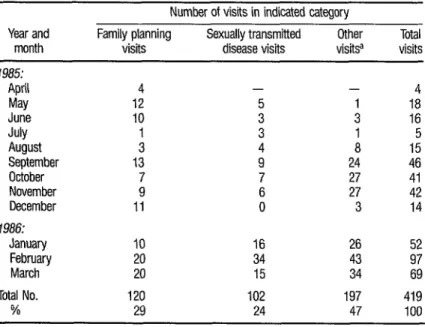
Use patterns. The number of clinic visitors was uneven and grew slowly at first, there being an average of 2 2 patient visits per month during the first nine months of clinic operation. However, during the last quarter the average num- ber of visits more than tripled to 73 per month. This dramatic increase will prob- ably continue, as youth clinics generally begin slowly because they are required to earn the respect of youth in the commu- nity over time. Also, there would natu- rally tend to be reduced utilization dur- ing the summer months, when young people out of school frequently leave the area.
Regarding repeated use, 30 % of all the patients attending the youth clinic made two or more visits. Such mul- tiple visits are a good sign of success in youth clinics, where young people are of- ten receiving primary care on their own for the first time. In this project, multi- ple visits were especially encouraged to help gain trust and respect. As might be expected, the frequency of multiple vis- its was especially high among family planning and sexually transmitted dis- ease patients.
Many of the patients said it was the first time they had visited a health center, confirming the impression that the clinic afforded their first con-
tact with primary health care services. Women far outnumbered men in terms of the total number of visits made, while persons aged 20-22 years accounted for the greatest number of visits (30%) for both sexes. Also, the average female pa- tient seeking services for the first time was younger than her male counterpart.
Family Planning and Sexually
Transmitted Disease Services
A breakdown of patients by type of visit (Table 3) shows that over half (53 %) of all the patients attending the clinic received family planning and I or sexually transmitted disease services, while the balance received curative, counseling, or referral services.
Besides the factors already mentioned, the gradual growth in clinic attendance can be partly explained by the fact that only one other “teen” or “youth” clinic was attempted in Jamaica between 1982 and 1986. Because all gov- ernment and most private clinics operate from 9:00 a.m. to 5:00 p.m., young peo-
ple in Jamaica were not accustomed to late afternoon or evening clinics. Many patients expressed high satisfaction and sometimes surprise that this clinic had evening hours, allowing them an oppor- tunity to attend after school or work (7).
Methods of Contraception Used
Oral contraceptives represent- ed the contraceptive method of choice in a preponderance of the family planning visits where a contraceptive method or device was accepted (Table 4). Barrier methods accounted for most of the re- mainder.
246
TABLE 3. A breakdown of services by the reason for the visit at the Duhaney Park Youth Clinic, April 1985 to March 1986.
Number of visits in indicated category
Year and Family planning Sexually transmitted Other Total month visits disease visits visitsa visits
1985:
April May June July August September October November December 1986:
January February March Total No.
%
4 12 IO i 13
7 9 11
10
20 20 120 29
-
: 3 4 9 7 6 0
16 34 15 102 24
- 4
1 18 3 16 1 5 8 15 24 46 27 41 27 42 3 14
26 52 43 97 34 69 197 419 47 100
Source: PAHO/WHO. Kingston, Jamaica, 1986. a For counseling. curative care, or referral.
TABLE 4. Contraceptive methods accepted during family planning visits to the Duhaney Park Youth Clinic, April 1985 to March 1986.
Contraceptive method accepted Oral contraceptives Condoms and foams Injections IUDs Total
No. of % of all acceptor family
visits planning visits 58 48% 24 20% 12 10%
1 1%
95 79oha
Source: Ouhaney Park Youth Clinic, 1986.
p The total is less than 100% because VISPS for certain noncontracepbve purposes such as pregnancy tests were counted as family planrung visits.
It should be noted, however, that 12 of the 95 acceptors chose the in- jectible (Depo-Provera) method. While this may seem a high proportion for some youth clinics, it is not surprising in Jamaica, which worldwide has the high- est percentage of Depo-Provera users (2 1% of all contraceptors) (I 9).
The reasons given by some pa- tients for rejecting contraception were similar to reasons given by young people in many countries, usually centering around the feeling that a contraceptive method was not necessary (20, 21). Some young people associated with a subcul- tural group unique to Jamaica and known as “Rastafarians” object to any form of contraception.
attention in developing future health ed- ucation strategies because of the current AIDS epidemic.
Abortion
In contrast to attitudes found in some other Caribbean countries (22), abortion is not considered a viable option by most Jamaican youth. Even very young mothers (those 13-16 years old) tend to carry their pregnancies to term and rely on parents or extended family for support or child-rearing.
Fewer than 20% of the young
people counseled in this project re- quested any information about preg- nancy termination. It seems unlikely that this lack of interest is due to regulations or laws, because Jamaican legal statutes do permit abortion under broad (health) circumstances on medical grounds (4).
Sexual Abuse
While sexual abuse was not one of the subjects specifically examined in the present study, it should be noted that the counselmg team reported an in- creasing incidence of reported sexual abuse among young girls. While this trend has also been observed in various other developing countries (231, it ap-
pears advisable to undertake additional studies in order to more clearly define the extent and seriousness of this prob- lem in the Caribbean.
C
ONCLUSIONS
Model and experimental youth projects that try to meet the needs of youth in different ways are relatively new in the English-speaking Caribbean. As one of these, the Duhaney Park Youth Project has continued to successfully combine the following elements: a well-
trained youth education staff, continu- ing community participation, peer counseling, skill-building activities, co- operating government ministries, a fe- male sports program, and an evening youth clinic.
Extrabudgetary support has allowed the Duhaney Park project to dif- fer markedly from more traditional proj- ects in Jamaica. Specifically, its approach is holistic and seeks to meet young peo- ple’s social and emotional as well as med- ical needs. Its design is not vertical or managed by one government ministry, but is horizontal and enjoys the ongoing administrative cooperation of two gov- ernment ministries (the Ministry of Youth and Community Development and the Ministry of Health and Environ- mental Control). Finally, and most im- portant, the project is directly influenced by the close two-way communication it enjoys with its young target popula- tion-as well as with community leaders, who have persisted in their support. Ac- cordingly, young people often decide for themselves upon future activities or top-
its for discussion. s * In general, it appears that the experience gained with this project to
2 date stands some chance of benefiting q other Caribbean agencies or govern-
& h ments that are seeking to develop their 2 own youth-specific programs to meet the 3 special needs of young people within z their countries. E
S
UMMARY
R
EEERENCES
In 1985 an undertaking known as the Duhaney Park Youth Project was established in urban Kingston, Jamaica. Since then it has provided extensive staff training, utilized supportive community participation, and expanded its range of activities to include peer counseling, fe- male sports, skills training, and a weekly evening youth clinic.
This article describes the basic precepts and features of the project, to- gether with relevant characteristics of the young people attending the evening clinic. (Over half of all these young pa- tients were seeking assistance for family planning or sexually transmitted dis- eases.)
Experience over the years has shown that vertical programming to reach adolescents and postadolescent young people has not been very success- ful. This project, one of the first such comprehensive youth programs in the Caribbean region and similar in orienta- tion to “The Door” in New York City, is more comprehensive and offers a variety of services for youth. It therefore appears that the program could prove to be a use- ful model, serving as a source of experi- ence and fresh ideas for similar efforts in other countries.
1 Gomes Ferraro& N. Health and Areas of Health Education in Adolescence. In: Pan American Health Organization. The Health of Adolescents and Youths in the Americas. PAHO Scientific Publication 489. Washing- ton, D.C., 1985, pp. 28-34.
2 Pan American Health Organization/World
Health Organization. Maternal and Child
Health Strategy for the Caribbean Commu- nity (Seconded.). Barbados, 1983.
3 Vadies, E. Innqvative approaches for reachjng
~;~~gppk;; h;$h A”,d fg:Jgla;;E
16(4):323-328, 1982.
4 Pan American Health Organization. HeaM of Women in the Americas. PAHO Scientific Publication 488. Washington, D.C., 1985, xvi
+ 157 pp.
5 Vadies, E. Primary health care: How eight communities got results. WlddHealth. World Health Organization, Geneva, July 1983.
6 Pan American Health Or anization. Commn-
nity Particibation in Hea th and Develobment B
in >he Am&as: An Analjsis of S&&d Case
Studies. PAHO Scientific Publication 473. Washington, D.C., 1984, xiv + 74 pp
7 Ministry of Youth and Community Develop-
ment and PAHO/WHO. Report of the First
Youth Team/Community Workshop of the
Duhaney Park Youth Project. Kingston, Ja- maica, March 1986.
8 Schofield, M. The Sexual Behavior of Young
People. In: Sex Education. Cambridge Univer- sity Press, 1974.
9 Jordkn , J R. Growth and Development of the Adolescent: A Cuban National Study. In: Pan American Health Organization. The HeaM of Adolescents and Youths in the Americas. PAHO Scientific Publication 489. Washing- ton, D.C., 1985, pp. 221-233.
10 Su%rez Ojeda, E. N., E. Roberts, D. Korin, and M. Cusminsky. Adolescence and Youth: Demographic and Epidemiological Aspects. In: Pan American Health Organization. The Health of Adolescents and Youths in the Americas. PAHO Scientific Publication 489. Washington, D.C., 1985, pp. 3-18.
11
12
13
14
15
16
17
18
Pan American Health Organization/World Health Organization. Survev of Duhanev Park and Surro&ding Communities (1982-1983), Primary Health Care and Family Planning in Eight Communities. Summary report. Kings- ton, Jamaica, December 1983, p. 1.
The Sunday Gleanel; volume 48, number 34, page 1. Kingston, Jamaica, August 24, 1986.
Pan American Health Organization/ World Health Organization. Primary Health Care and Family Planning in Eight Communities: Summary, Patient Services Data (Jan-dug 1984). Kingston, Jamaica, 1984.
Ministry of Health and PAHOIWHO. Report of the First Health Team Development Work- shop. Kingston, Jamaica, August 1983.
Pan American Health Organization/World Health Organization. Caribbean Cooperation in Health. Washington, D.C., 1985.
Association for the Care of Children’s Health. Position Statement on the Care of Adolescents and Families in Health Care Settings. In: Pan
American Health Organization. The HeaM of
Adolescents and Youths in the Americas. PAHO Scientific Publication 489. Washing- ton, D.C., 1985. pp. 293-300.
Ministry of Youth and Community Develop- ment, Government of Jamaica. Personal com- munication. Kingston, Jamaica, 1986.
Vadies. E. Peer Counselling for Adolescent Sexuahtv: A Model for International Consider- ation. In: D. Bogue (ed.). Proceedings: Ado- lescent Fe&&v. The First Interhemisoheric Conference ondAdolescent Fertility. Un&ersity of Chicago Press, Chicago, 1977.
19
20
21
22
23
Vadies, E. Assessment of the Logistics Associ- ated wnh the Use of Depo-Provera in Jamaica through the National Family Planning Board. Pan American Health Organization/World
Health Organization, Kingston, Jamaica,
1984, p. 3.
Palmer, E. Nurse, Ministry of Health and En- vironmental Control, Government ofJamaica. Personal communication. Kingston, Jamaica, July 1986.
Molina C., R., and M. I. Romero S. Adoles- cent Pregnancy: The Chilean Experience. In: Pan American Health Or anization.
Health of Adolescents an B Youths in the The
Americas. PAHO Scientific Publication 489. Washington. D.C., 1985, pp. 194-205.
Dulanto Gutiirrez, E. Adolescence in Peas- ants: A Study of Rural Communities in Quere- taro, Jahsco and Eu-naulipa+ Mexico. In: Pan
American Health Organizatron. The Health of
Adolescents and Youths in the Americas. PAHO Scientific Publication 489. Washing- ton, D.C., 1985, pp. 243-260.
World Health Organization. Young People i Health, A Challenge for Society. WHO Tech- nical Report Series, No. 731. Geneva, 1986, p. 66.
New Deputy
Director-General
of
WHO
Appointed
I
Dr. Hiroshi Nakajima, Director-General of the World Health Organization, has nominated Dr. Mohamed Abdelmoumene of Algeria as Deputy Director-General, with effect from 21 July 1988. He succeeds Dr. T. A. Lambo (Nigeria), who re- tired from the Organization on 30 June. Dr. Abdelmoumene has a background in neuro- physiology neurology, and neuropsychiatry Since 1983 he has served as Chief of WHO’s Office of Research Promotion and Development.
Sources World Health Organization, Press Release WHO/%,