Editorial
The risk of risk scores and the dream of
BraSCORE
The risk scores are predictive tools that can help patients and health professionals in decision-making, the report on the likely risk of complications or death of groups of patients with similar risk profile and subjected to the same procedure. The existence of risk scores goes back to the Collaborative Study in Coronary Artery Surgery (1980), but what really sparked the creation and proliferation of risk scores was the publication by the Health Care Financing Administration (1986), the results without adjustment to the risk of mortality in Medicare hospitals in the United States. The advantage of the score is its practicality, because it expresses the overall risk of the patient, represented by the sum of the values assigned to each of the independent variables. In Brazil, Ribeiro et al. [1] brought in the same context, memories of a crude mortality, impossible to be accepted in modern cardiac surgery. Over time, the incorporation of the EuroSCORE [2] in the main services from Europe brought the sight of the Hawthorne effect, explaining that nothing has improved, neither the results of cardiac surgery at the beginning of the century, nor monitoring by the EuroSCORE.
However, we must be careful in the incorporation of risk models, because we must respect the principles of statistical validation. Validating a model means to investigate the calibration and discrimination against a particular population under certain conditions. For this, the study variables must be defined similarly to those described by the model and the sample should include at least 100 deaths. The recording data should preferably be prospective and binding. In the validation, calibration evaluates the accuracy of the model to predict risk in a group of patients and discrimination measures the ability of the model to distinguish between patients at low and high risk. A suitable calibration and especially good discrimination are the basis
for a good performance of the model. So to have a model with high discriminatory power in general there must be many variables, bringing the risk of overfitting. Moreover, smaller models, but including such variables as those described by Jones et al. [3], tested by Tu et al. [4] and confirmed by Ranucci et al. [5], show good calibration, but unfortunately decreased the power of discrimination. Yet we must not forget that “fewer variables as possible” is better for a model. Another important characteristic for the incorporation of the model is that it must be comprehensive, therefore the methods are important. Among the techniques, the bootstrap is the most efficient way to find true independent predictors [6].
READ ORIGINAL ARTICLE ON PAGES 187-194
Clearly models derived risk and validated at a location usually have lower performance when applied at another location and even the same location over time. On this, Ivanov et al. [7] stated that in applying a risk score, it must first be remodeled (adaptation of the variables and their weights) or at least recalibrated (adjusting the weights of the variables) and never used the ready-made form (without adjustment of variables and their weights). Over time, the remodeling EuroSCORE would be necessary. That way, gave rise to the EuroSCORE II [8]. However, the concept of Ivanov took force when external models were applied locally and reshaped. Thus, Antunes Coimbra, followed by Billah, Australia, Shih, Taiwan, Berg, Norway, and Qadir, Pakistan, worked on this aspect.
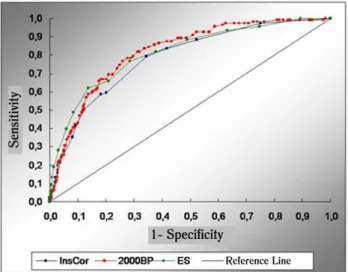
In Brazil, at the local level to merit the work of Cadore et al. [9] presented the first model for preoperative coronary surgery. At InCor-HCFMUSP remodeling all the model-2000Bernstein EuroSCORE and Parsonnet, through the bootstrap technique gave the InsCor [10,11]. This model has similar performance to the EuroSCORE and was simpler than this and that-Parsonnet 2000Bernstein to predict mortality in patients undergoing coronary and / or valve at InCor (Figure 1).
Omar Asdrúbal Vilca Mejía
1, Luiz Augusto Ferreira Lisboa
21 . Doctor of Science (Cardiovascular Surgery), School of Medicine, University of São Paulo (USP), São Paulo, Brazil.
2 . Professor in Cardiovascular Surgery FMUSP, São Paulo, Brazil.
DOI: 10.5935/1678-9741.20120032
But without doubt, the concept of BraSCORE ((Brazilian System for Cardiac Operative Risk Evaluation) goes further, will provide a predictive reference curve of the impact of the structure and resources available for programs on the results in morbidity and mortality of patients operated on cardiac surgery in Brazil. The BraSCORE will become the challenge to be overcome by teaching us the weaknesses of the practice.
Thus, from the InsCor to the BraSCORE there is a long, but important, way to go.
At the end, national or international reference, which will be easier, cheaper and appropriate?
Fig. 1 - ROC curve for InsCor (10 variables), the 2000Bernstein-Parsonnet (44 variables) and EuroSCORE (17 variables) in InCor-HCFMUSP
REFERENCES
1. Ribeiro AL, Gagliardi SP, Nogueira JL, Silveira LM, Colosimo EA, Nascimento CAL. Mortality related to cardiac surgery in Brazil, 2000-2003. J Thorac Cardiovasc Surg. 2006;131(4):907-9.
2. Nashef SA, Roques F, Michel P, Gauducheau E, Lemeshow S, Salamon R. European system for cardiac operative risk
evaluation (EuroSCORE). Eur J Cardiothorac Surg. 1999;16(1):9-13.
3. Jones RH, Hannan EL, Hammermeister KE, Delong ER, O’Connor GT, Luepker RV, et al. Identification of preoperative variables needed for risk adjustment of short-term mortality after coronary artery bypass graft surgery. The Working Group Panel on the Cooperative CABG Database Project. J Am Coll Cardiol. 1996;28(6):1478-87.
4. Tu JV, Sykora K, Naylor CD. Assessing the outcomes of coronary artery bypass graft surgery: how many risk factors are enough? Steering Committee of the Cardiac Care Network of Ontario. J Am Coll Cardiol. 1997;30(5):1317-23.
5. Ranucci M, Castelvecchio S, Conte M, Megliola G, Speziale G, Fiore F, et al. The easier, the better: age, creatinine, ejection fraction score for operative mortality risk stratification in a series of 29,659 patients undergoing elective cardiac surgery. J Thorac Cardiovasc Surg. 2011;142(3):581-6.
6. Austin PC, Tu JV. Bootstrap methods for developing predictive models. Am Stat. 2004;58(2):131-7.
7. Ivanov J, Tu JV, Naylor CD. Ready-made, recalibrated, or remodeled? Issues in the use of risk indexes for assessing mortality after coronary artery bypass graft surgery. Circulation. 1999;99(16):2098-104.
8. Nashef SA, Roques F, Sharples LD, Nilsson J, Smith C, Goldstone AR, et al. EuroSCORE II. Eur J Cardiothorac Surg. 2012;41(4):734-45.
9. Cadore MP, Guaragna JCVC, Anacker JFA, Albuquerque LC, Bodanese LC, Piccoli JCE, et al. Proposição de um escore de risco cirúrgico em pacientes submetidos à cirurgia de revascularização miocárdica. Rev Bras Cir Cardiovasc. 2010;25(4):447-56.
10. Mejía OAV. Predição de mortalidade em cirurgia de coronária e/ ou valva no InCor: validação de dois modelos externos e comparação com o modelo desenvolvido localmente (InsCor) [Tese de doutoramento]. São Paulo: Faculdade de Medicina, Universidade de São Paulo; 2012.
11. Mejía OAV, Lisboa LAF, Dallan LAO, Pomerantzeff PMA, Moreira LFP, Jatene FB, Stolf NAG. Validação do 2000 Bernstein-Parsonnet e EuroSCORE no Instituto do Coração-USP. Rev Bras Cir Cardiovasc. 2012;27(2):187-94.