*Correspondence: Elisangela da Costa Lima-Dellamora. Faculdade de Farmá-cia, Universidade Federal do Rio de Janeiro. Avenida Carlos Chagas Filho, 373 - Bloco L, subsolo, sala 28, Cidade Universitária, 21.941-902 - Rio de Janeiro, RJ - Brasil. E-mail: [email protected]
A
vol. 51, n. 1, jan./mar., 2015 http://dx.doi.org/10.1590/S1984-82502015000100017
The medicine selection process in four large university hospitals in
Brazil: Does the DTC have a role?
Elisangela da Costa Lima-Dellamora
1,2,*, Rosangela Caetano
3,
Claudia Garcia Serpa Osorio-de-Castro
21School of Pharmacy, Federal University of Rio de Janeiro, Brazil, 2 Sergio Arouca National School of Public Health, Post-Graduate Program, Oswaldo Cruz Foundation, Rio de Janeiro, Brazil, 3Social Medicine Institute,
State University of Rio de Janeiro, Rio de Janeiro, Brazil
Knowledge about evidence-based medicine selection and the role of the Drug and Therapeutics Committee (DTC) is an important topic in the literature but is scarcely discussed in Brazil. Our objective, using a qualitative design, was to analyze the medicine selection process performed in four large university hospitals in the state of Rio de Janeiro. Information was collected from documents, interviews with key informants and direct observations. Two dimensions were analyzed: the structural and organizational aspects of the selection process and the criteria and methods used in medicine selection. The indings showed that the DTC was active in two hospitals. The structure for decision-making was weak. DTC members had little experience in evidence-based selection, and their everyday functions did not inluence their participation in DTC activities. The methods used to evaluate evidence were inadequate. The uncritical adoption of new medicines in these complex hospital facilities may be hampering pharmaceutical services, with consequences for the entire health system. Although the qualitative approach considerably limits the extent to which the results can be extrapolated, we believe that our indings may be relevant to other university hospitals in the country.
Uniterms: Medicines/selection. Drug and Therapeutic Committees. University hospitals/medicines selection.
A produção de conhecimento sobre a seleção de medicamentos baseada em evidências e executada por Comissões de Farmácia e Terapêutica é ainda escassa no Brasil, apesar da ampla discussão sobre o tema em países desenvolvidos. Este estudo buscou conhecer e analisar os aspectos relacionados à seleção de medicamentos em quatro hospitais universitários de grande porte no Rio de Janeiro, por meio de abordagem qualitativa. Entrevistas, observação direta e análise documental instrumentaram a coleta de dados qualitativos e quantitativos. A análise considerou duas dimensões: (i) estrutura e organização para o processo de seleção e (ii) critérios e métodos utilizados para avaliação. Apenas dois hospitais possuíam Comissão de Farmácia e Terapêutica (CFT) ativa. A estrutura para a tomada de decisão era deiciente e os membros das Comissões apontaram pouca experiência e disponibilidade para a atividade. Os métodos de avaliação e critérios observados indicaram um processo de seleção acrítico nestes hospitais, comprometendo a assistência farmacêutica e potencialmente prejudicando o sistema de saúde. Apesar da metodologia qualitativa não permitir a extrapolação de resultados, é possível que este cenário seja parecido com o de outros hospitais universitários brasileiros.
INTRODUCTION
The rational use of health technologies – medicines, equipment and devices, medical and surgical procedures, organization and support systems (Brasil, 2010) – implies
that their selection must be satisfactory to justify inancing
decisions and also requires the identification of the conditions in which they must be used (Krauss-Silva, 2003). Clinical, social and economic impacts should be considered in terms of analyses of efficacy, safety and comparative cost-effectiveness. In the case of medicines, the World Health Organization states that activities linked to the selection process must be performed, either in institutions or in health systems, by the Drug and Therapeutics Committee (DTC), with the participation of health professionals with expertise in the assessment of
scientiic evidence (WHO, 2003).
The DTC must have clear goals, a firm mandate, support from institutional management or government, transparency in its procedures, wide representation, technical competence, multidisciplinary focus and
suficient resources to implement its decisions (WHO,
2003).
These Committees have several functions. Their main roles involve the evaluation and selection of medicines and the development hospital wise use of medicines policies, including guidelines and therapeutic monitoring (WHO, 2003). DTC activities are well established in most European countries, the USA, Canada and Australia.In Brazil, these committees are non-mandatory, and their implementation has not been forthcoming (Marques, Zucchi, 2006; Veberet al., 2011). A 2003 national assessment showed that a mere 29 (11%) of 250 investigated hospitals presented nominal DTCs, but operational DTCs were seen in only 3.6% of hospitals (Osorio-de-Castro, Castilho, 2004).
University hospitals have a central role in highly
complex health care. Due to this proile, they tend to adopt
new technologies (Medici, 2001). Theoretically, they are an adequate setting for health technology assessment and DTC membership. Clinical decision makers participating in the education of other health professionals and other stakeholders involved in health innovation are present in this setting.
Because the adoption of new technologies has very
important clinical and inancial impact for patients, health
institutions and systems, it is relevant to understand the selection process in greater depth. This process determines the technologies that will eventually be acquired and used. In terms of the adoption of new technologies, this generalization is especially true for tertiary Brazilian
university hospitals, which are perceived as playing a leadership role in the health system and where intense pharmaceutical marketing practices are ongoing (Palácios, Rego, Lino, 2008).
The principal trend-setters are hospitals located in the more developed Brazilian Southeast. These services are viewed as a gateway for the entire health system in terms of the adoption of new technologies. This study aims to analyze the medicine selection process in four tertiary university hospitals in the state of Rio de Janeiro.
METHODOLOGY
A multiple case study was conducted (Yin, 2005). The research involved the collection and analysis of quantitative and qualitative data, with the objective of understanding the role of the DTCs (if present), the alternative selection process (if no DTC existed), the perspectives of the actors involved and other underlying aspects related to the selection of medicines in these hospitals.
B r a z il h a s 3 9 t e r ti a r y u n i v e r si t y h o sp i t al s characterized by (a) a highly complex care profile, (b) the presence of multiple medical specialties and (c) a clinical body composed primarily of professors (Medici, 2001; Portela et al., 2004). Fifteen of these hospitals are in the Southeast. All tertiary university hospitals in the State of Rio de Janeiro were selected for study because of their geographical proximity and because of the size of the State´s population (16 million people) (Brasil, 2011; Abrahue, 2012; IBGE, 2012).
A reference matrix organized in dimensions — (i) structure and organization of the selection process and (ii) criteria and methods adopted — guided the collection, data analysis and presentation of results. This matrix was based on WHO recommendations on the evaluation and selection of medicines, on experiences in several countries (USA, Canada, United Kingdom, England, Spain, Denmark, Laos, Australia, Nepal, Sweden, Holland, Germany) reported in the scientific literature and on a national Brazilian gold standard institution (Lima-Dellamora et al., 2014).
A pilot study in a specialized 114-bed public teaching hospital was conducted to improve data collection instruments and procedures. A total of 27 visits were made to the selected hospitals between January and June, 2011. Data collection was accomplished through (i) document search, (ii) semi-structured interviews with key stakeholders and (iii) direct observation.
Information from hospital documents included
to the medicine selection process, such as an essential medicines list (EML); minutes of the DTC meetings; forms for requesting inclusion of medicines in the EML; requests for purchase of non-formulary medicines; forms or other documents related to medicines donations or medicines involved in clinical research; and other documents such as ordinances, statutes, internal communications, reports, studies or drug use evaluations and hospital pharmacy records.
The interviews were performed with 17 key stakeholders involved in the medicine selection process, such as hospital managers (general director and/or clinical director), heads of hospital pharmacy services and DTC members. All signed an informed consent form.
Direct observation of the DTC meetings was important in understanding the subtleties of the environment and the workings of the selection process. All information on (a) the structure and organization used for selection, (b) membership and participation criteria, (c) roles and responsibilities, (d) criteria, and (e) methods used throughout the drug evaluation process was recorded in a
ield journal, facilitating comparisons with information in
documents and interviews.
T h e a n a l y s i s w a s p r e c e d e d b y a t h o r o u g h organization of information based on dimensions (hereafter termed categories) in the reference framework. The interviews were analyzed based on content analysis,
irst by identiication of a set of central nuclei (Bardin,
2002) and subsequently organized in the pre-established categories and compared to the framework (Lima-Dellamora et al., 2014).
The project was approved by the National Public Health School Ethics in Research Committee.
RESULTS
The four hospitals selected were coded as A, B,
C and D to make their identiication more dificult. The
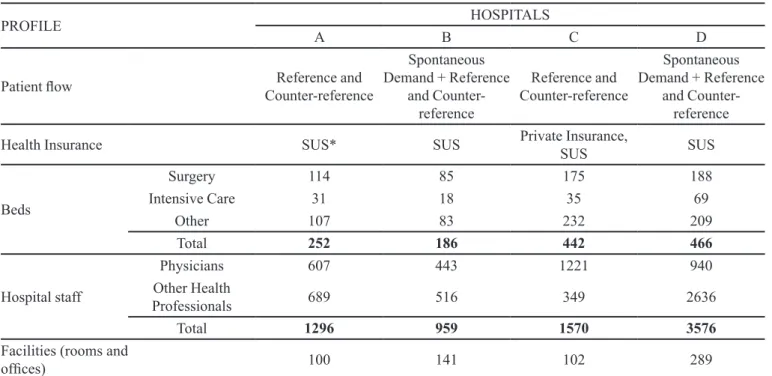
number of beds varied from 186 to 466 (Table I). All facilities had wards for highly complex care in Oncology, Nephrology, Neurology, Critical Care and Orthopedics. Three hospitals offered transplant services.
The ratio between the number of physicians and the number of beds was relatively homogeneous – between 2 (hospital D) and 2.76 (hospital C) – whereas the total number of health professionals per bed varied from 3.55 (hospital C) to 7.67 (hospital D).
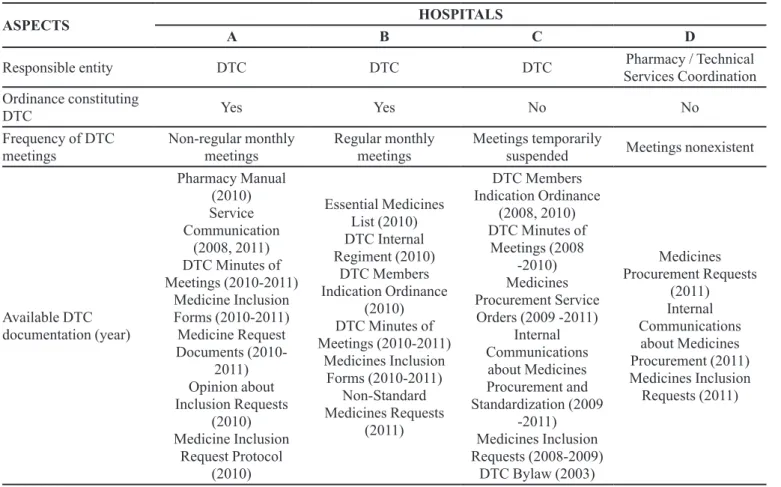
The DTC was cited as responsible for the process of selecting medicines in hospitals A, B and C but was
oficial only in A and B (Table II). In hospital C, the DTC
activities had been suspended, as mentioned by one of the interviewees:
The DTC selected [the medicines]. But this routine was subverted; (…) the DTC has stopped its
ac-TABLE I - Care proile of large, highly complex university hospitals. State of Rio de Janeiro, 2011
PROFILE HOSPITALS
A B C D
Patient low Reference and
Counter-reference
Spontaneous Demand + Reference
and Counter-reference
Reference and Counter-reference
Spontaneous Demand + Reference
and Counter-reference
Health Insurance SUS* SUS Private Insurance,
SUS SUS
Beds
Surgery 114 85 175 188
Intensive Care 31 18 35 69
Other 107 83 232 209
Total 252 186 442 466
Hospital staff
Physicians 607 443 1221 940
Other Health
Professionals 689 516 349 2636
Total 1296 959 1570 3576
Facilities (rooms and
ofices) 100 141 102 289
tivities. [As in the case of] clopidogrel: Cardiology requested it and Management suffered pressure to adopt it without any kind of evaluation (Interviewee 13).
In Hospital D, Pharmacy Services Management was responsible for decisions on medicine selection.
The Pharmacy selects the medicines. But it’s confus-ing; [actually] there are several other ways in which medicines are adopted here (Interviewee 17).
Structural and organizational aspects of the selection process
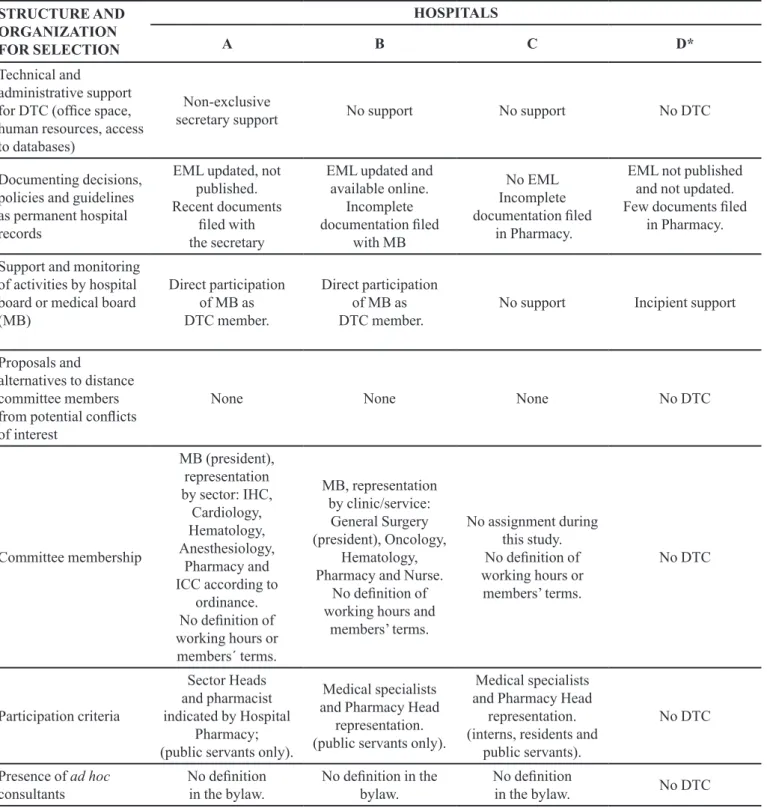
The results are presented in Table 3 (DTC structure and membership) and Table 4 (DTC functions). Important limitations were observed regarding DTC organization in cases in which this committee was present. In hospital D, information about the organization of the selection process within the Hospital Pharmacy was sought but was nonexistent (Table III).
In hospitals A and B, DTC meetings were held in the Board Room, which appeared to make activities more
dificult due to a work environment that did not meet the
needs of the DTC:
We lack a meeting room, equipment, a computer (...). So, it’s tough (Interviewee 9).
The DTCs of hospitals A and B had up-to-date statutes and procedures. In these same hospitals, there had been at least one DTC meeting within the six-month data collection period. Hospital management followed up activities. When questioned, however, managers did not produce even rough estimates of the yearly expenditures on medicines.
The DTCs of hospitals A and B had, on average, eight members, including doctors, nurses and pharmacists. Professors or department heads of Internal Medicine, Surgery, Oncology and Infectious Diseases (or the Hospital Infection Control Committee) usually represented the medical specialties. The Committees had no clinical pharmacologists.
All members, without exception, mentioned the inability to reconcile their work routines and DTC demands. The members prioritized other activities,
indicating this as one of their main dificulties:
TABLE II - Responsibilities pertaining to medicine selection in university hospitals. State of Rio de Janeiro, 2011
ASPECTS HOSPITALS
A B C D
Responsible entity DTC DTC DTC Pharmacy / Technical
Services Coordination Ordinance constituting
DTC Yes Yes No No
Frequency of DTC meetings
Non-regular monthly meetings
Regular monthly meetings
Meetings temporarily
suspended Meetings nonexistent
Available DTC documentation (year)
Pharmacy Manual (2010) Service Communication
(2008, 2011) DTC Minutes of Meetings (2010-2011)
Medicine Inclusion Forms (2010-2011) Medicine Request Documents
(2010-2011) Opinion about Inclusion Requests
(2010) Medicine Inclusion
Request Protocol (2010)
Essential Medicines List (2010) DTC Internal Regiment (2010)
DTC Members Indication Ordinance
(2010) DTC Minutes of Meetings (2010-2011)
Medicines Inclusion Forms (2010-2011)
Non-Standard Medicines Requests
(2011)
DTC Members Indication Ordinance
(2008, 2010) DTC Minutes of
Meetings (2008 -2010) Medicines Procurement Service
Orders (2009 -2011) Internal Communications
about Medicines Procurement and Standardization (2009
-2011) Medicines Inclusion Requests (2008-2009)
DTC Bylaw (2003)
Medicines Procurement Requests
(2011) Internal Communications
about Medicines Procurement (2011) Medicines Inclusion
TABLE III - Structure and organization of DTCs (or other) related to medicine selections in university hospitals. State of Rio de Janeiro, 2011
STRUCTURE AND ORGANIZATION FOR SELECTION
HOSPITALS
A B C D*
Technical and
administrative support for DTC (ofice space, human resources, access to databases)
Non-exclusive
secretary support No support No support No DTC
Documenting decisions, policies and guidelines as permanent hospital records
EML updated, not published. Recent documents
iled with the secretary
EML updated and available online.
Incomplete documentation iled
with MB
No EML Incomplete documentation iled
in Pharmacy.
EML not published and not updated. Few documents iled
in Pharmacy.
Support and monitoring of activities by hospital board or medical board (MB)
Direct participation of MB as DTC member.
Direct participation of MB as DTC member.
No support Incipient support
Proposals and
alternatives to distance committee members from potential conlicts of interest
None None None No DTC
Committee membership
MB (president), representation by sector: IHC,
Cardiology, Hematology, Anesthesiology,
Pharmacy and ICC according to
ordinance. No deinition of working hours or members´ terms.
MB, representation by clinic/service:
General Surgery (president), Oncology,
Hematology, Pharmacy and Nurse.
No deinition of working hours and
members’ terms.
No assignment during this study. No deinition of working hours or
members’ terms.
No DTC
Participation criteria
Sector Heads and pharmacist indicated by Hospital
Pharmacy; (public servants only).
Medical specialists and Pharmacy Head
representation. (public servants only).
Medical specialists and Pharmacy Head
representation. (interns, residents and
public servants).
No DTC
Presence of ad hoc
consultants
No deinition in the bylaw.
No deinition in the bylaw.
No deinition
in the bylaw. No DTC
MB: Medical Board, IHC: Intensive Health Care; ICC: Infection Control Committee, EML: Essential Medicines List.
The committee demands more time than I have to offer. This is a constant problem for everyone. We meet very seldom, even when there is an external demand (Interviewee 3)
Membership requirements ignored the minimum criteria regarding members’ theoretical knowledge of medicine selection or experience in evidence-based evaluation:
I got into this committee out of the blue (Interviewee 8).
I became a member and, you know, it’s not
neces-sarily because you it the proile. There is no one
else, so you have to go, to ensure the representation
(Interviewee 9).
Further difficulties regarded unjustified member absenteeism and vacations taken by individual members or by a majority of the group at the same time. At hospital C, documents sent to the hospital management by the DTC president, transmitted the previous year, brought complaints to light regarding the lack of members’ participation in meetings.
In the rules or statutes of the DTCs of hospitals A, B and C, the collaboration of specialists and researchers, both internal and external (ad hoc), was not foreseen. In none of the hospitals was the use of strategies for controlling possible conflicts of interest regarding medicines mentioned by any of the interviewees.
Only hospital A appeared to perform most of the functions foreseen for the DTC (Table IV). In hospital C, medicines use policies that had been developed in the
past were not followed. In hospitals B and D, deinitions
of therapeutic protocols and guidelines and of medicines use policies had not been established.
None of the DTCs aided the health care staff regarding information on medicines.
Criteria and methods used in medicine selection
The inclusion of medicines in the EML was limited to discussions, with little depth regarding the arguments presented by the applicant. In hospitals A and B, selection criteria were, at least, mentioned in the DTC statutes. One of the DTC members in hospital B reinforced the feeling that the implementation of selection criteria in the
institution was conducted only supericially.
We do as follows: we have a list of medicines. If the patient has a disease and the drug for it is listed, we accept the patient. If we don’t have the drug, we say that the drug of choice is not in the hospital´s EML
[and turn the patient away], see? (Interviewee 11).
No methods were observed for comparisons of
beneits and risks between the medicines suggested for
inclusion in the EML and those already on the list. The
only pre-existing condition for the request to be accepted for analysis was that it be accompanied by some type of literature:
(...) at the moment when an application for inclu-sion shows up, if it is accompanied by literature, the tendency is to approve [it](...) This new drug, due to the cost, may not be available at all times, but we do include it (Interviewee 8).
In hospital A, the evaluation of inclusion requests by the DTC would occur only after an evaluation feedback made by one of its members. However, the reviewer´s evaluation was always accepted without any debate by the other members. The requests submitted by DTC members were not passed on to reviewers. The medicine´s inclusion in the EML was automatic and became official at the following meeting.
In hospital B, neither analysis of inclusion requests by members nor a standardized review form were planned as minimum requirements in the evaluation process.
(...) when we are analyzing a scientiic paper, we must
have someone to draft the main results and show it to us. (...) the members don’t have time for that (…) it ends up as a task of the applicant, and he (or she) will give you the information (Interviewee 11).
The analysis of evidence never included the investigation of the quality of evidence (i.e., sample size and methodology, internal validity) or external validity of the studies. One of the interviewees noted that these analyses would not be feasible in Brazilian hospitals:
This is all very nice, but it’s not for us, OK? It’s not for Brazil. No one in this country can manage what the WHO recommends. (Interviewee 12)
The lack of organization and method in the evaluation process result in the insecurity of members when they are confronted with the need to make a selection decision:
I can tell you there is no script, no dynamics for the evaluation (...) I felt unprepared for positioning myself strongly (Interviewee 13).
In hospitals C and D, medicine selection was based on written demands for the purchase of certain drugs, either as prescriptions or signed requests sent to the Pharmacy Service:
expensive, I don’t decide it on my own, I send the request to my boss (Interviewee 17).
DISCUSSION
The selection of essential medicines represents one of the most important institutional policies for the rational use of medicines in health services (WHO, 2002). Observed together, other pharmaceutical services – forecasting, procurement, stockage, distribution, drug utilization (prescribing, dispensing and use) – are based on the list produced by the selection process. The critical, independent, comparative and transparent evaluation of the available options must precede decision-making. The
process reaches its goal with the selection of eficient, safe technologies for the proile of the population under care
(Gustafsson et al., 2011). However, meeting these criteria demands the structuring of DTCs that are aware of and committed to this crucial activity.
In the four large university hospitals that were studied, several common barriers were found: (i) very poor structural conditions and limited resources for the work of the DTC, (ii) nonexistence of participation criteria for the DTC members, (iii) very limited availability of the members for DTC functions and lack of regular attendance at meetings, (iv) little knowledge or understanding by DTC members about their functions in the evaluation process, (v) lack of expertise by members
for performing all DTC functions and (vi) supericial
monitoring of the DTC activities by the hospital managements.
Recent studies (Marinho, 2003; Azevedo, Fernandes, Carreteiro, 2007; Bittencourt, Hortale, 2007) have highlighted grave problems related to the management,
quality and eficiency of the care of patients hospitalized
in the state of Rio de Janeiro. The precarious structures of the hospital DTCs indicate that the context in these large complex-care hospitals is very similar but certainly more serious given their nature as centers for specialized care.
The actual conditions of the medicine selection process in all four hospitals, made clear by the statements of the stakeholders, reinforce the dire situation of the DTCs in these university hospitals, mainly because the minimum requirements for DTCs have been discussed throughout the world for more than 30 years (Lima et al., 2010). One of the first documents on the selection of medicines in Brazil was developed by the Ministry of Education, under which university hospitals are organized. This 1986 document discussed the implementation of DTCs in university hospitals. This fact is paradoxical and worrisome: in 27 years, highly complex care evolved, intense adoption of health technologies occurred, but little has changed in these hospitals.
The decadent infrastructure of Brazilian university hospitals is one of the most acute expressions of the crisis these institutions have experienced over the years (Guimarães, 2004). Discussing the bases for a national health, science and technology and innovation policy,
TABLE IV - Functions related to medicine selection in university hospitals. State of Rio de Janeiro, 2011
DTC ROLES AND RESPONSIBILITIES
HOSPITALS
A B C D
Assessment and
selection of medicines No monthly regularity. Poor evaluation.
Monthly meetings. Poor evaluation.
Suspended during the
period of this study. Not done
Drafting of list as inal product of medicine
selection Yes Yes Not done Not done
Developing drug use policies
Only deined for anti-infectives or for special unlisted under-protocol
medicines
Not done Deined but not followed. Not done
Developing and monitoring therapeutic guidelines
Related to the use of anti-infectives by the
HIC.
Not done Not done Not done
Dissemination of information on medicines to hospital clinical board
Guimarães (2004) mentions the asymmetry between health
beneits and costs and the speed at which health knowledge produced for the beneit of the population is appropriated.
Another aspect of this crisis is the decrease in working hours of the best professionals in the hospital. This issue relates to DTC membership in the hospitals. Meeting attendance by members must be a requirement for the renewal of the member mandate in the DTC (WHO, 2003).
Stakeholders’ perceptions regarding their role in the
DTC indicates insuficient knowledge about committee
functions. Without organized planning and monitoring of the selection process of new therapeutic options, absolute inertia by managers may be observed, and rational drug use is abandoned altogether.
A study on individual lawsuits demanding medicines in the State of Rio de Janeiro observed that in 2006, 22% of the Brazilian Health System (SUS) medical prescriptions present in lawsuits originated in university hospitals (Sant’ana et al., 2011). This access strategy may be justiied
if needed medicines are not available in the system or if there has been tardiness in adoption. Nevertheless, health litigation may also promote the unwise or hasty adoption of
new technologies of doubtful eficacy or untoward harmful effects of those without an established safety proile. This
scenario allows for greater expenses and ineffectiveness of health care while making institutions more prone to the pharmaceutical industry´s marketing interests (Chieffi, Barata, 2010). As the results of this study showed, many stakeholders do not have the necessary skills to counter
industry inluence or the will to participate more fully in
DTC functions, which could help prepare them for an
adequate selection process. Moreover, no conlict of interest
policies were observed for these committees, making
members easy targets for undue inluences.
During the analysis, we observed that the DTCs showed a vicious cycle of implementation. As hospital management teams changed over the years, all institutional policies regarding the use of medicines were constantly rebuilt and lost repeatedly. Some memory of past achievements existed in two hospitals, linked to members from the pharmacy services, but there had been no critical appraisal of these achievements.
The interviewees mentioned efficacy, safety and
cost as criteria for selection. Comparative, user
proile-sensitive, needs- and evidence-based evaluation of medicines should have been the basis for the selection process (WHO, 2003). However, we observed that the DTC members were, in fact, exempting themselves from an in-depth analysis of the selection criteria, favoring, instead, political relations in the hospital as a ‘substitute’ criterion. The power behind the decision-making process
on the adoption of health technologies in hospitals has been referred to in the literature, and university hospitals are the sites at which power struggles are prone to have
consequences that may relect on the health system as a
whole (Cecilio, 1999; Medici 2001).
Even if the ‘power-based’ decision-making process was not primarily sensitive to need, it was very sensitive to the cost of the drugs to be included in the EML. This awareness was observed in two hospitals (B and D). In both cases, however, special efforts to counter a possible ‘no inclusion’ decision were made by the manufacturers to empower the inclusion request. Interviewees mentioned these events. They were meant to convince larger numbers of health professionals within the institution and make way for the use and, lastly, inclusion of the drugs. This strategy is commonly used by the pharmaceutical industry (Angell, 2007).
The inability to manage effectively high-cost technologies in large institutions is similar to other cases studied in Brazil (Scheffer, 2008; Sancho, Vargens, 2009). Gertner (2010) followed up on the economic analyses performed by a company working for the pharmaceutical
industry, showing that artiicial demand was built for a
new technology within the system, thus creating a market where there was none before. This situation is very distant from health priorities.
The Brazilian Network for Health Technology Assessment (HTA) – Rebrats5 – seeks to stimulate HTA
hubs in teaching hospitals, introducing the HTA culture and training human resources for the activity (Brasil, 2000, 2010; Getner, 2010 – include reference). During the selection process, DTCs should follow all important HTA criteria. However, the results from the DTCs in hospitals A, B, C and D show their inability to act as influential groups to prioritize and promote the discussion of HTA.
CONCLUSIONS
To deny the importance of DTCs for the Brazilian Health System is to disregard the fact that a cautious
decision-making process is vital for eficacious, safe and
cost-effective health care.
Eficacy, safety and cost were the principal criteria
mentioned by the stakeholders involved in the process of medicines adoption in the hospitals. However, the analysis and interpretation of the results of this study indicate that decision-making is not, in fact, evidence-based and does not follow the above-mentioned criteria. Aspects such as the position or status of the health professional requesting inclusion of the medicine in the EML and
industry inluences may be contributing to the adoption of
medicines. Moreover, the actual need for the technology appears to be viewed as less important.
University hospitals house an important array of new or highly complex technologies for SUS. This study contributed to the provision of relevant information about medicine selection in the state of Rio de Janeiro, especially of the process taking place in important teaching hospitals, which are trend-setters for the health system. While the results cannot be directly applied to other hospitals, we
suggest that similar dificulties and barriers can be found
in other facilities in the country.
Therefore, the selection process for new medicines
performed in these hospitals must be carefully veriied,
and the flaws must be corrected. In the absence of the essential requirements for medicine selection long pointed
out by the WHO, the irst of which is the role of the DTC,
the health system will remain hostage to the non-critical adoption of health technologies, strengthening the undue
inluence of the pharmaceutical industry, increasing health
costs and producing risks for patients.
REFERENCES
ANGELL, M. A verdade sobre os laboratórios farmacêuticos. Ed. Record: São Paulo, 2007. 319 p.
A S S O C I A Ç Ã O B R A S I L E I R A D E H O S P I TA I S UNIVERSITÁRIOS E DE ENSINO. ABRAHUE. Available at <http://www.abrahue.org.br/>. Accessed on 10 Dec., 2012.
AZEVEDO, C. S.; FERNANDES, M. I. A.; CARRETEIRO, T. C. Sob o domínio da urgência: a prática de diretores de hospitais públicos do Rio de Janeiro, Brasil. Cad. Saúde Pública, v.23, n.10, p.2410-2420, 2007.
BARDIN, L. Análise de conteúdo. Lisboa: Edições 70, 2002. 174 p.
BITTENCOURT, R. J.; HORTALE, V. A. A qualidade nos serviços de emergência de hospitais públicos e algumas considerações sobre a conjuntura recente no município do Rio de Janeiro. Ciên. Saúde Col., v.12, n.4, p.929-934, 2007.
BRASIL. Ministério da Saúde – Informes Técnicos Institucionais - Política Nacional de Medicamentos. Rev. Saúde Pública,
v.34, n.2, p.206-209, 2000.
BRASIL. Ministério da Saúde. Cadastro nacional de estabelecimentos de saúde. Brasília: Ministério da Saúde, 2011. Available at: <http://cnes.datasus.gov.br>. Accessed on: 2 Feb. 2011.
BRASIL. Ministério da Saúde. Política Nacional de Gestão de Tecnologias em Saúde / Ministério da Saúde, Secretaria de Ciência, Tecnologia e Insumos Estratégicos, Departamento de Ciência e Tecnologia. – Brasília: 2010. 48p. – (Série B. Textos Básicos em Saúde).
CECILIO, L. C. O. Autonomy versus worker’s control: power management in the hospital. Ciênc. Saúde Col., v.4, n.2, p.315-329, 1999.
CHIEFFI, A. L.; BARATA, R. C. B. Ações judiciais: estratégia da indústria farmacêutica para introdução de novos medicamentos. Rev. Saúde Pública, v.44, n.3, p.421-9, 2010.
GERTNER, A. Science of uncertainty: making cases for drug incorporation in Brazil. Anthropol. Quart., v. 83, n.1, p.97-122, 2010.
GUIMARÃES, J. A. A pesquisa médica e biomédica no Brasil. Comparações com o desempenho científico brasileiro e mundial. Ciênc. Saúde Col., v.9, n.2, p.303-327, 2004.
IBGE. INSTITUTO BRASILEIRO DE GEOGRAFIA E ESTATÍSTICA. 2012. Available at <http://www.ibge.gov. br/home/>. Accessed on: 10 Dec. 2012.
LIMA-DELLAMORA, E. C.; CAETANO R.; GUSTAFSSON, L. L.; GODMAN, B. B.; PATTERSON, K.; OSORIO-DE-CASTRO, C. G. S. An analytical framework for assessing drug and therapeutics committee structure and work processes in tertiary Brazilian hospitals. Basic Clin. Pharmacol. Toxicol., v.115, n.3, 2014.
LIMA, E. C.; SANDES, V. S.; CAETANO, R.; OSORIO-DE-CASTRO, C. G. S. Incorporação e gasto com medicamentos de alta relevância inanceira. Cad. Saúde Coletiva, v.18, n.4, p.551-559, 2010.
KRAUSS-SILVA, L. Avaliação tecnológica e análise custo-efetividade em saúde: a incorporação de tecnologias e a produção de diretrizes clínicas para o SUS. Ciênc. Saúde Col., v.8, n.2, p.501-520, 2003.
MARINHO, A. Avaliação da eiciência técnica nos serviços de saúde nos municípios do Estado do Rio de Janeiro. Rev. Bras. Econ., v.57, n.3, p.515-534, 2003.
MARQUES, D. C.; ZUCCHI, P. Comissões farmacoterapêuticas no Brasil: aquém das diretrizes internacionais. Rev. Panam. Salud Publica, v.19, n.1, p.58-63, 2006.
MEDICI, A. C. University hospitals: past, present and future.
Rev. Ass. Med. Brasil, v.47, n.2, p.149-156, 2001.
OSORIO-DE-CASTRO, C. G. S.; CASTILHO, S. R. (Orgs.).
Diagnóstico da farmácia hospitalar no Brasil. Escola Nacional de Saúde Pública. Rio de Janeiro: Fundação Oswaldo Cruz, 2004. 150 p.
PALÁCIOS, M.; REGO, S.; LINO, M. H. Promoção e propaganda de medicamentos em ambientes de ensino: elementos para o debate. Interface (Botucatu), v.12, n.27, p.893-905, 2008.
PORTELA, M. C.; LIMA, S. M. L., BARBOSA, P. R.; VASCONCELOS, M. M.; UGÁ, M. A. D.; GERSCHMAN, S. Caracterização assistencial de hospitais ilantrópicos no Brasil. Rev. Saúde Publica, v.36, n.6, p.811-818, 2004.
SANCHO, L. G.; VARGENS, J. M. C. Avaliação econômica em saúde na esfera de atenção local à saúde. Ciênc. Saúde Col., v.14, supl.1, p.1513-1521, 2009.
SANT’ANA, J. M. B.; PEPE, V. L. E.; FIGUEIREDO, T. A.; OSORIO-DE-CASTRO, C.G.S.; VENTURA, M. Rational therapeutics: health related elements in lawsuits demanding medicines. Rev. Saúde Pública, v.45, n.4, p.714-721, 2011.
SCHEFFER, M. C. Aids, tecnologia e acesso sustentável a medicamentos: a incorporação dos anti-retrovirais no Sistema Único de Saúde. São Paulo, 2008. [Thesis of Master Degree. Faculty of Medicine. University of São Paulo]. 238 p.
VEBER, A. P.; DIEHL, E; LEITE, S. N.; PROSPERO, E. N. S. Pharmaceutical assistance in local public health services in Santa Catarina (Brazil). Braz. J. Pharm. Sci., v.47, n.1, p.75-81, 2011.
WORLD HEALTH ORGANIZATION. WHO. Selección de medicamentos esenciales. In: Perspectivas políticas sobre medicamentos de la OMS. Ginebra, 2002. p.1-6.
WORLD HEALTH ORGANIZATION. WHO. Drug and therapeutics committees: a practical guide Department of Essential Drugs and Medicines Policy. Geneva; WHO, 2003. 146 p.
YIN, R. K. Estudo de caso: planejamento e métodos. Porto Alegre: Ed. Bookman, 2005. 270 p.