A Case on Food Delivery Transformation in Lisbon and
Berlin – The Effect of Digital Adoption on Consumer
Online Purchasing Behavior
Alina Emilie Dolibog
Dissertation written under the supervision of Professor João Ribeiro da Costa
Dissertation submitted in partial fulfillment of requirements for the MSc in Management with Specialization in Strategy & Entrepreneurship, at the Universidade Católica Portuguesa,
Abstract
With the increase of convenience service offers responding to shifting consumer demands, online food delivery has gained relevance in recent years, and just now receives accelerated importance due to the COVID-19 pandemic. This work illustrates technological and cultural differences regarding food between the capitals of Portugal and Germany. Restaurants in Lisbon and Berlin need to realize the existential meaning of (digital) changes in consumer behavior concerning new generations of customers who grow up as digital natives, especially in the current crisis. Third-party online ordering platforms might take advantage of consumers’ faster food and digital adoption in the long run. Convenience was found to be a critical driver of shifts in consumers’ online food ordering behavior.
This research examines effects for Portuguese and German digital natives in Lisbon and Berlin. Therein, it studies the direct impact of personal digital maturity on third-party online ordering maturity, third-party online ordering overall enjoyment, online shopping maturity, and online shopping spending. Further, the moderating effect of Hofstede’s individualism dimension, as well as the mediating effect of online shopping enjoyment, are explored. Results indicate that digital maturity has an impact on all variables except online shopping spending. Therein, highly digitally mature respondents show higher frequencies of third-party online ordering and online shopping, as well as higher enjoyment of third-party online ordering. Individualism significantly moderates the effect for online shopping spending. It is found that highly digitally mature Germans spend more money than Portuguese. Online shopping enjoyment mediates the impact for all dependent variables.
Keywords: digital transformation of industries, online food delivery, personal digital maturity,
third-party online ordering, maturity, enjoyment, online shopping, spending, individualism, COVID-19
Title: A Case on Food Delivery Transformation in Lisbon and Berlin – The Effect of Digital
Adoption on Consumer Online Purchasing Behavior
Resumo
Com o aumento da oferta de serviços de conveniência em resposta às alterações dos padrões de procura, os serviços de entrega de comida na internet ganharam relevância nos últimos anos. A pandemia COVID-19 veio acelerar este processo. Neste trabalho analisam-se as diferenças tecnológicas e culturais relativas a comida entre as capitais de Portugal e Alemanha. Os restaurantes em Lisboa e Berlim devem tomar consciência do alcance das alterações nos padrões de consumo nas novas gerações, que cresceram como nativos digitais. As plataformas de encomenda de comida na internet podem tirar vantagem da adopção cada vez mais rápida de serviços digitais por parte dos consumidores, a longo prazo.
Esta investigação estuda o impacto da maturidade digital individual na utilização de serviços de compras na internet, na sua fruição, maturidade e no dispêndio nessas compras. Adicionalmente explora o efeito moderador da dimensão de individualismo de Hofstede, bem como o efeito de mediação da fruição das compras. Os resultados mostram que a maturidade digital tem impacto em todas as variáveis, excepto no dispêndio em compras. Os inquiridos com níveis mais elevados de maturidade digital evidenciam frequências mais elevadas de compras de comida e de compras, bem como uma fruição mais elevada na compra de comida nas plataformas na internet. Conclui-se que o individualismo tem um efeito moderador significativo no nível de dispêndio em compras, que os alemães com maior maturidade digital dispendem mais que os portugueses e que o nível de fruição das compras tem um efeito moderador no impacto das variáveis dependentes.
Palavras chave: transformação digital, serviços de entrega de comida na internet, maturidade
digital pessoal, encomenda em plataformas na internet, fruição, compras na internet, individualismo, COVID19
Titulo: Caso de estudo dos serviços de entrega de comida em Lisboa e Berlim – o efeito da
adopção do digital nos comportamentos em compras na internet
Acknowledgments
I want to take this opportunity to express my sincerest gratitude to my supervisor Professor João Ribeiro da Costa. Throughout this process, he has provided me with continuous support, challenged my way of thinking, and inspired me with his positivity. Thank you for sharing the passion for food and digital, and letting me peek into the current wave of food delivery transformation.
Further, I would like to give my thanks to Professor Vera Herédia-Colaço for her support, availability, and guidance.
A big thank you goes to all my interview partners for sharing their valuable expertise, insights, and time with me. Ana Rita Garcia, Ava Ghaiumy, Filipe Amoroso, Alexej Habinski, Paulo Gonçalves Salvador, Maximilian Hinz, and my anonymous source have tremendously contributed to the foundation of this thesis.
Last but most certainly not least, I want to acknowledge my family, friends, and the special someones in my life. Thank you to my family, who has supported and encouraged me unconditionally during my academic journey, and always believed in me every step of the way. Thank you to my friends for your patience and support during this process. Thank you to the special people in my life for always being there for me.
Table of Content ABSTRACT ... I RESUMO ... II ACKNOWLEDGMENTS ... III LIST OF TABLES ... VI LIST OF FIGURES ... VI ABBREVIATIONS ... VII 1 INTRODUCTION ... - 1 - 1.1 RELEVANCE ... - 1 -
1.2 OBJECTIVES AND RESEARCH QUESTIONS ... - 1 -
2 CASE ... - 2 -
2.1 A PERSPECTIVE ... - 2 -
2.1.1 E-Commerce Market Overview ... - 3 -
2.1.2 Food Delivery and Delivery Models ... - 4 -
2.1.3 The new Consumer’s Profile ... - 7 -
2.2 DIGITAL TRANSFORMATION IN BUSINESSES AND INDUSTRIES ... - 7 -
2.2.1 Definition ... - 7 -
2.2.2 Meaning, Opportunities and Threats ... - 8 -
2.2.3 Digital Transformation of Restaurants Through OFD ... - 9 -
2.3 DIFFERENCES IN DIGITAL TRANSFORMATION BETWEEN LISBON AND BERLIN ... - 10 -
2.3.1 Technological Landscape ... - 10 -
2.3.2 Cultural Landscape ... - 11 -
2.3.3 Culinary Landscape ... - 12 -
2.4 TRENDS WITHIN OFD ... - 13 -
2.5 INDUSTRY OUTLOOK – BEFORE COVID-19 ... - 14 -
3 LITERATURE REVIEW ... - 15 -
3.1 E-COMMERCE AND E-SERVICES ... - 15 -
3.2 HEDONIC MOTIVATION ... - 15 -
3.3 TECHNOLOGICAL ADOPTION AND DIGITAL MATURITY ... - 16 -
3.4 CULTURE ... - 17 -
4. CONCEPTUAL FRAMEWORK AND HYPOTHESES ... - 17 -
4.1 HYPOTHESES ... - 18 -
5. METHODOLOGY AND DATA COLLECTION ... - 20 -
5.1 RESEARCH METHOD ... - 20 -
5.2 SAMPLING ... - 20 -
5.3 RESEARCH INSTRUMENTS ... - 21 -
5.4 DESIGN AND PROCEDURE ... - 21 -
5.5 VARIABLE DESCRIPTION ... - 22 -
6. ANALYSIS AND RESULTS ... - 24 -
6.1 SAMPLE CHARACTERIZATION ... - 24 -
6.2 MAIN RESULTS ... - 25 -
6.2.1 The Impact of Personal Digital Maturity on Online Purchasing Attitudes and Actual Shopping Behavior ... - 25 -
6.2.3 The Mediating Effect of Online Shopping Enjoyment ... - 28 -
7 ANALYSIS CONCLUSION, IMPLICATIONS AND LIMITATIONS ... - 30 -
7.1 IMPLICATIONS ... - 31 -
7.1.1 Theoretical Implications ... - 31 -
7.1.2 Practical Implications ... - 32 -
7.2 LIMITATIONS AND FUTURE RESEARCH ... - 32 -
8 FINAL CONCLUSION WITH FIRST IMPLICATIONS OF COVID-19 ON CONSUMERS, RESTAURANTS AND TPOO PLATFORMS ... - 33 -
APPENDICES ... - 36 -
APPENDIX A: FOOD DELIVERY EVOLUTION TIMELINE IN BERLIN ... - 36 -
APPENDIX B: FOOD DELIVERY EVOLUTION TIMELINE IN LISBON ... - 36 -
APPENDIX C: HOFSTEDE'S (2020) COUNTRY COMPARISON - GERMANY AND PORTUGAL ... - 37 -
APPENDIX D: INDIVIDUALISM CALCULATION BASED ON HOFSTEDE & MINKOV (2013B) ... - 37 -
APPENDIX E: MAIN STUDY - STUDY 1 - SURVEY QUESTIONS ... - 38 -
APPENDIX F: MAIN STUDY - STUDY 2 - SURVEY QUESTIONS... - 45 -
APPENDIX G: CALCULATION OF PDMI ... - 52 -
APPENDIX H: FLYER ADVERTISING RESTAURANT DELIVERY (BERLIN) (31.05.2020) ... - 53 -
APPENDIX I: TIM RAUE'S ONLINE ADVERTISEMENT FOR DELIVERY-ONLY MENU (02.06.2020) - 53 - APPENDIX J: BAIRRO DO AVILLEZ’ ONLINE ADVERTISEMENT FOR DELIVERY-ONLY MENU (23.04.2020) ... - 54 -
APPENDIX K: INTERVIEW SUMMARIES ... - 54 -
Appendix Ka: Filipe Amoroso, E-Commerce Manager (Central de Cervejas e Bebidas) - 24.02.2020 ... - 54 -
Appendix Kb: Ana Rita Garcia, Craft & Varieties Brand Manager (Central de Cervejas e Bebidas) - 28.02.2020 ... - 55 -
Appendix Kc: Alexej Habinski, former Global Director of Performance Marketing (Foodora) - 10.03.2020 ... - 56 -
Appendix Kd: Paulo Gonçalves Salvador, Operations & Logistics Manager (José Avillez Group) - 23.04.2020 ... - 58 -
Appendix Ke: Anonymous, Online Food Delivery Expert in Lisbon - 04.05.2020 ... - 59 -
Appendix Kf: Ava Ghaiumy, Regional Director Global Food Services (Delivery Hero SE) - 26.05.2020 ... - 60 -
Appendix Kg: Maximilian Hinz, Managing Director (Bloom Partners) - 27.05.2020 ... - 61 -
List of Tables
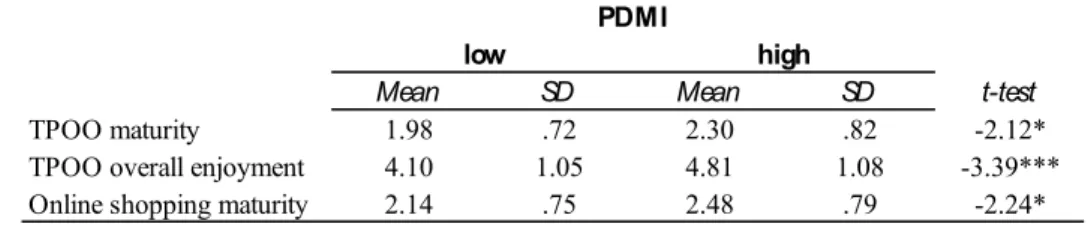
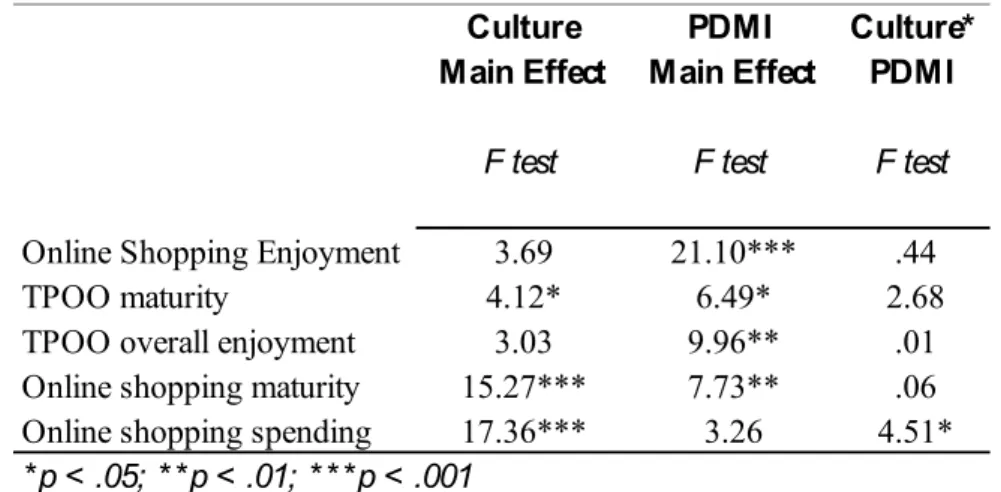
Table 1: Results for the One-way Interaction of PDMI ... - 25 - Table 2: Results for Independent Sample’s t-test of PDMI on Dependent Variables ... - 26 - Table 3: Results for the Two-way Interaction Between PDMI and Culture ... - 27 - Table 4: Results for Independent Sample’s t-test of the Effect of 2 (PDMI) x 2 (Culture) Interaction on Online Shopping Spending ... - 28 - Table 5: Online Shopping Enjoyment as a Mediator on the Effect of PDMI on TPOO Maturity ... - 29 - Table 6: Online Shopping Enjoyment as a Mediator on the Effect of PDMI on TPOO Overall Enjoyment ... - 29 - Table 7: Online Shopping Enjoyment as a Mediator on the Effect of PDMI on Online Shopping Maturity ... - 30 - Table 8: Online Shopping Enjoyment as a Mediator on the Effect of PDMI on Online Shopping Spending ... - 30 -
List of Figures
Figure 1: Food Delivery Models | Source: compiled by the author based on Lambert (2019), Hirschberg et al. (2016), Statista (2019a) and Marks & Foroughi (2017) ... - 4 -
Abbreviations
bn Billion
CAGR Compound Annual Growth Rate
EBITDA Earnings Before Interest, Tax, Depreciation and Amortization GDP Gross Domestic Product
IoT Internet of Things IT Information Technology
m Million
OFD Online Food Delivery
PDMI Personal Digital Maturity Index
RQ Research Question
TAM Technology Acceptance Model TPOO Third-Party Online Ordering
1 Introduction
1.1 Relevance
Without food, there is no life.
Viewing food from an existential point, it provides organisms with the necessary energy to fuel growth and sustain life (Merriam-Webster, 2020). It contributes fundamentally to humans’ emotional and physical well-being and is pursued with incomparable intellectual and bodily urgency (Maslow, 1943). However, the meaning of food goes beyond its vital role in life. Food is deeply embedded in peoples’ cultures and holds significant value in understanding nations and countries (Beer et al., 2002). Not only is it substantial, food has the power to bring people together since, in its nature, it is not only perceived as a necessity but as the enriching center of social activities (Fieldhouse, 1995).
Food is not only essential for the survival of any species, it is the biggest industry in the world (Murray, 2007). Food delivery has been around for a while in Berlin and Lisbon, but only very recently started to transform the industry with the rise of online food delivery businesses. With the advance of digital technologies, the food industry experiences major shifts from a business but also a consumer perspective. This increase in digitization is manifested in the new generation of digital natives that challenge the industry landscape with their desire for convenience through online solutions on the one hand, and their demand for exciting food-related experiences on the other. It is thus crucial for the food industry as a whole to recognize these shifts and not only adapt to their consumers’ needs but to create distinct added value.
Especially in times of crisis like the current COVID-19 pandemic, the food industry must awake to take advantage of the new digital era.
1.2 Objectives and Research Questions
This thesis is written based on expert interviews within the restaurant and online food delivery industry in Lisbon and Berlin. Further, it is grounded on academic literature and previous studies within the field of consumer behavior in e-commerce and online food delivery, and extended by own research to measure the impact of digital adoption and enjoyment in Germany and Portugal.
The goal of this work is to study how food delivery is transforming through the entry of third-party online ordering platforms like Lieferando.de and Uber EATS in Lisbon and Berlin, as well as through changes in consumers’ digital adoption. It aims to provide insights for managers about consumers’ online purchasing attitudes and behaviors, and further, to illustrate first implications of the COVID-19 pandemic on the further transformation of food delivery in the short and long-term, and give initial insights into consumer behavior shifts.
Therefore, with this thesis, the following research questions (RQ) will be answered:
RQ1: When did the food delivery industry start to transform in Lisbon and Berlin, and what drives this transformation?
RQ2: Do consumers’ technological adoption, culture and enjoyment of online shopping influence the digital transformation of food delivery in Lisbon and Berlin?
RQ3: As of May 2020, what implications does COVID-19 already have on the transformation of food delivery and restaurants in Lisbon and Berlin?
Accordingly, first, the market of e-commerce and food delivery, as well as delivery models, are discussed. This is followed by a comprehensive theoretical exploration of digital transformation, and differences in Lisbon and Berlin based on technological adoption and culture. An overview of consumer and digital trends, as well as a pre-COVID-19 industry outlook, are provided. In the second part, existing literature is evaluated as a basis for the subsequent study analysis. In the final section, first insights regarding implications of the COVID-19 crisis are presented and concluded based on the study’s and interviews’ findings.
2 Case
“You have got to sign up for the view that the Internet changes everything.” (Bill Gates, 1999)
2.1 A Perspective
With the introduction of the first computer in 1946 and the beginnings of the internet, roughly twenty years later, the first steps of commercializing the digital space were made (Licklider & Clark, 1962; Leiner et al., 2009).
2.1.1 E-Commerce Market Overview
In the 1990s, through increasing internet availability to a growing number of users, the first businesses, as well as some established brick-and-mortar stores, saw the opportunity of selling products online, creating an entirely new industry: e-commerce (Leiner et al., 2009).
E-commerce, short for electronic commerce, is understood as “the electronic exchange
(delivery or transaction) of information, goods, services, and payments over telecommunications networks, primarily the World Wide Web” (Warkentin et al., 2001), and interchangeably referred to as online shopping (Statista, 2020b).
In 2019, approximately 43% of the world’s population purchased products or services online, making them e-commerce users (Hootsuite & We Are Social, 2020), in consequence, generating global revenues of €1.7 trillion (Statista, 2019d).
With a Gross Domestic Product (GDP) of €3.7 trillion and a population of 82.3m, Germany’s e-commerce market was valued as one of Europe’s largest at €73bn in 2019. Its Compound Annual Growth Rate (CAGR) is expected to be 7.3% until 2021 (JP Morgan, 2019b; Hootsuite & We Are Social, 2020). In 2019, 78% of the German population were acknowledged as e-commerce users (Hootsuite & We Are Social, 2020). Portugal, in comparison, reached a GDP of €191.8bn with a population of 10.3m and e-commerce market value of €4.3bn in 2019. Although Portugal’s e-commerce market is one of Europe’s smallest, it is expected to grow at a CAGR of 12% until 2021 (JP Morgan, 2019a; Hootsuite & We Are Social, 2020). Portugal registered 46% of its population as e-commerce users in 2019 (Hootsuite & We Are Social, 2020).
In recent years, the sub-market e-services, focusing on “the sale of online services and digital goods via the internet”, evolved (Statista, 2020a). According to Statista (2020a), it is constituted of dating services, event tickets, fitness wearables and apps, as well as online food delivery. Therein, online food delivery is the largest segment with €98bn1 global revenue in
2019, making up 57.7% of total revenues within e-services, and a CAGR of 10.2% until 2024 (Statista, 2019b). The German online food delivery market was valued at €1,791m in 2019 and a CAGR of 9.7% until 2024. In comparison, Portugal’s online food delivery market valuation was at €102m in 2019; however, it expects a CAGR of 15.1% until 2024 (Statista, 2019e).
2.1.2 Food Delivery and Delivery Models
The first food ever to be delivered was pizza. When in 1889, Queen Margherita was visiting Naples, Italy, she desired to enjoy Italian commoners’ food instead of the typical fine-dining French Cuisine. She asked for three different pizzas to be brought to her. With her desire for pizza, Queen Margherita not only ordered the first delivery food in history, but also her favorite pizza has later been named after her (Nowak, 2014).
Continuing with pizza, in 1960, U.S.-based Domino’s Pizza was founded to deliver pizza within the restaurant’s physical neighborhood, creating the first traditional food delivery model (Domino’s, 2020). In 1994, Pizza Hut introduced the first online ordering website for pizza in the U.S., pioneering in the online food delivery space (Pizza Hut, 2020). In 1999, Seamless launched in the United States (Crunchbase, 2020), establishing the first third-party online ordering platform (Marks & Foroughi, 2017).
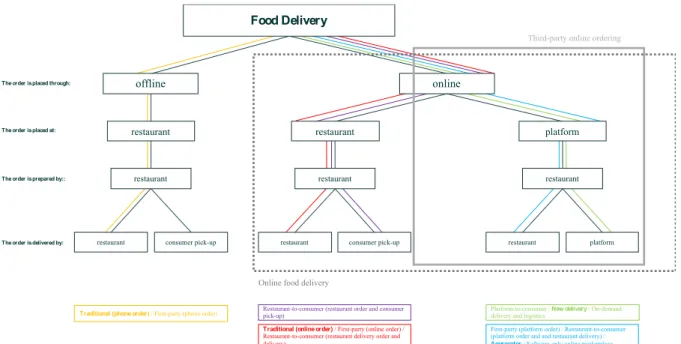
The various food delivery business models of today are based on the differences in the food delivery process. As can be seen in Figure 1, within this process, there are four stages: (1) how the order is placed, (2) where the order is placed, (3) by whom the order is prepared, and (4) by whom the order is delivered. The order can either be made online or offline, including phone calls. Then, the order can be placed at a restaurant or a platform. The order is prepared by a restaurant. Lastly, the order is delivered by a restaurant or a platform, or the food is prepared for consumer pick-up.
Figure 1: Food Delivery Models | Source: compiled by the author based on Lambert (2019), Hirschberg et al. (2016), Statista (2019a) and Marks & Foroughi (2017)
online
restaurant
restaurant
restaurant consumer pick-up
restaurant platform
restaurant
restaurant consumer pick-up
restaurant
restaurant platform
Food Delivery
offline
Traditional (phone order) / First-party (phone order)
Traditional (online order) / First-party (online order) /
Restaurant-to-consumer (restaurant delivery order and delivery)
Restaurant-to-consumer (restaurant order and consumer
pick-up) Platform-to-consumer / New delivery / On-demand delivery and logistics
First-party (platform order) / Restaurant-to-consumer (platform order and and restaurant delivery) /
Aggregator / Software-only online marketplace
Third-party online ordering
The order is placed through:
The order is placed at:
The order is prepared by::
The order is delivered by:
The online food delivery (OFD) market comprises all orders made online, independent of who takes the order and delivers the food (see dotted rectangle in Figure 1 for all OFD models).
2.1.2.1 Third-Party Online Ordering and Business Models
The main differentiator within OFD models is (2) where the order is placed: the restaurant’s or a platform’s website. Orders that are placed through a platform, independent of who delivers the food to the consumer, fall under the category of third-party online ordering (TPOO) (Marks & Foroughi, 2017) (refer to gray rectangle marked “third-party online ordering” in Figure 1). Herein, two distinct business models based on (4) who delivers the food to the customer arise (Lambert, 2019).
If the restaurant delivers the order, the business model follows the aggregator concept. If the platform carries out the delivery, its business model falls under new delivery (Hirschberg et al., 2016; Deloitte, 2019). Aggregators charge a fixed commission of up to 15% of the order value to the restaurant. For the consumer, no additional cost occurs. This brings an aggregator to an average EBITDA margin of 40-50%. New delivery business models charge a commission of up to 30% of the order value from the restaurant and an additional fixed delivery fee from the consumer. This leads to an EBITDA margin of around 30% (Hirschberg et al., 2016; Marks & Foroughi, 2017).
In Berlin and Lisbon, successful new delivery companies in the market of low margins and fierce competition need three things: capital, medium- to long-term scalability, and innovativeness. Since delivery requires high investments in equipment, pre-financing as well as drivers’ hourly salary - independent of the number of orders, it is crucial for any company offering delivery to ensure capital flow. Since the food delivery market is working on small profitability, it is critical to scale growth and profitability right through appropriate delivery fees and a vision for product development and business model diversification. A new delivery company needs to come up with any kind of innovation to remain relevant, attractive, and capable to fulfill consumer demands (Appendix Kc, Appendix Ke).
What started with the delivery of pizza and similar low-cost, fast foods has been challenged by TPOO platforms to cater consumers’ increasing demand for healthy, high-quality food options, thus, kick-starting transformation of the food delivery market (Deloitte, 2019).
2.1.2.2 Global TPOO Competition Overview
Globally, the biggest players by revenue include Just Eat, Grubhub, Delivery Hero, Deliveroo, DoorDash, Uber EATS, and Takeaway.com (Global Web Index, 2020; Global Data, 2018; Marks & Foroughi, 2017; Hirschberg et al., 2016). Takeaway.com mainly bases operations on an aggregator business model, making use of restaurants’ own delivery operations, as well as small-scale new delivery (Takeaway.com, 2019). Deliveroo, Uber EATS, and DoorDash adopt the new delivery model, exclusively providing their own fleet of delivery drivers (Deliveroo, 2020; Rawley & Wang, 2019; Marks & Foroughi, 2017). Delivery Hero, as a holding company, owns separate new delivery businesses as well as businesses with an aggregator model (Delivery Hero, 2017). Grubhub expanded its business model from aggregator to new delivery in 2015 (Marks & Foroughi, 2017). In 2017, Just Eat also re-shaped its initial aggregator business model, branching out into new delivery (Global Data, 2018).
The goal of TPOO platforms is to leverage the food delivery industry as a whole by slowly building an ecosystem of restaurants and deliveries. Platforms strive to facilitate OFD by building trust, overcoming consumer caveats, and answering to main consumer concerns like quality of the food (Appendix Kb). However, today, new delivery platforms are still on the verge of generating profits due to the considerable cost of capital (Appendix Kc).
2.1.2.3 Food Delivery Evolution in Berlin and Lisbon
In Berlin, food delivery started in fragmentation at the beginning of this century. Some restaurants occasionally offered delivery; however, there was no real consumer demand at the time. When Pizza.de was founded in 2007, it gave rise to OFD. The Berlin market experienced entry of various OFD players within the past years. The digital shift of food delivery happened in 2014/ 2015 when Foodora was founded, Takeaway.com started operations in Germany through acquiring local Lieferando.de, Delivery Hero picked up acquisition speed by taking over Pizza.de, and TakeEatEasy, as well as Deliveroo, entered the German market. Major acquisitions followed because of the creation of a highly competitive landscape. This led up to the consolidation of Pizza.de, Lieferheld, and Foodora under Takeway.com in 2018, followed by Deliveroo’s market exit in 2019. As of early 2020, there is only one provider of TPOO: Lieferando.de, which is part of the Takeaway.com corporation. The Berlin OFD market experienced the journey from fragmentation to quasi marketplace monopoly held by an aggregator (Appendix Kc). (timeline: Appendix A)
In Lisbon, food delivery started to develop around sixteen years ago. Comer em Casa was the first company to offer a platform for restaurant deliver, followed only about six years later by noMENU. Within the past ten years, Telepizza and Pizza Hut slowly expanded into online food delivery. Lisbon experienced a significant shift in food delivery when in 2017, the TPOO platforms Glovo and Uber EATS, and in 2018, Takeaway.com launched in the city. Until then, food was mainly ordered via phone call and exclusively delivered by restaurants themselves. Those delivery restaurants were disrupted and forced to adapt to the new digital reality. The digital shift happened in 2017/ 2018, transforming consumer behavior, fostering their demand for an ever wider selection of food choices. Selection of restaurants on a platform is driving demand in OFD. In turn, the growing variety of restaurants fuels consumer demand further. Today, the largest operators within TPOO in Lisbon are Glovo, Uber EATS, and Takeaway.com, where Glovo is adopting the new delivery model (Appendix Ke; Glovo, 2020). (timeline: Appendix B)
2.1.3 The new Consumer’s Profile
In 2017, 60% of all OFD orders were placed by consumers under the age of 24 (Global Data, 2018). These younger consumers fall under the term digital natives because of their increasing connectivity since childhood, and unique ability to handle digital information existentially differently and in speedier ways than previous generations (Prensky, 2001). The consumers in question are part of Generation Y (born between 1980 and 1994) and Generation Z (born between 1995 and 2010) (Francis & Hoefel, 2018).
Younger consumers search to try new things, innovate their ways of thinking, and boost convenience in all ways of life (Global Data, 2018; Wood, 2013). This hyper-connectivity, as well as increasingly busy lifestyles due to work, family, and social duties, influence shopping behavior based on the quest for efficiency and convenience (Global Data, 2018).
Currently, 35% (29m people) of the German population are aged between 10 and 40, and therefore considered digital natives (Destatis, 2019). Similarly, about 33% (3.4m people) of Portuguese are digital natives, born between 1980 and 2010 (Pordata, 2018).
2.2 Digital Transformation in Businesses and Industries
2.2.1 Definition
“Digital business transformation is the process of exploiting digital technologies and supporting capabilities to create a robust new digital business model” (Gartner, 2020).
Opposed to the frequent assumption that digital business transformation implies the one-time set-up of technology within part of a company, it really means an infinite agile and circular process. It requires implementation in not only one department but the company as a whole, thus, leading to organizational transformation (Yokoi et al., 2019). The integration of technology itself does not automatically provide competitive advantage since, nowadays, technology is seen as a commodity available to virtually every competitor (Carr, 2003).
“Technology’s value comes from doing business differently because technology makes it possible” (Westerman, 2017).
The development of information technology (IT) in the past 20 years reached critical mass and recently triggered digital transformation. As Carr (2003) predicted, IT was implemented as deeply and naturally in a firm’s strategy as the use of electricity.
IT provides tools to transform an organization’s business model, and further has the far-reaching power to transform the entire industry the organization is operating in (Mendelson & Kraemer, 1998). Digital business transformation produces irreversible change in the way businesses are competing and, thus, leads to digital transformation of industries (Garriga, 2015; World Economic Forum, 2016).
Digital transformation of industries is understood as the disruptive power of putting
technology at the center of organizational strategy, fueling innovation and creating value, digitally transforming a business, leading to re-shaping competitive landscapes, and shifting customer expectations (World Economic Forum, 2016).
2.2.2 Meaning, Opportunities and Threats
Digitization – purchase or built, and integration of technology to improve productivity in a
specific business area (Yokoi et al., 2019), may lead to digital business transformation (World Economic Forum, 2016). However, firms tend to mistake this simple digitization for transformation (Yokoi et al., 2019).
Successful digital transformation requires five things: (1) clear digital strategy, (2) visualization and understanding of technology’s influence on all business areas, implying organizational transformation, (3) digital mindset that is lived and promoted by the administrators, (4) digital fluency at the executive level, and (5) risk-taking as a standard. Digital fluency relates to executives acknowledging the transformative power of technology but does not necessarily require them to be digital natives (Kane et al., 2015).
Effective digital business transformation provides an organization with competitive advantage. The capabilities of transformation foster innovation in all business areas, even leading to business model innovation (Warner & Wäger, 2018). Within this innovation, companies create digital business transformation that raises consumer demands to the industry, giving organizations the opportunity to create further value for their customers and thus, providing firms with the outlook of higher profits. Within e-commerce as well as OFD, value creation implies higher convenience and increasing efficiency through reducing consumers’ time and cost (World Economic Forum, 2016; Statista, 2019a).
Implementing digital transformation is not only based on recognizing its transformative opportunities but first and foremost grounded in the vital need to not fall behind changing market dynamics caused by the digital transformation of industries (Hess et al., 2016; Garriga, 2015). Although one of the success drivers is risk-taking, companies need to reflect on their own specific needs, otherwise risking overspending on unnecessary IT (Carr, 2003). The biggest threat related to digital transformation, independent of the industry, however, is the failure to recognize its existential meaning for business. If the transformation movements are ignored, it will be highly likely to result in the death of the firm (Kane et al., 2015).
For the restaurant industry, digital transformation means a new view of customers and customer experience in the face of technology (Global Web Index, 2020). Technology enables restaurants to collect customer data and meet their increasing demands for convenience through methods adapted from the transformation of retail into e-commerce (Feinberg et al., 2016). Through the creation of new experiences, e.g. online reservations and deliveries, not only can additional revenues be generated, but also new customers are attracted by innovations that meet and ideally exceed customer expectations (The Fork Manager, 2018). If restaurants ignore the importance of technology in their customers’ lives and thus, fail to integrate technology into their strategic focus, they will be unable to meet the digital natives’ demand and be left behind in the process (Feinberg et al., 2016).
2.2.3 Digital Transformation of Restaurants Through OFD
Food delivery is already transforming the restaurant industry. Today, it is perfectly natural for consumers to choose from a vast selection of restaurants on any given platform, as well as to have as a convenient food ordering experience as they desire. Consumers have been provided with the option to order food right when they want, wherever they want. Since consumers are not willing to give up that comfort, OFD has become the new benchmark for the restaurant industry (Zhong, 2019).
In this, TPOO platforms are transforming the market with data-based innovations and integrations along the value chain to meet consumers’ changing demands. For both restaurants and platforms to be successful, strategic focus must lie on the creation of new opportunities, i.a. giving rise to concepts like dark kitchens (Appendix Kc). By offering their food on a TPOO platform, restaurants have the chance to expose themselves to a larger potential consumer base, hence, attract new customers, and specifically on new delivery platforms, benefit from the platform’s delivery fleet (Deloitte, 2019).
On an industry level, consumers perceive delivery food as a replacement for a meal at the restaurant. Food sold through TPOO platforms provides the restaurant with lower profits per meal due to additional cost of being on the platform (Deloitte, 2019). However, on average, consumers spend more money when ordering food online (IRI GIRA, 2017), and restaurants do not incur the same human resource cost related to serving the food in-house (Deloitte, 2019). Technologies, which are setting a new standard for the industry, steadily increase consumer desire for convenience (Hirschberg et al., 2016).
Today, restaurants face a digital threat: when consumers want to order food online, but cannot find the restaurant online, they will simply choose another restaurant (Deloitte, 2019). 2.3 Differences in Digital Transformation Between Lisbon and Berlin
2.3.1 Technological Landscape
Technology enables restaurants to respond to industry and consumer preference changes. The participation on TPOO platforms exposes a selection of restaurants to a large customer base while simultaneously providing them with added value through features like cashless payment and status tracking (Deloitte, 2019). The digital landscape that consumers live in shapes their preferences and plays a significant role in the creation of demands concerning e-services like online food delivery (Nielsen, 2018).
In 2019, the world’s population counted 7.7bn people, of which 67% (5.1bn people) use a smartphone, and 57% (4.4bn people) are internet users. Of internet users, 91% (almost 4bn people) access the internet via a mobile device. The average time per day a person spends on the internet is 06:42 hours, whereof nearly 50% of the time (03:14 hours) are spent on mobile devices (Hootsuite & We Are Social, 2020).
Portugal’s population counted 10.3m in 2019. 78% (8m people) of the Portuguese are internet users, of which 89% (7.1m people) connect via mobile device. Per day, on average, a Portuguese spends 06:38 hours on the internet, with 37% of the time spent on a mobile device
(02:27 hours). On average, a Portuguese has 8.5 social media accounts (Hootsuite & We Are Social, 2020).
Germany’s population counted 82.3m in 2019. 96% (79m people) of Germans are internet users, of which 81% (64m people) connect via mobile device. Per day, on average, a German spends 04:37 hours on the internet, with 33% of the time spent on a mobile device (01:30 hours). A German typically has 5.1 social media accounts (Hootsuite & We Are Social, 2020).
In recent years, the share of mobile internet usage of total time spent on the internet, increased overall (Hootsuite & We Are Social, 2020). 60% of Germans and 53% of Portuguese state that they can’t imagine their everyday life without the internet (Statista, 2020c).
Looking at the overall technological business landscape, German tech start-ups raised record sums in 2019 with the highest share of capital going to Berlin. Therein, mobility and e-commerce companies received most of the funding volume in 2018 and 2019 (Ernst & Young, 2020). Similarly, Portugal experiences growing investments in information and communication technologies, which is expected to be a pillar of economic growth in the future (Ernst & Young, 2019).
2.3.2 Cultural Landscape
Culture is defined as the collective behavior, rules, and norms of a group (nation), that make it
different from other groups of people (nations) (Hofstede, 2011). Hofstede (2011) defines the following six cultural dimensions:
(1) power distance - extent of hierarchical acceptance (2) individualism vs. collectivism - importance of self’s needs over group’s (3) masculinity - value of achievement and status
(4) uncertainty avoidance - extent of threat prevention
(5) long-term vs. short-term orientation - extent of future or past inclination (6) indulgence - extent of gratification and enjoyment (Hofstede, 2011; Hofstede Insights, 2020a)
Regarding power distance, Germany scores significantly lower than Portugal, indicating that Portuguese are more willing to accept power differences in social hierarchies than Germans, where power is distributed by knowledge. On the individualism dimension, Germany
scores much higher than Portugal. Thus, Germans tend to put their own needs above the group’s, where Portuguese are rather collectivist, based on relationships and group responsibilities. Further, Germany seems to have a rather masculine culture, meaning that status and performance are valued highly. In comparison, for Portuguese, success is rather measured relative to enjoyment. Portugal appears highly uncertainty avoidant, where people have an intrinsic motivation for rules and safety of well-being. Through their strong tendency for uncertainty avoidance, Portuguese might show some hesitance towards accepting innovations. Germany tends to be less uncertainty avoidant than Portugal; however, people still value precision and exact guidelines very highly. As for masculinity, the past seems of high importance to Portuguese, whereas Germans rather focus on what is next to come. Considering Hofstede’s indulgence dimension, Germans and Portuguese have rather low values of self-gratification and enjoyment, indicating that indulgence is not embedded in either society (Hofstede Insights, 2020b). (Appendix C)
2.3.3 Culinary Landscape
Food culture is deeply rooted in a country’s culture and subject to large variations between
different cultures (Beer et al., 2002), thus, implying that restaurants not only broadly impact economy but also culture (Deloitte, 2019).
In Portugal, the fifty-year long dictatorship of Prime Minister António de Oliveira Salazar impacted the county’s history and food culture (Beer et al., 2002). In Lisbon, the so-called quiosques de refrescos (= refreshment kiosks) were an integral part of the city’s culture for a long time, but forbidden under Salazar. After the regime ended in 1974 (Beer et al., 2002), it took 35 years for the first quiosques to open again (NPR, 2016). These quiosques, which today tend to be open 24/7, are the manifestation of the Portuguese feeling of community and represent social meeting points outside of people’s own homes for interactions and discussions (NPR, 2016).
When it comes to eating outside of their own homes, Portuguese opt for a quick meal during lunchtime. Snack bars like quiosques and cafés are popular amongst the population because they offer affordable options for anybody who is not able to have a meal at home, and thus, is forced to eat out on working days (Appendix Ka). This reflects the deeply rooted emphasis on the concept of family. It includes building strong bonds, loyalty, and long-term commitment within families (Hofstede Insights, 2020b).
Today, 50% of all cafés and restaurants in Portugal are located in Lisbon and the South Coast area, with a total number of 6,350 outlets (Appendix Ka).
In Germany, food culture is very flexible, with not only one typical German cuisine. German food shows influences from all its neighboring countries with distinct regional differences. This reflects the complex German culture that is marked by history (Heinzelmann, 2014). Shortly after World War II ended in 1945, the country was separated into East and West until unification in 1989 (Minkenberg, 1993). Throughout this time of separation, both areas developed different regional foods. Within the following 30 years of unification, German cuisine was shaped by influences from all over the world, making it a rather global than traditional food culture (Heinzelmann, 2014). Eating outside of home is a common and favorable leisure activity for Germans (Statista, 2019c).
In Berlin, there are roughly 5,000 restaurants (Berlin.de, 2020), making up only about 7% of the total number of restaurants in Germany (Statista, 2019c).
2.4 Trends Within OFD
Trends are divided into digital and consumer. Both perspectives are interlinked, thus, increasing consumer needs foster digital innovations, vice versa (Statista, 2019a; Global Data, 2018; Marks & Foroughi, 2017; Hirschberg et al., 2016).
OFD experiences four existential consumer trends: (1) lack of time, (2) changing demographics, (3) hyper-connectivity, and (4) “insperiences” (Global Data, 2018).
Since available free time becomes increasingly rare for the new generations because of higher workloads and rising social responsibilities, younger consumers are progressively looking for convenient solutions (Global Data, 2018). The benefit and ease of everything being only one click away foster the need for on-demand deliveries to facilitate the new consumer’s busy lives. Digital natives as the new consumer generation trust in technologies and appreciate solutions that let them experience the convenience of digital on-demand services (Appendix Kb). From this innate digital thinking arises a hyper-connectivity, which relates to the concept of the Internet of Things (IoT), implying usage of a network of various connected technologies and devices 24/7. Since the new generations are constantly looking for novelty and selection but increasingly desire to enjoy the comfort of home, within OFD, they are requesting on-demand restaurant experiences to create their “insperiences” (Global Data, 2018). At the root
lies the desire to increase convenience, driven by and, in turn, fueling digital trends (Deloitte, 2019; Statista, 2019a).
Three relevant digital trends are observed: (1) voice interface, (2) IoT, and (3) autonomous delivery (Statista, 2019a; Marks & Foroughi, 2017; Global Data, 2018). The following use case might illustrate the integration of voice interface into OFD: a consumer orders food by giving a voice command to their car on their commute with the food being delivered right when the consumer gets home. IoT in OFD ties in with voice interface integration. It implies increasing connectivity and communication of devices that enable online food ordering through digital assistance devices like Amazon’s Alexa or Apple’s Siri (Global Data, 2018; Statista, 2019a). Autonomous cars, robots, and drones are summarized as autonomous delivery (Marks & Foroughi, 2017). Tests have already started; Domino’s trialed utilizing robots and drones for pizza delivery in 2016 (Business Insider Intelligence, 2020).
The competitive nature of OFD requires TPOO platforms and restaurants to reinvent themselves continuously. One relevant trend kicked off by Deliveroo in 2016 is the concept of dark kitchens known as Deliveroo Editions (Global Data, 2018). These kitchens are designed as delivery-only cooking spaces provided for restaurants to manage higher demand through online orders (Deloitte, 2019). Dark kitchens require less capital to set up since they do not require prime locations and dine-in areas to attract consumers. With additional dark kitchen space, restaurants can serve higher numbers of customers at lower cost (Lien, 2017).
At the root of the development lies the need to match consumer’s increasing desire for convenient connected solutions as well as the creation of new demands (Deloitte, 2019). 2.5 Industry Outlook – Before COVID-19
In both Lisbon and Berlin, further shifts can be expected through the entry of new players. Ride-sharing app provider Bolt started its own OFD operations Bolt Food in 2019 in selected markets (Schulze, 2019). In early 2020, Bolt announced their expansion plans to Portugal; Germany could be another potential new market. To stay competitive, Berlin OFD requires increased innovativeness and new ways of consumer understanding to be ready for potential new market entrants like Bolt, Uber EATS, or Glovo (Appendix Kc, Appendix Ke).
Overall, there are major opportunities regarding expansion of food delivery into new category delivery. With grocery and beverage delivery, there is room for OFD platforms to access a wider range of delivery goods, although, differing margins and cost must be taken into consideration (Appendix Kc, Appendix Ke). Responding to shifts in consumer behavior
through OFD has disrupted the restaurant industry. New consumer demands have been created, changing the industry irreversibly (Deloitte, 2019; Zhong, 2019).
3 Literature Review
A study was conducted to understand the impact of changing consumer demographics and preferences in the face of technology on e-commerce and, consequently, TPOO behavior. The study additionally aims at exploring differences between Portuguese and Germans.
The below chapter provides a comprehensive overview of the theoretical standpoint of research regarding e-commerce and specifically OFD. It further illustrates motivations for TPOO, as well as measures for technological adoption and individualism, as defined by Hofstede (2011).
3.1 E-Commerce and E-Services
Increasing e-commerce availability and use are seen as a response to the main consumer trends described before (Nielsen, 2018; Global Data, 2018). As consumers experience less free time, they demand convenient shopping solutions. Since shopping decisions are made, i.a., based on accessibility of the shopping venue, e-commerce provides the option to shop online any time of day, from any place, and any digital device (Beauchamp & Ponder, 2010). Digital natives demand adoption of technologies in all aspects of retail and shopping for goods and services to match their connected digital lives (Nielsen, 2018). Hence, e-commerce leverages technologies to meet consumer demands, enhance consumer experience, and create consumer value (Rayport & Sviokla, 1995).
A large part of food delivery orders is still made by phone call, however, the number of OFD consumers is increasing (Yeo et al., 2016). This is raising the question of key drivers for consumers’ TPOO platform usage.
3.2 Hedonic Motivation
Motivation plays a determining role for general purchase intentions (Kang & Park-Poaps, 2010). Consumer motivation has been shown to consist of two parts: utilitarianism and hedonism. Where utilitarian motivation describes the necessity of the purchase based on rational decision-making, hedonic motivation relates to emotion-driven decisions (Batra & Ahtola, 1990). Previous research suggests that although actual purchasing behavior seems to be rooted in rational thinking, feelings significantly influence the process. The need to look for
a product arises from the utilitarian motivation. However, when a consumer enjoys the process of searching for the product and further expects positive experiences provided by the product itself pre- and post-purchase, this will lead to the actual purchase (Babin et al., 1994). In this, enjoyment is defined as a feeling of pleasantness with levels of happiness, joy, and entertainment. Concerning online shopping, research suggests that enjoyment might be a key determinant of consumer’s online shopping attitude and intention (Monsuwé et al., 2004).
Holbrook and Hirschman (1982) argue that hedonic motivation substantially extends traditional research in consumer behavior to study influences on shopping behavior. Yeo et al. (2016) suggest that hedonic factors (perceived convenience and post-usage usefulness) influence attitude towards OFD.
Current research starts to examine the effect of hedonic motivation on attitude towards online shopping and OFD. However, it does not fully study the impact of hedonism on actual purchasing behavior in online shopping and, specifically, OFD. This creates the need to research the connection of hedonism to online shopping and OFD attitude, and extend to actual behavior.
3.3 Technological Adoption and Digital Maturity
As a measure of technological adoption, the Technology Acceptance Model (TAM) is prevalent in research within information systems, as well as consumer and organizational behavior (Yeo et al., 2016). Originally, TAM was designed to measure the degree of individuals’ acceptance and use of technology based on how useful and easy to use they perceive that same technology to be (perceived usefulness and perceived ease of use, respectively) (Davis, 1989). The model has then been extended to include the effect of technology usage enjoyment on acceptance and actual use of technology (Davis et al., 1992). Initially designed to study acceptance of task-related systems in the workplace, specifically computers, TAM later has been applied to other digital fields like e-commerce (Hsiao & Yang, 2011). Various researchers have made specific adaptations to the model. Monsuwé et al. (2004) extend TAM through external factors like consumer traits to measure the influence of perceived usefulness, perceived ease of use, and enjoyment of online shopping on attitude and intention to shop online.
TAM focuses on measuring the influence of perceived usefulness, perceived ease of use, and enjoyment on actual use of a single technology. The model does not take into account an individual’s general acceptance, attitude, and use of multiple technologies. Therefore, it is hypothesized that a person’s general technological maturity would significantly influence their
attitude towards and use of e-commerce and OFD, creating the need for a variable that measures overall personal digital maturity.
3.4 Culture
Previous research suggests that culture plays a significant role in shaping consumer behavior, especially product diffusion and the adoption of product innovations (Dwyer et al., 2005). Since Germany and Portugal reach distinctively different scores on the individualism dimension, it is an important variable to consider when studying technological adoption.
It can be seen that diffusion of technologies is different for countries with high scores on individualism compared to countries with low individualism (collectivist cultures) (Dwyer et al., 2005). Germany is a highly individualist culture with a score of 67/100. Portugal, on the other hand, reaches a score of 27/100, implying high collectivist tendencies. In other words, the group’s needs are more important than the individual’s (Hofstede Insights, 2020b). This difference implies that technological adoption rates would be distinctively different for Germany and Portugal.
Although culture is a widely studied topic in many areas of organizational and consumer behavior, there is a lack of research that specifically examines the effect of individualism on attitude and behavior in e-commerce and OFD as part of the online services landscape in Germany and Portugal.
4. Conceptual Framework and Hypotheses
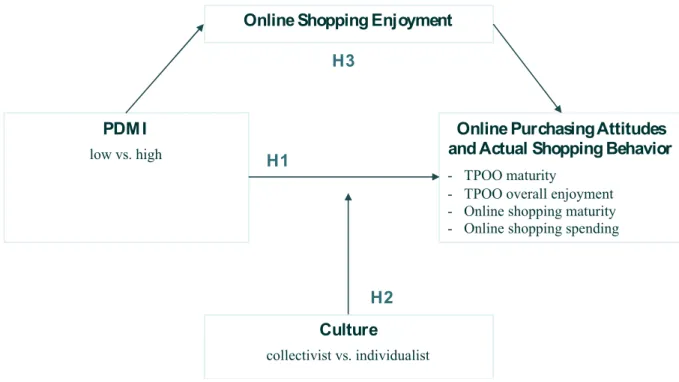
The results of the literature review, combined with the thorough analysis of the fieldwork outcomes, allowed the author to develop the conceptual framework (Figure 2).
This chapter provides hypotheses that will be explored to generate an understanding of the effects of technology adoption, motivation, and culture on online shopping and third-party
online ordering (TPOO) on Portuguese and German digital natives in Lisbon and Berlin,
respectively. This study specifically examines the impact of a consumer’s degree of digital maturity (low vs. high) on online purchasing attitudes and actual shopping behavior (TPOO maturity, TPOO overall enjoyment, online shopping maturity, online shopping spending). Further, this research assesses the mediating effect of online shopping enjoyment on the previous relationship, as well as the moderating effect of culture based on Hofstede’s (2011) collectivism versus individualism dimension.
Figure 2: Conceptual Framework
4.1 Hypotheses
As Yeo et al. (2016) suggest, technological adoption levels based on the Technology Acceptance Model (TAM) influences attitude and behavioral intention towards online shopping of products and services, including OFD. According to prior studies by Nielsen (2018), increasing technological connectivity and adoption lead consumers to purchase services increasingly online. This implies that general digital adoption based on multiple technologies should have an effect not only on behavioral intention but further on actual behavior and motivation. This leads to the first hypothesis:
H1: The personal digital maturity index (PDMI) (low vs. high) will have an impact on online
purchasing attitudes and actual shopping behavior (TPOO maturity, TPOO overall enjoyment, online shopping maturity, online shopping spending).
Van Slyke et al. (2010) suggest that culture has a significant impact on attitude and intention of purchasing goods and services online, and has been shown to influence technological adoption (Leidner & Kayworth, 2006). Prior literature proposes that individualism can be used as one indicator of the spread and acceptance of new technologies (Dwyer et al., 2005). Research largely uses the individualism vs. collectivism dimension as a key determinant for consumer behavior. Sabiote et al. (2013) suggest the existence of a stronger positive effect on consumers’ online perceptions for individualist cultures than for collectivist
PDM I
low vs. high
Online Purchasing Attitudes and Actual Shopping Behavior
- TPOO maturity
- TPOO overall enjoyment - Online shopping maturity - Online shopping spending
Online Shopping Enjoyment
Culture
collectivist vs. individualist
H1
H3
ones. Moreover, individualism indicates a positive impact on acceptance of new products (Yeniyurt & Townsend, 2003), and is positively associated with higher innovativeness (Lynn & Gelb, 1996). According to Hofstede Insights (2020b), Portugal is rather collectivist, Germany rather individualist. Consequently, it is hypothesized that the strength of the influence of personal digital maturity on online purchasing attitudes and actual shopping behavior will not be the same for Portugal and Germany. This leads to the second hypothesis:
H2: Culture (collectivist vs. individualist) will moderate the effect of PDMI (low vs. high) on
online purchasing attitudes and actual shopping behavior (TPOO maturity, TPOO overall enjoyment, online shopping maturity, online shopping spending), so that:
H2a: Consumers with individualist culture will show higher online purchasing attitudes and
actual shopping behaviors for high (low) levels of PDMI.
H2b: Consumers with collectivist culture will show lower online purchasing attitudes and
actual shopping behaviors for high (low) levels of PDMI.
Previous studies suggest that emotions drive actual behavior (Babin et al., 1994). Past literature has examined the effect of enjoyment as a feeling of fun and joy of the online shopping process on attitude towards online shopping (Childers et al., 2001), as well as hedonic motivation (perceived convenience and post-usage usefulness) on attitude towards OFD (Yeo et al., 2016). Research by Raghunathan et al. (2006) suggests that enjoyment in terms of fun and excitement is a driver for consumers to opt for less healthy food. Since delivery food is stigmatized as fast and inexpensive (Appendix Kf), it is proposed that consumers perceive delivery food as less healthy food. Since it has been shown that decision-making is rooted in utilitarianism but taken over by hedonic motivation (Babin et al., 1994), it is hypothesized that enjoyment of online shopping will play a mediating role on the relationship between personal digital maturity and online purchasing attitudes and actual shopping behavior.
Thus, the third hypothesis is stated:
H3: Online shopping enjoyment will mediate the relationship between PDMI (low vs. high) and
online purchasing attitudes and actual shopping behavior (TPOO maturity, TPOO overall enjoyment, online shopping maturity, online shopping spending).
5. Methodology and Data Collection
5.1 Research Method
To test the above hypotheses, two experimental studies were conducted to collect primary data. Due to the extent of the data to be collected, the author decided to run two main studies to optimize the participant’s time and attention. The titles of the two studies are Food Ordering Behavior and General Digital Adoption, study 1 and study 2, respectively. Both studies underwent a pre-test with a group of five individuals per study to clarify possible misunderstandings. During the pre-tests, no problems were identified. Thus, both main studies were initiated. Due to the nature and complexity of the research topic and specificity of the target segment, data was collected through the web-based survey platform Qualtrics. Additionally, paper questionnaires were used whenever the conditions would not allow for digital tool usage. The selection of the participants for both data collection methods is described in the next paragraph.
5.2 Sampling
Both studies used a non-probability convenience sampling technique. Participants were identified by the author according to the target group segmentation and contacted through online media, including WhatsApp, Facebook, and LinkedIn, leveraging the author’s primary and extended personal and professional network. The target group comprises digital natives between 18 and 30 years old, living in Lisbon or Berlin, of Portuguese or German nationality. The age segment was chosen narrowly to include legal adults as well as to limit the upper interval to include part of generation Y that is most connected to growing up in the emergence of the internet. In order to obtain a representative sample size, paper questionnaires were distributed in Lisbon at the beginning of March 2020. Portuguese participants were approached in small groups at the approximate end of their lunchtime and asked the segmentation questions after the author briefly introduced herself. Only individuals who fit the target group were given the paper questionnaires. The author ensured physical space between the participants and eliminated all interactions between the respondents during their answer period to minimize any potential biases during data collection. The participants’ names were not recorded to ensure the same anonymity as through Qualtrics. The same procedure was intended for Berlin, however, the legislative measures enforcing social distancing due to COVID-19 didn’t allow for the paper questionnaire method, thus extending the collection period through Qualtrics.
5.3 Research Instruments
Two main studies were created in English language, launched on February 27th, 2020 and stayed
active for collection until April 15th, 2020. The studies were distributed online and offline.
Study 1 obtained a sample size of one hundred and sixty-seven (167) responses, study 2 reached one hundred and fifty-two (152) answers. After the collection was completed on April 15th,
2020, the participants’ respective data from both studies were merged (see process described below), and thus, obtained a total valid sample size of one hundred and eight (108) responses. 5.4 Design and Procedure
The purpose of this research is to examine the influence of personal digital maturity (low vs. high) on TPOO maturity, TPOO overall enjoyment, online shopping maturity, and online shopping spending. Further, the moderating role of culture (collectivist vs. individualist) in this relationship between personal digital maturity and consumers’ attitudes and behaviors is tested. Moreover, the research investigates if online shopping enjoyment mediates the relationship beforementioned. The study design followed a 2 (PDMI: low, high) x 2 (culture: collectivist, individualist) between-within subjects’ design. The mediator – online shopping enjoyment was assessed as a continuous variable. The dependent variables are TPOO maturity, TPOO overall enjoyment, online shopping maturity, and online shopping spending.
Study 1 consists of six parts. The first part identified the respondent as part of the target group, asking segmentation questions regarding age, city of residence, and nationality. If the participant did not belong to the target group, the survey ended immediately. To gain insight into individualism distribution of this study’s sample, four questions by Hofstede & Minkov (2013a) were posed next. Based on the calculation (Appendix D), results show scores of 31 for Portuguese and 65 for Germans. However, these indices are not used in further analyses since they only give an indication of individualism but cannot be compared to Hofstede’s original research (Hofstede & Minkov, 2013b). Thirdly, preferences and actual behavior regarding food culture were requested. Next, attitude, preferences, and actual behavior within TPOO were measured. For the fifth part, the participant had to answer personality questions based on the Ten-Item Personality Inventory questionnaire by Gosling et al. (2003) as a short measure for personality. Lastly, the respondent was asked to provide demographics in five questions and thanked for participation. (Appendix E)
Study 2 consists of five parts. Following the same pattern, the participant was evaluated as part of the target group. The second part consisted of the first set of questions used to determine PDMI, explained in detail in paragraph 5.5. Next, the participant’s attitude, preferences, and actual behavior within online shopping were examined. Fourth, the second set of questions used in PDMI followed. Lastly, the respondent was again asked to provide demographic data and thanked for participation. (Appendix F)
The respective data from both studies was aggregated for each unique respondent. To successfully obtain a valid merged data set, first, both data sets were downloaded from Qualtrics into Excel. The author went through each response and aggregated the data from both studies according to age, city of residence and nationality, as well as start and completion times, IP address, recorded date and time, location latitude and longitude, as well as the demographic data collected at the end of each study (age, gender, employment status, household size, marital status, monthly available income). Since both studies were sent out simultaneously to the respondents, the strong assumption is made that the same respondent in both studies can be identified based on the interrelation of values from the marked variables. Within the data sets for study 1 and 2, a unique identifier was manually introduced by the author based on the matching values in all the beforementioned columns. Then, all data was transferred into a third Excel file and sorted according to the unique identifier. Further, calculated PDMI was added to the dataset for each individual. In the following, the merged data from study 1 and 2 is referred to as ‘the main study’.
5.5 Variable Description
INDEPENDENT VARIABLE
Personal Digital Maturity Index – PDMI (low vs. high) – this variable was calculated based
on the personal digital maturity framework developed internally at Católica School of Business & Economics (Appendix G). PDMI determines digital maturity based on four vectors explaining digital aptitude, with distinct weights: (1) use of digital devices (21.5%), (2) digital relationships (25.0%), (3) innovation (32.0%) and (4) digital transactions (21.5%). Each vector has a different weight of influence on the total PDMI, defining its relevance in digital maturity. The value of a vector is determined based on several questions from study 2. Each question within a vector received a specific weighted influence on the vector (question-specific weight). The weighting was necessary because not all vectors and questions contribute to the determination of PDMI with equal importance.
The questions’ nominal answer keys were re-coded into score points to calculate a respondent’s score for each question. Respondents received one score point per digital device and one score point per social media account. The remaining answers were coded into score points based on a raking, e.g. the better the internet access, the higher the screen time, or the higher the agreement with digital trends, the higher the respective score point per question. The score points obtained per question are then weighted based on the question-specific weight. These obtained weighted points per question are added up for each vector. The result for each vector was then weighted based on the respective vector’s weight.
The total maximum weighted (taking into account question and vector weights) point score amounts to 6.91 points, which means that each respondent could obtain a minimum of 0 and a maximum of 6.91 points to measure their personal digital maturity.
High or low personal digital maturity is determined based on a 50% benchmark. This means that respondents were allocated with “low PDMI” when their score was below and or equal 50% (= 3.455 points). Respectively, respondents with a score of above 50% were allocated with “high PDMI”. This process led to a dichotomous independent variable, namely PDMI (low vs. high).
MODERATOR
Culture (collectivist vs. individualist) – according to Hofstede Insights (2020a), measured
based on nationality by asking the participant if they were of Portuguese or German nationality, also measured as a dichotomous variable.
MEDIATOR
Online shopping enjoyment – was measured on a 7-point Likert scale, asking the respondent
how much they like to order products online (from 1 = “strongly dislike” to 7 = “strongly like”).
DEPENDENT VARIABLES
TPOO maturity – was measured on a 7-point Likert scale, asking the participant to rate how
often they order food through TPOO per month (from 1 = “never” to 7 = “daily”).
TPOO overall enjoyment – to assess the respondent’s overall enjoyment related to ordering
through TPOO platforms, the variable TPOO overall enjoyment was created, (“Ordering to-eat food through a platform like Lieferando or Uber EATS is convenient”, Ordering in ready-to-eat meals is more preferable than going out to eat”) from 1 = “strongly disagree” to 7 =
“strongly agree” and (“How much do you like to order in?”) from 1 = “strongly dislike” to 7 = “strongly like”. A Principal Component Analysis (PCA) with varimax rotation was conducted to explore respondents’ overall TPOO enjoyment. The factor analysis implied that all three items measuring overall enjoyment of TPOO loaded heavily (with factor loading of .72, .72 and .83, respectively) on one factor (Cronbach α = .63, which indicates moderate reliability and can be used for further analyses (Hinton et al., 2014)).
Online shopping maturity – was measured on a 7-point Likert scale, asking the participant to
rate how often they order products online per month (from 1 = “never” to 7 = “daily”).
Online shopping spending – was measured on a 6-point scale, asking the respondent to provide
approximate spending on online purchases (in €100 steps from 1 = “0 - 100€” to 6 = “> 500€”).
6. Analysis and Results
6.1 Sample Characterization
The main study’s sample consists of 108 participants – 59 of German nationality and 49 Portuguese. 48 of the respondents who are German live in Berlin; the remaining 11 Germans live in Lisbon. All 49 Portuguese live in Lisbon. Within the sample, there are 62% females and 37% males; the remaining preferred not to say. Most respondents in the sample are aged 24 to 26 years old (38.0%), followed by 27 to 30-year-olds (26.9%) and 21 to 23-year-olds (19.4%). The remaining 15.7% is between 18 and 20 years old. The two largest groups within employment status are full-time employees and graduate students (33.3% each), followed by 23.1% undergraduate students. The sample further consists of high school students, self-employed, part-time self-employed, and unemployed respondents (sorted in descending order). Most of the sample is single (68.5%), followed by respondents in a domestic partnership (27.8%). The remaining group of respondents is married (3.7%). 36.1% of the respondents are living in a household of two, followed by 27.8% in a household of three. Most Germans residing in Berlin live in households of two (45.8%), whereas 53.1% of Portuguese in Lisbon live in households of either three or two people. This is in accordance with marital status. Most Portuguese in the sample claim an average available monthly income of < €500 (42.9%), followed by 30.6% with 500 - €1,000 available. 33.9% of Germans within the sample claim 500 - €1,000, followed by 23.7% with 1,000 - €1,500.