89433 78972
9
CHALLENGES AND SOLUTIONS
PLUGINS AND APPS FOR FFECTIVE TEACHING
PTEE2014 Proceedings 8th International Conference
Physics Teaching in Engineering Education
Title: Challenges and Solutions
Plugins and apps for effective teaching Editors: Joao Lemos Pinto and Greet Langie Publisher: UA Editora, Aveiro University Date: May 2014
Design: Maria Joao Pinheiro ISBN: 978-972-789-433-8
Cataloging in publication
Challenges and solutions [Electronic Resource]: pluggins and apps for effective teaching / 8th International Conference Physics Teaching in Engineering Education; eds. João Lemos Pinto and Greet Langie. - Aveiro: UA Editora, 2014. - 126 p. : il.
ISBN 978-972-789-433-8
Physics education // Engineering education // Scientific instruments // Learning strategies CDU 371.3:53
SEFI - Société Européenne pour la Formation des Ingénieurs PWG - Physics Working Group
I3N&IT&UA - Institute of Nanostructures , Nanomodelling and Nanofabrication CIDTFF - Didactics and Technology in Education of Trainers
Challenges and Solutions, Plug Ins and Apps for Effective Physics Teaching, is ad-dressed to all those who are interested in physics education. The contributions pub-lished here were presented at the 8th International Conference Physics Teaching in Engineering Education organized by the SEFI Physics Working Group and I3N, IT and CIDTFF of Aveiro University.
For the PTEE 2014 conference edition a more activating format was chosen. It con-sisted of a set of flexible workshops dedicated to the topics of Great Successes in Lectures and Labs, Activating Students in Large Enrolment Courses, Project Based Learning, Video Analysis and Open Themes. The various addressed communications were mainly focused on successful case studies, problem methodologies, students and teacher strategies, project environments, video solutions, pre-lecture assign-ments, homework, concept mapping and optical tools. In addition, a preconference workshop was dedicated to the engineering education potentialities of historical physics instruments.
PTEE2014 aimed to discuss effective physics teaching and to explore innovative solutions for next future challenges. We hope it will contribute to a more active and societal European networking in engineering physics teaching.
João Lemos Pinto, Chair PTEE2014 Greet Langie, SEFI PWG President
Pre-conference Workshop
Historical physics instruments - engineering education potentialities 9
Malaquias, I.
WS1: Great successes in lectures and labs
What defines a success in lectures and labs? Case studies in Physics teaching 21
Radojewska, E. B.; Salejda, W.; Poprawski, R.; Szatkowski, J.; Cizman, A.
Enhancing scientific analysing and reporting skills – integrated
physics laboratory course 31
Suhonen, S.; Tiili. J.
Effects of PBL methodologies on the students personal competences 41
Pinheiro, M.
Activating students in laboratories. Trusty and reliable solutions. 59
Radojewska, E. B.
WS2: Activating students in large-enrolment courses
Activating students or activating teachers? 66
Tormen, G.
Activating Students in Large-Enrolment Courses: scope of the workshop 67
Bohrmann, S.
WS3: Project Based Learning
Project-Based Learning in the Polytechnic School of Águeda 70
Oliveira, J.
Project-Based Learning in the Industrial Engineering and
Management Integrated Master degree at the University of Minho 71
Alves, A.; Lima, R.
WS4: Video analysis
Video analysis of motions 73
Hockicko, P.
Using video solutions and “hi-score-list” to increase and to monitor
student’s homework 81
Tiili, J.; Suhonen, S.
WS5: Open themes
Using pre-lecture assignments to enhance students learning in
introductory physics 91
Manninen, R., Tiili, J.
Concept mapping for physics engineering 98
Leitão, C.
Fiber sensors for optical training courses 99
Novais, S.; Nascimento, M.; Antunes, P.; Pinto, J.
Water Level Optical System for Integrating Comptences 107
Nascimento, M. S.; Novais, S. C.; Antunes, P. ; Pinto, J.
TRIZ methodology for analysis and synthesis of innovation 113
Malaquias, I. Departamento de Física, CIDTFF, Universidade de Aveiro Aveiro, Portugal [email protected]
A
bstrActIn this workshop we will present some arguments to revisit historical instruments that have potentialities in the physics teaching of engineering education.
We will seek to inform and question the importance of different instruments, identify statutes historically assumed and analyze one or two cases where developments paved the way for issues such as the accuracy of measurements or the identification of properties of matter, topics of interest in the physics teaching context.
Keywords: Historical instruments; Physics teaching; Technology; Educational po-tentialities.
s
ummAryOld scientific instruments still enable a wide range of study for the historian of sci-ence, to the extent that in them converge knowledge and scientific / technical prac-tices, revealing the context in which they have been designed and used, and on their protagonists.
Frequently they also allow a clearer demonstration of the concept(s) and/or proper-ty(ies) when compared with the modern black boxes.
They give evidence of the evolutionary path of experimental science in its own, and are important testimonies of the scientific culture in which we are immersed. All these aspects are of great educative interest.
h
istoricAlPhysics instruments-
engineeringeducAtionPotentiAlities
Challenges and Solutions | Plugins and apps for effective teaching
i
ntroduction– h
istoricAlcontextuAlizAtionAsPectsModern science came up with a new paradigm: that it is possible to know and mas-ter nature through experimentation and through the use of instruments designed in purpose, combined with a possible mathematization of the observed phenomena. The new scientific practice makes use of “objectives, specific languages and meth-ods” that determine “attitudes, expectations and behaviors in the scientific commu-nity members themselves”. For accomplishing this it makes use “of instruments that will allow a controlled experimental observation as one of the conditions for valida-tion.” However, before relying on the information given by these “artificial means”, there was need to face them with skepticism until “the device could be accurately and thoroughly tested”.(1)
Since the sixteenth-seventeenth centuries the use of scientific instruments formed the basis for legitimacy of research on natural phenomena, enabling the experimen-tal repetition everywhere which led to the “acceptance of modern science as the cognitive device inherent to the culture of modernity.”(2)
The status conferred to instruments differed over the centuries since the modern age. To philosophical instruments were assigned a greater importance compared to mathematical and navigation instruments, as those should illustrate the truths of na-ture. Their use was intended for the philosophers. The practitioners, cartographers, engineers, astronomers, navigators would resort to the other type in their practical tasks of measurement.
The emergence of the term ‘scientific instrument’ was studied by Deborah War-ner, who dated the appearance of the English designation in the nineteenth century, motivated in part by commercial interests.(3, 4) Many of the objects that are now described as scientific instruments were produced and designated in the seventeen and eighteenth centuries, as ‘mathematical’, ‘optical’ and ‘philosophical’ instru-ments. To some extent these distinctions were related to instrumentalists’ corpo-rations, reflecting some specialized manufacturing practices from the standpoint of business and marketing. These designations also evolved over time.(2)
During the nineteenth and twentieth centuries, terms like ‘science’ and ‘scientific instruments’ were gradually and increasingly been used in contexts in which expres-sions like ‘natural philosophy’, ‘experimental philosophy’, and ‘philosophical instru-ments’ would have prevailed in earlier periods. The new terminology has been slowly adopted and replaced, while a set of objects described as scientific instruments also developed.
Maurice Daumas, historian of scientific instruments, was one of the first authors to emphasize the importance of natural philosophers and their artisans in developing a new culture where scientific instruments began operating.(5)
Historical physics instruments - engineering education potentialities
The nineteenth century witnessed, in a line clearly admiring and believing in prog-ress, the importance of giving particular attention to science areas, in order to pro-vide a new and solid education.
The attention to experimentation led to the acquisition of instru-ments whose function was to illustrate the phenomena or the start to the measurement techniques made possible by them. The reference to didactic/teaching instruments points out to those considered as “designed to show various physical effects and to assist the exposure of a scientific issue.”(6) It often indicates they needed to be robust, of appreciable size, and made of good materials. Recalling Ganguillem, and on the diffusion of new scientific con-cepts, he held the nineteenth century as the popularization of science century.(7) The action of a didactic instrument would not always be a proof for a scientific as-sertion just its illustration. But diversely, sometimes the important was to practice, to develop competencies of manipulation, measurement, and precision. The focus was using the instruments, put them showing some phenomena and still obtain, in some cases, the possible quantification to verify the subjacent physical law(s). It was then necessary to know the instrument through its description and learn on its manipulation in order to measure and obtain the values that would enable a deep-er knowledge of the already established laws. Comparing some of the instruments existent in schools and some old instrument catalogues, one verifies the similitude between more recent instruments1 (end of nineteenth/ beginning of twentieth
cen-tury) and some of those used in the seventeenth-eighteenth centuries to illustrate phenomena/similar physical concepts, for instance the Ingenhouz apparatus to study thermal conductivity.2 Other instruments illustrate or materialize recent discoveries or
concepts, and do not possess a former correspondent and/or evolved to the discov-ery/ materialization of previously unimagined phenomena.
To meet them today is to revisit/ unveil their ‘lives’ from the objectives that led to their construction, to the producing processes, their inventors/ makers, to their circulation, finding them an educative meaning, old or new, when we look at them under the twenty-first century light or simply when we observe them, just leaving a sensitive approach, following a recent proposal by Arnold and Söderqvist.(8)
In a previous work dealing with scientific instruments, we tried a possible meaningful route connecting Oerstedt’s needle with the Schweigger’s multiplier, the Bourbouze galvanometer, the tangent galvanometer, Desprez’s galvanometer, the one by Weber and by Thompson until the demonstrative galvanometer, the amperimeter and the voltmeter.(10) At the time we also tried the 3D replication using modern communica-tion technologies in order to a better access to those old instruments, completing it with some ‘history’ and ‘functioning’ information. At present we illustrate some other possibilities from the ephemeral production of a spark with a friction electric machine
Challenges and Solutions | Plugins and apps for effective teaching
to the Volta pile and then to the necessity of conceiving and measure the current and some of the instrumental achievements (Case 1).
c
Ase1 – e
lectriccurrent- f
romitsProductiontoitsmeAsurementProducing ‘electricity’…
Figs. 1 and 2 – Ramsden’s electrical machine and Volta pile - http://baudafisica.web.ua.pt
but … there exists something else (Fig. 3)
Fig. 3. Oerstedt needle http://baudafisica.web.ua.pt
Studying how currents act on each other… with an Ampère’s table (Fig. 4) and am-plifying the magnetic field with a Schweigger’s multiplier
Historical physics instruments - engineering education potentialities
Fig. 5 – Schweigger’s multiplier (11)
Fig. 6 – Nobili’s galvanometer (11)
d
etectingAndmeAsuringcurrents- g
AlvAnometersdeveloPmentsTwo periods can be distinguished in the process of developing instruments able to detect and then measure the intensity of electric current. From 1820, we find out the so called “free ‘magnet’ instruments” that gave rise to the suspended magnet galva-nometers. At first it was necessary to amplify the magnetic field created and that was possible with the Schweigger’s multiplier to which followed some galvanoscopes as those proposed by Nobili (1826) and by Poggendorff (1826).
But difficulties arrived in quantifying the intensity of the electric current by deviation of the magnetic needle. Nobili’s proposal included an astatic needles system so that the instrument is sensible just to the current magnetic field (Fig.6).
Poggendorf’s proposal included an optical ballistic system in a mirror galvanometer to obtain a better measurement of the current intensity (Fig. 7).
Challenges and Solutions | Plugins and apps for effective teaching
Fig. 7 - Optical ballistic system (11)
However there were difficulties in quantifying the intensity of the electric current by deviation of the magnetic needle, and some modifications were proposed as in the case of Pouillet’s tangent (& sinus) galvanometer (1837), Weber’s galvanometer (1842) or Thompson’s (1851).
Thompson’s galvanometer was improved with two smaller magnetic needles inside two coils; a torsion string; it possessed a quicker damping and an incurved magnetic bar to diminish the Earth’s magnetic effect.
From 1851 on, some other perfection were introduced and some didactical instru-ments appeared as well of which Bourbouze’s galvanometer was very common and also the projection galvanometer that was intended for projecting the detected cur-rent in the Nobili galvanometer to a larger audience.
Fig. 8 – Thompson’s galvanometer (11)
Historical physics instruments - engineering education potentialities
Fig.11 - Projection galvanometer (7, 11)
Nevertheless, they met neither the electrical industry requirements, nor those of the developing research. From 1871 on a different propose emerged – the ‘free’ current instruments or suspended coil galvanometers to which succeeded later the capillary galvanometer and since 1881 the amperimeters and voltmeters.
Fig. 12 – Deprez D’Arsonval’s galvanometer – A suspended coil galvanometer (11)
Challenges and Solutions | Plugins and apps for effective teaching
Fig. 13 – Discharge tubes -http://baudafisica.web.ua.pt
The electrical discharges in rarefied ampoules gave rise to one of the most fascinat-ing adventures in the history of physics and chemistry, while at the beginnfascinat-ing nothfascinat-ing could be foreseen.
From discharges in the ‘fulminant tube’ and in the ‘electric egg’ ensued discharges in different and embellished forms of tubes with different gases at low pressures to which was possible to count on glassware craftsmen capable of producing such wrappers. For quite some time, the discharges were produced just for the visual ef-fects. Geissler’s (1814-1879) invention using glass tubes with two electrodes for low pressure gas discharges came to give new impetus to this type of experience.3 The
use of more efficient vacuum machines, made it possible to achieve better degrees of rarefaction inside the tubes / ampoules. Since then it was resorted to something more elaborate than the use of the electrostatic machine, using the so-called ‘Mag-netic motor’ for producing the discharge.4
In a few decades we follow the discoveries of cathode rays, and the impressive pro-posals towards the structure of matter.(9) (Case 2)
c
Ase2 - i
dentifyingProPertiesofmAtterFrom the ‘electric egg’ to the discharge ampoules or from spectacle to the interior of atom
Producing ‘electricity’… for spectacular effects (fig. 13) … to J.J. Thomson’s (1856–1940) cathode ray tube and the discovery of a negatively charged corpuscle
Historical physics instruments - engineering education potentialities
not yet identified then as the electron (1897). We find easily such a tube in our sec-ondary schools (Fig. 14).
Fig. 14 – Cathode ray tube - http://baudafisica.web.ua.pt
At the same time, the development of electronic television systems was also con-nected with the development of the cathode ray tube. Karl Ferdinand Braun (1850-1918) in the same year proposed a cathode ray tube as a picture tube, although it was needed some decades until the commercial cathode ray tube for television was in the market place (in the 1930s) (Fig.15).
Fig. 15 – Brown’s tube - http://baudafisica.web.ua.pt
When revisiting some of these old instruments, we find frequently the easiness to know what is happening inside instead of the black boxes that the modern instru-ments represent.
Challenges and Solutions | Plugins and apps for effective teaching
c
oncludingremArksHistorical physics instruments still have educational potentialities in the physics teaching
They were initially conceived to present the concepts in a more direct perception of what was going to happen
Engineering and teaching education may benefit from analyzing them in their poten-tialities to unveil the mysteries of the phenomena, elucidating on the experimental science trail assumed, or as icons of a given fundamental discovery
At the same time helps to educate students on the preservation of science material culture in which we are immersed in our daily life.
A
cknowldgementsTo the Portuguese Science and Technology Foundation (FCT) through the projects POCI/ CED/60998/2004 - Old scientific instruments in the teaching and popularisation of Physics and POCTI/CED/36469/2000 - Precision Instruments and the Development of Experimental Physics Teaching in XIXth Century.
r
eferences(1) Morrison, P., Morrison, P., & Eames, C. & R. (2002). Potências de Dez. Porto: Porto Editora, 128. (2) Caraça, J. (1997).Ciência. Lisboa: Difusão Cultural, 68.
(3) Warner, D. J. (1990). What is a Scientific Instrument, When did it become one, and Why?. Brit. J. Hist. Sci., 23: 83-93.
(4) Taub, L. (2011). Introduction - Reengaging with Instruments. Isis, 102 (4), 689-696, on 692. (5) Daumas, M.(1953). Les Instruments scientifiques aux XVIIe et XVIIIe siècles. Paris:P.U.F.. English,
1st ed.1989.
(6) Guedes, M. J. (2001). Ciência ou Técnica: Uma Colecção de Instrumentos Didácticos da Faculdade de Engenharia da Universidade do Porto. Actas do 1º Congresso Luso-Brasileiro de História da Ciência e da Técnica. Évora: Universidade de Évora, 409-416.
(7) Malaquias, I., Gomes, E. V., Antunes, E. R., & Martins, D. (2003). O Ensino da Física no séc. XIX e o recurso didáctico a novos instrumentos de comunicação. In (eds.) Quintanilla, M. A., Encabo, J. V.. La ciencia ante el público – Cultura humanista y desarrollo científico-tecnológico. Instituto Universitario de Estudios de la Ciencia y la Tecnologia, Salamanca, 257-271.
(8) Arnold, K., & Söderqvist, T. (2011). Medical Instruments in Museums – Immediate Impressions and
Historical Meanings, Isis, 102 (4), 718-729.
(9) Malaquias, I. (2013). Aspectos materiais da cultura científica – instrumentos didácticos de Física e Química. In Valente M., & Rivera, J. C. (coords.). Culturas experimentais. Lisboa: Ed. Caleidoscópio, 11p.
Historical physics instruments - engineering education potentialities (10) I. Malaquias (2010). Cultura, Ensino e Sociedade – Contributos para uma interligação. Revista de
Educação, 17 (1), 97-106.
(11) Malaquias, I., Gomes, E., Martins, D., & Antunes, E. (2004). DESNORTE – percursos históricos da
galvanometria. Aveiro: Universidade de Aveiro. ISBN 973-789-135-7 (CD-ROM)
e
ndnotes1 - In the project ‘Baú da Física e Química – Old Physics and Chemistry instruments of Portuguese secondary schools’, we have studied several of those instruments still existente in many schools - <http://baudafisica.web.ua.pt>
2 - See different proposals for the Ingenhouz’s apparatus at <http://baudafisica.web.ua.pt> 3 - See <http://baudafisica.web.ua.pt> – discharge tubes.
ws1
g
reAt
successes
in
lectures
Radojewska, E. B. [email protected] Salejda, W. [email protected] Poprawski, R. [email protected] Szatkowski, J. [email protected] Cizman, A. [email protected] Institute of Physics, Wroclaw University of Technology Wroclaw, Poland
A
bstrActThe article describes successful results attained in teaching by a few people with miscellaneous viewpoints, by different means, various methods and in varied Physics teaching fields. A success has a different dimension for each of them. Four cases are discussed. More details can be found in the article.
Keywords: Teaching by observations and discovering; Teaching by developing; Teaching by involvement.
s
ummAryThe individual results of mastering the teaching are convergent with PTEE hot topics. A coincidence?
w
hAtdefines Asuccess inlecturesAndlAbs?
Challenges and Solutions | Plugins and apps for effective teaching
i
ntroductionAuthors of this article have over thirty year experience in teaching, except the last, young author. Such a long period must have provided findings and conclusions on what could define a success in teaching. Sharing these findings and considerations with others may be inspiring for a young generation of academic teachers.
cAsestudy no.1. involvementofstudentstoinnovAtivethinking, evenbeyondthe Physics.
Prof. Wlodzimierz Salejda lectures on Introductory Physics for Bio-Engineering stu-dents and Environment Engineering stustu-dents (the first year of study). First-year students came to the university with various scores from secondary schools (a full range: from excellent pupils to very poor ones with much to make up and learn). The original idea how to activate students to learn more than a minimum level rose not so long ago. The idea is that students are expected to become mini-experts in a certain field. It does not relieve students of not learning the other parts of material. Being an expert is important and ennobling. Students discuss their original thoughts and dispute any doubts (with a lecturer and with themselves). They have innovative ideas and interesting looks (sometimes a little wrong) while reading physics books and publications. They feel they are responsible for understanding and knowing this par-ticular single physics problem. This is a challenge for them. How do students prove they became an expert? They write an essay. Exemplary essay themes: “Physical properties of solid state matter to be used in energy conversion” or “Physical proper-ties of optical fibres applied in optical communications”. The topics are selected to cover physics peripheries, focussed on technical applications and engineering solu-tions. No-one wants to be a bad expert (a psychological trick), so students do their best to learn much on their theme. Generally the essays are good and very good. But more important thing is that a student is convinced that being a mini- expert (1) is possible, (2) is available after some finite work, (3) can be extended to other fields (such as mathematics or waste recycling etc.). This helps first-year students to start learning more effectively (than they would do before), to start thinking (in a scientific way) which should not stop after the physics course. What is a measurable merit of Case No. 1? Physics examination results. After the essays were introduced
(with all their requirements and consequences) 80% of students passed the Physics examination while before only 50%. The success consists in showing a student at the beginning how to individually gain a small part of knowledge by himself in order to let him or her extend this accomplishment farther. And to show that one’s thinking pays. A huge knowledge mountain raised in front of the first-year student can be reached in small successful steps only.
What defines a success in lectures and labs? | Case studies in Physics teaching
cAsestudy no.2. modifyingversuscreAting.
What has become more effective?
Assoc. Prof. Beata Radojewska teaches Computer modelling and simulations of phenomena (various years of study). It has two parts: proficient programming in a computer language and deep understanding of the simulated phenomenon. These two halves most frequently are unbalanced. Just by chance it happened once that for a level compensation the background models had been given to students prior to their laboratory to establish standards to start up. The majority developed a task unexpectedly well and quickly (by an extension of the given model). So it became a routine: a background complete model and a more difficult task to solve on its basis. Let me describe an example: a simulation of waves.
Fig. 1. One-dimensional transverse endless wave. Worked-out model to start modifications.
A model of the one-dimensional transverse wave (as in Fig.1) can be described by the equation:
After converting the equation to a conjugate system of first-order differential equa-tions:
and by discretizing the equations with the numerical differentiation (4th order
Run-ge-Kutta method), and imposing boundary conditions with initial conditions, a set of U( xi , tj ) is obtained in a computer program. Students got the ready code. Then they knew what happened with a phase when the wave was not endless (two cases: a fixed end and a loose end of a wire rope, Fig.2). Students have to write
Challenges and Solutions | Plugins and apps for effective teaching
Fig. 2. A wave phase behaviour at the rope end for two case: a fixed end and a loose end.
a code which models U( xi , tj ) for the two cases, assuming the wire rope length as L. This requires an extra insert to the existing code, not difficult, but without under-standing the wave propagation, doing this is impossible. Advantages of the approach are numerous:
• faster teaching, not wasting time for basics (a basic solution is ready to use and
given to students);
• wider range and higher level of knowledge reached by students this way;
• a real proof of good physics understanding and sufficient proficiency in
programming;
• (when the task is done);
• greater involvement of students to the tasks (students blush ashamed when they
cannot modify a ready simple thing, so they spend more efforts to learn in order to show they can complete the task).
If the students had been asked to create the final task from the zero level, they would not have completed the task in time or not at all. Starting from a certain level (given to them) and modifying the ready solution is more effective. Many years of employing this method confirmed the thesis that in Modifying versus Creation the Modifying won. There is a minor disadvantage: extra time spent to prepare ready to use ex-amples. I use this method to all my courses, even database programming. Another side of the approach is to provide students with more fun to play with Physics. Here is one of examples how to make laboratories more attractive. A ready solution is: an analysis of vector forces acting on a skier (or snowboarder) in a quarter-pipe with a constant friction coefficient and a constant radius of the pipe (Fig.3). The slope changes with a position and a centrifugal force also acts. Students got a ready to use code giving a force map (with time and position).
What defines a success in lectures and labs? | Case studies in Physics teaching
The task this time was more surprising. They watched a video http://radojewska. net/ptee2014/ski/
and had to recognize and discuss forces acting on a skier (many rotations and a fall at the end), Fig.4.
Fig. 3. A snowboarder in a quarter-pipe with a constant friction coefficient and a constant pipe radius (in the left) and the vector force diagram of gravity, friction, reaction and centrifugal
forces (in the right).
Fig. 4. Frame shots from a video with a skier making evolutions on snow (http://radojewska. net/ptee2014/ski/). A task is to analyse qualitatively forces acting on the skier at every stage.
After the students realized that a skier was their teacher, a discussion became more vivid, more excited and lively, interrupted with funny comments and laughter. Every-one wanted to add his/her considerations in this brainstorming. And it was only a video which activated the students. A success consisted in a video choice.
Challenges and Solutions | Plugins and apps for effective teaching
cAsestudy no.3. observAtionsoftheindivisiblePhysics, notdividedintohAndbookvolumes.
Dr Jan Szatkowski lectures on Introductory Physics for Electronics students and Photonics students (the first year of study). A level of physics teaching in secondary schools is rather low. So the main burden of this falls on the first year of stud-ies. Handbooks are to bridge a lecture. Most often the handbooks are published in volumes or arranged in specific chapters (Mechanics, Vibrations, Waves, Electricity etc.). But the surrounding world is not ordered this way, is completely intermingled. So lectures should follow such a perception to ease understanding of the surrounding world. The discussed problems should tie many physics chapters. It is even more important in case of physics demonstrations. The demonstration presented in a lecture must be simple (without black boxes), must show basic prin-ciples, must help students to explain observed phenomena and preferably must relate to more than one phenomenon. An explanation should not accompany the demonstration, only questions: what happens. Students by themselves should reach a correct model and principle through closer and closer approximations and findings. If they propose a wrong guess, a lecturer should guide to a correct one by disclosing questions, and not by negation. Students must find their fallacy themselves. This method can learn thinking through a critical analysis, can consolidate a uniform model of the surrounding world.
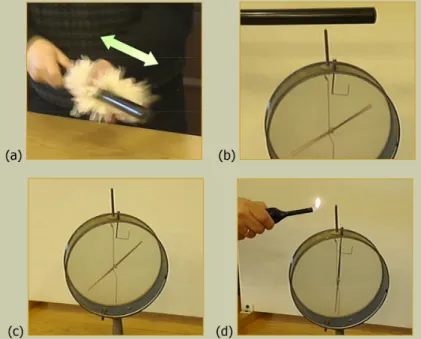
Charging an electroscope with an electrized stick and discharging with a flame is one of good examples of the mentioned demonstrations. Why does a friction charge a di-electric stick? How does the charge fill an electroscope? Why does hot air discharge the electroscope? The demonstration phases are shown in Fig. 5. The movie is also available: http://radojewska.net/ptee2014/electro/
What defines a success in lectures and labs? | Case studies in Physics teaching
Fig. 5. Distinguishing phases of the demonstration: (a) a stick electrization, (b) charging an electroscope, (c) the electroscope charged, (d) discharging the electroscope with a flame.
It is not easy for students to explain all phases at the beginning. They need to combine many branches of physics at the moment. And this was the aim of the demonstration. Specific problem- oriented teaching like this one can develop complete thinking, can accustom students to seeing more than a single page in a handbook, can learn how to solve any future engineering complex problems. The success consists in a teaching of combined problems with many phenomena involved which usually occur at the same time or in a typical sequence, to show that physics is indivisible, just like the surrounding world, just like a future engineer’s job.
Challenges and Solutions | Plugins and apps for effective teaching
cAsestudy no.4. exPerimentswhichcAnshow AbeAutyofthe nAture, Aclevernessof
PhysicsAndsAtisfActionofAneducAtor
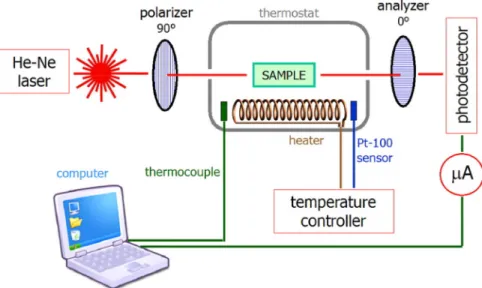
Prof. Ryszard Poprawski lectures on Dielectric Physics for Technical Physics Engi-neering students and Dr Agnieszka Cizman teaches in Solid State Physics Laborato-ry. No doubt that experimental physics is a necessary part of Physics teaching. There are physics laboratories at many, maybe all universities. Why is one experiment in such a lab better than other? The experiment should explain a physical mechanism of the phenomenon. The experiment should be related to phenomena applied in technology. The experiment should show future prospects and possible developments. The experimental set-up should not be expensive (taking care of the university budget). Looking for and finding such a kind of student experiments were the aim of Dielectric Physics Laboratory team. The team can point the most brilliant set-ups built (by the team) and used in the laboratory, for example: Set-up for tem-perature studies of the spontaneous birefringence in crystals (a diagram is shown in Fig.6). The set-up story reached only 2005. Ryszard Poprawski was a su-pervisor of Agnieszka Cizman’s master’s thesis on the set-up to be made within own (institute) capacity. A whole design was passed to Mechanical Workshops in Institute of Physics, to Mr Edward Ciupidro. All parts, made there, were then mounted and tested at our laboratory. Triglycine sulfate crystals, grown also at our laboratory, were used for tests, due to their ferroelectric properties with the second-order phase transition at 49oC. The crystals are centrosymmetric in paraelectric phase, so
the anomalous part of the spontaneous birefringence possesses a character of the spontaneous Kerr effect.
The set-up tests were successful (see Fig. 7). After the entire undertaking had been described in an article [Cizman et al. 2005], it brought an interest of Polish universities. After a few improvements the set-up was reproduced and sold to several universities. It is also an economical dimension of the venture.
What defines a success in lectures and labs? | Case studies in Physics teaching
Fig. 6. Schematic set-up diagram for temperature-birefringence measurements.
The set-up is not only used in a teaching process, but successfully in physics re-search as well [Cizman et al. 2006, Cizman et al. 2007]. Due to this experimental set-up our students can learn optics of anisotropic media and ferroelectric phase transition mechanisms. The birefringence phenomenon is an important point in stu-dents engineering education due to its technical and medical application such as medical diagnostics and imaging, seismology tests, mechanical stress analyses, also widely used in mineralogy and fiber optics.
Fig. 7. Temperature dependence of the linear birefringence changes for triglycine sulfate crystals along the a-axis (in the left) and along the b-axis (in the right) [Cizman et al. 2005].
The measurements were carried out with a set-up shown in Fig. 6.
Our success consists in a contriving of an interesting experimental set-up, in pro-ducing a prototype and in profitable selling the set-up to other universities, and most
Challenges and Solutions | Plugins and apps for effective teaching
important of all: in an enrichment of teaching infrastructure and research means. It is worth mentioning that on a basis of a bilateral exchange agreement between our university and Université de Strasbourg the French students have ability to study birefringence in our laboratory on their stay in Wroclaw.
f
inAlremArksA success in teaching has many dimensions and many faces. And after all it gives a great teacher’s satisfaction.
r
eferencesCizman, A., Poprawski, R. (2005). Set-up for spontaneous and induced birefringence measurements.
Optica Applicata 35, 163-170.
Cizman, A., Poprawski, R. and Sieradzki, A. (2007). Ferroelectric phase transition in (CH3NH3)5Bi2Cl11 and (CH3NH3)5Bi2Br11 crystals, Phase Transitions, 80, 171-176.
Cizman, A., Sieradzki A. and Poprawski, R. (2006). Ferroelectric Phase Transitions in (CH3NH3)5Bi2Cl11 – Excess Entropy and Spontaneous Birefringence, Ferroelectrics, 336, 101-106.
Suhonen, S. [email protected] Tiili, J. [email protected] Tampere University of Applied Sciences Tampere, Finland
A
bstrActPhysics laboratory courses have always been included in the curricula of all engi-neering degree programs at Tampere University of Applied Sciences. Physics labo-ratory course is usually the very first course in which freshmen encounter not only measurements, but also uncertainty evaluation and scientific reporting. The versa-tility of the skills needed is large: laws of physics, measurements, uncertainty eval-uations, reporting and yet skills in using MS Word and MS Excel. Despite the great interest the student have always shown in active doing in the physics laboratory courses, they have considered them as demanding and laborious. Therefore, the course contents have been changed to offer more support to analysing and reporting skills. Now the first physics laboratory course is called “Basics of measurements and scientific reporting” and it consists of equal amounts of physics, mathematics and communication studies, 1 ects each, instructed by a physicist, a mathematician and a communications teacher, respectively. The key idea of the course is to bring together all the basic skills a student – and an engineer to be – needs related to measurements and their reporting to an instructor or to a customer, for example. Furthermore, now the students get much more support and guidance. Students have this course scheduled in the same time at every week, but the classroom and the teacher changes. First they go to physics laboratory to carry out measurements. Next week they bring their measurement results to mathematics workshop, which content is related to the analysis of their results. In reporting workshop they learn how to report them in a correct way. This three-week circulation is repeated three times. As the course proceeds, the learning objectives are varied and they get more demand-ing. It is possible to generate a more cohesive and concise view to measurements and reporting aspects and prepare the students to the studies and work life to come. Keywords: Physics laboratory course; Measurement skills; Scientific reporting; In-tegrated course.
e
nhAncing scientific AnAlysing And rePorting skills-
integrAted PhysicslAborAtory courses
ummAryLaboratory courses are sometimes considered as demanding and laborious. There-fore, the course contents have been changed to offer more support to analyzing and reporting skills. Now the first physics laboratory consists of equal amounts of phys-ics, mathematics and communication studies, 1 ects each, instructed by a physicist, a mathematician and a communications teacher, respectively. The key idea of the course is to bring together all the basic skills a student needs related to measure-ments and their reporting. It is possible to generate a more cohesive and concise view to measurements and reporting.
i
ntroductionTraditional physics curriculum in Bachelor’s level engineering education at Tampere University of Applied Sciences (TAMK) has always included some laboratory work, either as its own laboratory course or integrated within a theory course. Physics laboratory courses develop engineering, scientific, and reporting skills of the future engineers. According to the student feedback, physics laboratory work and especial-ly writing reports is considered very time-consuming, even compared to the ECTS credits of the course. Despite the feedback, students very much agree that they have learned a lot of important skills during the elementary physics laboratory course. On the other hand, as physics educators, it was seen that the quality of reports needed to be improved further. In order to react to the students’ and instructors’ feedback, TAMK’s system of implementing elementary physics laboratory courses is going through a continuous developing process. This paper describes the latest step of the process, a change in curriculum, to form an integrated course in order to achieve enhanced measurement and reporting skills of first year engineering students. bAckgroundAndrePortedmethodstoimProvelAborAtorycourses
Even though the learning outcomes from physics laboratory course are seen very important, some pressure is coming not only from the students, but from the financ-ing. Laboratory teaching is more expensive compared to the theoretical methods of teaching. This raises the danger of reducing the amount of laboratory courses in the name of reducing costs. In some studies, students have reported laboratory expe-riences to be negative or dull, mainly because the tasks, working and the solution methodology are pre-stated (Das, B., Hough C. L. Jr, 1986). On the other hand, stu-dent feedback and a survey from Australia shows the opposite result: physics labo-ratory work provides students with many important skills that they think they do need in the future. Laboratory work is also seen to be useful, understandable, interesting and enjoyable by the students (Blathal R., 2011). In order to increase the students’ interest in physics laboratory work, the idea of self-designed, poster reported physics
Enhancing scientific analysing and reporting skills - integrated physics laboratory course
laboratory experiment was implemented in Tampere University of Applied Sciences (Tiili, J., 2012). In that study, it was shown that the quality of reporting needed further improvement.
In some cases, modern ICT has been seen as one tool to reduce costs of laboratory working. Laboratory experiments can be done hands-off using videos or live stream-ing from an actual measurement (Abdel-Salam et al., 2006). All different methods of laboratory work have their own advantages. Traditional hands-on laboratory work is initially needed to bring the sense of reality in the remote and virtual labs (Ma, J., Nickerson, J. V., 2006). Traditional hands-on laboratory work brings the important as-pect of a direct social interaction to learning. To increase the collaborative nature and social interaction to reporting, Google Docs is reported as a collaborative reporting tool in The United States (Wood, M., 2011).
Traditional hands-on experiments have their strengths. To improve students’ moti-vation, the method of implementing and reporting may vary. Mainly to increase stu-dents’ motivation, Greer has reported the method in which laboratory experiments’ traditional tasks have changed to challenge laboratories. In challenge laboratories, students work first in a traditional way doing measurements and calculating results. After that students face a challenge concerning the experiment (Greer, A. J., Bier-man, J. D., 2005). As instructors, the most important challenge is to make sure that students’ learning outcomes are up to date and relevant to their future studies and professional needs, no matter the method used.
evolutionofthelAborAtorycourses
Physics laboratory courses have been changed many times during the past decades. Most of the time, there have been two physics courses, both yielding 2 ects credits. In this study all data is for the first physics laboratory course, in which the students encounter measurement data analysis and reporting for the first time. Major, cur-riculum-level changes are summarized in table 1. The amount of classroom time for one laboratory work has increased from 4,5 h to 10 h, as shown in table 1. This increase includes workshops and theoretical lectures in mathematics and reporting to support the ongoing laboratory works and their reporting. Now all the necessary skills are taught within the laboratory course, not in separate mathematics lectures and writing lectures.
Until year 2005, classroom time was almost entirely used for carrying out mea-surements. At that time, there was only a three hour lecture of reporting and uncer-tainty evaluation. The students were supposed to learn the analysis and reporting autonomously by just reading instructions and doing it. At that time, the step from a freshman’s basic skills to the skills needed to complete the first report was huge, which created discomfort among some students and not all of them were able reach
Challenges and Solutions | Plugins and apps for effective teaching
the needed level. In addition to writing a report of all works, there was also an ex-amination related both to the topics and to data analysing methods of various works. Thereafter, from 2005 to 2013, scientific reporting workshops and peer reviews were included to course content to offer some support and guidance to the students. All this was carried out by physics teachers. The laboratory work final examination was discarded and the evaluation and assessment of learning outcomes was based on the reports and portfolio. Feedback about the reports was also given more contin-uously, not only by the instructors, but also as peer review.
At the latest step in 2013 curriculum development, the structure of the laboratory course was changed more dramatically, as described in detail in next chapter. The course contents have been changed to offer more support to analysing and reporting skills. The first physics laboratory course “Basics of measurements and scientific reporting” consists of equal amounts of physics, mathematics and communication studies, 1 ects each, instructed by a physicist, a mathematician and a communica-tions teacher, respectively. This course is then followed by “Physics laboratories”, which is extended to 3 ects credits and therefore the total amount of credits from physics labs is unchanged. The key idea of the new course is to bring together all the basic skills a student – and an engineer to be – needs related to measurements and their reporting to an instructor or to a customer, for example. With the new curriculum it is possible to generate a more cohesive and concise view to measurements and reporting aspects and prepare the students to the studies to come.
Table 1. Time usage of the first physics laboratory course.
Time usage -2004 2005-2013
2014-Total classroom time 27 h 33 h 30 h
Measurements 18 h 18 h 9 h
Intro, maths, writing, workshops 3 h 9 h 19 h
Feedback 2 h 6 h 3 h
Examination 3 h -
-Number of lab. works 6 6 3
Classroom time per work 4,5 h 5,5 h 10 h
ArrAngementsinthenewlAborAtorycourse
The course “Basics of measurements and scientific reporting” has three measure-ment assignmeasure-ments, which each are followed first by a mathematics lectures and workshop and then by reporting lectures and workshop, as shown in figure 1. From the student’s point of view, the course proceeds as follows:
Enhancing scientific analysing and reporting skills - integrated physics laboratory course
1. The concept, requirements and learning objectives are introduced (Intro).
2. The students carry out a measurement in physics laboratory working in pairs (Meas). The output is the measurement data, typically in the form of a log book. If the students have time after measurements, they can continue calculating the actual results. Time reserved for this stage is 3 h.
3. With the log book and data, the students go to mathematics lecture (Maths), which topic is related to the analysing skills the students need for the laboratory work. Typically, in the first cycle, this means error calculations. The lecture part is rather short and it is directly followed by a workshop, during which the students are able to carry out the necessary calculations with the help of the teacher. Again, the reserved time is 3 h.
4. In reporting lecture and workshop (Report), the layout and structure of a scientific report is presented together with the standards for the text. All the calculations needed for the report are already done, and therefore students can concentrate on producing text. During this three hour period of many students are able to finish the report. The deadline is, however, one week later, before the first reflection time.
5. Once the reports are ready, the instructror(s) read them and prepare collective feedback.
During reflection (Refl) the reports are given back to students. They are also provided with a list of requirements for scientific text and reporting. With the help of the list, they go through their own report and mark, which aspect are already well done and which need further improvement. This way, they are aware of their skills and are able to improve their text and reporting during the next cycle in a cumulative way. One measurement-analysis-reporting set, or a cycle, lasts for three weeks plus one or two extra weeks for finishing the report. The three hour sessions are scheduled to the same time window in the timetable during successive weeks. After the sec-ond and third cycles, students have two weeks to finish their report. The learning objectives are getting more and more demanding as the course proceeds. For the second cycle, the objectives are linear regression and graphs in mathematics and the correct way in referencing in reporting. Again, students have the opportunity to write their reports in workshops with the help of maths and communication teacher, consecutively. During the third cycle the students learn how to use total differential method in error analysis.
Challenges and Solutions | Plugins and apps for effective teaching
Fig. 1. Arrangements in the new laboratory course.
Like the student groups, the same time window is reserved for instructors every week. The difference is that a teacher has one group in first week, another in second week and yet third group in third week of a cycle. In this way, it is possible to fill in the time table of a teacher without unnecessary gaps.
feedbAckAndsurveyresultsofthenewcourse
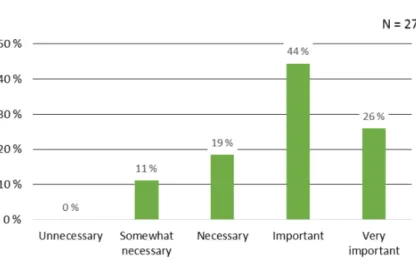
Feedback concerning experiences about arrangements and learning outcomes was collected from the students using questionnaires and some of the instructors of the course were interviewed. Figure 2 summarises the student feedback of their own learning outcomes. The students were asked how they experienced their skills to have increased during the course. The scale was from 0 (lowest) to 5 (highest). Most of the students rated their improvements as 4 in all other categories. In general, the feedback shows that most students feel that they have learned a lot during the course. The same conclusion can be made based on instructor experiences: physics teachers reported that especially last reports were better than before and, in general, they were handed out in time. Their layout and text properties also followed better the appropriate standards. Simultaneously, teacher’s work load in reading and com-menting reports has decreased.
Enhancing scientific analysing and reporting skills - integrated physics laboratory course
Fig. 2. Survey results of improvements in skills.
When a course has many teachers and many point of view to the same topic, there is a danger that the constituents remain separate, don’t support each other and don’t form an entity. Student experiences about this aspect were surveyed with a few questions and the results are shown in table 2. Majority of the answers (63 %) show that the teachers’ contributions to the course were in line with the learning objectives and they were able to help the students to construct their knowledge and skills coherently. Moreover, the students felt that measurement and reporting skills are relevant to an engineer to be, as shown in figure 3.
Table 2. Student feedback about course constituents, N=27.
Question: No. of answers “Measurements, mathematics and reporting were separate
and failed to form a coherent entity.”
0 (0 %) “Measurements, mathematics and reporting were
some-what separate.”
1 (4 %) “Measurements, mathematics and reporting were
support-ing each other, but the entity was somewhat unclear.” 9 (33 %) “Measurements, mathematics and reporting formed a
cohe-sive entity which enhanced learning.” 17 (63 %)
Challenges and Solutions | Plugins and apps for effective teaching
At least in this piloted case, the main challenges in this type of a course are not in the implementation, but rather in the planning stage. The management and planning of time-table and classroom reservations are rather complicated. All three parts need to be handled: 1) the student groups should have a clear schedule, the contact hours every week at the same time (but in different classrooms), 2) Un-necessary gaps in teachers’ schedules should be avoided and 3) classrooms booked only for needed usage.
Enhancing scientific analysing and reporting skills - integrated physics laboratory course
c
onclusionsThe new laboratory course implementation has offered the students much more support in data analysis and scientific reporting than before. Course implementations had 3-4 teachers: 1-2 physicists, a mathematician and a communications teacher. According to survey results, the teachers’ contributions to the course were in line with the learning objectives and they were able to help the students to construct their knowledge and skills coherently. Most students feel that they have learned a lot during the course. Physics teachers reported that reports were better than before and they were handed out in time. Their layout and text properties also followed better the appropriate standards. Simultaneously, teacher’s work load in reading and commenting reports has decreased.
Challenges and Solutions | Plugins and apps for effective teaching
r
eferencesAbdel-Salam, T., Kauffman, P. J., Crossman, G. (2006) Does the Lack of Hands-on Experience in a Remotely Delivered Laboratory Course Affect Student Learning?, European Journal of
Engineering Education, 31, 747–756.
Blathal, R. (2011) Retrospective Perceptions and Views of Engineering Students about Physics and Engineering Practicals, European Journal of Engineering Education, 36, 403–411.
Das, B., Hough C.L. Jr (1986) A Solution to the Current Crisis in Engineering Laboratory Instruction,
European Journal of Engineering Education, 11, 423–427.
Greer, A. J., Bierman, J. D. (2005) Challenge Laboratories, The Physics Teacher, 43, 527-529. Ma, J., Nickerson, J. V. (2006) Hands-On, Simulated and Remote Laboratories: A Comparative Literature
Review, ACM Computing Surveys, 38(3), 1-24
Tiili, J. (2012) Poster Presentation as The Report of a Self-Designed Laboratory Experiment – a Case Study. Proceedings of the NTF 2012 Conference, 11. – 12. October 2012, Brno, Czech Republic Wood, M. (2011) Collaborative Lab Reports with Google Docs, The Physics Teacher, 49 158–159.
Pinheiro, M. ISCA-UA - Institute of Accounting and Administration and CIDTFF - Research Centre Didactics and
Technology in Education of Trainers, University of Aveiro Aveiro, Portugal [email protected]
A
bstrActTo meet the challenges that are currently being faced by Higher Education Insti-tutions (HEIs) either in terms of the required roles for teachers and students, or of teaching and learning processes, it is pointed out, more than the reformulation of the (theoretical) mission of higher education, the recasting of the practice of the institutions that comprise it. In the present study we highlight PBL methodologies (either in a project-based learning or a problem-based learning perspective), based upon the principle of using contextualized problems of a professional nature as a starting point for the acquisition and integration of knowledge. This article reports on the effects of PBL methodologies on the students’ personal competences in a simulation environment for the business reality. The case study for our investigation was the course of Business Simulation (BS) at the Higher Institute of Accounting and Administration of the University of Aveiro (ISCA-UA), as a PBL-type methodology. The generic objective of the course is the applied and contextual integration of previous information, in a global perspective, in order to prepare qualified professionals able to work in organisational environments. The research made use of theory, data and methodological triangulation. While semi-structured interviews were made to tutors, students and graduates’ data was informed by questionnaires. Based upon some reflections we have been establishing, it is possible to consider new perspectives, capable of contributing for the activation of a debate around the dynamics of self-de-velopment competences, associated to the use of PBL methodologies. As it was observed, we identified two trends in the perceptions evidenced by the interviewees and the respondents. On the one hand, students, graduates and tutors support that PBL methodologies were important mainly at the level of resource use (management, planning and work methodology) and of knowledge construction (critical analysis, grounds for decisions and initiative). Another conclusion of the study is the fact that communication skills (oral and written) appear far less valued, when compared to the remaining items for self-development. On the other hand, for the employers, one can easily detect a persistent tendency to recognize PBL methodologies as responsible
e
ffectsofPbl
methodologieson thestudentsPersonAlcomPetences
Challenges and Solutions | Plugins and apps for effective teaching
for the valorisation of more consistent grounds and more confident attitudes, but not directly responsible for an improvement of graduates’ personal competences, in general. To some extent, this aspect recognizes that methodologies have the ability to foster students’ self-esteem, and self-confidence. Also and particularly interesting, seems to be the suggestion that, maybe, PBL methodologies can be related with the idea of self-employment and entrepreneurship. As literature does not approach this matter, it seems possible to us to sustain the possibility of inserting the entre-preneurship logic, motivated by PBL methodologies, in the existing theories. Once, mainly in vocational higher education, learning methodologies tend to become more reactive to the needs of employers, it seems important not to forget the mission of HEIs and so, we suggest a carefully analysis of the balance between the theoretical conceptualization and its practical applicability.
Keywords: PBL; Personal competences; Students; Academics; Employers; Higher education institution.
s
ummAryThis article reports on the effects of PBL methodologies on the students’ personal competences. On the one hand, students, graduates and tutors support that PBL methodologies were important mainly at the level of resource use (management, planning and work methodology) and of knowledge construction (critical analysis, grounds for decisions and initiative). On the other hand, for the employers, one can easily detect a persistent tendency to recognize PBL methodologies as responsible for the valorisation of more consistent grounds and more confident attitudes, but not directly responsible for an improvement of graduates’ personal competences, in general
1. i
ntroductionThe new economic challenges, the speedy developments in information and commu-nication technologies (ICT) or the emerging globalization, are some of the challenges that businesses are facing today. These rapid changes meant that business educa-tion must equip students to deal with increasing competieduca-tion in a global marketplace, and to face the requirements of multi-facet skills. As a consequence, there is an increasing importance on the quality of the learning experience being provided to business students (Byrne & Flood, 2008; Mohamed & Lashine, 2003). To achieve this, higher education institutions (HEI) need not only to understand student learning but also to realize how employers value graduates and their capabilities(Archer &
Da-Effects of PBL methodologies on the students personal competences
vison, 2008). Within the context of skills development, lifelong learning, collaborative strategies and other concepts, the discovery and deployment of new teaching and learning methodologies become an authoritative task (Chaparro-Peláez, Iglesias-Pra-das, Félix, Pascual-Miguel, & Hernández-García, 2013). A possible way to foster and supplement the change of a traditional lecture-based method is the usage of a PBL methodology (either in a project-based learning or a problem-based learning per-spective), supported by a business simulation context. The main goal of this study is to contribute for the theoretical discussion of the key factors affecting the students, tutors, graduates and employers’ perceptions of learning using simulation-support-ed PBL. More specifically, we did limit our field of study to the context of personal competences. The structure of this document is as follows: in the first section, an introduction to PBL and business simulation is presented. After having established the theoretical foundations, a description of the case study and the instructional methodology is made. Then, data analysis is performed in order to evaluate the influence of PBL methodologies supported by a business simulation context in the personal competences of the students. Finally, conclusions from the data analysis are summarized, followed by a discussion of the findings from the study.
2. c
omPetenciesAndPbl
methodologies:
thechAngingPArAdigmLifelong learning concepts, skills development and self-directed learning are con-cepts of growing importance in higher education agenda. Within the background of these educational trends, the positioning of new learning methodologies becomes an authoritative task (Chaparro-Peláez et al., 2013).
As developed countries struggle to produce the intellectual capital required to com-pete globally, the more businesses’ requirements of graduates’ comcom-petences in-flate. The effects of the expectation that new graduates can have the ability to add immediate value to businesses result in a growing interest on the current state and future of graduate skills. To assure that students acquire strategies, particularly in transferable skills which allows them to learn effectively and throughout their lives, organizations are tipping the balance of the responsibility of skill development to HEI (Jackson, 2010).
So, and mainly in vocational education, HEI need to produce graduates with the soft skills believed essential for increase productivity and innovation in their future workplace. So, and as several authors claim (e.g. Archer & Davison, 2008) there is a need for action by HEI and employers to address both skills deficit in the graduates. Even if the blame of inadequacies of the schooling system is consistently directed at the content, the design or the structure of undergraduate programs, the question of the methodological preparation of the future graduates is a central point (Jackson, 2010).
Challenges and Solutions | Plugins and apps for effective teaching
Different learning orientations and conceptions of learning have been explored in connection with different methods of learning, giving rise to the refinement of the concepts and their development in relation to specific educational contexts. In fact, if in the 1970s, studies that supported surface approaches to learning (memorization and rote learning), rather than deep approaches to learning (active construction and focus on meaning) arise, more recent studies in the 2000s (e.g. Fyrenius, Wirell, & Silén, 2007), show that understanding can be conceived of and attained in vari-ous ways. As the concept of understanding and of students’ approaches to learning evolves, the surface and deep dichotomy is being replaced by entangled and collab-orating activities. The expectation that education must be built on learning to know, learning to do, learning to live together and learning to be, is shared in the Jacques Delors’ report (Unesco, 1998). At the same time, accepting that optimal teaching and learning occur when teaching styles align with learning styles, it seems possible to tailor both by integrating interactive simulations to support face-to-face classroom (Proserpio & Gioia, 2007). On the other hand, if traditional lectures are predominantly oriented by learning to know and, specifically in vocational training, by learning to do, several authors (e.g. Fyrenius et al., 2007; Unesco, 1998) argue that it is necessary to provide education with designed methodologies able to involve, also, learning to live together and learning to be. Among several disadvantages pointed out to tradi-tional schooling, the lack of connection between one element to the others, the lack of teamwork or the lack of knowledge transfer motivated by no research investigation among students, are some of the most cited (Kaufmann, Mense, Wahl, & Pucher, 2011). In the Portuguese case, the binary higher education system distinguishes between a polytechnic approach (identified with a professional orientation) and a university approach (identified with a more conceptual and theoretical orientation). So, and particularly in polytechnic education it is possible to understand the impor-tance to adjust training to the professional needs demanded by employers. In order to strengthen such a position, new pedagogies centered in the relation between pedagogical practices and professional practices have been revealing themselves as an important methodological paradigm (Musal, Taskiran, & Kelson, 2003).
Several authors establish the benefits of problem solving skills in relation to a better understanding of the future professional activity (Karantzas et al., 2013; Papinczack, 2009; Tate & Grein, 2009), and they call for a deeper relationship between employ-ers organizations and HEI. These same skills are thought to enhance graduates’ capacity to deal with novel and blurred problems and their ability to make connec-tions between learning and practice (Karantzas et al., 2013). Besides, as Clifford and Montgomery (2014) claim, problem-solving is important in enhancing students’ ability to think and act as global citizens.
The PBL model, firstly developed by Howard Barrows and Robyn Tamblyn in the late sixties, was initially associated to medical schools. Nowadays, the PBL methodology
Effects of PBL methodologies on the students personal competences
has been used in various professional areas and programs, gathering more than 40 years of experience (Nel et al., 2008). Even if the concept of PBL varies some-what in the literature (e.g. Moesby, 2006), there are key elements common to most descriptions of this methodological approach. Using PBL, teachers firstly present students with a problem that require students to go beyond rote-learning. In fact, after analyzing the problem and identifying the necessary information to begin the analysis, solving the problem should require students to actively engage in research, analysis and exchange of ideas. In this methodological orientation, teacher does not provide answers. Instead, he acts as a facilitator or tutor as he provides crucial assistance by helping students develop their problem-solving skills (Chaparro-Peláez et al., 2013; Prince, 2004). In PBL, students are the center of the learning process as they are responsible for their own learning as well as for identifying their knowl-edge shortcomings and determining how to overcome them. Given the collaborative nature of the methodology, in PBL students usually work in small groups. All through the process, students are not only supposed to understand and critically explain the existing literature on the subject, but also to communicate with others and to develop self-learning competences. Accepting the perspective of several authors (e.g. Tate & Grein, 2009), the active nature of PBL call for a committed participation of the learner, which is a central point in knowledge reconstruction. As a result, it is possible to refer the acquisition of technical, (regarding the processes), personal (regarding questions of organization and communication), and social (regarding interpersonal relations) competences (Albanese & Mitchell, 1993; Musal et al., 2003). Therefore, problems are used not only as a way to develop the skills needed to solve them, but also as a means to achieve knowledge (Savin-Baden & Major, 2004).
In general, the learning cycle begins with the presentation of the problem to the students. Afterwards, students have to analyze the problem and identify the most rel-evant facts about it. As they begin to understand the problem, and hypothesize pos-sible solutions, they need to analyze the different strategies and decisions they must take in the process. The identification of knowledge shortcomings is an important part of the cycle. In fact, to do that, students have to research through a self-directed learning process (facilitated by teachers), search for relevant information to answer the questions that arise, reflect on the hypothesized possible courses of action, iden-tify which concepts are need to be researched in detail and bring together all the information acquired (Chaparro-Peláez et al., 2013).