International Corporate Governance Spillovers:
Evidence from Cross-Border Mergers and Acquisitions
*Rui Albuquerque
Boston College Carroll School of Management, CEPR, ECGI
Luis Brandão-Marques
International Monetary Fund
Miguel A. Ferreira
Nova School of Business and Economics, CEPR, ECGI
Pedro Matos
University of Virginia - Darden School of Business, ECGI Review of Financial Studies forthcoming
Abstract
We test the hypothesis that foreign direct investment promotes corporate governance spillovers in the host country. Using firm-level data from 64 countries during the period 2005-2014, we find that cross-border M&A activity is associated with subsequent improvements in the governance of non-target firms when the acquirer country has stronger investor protection than the target country. The effect is more pronounced when the target industry is more competitive. Cross-border M&As are also associated with increases in investment and valuation of non-target firms. Alternative explanations such as access to global financial markets and cultural similarities do not appear to explain our findings. (JEL G32, G34, G38)
* We thank Andrew Karolyi (the editor), two anonymous referees, Sophia Chen, Ing-Haw Cheng, Stijn Claessens,
David Dicks, Alexander Dyck, Mariassunta Giannetti, Peter Iliev, Wei Jiang, Karl Lins, Edith Liu, Darius Miller, Lukas Roth, Michael Schill, David Schumacher, Beibei Shen, and Adrien Verdelhan; participants at the China International Conference in Finance, Columbia Conference on Corporate Governance around the World, Darden International Finance Conference, Midwest Finance Association, Napa Conference, SFS Finance Cavalcade, FIRS, UNC Global Issues in Accounting, Telfer Annual Conference on Accounting and Finance; and seminar participants at Darden School of Business for helpful comments. Ferreira acknowledges financial support from the European Research Council. Albuquerque acknowledges financial support from the Fundação para a Ciência e Tecnologia (grant PTDC/IIM-FIN/2977/2014). Matos acknowledges financial support from the Mayo Center for Asset Management. The views expressed are those of the authors and should not be attributed to the International Monetary Fund, its Executive Board, or its management. Send correspondence to Miguel Ferreira, Nova School of Business and Economics, Campus de Campolide, 1099-032 Lisboa, Portugal; telephone: +351 213801631. E-mail: [email protected].
1
Foreign direct investment (FDI) has been an important element in financial globalization in recent decades. According to the World Development Indicators, the yearly average ratio of world FDI net inflows to gross domestic product (GDP) has increased nearly six times in the last decades from 0.5% in the 1980s to 3% between 2000 and 2014. More than half of FDI occurs through cross-border mergers and acquisitions (M&As). During the mid-2000s merger boom and again more recently in the 2010s, the value of cross-border deals exceeded the value of domestic M&As (Organisation for Economic Co-operation and Development 2007).
FDI, and especially cross-border M&As, can be a source of corporate governance improvements in the host country. An active international market for corporate control may substitute for weak investor protection and legal institutions in a host country (Manne 1965; Scharfstein 1988). Research supports the idea that cross-border M&As bring corporate governance improvements to target firms. Rossi and Volpin (2004) find that firms based in weak legal environments are frequently targets of acquisition by firms located in strong legal environments. Bris and Cabolis (2008) and Martynova and Renneboog (2008) find that cross-border M&As generate substantial valuation gains when the acquirer firm’s country has stronger investor protection than the target firm’s country. None of these papers, however, provides evidence of actual corporate governance improvements.
We investigate whether the change in corporate control following a cross-border M&A leads to changes in corporate governance. The main hypothesis is that there is a positive governance spillover for non-target firms following a cross-border M&A when the acquirer firm is from a country with higher investor protection relative to the host country. We discuss several mechanisms that predict such spillovers, which share the intuition that cross-border M&As act as a coordinating device for other firms to also improve governance. Further, we hypothesize that cross-border M&As lead to increases in investment and valuation of non-target firms in line with the predicted governance spillovers. In our analysis, we focus on non-target firms because it is empirically difficult to measure the effects on target firms as these firms are frequently delisted
2 following the M&A.1
To test these hypotheses, we use firm-level data on corporate governance and cross-border M&As in 64 target countries over 2005–2014, covering both emerging and developing nations. Although U.S. firms are included in the sample as acquirers, we exclude U.S. target firms in the main tests.2 The main dependent variable is a firm-level governance index. We measure corporate governance using the percentage of 16 attributes on which the firm meets the minimum acceptable requirements (in terms of board, audit, antitakeover provisions, and compensation and ownership) drawn from the Bloomberg’s Environmental, Social and Governance (ESG) database. The sample includes 6,691 unique non-U.S. firms, for a total of 33,498 firm-year observations for which we have data for the main variables of interest. While our index relies on fewer governance attributes than most international corporate governance studies, our sample is substantially larger and has greater cross-country and time-series variation. For example, Aggarwal et al. (2009) and Aggarwal et al. (2011) use an index that relies on 41 governance attributes from the RiskMetrics/Institutional Shareholder Services (ISS), but the sample only includes 22 countries, all of which are developed countries, over 2004–2008.
Our international setting allows us to consider substantially more differences in governance than what we can see in a single country such as the United States. While Aggarwal et al. (2011) study own-firm governance changes following cross-border portfolio investment flows, we study the spillover effects of FDI. Because foreign direct investors assume control of the target firm, they are more likely to enact governance changes in the target firm than foreign portfolio investors, and these changes can spillover to the local economy.
Our main explanatory variable depends on who the relevant peer firms are with regards to the target firm. The mechanisms for governance spillovers that we consider suggest that we look at
1 We identify 233 targets in cross-border M&As in our sample. Of these targets, 28 are delisted in the same year,
187 are delisted the following year, and only 18 remain in our sample for two years or more after the deal.
2 We focus on non-U.S. target firms for three reasons: (1) U.S. firms typically have better corporate governance than
otherwise similar non-U.S. firms (Aggarwal et al. 2009); (2) the results could be affected by the fact that there are many more U.S. firms than firms in any other country; and (3) we use domestic M&A activity in the United States as an instrumental variable.
3
non-target firms that operate in the same country and industry as the target firm. Our main explanatory variable measures the entry of foreign firms into a country/industry through cross-border M&As, interacted with the difference in investor protection between the source country and host country. We measure the value of all cross-border M&As in the target firm’s industry as a fraction of market capitalization. In our regressions, we also control for the level of cross-border M&As in order to control for the primary reasons that cause capital flows regardless of the differences in investor protection. We also control for covariates such as firm size, growth opportunities, leverage, tangibility, insider ownership, and institutional ownership as well as year and firm fixed-effects.
We find that cross-border M&As from source countries with relatively stronger investor protection vis-à-vis the host country produce significant positive governance spillovers within the target firm’s industry. In contrast, the level of cross-border M&As by itself is statistically insignificant. The governance spillover effect due to cross-border M&A from a source country with stronger investor protection is economically significant if compared with the effects of other important governance determinants such as foreign institutional ownership. A one-standard- deviation change in cross-border M&A from a country with stronger investor protection vis-à-vis the host country results in a change in the governance index that represents 2.5% of the annual standard deviation in that index. In contrast, in Aggarwal et al. (2011), a one-standard-deviation change in foreign institutional ownership results in a change that represents 3% of the standard deviation in their governance index. Thus, our governance spillover effect is about the same size as the direct effect of foreign institutional ownership on governance. What is remarkable about the effect in our paper is that, as a spillover effect, it changes the governance of all the firms in the industry (excluding the direct effect on the target firm, which presumably could be much larger). These findings are consistent with the notion that cross-border M&As can promote good corporate governance practices in the host country.
One specific mechanism that we hypothesize to lead to such spillovers is product market competition. Following Giroud and Mueller (2011), we hypothesize that firms in less
4
competitive industries may be subject to greater agency costs, which may persist even after the entry of a foreign competitor. We find significant differences in the degree of governance spillovers when the target firm faces tougher product market competition. A one-standard-deviation change in cross-border M&A from a country with stronger investor protection vis-à-vis the host country and into a perfectly competitive industry results in a change in the governance index that represents 5.5% of the annual standard deviation in that index. Our governance spillover effect in competitive industries is almost double the size of the direct effect of foreign institutional ownership on governance in Aggarwal et al. (2011).
It is possible that the industry spillover effects that we capture are in fact country spillover effects. While we do not find a statistically significant effect of country-wide cross-border M&As in the governance of non-target firms, we consider two prominent theories for country effects of cross-border M&As. First, Doidge, Karolyi, and Stulz (2007) hypothesize that increased access to global financial markets for firms located in countries with low economic and financial development can lead to governance changes across the board. Taking cross-border M&A activity at the country level as shocks to the access to global financial markets, we find no evidence of governance spillovers when the target firm is located in a country with low GDP per capita or low stock market capitalization (as a percentage of GDP).3 Second, Ahern, Daminelli, and Fracassi (2015) show that the volume of cross-border M&As is higher between countries with relatively similar cultures. We find no evidence of governance spillovers after cross-border M&As involving countries with relatively similar cultures. We conclude that the effect of cross-border M&As remains significant when we control for economic development, financial development, and culture variables. Other mechanisms such as the takeover market, the CEO labor market or technological efficiency also do not seem to explain our findings.
Next, we test whether the governance spillovers produce real effects. We find that cross-border M&A activity in an industry from a source country with relatively higher investor
3 It is, however, possible that our test of the Doidge, Karolyi, and Stulz (2007) hypothesis lacks power by not having
5
protection vis-à-vis the host country is associated with increases in investment of non-target firms in the target firm’s industry. We also find positive spillovers on the market valuation of non-target firms following cross-border M&As. This firm-level evidence is consistent with the
industry-level evidence in Bris, Brisley, and Cabolis (2008). They find a positive relation
between the industry Tobin’s Q and the average change in investor protection (difference between acquirer and target country investor protection) following cross-border M&As.
We redo our empirical exercise using an instrumental variables estimator to address omitted variables and reverse causality issues simultaneously.4 We use the level of tariffs by industry in the host country, the level of import penetration in the host country/industry, and domestic M&A activity in the United States (since the sample does not include U.S. firms as targets) as sources of exogenous variation in cross-border M&As in each country and industry. These instruments are jointly significant in explaining cross-border M&As. The instrumental variable estimates suggest a causal effect from cross-border M&A (from source countries with relatively higher investor protection) to peer effects in corporate governance.
Our work contributes to a literature that studies convergence of corporate governance practices around the world (see Denis and McConnell (2003) for a review of the literature on international corporate governance). Researchers have observed that home-country legal protection of minority investors is an important determinant of firm governance choices (Doidge, Karolyi, and Stulz 2007), but an increasing exposure to global markets can potentially change that. Gilson (2001) identifies three types of corporate governance convergence: (1) functional convergence, when firm-level governance responds to demands by market participants; (2)
formal convergence, when there is a change in legislation that forces the adoption of better
4 Note that our exercise is not subject to the reflection problem (Manski 1993; Leary and Roberts 2014). The
reflection problem is created when one tries to explain individual firm outcomes (e.g., firm leverage) using corresponding outcomes among a firm’s peers (e.g., peer leverage). An observed correlation between a given firm’s policies and the actions or characteristics of its peers can be attributed to an endogeneity bias i.e., selection of firms or an omitted common factor. Our experiment overcomes this challenge by examining the correlation between non-target corporate governance and a potential source of exogenous variation in peer firm attributes (i.e., industry average cross-border M&A activity), rather than examining how a given firm’s governance is related to its peers’ governance.
6
governance practices; and (3) contractual convergence, when firms commit themselves to better governance regimes such as through U.S. cross-listing (Doidge, Karolyi, and Stulz 2004; Kumar and Ramchand 2008; Lel and Miller 2008). Our evidence demonstrates the importance of functional convergence as compared to formal convergence that are less frequent and sometimes not fully implemented (Khanna, Kogan, and Palepu 2006) and contractual convergence through cross-listings, which have declined in the last decade (Doidge, Karolyi, and Stulz 2013).
Our research is also related to papers that link product market competition and firm policy choices (e.g., Kovenock and Phillips 1997; MacKay and Phillips 2005) as well as papers that highlight the importance of peer firms in determining investment and financial policies (e.g., Dougal, Parsons, and Titman 2015; Leary and Roberts 2014). Consistent with our results, Servaes and Tamayo (2014) show that when a U.S. firm is targeted by a hostile takeover attempt its industry peers respond by cutting capital expenditures and cash holdings and increasing leverage and payout to shareholders. In addition, Harford, Stanfield, and Zhang (2016) find that leveraged buyout target rivals engage in governance improvements, and Gantchev, Gredil, and Jotikasthira (2014) find that peers of firms targeted by hedge fund activism improve operating performance in the same way as targets. These findings are consistent with the idea that the threat of takeover and shareholder activism can help reduce industry-wide agency problems, since they also affect the policies of industry peers. We extend these findings by providing direct evidence of industry-wide corporate governance changes through spillover effects and therefore evidence of functional convergence driven by the international market for corporate control.
In addition, our research is linked to a literature that examines the determinants and valuation gains of cross-border M&As. Previous research highlights the role of differences in country-level investor protection (Rossi and Volpin 2004; Bris and Cabolis 2008; Chari, Ouimet, and Tesar 2010), cultural proximity (Ahern, Daminelli, and Fracassi 2015), economic nationalism (Dinc and Erel 2012), foreign institutional investors (Ferreira, Massa, and Matos 2010), currency and stock market valuation (Erel, Liao, and Weisbach 2012), international taxation (Huizinga and Voget 2009), bank regulatory arbitrage (Karolyi and Taboada 2015), differences in takeover laws
7
(Lel and Miller 2015), differences in labor market regulations (Alimov 2015; Dessaint, Golubov, and Volpin 2017), and industry specialization (Frésard, Hege, and Phillips 2017).
Finally, we contribute to the literature that studies the effects of FDI on the host country. FDI can be a source of valuable technology and know-how by promoting linkages with host country firms, which can generate improvements in productivity. Empirically, however, there is mixed evidence of productivity spillovers associated with FDI (e.g., Haddad and Harrison 1993; Aitken and Harrison 1999; Javorcik 2004; Haskel, Pereira, Slaughter 2007; Keller and Yeaple 2009; Bloom, Sadun, and Van Reenen 2012; Guadalupe, Kuzmina, and Thomas 2012; Abebe, McMillan, and Serafinelli 2017). If foreign firms become more productive at the expense of lower productivity in host country firms, FDI may actually have an adverse effect. We identify a new channel – corporate governance – through which FDI may generate productivity spillover effects at the industry level.
1. Data
The data source for firm-level governance is Bloomberg’s Environmental, Social and Governance (ESG). Our sample of governance attributes covers 64 countries over 2005–2014. We use 16 attributes (divided into four subcategories − board, audit, anti-takeover provisions, and compensation and ownership) to create a composite governance index, GOV, for each firm and year. These attributes are listed in Table A1 of Appendix A.5 The index measures the percentage of attributes in which the firm meets minimum acceptable requirements. If a firm satisfies all 16 governance attributes, its GOV is 100%. The evidence in Aggarwal et al. (2009) suggests that local minority shareholders benefit from governance improvements as measured by increases in governance indexes. They use an index that relies on 41 governance attributes from the RiskMetrics/Institutional Shareholder Services (ISS), but their sample is limited in terms of
5 Bloomberg’s ESG contains 269 indicators that vary greatly in coverage. We selected the 16 in our index from
those indicators with good coverage that are also most related to the attributes in the index used by Aggarwal et al. (2009). The overall correlation between the two indexes is 0.6.
8
the number of countries and years (22 developed countries over 2004–2008).
The data source for cross-border M&As is SDC Platinum, and our sample of M&As covers the period from 2004 through 2013 (all explanatory variables are lagged by one year). We select all completed deals in which the acquirer seeks to own more than 50% of the target’s equity (i.e., the parent’s target is a public company) from countries for which firm-level governance data are available. By restricting our sample to control acquisitions, we focus on the most significant M&As, which are more likely to change the level of protection to the target firm’s investors. We exclude leveraged buyouts, spinoffs, recapitalizations, self-tenders, exchange offers, repurchases, minority stake purchases, acquisitions of remaining interest, and privatizations. Of the resulting deals, we keep only those deals with a transaction value of at least $1 million. This gives a sample of 9,995 cross-border deals with acquirers coming from 144 countries.
The spillover mechanisms that we study can differ on which non-target firms are affected: industry peers or country peers. In the first case, we measure cross-border M&A activity (XVAL) as the annual value of all cross-border deals in the target firm’s country and industry (at the two-digit SIC level) as a fraction of market capitalization. In the second case, we measure cross-border M&A activity (XVALC) as the annual value of all cross-cross-border deals in the target firm’s country as a fraction of market capitalization. We winsorize XVAL and XVALC at the bottom and top 1% levels.
The final sample covers 6,691 unique firms for which firm-specific GOV and country-industry-level XVAL are available. In 2014, these firms represent roughly 56% of the market capitalization of these countries.6 To focus purely on spillover effects in our tests, we exclude firms that were targets themselves in cross-border M&As in the current year. Target firms might have improved governance because they are a target themselves and not due to governance spillovers. Although U.S. firms are included in the sample as acquirers, we exclude U.S. target firms and corresponding spillover effects for their local peers.
9
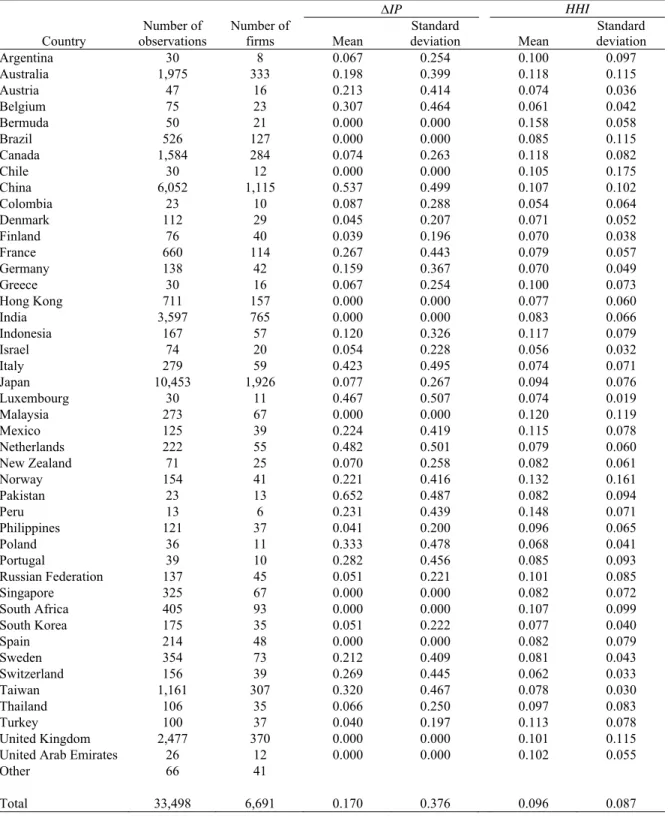
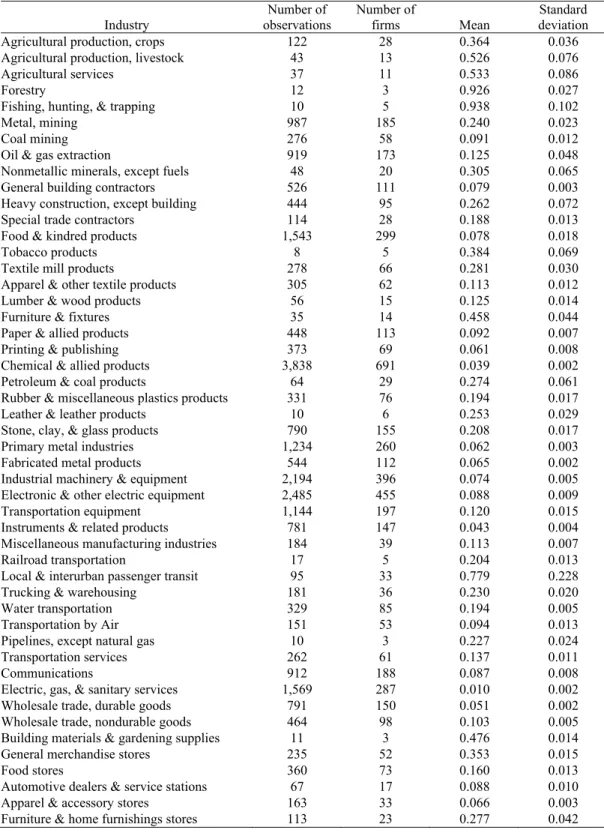
Table 1 shows that, on average, the countries with the highest GOV are Canada (82.1%), Switzerland (80.8%), and the United Kingdom (76.7%). The countries with the lowest GOV are India (60.0%), Thailand (60.2%), and the Philippines (60.7%). Average cross-border M&A activity (XVAL) is highest in Peru (7.7%), Poland (5.2%), and Belgium (4.9%) and is lowest in China, Colombia, Indonesia, Philippines, Taiwan, and Thailand (0%). Table 2 reports the top and bottom ten industries in terms of XVAL. There is considerable variation in cross-border M&A activity across industries. The “Trucking & Warehousing” industry has the highest average level of XVAL. The industries with the lowest average XVAL include “Food Stores” and “Heavy Construction, Except Building.”
We use the revised anti-director rights index of protections for minority shareholders from Djankov, La Porta, Lopez-de-Silanes, and Shleifer (2008) to build a measure of investor protection. For each cross-border M&A, the difference between acquirer and target country investor protection is denoted by IP, a dummy variable that takes a value of one if the value of transactions-weighted average difference between the acquirer and target anti-director rights index in a given country-industry (at the two-digit SIC level) is positive.7 We construct a similar measure of differences in investor protection for each country (IPC). Our regressions include
XVAL and XVAL IP as explanatory variables.
We control for the intensity of domestic M&As activity (DVAL) as the annual value of all domestic deals in the target firm’s country and industry (at the two-digit SIC level) as a fraction of market capitalization. DVAL is included because an active domestic market for corporate control could influence the governance of the target’s peers (Servaes and Tamayo 2014). We construct a similar measure of domestic M&As activity (DVALC) for each country.
We obtain firm characteristics from the WRDS-FactSet Fundamentals Annual Fiscal (North America and International) database. We use several firm-specific control variables in our regressions: logarithm of total assets in U.S. dollars (ASSETS), debt to assets ratio (LEVERAGE),
10
cash holdings to assets ratio (CASH), capital expenditure to assets ratio (CAPEX), property, plant, and equipment to assets ratio (PPE), return on assets (ROA), equity market-to-book ratio (MB), two-year annual sales growth in U.S. dollars (SGROWTH), research and development expenditures to assets ratio (R&D), foreign sales to total sales ratio (FXSALES), number of analysts following a firm (ANALYST), dummy variable that takes a value of one if a firm is cross-listed on a U.S. exchange (ADR), percentage of shares closely held (CLOSE), and sum of the holdings of institutions in a firm’s shares divided by market capitalization (IO_TOTAL). Firm-level controls that are defined as ratios are winsorized at the bottom and top 1% levels. Table A2 in Appendix A provides variable definitions and data sources. Table 3 provides summary statistics of the variables.
To test for the mechanism that leads to governance spillovers, we measure product market competition at the industry level (at the two-digit SIC level) using the Herfindahl-Hirschman index (HHI) based on annual sales for each industry and year in the United States. We use the
HHI based on the United States because in many countries publicly-listed firms are a poor
representation of the universe of firms.8
We also consider other mechanisms using country-level measures of economic development (GDP_PC, a dummy variable that equals one if the value of transactions-weighted average of the differences between acquirer country and target country GDP per capital is positive), and financial development (MKT_GDP, a dummy variable that equals one if the value of transactions-weighted average of the differences between acquirer and target country market capitalization to GDP is positive) as suggested by Doidge, Karolyi, and Stulz (2007); cultural differences (value of transactions-weighted average) between acquirer and target country in
8 Tables IA.1 and IA.2 in the Internet Appendix report summary statistics of HHI at the country level and industry
level, respectively. Some industries have maximum HHI of one, but they are unlikely to be outliers. The reason is that in the industries where the maximum HHI is one, the mean HHI is also high. These industries are “Agricultural Production - Livestock” (SIC 2) with mean HHI of 0.53, “Fishing, Hunting & Trapping” (SIC 9) with mean HHI of 0.94, “Local & Interurban Passenger Transit” (SIC 41) with mean HHI of 0.78, “Legal Services” (SIC 81) with mean HHI of 0.82, and “Services, Not Elsewhere Classified” (SIC 89) with mean HHI of 0.86. In addition, we find similar results when we repeat our main tests using the HHI variable winsorized at the top 1%.
11
terms of trust (TRUST), hierarchy (HIERAR), and individualism (INDIV) as in Ahern, Daminelli, and Fracassi (2015);9 differences in domestic M&A activity (as a fraction of market capitalization) between acquirer and target country (DVALC) to capture the variation due to differences in domestic markets for corporate control; differences in CEO labor market between acquirer and target country as measured by CEO total compensation (COMP); and differences in total factor productivity between acquirer and target country (TFP).
2. Corporate Governance Spillovers of Cross-Border Mergers and Acquisitions
We examine the relation between the non-target firm’s governance index and the intensity of cross-border M&A activity. We start with an analysis of spillovers to the governance of the target firm’s local rivals. We run a baseline regression using a firm-year panel:
, , ∆ , , ∆ , Γ , , , (1)
where GOVi,t is the corporate governance index for firm i in year t; XVALi,t-1 is the value of
cross-border M&As in firm i’s country-industry as a percentage of market capitalization in year
t-1; IPi,t-1 is dummy variable that takes a value of one if the average difference between the
acquirer and target anti-director rights index in a given country-industry is positive; and XVALi,t-1
IPi,t-1 is the value of cross-border M&As originating in countries with better investor
protection than that in the host country. We expect that XVALi,t-1 summarizes how cross-border
M&A affects corporate governance generally, while the interaction XVALi,t-1 IPi,t-1 captures
how differences in investor protection shape the effect of cross-border M&A on corporate governance. The regression equation (1) includes firm-level controls (Zi,t1), a firm fixed-effect
(µi) to control for time-invariant firm characteristics, and a year fixed-effect (t) to control for
changes in governance affecting many countries simultaneously (e.g., adoption of IFRS by European firms in 2005). All explanatory variables are lagged by one year. We correct standard
9 Ahern, Daminelli, and Fracassi’s (2015) measures, which come from WVS-World Values Survey, are available
12
errors for clustering of observations at the firm level (i.e., we assume observations are independent across firms, but not within firms).
The governance spillover effects that we consider may operate through product market competition. Following Giroud and Mueller (2011), we hypothesize that the positive spillover to the governance of the target’s local rival firms after a cross-border M&A is more pronounced in more competitive industries (e.g., managerial shirking would be more severely restricted after the cross-border M&A for the target and non-target firms). Firms in less competitive industries may be subject to greater agency costs and these may be perpetuated even after the entry of a foreign competitor.10 Thus, the relevant peers are the target firm’s country-industry rivals.
Table 4 reports the estimates. Column (1) for estimates without XVAL shows that the control variables have the expected signs. Corporate governance is positively associated with institutional ownership (IO_TOTAL), which is consistent with the idea that institutional ownership is associated with better corporate governance. While it is important to control for these ownership links, our focus in this study is to identify the governance spillover effects of cross-border M&As when foreign investors assume control of target firms. Column (2) considers the effect of cross-border M&A activity in an industry on the governance of non-target firms operating in the same industry. We find a positive but insignificant effect of XVAL on non-target firms’ governance.
The international market for corporate control should have a stronger effect if the acquirer country has better investor protection than the host country. To test this hypothesis, the regression in Column (3) includes the interaction XVAL IP (as well as XVAL). We find that the XVAL IP coefficient is positive and significant at the 1% level and that the XVAL coefficient is statistically insignificant.11 These results suggest that governance spillovers do not
10 A previous version of this paper formalized this argument based on a simple model à la Shleifer and Wolfenzon
(2002) and Albuquerque and Wang (2008).
11 We obtain similar estimates when we measure total cross-border M&A activity over the last three years,
normalized by lagged market capitalization of the industry, to account for delays in the implementation of governance changes.
13
occur from cross-border deals in general but are concentrated in those deals in which the acquirer firm comes from a country with stronger investor protection than that of the target firm. The estimates in Column (3) imply that in deals in which the acquirer country has better investor protection than the target, a one-standard-deviation increase in XVAL is associated with a rise in non-target firms’ governance index of 0.23 percentage points [= (-0.0189 + 0.0857) 0.035], which represents 2.5% (= 0.0023 / 0.094) of the standard deviation in GOV. The governance spillover effects caused by cross-border M&As from a country with stronger investor protection are economically significant if compared with the direct effects of other important governance determinants such as foreign institutional ownership. In Aggarwal et al. (2011), a one-standard-deviation increase in foreign institutional ownership (IO_FOR) is associated with an increase of about 3% of the standard deviation in their governance index. Thus, our governance spillover
effect is about as large as the direct effect of foreign institutional ownership on governance.12
Columns (4) and (5) test the product market competition mechanism by adding a measure of industry concentration, the Herfindahl-Hirschman index (HHI), and the interaction with both
XVAL and XVAL IP. Column (4) shows that the XVAL HHI coefficient is negative but
insignificant. Column (5) presents estimates of a regression that includes the interactions of
XVAL with the difference in investor protection indicator (XVAL IP) and with industry
concentration (XVAL HHI), as well as the triple interaction (XVAL IP HHI). The interaction XVAL IP coefficient is 0.1672 and statistically significant, which suggests that there is a governance spillover in perfectly competitive industries when the acquirer country investor protection is better than that of the target country. In this case, a one-standard-deviation increase in XVAL is associated with a 0.51 percentage points [= (-0.0202 + 0.1672) 0.035] improvement in governance of non-target firms that operate in the same industry as the target firm. The effect is more than two times stronger than that in Column (3) where we do not control
12 The firm fixed effects estimate of the effect of foreign institutional ownership on governance in Aggarwal et al.
(2011) of 0.023 multiplied by a one-standard-deviation change in foreign institutional ownership (0.15) results in a change that represents 3% of the standard deviation in their governance index (0.108).
14
for product market competition, and represents 5.5% (= 0.0051 / 0.094) of the standard deviation in GOV. This governance spillover effect is economically significant and is almost twice the magnitude of the direct effect of foreign institutional ownership on governance documented in Aggarwal et al. (2011). The governance spillover effect is significantly lower in less competitive industries as indicated by the negative and significant coefficient on XVAL IP HHI.
We conclude that the evidence is consistent with the product market competition mechanism, as the governance spillover effect is greatest when the target operates in a competitive industry and the acquirer comes from a country with stronger investor protection than that of the target.
3. Additional Mechanisms
Next, we consider additional mechanisms that may explain the observed governance spillovers using the regression equation (1). The regressions include the country-level measure of domestic M&As activity (DVALC) and the same firm-level control variables as in Table 4.
3.1 Country-wide governance spillovers
We investigate whether the spillover effects that we find are truly at the industry level or rather at the country level. In panel A of Table 5, we investigate whether country-level cross-border M&A activity from source countries with better investor protection than the host country leads to firm-level governance improvements in non-target firms in the host country. The regressions use country-level measures of cross-border M&A activity (XVALC) and investor protection differences between acquirer and target country (IPC).
Columns (1) and (2) show that the country-level measures of cross-border M&As and investor protection differences, and their interaction, are statistically insignificant. In particular, the effect of XVALC is insignificant when the acquirer country investor protection is better than that of the target country.
Columns (3) and (4) test the product market competition mechanism by adding a measure of industry concentration, the Herfindahl-Hirschman index (HHI), and the interaction with both
15
XVALC and XVALC IPC. We find that the effect of XVALC is insignificant in perfectly
competitive industries when the acquirer country investor protection is better than that of the target country. The overall country-level effect of cross-border M&As from a source country with stronger investor protection vis-à-vis the host country (evaluated at the median HHI of 0.076) is statistically insignificant (the coefficient is -0.453 with a p-value of 0.328). The effect is significantly lower in less competitive industries as indicated by the negative and significant coefficient on XVALC IPC HHI.
Our main explanatory variable XVAL IP remains statistically significant in all specifications despite the strong correlation between XVAL and XVALC. The estimates in Column (4) imply that the overall effect of cross-border M&As (at the industry level) from a country with stronger investor protection vis-à-vis the host country (XVAL + XVAL IP) is 0.082 with a p-value of 0.007. These results suggest that governance spillovers seem to occur at the industry level, rather than at the country level.
3.2 Access to global financial markets
Doidge, Karolyi, and Stulz (2007) propose a theory that has implications for country-wide spillover effects. They argue that financial globalization introduces incentives for firms to adopt better governance and move away from country-level determinants. They hypothesize that such mechanism is more likely in less economically developed countries and in countries with less developed financial markets.
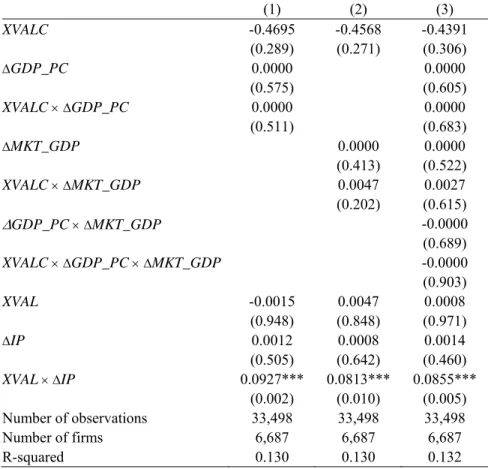
Panel B of Table 5 presents evidence for the Doidge, Karolyi, and Stulz (2007) country-level governance mechanisms. The regressions use country-level measures of cross-border M&A activity (XVALC), and differences in GDP per capita (GDP_PC) and ratio of stock market capitalization to GDP (MKT_GDP) between acquirer and target country.
The estimates show that XVALC is statistically insignificant. In addition, the interactions with GDP_PC and MKT_GDP of the country are insignificant. The overall country-level effect of cross-border M&As from a source country with stronger investor protection vis-à-vis the host
16
country (evaluated at the median GDP_PC and MKT_GDP) is statistically insignificant (the coefficient is -0.229 with p-value of 0.697). Our main explanatory variable XVAL IP remains significant when we control for economic and financial development. The estimates in Column (3) imply that the overall effect of cross-border M&As (at the industry level) from a country with stronger investor protection vis-à-vis the host country is 0.086 with a p-value of 0.002.
While we fail to find evidence of country-wide spillovers, it is possible that XVALC does not measure a relevant enough shock to the access to global financial markets and that our exercise has low power to test the theory in Doidge, Karolyi, and Stulz (2007).
3.3 Culture
We investigate the possibility that spillover effects are not due to investor protection differences, but rather to cultural differences across countries. We extend the conceptual framework in Ahern, Daminelli, and Fracassi (2015) to consider that firm-level governance changes are more likely if the source country and the host country share similar cultural values. The cultural dimensions that we consider are trust, hierarchy, and individualism. We therefore hypothesize that cross-border M&A activity from countries with similar cultures lead to firm-level governance improvements in non-target firms in the host country.
Panel C of Table 5 presents evidence for the Ahern, Daminelli, and Fracassi (2015) mechanism using country-level measures of differences in cultural values. Because this mechanism is not about differences in investor protection, but rather differences in culture, we do not interact IP with the culture variables.
The estimates in Columns (1)-(3) show that XVALC is insignificant as are the interactions of
XVALC with trust differences (TRUST), hierarchy differences (HIERAR), and individualism
differences (INDIV). Column (4) indicates that XVALC from countries that are further apart in terms of individualism contribute less to governance changes, while the other interactions with trust and hierarchy differences remain statistically insignificant. Our main explanatory variable
17
Column (4) imply that the overall effect of cross-border M&As (at the industry level) from a source country with stronger investor protection vis-à-vis the host country (XVAL + XVAL IP) is 0.088 with a p-value of 0.01. The evidence suggests that governance spillovers are not driven by similarities in culture between acquirer and target country.
3.4 Takeover market
Pressures from the takeover market may induce changes in firms’ governance practices that resemble the spillover effects that we identify. We investigate two possible alternative stories. First, firms may opt for stronger governance so as to attract a takeover bid, perhaps by a foreign acquirer that demands stronger governance (e.g., Kumar and Ramchand 2008). If this story explains our findings, we would expect target firms to have better governance prior to a cross-border takeover than non-target firms. In our sample, the average GOV for target firms in the year prior to the acquisition is 0.703 compared to 0.694 for the average GOV for non-target firms in the same industry and year; the difference is statistically insignificant.
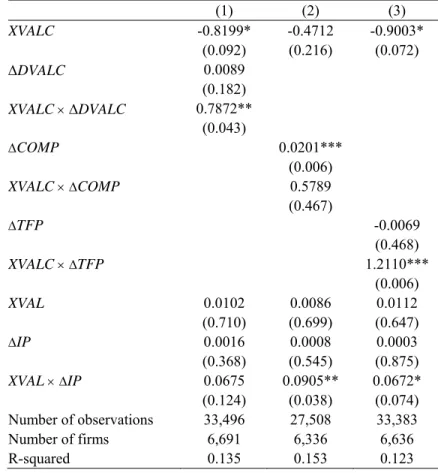
Second, the threat of a takeover may force competitors to shape up and avoid a “court of last resort” (Manne 1965; Jensen 1986; Scharfstein 1988). Cross border M&As could signal exposure to a larger takeover market. We measure DVALC as a dummy variable that equals one if the value of transactions-weighted average of the differences between acquirer and target domestic M&A activity (as a fraction of market capitalization) is positive.
Panel D of Table 5, Column (1), shows some evidence for this mechanism in the form of a positive and significant interaction XVALC DVALC coefficient, but the overall country-level effect (XVALC + XVALC × DVALC) is insignificant (coefficient is -0.033 with a p-value of 0.905). While the XVAL × IP coefficient is insignificant at the 5% level, we find that the overall effect of cross-border M&As (at the industry level) from a source country with stronger investor protection vis-à-vis the host country is significant at 0.078 with a p-value of 0.011.
18
3.5 CEO labor market
Changes in the executive labor market induced by cross-border M&As rather than by governance spillover effects via product market competition may explain our results. Improvements in governance could increase the amount of CEO incentive pay to incentivize CEOs to work harder (Acharya and Volpin 2010; Dicks 2012; Levit and Malenko 2016).
We measure COMP as a dummy variable that equals one if the value of transactions-weighted average of the differences between acquirer and target country median CEO total compensation is positive. The data source for compensation is Bloomberg ESG, the same source used to obtain the governance data. We use only observations for which we have at least five firms per country and year.
Panel D of Table 5, Column (2), shows that the XVALC × COMP coefficient is insignificant as well as the overall country-level effect of XVALC + XVALC × COMP (coefficient is 0.108 with a p-value of 0.883). Our main explanatory variable XVAL × IP remains significant, and the overall effect of cross-border M&As (at the industry level) from a source country with stronger investor protection vis-à-vis the host country is 0.099 with a p-value of 0.006. The evidence is inconsistent with governance changes responding to pressures from the CEO labor market.
3.6 Technological efficiency of foreign acquirer
Cross-border M&As can bring technological innovations that reduce the target firms’ marginal cost of production as well as the marginal cost of production of non-target firms operating in the same industry. To take advantage of lower marginal costs, firms may optimally choose to produce more, leading to higher revenues. To protect the additional revenues, firms would have an incentive to improve governance. This mechanism requires technological spillovers, which may be limited (Haddad and Harrison 1993; Aitken and Harrison 1999; Javorcik 2004; Haskel, Pereira, and Slaughter 2007). Without technological spillovers to peer firms, the revenues of the target firm would increase and those of the peer firms would decline as the target firm can grab a larger market share. In this scenario, peer firms might want weaker
19 governance and experience lower valuations.
Panel D of Table 5, Column (3), tests this hypothesis using total factor productivity to measure technological efficiency. We measure TFP as a dummy variable that equals one if the value of transactions-weighted average of the differences between acquirer and target country total factor productivity is positive. There is a positive spillover effect from cross-border M&As that originate in countries with higher technological efficiency but the overall country-level effect of XVALC + XVALC × TFP coefficient is insignificant (coefficient is 0.311 with a p-value of 0.263). Our main explanatory variable XVAL × IP remains significant, and the overall effect of cross-border M&As (at the industry level) from a source country with stronger investor protection vis-à-vis the host country is 0.078 with a p-value of 0.017.
Overall, the evidence supports that cross-border M&A activity originating from a country with strong investor protection generates positive corporate governance spillovers in the host country to firms that operate in the same industry as the target firm. The spillover is more pronounced in industries with tougher product market competition. In contrast, access to global financial markets, cultural similarities, exposure to large takeover markets, CEO labor markets, and technological efficiency do not appear to explain our findings.
4. Robustness
We perform a variety of robustness checks of our findings. The Internet Appendix presents the results of these checks. First, we perform a placebo test by randomizing XVAL across firms to see if there is a governance spillover in unrelated industries. For this effect, we randomly shuffle the values for XVAL and IP (note that IP depends on XVAL being non-zero) by country, industry, and year. The randomization is performed 1,000 times preserving the cluster structure and jointly for XVAL and IP.13 Table IA.3 shows the average coefficient estimates and the
13 The false XVAL variable has the same sample moments as the original one, but its relation to the original sample
is random. The randomization using the slope coefficients may be biased toward not finding significance since it
20
standard z-score. The resulting false XVAL variable and its interactions with IP and HHI have no explanatory power. We conclude that spillovers are observed only in the same industry, which is consistent with the absence of significant country-wide effects (see Table 5), suggesting that the spillover effects operate through the product market competition mechanism.
Second, we run the benchmark regressions in Table 4 using a sample that includes U.S. firms. Table IA.4 shows that the results are similar to those in Table 4.
Third, we replace IO_TOTAL, which measures total institutional ownership, by IO_FOR, which measures foreign institutional ownership, in an attempt to control directly for the effect uncovered in Aggarwal et al. (2011). Table IA.5 shows that IO_FOR is positively associated with firm-level governance, but the interactions XVAL IP and XVAL IP HHI remain statistically significant. In alternative, we replace IO_TOTAL by IO_ACT, which measures ownership by activist investors (e.g., hedge funds, private equity investors). Table IA.6 shows that firm-level governance does not appear to be associated with IO_ACT and the interactions
XVAL IP and XVAL IP HHI remain statistically significant.
Fourth, we control for country-level improvements in corporate governance in each period by including country-year fixed effects in the benchmark regressions in Table 4. Table IA.7 reports the estimates. Even though this is a demanding specification, we still find a significant effect of
XVAL IP and of the triple interaction XVAL IP HHI on non-target firm governance.
Fifth, we correct standard errors for clustering of observations at the country level (i.e., we assume observations are independent across countries, but not within countries) in alternative to firm level. Table IA.8 reports the estimates, which are consistent with those in Table 4.
Sixth, Table IA.9 presents estimates in which the regression allows for leads and lags (-1, +1) of XVAL. The XVAL(t + 1) lead coefficient suggests that firms may change governance in anticipation to cross-border acquisitions but the effect is not as strong as the effect associated
does not preserve much of the correlation structure among regressors. Kennedy (1995) recommends using the distribution of the t-statistics instead. We find that the distribution of the generated t-statistics yields the same results.
21
with XVAL (t 1) lagged values. Given that XVAL is to some extent predictable, local firms may act on the anticipatory effect of the M&A. But the realization of the M&A should have an additional effect provided that XVAL is not fully predictable.
Seventh, we estimate the effect of the interaction XVAL × IP on firm-level governance separately for the sample of diversifying deals (i.e., acquirer and target have the same two-digit SIC codes) and non-diversifying deals (i.e., acquirer and target have different two-digit SIC codes). Table IA.10 reports the estimates. We find that the governance spillovers are stronger, economically and statistically, in the sample of diversifying acquisitions.
Finally, we estimate the effect of the interaction XVAL × IP on non-target firm governance using three alternative measures of investor protection taken from Djankov, La Porta, Lopez-de-Silanes, and Shleifer (2008): the anti-self-dealing index, the ex-ante anti-self-dealing index, and the ex-post anti self-dealing index. Table IA.11 reports these estimates. The results are in line with those using the anti-director rights index with the exception of the broad definition of the anti-self-dealing index for which the results are statistically insignificant.
5. Endogeneity
Studies of the effect of peer choices on firm policies have a potential omitted variable problem (Manski 1993; Leary and Roberts 2014). In our setting, the problem would arise if we were to run a regression of a firm’s own governance choices on its peers’ governance choices. Naturally, a correlation between the two variables would be seen because of a common omitted factor (reflection problem). Our experiment overcomes this challenge because we use the average cross-border M&A activity in a given country-industry (XVAL) as the independent variable rather than the governance choices of peer firms. Another potential concern with interpretation of the results is that causality could run the opposite way. Specifically, cross-border M&As might occur more often (higher XVAL) when foreigners are expecting improvements in governance. To address these concerns, we conduct two tests.
22
(lagged) as the explanatory variable and XVAL as the dependent variable. We wish to determine whether cross-border M&As drive governance changes, or whether governance changes are intended to attract foreign bids. The regression also includes the same control variables used in Table 4. The results in Table IA.12 in the Internet Appendix show that the coefficient on GOV is statistically insignificant, which is inconsistent with reverse causality explaining our findings.
Another approach to address reverse causality (and omitted variable bias) concerns is to use instrumental variable (IV) estimation. Our choice of instruments is guided by previous research. From the international trade literature, we use tariffs (TARIFFS), defined as the average tariff rate as a percentage of the sale price in a given country-industry, and import penetration (IMP), defined as the ratio of annual imports to sales in a given country-industry. TARIFFS and IMP provide information about plausibly exogenous factors driving up foreign bidder interest in a given country-industry, irrespective of any anticipation of governance changes. While TARIFFS is directly related to barriers to trade, IMP captures non-tradeability across industries besides being related to trade barriers. We expect TARIFFS to be positively related to XVAL, and IMP to be negatively related, as openness to imports is likely to go hand-in-hand with openness to FDI. From the finance literature, we use the annual value of U.S. domestic M&As (as a percentage of market capitalization) in a given industry (US_DVALC). We use US_DVALC as an instrument because it should be positively related to XVAL, as FDI is driven by M&A waves (in the spirit of Rajan and Zingales 1998). We expect DVALC to be positively related to XVAL. The exclusion restriction is likely to be satisfied as we are unaware of any theories that link M&A activity in the United States directly to governance changes elsewhere in the world.
Table 6 shows the results of the IV estimation. The specification corresponds to that in Column (3) of Table 4, and XVAL, IP and XVAL × IP are the endogenous regressors. The regressions also include the same control variables as Table 4 as well as firm and year fixed-effects. Columns (1)-(3) present the estimates of the first-stage regressions. We find that the instruments are correlated with XVAL in a way that is consistent with our predictions. Further, the estimates do not seem to suffer from a weak instruments problem as the
Sanderson-23
Windmeijer F-statistic rejects the null of weak instruments in Columns (1)-(3).
The second-stage estimates in Column (4) are consistent with a positive and significant corporate governance spillover effect following cross-border M&A activity in a given country-industry when the source country has better investor protection than the host country. The XVAL IP coefficient in Column (4) implies that the increase in predicted XVAL generated by a one-standard-deviation increase in each of the excluded instruments is associated with an increase in non-target firms’ governance indexes of 2.8 percentage points, in cross-border M&As from a source country with better investor protection than that of the host country.14 This effect is not
significantly different from the OLS effect in Column (3) of Table 4.15
6. Real Effects
In this section, we test the hypotheses that acquisitions by foreign rivals from countries with better investor protection than the host countries lead to increases in investment and valuation gains to shareholders of non-target firms that operate in the same industry as the target firm.
6.1 Investment results
We first investigate the hypothesis that cross-border M&A activity leads to spillovers in investment in non-target firms. We use the ratio of the change in property, plant, and equipment to lagged total assets (INV) as proxy for firm-level (net) investment rate. We conduct our tests using both OLS and IV methods.
Table 7 presents the results. The XVAL IP coefficient is positive and significant in the
14 Table IA.13 in the Internet Appendix reports instrumental variable estimates consistent to those in Table 6 when
XVAL is calculated using only cross-border M&As in which the acquirer country investor protection is higher than
that of the target country. In this case, the explanatory variable of interest is XVAL instead of the interaction term
XVAL IP.
15 This effect captures the change in GOV induced by the variation in XVAL that is not related to other determinants
of GOV. Using the estimates from the first-stage regressions, this corresponds to a change in XVAL of -0.0367 0.049 + 0.0040 0.965 + 0.0104 0.035 = 0.0024. The estimated change in GOV is (-1.0225 + 12.6823) 0.0024 = 0.0280. The 90% confidence interval of the overall effect is [0.0012, 0.0547], which overlaps with the 90% confidence interval of the overall effect using the OLS estimate [0.0007, 0.0040] (point estimate of 0.0023).
24
OLS regressions in Columns (3) and (5), which indicates that cross-border M&As from countries with better investor protection than the host country are associated with increases in investment for non-target firms operating in the same industry and country as the target. Column (5) shows a less pronounced increase in investment in less competitive industries, as indicated by the negative and significant coefficient on XVAL × IP × HHI variable, consistent with the product market competition mechanism. A one-standard-deviation change in cross-border M&A from a country with stronger investor protection vis-à-vis the host country results in a change that represents 16% of the average investment rate (24% in perfectly competitive industries). Column (6) of Table 7 presents the IV second-stage estimates using the same instruments as in Table 6 (TARIFFS, IMP and US_DVALC). Consistent with the OLS estimates, we find that the coefficient on the XVAL IP interaction variable is positive and statistically significant.
Overall, our findings suggest that governance spillovers are an important channel to explain industry-wide increases in investment following cross-border M&As.
6.2 Valuation results
We next investigate the hypothesis that cross-border M&A activity leads to firm valuation gains in non-target firms using Tobin’s Q (TOBIN_Q) as the valuation measure.
The valuation results are subject to conflicting sources of variation because cross-border M&As may generate both productivity and governance effects in the target firm. While an improvement in the target firm’s governance has a positive effect on the valuation of non-target firms in the same industry, an improvement in the target firm’s productivity has a negative effect on the valuation of non-target firms, all else equal.16 As the two effects are correlated with governance changes, it may be difficult to identify the effect of governance improvements on non-target firm valuation.
16 Table IA.14 in the Internet Appendix reports that the unexpected component of GOV has in-sample predictive
power for firm valuation (measured by the logarithm of Tobin’s Q). A one-standard-deviation increase in the unexpected component of GOV is associated with an increase in Tobin’s Q of 0.36% (= 0.0716 0.05).
25
Table 8 presents the estimates of firm valuation regressions. The table shows that the coefficient on the XVAL IP interaction is positive and significant in the OLS regressions in Columns (3) and (5) as predicted. The effect of cross border flows is economically weaker in less competitive industries in Columns (4) and (5). A one-standard-deviation change in cross-border M&A from a country with stronger investor protection vis-à-vis the host country results in an increase of 0.8% in Tobin’s Q (2.4% in perfectly competitive industries). Column (6) presents the IV second-stage estimates using the same instruments as in Tables 6 and 7 (TARIFFS, IMP and US_DVALC). We find that the coefficient on the XVAL IP interaction variable is no longer statistically significant. While the valuation results using OLS regressions support our hypothesis, we do not find a positive valuation spillover effect when we use an IV approach to account for the potential endogeneity of XVAL.
Overall, we find that cross-border M&A activity in an industry generates positive firm valuation spillovers to other local firms that operate in the same industry as the target. Product market competition and differences in investor protection are important conditions for valuation spillovers to occur.
7. Conclusion
We test the hypothesis that cross-border M&A activity from countries with better investor protection is a source of functional convergence, leading to corporate governance improvements in the host country. We provide evidence consistent with spillovers to non-target firms in the same country and industry as the target firm, but not to non-target firms in other industries. This allows us to distinguish across several mechanisms for governance spillovers that may be at work, in particular product market competition. Furthermore, cross-border M&As lead to increases in investment and market valuation of non-target firms, suggesting that FDI not only affects corporate governance, but also produces real effects.
Our findings establish a direct link between FDI and the adoption of corporate governance practices that promote corporate accountability and empower shareholders worldwide. To our
26
knowledge, our paper is the first to provide direct evidence that FDI produces corporate governance improvements that are not restricted to target firms but spill over to the target firm’s industry rivals. Our findings show that market forces, namely the international market for corporate control, promote good corporate governance practices worldwide.
27
References
Abebe, G., M. McMillan, and M. Serafinelli. 2017. Foreign direct investment and knowledge diffusion in poor locations: Evidence from Ethiopia. Working Paper, Tufts University.
Acharya, V., and P. Volpin. 2010. Corporate governance externalities. Review of Finance 14:1-33.
Aggarwal, R., I. Erel, M. Ferreira, and P. Matos. 2011. Does governance travel around the world? Evidence from institutional investors. Journal of Financial Economics 100:154-81. Aggarwal, R., I. Erel, R. Stulz, and R. Williamson. 2009. Differences in governance practices
between U.S. and foreign firms: Measurement, causes, and consequences. Review of
Financial Studies 22:3131-69.
Ahern, K., D. Daminelli, and C. Fracassi. 2015. Lost in translation? The effect of cultural values on mergers around the world. Journal of Financial Economics 117:165-89.
Aitken, B., and A. Harrison. 1999. Do domestic firms benefit from direct foreign investment? Evidence from Venezuela. American Economic Review 89:605-18.
Albuquerque, R., and N. Wang. 2008. Agency conflicts, investment, and asset pricing. Journal of
Finance 63:1-40.
Alimov, A. 2015. Labor market regulations and cross-border mergers and acquisitions. Journal
of International Business Studies 46:984-1009.
Bloom, N., R. Sadun, and J. Van Reenen. 2012. Americans do IT better: US multinationals and the productivity miracle. American Economic Review 102:167-201.
Bris, A., N. Brisley, and C. Cabolis. 2008. Adopting better corporate governance: Evidence from cross-border mergers. Journal of Corporate Finance 14:224-40.
Bris, A., and C. Cabolis. 2008. The value of investor protection: Firm evidence from cross-border mergers. Review of Financial Studies 21:605-48.
Chari, A., P. Ouimet, and L. Tesar. 2010. The value of control in emerging markets. Review of
28
Denis, D., and J. McConnell. 2003. International corporate governance. Journal of Financial and
Quantitative Analysis 38:1-36.
Dessaint, O., A. Golubov, and P. Volpin. 2017. Employment protection and takeovers. Journal
of Financial Economics 125:369-88.
Dicks, D. 2012. Executive compensation and the role for corporate governance regulation.
Review of Financial Studies 25:1971-2004.
Dinc, I., and I. Erel. 2013. Economic nationalism in mergers and acquisitions. Journal of
Finance 68:2471-514.
Djankov, S., R. La Porta, F. Lopez-de-Silanes, and A. Shleifer. 2008. The law and economics of self-dealing. Journal of Financial Economics 88:430-65.
Doidge, C., G. A. Karolyi, and R. Stulz. 2004. Why are foreign firms listed in the US worth more? Journal of Financial Economics 71:205-38.
———. 2007. Why do countries matter so much for corporate governance? Journal of Financial
Economics 86:1-39.
———. 2013. The U.S. left behind? Financial globalization and the rise of IPOs outside the U.S. Journal of Financial Economics 110:546-73.
Dougal, C., C. Parsons, and S. Titman. 2015. Urban vibrancy and corporate growth. Journal of
Finance 70:163-210.
Erel, I., R. Liao, and M. Weisbach. 2012. Determinants of cross-border mergers and acquisitions.
Journal of Finance 67:1045-82.
Ferreira, M., M. Massa, and P. Matos. 2010. Shareholders at the gate? Institutional investors and cross-border mergers and acquisitions. Review of Financial Studies 23:601-44.
Frésard, L., U. Hege, and G. Phillips. 2017. Extending industry specialization through cross-border acquisitions. Review of Financial Studies 30:1539-82.
Gantchev, N., O. Gredil, and C. Jotikasthira. 2014. Governance under the gun: Spillover effects of hedge fund activism. Working Paper, University of North Carolina.
29
Gilson, R. 2001. Globalizing corporate governance: Convergence of form or function. American
Journal of Comparative Law 49:329-57.
Giroud, X., and H. Mueller. 2011. Corporate governance, product market competition, and equity prices. Journal of Finance 66:563-600.
Guadalupe, M., O. Kuzmina, and C. Thomas. 2012. Innovation and foreign ownership. American
Economic Review 102:3594-627.
Haddad, M., and A. Harrison. 1993. Are there positive spillovers from direct foreign investment? Evidence from panel data for Morocco, Journal of Development Economics 42:51-74.
Harford, J., J. Stanfield, and F. Zhang. 2016. How does an LBO impact the target’s industry? Working Paper, University of Washington.
Haskel, J., S. Pereira, and M. Slaughter. 2007. Does inward foreign direct investment boost the productivity of domestic firms? Review of Economics and Statistics 89:482-96.
Huizinga, H., and J. Voget. 2009. International taxation and the direction and volume of cross-border M&As. Journal of Finance 64:1217-49.
Javorcik, B., 2004, Does foreign direct investment increase the productivity of domestic firms? In search of spillovers through backward linkages. American Economic Review 94:605-27. Jensen, M. 1986. Agency costs of free cash flow, corporate finance, and takeovers. American
conomic Review 76:323-9.
Karolyi, A. G., and A. Taboada. 2015. Regulatory arbitrage and cross-border bank acquisitions.
Journal of Finance 70:2395-450.
Keller, W., and S. Yeaple. 2009. Multinational enterprises, international trade, and productivity growth: Firm level evidence from the United States. Review of Economics and Statistics 91:821-31.
Kennedy, P. 1995. Randomization tests in econometrics. Journal of Business and Economic
Statistics 13:85-94
Khanna, T., J. Kogan, and K. Palepu. 2006. Globalization and similarities in corporate governance: A cross-country analysis. Review of Economics and Statistics 88:69-90.
30
Kovenock, D., and G. Phillips. 1997. Capital structure and product market behavior: An examination of plant exit and investment decisions. Review of Financial Studies 10:767-803. Kumar, P., and L. Ramchand. 2008. Takeovers, market monitoring, and international corporate
governance. RAND Journal of Economics 39:850-74.
Leary, M., and M. Roberts. 2014. Do peer firms affect corporate capital structure? Journal of
Finance 69:139-78.
Lel, U., and D. Miller. 2008. International coss-listing, firm performance and top management turnover: A test of the bonding hypothesis. Journal of Finance 63:1897-937.
———. 2015. Does takeover activity cause managerial discipline? Evidence from international M&A laws. Review of Financial Studies 28:1588-622.
Levit, D., and N. Malenko. 2016. The labor market for directors and externalities in corporate governance. Journal of Finance 71:775-808.
Manski, C. 1993. Identification of endogenous social effects: The reflection problem. Review of
Economic Studies 60:531-42.
MacKay, P., and G. Phillips. 2005. How does industry affect firm financial structure? Review of
Financial Studies 18:1433-66.
Manne, H. 1965, Mergers and the market for corporate control. Journal of Political Economy 73:110-20.
Martynova, M., and L. Renneboog. 2008. Spillover of corporate governance standards in cross-border mergers and acquisitions. Journal of Corporate Finance 14:200-23.
Organisation for Economic Co-operation and Development. 2007. International investment perspectives: Freedom of investment in a changing world.
Rajan, R., and L. Zingales. 1998. Financial dependence and growth. American Economic Review 88:559-86.
Rossi, S., and P. Volpin. 2004. Cross-country determinants of mergers and acquisitions. Journal
31
Scharfstein, D. 1988. The disciplinary role of takeovers. Review of Economic Studies 55:185-199.
Servaes, H., and A. Tamayo. 2014. How do industry peers respond to control threats?
Management Science 60:380-99.
Shleifer, A., and D. Wolfenzon. 2002. Investor protection and equity markets. Journal of